Shocking reports of another major catastrophe gripped the whole world as the news was spread abroad that Italy was again the victim of an earthquake, believed to be more powerful than the one that destroyed Messina in 1908, when 100,000 lives were lost. The headlines took up the story: “Entire Countryside Laid Waste; Towns Razed in Worst Temblor Since 1908 Disaster; Populace Parades in Prayer;” “Forces of Nature War on Homeless Thousands at Both Ends of Kingdom With Tidal Wave and Volcano Menace Hanging Over Naples.”
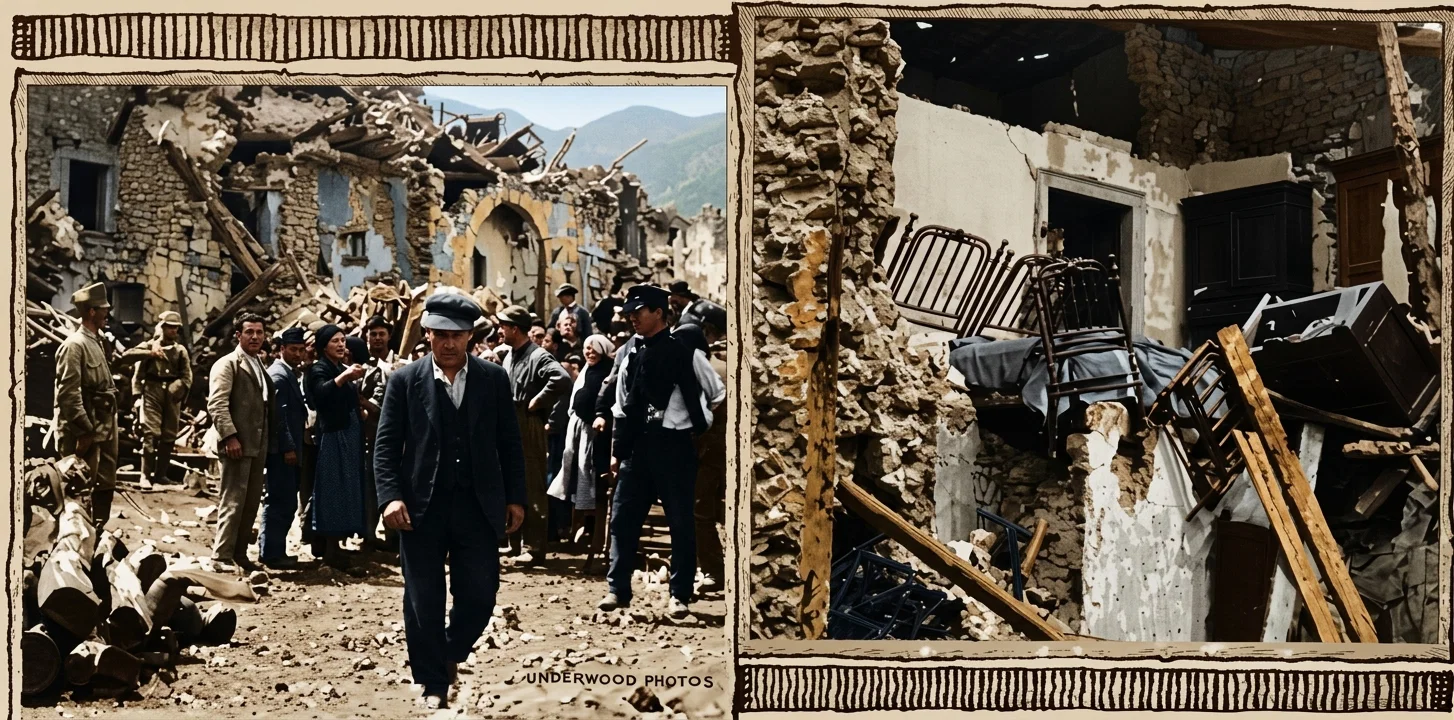
Touching scenes were graphically described by many who witnessed the disaster. One will suffice: “A group of black-shirted Fascisti were ‘digging like men possessed amid the ruins of a collapsed house, spurred on by a woman’s voice calling for help from under the wreckage. Two shifts of Fascisti had been digging in turns, without being able to reach the woman. The work had to be continually interrupted to prop up the tottering walls, threatening to fall in.’ After three days of frantic labor she was rescued, only to succumb a little later to her injuries.”
GREAT DESTRUCTION
The quake, the first heavy shock of which was felt at 1:15 A. M., centered around the cone of the spent volcano, Mt. Vultura, south of the city of Melfi. This city was destroyed, with casualties of 181 dead and several hundred injured. The neighboring city of Ariano was also destroyed, with a death list of ten. In the near-by towns of Montecalvo and Altavilla Irpina, sixty were killed. The principal areas where the shock was felt were in the provinces of Puglie, Campania, and Basilicata. However, it was felt as far north as Abruzzi and Molise, where some property damage was caused. The cities of Rome and Naples were also shaken.
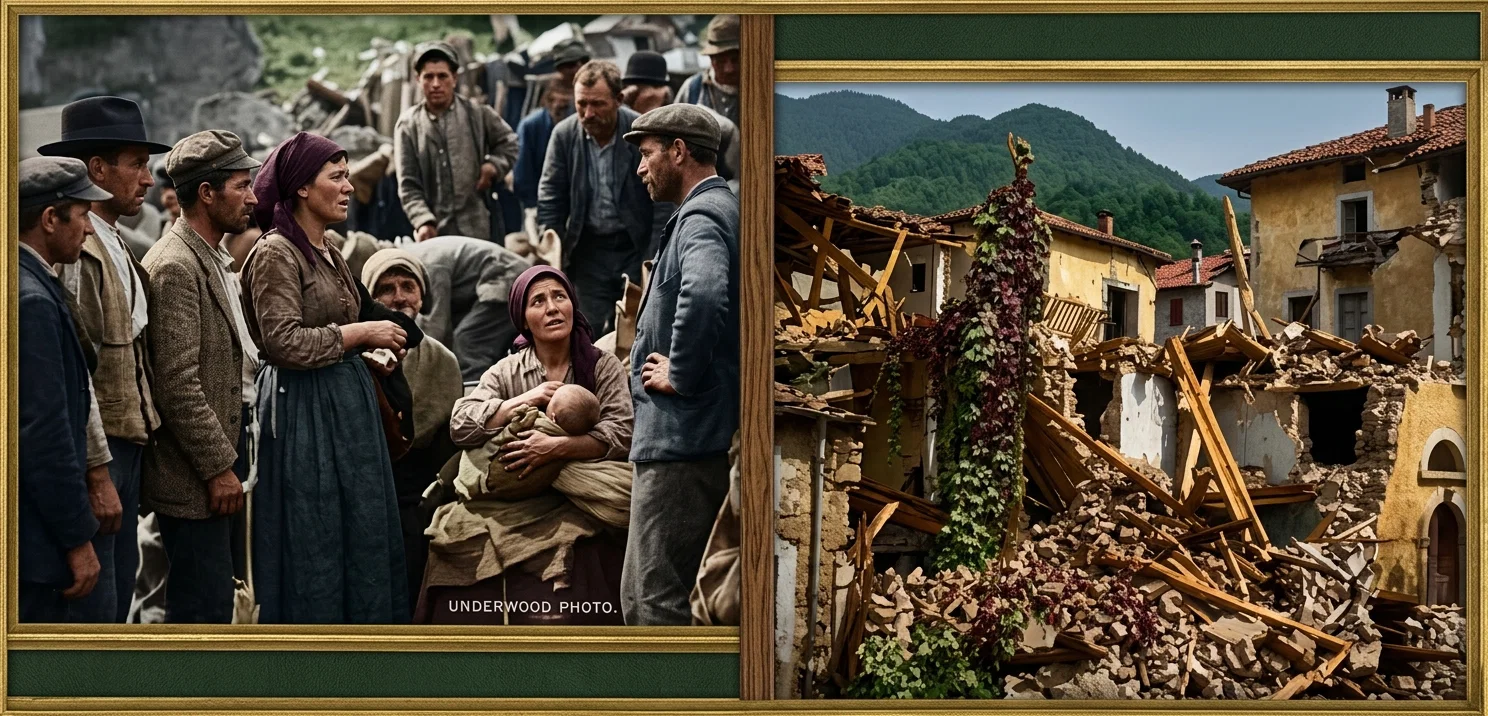
A pitiful group of homeless refugees seeking encouragement from an emergency relief worker. Right, a wrecked home in which the sleeping family was tumbled from beds to death below.
The account given by the San Francisco Chronicle continues: “Melfi, the city which was destroyed, had a population of 20,000, and is situated in a lateral crater on the slope of Montevulu-Pio, the center of the wine trade. The town was razed by an earthquake in 1851. The famous castle of Frederick II there was destroyed. Four or five hundred houses were wrecked, including the railway station.
“At Salerno, on the coast near Naples, the famous cathedral, which dated from the year 1080, was damaged, and numerous other buildings were cracked open.
“Reports from the prefects of the stricken area, and urgent appeals for aid, began to arrive in Rome early this morning, along with details of harrowing scenes enacted in the darkness. At the first sensation of the quake, the inhabitants of the small inland towns, who were in bed, rushed screaming into the streets amid crumbling ceilings and walls. The towns were plunged into darkness, for the quake cut off electric currents.”
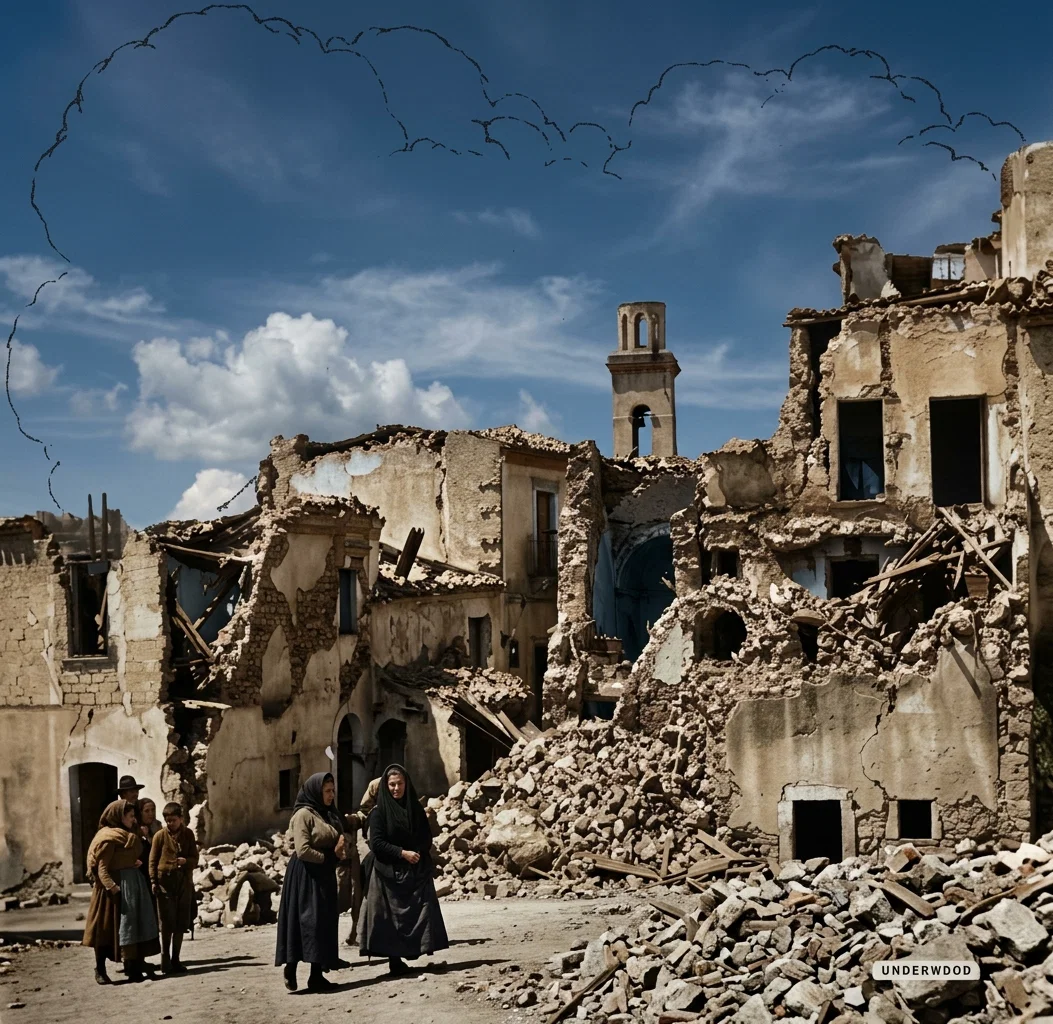
A scene at Melfi, Italy. Tragic human figures, robbed of many of their loved ones, to say nothing of all their earthly goods,—these stricken citizens roam idly through the scene of destruction where Italy’s disastrous earthquake has left an indelible mark.
PEOPLE INVOKE HELP OF SAINTS
“Heroic deeds were performed in rescuing people from piles of masonry under the menace of further crumbling walls. Most of the people were in their night clothes.”
“The people rushed as soon as possible into the open fields, where they prayed and invoked the powers of the saints. Religious processions were formed by priests, with the images of saints borne at their heads. The people besought the saints to stop the disaster.”
Commenting on the damage done by this latest catastrophe, one account reads: “Naples, metropolis of the area, lying under the glowering menace of Mt. Vesuvius, was under a war régime to-day. Soldiers were on guard, convoys of food and medical supplies rushed through the streets, buildings lay in ruins as though struck by shells, and flags everywhere flew at half-mast.
“From Naples almost as far as the plain of Apulia, on the other side of the Apennines, at least eighty-five towns and villages lay desolate.”5
Statistics given out a few days after the rescue work began, gave 2,142 as the number killed and 4,551 injured. The reason that the number of casualties was not as appalling as in many previous disasters is the fact that the center of the quake was in the middle of the peninsula, where the towns are smaller, otherwise the losses might have run up into the hundreds of thousands.
One item of unusual interest in reviewing the whole account is that scarcely had the news of this great calamity been voiced abroad when numerous offers of assistance poured in to King Victor Emmanuel and Premier Mussolini. Although these offers were refused, they demonstrated in a tangible way that the entire world was sympathetic and ready to lend a helping hand.
All this serves to bring to our minds once again the fact that the earthquake is still one of nature’s uncontrolled forces, against which man, with all his proud scientific achievements, is completely helpless and powerless, inasmuch as it is still an untamed, little-understood natural phenomenon, ominous in its implications, terrible in its results. And yet, on the other hand, the very action of the people in the midst of this awful calamity seems to point to an intuition that revealed to them the origin of these occurrences. It seems to convey the idea that the people afflicted realized that the devastating hand of this destroyer could be stayed by divine power, so they offered prayers to the saints, hoping thus to allay further destruction.
DEFINITE CAUSES UNKNOWN
The causes of earthquakes have been a matter of speculation since very early times. The reason for the difficulty in arriving at the solution is the fact that the origin of the disturbances lies within the hidden depths of the earth, and the exact conditions there can only be inferred. Two causes, however, are generally recognized as important factors in the earthquake problem. One, called tectonic, refers to crustal dislocations, particularly the differential movements along fissures known as “faults.” Throughout a period of time stresses accumulate in the strata to a point where the elastic limit is exceeded, resulting in a rupture or a slip, which once again restores the equilibrium. The other main cause, known as volcanic, is traceable to concussions within the volcanic conduit, produced probably by the gases in their progress toward the surface. Most of the imprisoned energy, of course, finds release in the eruption. There may be other contributing causes, but it seems that the day is still quite distant when the geologists and seismologists can tell us definitely just what causes earthquakes.
The student of the Holy Scriptures sees in the whole affair the accomplishment of one main objective, namely, the fulfilling of the word of prophecy that Jesus spoke stating definitely just what the conditions would be before His coming. “Nation shall rise against nation, and kingdom against kingdom: and there shall be earthquakes in divers places, and there shall be famines and troubles: these are the beginnings of sorrows.” Mark 13:8. Christ did not leave His disciples with this dismal outlook, however, for He told them, “When these things begin to come to pass, then look up, and lift up your heads; for your redemption draweth nigh.” Luke 21:28.
FULFILLMENT OF PROPHECY
Surely we need not dwell on the famines or pestilences that have held the world in their throes with especial violence since the World War. The terrible famine of 1919 in China, in which 13,000,000 were destitute of food, followed by the tragic one that convulsed Russia from end to end, and more recently the famine in China within the last year, coupled with the epidemics of influenza and malaria that took a toll of human life to be counted in the millions, are suggestive of the exact fulfillment of that phase of the prophecy.
While it is true that there have been numerous earthquakes in ages past, the most disastrous ones have occurred within the last two decades, two of which took a toll of nearly 300,000. These were the quakes in the Kansu province in China, in 1920, in which 200,000 lives were lost, and the Japanese quake and fire in 1923, which destroyed 99,331 lives.
While scientific minds study the origin of this grim destroyer, probing around, and delving into the mysteries of the earth, let us candidly state that it also has a higher origin than a mere physical disturbance, and that is a moral one, sin. Had it not been for the entrance of this fearful moral malefactor, God would not at this time be trying to warn the world of the nearness of His kingdom. Yet that is what it implies beyond the shadow of a doubt. Man has become so wicked, so selfish, so self-centered, that it takes a major disaster to arouse him from his spiritual lethargy and renew his search for the Lord while “He may be found.”
UNDERWOOD PHOTOS
The prophet Isaiah testifies, “When Thy judgments are in the earth, the inhabitants of the world will learn righteousness.” Isaiah 26:9. This has been proved time and time again. It wasn’t until the people of Nineveh were threatened with immediate destruction that they repented in sackcloth and ashes. The antediluvians did not make an attempt to enter the ark that Noah had built until they felt the first drops of the rain that was going to submerge the entire world. In like manner, the apostle Paul said the last days would be filled with “lovers of pleasures more than lovers of God.” Such is the condition of the world at the present time. Men are so engaged in playing the stock market, attending prize fights, dances, moving pictures, and other like attractions that the thought of God has been entirely crowded out of their minds.
CHRISTIANITY A CLOAK
True it is that there are more elaborate churches now than ever before, but the church has become merely a place to show off a new ensemble or to announce a social function. Christianity has become a sort of cloak that can be taken off during week days and that is not always worn on Sundays. In view of these conditions, is it any wonder that God should permit the world to be afflicted by such calamities as the one we have just witnessed within the last few weeks?
But should we blame God for all the disasters and calamities that keep our lives in peril from the moment we first see the light of day? Is God a merciless tyrant that is pleased to see the people of the earth destroyed as long as they disobey His express commandments? Most emphatically, no. “I have no pleasure in the death of him that dieth, saith the Lord God: wherefore turn yourselves, and live ye.” Ezekiel 18:32. Satan is the originator of all these plans to destroy mankind. In the Garden of Eden, he told Adam and Eve that he was working in their interest; that if they would obey him, they would live forever. The contrary, however, was the case. Death, with all the6
The “Black Hand”
(Continued from page 5)
causes that produce it, invaded the earth, and the archenemy of humanity has been busily engaged in destroying mankind ever since. You ask why God permits this nefarious work to continue unhindered? God does hinder it; if He had never exerted a restraining influence, the world would have been destroyed ere this.
SATAN IS TO BLAME
The history of this world is a record of a conflict that has waged between the forces of good and evil under the leaderships of God and Satan. God permits Satan to have his way to a great extent in controlling the elements of nature and in bringing on disease, sickness, and death, in order to prove to the entire universe that God is love and that His ways are best. Had God destroyed the devil the very instant that he declared himself ruler of this earth, usurping divine rights, God’s justice might have been questioned, and the created beings might have come to the conclusion that, after all, Satan had been right, and God was a despot instead of a God of justice and peace.
The enemy of mankind still holds sway over this earth. God still permits him to cause earthquakes, pestilences, and famines to take their awful toll; but the day is coming and is now very near when Jesus will again make His appearance. When that event takes place, it will be to every one’s advantage to have lived in harmony with the commandments of God, because the just Judge will reward every one according to his works.
Disasters like the one that has just taken place in Italy should be a forceful reminder that God is still looking after the destinies of mankind; and if He seems to be a little distant and slow in showing His protecting power, it is because He is still allowing Satan to expose his destructive nature and vent his wrath against the work of God’s hand. There is still time for man to forsake his evil ways and “the unrighteous man his thoughts: and let him return unto the Lord, and He will have mercy upon him; and to our God, for He will abundantly pardon.” Isaiah 55:7.
Moral Causes of Earthquakes
Though primarily due to physical causes, there is a deeper moral cause back of earthquakes that reveals the ingenious working of the archenemy of mankind.
WHAT THE NEW COVENANT DOES
G. F. Storing of Minnesota calls for the setting forth of the principles of the new covenant as contrasted with the old covenant.
That is indeed strange reasoning that assumes that the Sabbath of the old covenant “pertained to the natural, physical, carnal man, the mind of the flesh.” How the spiritual demands of God in any covenant can apply to the “physical” in this lower sense it is hard to see. It is to be feared that our questioner in his anxiety to do away with the binding obligations of the divine law allows himself to be led into the realm of the bizarre and the fantastic.
Assuredly, the Spirit of God writes, under the new covenant relation, the law in our hearts. However, this does not mean that because the Spirit does this, this new covenant “did not contain the letter of any law.” How could the Spirit write the law without the letter of its provisions; and how could the new covenant contain the “spirit of the law” without provisions in the letter upon which this spirit could be based? We speak of the spirit of American laws, but there must be provisions in the letter in these laws out of which this spirit of Americanism arises, and without which provisions in the letter there could be no spirit. Going a step further, how can we be good Americans filled with this good spirit of American institutionalism unless we observe the written provisions of these laws. To get the spirit of Americanism we must obey the laws of America. So it is with the new covenant and its divine law. How can we speak of having the “Spirit of Christ” without having the obedience to divine law and Sabbath observance that He had?
The trouble was not over the Ten Commandments in the old covenant, but over the way the people attempted to keep the commandments. They lost out because they endeavored to keep the law in their own strength. “All that Jehovah hath spoken we will do.” Exodus 19:8; 24:3, 7. The old covenant stands for righteousness by human works. On the contrary the new covenant stands for keeping the Ten Commandments, not in human strength, which none of us can do, but through the indwelling of Christ in the heart. “This is the covenant that I will make with the house of Israel after those days, saith Jehovah: I will put My law in their inward parts, and in their heart will I write it; and I will be their God, and they shall be My people.” Jeremiah 31:33. The new covenant stands for righteousness through faith in Jesus Christ and the keeping of the Ten Commandments through His power.
THE KEY THAT UNLOCKS
Understood in its right light, there is no more beautiful chapter in the Bible than 2 Corinthians 3. In a striking way, Paul presents in it the contrast between the old covenant of works, which spelled failure, and the new covenant of faith, which means success to the believer. If the reader will keep this contrast between the two covenants in mind, he will have no trouble understanding this chapter, which unnecessarily perplexes so many. The key to unlock its meaning is given in the sixth verse: “Who also made us sufficient as ministers of a new covenant; not of the letter, but of the spirit: for the letter killeth, but the spirit giveth life.” In other words, if we endeavor to keep the Ten Commandments, which are the basis of the covenant, in our own strength and by our own endeavor, we shall fail; for our naturally sinful natures make commandment keeping impossible. See Deuteronomy 4:13; Romans 3:19, 20. This is to put ourselves under the old covenant, to get merely the “letter” of the law; and, as Paul says, “the letter killeth.” It is to be under the “ministration of death,” which, while it deals with the law as “engraven on stones,” and was given to God’s people with “glory,” did not bring the life of victory over sin.
The purpose of the gospel of our Lord Jesus Christ is to make it possible for us to keep the Ten Commandments through faith in our Saviour, through the abiding presence of the Holy Spirit in our lives. (Romans 8:1-4). Contrary to the serious misconception that the gospel of Christ releases us from the obligation to keep the law of God, the gospel was given to do the opposite thing, make its obedience devolve upon us. Instead of making the law’s claims less binding upon us, the gospel of Christ makes the keeping of the Ten Commandments more binding upon us. That is why Paul writes: “Do we then make the law of none effect through faith? God forbid: nay, we establish the law.” Romans 3:31. See also Jeremiah 31:31-33.
UNABLE OF OURSELVES
It is plain to be seen why this is so. Sin is the violation of the Ten Commandments. “Every one that doeth sin doeth also lawlessness; and sin is lawlessness.” 1 John 3:4. See also Romans 3:20. Since the gospel is God’s plan to triumph over sin, which is the violation of the law, it must provide a way for us to keep the Ten Commandments. Unable to keep the law of ourselves, the gospel enables us to do so through faith in Christ. “There is therefore now no condemnation to them that are in Christ Jesus. For the law of the Spirit of life in Christ Jesus made me free from the law of sin and death. For what the law could not do, in that it was weak through the flesh, God, sending His own Son in the likeness of sinful flesh and for sin, condemned sin in the flesh: that the ordinance [margin: requirement] of the law might be fulfilled in us, who walk not after the flesh, but after the Spirit.” Romans 8:1-4.
This keeping the law in Christ, in the Spirit, is the new covenant relationship. “Behold, the days come, saith Jehovah, that I will make a new covenant with the house of Israel, and with the house of Judah: not according to the covenant that I made with their fathers in the day that I took them by the hand to bring them out of the land of Egypt; which My covenant they brake, although I was a husband unto them, saith Jehovah. But this is the covenant that I will make with the house of Israel after those days, saith Jehovah: I will put My law in their inward parts, and in their heart will I write it; and I will be their God, and they shall be My people.” Jeremiah 31:31-33. Jehovah keeps the law in us, through Christ, because we cannot keep it of ourselves. What the old covenant could not do in its human endeavor, the new covenant can do through its divine endeavor.
Turning again to 2 Corinthians 3, we can now understand why Paul speaks of the new covenant as that of the “Spirit,” as that which “giveth life,” as that which has “the ministration of righteousness,” as that which “remaineth” while the old covenant “passeeth away.”
FACE TO FACE
There is a fine spiritual truth brought out in the latter part of the chapter, drawn from Paul’s use of the veil upon Moses’ face. This veil, which Moses put on his face to hide the passing of the glory, typifies the unbelief, the lack of faith, caused by sin, which prevented their grasping the Saviour as the only way to soul victory. When this is removed, with “unveiled face,” we may deal with our blessed Lord face to face through faith, catching the inspiration of His enduring glory that transforms us more and more into His divine image. May that be our overcoming experience.
“The law of commandments contained in ordinances,” which Paul states was nailed “to the cross,” represents the ceremonial system spoken of in various parts of the Pentateuch, especially in Exodus, Leviticus, and Deuteronomy. This had to do with the sanctuary, its sacrifices, and priesthood; with purifyings, special feasts, Sabbaths, and other rites and exercises that were a type, a “shadow of the good things to come,”—the antitypical realities of our Lord, His passion, and His gospel. See Ephesians 2:15; Colossians 2:14-17; Hebrews 10:1-4. These typical, ceremonial laws have nothing to do with the eternal, immutable law of Ten Commandments, the Decalogue. See James 2:8-12; Matthew 5:17-19.
MATTHEW WOULD HAVE SAID SO
Charles F. Saunders of California asks, If Sunday had been designed as the Christian Sabbath, would not Matthew have clearly said it when he referred to the first day of the week in Matthew 28:1?
The questioner is correct when he states that had Matthew believed the first day of the week, the day upon which our Lord arose from the grave, to be the Christian Sabbath, the wording of Matthew 28:1 would bring out that idea clearly.
EDITORIAL
By Editor
“THIS IS THE HERITAGE”
A COUPLE of years ago Sir Philip Gibbs wrote his book, “The Day After To-Morrow,” in which he describes the fears of an approaching war that are haunting Europe. In one of his graphic paragraphs he states: “Europe is haunted by a thousand fears.” Many leading writers, in harmony with Sir Philip, have been talking the same thing. There seems to be quite a feeling among the leaders of the Old World that another general war cannot be prolonged beyond the year 1935.
Among other things, they think that the man power of the depleted nations will be built up again by that time, through the youths not old enough for war when the last conflict ended, but who will be old enough in 1935. A characteristic feature article in some of the recent leading papers, by Frank H. Simonds, goes into this question at length. He says:
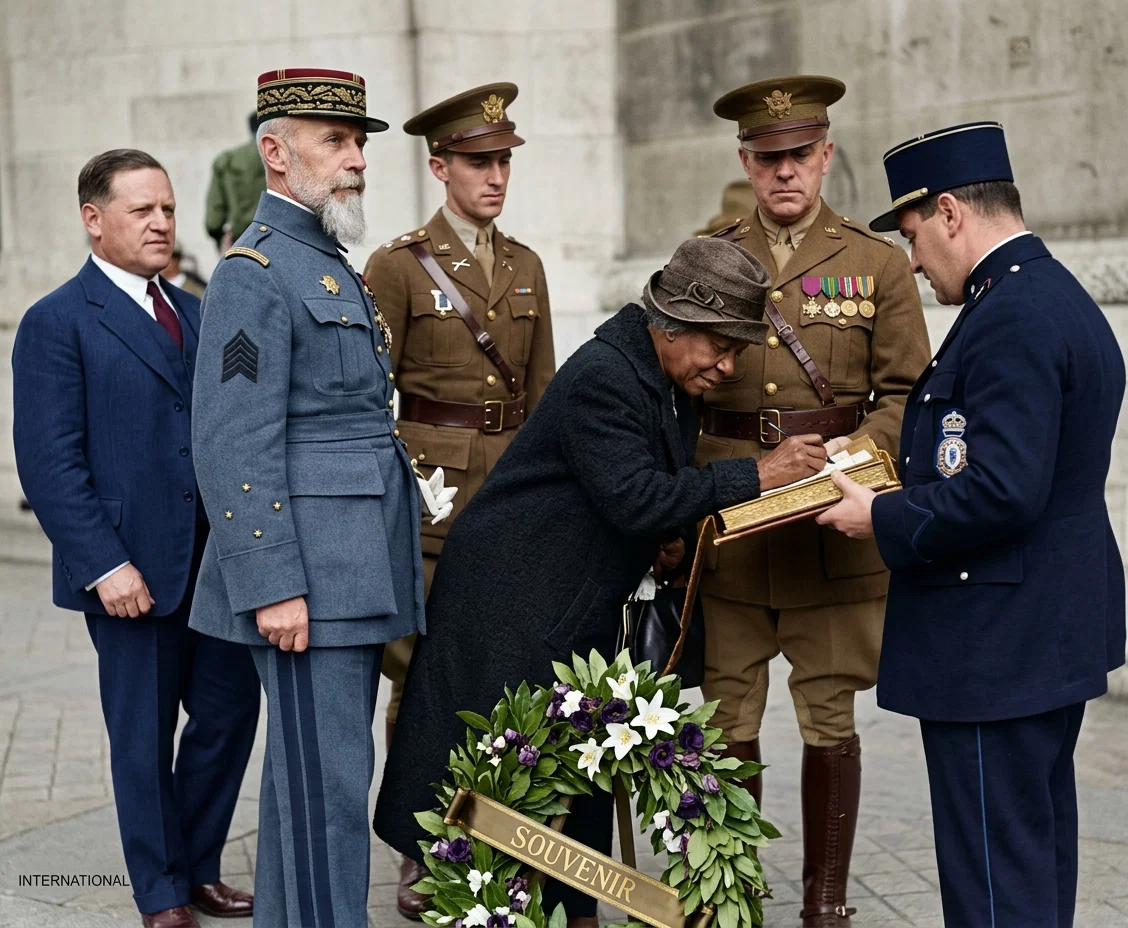
A negro war mother of America signing the golden book at the Arc de Triomphe after placing a wreath at the tomb of the “Unknown Warrior” of France.
“We shall, unquestionably, hear much in the next years of the possibility of war in 1935. Moreover, since many people are resolved to change their present status, and those nations which are opposed will be weakest at this time, it is not difficult to build up a theoretical case in favor of a new conflict. Nor is it hard to sustain such a case by pointing to the obvious preparations for the conflict going on along many frontiers.” And in a concluding paragraph he further states: “All in all, fixing the next war in Europe for 1935 seems, despite the appealing arguments advanced, rather more the product of fear than of actual sound reasoning. Europe is now, as it was in 1914, at the mercy of an accident. The material out of which wars are made is plainly available on every hand, but with precious few exceptions all peoples still remain ‘fed up’ in the matter of conflict, and every government, including the dictatorships [Italy and Russia], has sound reason for fearing the ultimate consequences of leading its supporters into the trenches.”
To-day, as in the years just prior to 1914, wise men are pointing out the threatened danger of a great world conflict, and to-day, the same as in those days, there are a multitude of other voices saying that another war can never come. But the individual who knows history, and especially he who knows human nature, understands perfectly well that greed, the desire for personal gain and personal wealth, the spirit of empire, and such like things, have been dominant in the degenerate human heart, and have always kept the world struggling with the problems of war. And in this time, as in no previous history of the world, men are reaching out for the amassing of wealth in the most senseless and greedy ways imaginable. For instance, just a few days ago a man who in his early life was a teamster, died over in Pennsylvania, leaving a fortune estimated at between $75,000,000 and $100,000,000.
Similar fortunes are being built up, and with greedy and conscienceless labors men are amassing wealth clear beyond any benefits that can accrue to the individual, and at the same time they are spreading poverty and distress among millions of men. This poverty and distress that are being spread through unemployment and the other contributing conditions are brought about by piling up fortunes in the coffers of a comparatively few men while leaving the millions to suffer. In the very nature of things such a situation results in revolutions that finally break out into war. The effect must follow the cause irresistibly and unquestionably. And our world-wide facilities for transportation and communication, and the tremendous advancements that have been made in destructive weapons since the last war closed, will make the next one the most terrible of anything that has ever been seen.
But has not the apostle said, “Know this, that in the last days grievous times shall come. For men shall be lovers of self, lovers of money”? 2 Timothy 3:1, 2. The love of money, which is the outgrowth of the love of self, says the apostle, will make the last days grievous, and we see how that is being brought about through the conditions of this time. And as we turn to that familiar scripture recorded in the sixteenth chapter of the book of Revelation, we read of how the spirits of the demons will go to the kings of the earth to gather them “unto the war of the great day of God, the Almighty. . . . And they gathered them together into the place which is called in Hebrew Har-Magedon.”
The conditions of these times should be studied in the light of the Scriptures, for we have fallen upon the troublous days so clearly foretold in the Sacred Book. And while the heritage of the people of the world is the heritage of war, yet God says to those who will trust in Him, “No weapon that is formed against thee shall prosper; and every tongue that shall rise against thee in judgment thou shalt condemn. This is the heritage of the servants of Jehovah, and their righteousness which is of Me, saith Jehovah.” Isaiah 54:17.
To know the power of this promise, and of the kindred promises scattered throughout the Sacred Book, is the greatest need and the greatest blessing of this hour. God can and will protect those who know how to place their trust in Him, and He conveys His power to you through His promises. Study these promises to know them for yourself. T.
Satan’s Deception Through Spiritism
More people believe in spiritism todayPage Ninethan ever before—in fact, that is just what Satan wants them to do; he wants them to believe that he can make communication with the dead a reality.