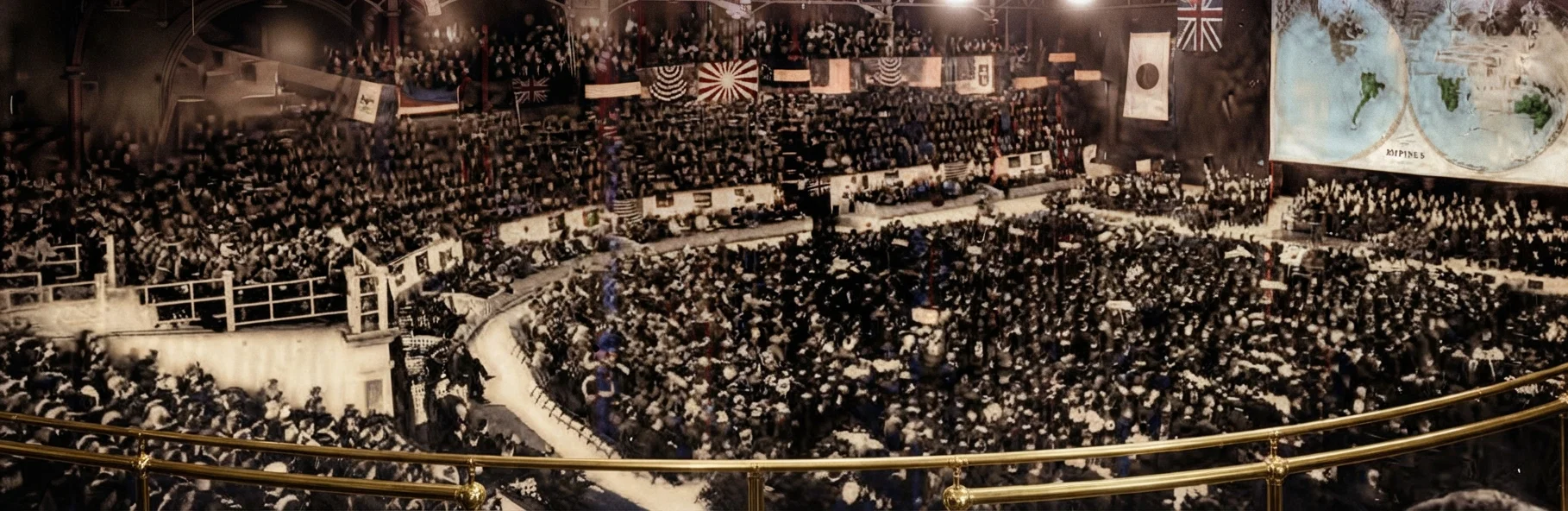
A SECTION OF THE CONVENTION HALL, KANSAS CITY, MISSOURI, WITH STUDENT VOLUNTEERS FOR MISSIONS IN SESSION
Student Volunteers in General Convention
By C. A. Shull
Five Thousand College Men and Women Assemble—"Evangelization of the World in This Generation" the Watchword—Christ’s Kingdom on Earth, but What of His Coming?
By C. A. SHULL
C. A. SHULL attended the Student Volunteer convention as a delegate from our college at Berrien Springs, Michigan, and was asked to report the meeting for us. The regular readers of this paper have well in mind the prophecy which says this gospel of the kingdom shall be preached in all the world for a witness, and then the end will come. This Student Volunteer movement can not be said to be fulfilling that prophecy, still it is mightily directing attention to it.
Editor.
THE seventh international convention of Student Volunteers was held in Kansas City, Missouri, December 31 to January 4, with over five thousand delegates in attendance, and prominent missionary leaders from all parts of the world present. The great convention hall, seating upwards of seven thousand people, was filled to overflowing with the delegates and friends, and fully a thousand were turned away daily, unable to secure seats.
SPEAKERS AT THE CONVENTION
Among the prominent speakers were Dr. Robert E. Speer, author of numerous books on missions and other subjects; Dr. Samuel M. Zwemer, for fifteen years a missionary to the Arabs, and a well-known authority on the Mohammedan world; George Sherwood Eddy, the “millionaire missionary,” a traveler and lecturer of note; Dr. John R. Mott, founder and president of the movement, who has been styled the greatest missionary leader in the world to-day. Dr. Mott recently declined the position of United States minister to China in order to continue his work of world evangelization. William J. Bryan was a prominent speaker of the convention. Dr. Harlan P. Beach, professor of missions at Yale, was also present; and Dean Shailer Mathews, of the University of Chicago, president of the Federation of Churches in the United States. Many other speakers and writers of international repute were in attendance.
GROWTH OF THE ORGANIZATION
Twenty-eight years ago, Dr. John R. Mott conceived the idea of forming an association among the students of higher schools of learning in the United States and Canada, for the purpose of studying missions and mission work, in order to furnish recruits for these distant lands. From a small beginning, this movement has grown until at the present convention 5,031 delegates were seated, coming from 755 different schools. Practically every state in the Union was represented, with a large number from Canada. Some two hundred delegates were Chinese and Japanese students, who are in attendance in the universities of this country.
Mr. Mott reported in part as follows:
"Since its inception twenty-eight years ago, 5,882 Volunteers have gone to foreign fields from our ranks. These are supported from various sources, and are sent under the direction of different mission boards; but their training for service, and in many cases their enlistment in this line of work, is the direct result of the inspiration received in the Volunteer organization. During the last quadrennium, 1,446 Volunteers have sailed for foreign fields, under the auspices of over seventy missionary societies.
INCREASE IN FOUR YEARS
"Within the last four years, there has been an increase in the number of young men and young women in mission study classes in the colleges from 29,300 to 40,400. This addition of 11,000, or of nearly forty per cent, represents one of the greatest advances ever made. During the last year, the colleges and seminaries secured $220,804 for missionary objects, of which about one half was contributed by the students themselves, and the rest was secured by them from the professors and immediate friends.
INFLUENCE ON STUDENT LIFE
"The student missionary uprising has been a mighty help in the direction of counteracting the perils of our modern college life. At a time when growing luxury, self-indulgence, and the tendency to softness are manifesting themselves in our colleges, it is well that we have a movement which makes such an appeal to the heroic, which summons men to such a stern and rugged self-discipline, and which assigns to them such stupendous tasks.
"The Student Missionary Volunteer Union of Great Britain and Ireland has from the beginning been a mighty factor in the missionary life of the British universities and of the British Empire. Over 18,000 of its members have sailed, the number in study circles ranging between 1,600 and 2,000. The student missionary movement in Germany, in the face of very great difficulties, has continued to carry forward its helpful activities. It has thus far enrolled about 110 Volunteers, of whom over sixty have already sailed, nine going out during the past year. It has about 400 students in mission study circles.
"Within the last four years, the Volunteer movement has been organized in the Swiss universities. It has enrolled over thirty Volunteers, a few of whom have already sailed. In Holland a Student Missionary Volunteer movement has been established, which includes not only those who plan to go to the mission fields, but others who are especially interested in missionary questions. The universities of Norway, Sweden, Denmark, and Finland have for years been centers of missionary interest. The more notable event of the past year was the student missionary conference at Goteborg, Sweden, attended by nearly 200 students from different Scandinavian countries.
"In the French universities, there has recently been developed a promising force known as the Volunteers of Christ. In Hungary and also in Austria there are the beginnings of missionary movements. The students are interesting themselves chiefly in the Mohammedan problem in the near East.
"The Student Volunteer movement of Australasia is one of the most promising in the world. Although its student field is not extensive, it has up to the present time enrolled between 300 and 400 Volunteers, of whom 106 have already sailed. It is doing more than any other country of the world to promote the missionary spirit in the churches of the country. Its activity is a splendid illustration of how a comparatively small company of earnest students can impress the spirit and policy of the church throughout an entire nation.
"The Volunteer movement in South Africa has also accomplished a work in some respects quite as remarkable as the one in Australasia and New Zealand. It has enrolled over 300 Volunteers, of whom 100 have already gone to the mission field. One of the most remarkable developments among the students of foreign lands during the last four years has been the organization in China of the Chinese Student Volunteer movement for the ministry. This movement has been raised up in answer to prayer, to help solve the greatest problem of the church in China, that of securing a sufficient number of well-qualified native students for the Christian ministry.
THE GREATEST FIELD
"The most critical battle-field, from the point of view of the Volunteer movement, is not the Moslem world, not the educated classes of Japan, not the literati of China, not the citadels of Hinduism,54not the areas of neglect in Latin America, but our own American and Canadian universities and colleges. If the churches of North America are to wage triumphant warfare in these distant, difficult fields which call to-day so loudly for our help, the missionary feeling and spirit must first dominate our own seats of learning. If we are to go forth to attempt world conquest, we must have no untaken forts in our rear."
"Whither I Go, Ye Can Not Come"
By T. E. Bowen
The Master's Word Should Not Be Reversed—Purpose of the Tree of Life—No Immortal Sinners
By T. E. BOWEN
It is Satan's purpose to turn every statement of Jesus' into a lie. Just before Jesus died on Calvary, He told His disciples — Peter, James, and John, and all the rest — that where He was about to go they could not come. Notice His words:
"Little children, yet a little while I am with you. Ye shall seek Me: and as I said unto the Jews, Whither I go, ye can not come; so now I say to you."
Where was He to go? "I go unto My Father." His Father was, and is, in heaven. After His resurrection Jesus went to heaven. The disciples saw Him go. But Jesus expressly told them that where He went they could not go. That is, they could not go to His Father in heaven as they would see Him go. No man can of his own will go there. Heaven must come for him.
And so while Jesus told His beloved disciples they could not then go where He was going, but that they should come later, He said that He Himself would come and get them. This certainly precludes the widespread idea that saints can go to heaven when they die, or before Jesus Himself comes to get them. "I go to prepare a place for you. And if I go and prepare a place for you, I will come again, and receive you unto Myself; that where I am, there ye may be also."
Any word, therefore, contrary to this, any hope held out to believers or unbelievers, of going to heaven before this time set by Jesus Himself, is the fabrication of that enemy who from the beginning has tried to turn God's word into a lie. Believe it not.
THE WAITING CONGREGATION OF THE DEAD
How much better it is to believe what the Lord says than to trust in some theory, however hoary with age, that has no foundation in the word of God! It is commonly believed and taught that as soon as people die they either go to heaven, or else go to some other place, to begin some sort of expiation for their sins.
Neither is true. The dusty bed of the grave is the place of waiting. See Job 14: 13, 14. This is clearly here upon the earth. With our own eyes we see our beloved ones laid away in the silent tomb. There they remain until Jesus comes, a great congregation of the dead, the righteous and the wicked together.
But a separation takes place in this congregation. Some are taken by Jesus as belonging to Him, and are made alive, and go to heaven with Him. The others are left, still silent in death. Hear what the wise man says:
"It is a joy to the just to do judgment: but destruction shall be to the workers of iniquity. The man that wandereth out of the way of understanding [wilfully chooses the paths of sin] shall remain in the congregation of the dead." Prov. 21: 15, 16.
And this congregation of the dead never leave the earth at all; for another scripture makes plain that their punishment is also meted out right here in the earth: "Behold, the righteous shall be recompensed in the55earth: much more the wicked and the sinner." Prov. 11: 31.
KEPT FROM THE TREE OF LIFE
If man by some natural inheritance had immortality, why did God drive Adam and Eve from the Garden of Eden, away from the tree of life? The Bible says He drove them from the garden to keep them away from the tree of life. Certainly the Lord must have had a good reason for doing this. "Therefore the Lord God sent him forth from the Garden of Eden, to till the ground from whence he was taken. So He drove out the man; and He placed at the east of the Garden of Eden cherubims, and a flaming sword which turned every way, to keep the way of the tree of life." Gen. 3: 23, 24.
Why? — So that nowhere in God's great universe there should ever be an immortal sinner. God did not purpose to perpetuate sin to all eternity, to continue it as long as He Himself should exist. He had placed in the tree of life the properties of life, so that as long as man partook of that tree, he might live.
When man disobeyed, he forfeited his right to life, and was driven from that tree. Hence there is not an immortal sinner, nor ever can be. Eternal life for us is hidden in the Son of God. By believing on Him we have life everlasting, and only so.
"And this is the record, that God hath given to us eternal life, and this life is in His Son. He that hath the Son hath life; and he that hath not the Son of God hath not life." 1 John 5: 11, 12.
THE MESSAGE
A noticeable feature of the convention was the utter absence of any reference to the greatest event of all the ages, soon to take place in the world,—the coming of Christ in the clouds. Despite the oft-repeated announcement of His second advent, in the Scriptures, and regardless of the express admonition to watch for this stupendous event, it received no consideration.
All Christendom Facing All of Islam
Dr. Samuel Zwemer, editor of the Moslem World, author of several books on missions, and an acknowledged authority on the Moslem question, said:
"Next to China, the largest missionary problem, as well as one of the most difficult, is the evangelization of the Mohammedan world. We face to-day a call from the Mohammedan world at large, and especially in Asia, such as we have never faced before. The whole of Christendom for the first time in history faces the whole of Islam. There never has been a time when this problem has so riveted the attention of the whole world. There never was a time when so many books were written on the character, growth, etc., of the Moslem people. Eight foreign magazines are devoted to it entirely. There are over two hundred million followers of the prophet in the world. Of these, fifty million are on the borderland,—geographically, psychologically, and spiritually,—who can be won to Christ with some effort."
AROUND THE WORLD WITH DR. MOTT
One of the most interesting reports of the entire convention was that made by Dr. Mott, president of the organization, on his recent trip around the world. He said:
"At Cairo we secured the largest theater in Egypt, and every afternoon it was full to overflowing. Twenty-five hundred people were in the hall, and hundreds outside. The last afternoon that it was possible for us to use the hall came, and I was not through. I told all who really wished to believe in the deity of Christ, if it were possible to do so with intellectual honesty, to meet me in another hall about half a mile away. When I reached the other hall, I found it crowded with over six hundred students who came in answer to my call."
Similar experiences in other large cities of heathen countries were related. A collection to help carry forward the mission work was taken up following this report, and over $113,000 was received. Announcement was also made of a gift of $1,000,000 to missions, offered by a millionaire of Kansas City named Long.
THIS GENERATION
Regarding the work in this generation, Dr. Mott said:
"There is need of placing stronger emphasis than ever upon the watchword of the movement—'The evangelization of the world in this generation.' Nearly a generation has elapsed since this watchword was adopted. The question has been raised in one quarter whether it might not be wise to abandon the watchword, in view of the fact that a generation has gone and the world still remains unevangelized. This reveals evident misunderstanding. From the beginning, the movement has insisted that although the watchword was to be taken as an ideal for the movement as a whole, the secret of realizing it lay in having a sufficient number, not only of individual Student Volunteers, but also of other individual Christians, adopt it as their personal watchword and as a governing principle in their lives."
We learn from Holy Writ that if the world is not evangelized in this generation, it will not be done at all, for "this generation shall not pass away, till all be fulfilled." We are living in the last generation that will ever exist upon this earth in its present state. This gospel of the kingdom must go to every nation, kindred, tongue, and people during the lives of those now alive upon the earth.
Setting Up of Christ's Kingdom
We heard a great deal, at this convention, about the setting up of Christ's kingdom on the earth, and of the desire to make His reign "coextensive with the bounds of the whole earth," as Dr. Mott expressed it in his opening address. And that is good. But Christ is never going to set a throne in this sin-cursed earth in its present condition. His coming, of which He asked His disciples to tell the world, is not to be solely in the hearts of men, but He will come in the clouds, and every eye shall see Him. He "shall so come in like manner" as He ascended into heaven—which was a physical, visible occurrence. "The Lord Himself shall descend from heaven with a shout, with the voice of the Archangel, and with the trump of God."
His Coming Should Be the Theme
Every Christian nation should be stirred to the heart with the great problem of carrying a knowledge of Christ to the world, but the message should not be confined to the events of the past and the circumstances surrounding the first advent. The hope of meeting Him in the near future, attended by all the myriads of holy angels, is a wonderful part of the message that we bear to the heathen nations of earth.
Signs all foretell that the coming of Christ is literally at our door. But our act of spreading this gospel does not usher in the kingdom of God, in any other sense than it removes the obstacles that prevent His appearing until all have been warned. When this is done, He will come, and will not tarry.
"Behold, He cometh with clouds; and every eye shall see Him, and they also which pierced Him: and all kindreds of the earth shall wail because of Him." Rev. 1:7.
Reports from the Field — Alarming Spread of Mohammedanism
Dr. Watkins, secretary of the Presbyterian Board of Missions, warned of the dangers of advancing Mohammedanism. He said:
“Fully one half of Africa is Mohammedan, and at least one fifth of the other half is seriously threatened by them. They come into the country of the pagan, well dressed, surrounded by comforts and luxuries, independent and haughty in bearing. All of these things are offered to the timid and uncertain pagan, living in ignorance and poverty.
“By day and by night the Mohammedan is encroaching on paganism. One out of every ten in the province of Nyasaland is a Mohammedan. In the last ten years, only ten Mohammedans have been converted to Christianity, while there have been fifty thousand pagans converted to Mohammedanism.”
Dr. Watkins closed his appeal with the question, “Shall we tarry, shall we trifle, while Africa is being made the prey of Islam?”
Unwarranted Restrictions of Religious Liberty
By J. F. Blunt
The Founders of the Government Sought to Establish Religious Freedom—But They Provided Whippings, the Stocks, and Even Death, for Dissenters—The Real Basis of All Sunday Legislation
By J. F. BLUNT
WHILE express guaranties of civil and religious liberty stand at the threshold of state and nation, mistaken advocates of state-enforced religion have secured legislation in nearly all the states, entirely opposed to these constitutional pledges. This is seen in the existence of Sunday laws, in all but the three states of California, Oregon, and Arizona, whereby the freedom of dissenters is constrained and citizens are coerced in respect to Sunday observance.
Despite the fact that America was settled by a people whose object it was to found here in the wilderness a government under whose protection they could worship God according to the dictates of their own consciences, the early lawmakers of this country were not slow in demonstrating that they were opposed to the exercise of equal freedom by those of contrary opinions who thought to find an asylum with them in the newly discovered continent. And the Quakers were hanged, and the Baptists were persecuted, together with the victims of the witchcraft superstition, while the resolute colonists set themselves about the enactment of laws in restraint of their fellows who might not voluntarily embrace their views of theology. A system of fines and imprisonment was inaugurated, whereby the recalcitrants might be brought into line with local customs; and in several colonies death was the legal penalty for persistent refusal to observe Sunday as a day of rest, if previous whippings and exposure in the stocks should fail to insure compliance with the popular error.
A PREMIUM ON HYPOCRISY
Thus a premium was placed upon hypocrisy, by a civil code demanding the compulsory observance of this religious custom in respect to days, and severe punishment was meted out to those who were not regular in church attendance. The later enactment of constitutional pledges of liberty in religious profession and worship did not deter the zealous disciples of the hour from ignoring these express guaranties, and laws of varying degree of severity were adopted by the legislatures of the various states, wholly opposed to the principle of religious liberty. This accounts for the presence of these despotic enactments on the statutes, where in recent years they have been permitted to lie, with only occasional demands for their enforcement.
So imbued were some of our early legislators with the idea that it was a duty of the state to inculcate their own peculiar dogmas of religion, and to compel, by the power of the constabulary, the acceptance of these by the entire community, that on every hand the same oppressive disposition that had been manifested in the colonies, cropped out in the later state enactments relating to religious custom and ceremonial. What wonder, then, that people reared in an environment where a practical union of church and state prevailed, and accustomed from childhood to submission to these purely sectarian restrictions, should have become tinctured themselves with erroneous theories of government and saturated with false doctrine! Nor need we feel any degree of surprise that their descendants should be affected, at least in some degree, by their early teachings, and that Sunday, contrary to all Scripture, should have seemed to possess, in their convictions, an odor of sanctity wholly undeserved. These considerations will suggest a reason for the wholly unwarranted but persistent demand for the exaltation of this heathen festival.
WHY CLOSE SALOONS JUST ONE DAY?
For these reasons, even now, among believers in Sunday sacredness, it is not strange56to hear lamentations over the non-observance of the day. Public abuses have crept into society which have been conspicuously exhibited on that day, owing to the prevailing idleness, and frivolities that ought not to be indulged at any time are pointed out as affording an excuse for further restrictions. Forgetting that it is the thing itself, and not merely the day it is tolerated, which determines whether it is culpable or otherwise, the advocates of Sunday keeping have been led into the unreasonable and illogical demand for the closing of saloons on Sunday, as if their operation on other days were not equally reprehensible.
Particularly is such a basis for their crusade to be deplored, inasmuch as many who are genuinely opposed to the maintenance of the whisky traffic are equally opposed to the ulterior objects of the champions of temperance, whose campaigns are frequently undertaken primarily with a view of forcing Sunday observance. What is called for is the abatement of the evil of intemperance, and not merely the suspension of the liquor traffic for a single day, while the churches are holding weekly services. But it is difficult to persuade these modern crusaders that their methods are not such as to commend them fully to the minds of more logical champions, who gladly would break a lance in the engagement, if only the unmixed question were presented of absolute prohibition of the manufacture and sale of intoxicants, without the covert introduction of the Sunday issue.
SOME WOULD LEAVE SUNDAY TO THE CONSCIENCE
But so far has this defective idea of reform been carried, that a great association of devoted women has been misled into the endorsement, by their national organization, of the plans for compulsory Sunday observance. To the credit and lasting praise of individual members, and to some extent of local associations, be it said, the falsity of the position assumed by the national representatives has been discerned, and a protest against interference with the weekly rest-day has been voiced by those of clearer vision within the union. These dissenters declare that while distinct and conscientious differences of conviction exist as to which day ought to be observed as the Sabbath, this great body of Christian women might well leave to the individual citizen the determination of the question, in harmony with his God-given right and constitutional privilege. So the anomalous situation is presented, at the present time, of some of the members of this worthy organization being engaged in the circulation of petitions for a drastic Sunday-closing law, proposed on the initiative, while others in the same society are diligently opposing all such invidious distinctions.
While this campaign is in progress, the federated churches have seized upon the interest manifested in the prohibition of prize-fighting in California, and must needs entangle their petitioners for the submission of the issue to a vote of the people, in the question of Sunday sacredness. While it is proposed to end for all time the holding of real prize-fights, it is the policy to tolerate, at least for the present, the presentation of "sparring exhibitions," provided none are offered on Sunday. Thus the opportunities of the prize-ring for bringing into prominence the spurious sabbath have not escaped the notice of these would-be reformers.
LABOR WANTS A DAY OF REST
But while the ulterior designs of the purely religious organizations are readily discerned in all these methods, another element is entering into the proposition of civil enforcement of Sunday keeping. The labor-unions, having in mind the relief of the various gilds from continuous labor, have thought to profit from the superstitious regard bestowed upon the first day of the week, and thus to secure from the church-members the help needed in their demand for one day in seven for recreation. If all engaged in these lines of business were agreed, they could readily adjust the matter among themselves, without legislation. But a goodly number so engaged are opposed to any distinction in respect to days; and to coerce this considerable minority, it is proposed to invoke the aid of state or municipality, to compel all to close their doors on Sunday.
The state law of California already provides that for an employer of labor to deny his operatives one day of rest after six consecutive days of labor shall be a misdemeanor; but it is sought to constrain the owners of private establishments from operating at all on the day of general preference, lest any, by remaining in business when others had suspended, should secure unequal benefits from public patronage. Particularly have some of the barbers' fraternity sought to compel the simultaneous closing of barber shops on Sunday; and in their desire to accomplish their object, they have urged that all constitutional guaranties be ignored, and that all shops be closed on the first day of the week, on divers pains and penalties.
THE RELIGIOUS CHARACTER OF SUCH LAWS
In some quarters, the more radical members of the clergy have been making common cause with these factions of the labor elements, hoping to gain by cooperation their own ends in the exaltation of Sunday, though their solicitude is distinctly religious, while customarily attributed to their interest in labor. In this attempted union of wholly dissimilar organizations, the fundamental object of the churchmen is well expressed in the words of the Rev. W. F. Crafts, in a speech at Wichita, Kansas, wherein it is declared:
"We are laboring with all our might to carry the religious sabbath with our right arm, and the civil sabbath with our left. Hundreds of thousands will receive it as a religious institution, and all the rest will receive it as a civil institution, and thus we will sweep in the whole nation."
DESIRE NOT TO BE COMPELLED TO CHOOSE SUNDAY
So the underlying object of the clergy is plainly revealed as sectarian, while it may be said, to the honor of certain of the clear-headed leaders of the labor elements, that they are looking about them in the hope of securing a trade agreement whereby all operatives may be sure of a respite of one day in seven, without compelling the choice of Sunday. In harmony with this idea, the American Association for Labor Legislation, which had drafted a bill to be presented in the legislature of every state in the Union, providing for the enforced observance of Sunday as a day when it would be unlawful to carry on legitimate business, is said to have amended that instrument, so as to require from employers of labor the uniform concession of one day's rest after six consecutive days of labor, leaving to agreement with their individual operatives the question as to the day severally to be allotted to them.
Under existing constitutional guaranties, of course private industries could not legally be coerced, and the ultimate determination as to the days of labor would necessarily depend upon the proprietor. He could not be compelled to grant concessions entirely involuntary on his part, without the abandonment of the American principle of liberty. A closer espionage of his business, or any arbitrary requirement, on the part of the civil power, for the suspension of labor on Sunday that would be allowed on other days of the week, would be in violation of his civil rights, inherent and self-evident, for the maintenance of which the whole government is pledged by the most ample guaranties. It only remains for the lovers of liberty to see that these basic principles are observed in the administration of government, for their abandonment would mean anarchy, even if brought about with the most hopeful purpose of benefiting humanity.
The Present Peril
By Adelaide D. Wellman
WHILE discerning men are dismayed at the world's outlook as it pertains to industrial and governmental matters, and various material aspects of life, yet not the direst evils that threaten are material.
A writer of more than human ken has declared that the transcendent danger of this age is lack of spiritual power in the church.
The salt that preserves the world is the religious element. But "if the salt have lost his savor"—if Christians have lost the transforming power of vital godliness out of their lives—then verily are the times perilous.
Note what is said: "Men . . . having a form of godliness, but denying the power thereof," "shall be . . . covetous, . . . incontinent, . . . lovers of pleasures more than lovers of God." 2 Tim. 3: 1-5.
Is the nominal Christianity of this time marked by covetousness?—The fact is so apparent as to render the statement of it superfluous.
Is incontinence prevalent in the church?—The divorce courts furnish an emphatically affirmative answer.
Is love of pleasure more evident than love of God, on the part of church-members?—Even those who fain would refute the charge, are compelled to acknowledge it.
These are but a few of the indictments brought against the present-day church by the greatest apostle the church ever had—aye, through him, by the Head of the church. And unless our "righteousness shall exceed the righteousness" of popular Christianity, we have yet to learn what real Christianity is—what that power of godliness is whose lack is the world's most serious menace.
ADELAIDE D. WELLMAN.
The Path to Victory
By Worthie Harris Holden
By WORTHIE HARRIS HOLDEN
THERE is no easy path to Zion’s hill—
No road that can each mortal wish fulfil.
Desire, pregnant with the lust of time,
E’er strives to find some other way to climb.
The tempter’s voice persuasive whispers still,
“Would ye be gods, then know both good and ill.”
But angels, beckoning to the narrow way,
Are leading back repentant ones astray;
And Christ, the Guide, inspires the faltering will
With courage to press on and mount the hill,—
Up rugged ledges, lifted by His hand;
Through swollen streams that part at His command
Befogged by mists, led onward by His voice.
Distressed by fears, hope bids the soul rejoice.
When grief and loss snatch earthly staves away,
His arm of might sustains through all the day.
Though marshaled hosts of evil may assail,
No power ‘gainst heaven’s guardians can prevail;
And yonder citadel is nigh at hand,
When victory shall crown the pilgrim band.
Conditions as in the Time of Noah
By H. G. Thurston
The Reign of Lawlessness Throughout the World—An Ancient Prediction Concerning It
By H. G. THURSTON
“THE earth also was corrupt before God, and the earth was filled with violence.” Gen. 6:11.
THAT manifestation of violence was in the days of Noah, and was but the working out of the inward corruption of the race. Corruption of the heart first, then works of violence. When the violence manifested itself, then men could know something of the fearful corruption God saw in the heart. When God spoke to Noah, the violence seen everywhere became, to him, a continual sign of the impending Flood that had been promised.
During those dark years of violence and oppression, fair women, and renowned men of giant stature and intellect, might be found. But did not even their beauty and might foster their pride and lead to violence?
Truly an appalling picture is presented in this chapter. The Deluge came and swept all away save Noah and his family. Through them another start was made to people the earth.
Thousands of years have passed into history, and another reign of violence is on.
ALL THE NATIONS IN FERMENT OF STRIFE
Every great nation on the globe is to-day tottering on the very brink of a great crater of strife, either external or internal, or both.
Judge Gary recently declared: “There is throughout the world just now, a feeling of unrest. . . . I tell you, gentlemen, that there are things being said nowadays which are very similar indeed to things said just before the French Revolution. I tell you that the spark may yet make a flame, and that soon.” His intimate connection with the great United States Steel Corporation gives the judge a close insight into existing conditions in the labor world. And who dare say he is mistaken in the foregoing utterance?
BESIDE THE SLUMBERING VOLCANO
Vines may be planted and quietly grow on the sloping side of a volcano. Neat cottages may nestle around its base. But the volcano is there just the same, ready to do its awful work of destruction with scarce a warning. The condition of every nation is now like the volcano, only waiting. The death-dealing lava of strife may burst forth any day, and the time will not be long delayed. Fever is seen in the hasty but gigantic war preparations. Every nation is getting ready for “something.” These preparations are caused by political troubles or changes or a fear of changes.
Thugs, pickpockets, grafters, and other criminals are multiplying, and are bolder and more active. Their boldness in wrong-doing and their deeds of violence cause the stoutest hearts to ponder. Women are now among the experts in forging, highway robbing, and grafting.
Property rights, the right of free speech, and the rights of conscience which our fathers suffered so much to gain, are fast being undermined. The price paid for our liberty seems about to be forgotten.
THE VIOLENCE OF STRIKES
The torch, the knife, the bribe, and the bomb are in evidence on every side. Labor, feeling the heavy hand of oppression, has gradually united, until it now stands like a huge giant ready to assert its rights; and in many instances resistance resulting in bloodshed is the outcome. Before me lies the record of a recent opening struggle between capital and labor. The heading is as follows: “First day of strike shows five men killed, two more fatally wounded, railroad bridge burned, and troops deported.” This is but a fair sample of conditions of strife and violence fast becoming world-wide. The apostle writes of the just of this time, “He doth not resist you.” James 5:1-6. Violence, oppression, and resistance must exist, or this language has no force.
PREDICTION OF TWO THOUSAND YEARS AGO
Our Saviour, beholding the time preceding His return to earth, declares it will be like the days of Noah. Do not present conditions exactly repeat the time described in Genesis 6? Strife and increasing preparations for strife among the nations; crimes of every kind abounding everywhere, perpetrated by women and men; organized resistance on the part of millions of toilers, against the oppression of great corporations in heaping together their great wealth.
Is not the picture complete? Violence among individuals, societies, and nations. What next? “Behold, the Judge standeth before the door.” “Be ye also patient; stablish your hearts: for the coming of the Lord draweth nigh.” James 5:9, 8.