The Youth’s Instructor, Vol. 33, No. 34.

CONSIDER THE LILIES

The Youth’s Instructor

Sep 9, 1885

S. D. A. Publishing Association · Battle Creek, Mich. · Sep 9, 1885

CONSIDER THE LILIES.

They have no care. They bend their heads before the storm, And rise to meet the sunshine warm, And dance responsive to the breeze, And nestle underneath the trees, And take whatever life shall bring As gaily as the birds that sing.
They do not toil. Content with their allotted task, They do not grow, they do not ask A richer lot, a higher sphere, But in their loneliness appear, And grow, and smile, and do their best, And unto God they leave the rest.
They have no sin. Their pure, sweet faces they upraise, And shrink not from the sun’s bright gaze; And if the earth should soil, the rain Comes down to make them clean again. And scented, beautiful, and white, They live their lives in God’s dear sight.
They weep no tears. No shadow dims their happiness, They do but live the world to bless; Enough have they of cloth of gold, They lift their cups the dew to hold, About them are the light and song, And they are glad the whole day long.
God cares for them. His love is over every one. He wills their good, his will be done! He doth neglect no single flower, He makes them rich with sun and shower, Their song of trust is sweet and clear, And he that hath an ear may hear.

HOW THE CHILDREN HELPED PAY FOR THE FARM.
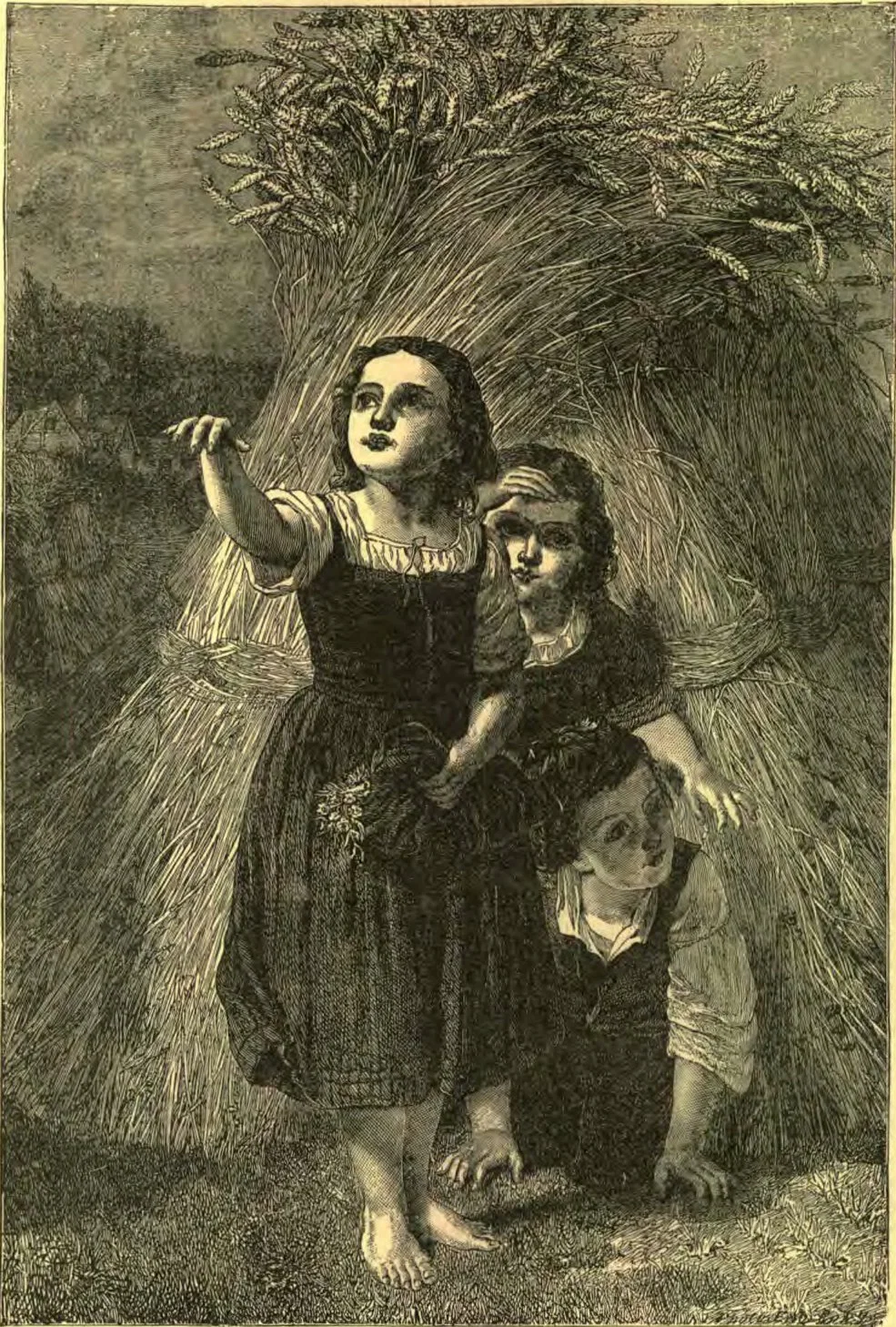
HILDA, BERTHA, and OTTO KARSTEN were three little German children who, with their parents, had come from that far-off land beyond the sea to find a home on our Western prairies. They had once had a dear little home in the old country, but they had lost it, and I will tell you how.
Their father had been a miller, and had owned the mill, together with the house and the few acres surrounding it. This land joined on every side the estate of a rich baron, and in fact, had once been a part of it; but it had been sold years before by the baron's ancestors to meet some reckless expenditure.
Now the baron had coveted these few acres for a long time, and had several times offered to buy them; but the sum he offered was not half the value; besides, Mr. Karsten loved his mill and his little home, and did not care to part with them. Well, as I have said, the baron coveted this land, and as he broke one commandment in doing so, it was not long before he began to lay plans how he might break another. The more he thought about it, the more he wanted it, till in his eyes it became worth more than all his vast possessions. He thought he could never be happy unless he had it; and at last he determined to steal it.
You think it would be hard work to steal land. So it would in this country, where the poor have privileges as well as the rich; but in that country, might makes right, and it was an easy matter. Let me tell you how he did it. The little stream that turned the big wheel in the mill flowed from the baron's land, and entered it again after running through the miller's; so this wicked man dug a great ditch around the poor miller's farm, connecting it at both ends with the stream, and thus drew the water all off. Then the big wheel stopped turning, and no grists could be ground. The miller did not know what to do, for he could get no work to make a living. Finally the little money he had saved was gone, and he was compelled to sell his home to the baron (no one else would care to buy it now) for whatever he pleased to give him, which was not much.
Mr. Karsten had heard of this good land of ours, and had heard that here by patient industry the poor might win homes; so one spring found the Karsten family on the rolling prairies. A farm was bought and partially paid for, and a comfortable house was built.
In a year or two the grassy plain was transformed into fields of rustling corn and waving wheat, and that in turn into shining dollars; and slowly and surely the farm became their own. “When the farm is paid for!” That was the children's idea of perfect happiness. To this end they hoarded even their pennies, and worked like little heroes, too. Barefooted and bareheaded, clad in their old-fashioned, home-spun clothes, they weeded the garden, cared for the cows and sheep, and fed the calves and chickens. When the other children laughed at their odd clothes, they only smiled at each other and said, “We'll have new clothes, too, when the farm is paid for.”
At last came the long-looked-for summer when the last dollar would be paid, if all went well. But alas! the spring was so damp and cold that the corn seed rotted in the ground; and though it was planted over and over again it became evident that the corn crop would be a perfect failure. But how the wheat grew!—as if it knew that eager eyes with anxious hearts were watching it,—as if it knew that joy or grief depended on its growing. The children measured by it. Now it was as tall as Otto; now it was over Bertha's head, and now Hilda, the eldest, could just reach the golden-turning heads by standing on her tip-toes.
“The wheat would pay for it all if I didn't have to hire some help to take care of it,” said the father, “but that will cost money, and now the corn is gone.” “O father,” cried Hilda, Bertha, and Otto all together, “we can help you take care of it, I'm sure we can. Do let us try.”
The father looked doubtful, and shook his head, but when he saw their eager faces cloud over, and tears come in their eyes, he thought again and said, “Well, you may try.” They could hardly wait till it was ripe, they were so anxious to prove that they could help; but at last the father shouldered his cradle, and went to cut it down. Then the children raked it up in bundles, and very careful they were to get every scattered stalk. Then the mother left the house to care for itself, and came out with them, and bound the bundles tight with wisps of straw. The children learned how, too, but they could bind only the small ones.
But they could set the bundles all on end in great shocks though, and thought it fun. They called it building houses. Once it rained when they were far from home, alone in a distant corner of the field. Then they built a larger house than usual, and crawled inside. It thundered and lightened, too, but they were not afraid. The shower was soon over, so that Bertha holding out her hand, could scarcely feel a falling drop. Then they crept from their safe retreat, and soon were at work again as merrily as ever.
Finally it was all cut and bound and set up. Now it must be stored in the barn. Again the father shook his head, but again they all cried, “We can do it. Try us, father.” They were not afraid to work, you see. When the great wagon was driven to the field, Otto held the lines, and drove from shock to shock, while Hilda and Bertha laid the great bundles, as large as themselves, evenly, side by side, as fast as the father could toss them up. As proud as kings and queens in a royal chariot, they rode on the loaded wagon to the barn, and there they packed the grain in so tight that when the threshers came to thresh, they asked the father what man he had that packed the bundles so. How they stared when they were told, and how the children laughed!
But they laughed a great many times that winter when, clustered round the fire in a home now all their very own, they would recount their summer's work, and tell how they, too, had helped pay for the farm.
ISADORE S. MINER.

SHOES AND HOW THEY ARE MADE.

All little boys and girls, as well as older people, have to wear shoes. We could hardly get along in the winter without them. I wonder if you ever stopped to think how these shoes are made, and where they come from? Thinking that you might want to know something about this, I went yesterday to a large manufactory, to see what I could learn about it. Goodrich & Porter of Haverhill, Mass., is a first-class firm, and carry on a large business. They turn out from fifty to one hundred cases of shoes a day; each case contains thirty-six pairs, which you see would be from eighteen to thirty-six hundred pairs a day. When doing full business, they employ about two hundred and fifty hands; about one half of these are women or girls. Each hand works by the piece, so that they get pay just according to the work they do. So it happens that some persons earn a great deal more than others. The average wages are from ten to fourteen dollars a week. Mr. Hall, one of the foremen, very politely showed me all through the establishment, and explained everything to me.
What are shoes made of? “Of leather, of course,” you say. Well, that is so; but there are other materials which are used, such as cloth, thread, twine, cement, steel shanks, etc. Now if you will follow me carefully, I will take you all through the rooms, and show you just how shoes are made, from first to last.
Here lies a large pile of leather, all ready to make into shoes. This leather is received from all parts of the world. The best leather, such as French calf, comes from the old country; this is because the labor is so much cheaper there that they can put more work on it. Now, here stands a man at a large table; and spread out before him lies a whole side of leather, that is, a tanned skin of an animal, such as a calf, a sheep, or an ox. Some are very large, as big as the top of the table; some are very small, not much larger than the bottom of a chair. In his hand he holds a very sharp knife, and before him lie a large number of patterns. This man is a cutter. He lays the patterns on the leather, and very quickly cuts out a piece such as he wants, then another, and still another, until he has cut the leather all up. This he does day after day, month after month, in fact, all his life. He does not cut out shoes, and then sit down and make them. No, he could not make a shoe much easier than you could, because he has only learned to do one thing, and that is to cut them out. By doing one thing all the time, he learned to do that very quickly. Years ago one man did all the work on the shoes; now, as you will see, it takes a great many persons to make a shoe. Each person only does a small part of it. Now, go to this table; here stands another man with knife in hand, but his business is to cut out the linings. These are cut from cloth, and from thin, soft leather. He does nothing else but just that part of the work.
There stand three men whose whole business is to cut out the trimmings, that is, the little pieces that go on the shoes. These three cutters are always men.
The shoes thus cut out are carried to the next room. Here we find a larger number of persons at work on large machines something like sewing machines. Most of the persons are young women. The first girl takes these pieces, and puts them together with common flour paste.
The next girl takes these pieces, and sews them together. Remember this work is all done by machine.
The next person sews up some of the seams. This is what they call, “closing in.”
The shoe goes next to the corder; she sews on the cord wherever it is needed.
The next workman is a “vamper,” that is, he sews on the piece that goes across the toes.
The next girl takes the shoe and sews on the buttons. This is the funniest thing of all. She has a little machine which takes these little buttons, and places them just where they belong on the shoe, and sews them on; and does it faster than you could pick up the buttons, to say nothing about sewing them on.
The next girl is a button-hole cutter, and all she does is to cut these on a machine. From her the shoe is passed to the button-hole sewer. This machine will work a button-hole so quickly that you hardly know that it is begun before it is done. It goes round it, and sews it nicely, and when it has gone all round, it stops as if to say, “That is done; give me another.” And so it goes all day long, “Click, click, click.”
Thus far we have only worked on the uppers of the shoes; now let us examine a little farther. This firm does not cut the soles, they buy them already cut. There are large shops where they do nothing else but cut soles. They cut them little and big, and make them in every shape. The reason of this is, that the person who does only one thing can do that better, and faster, and cheaper than a man who tries to do several things. Then there are a good many kinds and qualities of soles. He sells one quality to one firm, and another to another firm, and so uses up all his leather. Goodrich & Porter cut their own in-soles and stiffenings, and so we have a man here at work all the time cutting these in-soles.
Now we come to the heels. Here again we find that this firm buy all their heels ready made. Just across the way is a firm who do nothing else but make heels. They buy up all the pieces and scraps of leather, and make them into heels, and sell them. In this way, everything is saved. But here the firm take these heels, and put what they call a “top-lift,” that is, a last layer of leather, on the bottom. This is of much better material than the others.
Here stands another man cutting linings to the soles. Here is another cutting counters, that is, a stiffening round the back part of the heel. They are passed to the next man, who trims them down to just the shape he wants them.
The next man takes the sole and “channels” it, that is, he cuts a deep mark all around just where it is to be sewed. From this it is passed to a man who edges it; they call it “champering.” All this is done on a machine. Here is a machine that will do both at once. It is wonderful how quickly it will be done.
Here is a machine that shaves the pieces of leather, just as you would shave a piece of board with a plane, so as to make it of equal thickness. There stands a man with a stamp, with which he marks each sole as number 6, 7, or 8, whichever it is.
Now we go into the room where the soles are put on. It takes five men, called “a team,” to do this. The first man puts a last into the upper, and lays the in-sole on the last; then he draws the upper over it, and tacks it on; then the outer sole over that, and tacks that on. The next man is called a “beater out.” He hammers down the seams smooth. The next man is a “trimmer;” he works the edges of the soles down nice and smooth. The next one is an “edge-setter;” he smooths the edges of the soles, and blacks them; then the next man polishes them and ties them up in pairs. But the most wonderful thing is the machine which sews on the soles. This is called the McKay Sewing Machine. It will sew heavy soles on shoes as easily as your mother's sewing machine will sew a seam in cloth. These shoes are then passed down into another room where they are polished up nicely, and then are packed away; some in single pairs in little boxes just as you see them in the stores, and some a dozen pairs in a box. Then they are sent all over the country.
Nearly all this work from first to last is done by machinery, so that one man can do as much on a machine as several men could do by hand. You will notice that the shoe, from the time it is cut out till the time it is packed, goes through more than twenty different hands, each one doing a little piece of the work; and the same person always does just that part of the work, and nothing else. This is why they can do it so quickly. From this we should learn the important lesson of not trying to do too many things, but to do our very best on what we do undertake; that is the way to succeed in anything.
There are a good many different kinds of shoes made, as you will see in any store. All are not made in the same way, but what I have told you will give you some idea about them. Goodrich & Porter make only the best class of shoes. Some firms make very poor shoes, and make them out of the poorest materials, sticking them together in any manner; but those who make the best shoes do the best work. D. M. Canright.

FAITH'S REFINING.

It was hard! If it had been ribbons, or a new dress, or even that beautifully bound volume of Longfellow which Faith had seen in Mr. Stone's window the week before, she would not have said a word. But to give up school, that was different.
“And Alice Carr and May Manning and Jennie Cone will all begin Latin on next Monday, and I can't be there. Oh, dear!” And the bright head went down on the pillow with a sob.
“If grandma wasn't sick, and if there was anybody to take care of her but mother, and if”—
But here Faith raised her head from the pillow and faced the situation, like a brave girl of fourteen, as she really was. Grandma was sick, and Faith's mother could go to care for the dear old lady, forty miles away.
In the meantime Faith had her share of the burden to bear. She remembered how her mother's hand rested on her shoulder, the evening before, as she said, “I am very sorry for your disappointment, daughter, but the next thing for each of us is clearly shown. I am to go to grandma, and you are to help Katie till I come home.”
Faith felt very brave then, but now the mother's loving eyes and tender voice were forty miles away, and she was here with Lucy and Fred, “to make home cheerful for them and for father,” as Mrs. Latimer had said. Not very cheerful did the girl feel, as she went down stairs, the deserted rooms reminding her of mother, and the thought more than once entering her mind that it was hard to be out of school just now.
On entering the kitchen, Katie stood by the sink, polishing the faucet. Faith looked on intently for a few minutes, and then said:—
“It shines now, Katie; isn't it done?”
“No; I like to see my face in it,” said the girl, rubbing vigorously.
What was it that brought Miss Moore's words to Faith's mind? “Girls, do you remember that verse in Malachi? ‘He shall sit as a refiner and purifier of silver’?” She remembered how, in her winning way, Miss Moore had told her that the refiner of silver watched his work carefully until he could see his image in it; then the refining was complete. The same lesson had been taught again in Katie's homely words.
Until his image can be seen! Might it not be possible that this home experience which seemed so hard had something to do with her refining? Might it not be that by caring tenderly for Lucy, being patient with Fred, making home cheerful for father, the traces of his image would become more strongly marked?
Faith turned to leave the room, with a different expression on her face. It was worth trying for; she would make the attempt. And did she care tenderly for each member of the family? Perhaps not always. But the decision was made; her life had the right direction, and often in after years she looked back to this experience as the time when the help of the Father in every-day duties, began to seem a reality to her, and his presence her greatest blessing.—Congregationalist.

DREADING AND DOING.

If father, or mother, or teacher should say, Here's some work or a lesson to conquer to-day, Don't look at it, dreading it; that never will win; But steady, hard work will. Be brave and begin.
A task may seem hard if one dreads it. But when We've determined to do it, though difficult, then It's often the case that we find we have made A mistake. There is nothing to make us afraid.
'Tis said if a man meets a wolf in the way, And faces him bravely, the beast slinks away. It's the same with our tasks. Face them bravely, and find There's nothing to frighten a resolute mind.
—Eben E. Rexford.

MOTHER WAS GOOD TO HIM.

We can all look back to our childhood days, and recall times when we thought mother was not good to us, times when her mild restraints seemed irksome and even cruel, and when we would have put them aside in our wilfulness and anger. In later years we understand better how good mother was to us, and in all true hearts there comes a feeling of sorrow in remembrance of the times when we were not always good to mother. The following beautiful incident will touch the hearts of many:—
“But after all, she used to be good to us.” It was a son who said this of a mother whom some nervous malady had overtaken, and who was certainly a very serious trial to her family.
The young man’s life, too, was a weary one. He was hard-worked through the day, and it was depressing to go home at night to fault-finding and fretfulness.
Harder still was it to sleep, as this son did, week after week, and month after month, with all his senses half awake, that he might hear his mother’s footsteps if they passed his door, and hurry after her to keep her from wandering out into the night alone, as her melancholy half-madness often led her to try to do.
Strangely enough, she had turned against her own husband and her daughters. Only this one son had any power to persuade her for good. His work by day and his vigil by night wore on him sorely, but he never complained.
One day his sister asked him how he could bear it and be always patient, when she—mother though she was—was in the house only as a presence of gloom and foreboding and unrest. And the answer came,—
“But, after all, she used to be good to us.”
And then the thoughts of all the group went back to the years before this nervous prostration came upon her, when she had nursed them in illness, and petted them in childhood—when she had been “good to them,” one and all.
“I know,” the boy said, thoughtfully, “that I was a nervous, uncomfortable child myself the first three years of my life. Father said he thought they’d never raise me; but mother said, ‘Yes, I will,’ and she tended me day and night for three years, till I began to grow strong like the rest of you. I owe her those three years, anyhow, and she shall have them.”
And so he girded himself afresh for the struggle. It did not last forever. There were signs by which the doctors could recognize that the cloud was lifting, and, no doubt, before long she was her old self again. And then came her son’s reward. He felt that he had paid a little of the debt he owed to the love that watched over his weak babyhood.
To many mothers, worn by long care, such years of melancholy and nervous prostration must come. And the sons and daughters who find their homes saddened by such a sorrow should lovingly remember the days in which they were helpless, and mother was “good to them.”—San Francisco Call.

Beautiful Activity and Beautiful Stillness

BEAUTIFUL, is the activity which works for good, and beautiful the stillness which waits for good. Blessed the self-sacrifice of the one, and blessed the self-forgetfulness of the other.

Watching for Souls as Those Who Must Give Account

OURS is the life-saving service to which the Captain of our salvation has called us. Let us watch for souls as they that must give an account.

A TRUE PHILANTHROPIST.

Do the readers of the Instructor know that the first Sunday-school established in the city of New York was by a black woman? You have all heard of Sojourner Truth, the colored woman who lived to such a great age, some of the time in Battle Creek, where she died a few years ago; and how hard she worked in trying to get the freedmen into positions where they could help themselves? Sojourner did a good work for her people; but the person referred to at the beginning of this article is another distinguished colored woman, who was born a slave, near 1780, while her mother was traveling from Virginia to New York City. Her name was Catherine Ferguson, or Katy, as she was called. When Katy was eight years old, her mother was sold, and they never saw each other again. Her grief was so great at being separated from her mother that she always sympathized with orphan children, and felt a great care for them. She had a kind mistress, who allowed her to attend meetings; and although she never learned to read, having a good memory, she treasured up a great deal of Bible knowledge, which she put to good use afterward, when she consecrated her life to the service of the Lord. The following is an extract from Lossing’s sketch of her life in “Our Countrymen”:—
“A benevolent lady purchased Katy’s freedom for two hundred dollars, when she was sixteen years of age, and allowed her one hundred of it for eleven months’ service. The excellent Divie Bethune raised the other hundred, and Katy became free. For fifty years she was a professional cake maker, for weddings and other parties, and was held in high esteem. She married at eighteen, had two children, and lost them, and from that time she put forth pious efforts for the good of bereaved and desolate little ones. At her humble dwelling in Warren Street, she collected the poor and neglected children of the neighborhood, white and black, every Sunday, to be instructed in religious things by herself and such white people as she could get to help her. Sometimes the devoted Isabella Graham would invite Katy and her scholars to her house, and there hear them recite the catechism, and give them instruction. Finally, Dr. Mason heard of the school, and visited it one Sunday morning. ‘What are you about here, Katy?’ he asked. ‘Keeping school on the Sabbath!’ Katy was troubled, for she thought his question a rebuke. ‘This must not be, Katy; you must not be allowed to do all this work alone,’ he continued; and then he invited her to transfer her school to the basement of his new church in Murray Street, where he procured assistants for her. Such was the origin of the Murray Street Sunday-school, and it is believed that Katy Ferguson’s was the first school of the kind established in the city of New York.
“The Rev. Dr. Ferris, chancellor of the New York University in 1855, informed the writer that his first extemporary expositions of the Scriptures, while he was yet a theological student, were made in Katy’s Sunday-school, in the Murray Street church.
“Katy’s benevolent labors did not end with her Sunday-school duties. Every Friday evening and Sunday afternoon she gathered the poor and outcast of her neighborhood, children and adults, white and black, into her dwelling, and always secured some good man to conduct the services of a prayer-meeting there. Such was her habit for forty years, wherever in the great city she dwelt. Her good influence was always felt; and tract distributors uniformly testified that wherever Katy resided, the neighborhood improved.
“Nor was this all. Though laboring for daily bread, at small remuneration, she cheerfully divided her pittance with unsparing generosity. She always found some more needy than herself; and during her life, she took forty-eight children (twenty of them white), from the almshouse or from dissolute parents, and brought them up or kept them until she could find good homes for them! The example of such a life ought not to be lost. She was a philanthropist of truest stamp. She died in 1854. Her last words were, ‘All is well!’”

PEOPLE WHOM CHILDREN LOVE.

Most people profess to love children. I have seldom met anybody who declared that he felt an aversion to them. Yet there are many who look on the little ones very much as though they were superfluous luxuries, pleasant to play with now and then. There are many more to whom they are simply interruptions and discomforts.
You cannot buy a child's love. You may load him with your gifts, and spend your money for his pleasure lavishly, while you are only awakening in him a desire for gain, and an appetite for new toys. It is pitiable to observe how selfishness and ingratitude are cultivated in some little hearts by those who never approach the nursery without a bribe in their hand.
Teachers cannot hope for any success except as they can obtain the sympathy and affection of their classes. A child loves a genuine character. The dancing eyes of Jennie and Robbie are very quick to see through shams. You may impose upon older people, but you shall be weighed for what you are in the balances which are held by dimpled fingers.
Another thing which children love is simple-heartedness. There are royally-endowed men, men of large culture, wide influence, glorious attainment, and lofty aims, who keep always the simplicity of children. They never lose it, and the little ones discover that there is something beautiful about them, and fearlessly follow them, quite unaware that there is any reason for awe, or that the world holds their companion in reverence. Macaulay's nephews and nieces adored him, knowing him not as an author, but as a man.
I think, too, that children are greatly attracted by a true love for Christ outshining from any nature. When Jesus was here, the little ones went to him confidingly; and they are as ready now to go to those in whom he reveals himself. If we are so often in communion with our Lord that we are being even now changed from one image of him to another, day by day, we shall be so sweet, so patient, and so tender, that the children will delight in our society. We will not invade their rights, nor hurt their feelings, nor ignore their presence. We cannot obey the command, “Feed my lambs,” unless we love him, and love them, and they love us. Let us try, for the children's sake, to cultivate those graces which are most Christlike.—Margaret E. Sangster.

NOTES ON LESSON 1.

(GEN. 1: 28; 2: 16, 17.—We understand from these verses and from Gen. 3: 8-19, that before the fall, God talked with man, face to face; and that he and his Son were personally present with Adam at times. See pp. 33 and 42 of “Great Controversy,” Vol. 1. There have been times since the fall when God has spoken with an audible voice to mankind, but his glory has always been shrouded from their view. From reading Ex. 20 we understand that the law was spoken with an audible voice from Sinai; but God’s glory was hidden from the people by the smoke and the clouds, as recorded in the 19th chapter and 18th verse. And even while Moses was with him forty days and forty nights, the face of God was not seen. In Joshua the fifth chapter, we read that the captain of the Lord’s host appeared before Joshua, with a drawn sword in his hand. The captain of the Lord’s host is none other than the Son of God himself. See “Great Controversy,” Vol. 1, p. 348. In this instance the glory of Christ was so hidden that he appeared to Joshua as a common warrior.

WORK ON.

Hold up your brow in honest pride, Though rough and soiled your hands may be; Such hands are sap-veins that provide The life-blood of the Nation’s Tree.
There’s honor in the toiling art That finds us in the furrowed fields; It stamps a crest upon the heart Worth more than all your quartered shields.
Work, work, my boy, and murmur not; The fustian garb betrays no shame, The grime of forge-soot leaves no stain, And labor gilds the meanest name.

THE ARC DE TRIOMPHE.

A DESCRIPTION of this arch was given you by “Uncle Ide” in “Foreign Travels, No. 6, Beautiful Paris,” in which he stated that “there are various figures and representations sculptured upon the arch, and the names of the great victories of France are inscribed upon the stones.”
An exchange says:—
“The number of names of battles, sieges, and captured towns engraved upon the Arc de Triomphe, Paris, is 158, the first being the battle of Valmy, September 20, 1792, and the last, the combat of Ligny, which preceded the battle of Waterloo, and is claimed by the French as a victory.
“The number of marshals, generals, and other field officers whose names are also to be read upon the walls of the arch is 658, of whom 126 were killed upon the field of battle. The first of the 658 names is that of ‘Chatres,’ the son of Philippe Egalité, better known to history as Louis Philippe, who, like his father, distinguished himself at Valmy. Upon the summit of the arch, facing the suburb of Neuilly, is the inscription, which, translated, would read:—
“This monument, commenced in 1806, in honor of the Grand Army, for some time left unfinished, was continued in 1836 by King Louis Philippe I., who has consecrated it to the French armies.”
“The Arc de Triomphe is the largest monument of its kind. It is rather more than double the height of the Arch of Constantine at Rome. The total cost of the Arc de Triomphe was $1,860,700.”

IMPORTANT BIBLE SUBJECTS.

LESSON 1.—PROPHECY, ITS USE AND IMPORTANCE.

(NOTE TO THE STUDENT.—Do not consider the lesson learned until you can give at least the substance of every text, with the correct reference for each. The references in black letters indicate those texts that should be committed to memory. A little diligent application each day will enable you to do this.)
1. How did God talk with man before the fall? See note on Gen. 1:28; 2:16, 17.
2. What is one result of sin? Isa. 59:2.
3. After man had sinned what effect would the immediate presence of God have upon him? Ex. 33:20.
4. What instance have we where God spake direct to the children of Israel? Ex. 20:1, 2.
5. Why did they desire Moses to speak the word of the Lord to them? Ex. 20:19.
6. What is one medium through which God can make known his will to sinful man? Num. 12:6.
7. How much of what God proposes to do will he reveal to his prophets? Amos 3:7.
8. Name examples of visions given for the benefit of generations to come. Dan. 2:28; 10:14; 12:4.
9. How were they preserved for the benefit of mankind? Dan. 7:1; Rom. 15:4.
10. What does David say of God’s word? Ps. 119:105.
11. What especially gives it the character of a lamp? 2 Pet. 1:19.
12. How are we exhorted in this verse to give attention to prophecy?
13. What is prophecy?
14. Have we a right to study prophecy? Deut. 29:29.
15. Show that the man of God cannot be fully equipped without a knowledge of the prophetic word. 2 Tim. 3:16, 17.
16. Give instances where Christ referred to prophecies concerning himself and his mission. Luke 4:16-21; 24:27.
17. How did he rebuke the unbelieving disciples? Luke 24:25.
18. What two books are largely composed of prophecies for the last days?
19. What is the inspired title of the last book of the Bible? Rev. 1:1.
20. What is a revelation?
21. How are we encouraged to become acquainted with the contents of the revelation? Rev. 1:3.
22. What curse is pronounced on those who shall interfere with the prophecy of this book? Rev. 22:18, 19.
23. What shows that the book of Daniel would not all be understood from the first? Dan. 12:4, 8-10.
24. When may we expect it to be understood? Verses 4, 9.
25. Who will understand it? Verse 10.

ADVICE TO YOUNG SPORTSMEN.

It would seem the safer way for the young to let firearms alone; but so long as they are sometimes allowed their use, the more caution they observe in handling them, the less danger there is of accident. Maurice Thompson’s advice in St. Nicholas may be of benefit to some. He says:—
“Always bear in mind that it is the muzzle of a gun that is dangerous; therefore never allow the muzzle to point toward yourself or any other person.
“Never put your hand over the muzzle of a gun, nor allow another person to handle your gun while it is loaded.
“Use a breech-loading gun with rebounding hammers. A muzzle-loading gun is both inconvenient and dangerous to load.
“Hammerless guns are beautiful and convenient weapons; but they are not fit for boys to use, especially boys who are just beginning to shoot.
“If you are hunting in company with others, be careful and courteous, always refraining from shooting at birds that are flushed nearer to your companion than to you, and do not allow your gun, under any circumstances, to point at or in the direction of any human being.
“Open your gun at the breech, and take out both shells before climbing over a fence, getting into a wagon, going into a house, or handing the gun to a person not used to firearms.
“Never drag a gun toward you, muzzle foremost.
“Treat an unloaded gun with the same care that you would use in handling a loaded one. ‘I did not know it was loaded,’ has caused many terrible accidents.
“It is best to thoroughly clean and dry a gun after it has been used all day; and when not in use, it should be kept in a woolen or leather case.
“Boys, when hunting together, should be very cautious in a thick covert, as there one may be quite near another and not see him.”

CHINESE IVORY BALLS.

Nothing can afford a greater proof of the patience and perseverance, as well as the taste of a Chinese handicraftsman, than one of these elegant baubles, each ball being exquisitely carved, and no two alike in pattern. Each of the balls rolls freely within that which incloses it, and is visible through apertures, so that however many there are, the beauties of each can be examined, and the number of the whole counted. Much time is spent upon the carving of these toys, for the cleverest artist will employ a whole month in the execution of each separate ball; consequently the labor of two years is not unfrequently bestowed on the production of a single toy, which is formed out of a solid globe of ivory, and has no junction in any part. The outside of this globe is first carved in some very open pattern, and is then carefully cut with a sharp, fine instrument through the openings, till a complete coating is detached from the solid part inside, as the peel of an orange might be loosened with a scoop from the fruit, without being taken off.
One hollow ball is thus formed, with a solid one inside of it.
The surface of the inner ball is then carved through the interstices of the outer one, and when finished, is subjected to the same operation as the first; and thus a second hollow ball is produced, still with a solid one of smaller dimensions inside.
This process is repeated again and again, the difficulties increasing as the work proceeds, till at length only a small ball, of the size of a marble, is left in the center, which is only ornamented with figures cut upon it, and then the ingenious but useless bauble is complete. This process is said to be performed under water.—Selected.

SOME THINGS ABOUT SILVER.

SILVER is found in a great variety of forms. It is the whitest of the metals, and so malleable and ductile that a silver rod an inch thick, and covered with gold leaf, may be drawn to the fineness of a hair, and yet retain a perfect covering of gold. Three ounces of the metal may be drawn in wire one hundred miles long. Although silver is the whitest of the metals, it has a powerful attraction for sulphur, and is readily tarnished by coming in contact with it. Hence silver door-knobs, silver spoons, etc., turn black from exposure to water and other substances (as India-rubber) containing sulphur. Even the perspiration from our bodies contains sulphur in sufficient quantities to corrode silver which may be carried in the pocket.—Peoples' Manual.
Continue reading: Be Fit for More Than You Are Doing