The Youth’s Instructor, Vol. 33, No. 34.

CONSIDER THE LILIES
Earlier text: CONSIDER THE LILIES

Be Fit for More Than You Are Doing

Be fit for more than the thing you are now doing.—J. A. Garfield.

CLOVER WREATHS

Written for the INSTRUCTOR.

CLOVER WREATHS.

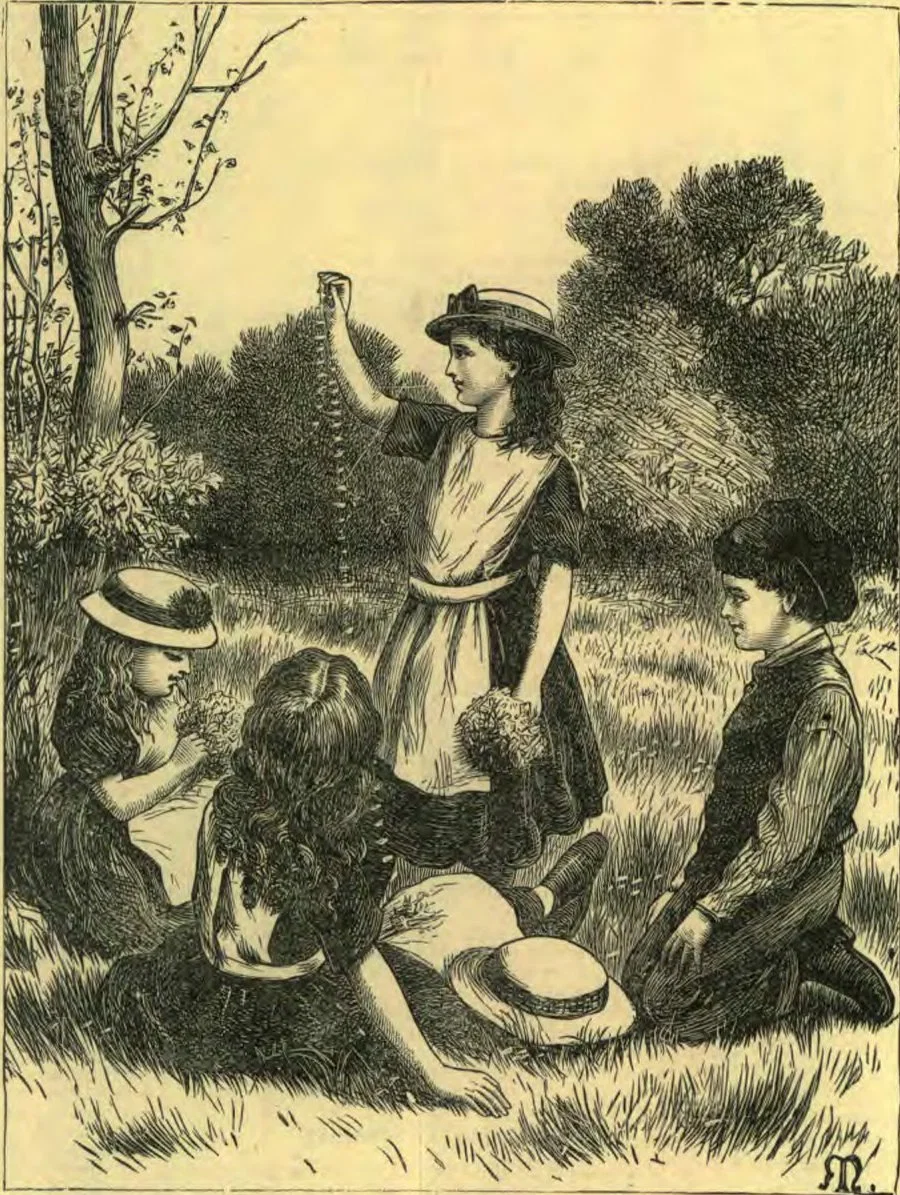
Happy children in the garden, Cheeks with crimson all aglow; Taper fingers deftly weaving Clover blossoms in a row.
Gladsome strains of childish music Float upon the evening breeze; Dearer far, to listening mother, Than all the pearls beneath the seas.
One comes bounding where I'm sitting, Eyes with pleasure beaming bright; "See! I've woven you a garland Out of clover,—red and white."
Nimble fingers quick entwine it, When my head to her I bow; Half my troubles seem to vanish As she puts it on my brow.
Now they've found a four-leaved clover, Blessings follow it, they say; Each one telling what will happen In a shadowy far-off day.
Clover wreaths are but an emblem Of that fadeless diadem That awaits the little children, When our Father comes for them.
MRS. N. A. MONFORT.

Letter Budget.

These are vacation days, when school books are not much thought of, and when our little people are having fine times at play. But we don't think of you as playing all the time, leaving your little, every-day duties for father and mother, or the older brothers and sisters. There are certain home duties which always belong to you, and which it is better that you should perform. We wonder if you ever stop to think about those children who never seem to have any rest? If they are so fortunate as to go to school part of the time, as soon as school closes they have to put in all their spare moments in trying to earn a few pennies toward buying food and clothes, or else they must stay at home from school altogether. It may be you could sometimes change places with them a few hours, letting them have a playtime. Or perhaps you could lighten their burdens in some other way. This is a good subject for the little boys and girls to think of and talk over these long summer days. We would like to have you write out for the Budget some of the useful things you have been engaged in this summer.
This Budget brings you letters from six little girls, and the first one tells how she is trying to be useful. The writer is WINNIE PEEBLES, of Burlington Mission, Vt. She says: “I am trying to do good here, and help about the work. I read to a poor, old blind lady nearly every morning. I am nine years old. I have a little brother five years old. His name is Alden. I had a little baby brother older than I, who died, and a little baby sister who died last winter. I am trying to be a good girl, so I can meet them in the kingdom. I hope all the INSTRUCTOR family will pray for me. This is my first letter to the Budget.”
GERTRUDE M. PARKER, of Holt Co., Neb., a little girl twelve years old, writes for the first time. She goes to Sabbath-school, and day school. She learns her Sabbath-school lessons in the INSTRUCTOR. She likes to read the paper, and she wants to meet all its readers in heaven. She has two sisters and one brother.
MARY FROM, a little girl twelve years old, writes from Washington Co., Neb.: “I keep the Sabbath with my mother, and go to Sabbath-school every Sabbath. I study Lesson Book No. 3. I was baptized three years ago, and want to be a good girl, so that I may meet the INSTRUCTOR family in the new earth. Pray for me.”
RACHEL BUDD, writing from Todd Co., Minn., says: “I am eleven years old, and study in Lesson Book No. 3. We have a good Sabbath-school, which I attend with father, mother, six brothers, and one sister, and all are keeping the Sabbath. Our family have kept the Sabbath about twelve years. I like the INSTRUCTOR very much. I hope to meet all in the earth made new.”
MILLIE SALTER writes from Buffalo Co., Neb. She says: “I am fifteen years old. I have four brothers and four sisters, and we all keep the Sabbath but my oldest brother and sister. We live four miles and a half in the country. I am a member of the Tract Society, and try to do all the missionary work I can. We have been keeping the Sabbath about one year. I am glad we found the truth as soon as we did, and I hope God will help us to be Christians and to do his will. This is my first letter to the INSTRUCTOR. We get the paper every Sabbath. I like to read it. I send my papers to my cousins in Michigan. I send my love to the INSTRUCTOR family, whom I hope to meet in the new earth.”
JESSIE B. CASSIDY incloses a letter in the envelope with Millie Salter's. Jessie, too, lives in Buffalo Co., Neb. She says: “This is the first time I have written for the Budget. I have a mother and brother, but my father is dead. We have kept the Sabbath nearly a year. We have Sabbath-school, and I have been absent from it but once. We have a Tract Society of sixteen members. I am one of them, and I am trying to do all the missionary work I can. We take the Review, and like it much. I like to read the INSTRUCTOR, and hope to meet its readers on the new earth. I send my love to all.”

PULLING WEEDS.

AUNT KATIE and Arthur were out in the garden looking for raspberries, and as they passed the beet-bed, Aunt Katie said, “The bitter weeds are choking out the beets; there will be none worth having if the weeds are allowed to grow a few days longer. Let us pull them out.”
So Aunt Katie and Arthur went to work, and in a few minutes the beet-bed had a tidy look.
“Arthur,” said Aunt Katie, “do you know what weeds are like?”
“Is that a conundrum?” asked Arthur.
“No,” said Aunt Katie, “it is something much more important than a conundrum.”
“Well,” said Arthur, “the weeds must be like any bad thing that crowds out a good thing.”
“Yes,” said Aunt Katie; “all evil traits in our character are like these bitter weeds, and if not overcome in youth, will grow worse, and crowd out the good.”
“I wonder what are my bitter weeds,” said Arthur. Aunt Katie did not tell him; but the next day, when his mother asked him to do an errand, and he said, “Oh, I can’t!” Aunt Katie said, “Let’s go and pull bitter weeds, Arthur.”
After a moment’s thought, he smiled and said, “I will pull mine,” and then started on the errand. His mother, who did not know what this meant, was surprised, but thought to herself, “Katie has a way of making children mind.”
On his way, Arthur was thinking, “Selfishness is my bitter weed. I know I always think of only what I want to do, or not to do.” And when on his return he met his aunt, he said, “Aunt Katie, is selfishness the worst fault a boy can have?”
“I cannot say,” she replied, “whether it is or is not the worst, for there are many degrees of selfishness; but this I can say, it is the cause of all faults, sins, and crimes. What is the reason you do not like to do things for others?—Because it interferes with the pleasures of self. Why does any one steal or lie?—Because he thinks he will gain something for self. Why does any one commit murder?—Either for the same reason, or in revenge for some injury to self. You have, perhaps, heard the old saying, ‘The love of money is the root of all evil,’ but the truth is, we must go one step farther back. Why does one want money?—To get pleasures for self, usually. Truly, the root of all evil is selfishness, and the prayer, ‘Lead us not into temptation,’ is equivalent to ‘Save us from selfishness.’”
The next day, Arthur began to pull at another bitter weed; he was very apt, when anything vexed him, to get into a passion and destroy something, often tearing some part of his clothing if it bothered him in putting it on. On this day, the trouble was about his new rubber ball; he found that his little sister had cut it, and placed it on the head of her doll. In his vexation and anger, he seized the doll, and was about to dash it against the stove, but the thought came to him that this temper was a bitter weed. When he talked with his aunt about it, she told him that it was, indeed, a weed which, if left to grow, might cause one to become insane or a murderer; and she told him how a boy whom he had seen, happened to have but one eye; his brother, when in a passion, had thrown a knife at him, which struck the eye, and destroyed it; and that many children have been crippled for life by a kick, or a blow, or even a push. If Arthur keeps on pulling at his weeds, his life will be like a well-kept garden, instead of a mass of useless, bitter weeds or poisonous plants.—Children’s Magazine.

LINKS

LITTLE May came home from Sabbath-school with a bright smile on her face, and a pleasant word for everybody that came in her way that day. Her brother and sister wondered what made her so obliging and kind. She was the pet of the household, and so expected and generally waited for others to attend upon her. This day if even a wish were expressed by any one, May ran up and down stairs in her efforts to be good and useful.
When the time came for her mother to put her to bed, May said: “Mamma, don't you think I have made a great many links to-day?”
“Links, my dear; what does my little daughter mean by links?”
“Why, mamma, the teacher told us this morning in Sabbath-school, that for every kind word or deed, and for every pleasant smile we made one link in a golden chain that, when long enough, reaches from earth to heaven; and I have been trying all day to make links. Don't you think I have made a good many?”
The mother kissed her little girl, and told her she had been very good, and she hoped she would try every day to make links, so that the chain would indeed grow till it reached heaven.
But the next morning May slept longer than usual, and when her mother went to her room to help her dress, May yawned and sighed, and said, “Mamma, I am very tired. I guess I will let sister Nellie make links to-day.”
Too many children are like this little girl; they try for one day to be good, and then grow weary; and why?—Because they try to do too much at one time. Be gentle, be kind and thoughtful always, a little each day, and soon the habit of being kind and gentle will grow until there will be no effort required to make you so. Only by trying will you ever know the happiness that comes of doing unto others as you wish to be done by; it brings its own reward. After awhile you will not care whether the little links you are daily making are seen or not. You will know that God sees each link, and that the chain is growing every day. How happy you will be if, at the close of life, you can look back and see that there has been no day in which you have not done one good deed—a kind word said, a tear wiped away, one sad heart made glad, one link added to that chain upon which the poor and weary cling for support.—The Christian at Work.

Golden Hours: Duty Done, Duty Begun

GOLDEN are the hours when duties have been done; Silver are the hours when duties are begun; Leaden are the hours when nothing has been won.

You have reached the end of this edition.

The Youth’s Instructor · Sep 9, 1885