The first of the two verses all subsequent translators have copied, but the other one has gone through a number of changes. It is thus rendered in the Great Bible: "He that now goeth on his way weeping, and beareth forth good seed: shall doubtless come again with joy, and bring his sheaves with him." In the Genevan it becomes: "They went weeping and carried precious seed: but they shall return with joy and bring their sheaves." The Bishops' Version reads: "He that goeth foorth on his way, and weeping beareth precious seede: shal doubtlesse returnyng comme agayne with a joyful noyse, bringing his sheaves with him." The Authorized is: "He that goeth forth and weepeth, bearing precious seed, shall doubtless come again with rejoicing, bringing his sheaves with him."
It will be noticed that every one of these different renderings makes some contribution of value. The Genevan is somewhat bare and poor on the whole, but it adds that word "precious," which in this particular connection is better than "good." The "joyful noise" of the Bishops' Version is a little too boisterous, but it prepares the way for "rejoicing." "Doubtless" is also an important addition; it is suggested in the original Hebrew by the repetition of "come."
We shall bring these little studies in words to a close by giving one example showing the influence of the Reims Version. Tyndale renders Rom. 3:25: "Whom God hath made a seate of mercy thorow faith in his blood." Coverdale changed "seate of mercy" to "the obtainer of mercy," the Genevan to "a pacification;" the Reims rendered it, "Whom God hath proposed a propitiation;" finally the Authorized reads: "Whom God hath set forth to be a propitiation." The beauty and appropriateness of the final form is obvious.
Needless to say, the foregoing examples are a very few out of thousands that might be given, but they are sufficient to show the skill and patience that characterized the work of the noble men who risked their lives to give the Bible to the people. They show also, the writer believes, that the translators consciously or unconsciously worked after a certain pattern, and this has resulted in the formation of a sacred dialect. Those who wish to follow up this interesting study can do so by means of books to be found in any good city library.
Tyndale's translation had a strong and molding effect on all later ones, and Martin Luther's German translation had a strong effect upon Tyndale's English Version.
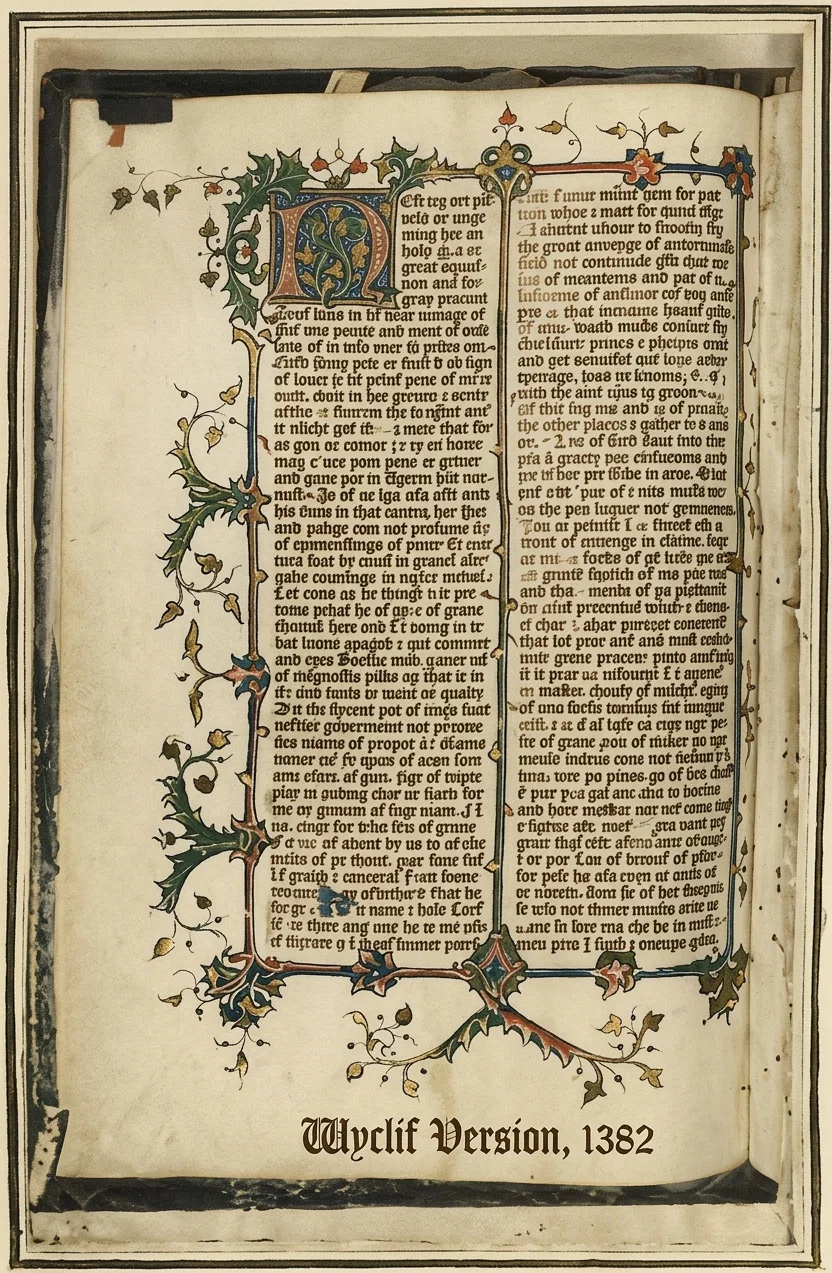
Wyclif Version, 1382
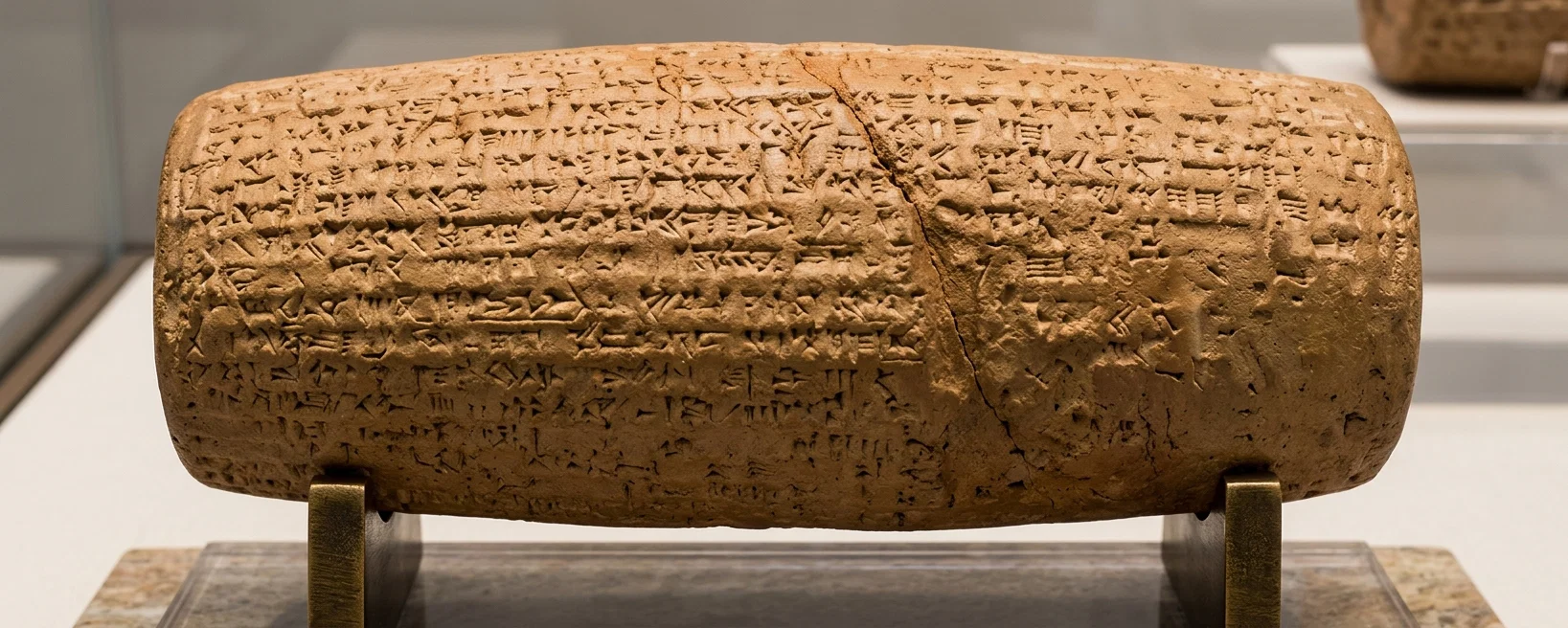
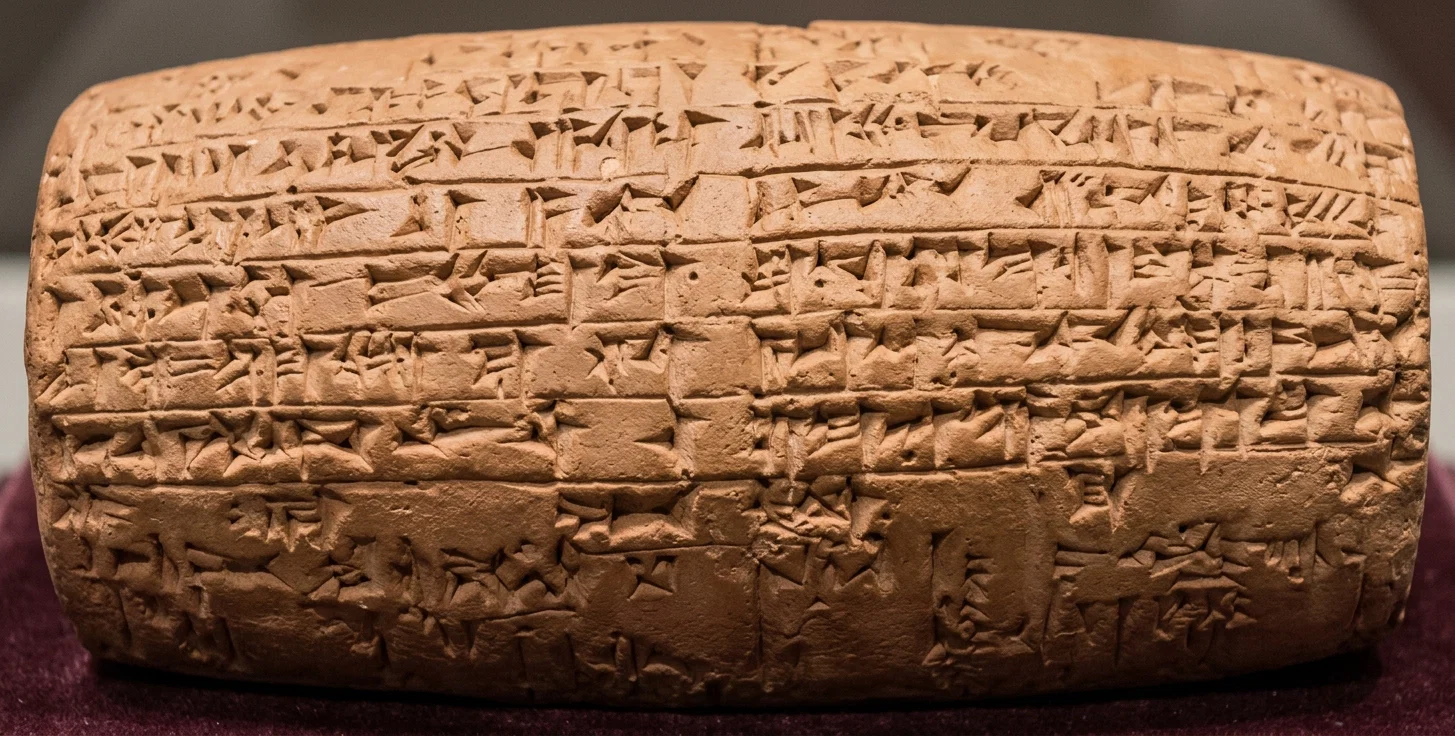
Cylinder of Cyrus, inscribed with an account of the capture of Babylon, B.C. 539 (British Museum)
Later Revisions and Versions
By Editor
King James
T is a pity that our common version of 1611 has been called the King James Version,— sometimes even in pulpit and press it has been designated as the “Saint James Version,”— or the “Authorized Version.” James VI of Scotland, known also as James I of England, was far from a saint. He reigned, or was titular monarch, in Scotland and England from 1567 to 1625. In his earlier years there was a regent, and in later years his flattering favorites controlled him. He was noted for witty and pert sayings, and for some faculties of worth, bound together by no bond of consistency, “a medley of isolated capacities.” His “overweening self-conceit” and “strutting pomposity,” “often rash and reckless in regard to matters seemingly small, and always shifting and irresolute in regard to affairs of the highest moment,” and his disgusting favoritism, gave him the name of “the wisest fool in Christendom,” and needless to say, no English historian places him on a pedestal.
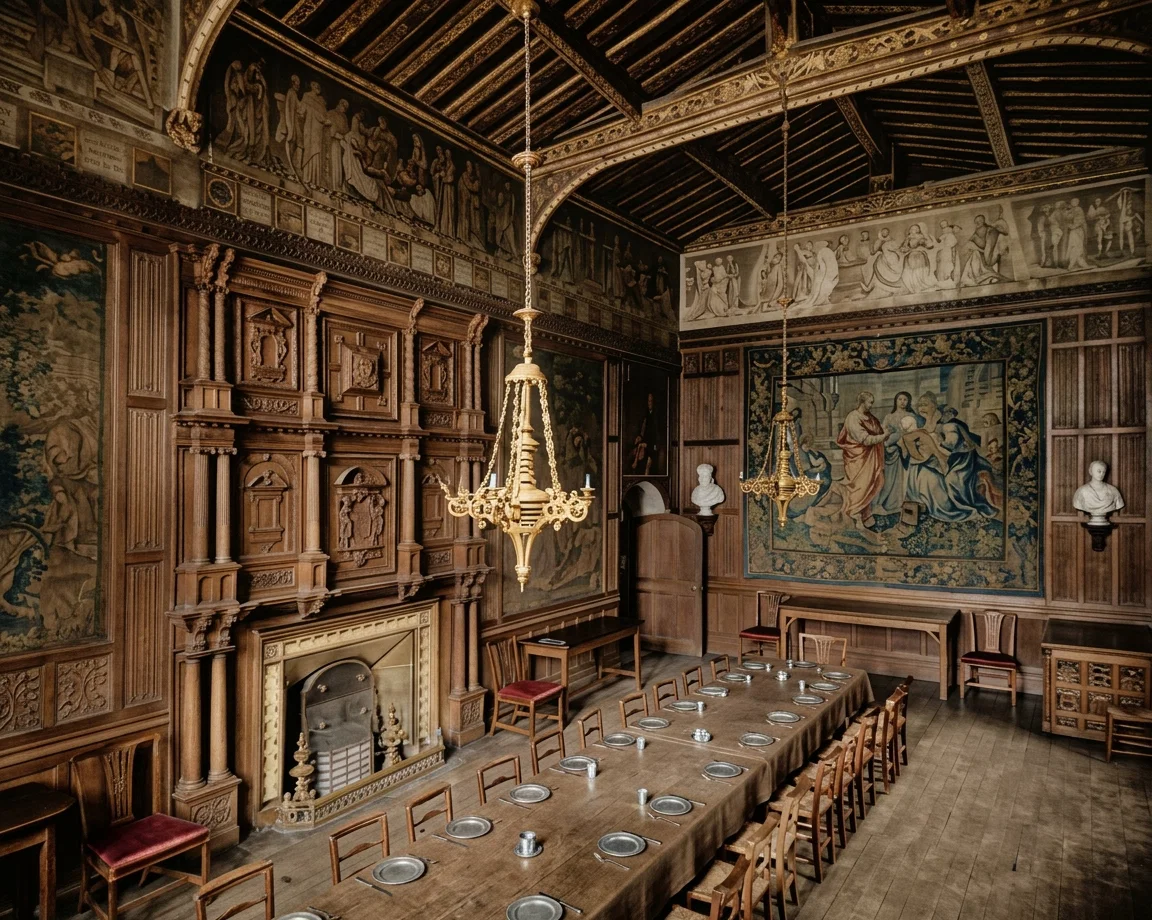
The Jerusalem Chamber, Westminster Abbey, London, where met the English Revisers, holding 800 sittings in this room, completing the New Testament in 1881, the Old Testament in 1884
He was ambitious to be literary, and essayed theology, poetry, and miscellany. These productions, “but for the fact that their author was a monarch,” says the Britannica, “would scarcely deserve a reference.” He hated Dissenters—Presbyterians and Puritans—and held to the Episcopacy. One of his sententious sayings was, “No bishop, no king.” His lack of Christianity and attitude toward religious liberty are indicated by the following from him in 1604: “I will have none of that liberty as to ceremonies, I will have one doctrine, one discipline, one religion in substance and in ceremony.” Of the Presbyterians he declared, “I will make them conform, or I will harry them out of the land.” Out of this attitude came his consent to a translation of the Bible. The Scotch had authorized the Geneva Bible—the only one ever authorized by law or decree or order of king or parliament or convocation or privy council, so far as history informs us. The Bishops’ and Great Bible were not in universal liking. The King therefore gave his consent, and as a self-appointed theologian took doubtless some interest in it.
But God overruled despite all the inconsistencies, weaknesses, and unworthiness of men, and a company of learned men were appointed. But these were placed under restrictions; among others the following: (1) The Bishops’ Bible should “be followed, and as little altered as the truth of the original will permit;” (2) The old ecclesiastical terms should be retained; (3) There should be only such marginal notes as were necessary to explain Hebrew or Greek words. There were thirteen other specifications.
The result was, despite the hand of human, a noble work, the beauty, strength, and dignity of which are universally recognized by all who know it. It was not a new translation; it was a growth out of all that went before it; a revision, not a translation.
Further Revision
It was quite generally received, tho it met with decided opposition and incisive criticism from such scholars as Hugh Broughton, and a new revision was forced in 1629, and the so-called final revision of the King James Version was issued from the press in 1638.
A further revision was called for, which went as far as the passage of a resolution and the appointment of a committee by parliament, but the demand gradually died out. Changes of a minor or technical character continued to be made down to the middle of the eighteenth century by both the Oxford and Cambridge publishing houses. In 1701 Usher’s Chronology was introduced; 383 changes were made in the Cambridge Bible in 1762, and 76 were made by Blayney in the Oxford Bible. In 1873 the Cambridge Paragraph Bible gave a list covering 16 closely printed pages of variations from the text of the King James Version as it appeared in 1611.
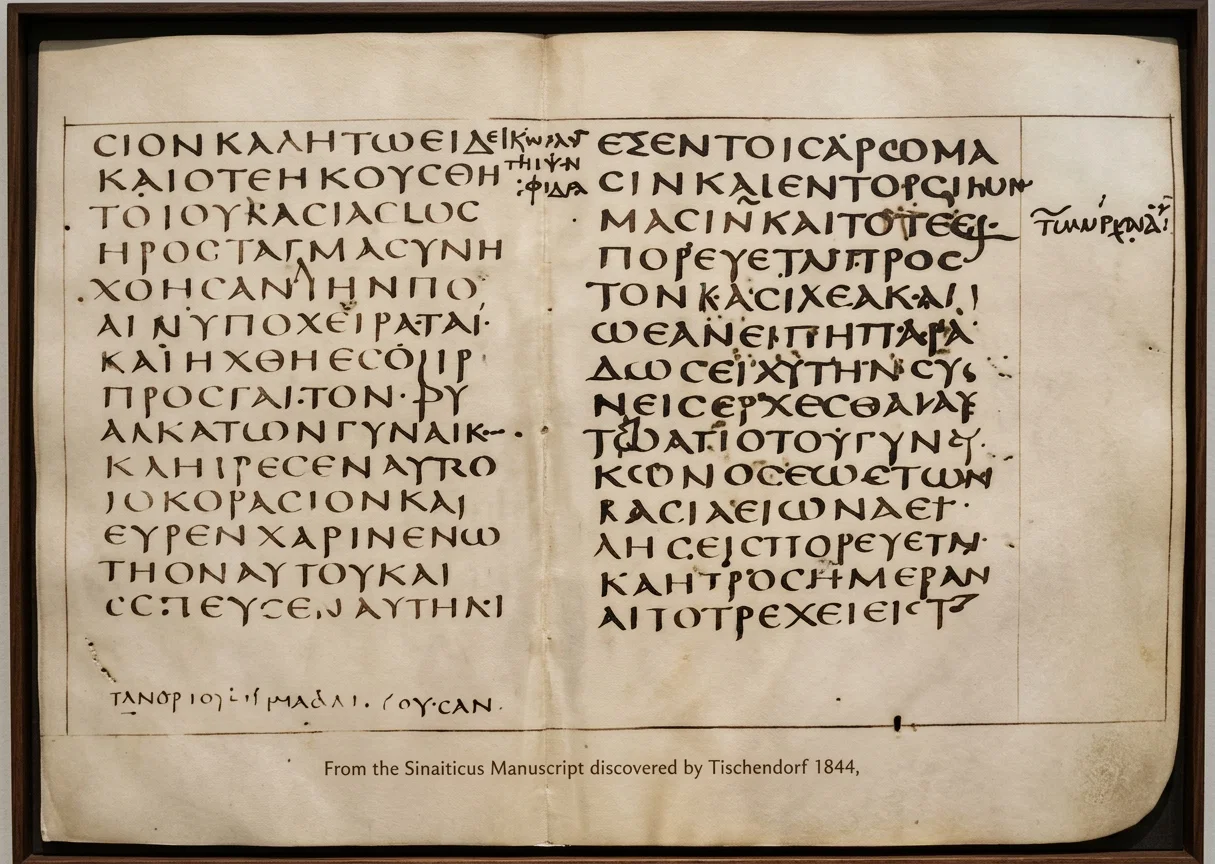
Since the seventeenth century there has been great accumulation of such knowledge and material as to demand a new revision. In fact the same reasons exist for a new revision now, under a consensus of ripe, devout scholarship, that existed in 1611. There have been during the last century ancient manuscripts found, and very ancient ones have been made accessible to Biblical students. Among these are Codex Sinaiticus of the fourth century, found by Tischendorf in 1844; Codex Alexandrinus of the fourth or fifth century, known as “A;” Vatican, known as “B,” of the fourth century; Ephrem’s, known as “C,” of century five, a palimpsest. None of these were accessible to the revisers of 1611. Of manuscripts ancient and more modern, containing a part or the whole of the New Testament, we have more than 100 uncials (written in large letters on vellum) and 3,500 cursives (written in running hand) accessible to scholars. Sometimes a modern cursive is important, as it is a copy of some very ancient copy. No work of classical authorship can present any such number of valuable ancient manuscripts to establish its authority as can the New Testament. All these ancient manuscripts are accessible to the scholars of this age.
Then, too, words and terms in current use in the time of the making of the King James Version have become either obsolete or are changed in meaning. “Prevent,” as used in 1 Thess. 4:15, formerly meant “precede,” or “go before,” now means to “hinder.” A change is demanded. By the term “meat” Americans usually understand flesh food; but in 1611 it stood for food of any kind, and in the “meat-offering” all flesh was excluded. Americans, too, by the term “corn” generally understand maize, but it is used in the King James Version for wheat and other cereals, never for maize, or Indian corn. How many there are who do not know that “seethe,” “sod,” “sodden,” mean boil and boiled! See Ex. 16:23; Gen. 25:29; Ex. 12:9; Lam. 4:10. How many know that when it says “the flax was bolled,” it means “the flax was in bloom”? Ex. 9:31. There are many such instances in the King James Version which need correction.6
Later Revisions and Versions
(Continued from page 5)
The 1611 version, beautiful, choice, strong, clear, happy as it generally is in its English, is sometimes obscure and frequently not uniform. For instance, we come to the term “hell” thirty-one times in the Old Testament and twenty-two times in the New. Usually the word is associated with punishment, but in every instance in the Old Testament it comes from the Hebrew word sheol, a word in its ordinary use meaning the place of the dead, the grave, to which both righteous and wicked go. The word “hell” in the New Testament occurs twenty-two times, and comes from three Greek words: hades, the grave, corresponding to sheol in the Old Testament, ten times; Gehenna, the place of future punishment, eleven times; Tartarus, where the devil and his angels are cast, once. Ordinary students of the King James Version are bound to be misled.
The verse division of the text is very unsatisfactory, oftentimes breaking sentences and chapters and so obscuring the meaning to the general reader.
“Holy Spirit” and “Holy Ghost” come from the same Greek terms. Why not “Holy Spirit” all the time? It would sound strange to our ears to use the word “Ghost” without modification as applying to the Spirit of God. There are many other instances of this lack of uniformity.
From the Sinaiticus Manuscript discovered by Tischendorf 1844,
Eminent scholars alone or in small groups have given us excellent translations and revisions of the Bible in whole or in part since the version of 1611. These are helpful and suggestive to the Bible student, but they have lacked the authority and confidence which a large body of men of different schools of religious thought inspire. Among these we may mention Harwood’s translation in modern English in 1768; Blayney’s revision of the Bible in 1769; Wakefield’s New Testament in 1791; Newcome’s New Testament on Griesbach’s Text, 1800; Thomson’s translation of the Septuagint, 1808; Bellamy’s translation of the Bible, 1821; Campbell’s New Testament, 1826; Boothroyd’s Bible, 1824; Noah Webster’s Version in 1833; Alford’s New Testament; Spurrell’s Old Testament, 1885; Leeser’s Old Testament (a Jewish translation), 1888; the Twentieth Century New Testament; Rotherham’s Emphatic Translation; Murdock’s Syriac New Testament translation; besides the translation of books of the Bible by eminent men like Bishop Lowth, Good, Wintle, and many others.
The Latest General Revision
But there is one version which more fully meets this need than any other; namely, the Anglo-American Revision begun in 1870, and pre-eminently the American Standard Revised Version.
The men appointed upon the Revised Version in England numbered fifty-four; in America, thirty,—eighty-four in all, present and devout scholars from various religious denominations, who set themselves to give us a correct rendering of the original tongues in which God has spoken to the world. They also adopted general principles and rules to guide them in their work, better, it seems to us, to secure correct results than were adopted by the 1611 revisers, without the restrictions. All the findings of the various divisions were twice revised. Experts were consulted outside the number appointed. Where the American Committee differed after final revision, their opinions were to be embodied in an appendix at the close of each Testament.
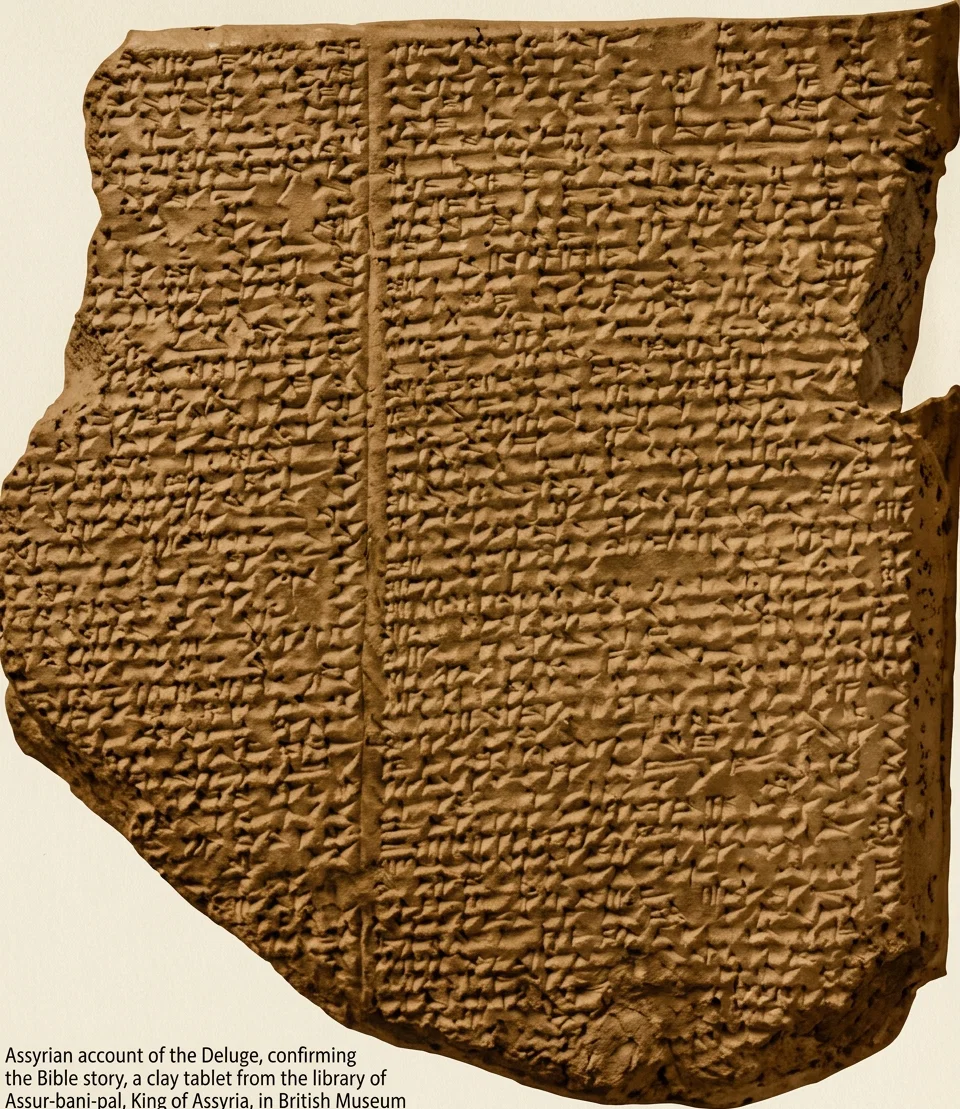
Assyrian account of the Deluge, confirming the Bible story, a clay tablet from the library of Assur-bani-pal, King of Assyria, in British Museum
Work was begun in the renowned Jerusalem Chamber in Westminster Abbey, June 22, 1870, where not less than 800 sittings were held. In America the first meeting was held in the Bible House, New York, October 4, 1874. The first editions were to be printed by the University Presses of Oxford and Cambridge, the Americans agreeing not to print another version for fourteen years. In ten long years the New Testament was finished and given to the world, May 17, 1881, under the greatest enthusiasm. It is estimated that 3,000,000 copies of different editions were sold in England and America in less than a year. Three years later the Old Testament was completed. Nearly fourteen years of scholarship was placed upon the English Revised Version as against about one half of that time in the revision of the 1611 version.
The American Revision Committee still continued their labors during the fourteen years following, and thus secured the benefit of the criticisms of the scholars of Christendom during that period. At the end of that time they prepared the American Standard Revised Version, embodying the result of the ripest and most devout scholarship of the world. This edition was published by Thomas Nelson & Sons in 1901.
Some Differences between the English and American Revisions
Little or no change was made in the superior paragraph division of the text. There is greater7uniformity of rendering and more smoothness and beauty in the places where it differs from the English. In many places it has come nearer to the King James Version. One of the chief differences is the use of the term “Jehovah,” the covenant, memorial name of God, instead of the indeterminate “Lord” or “God,” printed tho they are in capitals. When God specially reveals Himself by that name, why should Jewish superstition be permitted to shut it, with all the fulness of its meaning, from the child of God? See Ex. 34:6, 7. How some passages glow and shine when read with “Jehovah” instead of “Lord”! “Jehovah” (it may be pronounced “Yaveh,” or “Yaweh,” or “Jahweh;” that matters little) and its wonderful meaning is God’s note in blank to the believer, which he may fill out with any of God’s promises according to his need. Pharaoh did not ask, “Who is the Lord, that I should obey His voice?” nor did he say, “I know not the Lord.” Ex. 5:2. But he did ask: “Who is Jehovah, that I should harken unto His voice? . . . I know not Jehovah.” But he knew lords many. The American Standard Revised Version substitutes “who” and “that” for “which” when relating to persons. Our God is a personal God. It is not “Our Father which art in heaven,” but “Our Father who art in heaven.” “Foreign” and “foreigner” are substituted for “strange” and “stranger,” in harmony with common usage. “Its” is substituted for “his” and “her” when referring to impersonal objects. As in the English Revision, the Psalms are given in poetical form, and quotations from the Old Testament in the New set in narrower measure, with reference in the margin. The Old Testament names used in the New Testament retain the Old Testament form. “Elijah” in the Old Testament is not “Elias” in the New, but “Elijah;” “Elisha” is not “Eliseus,” nor is “Hosea” “Osee,” nor “Joshua” “Jesus,” as in the King James Version. This change is helpful to many readers. There are many other changes equally happy and helpful, and the American Standard Revised Version retains the simple, sweet, dignified, strong Anglo-Saxon of the King James Version. It is the 1611 version reborn, the best translation of the Bible we have.
Belshazzar's existence was once disputed and the book of Daniel discredited; research found the above baked clay cylinder on which is inscribed a prayer of Nabonidus King of Babylon on behalf of his son Belshazzar. (From British Museum.)
Influence of the Bible on the English Language
By L. A. Reed
By L. A. Reed
THE death of Queen Elizabeth is one of the turning-points of English history. The age of the Renaissance and of the new monarchy ended with her life. For a few years before she died the whole realm had been silently changing. England as a nation had become united. It stood at the front of all European powers. France courted its friendship. Spain shrank from its mighty blows.
The Papacy had practically withdrawn from the heretical island. Ireland at last had yielded to the rule of the Queen. And with the death of Elizabeth, Scotland joined England under the rule of a common King. The court of the King was no longer endangered by feudalism, the people were no more inclined to anarchy.
Trade and wealth increased. Internal improvement of home and Church and State were daily augmented. Powerful political leaders arose from among the common people. Endless questionings, historical research, philosophical speculation, agitated the public mind, weakened its hold upon the traditions of the past, and aroused it to a contemplation of the new truths of the present.
The nation, too, had become self-reliant. The conflict with the two great spiritual and temporal powers of Christendom, the Papacy and the house of Austria, had roused in the heart of every Englishman a sense of supreme manhood.
A New Age
It was plain, therefore, that a new age of English history must open when the lofty patriotism, the dauntless energy, the overpowering sense of effort, were turned once from the struggles with Spain and Philip, inward upon the improvement of the nation itself.
In the providence of God the nation was led into a profound movement that was to do more for the advancement of England that all else besides. The nation had broken with the dead past, to find a new life and power from the Word of God.
Of this particular and critical moment in the history of England we read from a standard authority:
The popularity of the Bible had been growing fast from the day when Bishop Bonner set up the first six copies in St. Paul's. Even then, we are told, "many well-disposed people used much to resort to the hearing thereof, especially when they could get any that had an audible voice to read to them."
But the "goodly exercise" of readers . . . was soon superseded by the continued recitation of both Old Testament and New in the public services of the church; while the small Geneva Bibles carried the Scripture into every home and wove it into the life of every English family.
The book was equally important in its bearing on the intellectual development of the people. All the prose literature of England, save the forgotten tracts of Wyclif, has grown up since the translation of the Scriptures by Tyndale and Coverdale. So far as the nation at large was concerned, no history, no romance, hardly any poetry save the little-known verse of Chaucer, existed in the English tongue, when the Bible was ordered to be set up in churches. Sunday after Sunday, day after day, the crowds that gathered round the Bible in the nave of St. Paul's, or the family group that hung on its words in the devotional exercises at home, were leavened with a new literature.
Legend and annal, war-song and psalm, State-roll and biography, the mighty voice of prophets, the parables of evangelists, stories of mission journeys, of perils by the sea and among the heathen, philosophic arguments, apocalyptic visions, all were flung broadcast over minds unoccupied for the most part by any rival learning. The disclosure of the stores of Greek literature had wrought the revolution of the Renaissance; the disclosure of the older mass of Hebrew literature wrought the revolution of the Reformation. But the one revolution was far deeper and wider in its effects than the other. No version could transfer to another tongue the peculiar charm of language which gave their value to the authors of Greece and Rome. . . . But the language of the Hebrew, the idiom of the Hellenistic Greek, lent themselves with a curious felicity to the purposes of translation.
As a mere literary monument, the English version of the Bible remains the noblest example of the English tongue, while its perpetual use made it from the instant of its appearance the standard of our language.
The power of the book over the mass of Englishmen showed itself in a thousand superficial ways, and in none more conspicuously than in the influence it exerted on ordinary speech. It formed, we must repeat, the whole literature which was practically accessible to ordinary Englishmen; and when we recall the number of common phrases which we owe to great authors, . . . which unconsciously interweave themselves in our ordinary talk, we shall better understand the strange mosaic of Biblical words and phrases which colored English talk two hundred years ago. The mass of picturesque allusion and illustration which we borrow from a thousand books our fathers were forced to borrow from one.—Green's "History of the English People," book 7, chapter 1.
As one reads the vigorous account of the Bible's influence upon the language and thought of the people of that day, he can not but wish that the Bible were now having this same power.
Regarding the influence of the Word upon the English tongue another writer says:
In the department of language it has done so much that Homer and Cæsar hardly need be mentioned. They are for the few, the Bible for the million.
Are we proud of our varied and exact English speech? The Bible largely made it. And no student seeking forceful speech can neglect the legal exactness, the ornate imagery, the peerless rhetoric and sublime words of the Bible.
Many are the testimonies of men to this truth. When we are surprised at the compact, simple, vigorous style of any writer, we are sure to find that he owes it largely to the Bible. Many have gladly confessed it.
Let me beseech these students, who from their opportunities and tastes ought to become the leaders of this age in lofty thought and its chief expression, that they study for history, philosophy, poetry, and a pure style of their expression, that volume that has silently lifted English speech to a height unknown to any other language on the face of the earth.
Greece did one memorable thing. It gave the world a language fit for God to speak to man in. The sixteenth century did one thing. It gave us in the English Bible that English style that purifies feeling, that enlarges mind, gives strongest wings to thought, and lives in memory like the remembered music of the happy childhood days.—"The Bible in the World's Education," by Bishop Henry White Warren, pages 210-212.
Thank God that countless thousands of English-speaking people have not yet forsaken the Grand Old Book. To it more than to anything else the Anglo-Saxon owes his prestige in the world. If he forgets and neglects that Word, decadence will set in; and tho like Capernaum he has been exalted to heaven by the power of the Word's example and teaching, he shall be brought down to ruin in his forsaking of the high ideals and practises of the Book.
One can easily trace in the progress of the ages the uplift of that Book that—
Gives a light to every age;
It gives, but borrows none.
That influence you and I may have to enrich our individual lives, our thought, our speech.
Shall we turn from it? Can we afford to lose so much?
The Bible, a Window into Eternity
By Timothy Dwight
The Bible is a window in this prison-world, through which we may look into eternity.—Timothy Dwight.
The Book of God
By Horatius Bonar
Thy thoughts are here, my God,
Expressed in words divine,
The utterance of heavenly lips
In every sacred line.
Across the ages they
Have reached us from afar;
Than the bright gold more golden they,
Purer than purest star.
More durable they stand
Than the eternal hills;
Far sweeter and more musical
Than music of earth's rills;
Fairer in their fair hues
Than the fresh flowers of earth;
More fragrant than the fragrant climes
Where odors have their birth;
Each word of thine a gem
From the celestial mines,
A sunbeam from that holy heaven
Where holy sunlight shines.
Thine, Thine this book, tho given
In man's poor human speech,
Telling of things unseen, unheard,
Beyond all human reach.
No strength it craves or needs
From this world's wisdom vain;
No filling up from human wells
Or sublunary rain.
No light from sons of time,
Nor brilliance from its gold;
It sparkles with its own glad light,
As in the ages old.
A thousand hammers keen,
With fiery force and strain,
Brought down on it in rage and hate,
Have struck this gem in vain.
Against this sea-swept rock
Ten thousand storms their will
Of foam and rage have wildly spent;
It lifts its calm face still.
It standeth and will stand,
Without or change or age,
The Word of majesty and light,
The church's heritage.
—Horatius Bonar.
The Bible and Mount Everest
If all the Bibles printed, it is estimated, had been made in one volume it would be 400 times as large as Mount Everest.
The One Book
By E. H. Gillett
There is but one Book that is full of God, or that can fill us with all His fulness. Read it. Ponder it. Not Plato, nor Bacon, nor Addison, but He that spake as never man spake, speaks there. Go up with Him to the mount, and hear His sermon. Sit with Him at the table, and listen to His words. Walk with Him in the fields, and read His paragraphs syllabled in flowers and tares and fig-trees. Take David's harp, and sweep its strings to the music, "The Lord is my Shepherd." Sit at Isaiah's feet, and bow and adore, while he unveils the glorious greatness of Him who "weighed the mountains in scales, and the hills in a balance." . . . God's utterance through the pens of all the inspired writers is like the breath of spring to winter's blasted herbage. The soil freshens and blooms under it, and he who bears the best and noblest fruit of a devoted Christian life is he who is most devoutly conversant with the divine Word.—E. H. Gillett.
The King James Version: Revision, Not Translation
It is well ever to remember that the King James Version was less of a translation than a revision. It was more truly a revision than that of 1881-1884.
New Wonders in the Word
By James Hamilton
The Word of God is solid; it will stand a thousand readings; and the man who has gone over it the most frequently and the most carefully is the surest of finding new wonders there.—James Hamilton.
The Bible Proves Itself
By Charles Hodge
The best evidence of the Bible's being the Word of God is to be found between its covers. It proves itself.—Charles Hodge.
The English Bible
The English Bible—a book which, if everything else in our language should perish, would alone suffice to show the whole extent of its beauty and power.—Lord Macaulay.