The jubilee proclaimed for 1881 by Leo XIII. has attracted pilgrims from France, Spain, Bavaria, and the Slavic States, but not in as large numbers as was anticipated.
The French pilgrimage was not numerous; the Spanish, which it was said would number three thousand persons, dwindled down to one hundred and fifty; the Bavarian was so small that it passed almost unnoticed, and the Slavic, by far the most remarkable for the numbers, the picturesque costumes of its members and their elevated social positions, consisted of one thousand persons. The hopes of the Vatican were, therefore, concentrated on the Italians. This great demonstration was prepared months before it took place; circulars and pastoral letters were sent all over Italy; indulgences of all kinds were promised; committees of organization were formed; aid was given to those who could not pay their own way; the prison, the straw, and the night of the thirteenth of July were called to remembrance, and yet the result was less than two thousand five hundred pilgrims.
There is no doubt of the accuracy of this number, as the pilgrims were counted at the railroad station when they arrived. The clericals endeavor to conceal their disappointment and proclaim the great success of the pilgrimage, but their own records prove that they expected a far larger number. Not long ago there was a dedication of a church in the Province of Venice, when they counted, although the number was greatly exaggerated, that there were present one hundred and twenty thousand persons, and it was said then that the concourse at Rome would be far superior. When it is remembered that the greater part of these twenty-five hundred pilgrims were priests, friars, nuns, and employés, it is evident that the mass of the Italian population do not consider it necessary to protest against the government or to journey to Rome for the salvation of their souls. The days of pilgrimages and crusades are over, and no arts avail to revive them in their former splendor. The Holy Year, which four times in a century gathered pilgrims from every nation to Rome, practically exists no longer; the popes, since 1870, having appointed jubilees according to their own pleasure.
Caravans, where the evil and the good traveled on foot together, are no longer seen approaching la Santa Citta; copper coins, the offerings of the poor, are no longer so abundant that they are raked in by the priests at the altar; the streets and bridges are not now so crowded that father and daughter, husband and wife, are separated perhaps never again to meet; and there is no danger now that one hundred and seventy strong men and women will be trampled under foot, as happened once. There is no use for the ample cape to protect from the weather, for the heavy cane to aid the weary feet and sinking frame, for the shell to drink from in passing a stream of clear water. If the pilgrims wish to appear in these at the pope's reception, they must bring them in their trunks or consent to be conspicuous on their way. In place of a weary and dangerous journey, when they were exposed to violence, to disease and famine or pestilence, they are now swiftly and easily transported to Rome to kneel at the feet of His Holiness and kiss his slipper, to worship the relics of the apostles Peter and Paul, and to gain ample indulgences by visiting only three Basilicas.
The Italian government also, which, according to their theory, is the bitter enemy of both pope and pilgrims, assured them of perfect liberty in coming to Rome, and complete security in the observance of the jubilee. Policemen, guards of public security, and carabinieri, were stationed in large numbers around the Vatican and in all the streets leading to it. All demonstrations hostile to the pilgrims or the Vatican were forbidden. The anti-clerical society which had arranged a demonstration either at Piazza del Popolo, to celebrate the burning of Arnaldo da Brescia, or at Campo dei Fiori, for that of Giordano Bruno, were constrained to defer it to a more convenient time. The only restriction imposed upon these people who came here ostensibly on a religious errand, but really to encourage the pretensions of the ex-king of Rome to the temporal sovereignty was, that no insults to the Italian government would be tolerated. It was rumored that the government would prohibit the pilgrimage, but on the contrary it wisely assured them of complete liberty and protection. The real strength of the party was thus revealed, and it was deprived of the satisfaction of proclaiming itself a martyr.
To the twenty-five hundred pilgrims from other parts of Italy were added the friars, nuns, priests, and collegians of Rome, as well as the Catholic Associations. Tickets were freely distributed also to all who asked for them previously.
THE POPE'S APPEARANCE.
As it was the first time that Leo XIII. had shown himself to the public, even with the doors of St. Peter's closed, during his Pontificate, and with almost all of the ancient splendor, great curiosity was felt by foreigners in the city, as well as by many of the well-known liberal Romans. The throng in St. Peter's church, therefore, on last Sunday morning, was a mixed one, and was variously estimated by the liberals at eight thousand, and by the clericals at eighteen thousand.
At noon the Pontiff was borne from the Chapel of the Sacrament to that of St. Simon and St. Jude on the opposite side of the immense church. There the throne was erected, around which were grouped twenty four cardinals, and many bishops, priests, and nobles. The sedia gestatoria is a kind of portable throne upon which the pope is seated, while the rich draperies that cover it conceal the men underneath who carry him on their shoulders. He made the sign of benediction as he passed through the crowd, which was kept back by lines of the Swiss and Noble Guards, in their brilliant costumes. Cries of “Viva il Papa-Re” (the Pope-King) filled the church and drowned the silvery voices of the singers of the Giulia chapel, as they greeted the Pontiff with “Tu es Petrus.” He appeared weak and suffering, and was agitated by the reception. He wore a white dress, with the red rocchetto and red gilt stole over it, and a white cap on his head.
A PATRIARCH'S DISCOURSE.
The discourse made by the Patriarch of Venice, who wore a red costume similar to that of a cardinal, was a remarkable exposition of the ideas of the Roman Church. After prostrating himself at the feet of the Pontiff, he stood at the side of the throne to read his address. “You,” he said, “offer to the princes and the people, your compassionate hand, that hand which alone can raise the world suffering from so many evils. You, repeating the words of the first Pontiff, say to languishing and suffering humanity: ‘I alone possess divine revivifying power; if you have faith, arise and walk.’” Then, quoting from the apocryphal book Tobias the prophecy: “Thou shalt shine with a bright light and shalt be adored by all the earth; the remotest nations shall come and bring thee gifts, and they will adore the Lord in thee and will call thy land holy,”—he applies it to the Roman Church. “This, Holy Father, is our history. From all parts of the earth the faithful, with their pastors, come to visit you in your glorious imprisonment, impatient to prostrate themselves before you who hold the place of God on earth, and with noble emulation to present the tribute of their faith and veneration.”
THE POPE'S REPLY.
The pope made an answering address, the chief points of which were a protest against the sects, and a declaration that neither he nor any of his successors could ever accept the present state of things in Italy. After admitting the chiefs of the pilgrimage to the privilege of kissing his slipper, he reascended the sedia gestatoria, and, amid the acclamations of the pilgrims, was borne away to the Chapel of the Sacrament, from which there is a private entrance to the Vatican Palace.
A rumor has been circulated for some time that the pope intends to leave the Vatican. The subject has been really discussed by the cardinals, many of whom urge him to take this measure, in the hope of exciting other nations against Italy. They hope that his cause might become popular in the place where he should go, and that public opinion would urge that government to make war upon Italy and bring him back to the Vatican, with the addition to his kingdom, perhaps, of Rome itself and the country surrounding it. These rumors are vague, but various places are named for his refuge,—Malta, under protection of the English; Avignon, with the French; or Salisburg, about two hundred miles from Vienna. There is an ancient fortified castle at the latter place, which was formerly the seat of the Prince-Bishop of Salisburg. It is more than doubtful whether any of these nations would desire his presence among them, and also whether they would aid him to return to Rome. But the pope and the cardinals know well that the Papacy would lose influence out of Rome, and the only object in going away would be to return in triumph. No other nation would suffer his exactions and complaints as Italy has done, and she rejects him as king while as yet she tolerates him as a priest. But it is evident from the result of the Italian pilgrimage that there is little enthusiasm, and that the question of the temporal power is considered settled.—Rome Correspondent of N. Y. Observer.
Ericsson's Destroyer: A Submarine Torpedo Vessel
—Wonderful is the progress of invention in our day. Our readers recall the revolution in naval warfare made by Capt. Ericsson when he introduced the revolving turret into the ironclad “Monitor.” The same ingenious inventor has now, though nearly fourscore years old, made a still greater advance, which bids fair even to dispense with navies as an instrument of350offensive warfare. He last week gave an exhibition of a new vessel he has constructed, which he significantly calls the “Destroyer.” It is 130 feet long, and but 11 feet deep and 12 wide. Nearly the whole of it is under water, where it moves at great speed, and not only so, but its single gun, loaded with a torpedo charged with 340 pounds of dynamite, is also fired under water without danger to the vessel that carries it. The experiments amazed the army and naval officers that witnessed them, and satisfied them that with a few such vessels in our harbor we could successfully defy the combined navies of the world.—Christian Weekly, Nov. 26.
A REMARKABLE NATURAL PHENOMENON.
The Christian Herald and Signs of our Times publishes the following account of a remarkable storm that occurred at Elmira, N. Y., Sept. 25, 1881:—
At half-past four o’clock in the afternoon, without a moment’s warning, a terrible hurricane struck the city. Two minutes later, it had passed, leaving as evidence of its visit overthrown buildings, uprooted trees, and immense piles of bricks and debris of buildings scattered on the streets. Entire roofs with heavy timbers were carried away hundreds of feet. The Rathbun House was unroofed, the spire of the Hedding Methodist Church was blown across the street into a yard, about two tons of brick was deposited in the organ of the First Presbyterian Church, and holes were blown through the walls of several brick buildings, and the brick was scattered in all directions. Immense oak, elm, and maple trees were snapped at the roots like pipe-stems. The spire of a negro church was blown upon a house adjoining, and crushed it, but injured no one. The roof of the palace car-shops was blown over the freight office, a distance of several hundred feet. It is believed that no lives were lost. Many of the citizens declare that before the tornado came they distinctly heard a shock of earthquake. After the storm there was a perfect calm, and rain fell heavily. Those who witnessed the strange scene say that the suddenness of the visitation and the extent of havoc worked in so short a time render it wholly unprecedented in their experience.
THE HOLY WELL AT MECCA.
When Mohammed captured Mecca, which had been regarded for ages by his countrymen as a place of peculiar sanctity, he interfered with the worship of the Black Stone (probably a meteorite) which the angels had brought from Heaven, and of the Zemzem, or Holy Well of Hagar, only so far as to suppress the ancient polytheistic rites. This well is close beside the Caaba, or Square House, the chief sanctuary of the Mohammedan world. The princes of Islam maintain at Mecca keepers of the Holy Well, who annually supply them with water to be used on great occasions and in great emergencies, as when stricken with disease. Every pilgrim to Mecca—and thousands come thither from all countries—visits the well and is purified by drinking the water or pouring it on his person, or both. The water is described as unpleasant in taste and cathartic in effect—qualities which are now to be accounted for without recourse to miracle.
With occidental irreverence the British Consul-General at Jeddah has sent a bottle to the Royal College of Chemistry at South Kensington to be analyzed. Dr. E. Frankland, in his report of the analysis, says that the water is of the most abominable character. “In fact, it is sewage more than seven times as concentrated as London sewage, and it contains no less than 579 grains of solid matters per gallon. Knowing the composition of this water, and the mode of propagation of Asiatic cholera by excrementitious matters, it is not to be wondered at that outbreaks of this disease should often occur among pilgrims to Mecca, while it would scarcely be possible to provide a more effective means for the distribution of cholera poison throughout Mohammedan countries.
It would be interesting to know the composition of the waters of other holy wells, of which Islam has by no means the monopoly.
Notes of News.
—Hundreds of toads fell during a recent rain-storm on Staten Island.
—Mr. Vanderbilt is building a house in New York, and the front door alone is to cost $20,000.
—Seventeen persons were recently drowned by the wrecking of a ship in the river Clyde, Scotland.
—The Austrian government is trying, by the aid of the military, to put down brigandage on the borders of Austro-Turkey.
—On the 21st instant, an attempt was made to murder the Italian Premier, while he was speaking in the Chamber of Deputies.
—It is said that in one square mile in London, where the poorest people congregate, over $2,000,000 a year is spent in strong drink.
—A proposition is under consideration to construct a tunnel through the Pyrenees, the cost to be borne by France and Spain equally.
—A Christian family at Lucca has been massacred by Turkish soldiers and officers. Other Christians, men, women, and children, were carried off.
—The beautiful monument to the late Prince Imperial, which was intended for Westminster Abbey, has been erected in a chapel of St. George’s, at Windsor.
—Edward Judson, who some time since entered upon a home mission in New York City, has a congregation of from 600 to 700, and a Sunday-school of 180 members.
—Fighting in Tunis between French troops and the insurgents continues. The French report a decisive victory, in which the insurgent chief and many others were captured.
—One-eighth of the horses in New York City are suffering from a serious epidemic disease of the character of a catarrhal influenza. Very few of the laboring horses have escaped.
—The subterranean telegraph system, connecting 221 towns and cities in Germany, is now complete. The total length of buried cables is 5,500,000 kilometers (3,437,500 miles).
—A dispatch from Panama, dated Nov. 16, chronicles the wreck of the steamer Albion, and the loss of 32 of the 40 persons on board. The vessel and cargo were valued at $60,000.
—The Advance considers the notion that the Indians are dying out a fallacy. It believes there is not a tribe—except it be of the wildest nomads—that is not, at least, slowly increasing.
—The complete annihilation of the village of Elm, in the canton of Glarus, Switzerland, appears only a question of time and bad weather. The summit of the peak nearest the village is moving.
—A company has been formed to encompass the whole of London with a broad and continuous street. It will be about 25 miles in length, planted with trees, and with broad footpaths on each side.
—Not less than 90 British and foreign vessels were wrecked on the British coast during the great storm of October; 673 persons were lost and missing, and the loss of property was immense.
—The Asiatic cholera, which has caused so much mortality in Southern Arabia, is traveling northward. It has appeared in Northern Egypt, also in Lazistan, where Turkish troops are employed to isolate it.
—Murders of rent-paying farmers are becoming frightfully frequent in Ireland. In several parts of the island a virtual state of siege prevails, and to prevent murder and outrages, a system of military patrol is organized.
—Gambetta, the new French Premier, says that it shall be the aim of his foreign policy to preserve peace with all European nations, while his internal policy will be characterized by more stringent action against the clergy.
—The storm in the British Isles which commenced on the 21st inst., raged four days, and has been one of the severest known there. It did much damage to shipping and buildings, and in wrecks on the coast a number of lives were lost.
—The Madagascar government has prohibited the planting of the poppy for the purpose of raising opium, under a penalty of $100. If the guilty party shall fail to pay the fine, for every 6d. unpaid he shall spend a day in long irons or chains.
—A curious insight into the present disturbed condition of Russia is afforded in the fear expressed by the Minister of War that the army curtailments would cause the ex-army officers to join the Nihilists, and it is therefore proposed to find posts for them in the Caucasus.
—Alsace and Lorraine, conquered from France in the Franco-German war of 1870, stubbornly refuse to become a component part of the great German empire. In the recent elections, the victory gained by the party of Protest was so complete that the German party may be said to disappear.
—At the approaching coronation of the Czar and Czarina of Russia, the ivory throne of Constantine, the last of the emperors of Constantinople, is to be used. The throne designed for the Czarina is to be adorned with 876 diamonds and rubies, and 1,223 sapphires, turquoises, and pearls of the first water.
—The telegraph wire in India is stretched between the summits of two hills—each hill being 1,200 feet high—across the Kistnah River. The span of wire is over 6,000 feet in length, and is the longest in the world. The only engineering appliance used in stretching this cable was a common windlass.
—It now appears that the recent rise in Confederate bonds is due to the fact that certain speculators, believing there were large sums of money deposited abroad to the credit of the Confederate States, determined to buy up the bonds, and thus obtain the deposit. There is no probability that such funds exist, and in any case the speculation is utterly hopeless.
—A Vienna dispatch states that a most remarkable conspiracy has been discovered in Russia for the capture of the Czar and his family. A balloon filled with explosives was to descend on the Imperial Palace at Gatschina, and in the confusion caused by the explosion the Czar and family were to be seized. Government officials, students, Nihilists, and two Jewish merchants have been arrested.
—There is in Roumelia a valley known as the Kezanlik, entirely given up to rose culture. During the flowering season it is from the top of the hills on either side one mass of flowers. So saturated is the air with the perfume that it clings to the hair and the clothes, and the scent remains for days on the latter. The essence sells wholesale in Paris at 1,500 and 2,000 francs the kilo, and is retailed at 5,000 francs and over.
—It is not a pleasant fact, nor one at all calculated to flatter pride of race, that President Blyden, of the Liberia College, has ordered the Principal of the Preparatory Department to desist from teaching the English language, on the ground that it tends indirectly to the degradation of the negro, having ideas and expressions inconsistent with a high self-respect. This is stated on the authority of the Christian Recorder.
—A remarkable clock has been set up in the reading-room of the municipal library of the town of Rouen, France. It goes for fourteen months without rewinding, and shows the hour and the day of the month. It was originally constructed in 1782, but underwent some alterations in 1816. It was bought by the town for 1,000f. in 1838, and has recently been repaired and set going, after being for some time disused.
—The German Gustavus Adolphus Society aims to assist Protestant ministers and to build Protestant churches in Roman Catholic countries in Europe and foreign lands. Last year it received $190,000, and built 22 churches and 6 parsonages, and laid the foundation of 16 new churches, 11 school-houses, and 13 parsonages. In the 49 years of its existence, it has received $3,863,000 in contributions, and aided 1,156 congregations.
—There is a decided flavor of antiquity in the claim of King Menelek, of Shoa, Abyssinia, to be at the head of the oldest dynasty in the world, which he traces back to 1183 B. C., in a direct line, to the Queen of Sheba. He has several relics which are said to have belonged to that historic sovereign. The daughter of this ancient and honorable house, who has been educated by a Christian missionary, is soon to marry the son of the king of Siam.
—Emperor William, the loved and venerable ruler of Germany, is 84 years of age, and cannot, in the common course of events, long sway the scepter of empire. “Our Fritz,” as the Crown Prince is lovingly called by the people, is now the hope of the nation. It is said that he is dearly loved by the German people, as he possesses many qualities that find unqualified admiration among all Germans. These qualities are thus enumerated: He is a fine specimen of strong, manly beauty; he has a clear mind and a straight-forward character; he is a man of varied acquirements and sound judgment, a hero on the battle-field, and a simple, loyal citizen in the councils of peace. He is, moreover, happy in his domestic relations, and a genial friend of the people; and in all good governing qualities he is said to be most nearly allied to his illustrious ancestor, Frederick the Great.
Army Insubordination in Egypt.
A dispatch from Vienna, dated Nov. 21, says:—
“Want of discipline in the Egyptian army is increasing. If energetic measures are not taken soon, the authority of the Khedive will fall to pieces. Allegations are made that Hedjaz addressed the High Sherif of Mecca, saying that if the inhabitants of Mecca and Medina would pledge themselves to submission they would not be molested, but if they took part with the Sultan, both towns would be sacked and reduced to ashes.”
Ordinary Notices.
“Blessed are the dead which die in the Lord from henceforth.” Rev. 14: 13.
UPSON —Fell asleep near Charlotte, Mich., Nov. 16, 1881, Freddie, son of Jessie T. and Ella Upson, aged 6 years and 9 months. Freddie was a great sufferer, yet he tried to cheer the hearts of his parents with comforting words, when it was known that he must die. Remarks were made at the funeral by the writer, from the words of Paul to the Hebrews, “The Lord is my helper.” J. O. CORLISS.
FARWELL —Died of consumption, at my home in Seymour, Outagamie Co., Wis., Mrs. Hattie M. Farwell, aged 39 years and 6 months. She suffered much. She was a believer in present truth, had attended the tent-meetings held near here by H. W. Decker last year, but had never made a public profession. She was willing to go, and said she felt ready to die. We have hopes of meeting her in the morning of the resurrection. Sermon by Eld. Bullock, Methodist, from Ps. 23: 4, a text chosen by herself. MORRIS REED.
BARSTOW.—Died at Reedsville, Meigs Co., Ohio, Oct. 3, 1881, sister Barstow, wife of Horace Barstow, aged 67 years, 8 months, and 22 days. Sister Barstow was born in Maine in 1814, and moved to Ohio when quite young. She was formerly a member of the Methodist church; but left them after fifteen years’ experience. For twenty-four years she lived without being connected with any church. Four years ago she embraced the doctrines of Seventh-day Adventists. For six years she has suffered with paralysis of the lower limbs, and during the most of the time has been confined to her bed. She united with the Reedsville church at its organization last May. She felt prepared for death, and said she was going home. E. H. GATES.
SMITH.—Again we are called to mourn. Nov. 7, 1881, three weeks and two days after the death of our youngest son, Harvey Elmer, we were called to lay beside those already departed our next older son, Lauren C. Smith, who died at our home in Oriole, Smith Co., Kan., at the age of 26 years. Our son was a member of the church in Loyal, Clark Co., Wis., and after his removal to this State continued his efforts to develop a consistent Christian character. Many friends mourn his loss.
There are now three mounds side by side, beneath which lies the precious dust of our children, whose prospects for life were so fair. It is hard to part with those we love so dearly, but Jesus is soon coming to call them from their dusty beds.
We earnestly pray that the remaining brothers and sisters may give their hearts to God, that should they be called hence they may die in hope. GEO. H. SMITH.
WRIGHT.—Died in Breckinridge Co., Ky., Aug. 30, 1881, James Wright, aged 29 years, 1 month, and 2 days. Bro. Wright embraced the Sabbath in the summer of 1880, during the tent-meetings held at Custer. On the 17th of last July he was baptized, and joined the church. He lived a consistent Christian until the day of his death. On the morning of Aug. 30, in company with his brother, he went to a well which was being dug. Three or four hours afterward they were both found in the well. Bro. Wright was dead, and his brother expired in a few moments. The latter was entirely unconscious when found, hence we have no means of ascertaining how the accident occurred. The well was some over thirty feet deep, and for over twenty feet it was dug through solid rock; so Bro. W. was much bruised in the fall. He leaves a wife and three children to mourn his loss. Words of consolation were given by the writer from 1 Cor. 15: 21, 22, to a very large and attentive audience. S. OSBORN.
MEAD.—Departed this life, near Ligonier, Ind., Nov. 11, 1881, Ida O. Mead, youngest daughter of Ephraim and Margaret Mead, aged 16 years and 10 months. Sister Ida became interested in the subject of religion several years ago, when she first listened to the presentation of our denominational views. She was converted and baptized two years ago, and united with the church at Ligonier, Ind. She possessed a kind and gentle disposition, and was always ready to give a good cheering testimony in the prayer and social meetings, and to pray at the family altar at home. She was an obedient daughter and a loving sister, and will be greatly missed by her family and church. She leaves parents, three sisters, and a large circle of friends to mourn their loss, but they are cheered with the thought that soon Jesus will come, and then Ida will live again at the resurrection of the righteous. Funeral discourse by the writer before a large and sympathizing congregation. S. H. LANE.
VICKERY.—Died of cancer, Nov. 12, 1881, in the fifty-second year of her age, Eliza Vickery, wife of Robert Vickery of Beaver, Ill. Sr. V. embraced the truth under the labors of Eld. T. M. Steward over twelve years ago. She has ever been a kind and generous-hearted woman, always ready to help those in need, devoted to the cause of Christ, willing to spend and be spent for the truth’s sake. The church at Belvidere has lost one of its most worthy members; the community has lost a kind, sympathizing woman; a son, daughter-in-law, and an adopted daughter have lost a good mother; and a husband has lost a true and devoted wife. But their loss is her gain. A long year of suffering is over and past, and she peacefully sleeps in bright hope of a part in the first resurrection. It truly may be said of her, “She rests from her labors, and her works do follow her.” On the occasion of the funeral, the writer spoke to a congregation of sympathizing friends from 1 Cor. 15: 22, 23. R. F. ANDREWS.
Temperance and Gospel Songs
By J. E. White
By J. E. White
This new song book is greatly in advance of the temperance song books of the day, and adds much to the interest of temperance meetings wherever used. The words and music are mostly new, from the hands of our best authors.
The book contains a good assortment of popular and stirring congregational pieces, which are easily learned, together with a large number especially adapted to choir and quartette use; also, a few anthems and male quartettes.
Commencing with page 35, there are seventeen pieces, of words written to old familiar tunes, such as Sweet By and By; America; Tramp, Tramp, Tramp; Only a Step; Auld Lang Syne; Shall we Gather at the River; Hold the Fort; Pull for the Shore; Hold On; Pass Me Not; Home, Sweet Home; etc. These words were written especially for this book, by such authors as E. R. Latta, W. C. Gage, Eliza H. Morton, and Cora F. Davis, and are full of life and sentiment. The music to which these words are adapted is known everywhere; hence, as soon as introduced, these pieces can be sung by all, and there are enough of them to last until new ones can be learned.
TESTIMONIALS.
Among the many words of commendation received for this book are the following:—
“I think ‘Temperance and Gospel Songs’ one of the best temperance song books I have seen.”—D. C. BABCOCK, Dist. Sec. National Temperance Publication Society of New York.
“I think ‘Temperance and Gospel Songs’ is not only good, but the very best work of the kind before the public to-day, and as such, I cheerfully recommend it.”—W. A. OGDEN, Toledo, Ohio.
“This book is far superior to all other temperance song books I have seen, for solid, practical, gospel temperance songs.”—P. T. LYNN, Musical Director, Hornellsville, N. Y.
“Among the many things which made our meeting a glorious success throughout, was the inspiring singing by our grand choir from your new work, ‘Temperance and Gospel Songs.’ It is overflowing with good music and fine hymns.”—C. HENRY MEADE, Conductor, Silver Lake, N. Y., Temperance Camp-Meeting.
“The music throughout is musician like—a rare excellency in such books. The words, too, are fresh and have a meaning.”—W. T. GIFFE, Logansport, Ind.
“The book is full of real gems.”—S. FILLMORE BENNETT, Richmond, Ill.
TEMPERANCE AND GOSPEL SONGS was endorsed and recommended by a resolution passed at the annual meeting of the American Health and Temperance Association held at Battle Creek, Michigan, October 11, 1880. Adopted by the National Temperance Society and Publication House, New York, October 6, 1880. 4,000 copies sold in a few weeks.
Printed on fine, tinted paper, neatly and substantially bound.
Price, in board covers, 30 cents. Sample pages free. Address,
REVIEW AND HERALD,Battle Creek, Michigan.
REVIEW AND HERALD PUBLISHING HOUSE.
BOOK AND JOB PRINTING
BOOK AND JOB PRINTING,
BOOK BINDING,
Electrotyping, Stereotyping, Paper Ruling, Blank Book Manufacturing, Etc.
The largest and best equipped printing office in the State. Orders by mail promptly attended to.
Address REVIEW AND HERALD, Battle Creek, Mich.
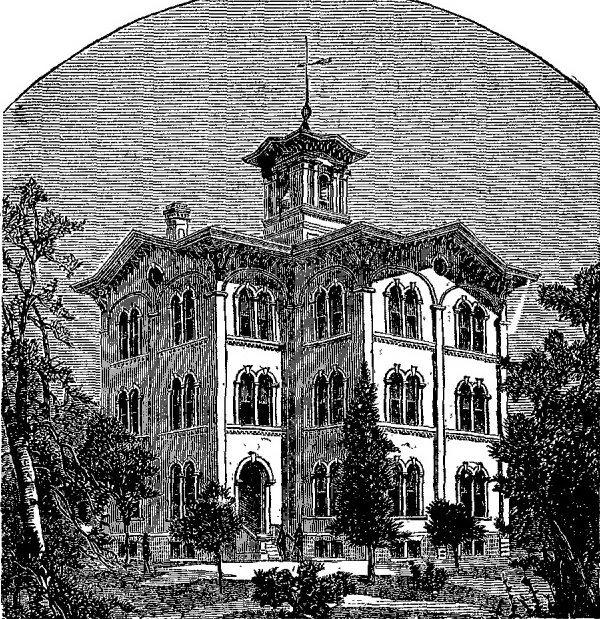
BATTLE CREEK COLLEGE.
This institution, since its establishment in 1874, has gained an enviable reputation, and in many respects its success has been unparalleled in the history of colleges during the first years of their existence. NEARLY FIVE HUNDRED STUDENTS ENROLLED EACH YEAR.
It is Thoroughly Practical in Its Methods of Instruction and Discipline.
In the various departments young men and women are receiving just what they need as a preparation for the positions in life which they intend to occupy.
THE COLLEGE BUILDING IS NEW, SPACIOUS, AND BEAUTIFUL.
Five Departments of Instruction are open to receive students:— 1. Department of the Arts and Sciences. 2. Normal Department, with its Model School, and Course of Four Years. This includes all the Common Branches. 3. Biblical Department. 4. Commercial Department. 5. Department of Hygiene, with a Course of One Year.
For full Descriptive Catalogue, address,
BATTLE CREEK COLLEGE, Battle Creek, Mich.
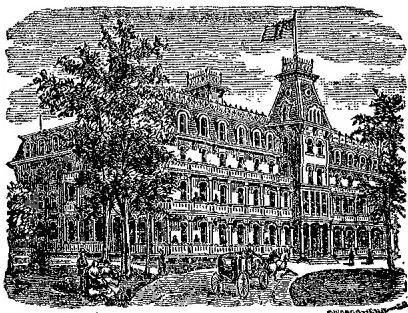
MEDICAL AND SURGICAL SANITARIUM, Battle Creek, Michigan.
By John Harvey Kellogg
This institution, beautifully located in one of the most healthful cities of Michigan, is everywhere recognized as the
GREAT SANITARIUM OF THE WEST.
More than 4,000 patients successfully treated. The erection of new buildings and the addition of all the most approved remedial appliances known to the profession, have made it The Most Complete Institution of the Kind in America. All modern hotel conveniences furnished. Terms very reasonable.