The Youth’s Instructor, Vol. 31, No. 31.

DAY BY DAY

The Youth’s Instructor

Aug 1, 1883

S. D. A. Publishing Association · Battle Creek, Mich. · Aug 1, 1883

DAY BY DAY.

What was a grand commendation of Caleb when God said that he should be permitted to enter the Promised Land. “He shall see it, and to him will I give the land that he hath trodden upon, and to his children, because he hath wholly followed the Lord.” That sentence describes a character worth having.
We like whole-heartedness in anything. When a boy plays, we think the more of him if he plays all over. When a girl entertains her friends, we are glad to see her thoroughly interested to make them happy. When children are studying, we want them to be absorbed in their work. One who is half-hearted in what he undertakes will almost surely fail of success. But now if whole-heartedness is needed anywhere, it is in the Christian life. A Christian who is only half a Christian—that does not sound well, does it?
Of course if we are only half Christians, we do not like to admit it to ourselves. But we know, down at the bottom of our hearts, that such is the fact. We try to make excuses for ourselves, or, by promises for the future, to cover up the real truth of the case. So I think one of the first things for us to settle—and it is just as important for a young Christian as for any other—is whether we are content with a half-way kind of piety, or whether we want to be imitators of Caleb, and “wholly follow the Lord.”
But you say that this is too hard for you. You say that it is a very different thing for a good man far back in those old Bible times to live such a life as Caleb did, and for a young person like you to be so devoted. And yet Caleb had our human nature; he was no different in that respect from any man of the present day. It was no easier then than now, not a bit, to do God’s will. But we read of Caleb that he “wholly followed the Lord.” If it was possible for him, it is possible for you.
One of the difficulties in the way of our living, such a life as this is, I think, that we try to live too much at once, when the fact is, that we can live only one minute, or one duty, at a time. You can strike a medal or a coin with a single blow of the die, and then you have the thing complete! But when you want to make a silver vase with clustered flowers and trailing vines worked in the metal, it must be done stroke by stroke, and line by line. So it is with our lives. We have the pattern before us,—the perfect example of the Lord Jesus Christ. But day by day we must strive toward that pattern.
Now suppose we set it before ourselves to be like Caleb, and “wholly follow the Lord.” In the first place, we must ask divine strength, and must always depend upon that. Then our true way is to think each day: This day I am to try to do everything just as God wants it to be done. It is no matter about to-morrow; that is not here. I am to try to follow the Lord to-day wholly. Certainly, if we get the strength we can have for the asking, we shall succeed thus day by day. In that way our life will be like Caleb’s,—a good life, because a Christlike life,—a life that in following him day by day, wholly follows him.—Child’s Paper.

LITTLE SETMA.

One day, more than two hundred years ago, an elderly woman and a young girl were on their way from Weilerstadt to Stuttgart. They were in haste. They would have rejoiced to have had wings, for once at least, and to have flown as the birds fly. But they were obliged to walk slowly and in fear, looking this way and that. The young girl was in peasant dress—clothes to which she was evidently not accustomed. She seemed, moreover, to find the exertion of walking very tiresome. Suddenly, with a cry of terror, she clung to her companion, whispering, “Look! he comes! One of my master’s guards! He will seize me and carry me back.”
The two turned, in their fright, into a by-path, and the horseman dashed on without noticing them.
“God kept him from seeing us,” said the girl reverently. “Yesterday I read in your prophets, ‘He is wonderful in counsel and excellent in working.’” As yet she was not accustomed to the delightful truth that the Bible belonged to her as really as to her older friend. In that moment of terror it happened to her as it sometimes does to those who are drowning,—the whole of her life seemed to come back to her. She saw herself a child again, the daughter of a Turkish merchant in the city of Belgrade. She was dressed in the robes of a rich Turkish maiden, and surrounded by slaves whose business it was to wait upon her. There was little variety in her life from day to day. There were but few things to give her pleasure—nothing really that she cared much for, except the love of a little playmate.
But this picture passed quickly. There came another scene, in which she was older. Meanwhile, her father had died, believing in the false prophet Mohammed, and crying, “Allah Akbar!” (“God is great”).
Setma remembered that then her brother became master of the house and of the family treasures, and that he had the right to tell her just what she must do, even in so great a matter as her marriage. He chose a man for her husband whom she had never seen, and fixed the day for the wedding, which, however, he said should not take place till he had made a certain journey. While the brother was away, a war arose between the Turks and the Germans. The city was besieged; the Germans succeeded in getting into it; many persons were killed in the streets, or seized and carried away to be slaves. Among the latter was Setma. She was captured by a general, who gave her to his wife.
Poor Setma wrung her hands and cried with terror at the thought of falling into the hands of Christians. She would rather have been murdered in the streets. She had never heard of the Bible; she knew only about the Koran, the holy book of the Mohammedans, and about Mohammed, whom the Turks believed to be the prophet of God. She had heard prayer called the “key of Paradise,” and she knew well the sound of “the call to prayer,” as it was chanted from the minarets of the mosques five times in every twenty-four hours.
Setma believed that the most holy act was for one to make a pilgrimage to Mecca, the birthplace of Mohammed. If a man took this journey and performed all the ceremonies, he was sure, it was supposed, of a home in heaven. She had seen her father leave home, with a caravan, on this pilgrimage, and the remembrance of this pilgrimage helped him to die in peace.
Poor Setma believed all that was taught by her religion, and regarded falling into the hands of Christians as a terrible misfortune. At first she had reason to think so. Her master and mistress did not deserve the name of Christian; no Turk could have been more cruel than was her mistress. But God was guiding her, as indeed it is sweet to believe that he is doing with each of us. We do not forget those words of Jesus about the sparrows. We know that we are more precious in God’s sight than many sparrows.
Just when Setma’s troubles seemed more grievous than she could bear, she came for a time into the family of her master’s brother. There was a good Christian man in the family, who was kind and thoughtful; anxious that all should know and love God. Perhaps he did not understand who Setma was. She, however, watched him, heard his kind words, saw his good deeds, and learned that he prayed to God without believing in Mohammed. She heard him talk about the Lord Jesus Christ, the Saviour.
All this was new to her. The light came into her mind slowly, as the sunlight follows the dawn. She was glad to believe in Jesus. At length, after months of suffering, she was full of delight and gratitude that she, a little Turkish maiden, had fallen into the hands of Christians.
Her troubles were not over, however. Her mistress was a drunkard, and abused her as much as ever. One day Setma found a way to escape. She put on the peasant dress, and began the journey from Weilerstadt to Stuttgart in the company of a woman who had felt very pitiful toward her. It was a long distance for Setma to walk, especially as she had spent much of her life shut up in her own home. But she would have made the effort had the journey been ten times as long.
It is just here that we meet her, and see her pass safely through one danger. The horseman did not even look toward them, little knowing that just in his way was the young girl for whom his master was searching. As Setma said, God saved her.
When she got to Stuttgart, she was frightened by the rough guards. Finding from her accent that she was a foreigner, they teased her with many questions, till a good peasant-woman, passing at the moment, took her home and made her rest two days, and then found the friends for whom Setma was inquiring. Afterward she became maid of honor in the household of the princess Magdalena Sibylla, a good Christian woman, and lived at court many years. At her baptism, Setma gave up her Turkish name, and received that of Christina Magdalena Eberhardina, to which was afterward added the name of Gottlieben. In the days of her prosperity she was liberal in her charities to the poor and sick, and consoled many of the dying by her ministrations.
God says: “I will bring the blind by a way that they know not; I will lead them in paths that they have not known; I will make darkness light before them, and crooked things straight. These things will I do unto them, and not forsake them.” Isa. 42: 16.—Meade Middleton.

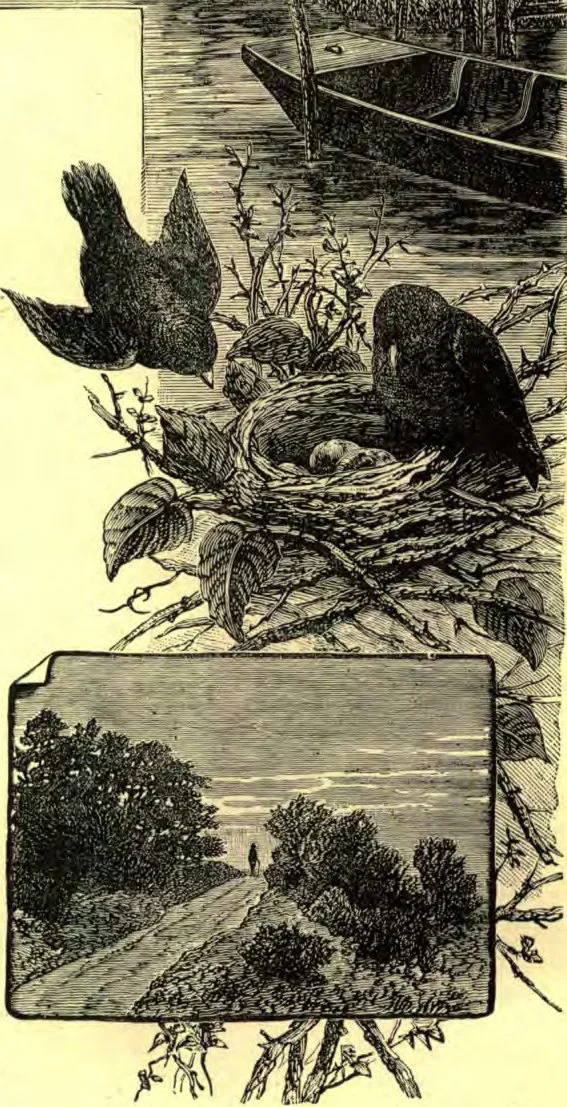
THE WREN'S NEST.

It was a wee bit housie, But shaped with deftest care, Of twisted twigs, a feather or two, A scrap of cloth of doubtful hue, And a bit of tangled hair.
And the merry little artist, Who twittered overhead, Viewed her work with happy pride, Fluttering about from side to side Around the pretty bed,
Which held a tender promise Of something fair to be; And she poured a song, The whole day long, Over the pale eggs three.
Never a fear of the morrow Clouded her hope so glad; Never a doubt in the little brown breast, As she gaily trimmed the dainty nest With such things as she had.
Oh! happy little warbler, In thy blithe note is blent A song of trust from day to day, And I learn of thee, as I go my way, A lesson of sweet content.
— Lucy Randolph Fleming.

SHUN THE FIRST SIN.

The first sin is usually a little sin; but in that first sin lies all the danger. The little thief put in at the window, opens the way for the big thief to march in at the door. He who never commits a little sin, will never be guilty of a great sin. He who indulges in little sins, is most certain, finally, to be guilty of great ones.
A post-office clerk was arrested in a Western city for stealing packets of money which daily came into his hands. When he confessed his crime, he stated that it was with great hesitation and reluctance that he opened the first letter in search of money; but after this act had been performed, he could hardly allow a money-letter to pass through his hands without searching it. His experience soon enabled him to judge as to the probable contents of letters, and although pressed by no necessity, yet he was hardly able to keep his hands from opening a letter which he supposed contained money. From little sins, he went on to great ones, until at length he reaped his reward in detection, disgrace, and punishment.
Those who do not wish to travel to the end of the devil's road, would better not enter it at all. Once on the way, it is very hard work to stop. Sins of thought end in sins of action; and those which seem innocent at first, grow to be great and terrible monsters. He who commences a life of sin is in danger. His sins may seem little, and harmless; and so lions, and tigers, and serpents, are little at first, but small as they are, they grow most rapidly; and soon little sins grow into hideous and giant forms, which ruin and destroy all around them.—Selected.

THE WATER-SPIDER.

The water-spider is a curious and interesting insect. It leads a strange life. Though really belonging to the earth, and needing to breathe the air, it passes nearly the whole of its time in the water. Several other spiders sometimes go under the water, sustaining life by means of the air which is entangled in the hairs clothing the body. Their submerged life is, however, only accidental, while with the water-spider it is a constant habit.
The body of the water-spider is lavishly covered with hairs, which serve to entangle a large amount of air, but it has other powers which are not possessed by any other species. It can dive below the surface, carrying with it a very large bubble of air which is held in place by the hind legs; and in spite of this obstacle to its progress, the spider can pass through the water with great speed.
But the strangest thing about this creature is, that it actually lives under water for a considerable time before it ever sees the land. At some depth below the water, the mother spider spins a dome-shaped cell, or nest, with the opening downward. Having made this, she ascends to the surface, and there charges her whole body with air, arranging her hind legs in such a manner that this bubble cannot escape. She then dives into the water, and, going to her nest, discharges the bubble into it. A quantity of water is in this way displaced, and the upper part of the cell is filled with air. She then returns for a second supply, and so proceeds, until the nest is full of air. In this curious house the spider lives, and is able to deposit and to hatch her eggs under the water even without wetting them. And strange to say, the spider itself is never wet; and though it may be seen swimming rapidly about in the water, yet the moment it comes out on the land, its hairy body will be found as dry as that of any land-spider. The reason of this is that the minute bubbles of air which always cling to the furred body repel the water, and prevent it from wetting the skin. The eggs of this spider are enclosed in a cup-shaped cocoon, like a circular vegetable dish. This cocoon is said to contain about one hundred eggs.
The movements of this interesting little creature may be watched by placing one in a dish nearly filled with water. If possible, some water-plant should be placed in the vessel. Here the spider will soon construct its house, and exhibit its curious habits. It must be well supplied with flies and other insects thrown into the water. It will pounce on them, carry them to its house, and there take its meal.
Disgusting and unsocial as spiders are generally thought to be, they are capable of being tamed. Pelisson, a prisoner in the noted French prison of the Bastile, had a pet spider which came regularly, at the sound of a musical instrument, to get its meal of flies. A spider-raiser in France is said to have tamed eight hundred, which he kept in a single apartment for their silk.
According to a celebrated German naturalist, it takes 4,000,000 of the extremely delicate threads of a spider's web to make a filament as large as a human hair, and each thread of the spider, as used in the web, is made up of thousands of smaller ones.
Some men have even been saved from death by the spider. When pursued by his enemies, Mohammed once took refuge in a cave, and a spider spun its web across the entrance. His pursuers, coming along a few hours later, and seeing it, thought of course no one could have gone into the cave without breaking the web; and so they passed on. Thus we see that even the smallest of God's creatures are sometimes instruments for accomplishing wonderful things. M. E. G.

NEW-TESTAMENT HISTORY.

LESSON 146.—PAUL AT ICONIUM, LYSTRA, AND DERBE.

When Paul and Barnabas were driven from Antioch, they shook off the dust of their feet, thus fulfilling the instruction of our Lord to his disciples, as found in Matt. 10:14; Mark 6:11; Luke 9:5; 10:11. They traveled in a south-easterly direction, and stopped at Iconium, an important city of Lycaonia, and situated nearly a hundred miles from Antioch. In Iconium, as in all the chief cities of Asia Minor, there were many Jews, who worshiped in their synagogues every Sabbath. So, by going into the synagogue, Paul and Barnabas gained an opportunity of speaking to the people, or to the Jews at least. Here they taught that Jesus was the Christ, and that through him alone can men be saved. They must have had other listeners besides the Jews; for the Sacred Record says that a great multitude both of the Jews and also of the Greeks believed.
Here, as elsewhere, the unbelieving Jews were the worst enemies the apostles had to meet. They not only opposed publicly, but in private stirred up the minds of the Gentiles, and set them against the truth, and all who believed it. But the apostles remained here a long time, speaking the word of God with boldness, and proving the truth of their doctrine by many miraculous signs and wonders, which the Lord graciously granted them power to perform. The people of the city were divided, some taking part with the apostles, and others against them. The opposition finally became so violent that plans were laid for stoning Paul and Barnabas; but they, having learned of their danger, fled from Iconium, and taught in Lystra, in Derbe, and in other parts of Lycaonia.
While they were preaching in Lystra, a man sat listening, who had been a cripple from his birth, having never walked. To him Paul’s attention was directed, doubtless by the Spirit of God; and perceiving that the man had faith to be healed, Paul cried with a loud voice, “Stand upright on thy feet.” Immediately the man leaped upon his feet, and walked. The people were astonished at this miracle, and cried out in the speech of Lycaonia, “The gods are come down to us in the likeness of men.” They thought that Barnabas represented the god Jupiter, and that Paul was the impersonation of Mercury, since he was the chief speaker, and, according to their false religion, the god Mercury was very eloquent.
Now there was before the city a temple dedicated to the worship of Jupiter; and when the priest of that temple heard that the gods had come down among them, he brought oxen and garlands to offer sacrifice, and join with the people in worshiping the apostles. As soon as Paul and Barnabas learned of this, they were greatly distressed, and running in among the people, cried out, “Sirs, why do ye these things? We also are men of like passions with you, and preach unto you that ye should turn from these vanities unto the living God, which made heaven, and earth, and the sea, and all things that are therein: who in times past suffered all nations to walk in their own ways. Nevertheless he left not himself without witness, in that he did good, and gave us rain from heaven, and fruitful seasons, filling our hearts with food and gladness.”
The utmost efforts of the apostles could scarcely prevent the Lystrians from worshiping them: but no sooner had certain wicked Jews come to them from Antioch and Iconium than they were persuaded to join in stoning Paul until he was supposed to be dead, and was dragged out of the city. As some of the faithful disciples were standing, as they thought, around the dead body of their beloved teacher, he rose up, and went back with them into the city.
On the next day after being stoned, Paul took Barnabas, and went to Derbe, where they faithfully preached the gospel to the people of that city. So far as we know, they met with no persecution here; and after fulfilling their mission, they retraced their steps, visiting Lystra, Iconium, and Antioch, and strengthening the churches they had established at these places. Luke says that they confirmed the souls of the disciples, exhorted them to continue in the faith, and taught them that through much tribulation we must enter the kingdom of God. When they had ordained elders in every church, and had prayed and fasted with the brethren, they commended them to the Lord on whom they believed.
The apostles then continued their journey homeward, through Pisidia and Pamphylia, to Perga. After preaching in this place, they went to Attalia, a seaport town a few miles west of Perga. On leaving Attalia they sailed to Antioch in Syria, the place from which they had been sent out by the command of the Spirit of God, and with the prayers and benedictions of their brethren. When the church had come together, Paul and Barnabas related all that God had done with them, and how he had opened the way of salvation to the Gentiles.

QUESTIONS.

  1. When Paul and Barnabas were driven from Antioch, by what sign did they bear witness against the unbelieving people of that city? Acts 13:51.
  2. On what occasion had our Lord instructed his disciples to do in this manner?
  3. Which way did Paul and Barnabas travel on leaving Antioch?
  4. At what city did they next stop to labor?
  5. How far is this city from Antioch in Pisidia?
  6. How did the apostles first gain an opportunity to speak to the people? Acts 14:1.
  7. How do we know that they must have had other listeners besides the Jews?
  8. Who were the worst enemies they had to meet?
  9. How did these Jews oppose them in this place?
  10. How long did the apostles remain at Iconium?
  11. How did they prove that they were sent of God?
  12. What position did the people of this city take?
  13. How violent did the opposition become?
  14. How did they escape the danger that threatened them?
  15. To whom was Paul’s attention directed, as he was preaching at Lystra?
  16. Describe the miracle performed upon this man?
  17. How were the people affected by what they saw?
  18. What did they say?
  19. Whom did they think Barnabas represented?
  20. Why did they take Paul to be the impersonation of Mercury?
  21. What temple stood before the city?
  22. What was done by the priest of this temple?
  23. How were Paul and Barnabas affected when they heard of this?
  24. What did they do?
  25. How did Paul expostulate with them?
  26. What did he say to them about the living God?
  27. What witness of his divinity has God at all times given?
  28. How did these Lystrians manifest their fickleness?
  29. How were the faithful disciples surprised, while standing, as they supposed, around the dead body of Paul?
  30. What did Paul do on the next day?
  31. How were the apostles received at Derbe?
  32. Where did they go after fulfilling their mission at this place?
  33. What does Luke say about the good work that they did for the disciples?
  34. How did they organize the churches they had established?
  35. How did they part with the brethren in these places?
  36. Whither did they then continue their journey?
  37. To what place did they go after preaching in Perga?
  38. Whither did they sail from this latter place?
  39. What did Paul and Barnabas relate to the assembled church at Antioch?

NOTES.

Acts 13:51. Came to Iconium. A considerable city of Asia Minor, generally considered as belonging to Lycaonia. It lay in a fertile plain at the foot of Tarsus, on the great line of communication between Ephesus and the more eastern cities of Tarsus and Antioch, and the Euphrates. Under the Byzantine emperors it was the metropolis of Lycaonia, was subsequently captured by the Turks, and made the capital of an empire whose sovereigns took the title of Sultans of Iconium. During this period of its history it acquired its greatest celebrity. It is now called Koniyeh, and has a population variously estimated at from twenty to thirty thousand.—Abbott.
Chap. 14:6. Lystra. A small town thirty or forty miles south of Iconium. The site of Lystra has never been made out with perfect certainty, but there is good reason to believe that it was at a place now known as Bin Bir Kilisseh or the Thousand and One Churches, once the see of a bishop, and crowded with the ruins of sacred buildings. It lies in the northern hollows of the huge isolated mass of an extinct volcano, “rising like a giant from a plain, level as the sea.” It is called the Kara Dagh, or Black Mountain, and is still the haunt of dangerous robbers.—Farrar. Derbe. Little or nothing is known of this city. Its very ruins are only identified with doubt, but it was probably about twenty miles southeast of Lystra. Paul made at least one friend here, Gaius of Derbe. Chap. 20:4. Lycaonia. The district of Lycaonia extends from the ridges of Mount Tarsus and the borders of Cilicia on the south to the Cappadocian hills on the north. It is a bare and dreary region, unwatered by streams, though in parts liable to occasional inundations. Strabo mentions one place where water was even sold for money. Of the whole district, Iconium was properly the capital; and the plain around Iconium may be reckoned as its great central space, situated midway between Cilicia and Cappadocia. This plain is spoken of as the largest in Asia Minor.—Conybeare and Howson.
Ver. 12. They called Barnabas, Jupiter; and Paul, Mercury. Jupiter (or Zeus) was the greatest of the classical deities, the “father of gods and men.” Mercury (or Hermes) was the god of eloquence, and regarded as “the messenger of the gods.” The poet Ovid preserves a legend that Jupiter at one time assumed human form, and visited these very regions, attended by Mercury; which accounts for Paul and Barnabas being taken for them. Barnabas was probably older than Paul, and perhaps of more commanding mien (see 2 Cor. 10:10), and would therefore look more like the superior deity; while Paul, as “the chief speaker,” would naturally be identified with the god of eloquence.—Stock.
Ver. 13. Brought oxen and garlands. These garlands were to crown the oxen about to be sacrificed. Such floral crowns were also worn by those sacrificing. They were composed of the various plants and flowers sacred to the gods to whom the sacrifice was offered.—Rev. Com.
Ver. 22. Through much tribulation. Tribulation is derived from the Latin “tribulum,” which was the threshing instrument or roller whereby the Roman husbandman separated the corn from the husks. “Tribulation” is the act of this separation, and hence is used for sorrow and adversity, the appointed means for the separating in men of their chaff from their wheat, of whatever in them is light and trivial and poor, from the solid and true. Therefore, these sorrows are called tribulations, “threshings,” i. e., of the inner spiritual man, without which there could be no fitting him for the heavenly garner.—Trench’s Study of Words.
Ver. 25. Preached the word in Perga. Which they could not do when they passed through it before on their way inland, probably because the inhabitants were leaving it for their summer exodus to the mountains.—Peloubet. Went down into Attalia. About sixteen miles southwest of Perga, on the coast of Pamphylia, at the mouth of the River Catarrhactes. It was named after its founder, Attalus Philadelphus, king of Pergamus.—Cook. Attalia was famous in the story of the Crusades, under the name of Sataleia, as the port whence King Louis of France, after his disastrous march through Anatolia, embarked with his knights and nobles for Antioch, leaving the plebeian crowd of infantry to perish at the foot of the Pamphylian hills, A. D. 1148. It is now called Adalia, and is a harbor much frequented.—Schaff. It now contains almost 8,000 inhabitants. There is no record of any work done there, and they probably only went to it as the port where they were most likely to find a sailing vessel that would take them to Antioch.—Plumptre.

LOOK PLEASANT.

Did you ever notice a bed of pansies in a dry time, how their leaves are all curled up, and what queer little faces they make, some cross and worried, and some fierce?
They are not to blame, to be sure, for losing their smiling faces. Somebody neglected to give them a drink of water, and that is the only way they have to let it be known that they are “just dying for a drink,” as you sometimes say.
But what shall be said of girls and boys who allow a great deep scowl to come between their eyes, or who go about with seven wrinkles crosswise of their foreheads, or who wear lips stuck out as if they were displeased about something?
“What a cross, disagreeable-looking child that is,” a lady said of a little girl in a school which we visited. It made me feel bad to hear it, because I knew she was not cross, nor unpleasant, and that she was trying to live as a little Christian should; but when I looked at her again, I did not wonder at the remark. She was busily working out an example in her arithmetic which puzzled her somewhat, and she had a great scowl on her face. I knew it was only there because she was so intent on her work. Another lady saw her in church, and asked, “What makes that little girl look as if she had lost all her friends? such a sour, gloomy look as she wears!”
“Why do you look so cross, Nettie?” I asked her one day.
“Do I look cross?” she said, as a bright smile quickly beamed from her face; “I don’t feel cross.”
“Oh,” I thought, “what a sunbeam you could be if you always looked like that!”
You see that tyrant Habit had gotten hold of her, and so when she was simply earnest, or perplexed, or thoughtful, she looked like a little fury.
A funny little boy, who could not yet talk quite plain, one day watched his grandmother while she read the newspaper. I suppose she began when she was quite a little girl to scowl up her forehead over her lessons, so when she was old, she had those deep frowns between her eyes that I have been telling you about. She was a dear grandma, and kind to everybody, but the frowns were there because she did not drive them away years ago. Robbie looked at her a few minutes, then he put up his little chubby hand and smoothed her forehead, and said, “Grandma, please do not growl so.” That was as near as he got to “scowl,” which he had been told he must not do.
Well, is it not a good word to use? for it often is one way of “growling.”
I heard one little girl, whose forehead was all scowled up, say that she couldn’t help it if it was. Another one said, “It does not make any difference how you look, if you only behave.”
But, my children, don’t you know that it is the duty of every Christian man, woman, or little child, to wear a pleasant face! If your faces are all scowled and wrinkled up like those thirsty pansies, does it not show that you want something that you have not; that you are not satisfied with what the heavenly Father has given you?—The Pansy.

THE CANOE OF THE WATER MOTH.

The gnat builds an egg boat, in which to sail about. The water moth, another little creature, puts together a real canoe. It is a very curious thing, made of bits of straw and reeds all matted together. It is just the shape of the caterpillar that lives in it. The insect breathes with gills just like a fish, and yet cannot swim.
So he fastens this straw and grass together, winding them all around with his own silk. The body of the caterpillar is soft and delicate, you know, and might get hurt if it was left exposed. This is the reason why he covers it so carefully, all but his head. This funny sort of canoe is open at both ends. It is so fixed that when the grub is tired of sailing, he can sink down upon the sand. Reaching out of the upper end, are his six little feet, with which he drags his small boat after him whenever he wants to get his dinner or put up for the night. After several days, he not only creeps out of this strange house, but out of his skin, at the same time taking on moth wings.
Many people call these queer creatures “caddis worms.” If you hunt for them with your young eyes, you can find these little nests of stone and gravel and leaves, made by the grubs, though they are very small. They seem to have great taste in fixing them. You should see the houses they make of fresh leaves, curiously put together. They hang from their shoulders like so many wings. They are even more like a bud just ready to open.
These pretty cases of leaves are glued together, leaving an opening at its top just large enough for the little creatures to put out their head and shoulders when they want to look about for food; others of the same species cut pieces of reed or wood into lengths, or strips, and join them together as they go on with their work. They use a certain kind of cement, which is better able to stand water than any ever made by man. And they often finish up the whole by putting a broad piece, longer than all the rest, overhead, to shade the doorway, so that no one shall see them work. Some of these funny grubs break off bits of the stems of rushes, which, you know, grow in the water, and weave them into a sort of round ball. Then they hang them together on the stem of some other water plant, making a little cell in the middle to live in. Some use tiny shells even, with snails or other animals alive in them. They keep these poor things just as if they were in prison, and drag them all about with them.—Our Little Ones.

Letter Budget.

INA R. HOONER writes from Alpha, Arkansas. She says: “I have never seen any letters from Arkansas; so I thought I would write. There are no Sabbath-keepers in this part of the State. We take the INSTRUCTOR, and have Sabbath-school at home. I would like very much to go to a good Sabbath-school. We have kept the Sabbath seven years. I want to meet Jesus when he comes.”
WARREN MATHEWSON, of Fergus, Mich., says: “I am eleven years old. We have two and a half miles to go to Sabbath-school, and we all love to go. I have read the Bible nearly through, and the Spirit of Prophecy Nos. 1, 2, and 3, and Early Writings. I read the INSTRUCTOR every week. I go to school, but it is vacation now.”
CORA JOHNSON writes from Lebanon, Kan. She says: “I am nine years old. I have a father and mother and one brother. I go to Sabbath school, and study in book No. 2. Our day-school has closed, and the last day I got the prize for spelling. This is my first letter to the INSTRUCTOR. I am trying to live so that I can meet the INSTRUCTOR family in the new earth.”
ANNA MORTON, Paralta, Iowa, says, “I have written for the Budget twice before, but did not see my letters in print. I am eleven years old. We all keep the Sabbath, but do not go to Sabbath-school because it is so far away. Our day-school was out last Friday. I am reading the Testament through. I take the INSTRUCTOR, and like to read it very much. I went to camp-meeting at Des Moines. I want to be a good girl, so that I may meet the INSTRUCTOR family in heaven.”
Continue reading: PROGRESSIVE SERIES OF BIBLE LESSONS