THE apostle Paul enumerates eighteen sins that would exist in the last days among a certain class, who, while “having a form of godliness,” in their lives deny the power thereof. This class he describes as being “without natural affection.” 2 Tim. 3:3. By natural affection reference is made to what we would expect to see manifest in the family and among kindred. Even in the animal kingdom there is that fondness of the parents for their offspring that leads them to risk even their own lives for the protection of their young. Surely this devotion and tenderness ought to be more fully manifested among reasoning, intelligent beings.
When the family relation was instituted by the Lord in the garden of Eden, he said, “Therefore shall a man leave his father and his mother, and shall cleave unto his wife: and they shall be one flesh.” Gen. 2:24. In our Saviour’s instruction, as he quoted these words, he added, “Wherefore they are no more twain, but one flesh. What therefore God hath joined together, let not man put asunder.” Matt. 19:6.
The apostle, speaking of this same relation, said, “Husbands, love your wives, even as Christ also loved the church, and gave himself for it. . . . So ought men to love their wives as their own bodies. He that loveth his wife loveth himself. For no man ever yet hated his own flesh; but nourisheth and cherisheth it, even as the Lord the church.” Eph. 5:25-29. On the other hand, he writes, “Wives, submit yourselves unto your own husbands, as unto the Lord. For the husband is the head of the wife, even as Christ is head of the church: and he is the savior of the body.” Eph. 5:22, 23.
When the husband realizes that on him so largely rests the preservation of the union in the family, much dissension and difference can be avoided. In the words of another, “Every member of the family centers in the father. His name, ‘house-band,’ is the true definition of husband. He is the lawmaker, illustrating in his own manly bearing the sterner virtues,—energy, integrity, honesty, and practical usefulness. The father is in one sense the priest of the household, laying upon the altar of God the morning and evening sacrifice, while the wife and children unite in prayer and praise. With such a household Jesus will tarry.”
Speaking of the harmony that should exist in the household, the apostle says still further: “Husbands, love your wives, and be not bitter against them. Children, obey your parents in all things: for this is well pleasing unto the Lord. Fathers, provoke not your children to anger, lest they be discouraged.” Col. 3:19-21.
In the world, with the masses, little regard is given to these Scriptural injunctions, while self-love and self-gratification seem to be the ruling motive and power in their lives. With those professing godliness there surely should be a recognition of the sacredness of the family relation, and an earnest heeding of the Lord’s instruction concerning the same. But, alas! there are altogether too many instances of transgression, even as the apostle intimated, among those “having a form of godliness.”
Looking at things as they exist in the world to-day, we see that there has been in the past half century a very rapid increase in that which the apostle said would be seen “in the last days.” Until the writer was eighteen years of age, he never heard of but one divorce in the county where he resided in central New York. In that case a man deserted his wife, an estimable woman, and lived in another State for one year, that desertion might be proved against him. His course was the topic of conversation among the people for many months, and it was looked upon as a heinous offense.
As an evidence of the great change in this line of immorality we will quote a statement made in the San Francisco Chronicle of Sept. 25, 1889, a communication concerning what happened in the city of Chicago the day before. It reads as follows:—
“CHICAGO, September 24.—This city has to-day, it is asserted, broken the record in divorce cases; from morning until evening five judges were at work, and over one hundred cases were disposed of. Over two hundred persons, martyrs to wedlock, wanted their matrimonial existence judicially murdered, and over four or five hundred sympathizing friends were on hand to witness the executions. It was the biggest day’s work the divorce mills have had in a long time. Marriage knots were shattered with more than usual celerity in the Chicago divorce courts, and for every possible reason. One of the gray-haired judges, after the adjournment of the court, shook his head and said that something surely was wrong these days. He did not know what the world was coming to.”
Since the days of that article, judging from the multitudinous daily reports of divorces, we must conclude that this shattering of marriage ties is still on the increase. Noting the glibness with which this work is carried on, and reported, one would conclude that men thought they had received a commission to “put asunder” what the Lord had said “let not man put asunder.”
Not only is the lack of “natural affection” manifest in the increasing number of divorces, but in the bitterness, and even enmity, between parents and children. This is seen in the neglect of parents to care properly for their children, and in the children’s leaving aged and feeble parents to suffer for lack of support, or “go over the hill to the poorhouse.” The Lord has given in his Word instruction, which, if heeded, would materially remedy this difficulty. “Harken,” he says, “unto thy father that begat thee, and despise not thy mother when she is old.” Prov. 23:22. It is certainly a lovely sight to see a child, though grown to manhood or womanhood, tenderly caring for the aged, feeble parents, even though they be in their dotage and second childhood. Who does not think with pleasure on the act of President Garfield, who, on the day of his inauguration as president of the United States, requested that his aged mother be placed near him, to share with him the honors bestowed upon him? To her his first attention was directed as the one to whom credit was due for the training she had given him, which brought him to the highest position in the nation.
Very different from this is a case which occurred in my ministry, when by request I was visiting a family professing godliness (not Seventh-day Adventists, however). In the corner by the fireplace I saw a very aged woman13eating her morsel as best she could from a tin plate, while we were eating at the table. True, she was childish with age, and was spoken of by the family as “that old woman.” But what was my astonishment to learn afterward that “that old woman” was the grandmother of the family whose hospitality I had shared.
Not long after this occurred, I read of a case, in a secular paper, where an aged father’s food was given to him by the wife of his son, in a wooden bowl, in the chimney-corner, while the family ate at the table. The report read that the little son was observed one day to be very busy with his jack-knife and tools, trying to form a little trough. When asked what he was making, he replied, “I am making a dish for my father to eat out of when he gets old like grandpa.” Suffice it to say there was a sudden change in that family toward the aged grandfather. It may be the words of the Saviour occurred to them, “With what measure ye mete, it shall be measured to you again.” Matt. 7:2.
While those of the world are full of bickering, strife, and family jars, and are wronging the aged and needy, surely the church of Christ should be free from these sins. Those having the leadership of the church should teach the doctrine of the apostle, “If any provide not for his own, and specially for those of his own house, he hath denied the faith, and is worse than an infidel.” 1 Tim. 5:8.
Those who profess to be preparing to go to “heaven above, where all is love,” should seek to have their homes here “a little heaven on earth” in which they are preparing to go to the heaven of eternal bliss. The words of the apostle Peter should be carefully considered and heeded: “Likewise, ye husbands, dwell with them according to knowledge, giving honor unto the wife, as unto the weaker vessel, and as being heirs together of the grace of life.” 1 Peter 3:7.
Mountain View, Cal.
The New Zealand Maoris
By R. HARE
R. HARE
NEW ZEALAND was discovered in 1642, by Tasman, the Dutch navigator. It was surveyed by Captain Cook in 1769, and the first settlement of Europeans was established there in 1814. For a time the country remained a dependency of New South Wales, but in 1841 it became a separate colony.
New Zealand consists of three islands, known respectively as North Island, South Island, and Stewart’s Island. The islands lie north and south, and form a long, narrow, irregular portion of land. Its three divisions are separated by two straits, one eighteen and the other fifteen miles across. In length the islands measure over one thousand miles, while in breadth they measure about two hundred and fifty miles. The climate of the North Island is mild and warm, but in the South Island snow and ice are frequent.
MAORI WOMAN AND CHILD
The New Zealand natives—a dark race called Maoris—are a strong, hardy people, well developed and muscular; and had it not been for the white man’s curse, they might still have remained an undiminished nation. At the time of the European settlement in 1814, the natives numbered one hundred thousand. They were then divided into eighteen nations, and these were divided into many tribes. The natives were thus almost constantly at war; for this seemed the only way they could maintain their territory, or avenge their wrongs. Nearly all the tribes were cannibals, it being customary for them to eat the men slain in battle, and also those taken as prisoners.
The Maoris are a branch of the Malayo-Polynesian family. Both their language and appearance indicate that relationship. They are of medium height, their hair is generally coarse and black, while the color of their skin ranges all the way from olive-brown to the negro blackness. A large mouth, dark-brown eyes, broad nose, and tattooed lips are striking features of the native face.
The original diet of the natives consisted of berries, fern roots, animals, birds, fish, and men, wars not infrequently being undertaken that they might secure either the living or the dead of another tribe for food. Their method of cooking was simple, but effective. A hole was made in the ground, over which a fire was built, and on top of the wood a number of large round stones were placed. As the wood burned, the stones heated, and, finally, over them some fern leaves were spread. On these leaves the food was laid, water was sprinkled to produce steam, the whole being covered by other leaves and a thickness of earth. After an hour in the primitive oven, the food would be served in small baskets of flax.
In 1814 the Church Missionary Society of England established a mission at a place called the Bay of Islands. Many of the natives were friendly, and remained loyal to the interests of the missionaries. In 1840 a treaty of peace, known as the Treaty of Waitangi—place of the crying waters—was signed by about fifty chiefs. By it the chiefs ceded to England the sovereignty of the islands of New Zealand.
But peace did not last, for in 1860 an insurrection broke out among the natives. This was due to the unjust treatment the natives received from unprincipled white men, who took away their land. This resulted in a war that lasted until 1866.
One tribe of natives, known as the Hau-Haus, inhabiting the interior of the North Island, have for many years observed the Sabbath. Their religion is a mixture of pagan forms and Christianity, but they still cling to the recognition of the seventh day.
The Maori race have decreased from one hundred thousand to their present standing of forty thousand. They are now rapidly dying. This is, no doubt, largely owing to the evils introduced by white men. About three fourths of14the race profess Christianity. Most of them are adherents of the Catholic Church, and of late the Mormon faith has found many followers among them.
A very pathetic message was recently sent to the premier, Mr. Seddon, from the people of the Wanganui district. The message was sent as an appeal for the continuance of the village scheme. It read thus: “We are dying fast, and want you to show us how to live and work, so that we may not all go down to the grave.”
The natives of New Zealand, like the natives of all other lands, need just the light that the third angel’s message can give. This alone can show the true path to life at this time, and God has entrusted us with the heavy responsibility of giving that message to those who sit in darkness.
God’s last message must gather a people “from every nation, kindred, tongue, and people,” and among the redeemed there will be found some from among the dark sons of New Zealand. A few of them have accepted the message, but the field lies waiting, for the laborers are few. May God give his people courage and faith to carry his message to the dark places of every land.
How Suffering Shapes the Soul
By John White Chadwick
As the insect from the rock
Takes the color of its wing;
As the boulder from the shock
Of the ocean’s rhythmic swing
Makes itself a perfect form,
Learns a calmer front to raise;
As the shell, enameled warm
With the prism’s mystic rays,
Praises wind and wave that make
All its chambers fair and strong;
As the mighty poets take
Grief and pain to build their song —
Even so for every soul,
Whatsoe’er its lot may be,
Building as the heavens roll,
Something large and strong and free.
Things that hurt and things that mar
Shape the man for perfect praise:
Shock and strain and ruin are
Friendlier than the smiling days.
— John White Chadwick.
The Fruit of Success Is Greater Opportunity
THE fruit of success is greater opportunity.— Selected.
News From Haran—2
By Z. G. BAHARIAN
Z. G. BAHARIAN
JANUARY 2 the accusation made against us was returned from Aleppo’s council. We were called up by the judge, and a copy of that accusation was given us. Then we could know definitely what we had been accused of. The following is a brief statement of it:—
“That they have formed a committee law at Constantinople, under the presidency of Zadour Baharian, making an excuse the preaching of Sabbatarian religion, and have correspondence; that though they pretend that they do this correspondence in order to preach the mentioned religion, it has been found that there is in Constantinople a treasury for this purpose, and that Enock, who had been formerly accused for this same preaching, has a salary of two liras from this treasury, which is paid through Zadour Baharian; that there have been found the following important words among the writings arrested and gathered: ‘The wheels of the throne of God are as wheels in wheels;’ and, ‘May God forgive the officers of the government, because they do not know what they do. If they should know that their own life is in the message you are giving, they would set you on throne;’ and ‘my address is again at British post-office;’ and ‘this is a means for the Southern field, but thousands of copies might be sent to the North;’ ‘lately we sent you a letter and some copper;’ ‘there have been gatherings at Lazarus’ house in Samatia, and at Toannis’ house in Scutary;’ ‘I spun the worsted for stockings, and it made two pairs;’ ‘Hadji Nazur Kupelian has been punished with Alexan Buzugherian;’ ‘received the diamond and the tin and the tin flowered;’ ‘their arresting the letter is wrong, because I had put it in the sack. I do not think that they looked for and took it;’ ‘our wound is hearty. This, too, might not be established;’ ‘I met a few good timbers;’ ‘the place where you are has attracted my attention;’ ‘a great light shone to the people who sit in darkness;’ ‘I am sowing seeds in Constantinople. O, would that I had seen the fruits also.’ From their other writings and correspondence through British and French post-offices, while they are Turkish subjects, and their having correspondence with America, it has been proved that they travel pretending to preach the gospel, and create insurrection against the government, and they are guilty, according to the sixty-sixth topic of the law of punishment, and so they must be accused.”
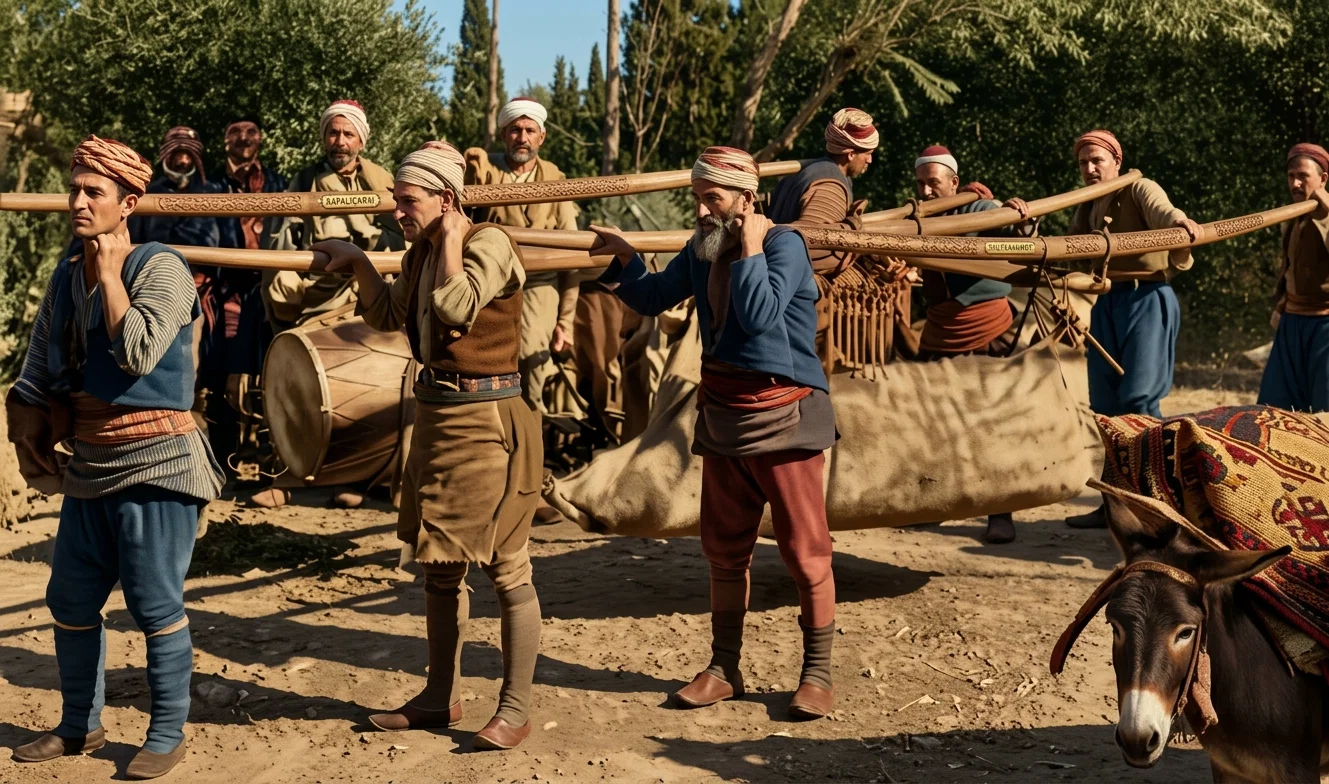
TURKISH CARRIERS, CONSTANTINOPLE
When this was presented to us, five days were given us to protest, if we would, against it to the council of accusation at Constantinople, and to hire a lawyer and prepare for the trial. We did not protest, because it would take at least eight months. We hired a lawyer, and entered into trial, believing that God would overrule in the case.
On January 16 we were called up to the court for the first time. Our case was united with that of Brother E. Aywazian. Time was given the general attorney to accuse us, who read a long accusation, bringing out all the points in the paper of accusation sent from Aleppo, and adding many other points, the chief being that we do not obey the government in preaching our religion. The general attorney took all the time allotted, and our trial was deferred to another day.
One week later we were called up the second time. Many had come to hear our trial. First I was asked to explain the sentence, ‘The wheels of God’s throne are as wheels in wheels.’ I opened my Bible, and read the first chapter of Ezekiel, and told them that the purpose of God in the events of his providence is manifold, as in the case of Joseph. They seemed to be content, seeing that this sentence had been borrowed from the Bible. Brother Alexan was then called to stand, and was questioned as to whom he preached the gospel. He answered that he preached to all. Then he was asked if the Moslems are included in the “all.” “Yes, sir,” he replied. Then he was asked if he preached to Moslems, and what he preached, and if any accepted the gospel. He answered that he had preached to Moslems, and told them that Christ is the Son of God, and only through his name salvation is possible to all; that he had preached to them the law of God, the second coming of Christ, and other truths, but that he was sorry no one had yet accepted the truth.
The president judge asked me also to whom I preached. I opened the Bible to the sixteenth chapter of Mark, and read that we should preach to all nations. I was asked whether Moslems are included in the “all nations.” I answered, “Yes.” These questions were purposely asked, because the general attorney had accused us of preaching to Moslems and creating a tumult. From our answers they learned that the way of salvation to Moslems also is the gospel. This testimony stirred them to anger. They knew what our answer would be. They asked these questions to stir themselves to anger against us. They knew well that we had committed no political crime, but they would have us found guilty before the Turkish religion.
<i>Aintab, Turkey.</i>
First Report From the Hayti Mission
By W. J. TANNER
W. J. TANNER
SEPTEMBER 27, after a brief rest among our relatives in New Jersey and Maryland, we embarked for the West Indies once more, this time to make our field of labor Hayti, rather than Jamaica. The fifth day after leaving New York we spent seven hours at Inagua, one of the Bahama group of islands. Here we left some reading-matter. In these islands something was15done in the way of circulating our literature about ten years ago, by Brother C. F. Parmele. But the work was never followed up, and so far as the writer knows, the truth has no representative there at the present time; yet nearly fifty thousand souls are waiting for the last message.
Early in the morning of October 3 we steamed into the harbor of Cape Haytien, the second town in size and importance in the republic, situated on the northern coast of the island, not far from the Santo Domingo line. Our ship had not long cast her anchor when a delegation from the little company of believers in Hayti came aboard to escort us ashore. The welcome that we received from our own people was very warm indeed, and we have also been made cordially welcome by many not of our faith, including the mayor, and also the delegate representing the president in this part of the republic. The friendliness shown us has been in marked contrast to the reports we had heard concerning the people and their attitude toward foreigners. In an American paper we read that the life of a white man is unsafe in Hayti; and a gentleman who had traveled in the island very extensively informed us that “the Haytiens never smile,” all of which we can certify is not only untrue, but also unjust to the people.
As yet I have been unable to visit the two companies that profess to be keeping the Sabbath in the interior. Some, however, have come down to see us, and these have impressed us very favorably. After I have studied the situation more closely, I will write more fully concerning it.
All about us we see evidences that the world is waiting for the last message. Two days ago an American, who was a fellow passenger coming down, and who has large business interests in Santo Domingo, called on us, and earnestly suggested that we open up work in the republic, as he thought the time was favorable. I have also learned from one of the sisters here, who was over in Turk Islands in August, that there she found a woman who had been keeping the Sabbath for over five years. She had been convinced of her obligation to keep it through reading her Bible alone. From the report that the sister brought back, there is quite an agitation in Turk Islands at present over the Sabbath question. Yes, here as elsewhere, the evidences all go to prove that the isles are indeed waiting for God’s law.
Siam
By R. Caldwell
BANGKOK.—I have been through the Malay Peninsula, and had fair success. Bangkok has a population of four hundred thousand. It is a dirty place. The streets are ill-kept and rough. The women wear short hair, and have very black teeth, and are by no means attractive. The men are of small size. I have seen the crown prince. I have been here about a fortnight, and expect them to leave in about a week. My work has been among the English readers. But it is a step.
R. CALDWELL.
Sumatra
By R. W. Munson
PADANG.—There are no less than sixty thousand baptized converts to Christianity among the Battaks, of north Sumatra. In June last, the son of the senior Battak preacher came down to Padang to assist in the publication of a Batta newspaper.
He longed for Christian fellowship, and so called to make our acquaintance. Knowing Malay well, I had no difficulty in conversing with him. Learning that we were Sabbath-keepers, he came with the intention of convincing me that Sunday is the Christian sabbath. But when I had read the fourth commandment and Matt. 5: 1-19, he was silent. Without knowing it, I had 'spiked his guns.'
Subsequently I went over the whole ground of Sabbath truth, and he seemed to be thoroughly convinced. But in order to be quite sure, he sent for his Batta Bible, so that he could read the proof texts in his mother tongue. He is a graduate of the Royal School, is about twenty-five, and is a fine young man.
He seemed very sorry when we left for Australia. He used to come, like one of the family, and play sacred music on our organ for hours at a time. He said to me, 'Why do you go away? Why can't you stay and instruct me in these new truths?' At another time he said, 'If I become a Sabbath-keeper, I shall go back to my people and teach them the truth.' This is a fulfilment of what has been told us by the spirit of prophecy as to the manner in which the message is to go to new peoples. He knows some Dutch, so I gave him 'Bible Readings' in that language. Pray, for Immanuel, for it is only through such as he that the truth can reach the Battaks.
R. W. MUNSON.
Western Washington
By W. F. Martin
ABOUT the middle of June Brother John Reith and I pitched a thirty-by-fifty-foot tent in what is known as Sixth Addition, Tacoma. We kept our tent in this place the remainder of the season, taking it down in time for the Seattle camp-meeting. The tent was pleasantly located. The city furnished us a large arc light for only a small sum. The attendance was good most of the time. The interest was excellent. I have now been about one year and a half in Tacoma, and during this time the Lord has added between forty-five and fifty members to the church. Some of these have gone to other places, but last Sabbath our church was filled almost to its capacity.
July 27 to August 7 I attended the Coos County, Ore., camp-meeting. Here I had the privilege of meeting Elder Nettleton, whom I had not seen for fifteen years. At that time I was just beginning the work in Arkansas. The attendance was not large at this meeting, yet the Lord was present. We felt his blessing to a great degree. The laborers were Elder Nettleton, Elder Bunch, president of the conference, and myself. The Lord has some good people in Coos County who are holding up the light. On my return to Tacoma, I baptized a young lady who had accepted the truth under severe trial. Her family have turned her away from home because she keeps the Sabbath.
From Tacoma I went to Seattle to attend the camp-meeting. It was my privilege to assist in the preaching, and to have charge of the young people's meeting. It was a pleasant sight to see a large company of devoted young men and women gather each morning and afternoon, and to listen to their earnest prayers and testimonies. Western Washington is greatly blessed with talented young men and women, whom we hope to see engaged in carrying the message to those who know it not. At the close of the meeting, quite a number of young people were baptized.
After the camp-meeting, I spent a16short time at College Place, then returned to Tacoma. There is a good interest in the city, and many are inquiring for the truth. One week ago I was asked by the ministerial alliance of the city to read a paper before them on “Christian Stewardship.” The Lord blessed in setting before them the principle of tithing. The paper was well received, and indorsed by nearly all present. It was suggested that the matter be printed and distributed among the churches of the city. I am thankful for a great message in which there is not a single weak point. My courage is good, and with God's help I intend to press on in this great work.
W. F. MARTIN.
Colorado
By L. A. Spring; Wm. Kennedy; Mrs. L. A. Spring; Carrie Dowden
MONTROSE.—After our good State camp-meeting we came to this place and pitched a new forty-foot round tent, and began meetings with a fairly good attendance, which gradually increased. The attention given to the precious truths presented night after night was very good throughout the meetings. Satan tried very hard and in many different ways to hinder the work, even to jeopardizing our lives; but God, who has a watchcare over his children, did not permit the enemy to have his way, but delivered us from his hand in each effort he made. Our hearts are filled with gratitude to our Heavenly Father, not only for the deliverance wrought for us, but especially for the deliverance he gave to thirteen dear souls who took their stand on the Lord’s side and for his blessed present truth. To him be all the praise, for we have seen in this effort more plainly than ever before, that it is not “by might, nor by power, but by my Spirit, saith the Lord,” that anything can be done in this work.
L. A. SPRING,
WM. KENNEDY,
MRS. L. A. SPRING,
CARRIE DOWDEN.
Orphan Girls Learn to Play
SOME little girls recently received into the orphanage at Aintab, Turkey, to take the place of boys who had left to earn their own living, did not seem even to know how to play. They would sit all huddled together during playtime, and had to be shown what it was to play. What a poor, cramped life theirs was, which never suggested to them the thought of playing.
Newfoundland
By F. A. TRACY
In company with Brother J. R. Johnston, I left St. Johns August 2, for Twillingate, an island twenty miles from the mainland of Newfoundland, yet part of its territory. After laboring in St. Johns one year, I found the sail along the picturesque coast a most delightful change. Twillingate is called the northern metropolis, as it is the largest “outport” in the north of the island.
We passed several icebergs on the trip, and some raised their spires about one hundred feet in the air. As we looked on nature’s delicate architecture, and felt the refreshing breeze, made cool by this mountain of ice, we thought of the great privileges we enjoyed in living in such a favored land, while in the paper before us we read of the suffering from the severe heat in America. The word of the Lord in Job 37:22, 23, came with new force into our minds, also. Coming into Twillingate, our steamer dodged several small bergs, and was at last berthed at the wharf.
Although they are in sight of ice nearly all the year round, yet we found a very warm-hearted, intelligent people. We were forcibly reminded of the fulfilment of the Scripture, “Knowledge shall be increased,” when “many shall run to and fro.” These northern ports, even to Labrador, receive calls from a line of steamers recently built in England, modern in every way, and as fine as any of their size afloat. Thousands visit these shores, now that facilities are provided, and many receive a shock when they find that the people here are ahead of some of their visitors; they are eager for every new thing in the way of advancement.
The friends were anxious to hear once more the message for to-day. Their interest had been aroused by a series of meetings held there some years ago by Elder H. J. Farman. We accordingly had two services in the Congregational church, which was opened for us. The few days spent here, while the boat went farther north, gave us an opportunity to get better acquainted with the people. There are several who have a live interest in present truth, and manifest a desire to have a laborer locate there for an aggressive effort. We are working to that end, and trust that Satan will be unable to snatch away from them the impressions of the Holy Spirit.
A NEWFOUNDLAND INDUSTRY
On our way south we hoped to see some whales, but were disappointed. They are rapidly disappearing from the coast, as many factories are operating, and have specially constructed steamers to capture them. Besides the valuable oil obtained, the meat of the whale is prepared and shipped away, and some have said it is hard to distinguish it from beef.
Once more we entered the “Narrows” of St. Johns, and as the city loomed up before us, we realized how dear this old town and its little company of believers are to us. A thrill of joy was felt in our hearts, as, looking at the REVIEW, first page, we read, “There will be no surrender.” What cheering news to those so far from the center of our work!
We have been expecting another laborer for this field, and our spirits were dampened when the missionary reading for September told us that funds were so low that Prince Edward Island could not expect a worker on that account. However, we soon learned that the Lord gives us more than we can ask or think. A prominent interested man, on learning of our need, sent word, and afterward told me on the street, that he had five hundred dollars for me whenever I wished to get it. He has since handed me a check for the full amount. Brethren, we had a real missionary meeting, and all agree that the reading was worth five hundred dollars to our work in Newfoundland.
Last month two of our young ladies left us to take the nurses’ course in Melrose, Mass., and two more go in September. We trust these will develop into strong workers for the harvest that is ripe.
Several of our members have recently sold a number of denominational books—about sixty dollars’ worth. One sister, in the time she could leave her household duties, sold seventeen dollars’ worth. About five hundred dollars has been spent on church improvement, and, with the donation of five hundred, makes one thousand dollars that has been raised in the field for the local work in one year. I have had the privilege of baptizing one, who united with us. Others are almost persuaded to go forward.
As we look back over one year’s work, we thank God for what the members have accomplished, and for the evidences of his leadings. Yet there comes a pang of disappointment known only to workers in this message, as we see so little fruit for our labors. We go forth into a new place, trusting that God will yet use us in bringing many to a saving knowledge of the Redeemer.
We are anxiously looking for Brother Keslake, believing that the Lord has great blessings in store for us, and that we may be used in fulfilling the Scripture, “And they shall come from the . . . north, . . . and shall sit down in the kingdom of God.” F. A. TRACY.