The Youth's Instructor, Vol. LII, No. 14

Central Africa

The Youth's Instructor

Apr 5, 1904

Review and Herald Publishing Assn. · Washington, D. C. · Apr 5, 1904

Central Africa

THE central portions of the Dark Continent have been immortalized by the labors of Livingstone and Stanley, which opened the way for civilization and evangelization to enter into its mysterious depths. The mouth of the Congo River shoots an unmixed current of water fifty miles out to sea, the “reedy” tract which Diogo Cam discovered by its color over four hundred years ago, while sailing the sea out of sight of land. This vast flood pours two million cubic feet of water a second into the ocean, through a channel ten miles wide and thirteen hundred feet deep. This mysterious river had for centuries baffled all attempts to solve its source. Dr. Livingstone had discovered its head waters in the heart of Africa, yet did not know it. The noble Christian philanthropist, the manful champion of the weak and oppressed, the unwearied and keen-eyed lover of nature, the intrepid explorer, whose name is as inseparably connected with Africa as that of Columbus is with America, had sunk down exhausted in the very heart of the continent, with his life-work unfinished. His highest praise is that he spent thirty years in the darkest haunts of cruelty and savagery, and yet never shed the blood of his fellow man.
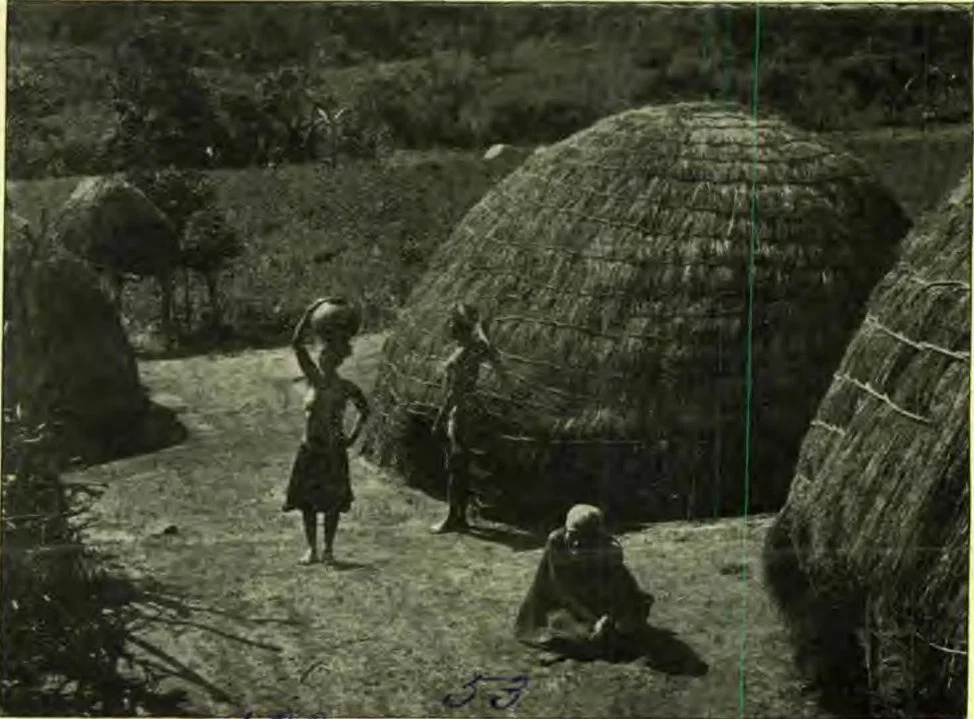
SCENE IN EAST AFRICA
The noblest testimony to his character and his influence is the conduct of that faithful band of native servants who had followed his fortunes so long and so far, and who, embalming his body, and secretly preserving all his papers and possessions, carried safely back over the long, weary road to the east coast all that remained of the hero and his work. Dr. Livingstone in April of 1873 died on the southern shore of Lake Bangweola, the head waters of the mysterious river he discovered flowing into Lake Nyangwe, unconscious of the fact that his mighty stream was the great Congo, and not the Nile, as he had fondly hoped.
NATIVE AFRICAN HUTS
NATIVE AFRICAN HUTS
Lieutenant Cameron, sent by the Royal Geographical Society of Great Britain to carry aid to the doctor, met his dead body being conveyed to the east coast, so continued his journey with the materials he had hoped to deliver to the doctor, thinking to follow the course of the river. But he failed to induce his men to attempt the solution of the problem, and striking southward, followed the lower edge of the Congo basin to the west coast at Benguela.
He records some of the most extraordinary examples of rock and tree scenery in the world, found along the southern end of Lake Tanganyika—“magnificent terraces of rock, which looked as if built by the hands of man; and scattered and piled in fantastic confusion were overhanging blocks, rocking stones, obelisks, and pyramids. All were overhung with trees, whose limbs were matted together by creepers.” It seemed to the eye of the lieutenant like a transformation scene in a pantomime, rather than a part of Mother Earth. “The creepers sway and are pulled apart”—spirits?—O, no, “an army of monkeys swing themselves into the foreground, and, hanging by their paws, stop and chatter and gibber at the strange sight of a boat. A shout from the men, and they are gone with a concerted scream which echoes far and wide.”
Lake Tanganyika had been known to the Arab slave hunters of the east coast of Africa long before the white man gazed upon its blue waters. These cunning, cruel people had good reason for guarding well the secret of its existence. It is six hundred miles inland from Zanzibar, on the east coast, and almost in the center of that wonderful basin whose reservoirs contribute to the Nile, Zambezi, and Congo. Ujiji, on the eastern shore, is the rendezvous of all expeditions, scientific, commercial, and missionary, that have ever reached these waters. Burton and Speke were the white discoverers of Tanganyika. It seemed to them the revelation of a new world—“a sight to make men hold their breath with a rush of new thoughts, as when Balboa and his men stood silent on the peak in Darien, and gazed upon the Pacific Ocean.” Fifteen years later Lieutenant Cameron struck it, and could hardly believe that the vast gray expanse was aught else than clouds on the distant mountains of Ugoma.
Livingstone came upon it from the west side, on his last journey through Africa. Tanganyika is an immense trough sunk far below the tableland which occupies the whole of Central Africa. Its surrounding mountains are high; its length is nearly five hundred miles; its waters, deep, clear, and brackish. It has twelve hundred miles of coast.
When news of Dr. Livingstone’s death reached the world, plans were immediately laid to continue his work in the heart of Africa. The successful expedition of Henry M. Stanley through Asia Minor, the Caucasus, and from Persia to India, thence by Egypt to Spain, marked him to be the man to carry on further exploratory work in Africa.
The London Daily Telegraph and New York Herald combined to send Mr. Stanley to Africa. When the sad news of Dr. Livingstone’s death reached Europe, Mr. Stanley, fired with the desire to carry on the work of the great doctor, gladly accepted the commission, and starting from Zanzibar in November, 1874, he circumnavigated the lakes of Victoria Nyanza and Tanganyika for the first time, carefully charting them, settling forever the point of any connection with the Nile.
Had Livingstone known this, he could have saved himself the last two years of his journey, and the perils and sickness which led to his death in the wilderness. From Tanganyika, Stanley struck across to Nyangwe, to the doctor’s mysterious river, called by the natives Lualaba. In spite of all the obstacles and difficulties which had hindered others, Stanley’s great determination, his resources and knowledge of the Swahili language, enabled him to induce his men to follow him down the river. He very forcibly recalled to their minds the long, weary marches, and the terrible Urega forests through which they had recently passed, and told them how much easier it would be to sit in canoes and paddle down this great river, which must flow into the sea.
But could Stanley master its secret? Cameron found it impossible to follow the Lualaba. Livingstone had tried it again and again, to meet a more formidable obstacle in the hostility of the natives than in the forests and animals. Stanley was better equipped than his predecessors, and not averse to using force, if mild means failed. He would see if this swelling tide went toward the Nile, or came out, as he suspected, through the Congo into the Atlantic.
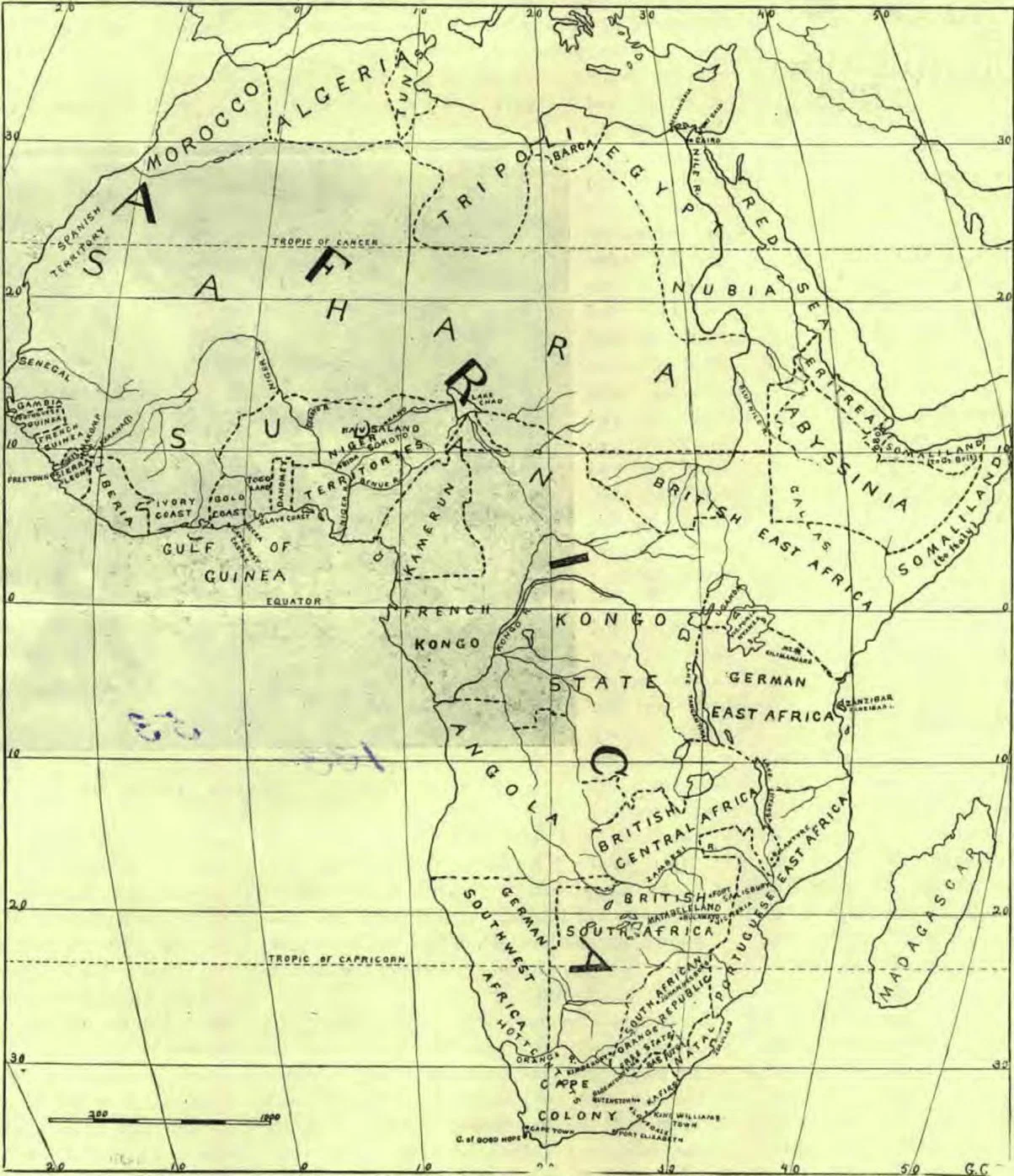
MAP OF AFRICA
MAP OF AFRICA
It was a mighty stream where Stanley struck it—“full fourteen yards wide, and moving with a placid current.” Here he marshaled his forces, only one European attendant being left. The party had been thinned out in the previous explorations, but it still consisted of one hundred and forty men. Not a native attendant faltered now. It would have been death to desert in this hostile region. Such woods! so tall, so dense, so somber,—they had never seen before. Those of Tanganyika and Uganda were jungles in comparison. Even the natives had penetrated but little into their depths. They line the course of the Lualaba for fifteen hundred miles northward from Lake Nyangwe. MRS. L. E. LA BONTI.
(Continued)

Peace and Rest

LIKE a river glorious Is God's perfect peace, Over all victorious In its bright increase; Perfect—yet it floweth Fuller every day; Perfect—yet it groweth Deeper all the way.
Every joy or trial Falleth from above, Traced upon our dial By the Sun of Love; We may trust him solely All for us to do; They who trust him wholly Find him wholly true.
Stayed upon Jehovah, Hearts are fully blest, Finding, as he promised, Perfect peace and rest.
—Frances Ridley Havergal.

Chlorosis, or Green Sickness

There is a very common disease of young girls in their teens called green sickness, or chlorosis. It may be that a short article on this disease may help a large number of girls who are unaware of the causes of it, and who go on in faulty ways of living until their health is ruined, and the foundation laid for consumption, or some other fatal disease.
Chlorosis is a disease which is characterized by extreme anaemia, or bloodlessness. The skin takes on a very pale color, deepening into yellow, and sometimes an almost or quite green shade. When the eyelids are turned out, they are seen to be yellow, and the lips likewise. The patient loses strength, and easily gives out, the heart flutters under the least excitement, and that tired feeling we are inclined to laugh about is the everyday experience.
Now it occurred to me that if I could only make plain the great cause of all causes that in my opinion is at the bottom of all the trouble, many might be cured, and others kept from contracting it from lack of knowledge of its cause.
A characteristic symptom of all these patients is almost without exception a perverted appetite. One will make a diet of oatmeal, rice, perhaps, another of green olives, another of chalk or slate pencils. In other words, they have “repetition dyspepsia.” The stomach needs a change as much as the mind. The constant grind on some one subject has broken more hearts, sent more people to the asylum or to a suicide’s grave than any other one thing. So with the stomach, it utterly refuses to work constantly on the same thing without rebelling. It is a common remark among young people at the table, “I don’t like that,” or “I only want my bread and jam;” and so the wrong habit is formed. After a while this will give place to another depraved habit, and then to a totally abnormal one, such as the eating of chalk or blue clay. Even if the abnormal one is not formed, the stomach becomes anaemic, or bloodless, from the eating of the same thing over and over.
Now, of course, the remedy is simple. Eat very few things at any one meal, but surprise your stomach with an entire change of menu every meal. Do not repeat and repeat. Leave off even those commonly used articles of diet, butter, sugar, and milk, from many of your meals, and you will gradually assume a rosier hue, and a more elastic step, and life will grow sweeter, and love stronger, and hope will fill your heart, and peace your soul. E. L. PAULDING, M. D.

Two Kinds of Reading

A YOUNG man found that he could read with interest nothing but sensational stories. The best books were placed in his hands, but they were not interesting. One afternoon as he was reading a foolish story, he overheard some one say: “That boy is a great reader; does he read anything that is worth reading?”
“No,” was the reply, “his mind will run out if he keeps on reading after his present fashion. He used to be a sensible boy till he took to reading nonsense and nothing else.”
The boy sat still for a time, then rose, threw the book into the ditch, went up to the man who said his mind would run out, and asked him if he would let him have a good book to read.
“Will you read a good book if I will let you have one?”
“Yes, sir.”
“It will be hard work for you.”
“I will do it.”
“Well, come home with me, and I will lend you a good book.”
He went with him, and received the volume that the man selected.
“There,” said the man, “read that, and come and tell me what you have read.”
The lad kept his promise. He found it hard work to read simple and wise sentences, but he persevered. The more he read, and the more he talked with his friends about what he read, the greater became his interest. Erelong he felt no desire to read the feeble and foolish books which were once his delight. He derived far more pleasure from reading good books than he ever received from reading poor ones. Besides, his mind began to grow. He came to be spoken of as an intelligent, promising young man, and his prospects are bright for a successful career. He owes very much to the reading of good books, and to the gentleman who induced him to read them.— Selected.

At Mrs. Mortimer Brown's

How a Minister's Wife Won the Support of the Ladies of the Aid Society

The minister's wife viewed the pile of unfinished garments with a sigh. She wondered how many members of the Aid Society would come to-day. Last week there had been two, the week before that only four. She wished she knew how to reach their hearts, and cause them to love the work for the dear work's sake.
She was a fragile, dark-eyed, little woman with a sweet, thin face. The minister had come West for her sake, in the hope of building up her broken health. But in spite of a rarified atmosphere and pure, invigorating air, she did not improve as her husband wished she might. She felt the responsibility, the importance of the work, and with the exception of her husband there was no one to help her share it. In spite of her weakness it was wonderful how much she accomplished. She visited the poor and the sick, and she never missed any of the church services. Her little flock of four, too, were always neatly dressed, the work of her willing, industrious, never idle hands.
She used to trouble over matters a good deal, for, try as she would, she could not get used to the lax church-going ways of the West, with its indifference, its coldness, its want of zeal. The members, even the best of them, came infrequently to church, and never to Sunday-school.
The Aid Society was her worst burden perhaps. She was so anxious to see it grow, so anxious to see it do good work for God, and yet the workers were so few.
The gate clicked, and Miss Mehitable Lyon came up the walk, with her little black bag on her arm. Miss Mehitable was old, past seventy now, but she never missed a meeting of the church.
“Well,” she began as she took her seat, “you won't be troubled with many visitors to-day. The club meets at Mrs. Mortimer Brown's, and every member I know is going.”
The minister's wife looked up. “There weren't but two here last week, Miss Mehitable,” she answered slowly. Her voice trembled a little. “I'm so discouraged I don't know what to do,” she added.
“No need to be that,” returned Miss Mehitable as she reached for the scissors. “You can't do anything with them. The club mania's got this town in its clutches deep and hard I can tell you. They aren't going to come to an Aid meeting when a club is in session. They'd miss too much, they think.”
The minister's wife's face saddened a little. “It does dishearten me though, Miss Mehitable,” she answered, gently. “If it were only once in a while, but it is every week. No one comes, and the work falls way behind. Mrs. Moss died last week, you know, and her children are very nearly destitute. I was in hopes we might do something for them to-day, but —”
Miss Mehitable looked across at her with a kindly look in her faded eyes. “Bless your dear heart,” she cried, “don't you go to worrying too much. I'll do what I can. If they won't come, they won't. The Lord forgive them. I'll sew all the afternoon for you, even though my eyes ain't as good as they used to be. Hand me that skirt. It's a wonder to me how some children ever get raised, to say nothing about having any sewing done for them, the mothers a running to clubs night and day.”
The minister's little wife handed over the small skirt in thoughtful silence.
“There goes Mrs. Judge Symms now,” announced Miss Mehitable from the window, “and little Mrs. Adams, and, bless me! if there isn't Barbara Sparrow. You'd be surprised to know what good Aid members every one of the three used to be,” she went on, “but now they're too busy playing cards to take any time to serve the Lord.”
The minister's little wife threaded a needle. “I wish I knew how to reach their hearts,” she whispered, “I wish I knew,” and then an inspiration came to her.
Mrs. Mortimer Brown was one of the few wealthy members of the church, gay, dashing, young, and full of life. She never attended an Aid meeting or a prayer-meeting; rarely if ever did she come to church. She subscribed toward the salary, and her name was on the church book. That was about all there was to it.
The club met this afternoon at her house, and she was in gay spirits.
The afternoon flew by. The card game, so fascinating, was ended. It was almost time for dispersing. The refreshments had been of the finest and choicest, the prizes most satisfactory. The first one, a handsome cut-glass bowl, had gone to Mrs. Judge Symms. The other, a picture, had fallen to little Mrs. Adams.
The members, in high, good humor, were talking and laughing when the door opened. Some one entered. It was a little lady in a black dress, with a sweet, thin face. Instantly every eye was upon her — the minister's wife.
“Ladies,” she began, “I've been wanting to speak to you for a long time, but the opportunity did not seem to present itself. There are so few of us at the Aid meeting (her voice trembled a little, and two large tears glittered on her lashes), it hardly seems worth while to continue them with the present attendance. I thought before I quite gave up, I'd come and speak to you this afternoon. If you would only come, and bring to it your labors and your prayers, I believe, firmly believe, much could be accomplished. There is the debt still on the church, there are some unpaid bills, and one of our poorer members died last week, leaving her little children destitute. There is a baby, too. Mr. Sells has given us the goods, and if you would only come, we could soon fit them in garments. Last week two, only, were present. To-day, Miss Mehitable was the only member there. I do what I can, but it is so little compared to what it would be with your help and co-operation.”
She ceased speaking for a moment, and there was a silence.
“I hope I haven't said too much,” she added, gently. “It is the Lord's work, his own.”
No one spoke. Then Mrs. Mortimer Brown came rustling across the room. She took the thin little hand and pressed it. There were tears in her eyes. “My dear,” she said, “I'm ashamed of my own heedlessness and heartlessness. We all are. We've let you bear the burden alone. Now appoint a day and try us again. I believe we'll surprise you.”
The tide had turned. The minister's little wife had gained a victory. Other members came crowding around, penitent and remorseful, and the day for a new meeting was named.
Late that night, Mrs. Mortimer Brown, in the privacy of her splendid room, took up her Bible. “I'll never give another card party,” she whispered. “Somehow, when that fragile little creature with her angelic face stood in my parlor in the midst of those card tables, it seemed to me as if an angel had dropped into our midst, and shown us where we were drifting — far away from the narrow way I'm afraid.”
She opened her Bible, and in that moment, in the solemn stillness of an awakened heart, the step was taken. The fashionable Mrs. Mortimer Brown left off her selfishness and worldliness and entered the ranks of the great Commander whose name is Christ.
“What!” cried the minister that same evening when he heard the story, “Ruth, how did you — how dared you face the club at Mrs. Mortimer Brown's?”
The minister's little wife laid her head on his shoulder. “I dared — because I must — dearest,” she said. — Susan Hubbard Martin, in the Ram's Horn.

What Does It Mean?

It does not matter what it means, poor heart, The dear Lord knows; to bear it is your part; Nor think some strange thing happens unto you Which he would not allow so if he knew. He does know. In his all-wise Fatherhood He knows it, and allows it for your good. He is not hard, you do not think he is, When in the dark you find your hand in his; When it was light, you tried to walk alone, And thought the strength he gave you all your own. You did not question what the blessing meant, Just smiled and took it, satisfied, content; You did not think it strange, you thought he knew, And planned the sweet surprise which came to you.
Tried one, then do you take life's sweet and good, Yet can not trust that tender Fatherhood, But think it makes mistake whene'er it sends Some hindrance, which your eager haste offends? Or when he lets the wicked plot your harm, And stir a whirlwind when you seek a calm; You think it strange, this trial swift and keen, And in your weakness ask, "What does it mean?"
I think the language of God's heart would read: "I love my child, I note his slightest need; I long to prosper him in all his ways, To give him quiet nights and peaceful days; But if I do, he'll lose himself from me, My outstretched hand he will not wait to see; I'll place a hindering wall before his feet, There he will wait, and there we two will meet. I do it not in wrath for broken laws Or wilful disobedience, but because I want him nearer, and I can not wait For him to come, for he might wander late; My child will wonder, will not understand, Still half in doubt he'll clasp my outstretched hand; But when at last upon my heart he leans, He will have ceased to wonder what it means."
— Anna J. Granniss, in "Sandwort."

What a Girl Should Know

THE modern girl's education is incomplete unless she has learned:—
To sew. To cook. To mend. To dress neatly. To avoid idleness. To be self-reliant. To be cheerful and happy. To darn stockings. To respect old age. To keep a house tidy. To be above gossiping. To control her temper. To take care of the sick. To take care of the baby. To take plenty of active exercise. To be light-hearted and fleet-footed.—Selected.
Planting a Missionary Garden

The Children Can Help

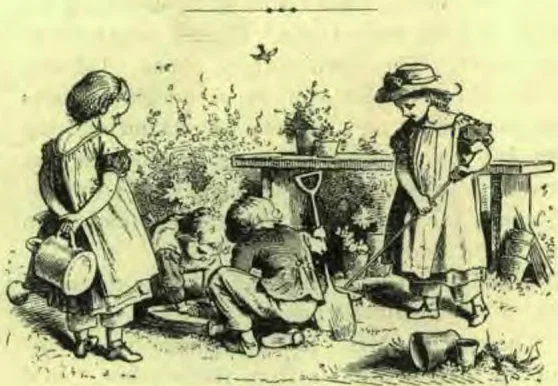
From nearly every State—north, south, east, west—comes the story of how the children are planning to help the missionary work. How glad we are that the children want to help, and that they can help! Our Sabbath-keeping children have many blessings. Nearly all have pleasant homes, kind parents, plenty of food, proper clothing, good books and papers; and, best of all, they have the Bible, and have heard that Jesus is soon coming to take them to that splendid home which he has prepared for them in heaven. Why should not such happy, blessed children remember the thousands and millions of little ones in heathen countries who have not good homes, who many times go hungry and without proper clothing, and, saddest of all, have never heard a word about Jesus, never a word about heaven, never a word about the Bible?
Jesus wants each boy and each girl to be his little missionary. There are many ways in which children may be missionaries in their homes and in the neighborhoods where they live; for they may do as the Saviour did when he was a boy and “went about doing good.” Every helpful, kind act is missionary work for Jesus. We should remember this, for some things we have to do are unpleasant, and this thought helps us to perform them cheerfully. The Lord also wants us to do missionary work for him in far-away heathen lands. He asks the children to help in this, and there are many ways for them to do so. Last year I learned of a number of children who had earned and given to missions all the way from ten cents to several dollars. Twenty children in one Sabbath-school earned forty dollars in seven weeks.
Perhaps you would like to know of some of the ways the children have earned money for missions. One of the very best ways is to plant a missionary garden. Making gardens is very pleasant work, and it is interesting to watch the little plants come up, grow taller and taller each week, and by and by yield their harvest. Of course the weeds have to be pulled up, and when it does not rain often enough, water must be carried for the plants to drink, but surely no one raising a missionary garden would forget to care for it.
It is better not to plant many kinds of seed in one garden. Several of the nicest missionary gardens I have ever seen had just one kind of seed growing. One boy had several rows of pop-corn planted. He cared for it faithfully, and in the autumn he had several bushels of fine “mice-tooth” pop-corn. He sold the most of it to a man who kept a pop-corn stand, and received over five dollars to give to missions. The rest of the corn he saved, and occasionally would pop some of it, make balls, and sell them. All the money went to missions. One small potato garden brought its little owner one dollar for missions. An onion and radish bed gave one little girl many nickels and dimes. She kept her garden in excellent condition, and every morning carried the five-cent bunches in a little basket around to her neighbors. Some of the neighbors found out what the little girl was planning to do with her money, and occasionally they gave her double the price, for the missionary spirit touched their hearts also, and made them want to give.
Sometimes little people think garden-making a slow way to make money for the Lord. They feel just as the little boy does in this verse:—
“ ‘But a week is so long,’ he said, With a toss of his curly head. ‘One, two, three, four, five, six, seven! Seven whole days! Why, in six, you know (You said it yourself—you told me so), The great God up in heaven Made all the earth, and the seas, and skies, The trees, and the birds, and the butterflies— How can I wait for my seeds to grow?’ ”
It will take longer than a week for some seeds to grow, but we must learn to wait patiently and to work patiently, remembering that God will be grieved at any neglect of a garden that is set apart for his work.
Some children do not live where they can plant gardens. There are other ways they can earn money for the Lord’s work. One little girl bought gingham for an apron, made it neatly, and sold it for enough to buy gingham for two more aprons. She kept working in this way until she had quite a little sum for missions. One girl knit baby hoods, another worked mottoes, one boy bought paper and made and sold lamp lighters. An eleven-year-old girl learned how to make good graham bread, and baked bread to sell. Many children last year had missionary hens, some selling eggs, and others raising a flock of chickens to sell. O, there are many, many ways in which the children can help! No one should be discouraged if he can earn only a few pennies. Jesus blessed five loaves of bread and two fishes—a little boy’s offering—and made them furnish food for a great company of people. Jesus can bless a single penny given to him so that many people in heathen lands may be reached by that small gift.
We hope that all the children will begin now to arrange for their missionary gardens, missionary chickens, and missionary plans. In the autumn, when all the harvests are gathered, we will ask that a special service be held for the children of each Sabbath-school, and then the missionary offerings may be brought, and counted, and sent out upon their mission of love to far-away lands. MRS. L. FLORA PLUMMER.

A Great Religious Declension

SCRIPTURE STUDY:—

CHAPTER STUDY:—

“Great Controversy,” Chapter Twenty-one.

PARALLEL READING:—

“Thoughts on Daniel and the Revelation,” Chapter Fourteen, pages 611-618.

LESSON TOPICS:—

The effect of the “Disappointment” upon the various classes of persons.
The spiritual condition of the churches since 1844.
The cause of the declension.
Rejecting truth.
Conformity to the world.
Unlawful means of supporting Christian enterprises.
Accepting creeds instead of the Word. Beecher’s testimony.
Church-membership obtained from worldly interests.
Responsibility of the church for the present condition of the world.
The present call to the people of God.

ADMONITIONS TO THE TRUE BELIEVER:—

“Buy the truth, and sell it not.”
“Hold fast that which thou hast.”
“Keep himself unspotted from the world.”
As the Saviour did not come in 1844 as was preached, the believers were bitterly disappointed. Disappointment does not prove that God has no hand in the guidance of his people. The trusting disciples were most sadly disappointed when He whom they expected to deliver Israel was by wicked hands taken and slain. God was not the cause or the occasion of their disappointment; in fact, the very plain teaching of Jesus was calculated to prevent the disaster. But the disciples were blinded and biased by human tradition, and God suffered them to awaken to the fact of their bondage by this bitter experience.
It was the same with the believers of the Advent message. It might have been apparent to every student of the Scriptures that the angel who proclaimed the hour of God’s judgment was not to give the last message of mercy. This announcement, the Word plainly states, is to be followed by two other messages of mercy; but the coming of the Son of man finishes the mystery of godliness. There is no probation after this event.
The disappointment of 1844 should have led the believers to cast about at once for their mistake, knowing that God makes none. His word is sure. Instead of casting away their confidence, as many did, they should have earnestly searched the Word with prayer that the whole truth might be revealed. Some did this, and were rewarded by the glorious light of the third angel’s message flooding their souls, making very clear the meaning of the prophecies and the disappointment.
“The sin of the world’s impenitence lies at the door of the church.” This fearful charge is laid to the professed church by the Spirit of God. “If it were not for the false doctrines which she has instilled into the minds of all men, how the plain truths of the Bible would move the world! But people are held by these, as under the stupefying influence of the most powerful intoxicant.”
F. M. D.

What a Penny Can Do

WILLIE'S penny made heaven rejoice. It would not have bought more than a stick or two of candy, or given much help to a starving family. What did he do with it? His sister was a missionary's wife in Africa, and the family were filling a box to send to her. As one after another brought their gifts, Willie said, “I want to give my penny.”
“What shall be bought with it?” was the next question. It was decided to buy a tract, and write its history on the margin, and with a prayer for its success, send it on its distant errand.
The box arrived on the mission ground, and among its valuable contents, Willie's gift was laid away unnoticed, and for a while it was forgotten. But God's watchful, all-seeing eye had not forgotten it. One day a native teacher was starting from the mission station to go to a school over the mountain. He knew the language well, and was a great help to the missionaries; but he was not a Christian. He had resisted everything the missionaries had done to make him one.
In looking over some papers, Willie's tract was discovered, with writing on the margin which said that prayer was offered in America that it might do good. It was handed to the native teacher. He read it on his journey, and what years of labor by the missionaries had not done, was now brought about by the penny tract. The man became a sincere Christian. Those who put the tract in his hands were full of joy; and there is joy in heaven over one sinner that repents.
So you see how Willie's penny made heaven rejoice.— Missionary News.

Snuggle Close to Jesus

Two little babes so fair, one bitter, stormy night, Were tucked away, with mother's care, in dainty beds of white. One was timid little May, with hair a golden crown; And one brave little Bert, with hair and eyes of brown. “I don't like storms,” said May; “I'm 'fraid of lightning, too; Thunder re’ly hurts me,—I wish ’twould stop; don't you?” “We prayed to-night, dear sister, to be kept safe from harm. Don't you know that Jesus can save us from the storm? So I'm not 'fraid of storms at all.” Thus answered Bert,— “Just snuggle close to Jesus, and you won't get hurt.” Both little babes that stormy night were made to see That very close to Jesus is the safest place to be. But, in the stormy days of life, there's greater danger dire, As Satan brings temptation in poisoned darts of fire: And so, in all life's storms, the safest place to hide, For old, as well as young, is close at Jesus' side; And he who stilled the tempest once, on raging Galilee, Can deliver from temptations that come to you and me. Then let's remember, in the storms, the words of little Bert, “Just snuggle close to Jesus, and you won't get hurt.”
—Selected.
Continue reading: The Missionary Pumpkin