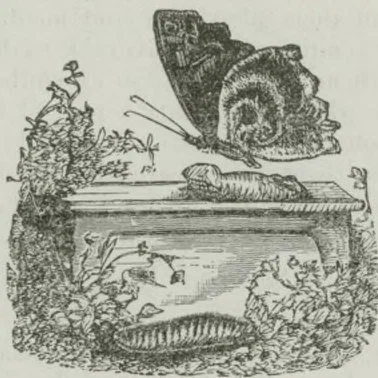
Have any of you children seen a butterfly yet this year? Oh, didn’t you think there were any so soon? Yes, the Morning Cloak comes out early in April, in Washington, and if you haven’t seen him yet, just keep your eyes open for a medium-sized purple butterfly, with a yellow or white margin around the edge of his wings, and blue spots just inside the margin. In the Northern States he sometimes comes out before the snow leaves the ground. Did you know that there are butterflies in every part of the world where flowers grow?
“Where have the butterflies been all winter?” Ray wants to know. Why, most butterflies, soon after they are hatched, choose a leaf that their babies can use for food when they are hatched, and lay their eggs on it. Then in a short time the butterflies die. So the beautiful butterflies we see in the spring and early summer are new ones. You see, Ray, most butterflies live only a few weeks, though there are a few kinds that live to be two or three years old, and sometimes these fly south in droves, like the birds, and come back again next year.
Butterfly eggs are of every shape and color,—white, orange, red, blue, and green. Some are round; others long. They take only a few days or weeks, depending on the kind of butterfly, to hatch. And what do they look like when they hatch, Violet? “They look like worms,” says Violet, “but they are caterpillars.” Violet found one last fall and kept it in a box on some leaves and watched it turn into a chrysalis. These chrysalises are of varying colors—sometimes gray, and sometimes bright colored, with spots. They are nearly the same shape as the caterpillar, only they have corners and bumps on them, while the cocoon of the moth is round and smooth. In this stage the butterfly spends the winter, and any little boy or girl with sharp eyes can find these chrysalises under old boards, or fastened to trees or fences or lying on the ground. Shall we each see how many different kinds of chrysalises we can find this spring?
When you find one, if you will put it into a box or glass where it can have air, one of these days you will find a new butterfly anxious for a chance to use its wings; or if you are so fortunate as to be there at just the right time, you will see a strange-looking bug crawl out of the shell, and from two bumps on its back you will see the beautiful wings slowly unfold, while the insect quivers and trembles violently. Presently a pretty creature will be ready to brighten his little corner with his gay colors and flit from flower to flower in search of honey.
When I see this wonderful change in the butterfly’s life, I think of the change that will come to Jesus’ children who are sleeping in their graves, when He calls them and they come out of their graves all shining and beautiful, like the angels.
Please write me about the first butterflies you see this spring.
COUSIN JOY
Earth to Air
By Lydia A. Coonley
A LITTLE worm on a branch of gray
Began his work one summer day.
He planned and built, he wove and spun,
Until his tiny house was done.
He laid the walls with leaf-green rails;
He set the roof with golden nails;
He wove a sheet of softest lace,
And in its folds himself found place.
He slept, and in the dark of night,
Upon his sides grew wings of light.
The shining house became a veil,
And gone was every golden nail.
Through the thin walls of gauze I spied
The rainbow wings he had not tried.
They cradled close and folded tight
His velvet body, strong and light.
On sped the hours till sleep was done;
Wide swung the doors to life's new sun.
He woke. He longed his wings to try,
And found himself a butterfly.
— Lydia A. Coonley.
Pain in the Abdomen a Danger Signal
By Harry W. Miller
BY HARRY W. MILLER, M. D.
SOMETIMES a comparatively simple condition, such as acute indigestion with the formation of gas, may be accompanied by severe pain and other more or less alarming symptoms; but ordinarily, severe pain in the abdomen, especially if throbbing in character and if accompanied by fever, is an indication of an inflammatory condition that should have the immediate attention of a physician or surgeon. If the pain is caused by retained gas, it should be relieved in a short time by drinking a glass of hot water containing a few drops of oil of peppermint. This article will describe some of the conditions that may cause abdominal pain.
Biliary Colic, or Gallstones
A sore, tender, and painful gall bladder is among the more common causes of abdominal pain. The onset of biliary colic is often quite sudden, and is the result of an obstruction of the flow of bile by a stone, or of inflammation causing swelling and distension of the gall bladder. It is characterized by a short pain across the abdomen, which shoots up to the right shoulder blade, and is usually accompanied by considerable nausea and vomiting of bile. The pain is of a repeating character, comes every little while, and causes a great deal of perspiration to stand out on the forehead. There may be accompanying jaundice, in which the whites of the eyes are tinged with yellow, and in which there is a deepening yellow discoloration of the entire body—a deep yellow.
Treatment.—Heat is the most efficient remedy for any colicky pain. It may be in the form of fomentations applied over the entire abdomen. Oftentimes a fomentation over the back will accomplish the same purpose. The indications are always surgical. However, the time of the attack is a poor time to operate, as the operation is an emergency measure.
Kidney Colic
Pain in the region of the kidney is often caused by obstruction of the duct leading from the kidney to the bladder. Concretions, or “stones,” sometimes form in the kidney and lodge in this duct, blocking it and causing back pressure on the kidney because the urine cannot escape. Violent pains, starting from the loins, dart through the groin, and down the inner part of the thigh. There is an irritability of the urinary passage and the bladder, causing a constant desire to urinate and painful urination.
During the attack, the pain may be excruciating, sometimes radiating over the entire abdomen; but the tendency to dart down into the groin and thigh is rather characteristic of this trouble, and serves to distinguish it from other troubles that cause abdominal pain. Accompanying the pain, there may be nausea, vomiting, and intestinal irritation, with a coated tongue, and sometimes an odor of urine in the breath. There is a slight increase in the pulse rate, possibly also in the temperature. Most of these symptoms are the result of the retention of urine in the system.
Treatment.—For relief of the pain, the patient may be put into a moderately hot bath, or hot applications may be made to the back, side, and front of the abdomen. The hot sitz bath is also good.
The only permanent relief is surgical; and one who has gone through one siege of kidney colic, ought to be willing to submit to an operation in order to avoid future attacks.
Appendicitis
The vermiform appendix is a closed-end tube, about the same diameter as the little finger, and from two to five inches long. It opens into the large intestine in the region of the right groin. It sometimes becomes inflamed, perhaps from fecal matter or bacteria. The inflammation swells the mucous membrane. This is followed by the closure of the opening, and the pressure of the retained secretion causes the colicky pain that induces the patient to call for the doctor. Pus forms in the cavity,—a little boil, as it were,—and if it is not cared for in time, the boil bursts into the peritoneal cavity, with a fatal ending.
The following symptoms distinguish appendicitis: Pain on the right side, producing boring sensations in the abdomen, with nausea, vomiting, and retraction of the right knee. The pain is sharp and excruciating. There is also a part known as McBurney’s point, midway between the groin and the navel, which is exceedingly sensitive to pressure. The physician will probably confirm the diagnosis by making a count of the white blood cells.
Treatment.—Most patients may recover once, twice, or even more times from an attack of appendicitis; but no patient can know that the next attack will not be the last. Any attack may be followed by perforation and a fatal peritonitis. The only safe course for one who has had an attack of appendicitis is to have the appendix removed. While it is true that many cases of catarrhal appendicitis recover by the application of simple hydrotherapeutic measures, there is always the danger that the next attack may be fatal. In all cases of abdominal colic, skilled aid should be called at once.
Meantime, for temporary relief of the pain, hot applications may be made locally, or else an ice bag may be placed over the appendix, with a hot pack to the legs or a hot leg bath.
Peritonitis
Peritonitis is an inflammation of the membrane that lines the abdominal walls and the outer walls of the abdominal organs. The peritonitis may involve only a part of the peritoneum, following appendicitis, or inflammation of the bladder, or other of the pelvic organs. Peritonitis may result from tuberculosis, typhoid, dysentery, or other infection involving the abdominal organs. Or it may follow gunshot or other wounds, or severe blows on the abdominal wall.
In peritonitis there is marked rigidity of the abdominal walls, severe radiating pains throughout the abdomen, boring sensations, and often thirst. In order to lessen the tension on the abdominal muscles, the knees are drawn up. The pulse is rapid, and there is some fever, shortness of breath, an anxious expression, and marked prostration. Diarrhea is common. Death usually occurs within two or three days in fatal cases. If the patient survives for five days, he usually recovers.
Treatment.—First in importance is to secure rest for the inflamed parts. For this purpose, it is necessary to stop all movement of the bowels, as the bowel movements increase the agony. To this end it is necessary to give an opiate, under direction of the24physician. Cold is the important local application in peritonitis, never heat. Use either the ice bag or ice compresses frequently renewed. Give little if any food, and avoid cathartics or anything that will increase abdominal action. The patient must be kept warm and free from any disturbance, and be given plenty of fresh air. He should drink only in sips. Liquids may be administered by the bowel, using Murphy’s method.
Speaking of Operations
By Ruth F. Wadsworth
BY RUTH F. WADSWORTH, M. D.
(Condensed From Collier's, the National Weekly, Jan. 19, 1929)
My friend, the professor’s wife, had recently had her appendix removed, and when I went in to see her, she greeted me with wan enthusiasm.
“I’m glad it’s you,” she said, “because you may be willing to talk to me intelligently.” She waved scornfully at a pile of humorous books on her bureau. “I don’t mean to be ungrateful for these offerings, but at present the subject of operations seems to me anything but funny. That’s why I wanted to see you. Perhaps, not being my own doctor, you will answer a few questions I have been asking myself since I started on this painful adventure.”
“Ask away,” I said. “If I think it’s none of my business to answer you, I’ll say so.”
“First,” she said, “I have a small wound, they tell me, on the right side of my abdomen. Then why did they scrub and shave and disinfect me with stinging alcohol from head to foot?”
I explained that while a surgeon might expect to make his incision in a circumscribed area, he never knew certainly until the incision was made whether another incision might have to be made. The shaving and disinfection are attempts to eliminate one source of operative infection—the skin, and hair cups.
“And why was I starved beforehand?”
“Because ether causes nausea in most people, and is best tolerated on an empty stomach.”
“What was in that hypodermic injection?”
An injection, I told her, containing a small dose of morphine and atropine, is generally given to quiet the patient during the giving of the ether, and to reduce the production of saliva, which is often profuse and interferes with breathing.
“I was so calm when I went to the operating room that I looked about and saw Dr. Blank and his assistants scrubbing their hands as if their lives depended on it, although afterward they put on rubber gloves. What was the sense of that?”
“No surgeon depends on rubber gloves to protect the patient from infection which might come from his hands. Rubber gloves may break or be punctured during the operation, and his hands must be as nearly sterile as possible.”
The importance of disinfecting the surgeon’s hands has been emphasized ever since a dramatic medical meeting in Paris in the last century. One of the physicians present, attempting to account for an epidemic of septic fever among mothers whose babies were delivered in hospitals, announced bitterly, “The trouble lies in our own finger nails, gentlemen!” thereby nearly losing his status in the medical fraternity.
“I suppose,” said my friend, “that is the reason everybody wore caps and masks, too. But why, if they are so particular, do they have a dirty nurse in the room? I heard one of the doctors asking for the dirty nurse.”
“It does sound bad,” I admitted, “but she is dirty only in a surgical sense. She pushes away tables and stools, ties the surgeons’ coat fastenings, wipes off their foreheads when they perspire, and does a thousand odd jobs which the scrubbed-up nurses could not do without losing their surgical cleanliness.”
“Fine,” said the patient, “now we have got me on the table. But how does the man who gives me ether know when I have had enough?”
“Well, the anesthetist has various ways of testing the completeness of the patient’s unconsciousness. He uses nervous responses which are independent of the mind. The eye, in the reaction of the pupil, gives a very good guide to the depth of the narcosis, or anesthesia. Just before the patient is completely unconscious he will frequently make small voluntary movements, such as wiggling his fingers. Soon thereafter he becomes fully relaxed and insensitive.”
“That sounds nice and safe; I wish I had known it beforehand. Now go on and tell me what happened next.”
“Well, the surgeon, his two assistants, and the nurse were waiting to receive you in the operating room, their hands held up and together so that they would touch nothing. The dirty nurse uncovered the operative field on you, because much as you had been scrubbed you also were considered dirty. Then one of the clean nurses painted you with iodine or picric acid, and covered you with a sterile sheet, in the center of which was a neatly bound opening for the operative field.”},{
“Everything they did,” interposed my friend, “seems directed to the prevention of infection. What did they do for antisepsis in the last century?”
“They did very little, and all operative wounds became infected as a matter of course. If the patient had sufficient resistance to survive in spite of it—well and good. Nowadays an infection is rare. Everything that comes in contact with the patient is disinfected: instruments are boiled; towels are baked; catgut sutures are subjected to lengthy disinfection, and samples of each batch tested for sterility.”
“That’s interesting,” remarked my friend, “because I know many people who feel that most things in an operation are left to chance. Another thing: I expected a great deal of pain in my wound. I did have much pain at first, but not in my wound; it was all over me, and later it was gas pains.”
“The general pain and discomfort, I believe, are the result of shock. Shock is greater if the operation is prolonged, and every effort is now made to shorten the time of operations and protect exposed organs from the air by covering them with warm towels wet with a salt solution so near the composition of the body fluids that it does not allow evaporation or shrinking.”
“I have always been in terror of having a sponge left in me. I have often heard of its being done!”
“I believe it did happen now and then at one time,” I confessed. “But such an accident is now prevented by attaching to each sponge (which is just a large square of folded gauze, not a true sponge at all) a double strand of tape to the end of which is fastened a large metal ring. The ring is left well outside the wound, and so the sponge cannot be forgotten.”
“If I had known that beforehand it would have spared me a fearful panic. Now go on: what about those gas pains?”
“The gas pains that follow an operation are much the same as any pain caused by gas in the intestines, except that they are more severe. When gas accumulates in the intestine and is not promptly passed, it distends the wall of the intestine, and the result is pain. After an operation the intestinal wall is more or less paralyzed from the ether, and the gas, which would normally be passed along by the intestinal muscle, stays in one place and distends the walls painfully.”
“Well,” said the inquisitor, “I guess that’s all for to-day.”
I went out softly and closed the door.—The Readers’ Digest.
A Missionary Investment
By E. C. Waller
BY E. C. WALLER
THE opportunity for making the mission school the center of the rural school community work grows less and less each year. By this we do not mean to say that there are no localities in the rural South where schools may be conducted with profit, but that the number of such localities is diminishing year by year. The efficiency of public schools throughout the mountain territory, particularly, has greatly increased in recent years. In many places the unequipped one-room school, with a poorly trained teacher, has been replaced by the substantially built, consolidated school, with a normal school or college graduate as teacher. Good roads have either preceded or followed this new school, and school busses offer to all students in the district equal transportation facilities. Indeed, this very thing has happened in the districts near our school here at Pisgah, and is typical of what has happened in many counties in North Carolina and other States. There are, however, even yet, back among the hills, many localities where the mission school would be a great blessing to the people occupying these sparsely settled regions.
The changing status of public education has not lessened the opportunity for an industrial boarding school such as ours. It makes possible a selective process, the gathering out here and there of an individual student who is willing to leave his home to come into an entirely different environment, where his life may be molded at the most critical time. Here the students learn the value of a balanced vegetarian diet, which to many of them is almost a new bill of fare. They learn to grow and preserve fruits and vegetables, which are so necessary for providing a balanced dietary throughout the year. Many of the students who come from homes without screens and other sanitary safeguards, are taught sufficient applied bacteriology to meet the simple needs in their homes.
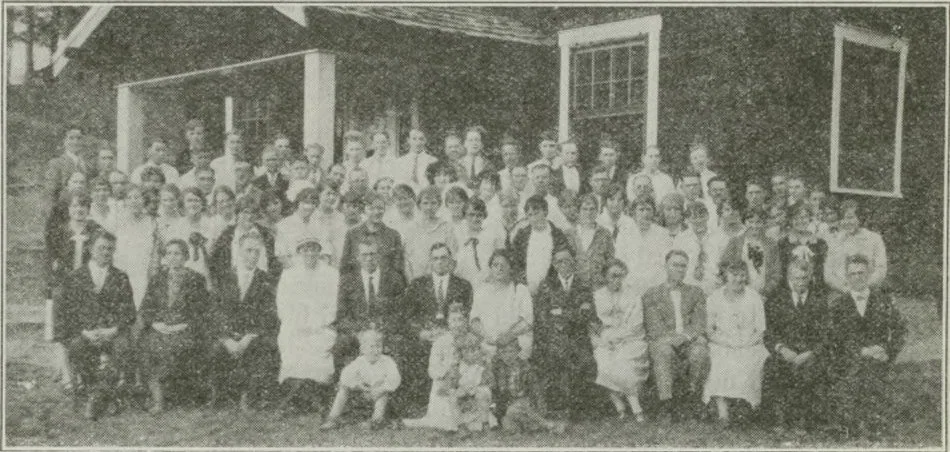
Faculty and Students of Pisgah Industrial Institute, Candler, N. C., 1927-28
In the industrial work the teachers find one of the most effective avenues for a full display of their personality, which after all is the greatest educational force. Through the chapel and other religious exercises, through music and other cultural means, the students gain an aspiration for the higher things of life. Some of those who in former years have attended the school as day students have realized that the work in the classroom is only a part of education given, and have entered later as boarding students, even though their parents reside within easy access of the school.
It is our experience that the industrial feature of the boarding school is a great tester of character. For several years we have been giving more than fifty students the opportunity to work their way through school. Some of those who have come have remained only a few days or weeks, having been unable to meet successfully the first test—the work test. Some others who have met this test successfully have remained to complete their academic course, even though they began work in the upper elementary grades, and have taken six or seven years to reach their goal. This experience has built into their character that industry, adaptability, and stick-to-it-iveness which has enabled them to succeed in their work in college or in the larger school of life. We call to mind many students who have made good. Among these we may mention one who is now missionary secretary of a conference; another who is pastor of a local church; another who, with his wife, is conducting a successful school. Others have gone on to our advanced schools, and are now preparing for the ministry, for the practice of medicine for nursing, and for other lines of work.
When we make a survey of our student body the present year, we have the satisfaction of knowing that the opportunities offered here make it possible for a large number to receive the blessing of a Christian education.
We find that many of these young people have been deprived of the help of parents, and must therefore make their own way in the world. It is a satisfaction to be able to help sixteen students who are orphans, and twenty-five others who have only one parent. One student, whom we will call Henry, has proved his dependability at the sanitarium, and is assistant buyer for the institution. Another, named Mary, is as much at home with a hoe as in the kitchen, and has had the responsibility of the school store. A third, we will call her Matilda, who has made her home here for the past seven years, is a leader in music and in Missionary Volunteer activities, and has also proved her worth as cook at the sanitarium. Still another, Thomas by name, has not only been a successful colporteur during the vacation, but has been one of those whom the faculty have depended upon as a loyal student and an upholder of the school government. And lastly, we must mention our sweet singer, Belle, who, after completing our nurses' course, has made a success as community nurse.
It is a severe tax on the financial resources of the school to supply work for so large a number of students. More and more are appealing each year for an opportunity to work their26way. Over fourscore have already signified their desire for this privilege the coming year. We regret that we shall not be able to accept all of these. We appreciate the help that we have received from the rural school collection in past years, and trust that the funds this year will be greatly increased, so that the opportunities for obtaining a Christian education may be available to a larger number of worthy students.
Main Building, Pisgah Sanitarium, Candler, N. C.
A Great Need
By F. R. Isaac
Our Opportunity to Supply It
BY F. R. ISAAC
Educational Secretary Southeastern Union Conference
Great changes are taking place in the South. Mountain roads are being built, and the people are venturing away from home. The old fireside is losing its hold. Curiosity for a knowledge of the world is crowding out religious tendencies. The people in the rural sections of the Southland are fast imbibing the idea that reason takes the place of faith in the word of God, and therefore the statement of our Saviour, “What thou doest do quickly,” might well be applied to the work God wants us as a people to do for the rural sections of the South where the people are still susceptible to the truth.
Last week while attending a meeting at the Pisgah Rural Industrial Institute, the principal informed us that fifty-eight of their students had entered other schools of our faith, about half that many had enlisted in nurses’ training schools, and six young persons who had learned to love this truth and while there had gained a vision of the mission fields, are now in distant lands proclaiming this message, one having just recently sailed to India.
These young people make good workers. The very fact that it is a struggle and a sacrifice to go to school, prepares them for hardships they may encounter later on. A General Conference representative, when informed by a student while going from the station to the school on a cold, rainy day, that he had no overcoat, rubbers, or raincoat, was deeply moved, and mentioned the possibility of our people’s sending clothing to these centers, and thus bringing comfort and cheer to many boys and girls striving to obtain an education that will fit them to do service in the cause that grows dearer to them each day. Although they need every available nickel and dime they can earn for their own necessities, they sell papers and books, and in one way or another earn money so they too may have their share in the Sabbath school offerings.
Our teachers in these schools work for extremely low wages. With the exception of what is received from the rural school offering and a little from friends now and then, these schools are entirely self-supporting. What a blessing it would be to both teachers and students if at least once a year all our people would give an equivalent of 25 cents per church member to this fund. Brethren and sisters, is that too much to ask for the work the servant of the Lord has written so much about and pleaded so earnestly for? I feel confident that if our people understood the needs and privileges, their hearts would be touched to the extent that they would give more liberally toward this fund than ever in the past.
It was my privilege to spend a few days with our newest school during a very cold spell. The firewood was covered with snow; but the boys donned their heavier clothes and braved the weather to supply the different rooms with the necessary fuel. Since rooms were scarce, the boys slept where the snow formed the top cover of their bedding. They did not mind what was on top of the covers, but what found its way into the bed with them was not quite so pleasant. Salable foods raised on the farm are taken to market. This may reduce their variety somewhat, but all have learned to sacrifice to obtain the absolute necessities. Courageously the young people work and study, striving for knowledge, and seeking God for wisdom to do their part in His service.
Another one of our rural schools, which has already made its way into the hearts of the people, is near Fletcher, N. C. Each morning the boys and girls make their way down the mountain to the school, where the word of God is made the foundation of all studies. Several families have been brought into the truth, and the students find their way to our advanced schools and sanitariums. In connection with this school there is a small hospital. While there we were ushered into a room occupied by a boy who, while chopping wood, had cut a deep gash in his knee. His parents applied cobweb and soot to stop the bleeding, and naturally blood poisoning set in. In their extremity they finally brought the boy to this little hospital. The knee had swollen to several times its natural size. It required skillful medical aid to save the lad’s life. But he was improving, and thus another act of kindness sheds its influence in the community.
In one of our schools the children come for miles, even before daylight, to get in a full program before the noon hour, and then go back to help their parents with the farm work in the afternoon. On account of lack of funds and other causes, one school closed not long ago, much to the regret of both parents and pupils. The workers, however, use their knowledge of the nurses’ profession, and find employment where opportunity may present itself.
In a certain locality where county school authorities were determined to close our school, the teacher has labored steadily on, even organizing a Sabbath school of about twenty-five members, and by the close of this school year will have several boys ready to send away to our higher schools.
A well-conducted Christian school has its drawing powers, perhaps more so in the rural sections of the South than elsewhere. This was demonstrated by a consecrated teacher, who in a few weeks’ time raised the enrollment of her school from twelve to forty-two. Drawing the pupils from the country schools round about incurred the ill feeling of those opposed to our work, so that the officers were summoned to close the school, but after an extended visit they were so impressed with the quality of the work that they could express only words of praise and give the teacher full liberty to proceed with the school.27Soon it was necessary to secure additional teaching help.
The financial depression in the South just now, very materially affects our rural schools. Some are struggling to keep going. Let us remember these laborers before the throne of grace, and make the offering an unusually large one, as more help is needed to keep the schools in operation.
The Uruguay Annual Meeting
By W. W. Eastman
BY W. W. EASTMAN
THIS meeting was held January 10-17 in the town of Nueva Helvecia, in the church building belonging to our people of the place. Meetings were held each day, beginning at six o’clock in the morning and closing with the night meeting. Each evening the church was packed to the limit, as there was a good attendance by the people of the city. These night meetings were sermons on the doctrines of the message, presented in Spanish by the brethren who could speak the language. E. L. Maxwell, president of the Union Conference, and J. W. Westphal carried the chief burden.
Carlos E. Krieghoff, superintendent of this mission, rendered an encouraging report of the progress of the work. Fifty-four new members had been received during the year, the largest number of additions for any one year in the history of the mission, making a net increase of thirty-nine and bringing their total membership up to 326. This was an encouragement to the brethren and sisters.
For some reason the message has not made the progress in Uruguay through the years that has been made in other parts of the Austral Union. More than thirty years ago a colporteur entered this republic with the book, “The Great Controversy,” in the very community where this meeting was held. An interest was awakened among the Swiss-German colonists, and was followed up by F. H. Westphal, then a pioneer preacher in South America, with the result that a church was raised up which has stood stanchly for the truth all these years. Some of its sons and daughters have attended our training school and taken their place in the work as standard bearers of the message. The superintendent’s report showed also the substantial increase in tithe of $1,413.56 and a gain of $245.05 in mission offerings.
Speaking of the colporteur work in his report, Elder Krieghoff said, “It is, under the leadership of God, one of the most powerful and economical means for the evangelization of city and country.” Under the direction of José Viñolo this work had made excellent progress, the colporteurs having delivered over $15,000 worth of our literature in the homes of the people.
I was especially impressed with the fine group of young people, and was glad to be permitted to speak to them with a view of inspiring them to seek a preparation for the service of the Lord.
The meeting was a good one, and the brethren and sisters returned to their homes with renewed courage, rejoicing that the Lord had met with His people and poured out His blessed Spirit upon them.
Atlantic Union Secondary Teachers’ Institute
By C. A. Russell
BY C. A. RUSSELL
FOR the first time in the history of the educational work in the Atlantic Union, the teachers in our secondary schools have enjoyed the privilege of institute work. The following schools were represented, nearly every member of the various faculties being present: Atlantic Union College Academy, Greater New York Academy, Harlem Academy (colored), Pine Tree Academy, Union Springs Academy.
Several teachers from church schools carrying academic work also attended. The educational superintendents of the four conferences comprising this union were present, and took an active part in the work of the institute. We were favored with the presence of E. K. Slade, union president, and F. D. Wells, president of the Northern New England Conference, for a considerable portion of the time. O. M. John, president of the college, and several of the college teachers rendered valuable assistance. N. H. Saunders, union educational secretary, presided over the sessions of the institute. The general educational department was represented by C. W. Irwin and the writer.
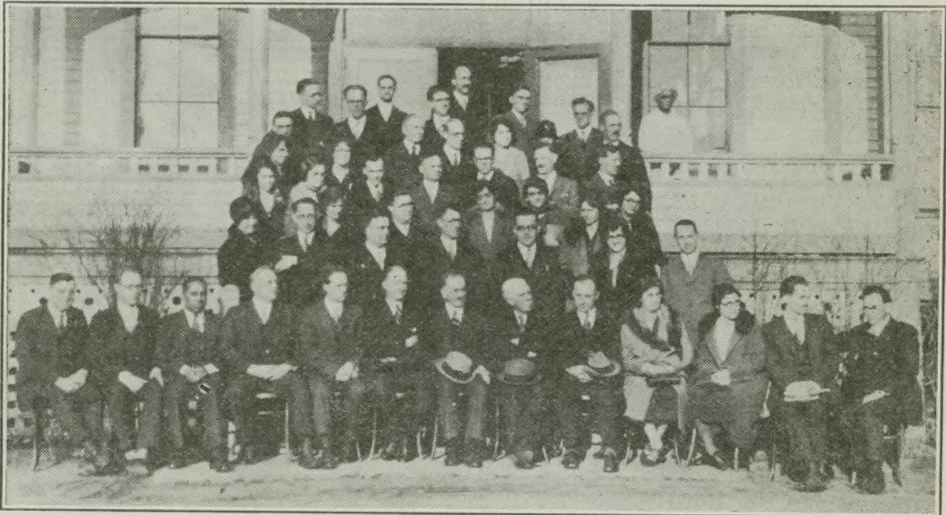
Atlantic Union Secondary Teachers' Institute
Among the many problems discussed were those pertaining to the spiritual interests of the school, disciplinary problems, school finance, school homes and their administration, vocational training, and problems pertaining to the school curriculum.
Six of the ten unions in the United States have now held one or more secondary school institutes. The benefits derived from such a close-up study of school problems have become so apparent that at the last Fall Council the following action was passed:
“WHEREAS, Several of our union conferences have made possible the holding of secondary teachers’ institutes, either annually or biennially, with great value to the educational work in the union;
“We recommend, That study be given to this plan, especially in those unions where several secondary schools are in operation, and that such institutes be conducted where possible.”
South American Mission Growth Reported by C. B. Haynes
From C. B. Haynes comes the report that there are 20,000 baptized believers in South America. Baptisms are averaging 200 a month. In Peru alone we have 7,500 members, 1,600 Indians in one church and 1,200 in another. Requests for teachers are coming by the hundreds to our mission stations.
Seventeen Baptisms on Malekula Island, New Hebrides
Seventeen natives were baptized October 20 on Malekula Island, New Hebrides, making a total membership of twenty-four on that dark island. Two of these were men who first came under the influence of the third angel's message at the time Brother Norman Wiles labored in that field.