Signs of the Times, Vol. 33, No. 40.

Wine and Self-Control
Earlier text: Wine and Self-Control

The Outlook for Prohibition

By Prof. George W. Rine
Of all the forms of sin, probably none is working greater havoc upon human health, morals, and happiness than is the drink octopus. In the United States alone, 100,000 souls annually sink into drunkards' graves. Incredible as it seems, the people of this "land of the free" waste every year over $1,600,000,000 for alcoholic beverages. The yearly drink-bill of London has grown to the unthinkable magnitude of $125,000,000, three-fourths of which come out of the lean pockets of the "working-people." Every day in the year the people of Chicago let slip over the saloon bars of that city $400,000 of their cash.
Of the 67,000 annual arrests for crime in New York City, Judge Davis charges up nine-tenths of them to the demon of strong drink. The Lord Chief Justice of England recently averred: "Make England sober, and you close nine-tenths of her prisons." The well-known missionary, Rev. C. S. Morrison, alleges that alcohol slays 200,000 savages every year. Not less than seventy-five per cent of the crime and fifty per cent of the insanity in Christendom are directly traceable to the drink traffic.

Working for Statutory Prohibition.

Being by far the most prolific breeder of destitution, disease, crime, and misery, the liquor traffic has long been marked for destruction by the true friends of humanity. To this end various devices have been tried, but, as a rule, with indifferent success. To-day, as has been the case for many years, a large majority of the friends of temperance look to statutory prohibition as the ultimate and only adequate solution of the vexed question. They cherish the conviction that prohibition does prohibit. Ever since 1851 prohibitionists have sedulously endeavored to accomplish their purpose thru the medium of politics. In that year the first State organization was effected in the State of Maine. The movement spread rapidly until a like party was in full flower in nearly every State of the union. In 1872, the several State parties amalgamated themselves into a national party, and in the same year placed in the field their first candidate for the office of President of the United States. The number of votes that their successive candidates commanded gradually increased until 1892, when their nominee, General John Bidwell of California, received 260,000 votes. Ever since then the political strength of the Prohibition Party has been waning.

Various States Enact Prohibition Laws.

Under the leadership of the famous General Neal Dow, the people of Maine, in 1851, adopted a constitutional amendment prohibiting the manufacture and sale of alcoholic beverages in the State. Either statutory or constitutional prohibition was subsequently enacted by the States of New Hampshire, Vermont, Kansas, Iowa, and North Dakota. The voters of a dozen more States have registered their judgment regarding the same measure, but each time with decisively adverse results. After having lived under prohibition laws for a half century, both New Hampshire and Vermont swept those laws from their statute books in the spring of 1903, and in their stead adopted the policy of high license with the alternative of local option. Several years earlier Iowa likewise repudiated State prohibition, and went back to the principle of local option. The only States still under prohibition laws are Maine, Kansas, and North Dakota.

The Logic of the Prohibitionist.

Starting with the indisputable proposition that the drink habit is harmful to the individual, to society, and to the State, the prohibitionist rightfully assumes that the business is essentially bad. The liquor-seller takes advantage of the weaknesses and pernicious appetites of men to their injury and ultimate ruin. Such a business must, in the very nature of things, be subversive not only of individual well-being, but of all social and political institutions.
Governments are instituted, among other reasons, for the purpose of protecting the weak, defenseless, and helpless from the predatory, strong, powerful, and greedy. Hence no government can be indifferent to the liquor traffic without stultifying itself. The success of the saloon means the destruction of citizenship, at least in part.
As to thieves, the question is not, Can the government put a stop to all stealing? As to murderers, the question is not, Can the civil magistrates absolutely prevent murder? As to counterfeiters, it is not, Can the government prevent counterfeiting so completely as to make our circulating medium absolutely safe? The question is, Shall the government forbid those things, and to the fullest extent of its power punish the violators of its laws, or shall it make some bargain or compromise with them?
Our laws against stealing stand without any attempt to regulate the thief or to license him. Yet stealing goes on, and even increases amazingly. The liquor evil can never be killed by any kind of compromise. No one would think of denying that the drink traffic is inimical to good government; yet, by the license system, the government assumes the obligation to protect the liquor-seller in his wicked business which tends directly to contravene the very ends for which governments exist. Hence the prohibitionist maintains that the government should in self-defense exterminate the distillery, the brewery, and the saloon by placing them under the absolute ban of the law.

Prohibition Does Not Wholly Prohibit.

For nearly half a century the Maine prohibitory law has been little more than a name in Portland and other large cities of the State. In Portland one sheriff after another has allowed a large number of saloons to remain open and sell liquor in defiance of the law. At intervals the keepers of these saloons were summoned before the magistrate and fined, but these fines almost always found their way into the pockets of the sheriff and of his political henchmen. About six years ago, however, a clergyman succeeded to the office of sheriff, and made relentless efforts to enforce the State prohibition law. Raids, fines, and imprisonments were of constant occurrence. The traffic was, for the time being, apparently suppressed; to outward view the saloons were closed.
But what really happened? A careful investigation conducted by a committee of expert officials disclosed the startling fact that during the regime of the parson-sheriff, intoxicating drink could be procured in more than 400 places spread over seventy-two of the city's streets. Three years ago the secretary of the Portland Y. M. C. A. told Mr. Whittaker, a noted Englishman, that he had never seen a glass of spirits in the city of Portland; yet at that very time he could have bought whisky over thirty bars in that city in daylight. After many years of constitutional prohibition, the police force of the city of Bangor made in one year 1,044 arrests for drunkenness.
New Hampshire had statutory prohibition for fifty years. During the greater part of that time the saloon business was carried on openly in such cities as Manchester, Nashua, Dover, and Portsmouth. The system of "periodical fines" regulated the traffic in these places. These fines, as is also the case in many of the cities of Kansas, were virtually equivalent to high license. In New Hampshire "roadside houses of the vilest character were planted in the country districts without any regulation whatever."
But former Governor Goodell petitioned for and received from Judge Peaslee, Jan. 1, 1902, a mandatory order that the saloons be closed. This mandamus proved to be the downfall of the State prohibitory law. For several weeks the saloons were actually out of business, but, under the pretext of selling "soft drinks" and "no percentage" beer, they gradually resumed a thriving trade. The demand for the repeal of the prohibition law rose to irresistible proportions. A local-option Legislature was elected. The law was repealed by a vote of 218 to 84, and New Hampshire passed out of the prohibitory column.
Kansas has been under constitutional prohibition since 1881. In several of her largest cities the prohibitory law has seldom, if ever, been enforced. To-day there are thirty towns in which illegal saloons, or "joints," as they are called, are operated openly. In these towns a system of monthly fines, which is tantamount, in effect, to a license system, is in vogue, so that Kansas now practically has local option.
Municipal campaigns are frequently waged between the "wet" and the "dry" elements. This is especially true in mayoralty campaigns. This lamentable status of things breeds contempt for law. In some Kansas towns it is impossible to convict a law-breaker of selling liquor, no matter how strong the proof of his guilt may be. This contempt for the prohibition law fosters contempt for other laws. Hence in these same towns the laws against gambling are systematically ignored. In some towns the illegal saloons are allowed to run wide open in second stories, but are not tolerated on first floors. In Salina, a town of 7,000, from twelve to sixteen of these second-story "joints" have operated for years. They each pay fifty dollars a month into the city treasury as fines.
The experience in Kansas teaches that even with constitutional prohibition the battle for the suppression of the drink traffic is only partly won. In short, absolute prohibition is not possible where it lacks the well-nigh universal support of public opinion and sentiment.
Again and again since 1864, the friends of prohibition in Canada have tirelessly worked to secure the enactment of prohibitory laws in the several provinces, with only partial and often temporary success. The number of saloons in the Dominion has been cut down about sixty per cent, but not suppressed.
Obviously, then, the prospect for the ultimate triumph of the prohibition movement is dismaying, unpromising. Thousands of our recognized intellectual and professional moral leaders are among the avowed enemies of prohibition. Of this influential class, Dr. Lyman Abbott is typical. He recently declared editorially: "As a national policy prohibition has no visible chance of success."

Prohibition Is Worth While.

Yet, notwithstanding all its defects and shortcomings, prohibition is a righteous and salutary policy, and therefore deserves the unqualified support of every friend of human well-being. By no means, as we have seen, does it circumvent all the dire evils of the saloon curse, but it minimizes them amazingly. Even the enemies of statutory prohibition admit that it has many distinct advantages where it is in force.
  • To a very large extent it prevents the drink habit from being formed by young men who are decently brought up. No one doubts that in the prohibition States of Kansas, Maine, and North Dakota, multiplied thousands of young men have been saved from the physical and moral ruin inseparable from the demon of rum. In those States it is no longer respectable to drink in public. There the business man, the clerk, the artisan, is not confronted with the fatal facility of procuring liquor, which is so awful a curse elsewhere; nor is the ordinary citizen, in the course of a walk down the street, able to "warm himself" or "cool himself," according to the special pretext for alcohol furnished by the weather. Further, the incitement to drink provoked by the pernicious free-lunch system of American saloons is, of course, non-existent in prohibition territory.
It must not be forgotten that in Maine and other prohibition States, the liquor interests are relentlessly clamoring for a resubmission of the whole question to the electorate. What does this fact mean if not that more liquor would be sold if high license and local option could be substituted for prohibition? Why should men sink money in a campaign for resubmission if they do not expect to gain more than it costs?
There are counties in Kansas in which the jails have had no occupant for ten years, and in which the poorhouses have long since become the "spider's banquet halls." All the Kansas towns in which the saloons are permitted to operate under a system of fines, are deeply in debt, while the actual prohibition towns are free from debt, and their tax-rate is lower than in the saloon towns. No one in Kansas who uses intoxicants to a considerable degree can hope to be elected to any public office. It has been stated on excellent authority that practically all the rural young people of Kansas look upon liquor-selling as a crime in the same sense as are theft and robbery.
The fact that prohibitory laws are often violated is by no means a convincing argument against them. Were this the case, there would be a great deal to say against the expediency of every law, from the Decalogue to speed regulations.

The One All-Sufficient Remedy.

Prohibition, then, does mitigate, but can not eradicate the plague of strong drink. The power of this curse is vastly greater than that of man. But the power of God in Christ infinitely transcends that of any form of sin. The power of God, the Gospel, is set for the ultimate destruction of all wrong. Both inspired revelation and the facts of human experience compel us to conclude that the crime and sin of intemperance, like all other evils, will not be absolutely exterminated until the timeless reign of the Christ shall embrace a renovated earth in possession of a race of regenerated men. For then "the earth shall be full of the knowledge of the Lord, as the waters cover the sea."
But, thanks be to God, His limitless power is always available for the destruction of the drink habit in any individual life. Every soul enthralled by the demon of alcohol may by faith fling himself at the feet of the great Deliverer and cry out, "Lord, if Thou wilt Thou canst set me free!" And just as certain as he believes with all his heart that the Lord Jesus died upon the cross in order that He might in justice "set at liberty them that are bruised," the fetters will break, and the Saviour will keep him from falling and preserve him in the liberty of Christ forevermore.

Christ's Power to Save ## A Clean People

By Francis McLellan Wilcox
THE human family has sought many ways of salvation. By gods of their own creation, by great systems of human philosophies, by culture and education, by seeking to draw inspiration from their own counterfeit goodness, they have endeavored to obtain righteousness. And not content with seeking salvation for themselves in ways of their own appointing, they have endeavored not only to persuade, but to force, others to follow the same methods. We see great efforts put forth to make men righteous by legislation. All these human and man-made efforts have been utterly and absolutely unavailing, and have served to make none of their devotees one whit more holy.

Only One Way.

There is but one avenue by which man may obtain salvation, and that is in God's own appointed way. When sin entered this world and Adam and his posterity were brought under its thraldom, not one ray of light pierced the gloom and darkness of their despair. So far as man's own action and choice were concerned, the race was wholly given up to Satanic influence, and there was utterly no escape from the prison-house; but God, in His infinite mercy, provides a way of escape. A star of hope appears on the horizon. Jesus Christ offers Himself as a substitute to die in man's stead. He purposes to receive in His own holy person the penalty of the violated law. The substitute is accepted, and Jesus Christ appears as the Saviour of all men.

A Twofold Salvation.

The salvation He provides is twofold in its character: first, a release of the whole human family from the Adamic death, a death which comes from inheritance and nature upon every man. This release will come to the whole human family in the general resurrection of the last day, when all, irrespective of character, are raised from the dead; secondly, upon those who accept Him as their personal and individual Saviour, who take Him as their substitute, He bestows "abundance of grace and of the gift of righteousness." These "shall reign in life by One, Jesus Christ." Rom. 5:17.
And so by the power conferred upon Him as the Saviour of the human family, Jesus Christ says to all the world, "Look unto Me, and be ye saved, all the ends of the earth: for I am God, and there is none else." In recognition of this one salvation thru Jesus Christ alone, the apostle Peter declares, "Neither is there salvation in any other; for there is none other name under heaven given among men, whereby we must be saved." Jesus Christ is set forth as the one Saviour of the human family. His power to save lies in the fact that He is God. He saves the human family not in their sin, but from their sin. Said the angel to Mary, "Thou shalt call His name Jesus: for He shall save His people from their sins."

Creative Power in Salvation.

His power to save is the power of creation. The conversion of the child of God is but the manifestation of creative power. The psalmist prays, "Create in me a clean heart, O God; and renew a right spirit within me," and the apostle Paul declares that "we are His workmanship, created in Christ Jesus unto good works." From the exercise of this creative power, this union of the human with the divine, there results the new man: "Therefore if any man be in Christ, he is a new creature: old things are passed away; behold, all things are become new." This new man possesses a new mind—the mind of Christ. Phil. 2:5. A new life, even the life of God, is bestowed upon him. Gal. 2:20.

How to Obtain Salvation.

How may the sinner obtain this salvation?—By complying with two simple conditions, asking and receiving. In this is manifest the love of God for His poor, weak children. If Heaven provided that salvation could be obtained only thru education, wealth, or influence, how few of earth's multitudes could come to God! The great unnumbered masses would be shut out from all hope in the life beyond. But God has made the conditions so simple that the poorest and the humblest and the most illiterate may come to Him equally with the mightiest and most learned of the human family. The conditions apply alike to the king on his throne and the serf in the field. The Lord in His tender mercy pleads with His people to come. He frames for us the very words we may employ in coming.

The Invitation.

He says, "O Israel, return unto the Lord thy God; for thou hast fallen by thine iniquity. Take with you words, and turn to the Lord: say unto Him, Take away all iniquity, and receive us graciously." To this appeal which the Lord puts in the mouth of the sinner, He Himself responds: "I will heal their backsliding, I will love them freely; for Mine anger is turned away from him." How could the great God be more gracious! How could He more signally multiply His mercies and magnify His love to the children of men! He holds out the cup of salvation, He offers it to every soul, and all He asks is that each will come and drink.

The Acceptance.

The repentant sinner accepts the invitation of God, and follows the good impulses of the Spirit of God upon his heart. Entirely unable to find salvation elsewhere, he throws himself upon the mercy of his Creator. He confesses his sin, he asks for pardon. By simple, childlike faith he believes that God hears his cry; this brings to him peace and joy in the Holy Ghost. Says the apostle Paul, "Christ may dwell in your hearts by faith;" and John says, "If we confess our sins, He is faithful and just to forgive us our sins, and to cleanse us from all unrighteousness." This is the easy, simple way chosen of God by which we may come to Him. It is not by whippings and scourgings; it is not by any man-made methods of righteousness; but by simple, childlike asking and faith in receiving. Who that has not followed this simple way of escape which has been appointed for him will finally stand guiltless before God?

What Salvation Means.

This new life in Christ involves not only salvation in the eternal ages, but salvation in this life. It means salvation to-day. It means new plans and purposes working in the life, new motives as a basis of every action. It means being kept by the power of God; "strengthened with all might according to His glorious power unto all patience and long-suffering with joyfulness." We have little confidence in the highly vaunted but man-made salvation which boasts of holiness and perfection. True righteousness will lead no man to boast of his merit, and yet, notwithstanding this counterfeit which has justly disgusted all except its own votaries, God places before us a standard of righteousness and perfection to which He asks us to attain even in this life. He admonishes us, "Be ye holy; for I am holy." Thru His apostle He says, "My little children, these things write I unto you that ye sin not." God places before us a standard of absolute perfection. The perfect God could place none other standard before His children; yet while God does this, His infinite wisdom knows that His children will many times fall short of reaching His or even their own ideal, and so He adds to the exhortation given above, "And if any man sin, we have an Advocate with the Father, Jesus Christ the righteous."

The Riches of His Grace.

It is in contemplation of this wonderful mercy that Paul exclaims, "O the depth of the riches both of the wisdom and knowledge of God! How unsearchable are His judgments, and His ways past finding out." And the apostle prays that we "may be able to comprehend with all saints what is the breadth and the length, the depth and the height, and to know the love of Christ which passeth knowledge."
Dear reader, will you not accept the Lord Jesus Christ as your perfect Saviour, as One who will save you from sin now, and give to you everlasting salvation in the kingdom of God? He is merciful, He is gracious; He pleads with you to turn unto Him. Thru His grace He has made the way of escape from the meshes of sin so plain and simple that you can not miss the path or fail of success. "To-day if ye will hear His voice, harden not your hearts."

Joy in Doing Justice

It is joy to the righteous to do justice; but it is a destruction to the workers of iniquity.

Dedicatory Exercises

of the

New Pacific Press Factory

September Eight, Nineteen Hundred and Seven Mountain View, California

Program.

Chairman . . . . . . . . . . . . . . . . . . . . . . Elder H. W. Cottrell Song . . . . . . . . . . . . . . . . . . . . . . . . . . . . . . . . Congregation Scripture Reading . . . . . . . . . Elder W. T. Knox Invocation . . . . . . . . . . . . . . . . . . . .Elder J. O. Corliss Song (Written for the Occasion) . . . . . . . . . . . . . . . Double Male Quartet History and Work of the Institution . . . . . . . . . . . . . . . . . . . . . . . C. H. Jones Our Branch Offices . . . . . . . . . . . . . . . H. H. Hall The Erection of the Building . . Elder A. O. Tait The Cost . . . . . . . . . . . . . . . . . . . . . . . . H. G. Childs Dedicatory Hymn . . . . . . . . . . . . . . Congregation Original Poem . . . . . . . . . . . . . . Elder M. C. Wilcox Address . . . . . . . . . . . . . . . . . . . . . Elder M. C. Wilcox Dedicatory Prayer . . . Elder J. N. Loughborough Remarks . . . . . . By Directors, Ministers, and Others Song—Doxology . . . . . . . . . . . . . . . . . . Congregation Benediction . . . . . . . . . . . . . . . . . . . Elder W. T. Knox (Inspection of the Building)
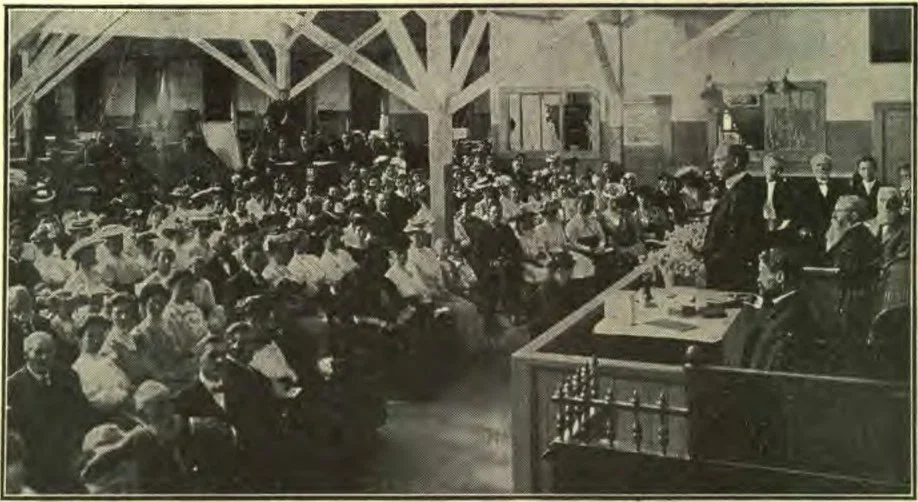
A goodly congregation gathered in our factory on seats improvised for the occasion to attend the dedication of the building and its equipment.
The chairman opened the exercises with a few appropriate remarks in which he said: "This institution stands for a very definite object and a very definite work." Elder Knox read from the Scriptures Matt. 7:24-27, Ps. 127:1, and 121:1-8. Following this Elder J. O. Corliss led the congregation in prayer. A double male quartet sang a song that was written for the occasion by Brother Max Hill. The words of this song are found elsewhere in this issue. A quite full report of the remarks that were made on the occasion are in the following columns.
A number of the prominent citizens of the town showed their interest by being present, and making remarks commendatory to our work.

History and Work of the Institution.

By C. H. Jones.
THE Pacific Press Publishing Company was incorporated under the laws of the State of California, April 5, 1875, and the following year a factory was erected at the corner of 12th and Castro Streets, Oakland.
Prosperity attended the work. The institution grew. New buildings were added from time to time, and the Pacific Press came to be recognized as one of the largest and best equipped publishing houses west of Chicago.
In October, 1888, a branch office was established in the city of New York; and in August, 1889, another branch was opened in London, England.
Both of these branches were successfully operated for several years, but were finally turned over to local organizations.

Commercial Work.

In addition to issuing our own denominational publications, a large amount of commercial work was done. As the years passed by, it became evident that this commercial work was interfering to a great extent with our own denominational business. At a meeting of the stockholders held in Oakland, April 28, 1902, this matter was carefully considered, and a resolution adopted instructing the Board of Directors to curtail the commercial work, to sell the real estate in Oakland, and to move the plant to some rural place away from the noise and confusion of the large city where the surroundings would be more congenial to our employees.

Moving the Plant.

In harmony with this resolution, and after thorough investigation, it was finally decided to locate in Mountain View. Five acres of land were donated to us by the citizens, a fine, large brick factory was erected, and the whole plant moved to this place in the autumn of 1904—just three years ago. It was a tremendous undertaking and the move was made at great expense.

The Great Earthquake.

The past three years have been eventful ones. Just as our plant here at Mountain View was getting into good running order, the great earthquake of April 18, 1906, came. The brick walls of our factory were thrown down, but, providentially, the roof was left standing and the machinery remained intact. Temporary walls were put up. Within an hour after the usual time of opening, business was being carried on about the same as usual.
View of the Congregation and a Corner of the Interior of the Factory while the Dedication Was in Progress.
We believe that this calamity came to us as a warning, but the warning was not heeded. In moving the plant to Mountain View it was with the avowed purpose of cutting out commercial work and devoting our whole time and attention to denominational business, but this was not done. The fact is, commercial work kept increasing right along, and interfered materially with our regular denominational work. After the earthquake the conditions were aggravated. Commercial work came in like a flood and claimed the largest part of our attention.

Consumed by Fire.

Only a few short weeks, however, were we allowed to go on in this way, for on the evening of July 20, 1906, our entire plant was consumed by fire, entailing a loss of about $200,000. The loss was appalling. Not only was our beautiful factory laid waste and our entire stock of paper, books, machinery, etc., destroyed, but nearly two hundred employees were thrown out of employment without a moment's notice.
Never will we forget the sensation that came over us that night as we stood helplessly looking on—there being no water with which to fight the flames—and saw the building consumed inch by inch; we hope we will never be called to go thru such an experience again.

A New Date from Which to Reckon Important Events.

It has been said that in the South, after the close of the Civil War, they took a new date from which to reckon all important events, and that was so many months or so many years "before the surrender" or "after the surrender." They had staked their all upon the outcome, and, having lost, they had to face a new situation and grapple with new difficulties.
So with us, only we have two dates from which to reckon important events: one is from the earthquake, April 18, 1906, and the other from the fire, July 20, 1906.
July 21 was a dark day. Altho the sun shone as brightly as usual, all nature seemed to be covered with a pall. There were the smoking ruins of our once splendid factory; here were nearly two hundred employees thrown out of employment; and there were hundreds of our faithful canvassers in the field waiting for books. The situation was desperate. It was enough to make the stoutest heart quail. However, notwithstanding the fact that the buildings were in ruins, we knew very well that the institution still lived in the hearts of our people and that the work would go on.

Plans for Continuing the Work.

But not a moment was to be lost. Before the embers had cooled, or even the fire had stopped burning, a meeting of the Board of Directors and leading brethren was called, and definite plans outlined for carrying on the work.
Arrangements were at once made with other printing-offices to print the SIGNS OF THE TIMES and Our Little Friend, two of our weekly publications. Brother B. R. Nordyke, an experienced bookman, was sent to Kansas City and Chicago to arrange for printing and binding our subscription books to supply our canvassers; and work was at once begun on temporary buildings to house what little of new material we were able to secure.
It must be remembered that only three months before this every printing-office in San Francisco had been destroyed, and we were told that it would be impossible to secure machinery, but within a few weeks we had in operation two large cylinder presses, one job-press, two linotype typesetting machines, paper-cutter, folding-machine, wire-stitcher, etc., so that we were able to print and bind our regular periodicals as well as some other work.
The day after the fire every employee was interviewed, and definite arrangements were made with each. Some secured work in near-by offices; some took long-looked-for vacations; and some were employed on the temporary building. But all that left went away with the understanding that they would return on call.

Expressions of Sympathy.

Telegrams and letters of condolence, expressions of sympathy and offers of assistance, came pouring in from every quarter, and we were urged to rebuild at once. The good people of Mountain View called a public meeting and adopted resolutions expressing their sorrow and sympathy and urging us to rebuild, promising material assistance. All these things were a source of great encouragement to us.
But, before taking any steps toward rebuilding the factory, it was thought best to call a special meeting of the stockholders and friends of the institution to consider the whole question.

Stockholders' Meeting.

This meeting was held at this place on Monday, September 10, 1906, and by a unanimous vote it was decided to rebuild the factory here in Mountain View at once.The plans for a new factory had been carefully drawn, and with slight changes were approved by the stockholders. The work of clearing away the débris and putting up the new building on the old foundation began at once. Brother A. O. Tait was requested to superintend the erection of the factory. He will explain to you in detail the manner of construction, and Brother H. G. Childs will tell you the cost.

The Lesson to Be Learned.

We think that one of the lessons the Lord wanted us to learn by this terrible calamity was that we should not have a divided interest, but that we should devote our whole time and attention and all our facilities to denominational business, and have nothing more to do with commercial work in this institution.
In harmony with this thought, the following action was taken at a meeting of the Board of Directors held soon after the fire:
"Whereas, Giving the last Threefold Message to the world demands the best energies and the undivided attention of God's people, more especially of those directly engaged in its organized work; and,
"Whereas, This office was established for the purpose of giving this message to the world; and,
"Whereas, Whatever may have been expedient in the past, the time now demands that all the facilities of the office and the talents, energies, and ability of its employees be devoted solely to the work for which the institution was established;
"Therefore, Be it resolved that from henceforth commercial work shall be eliminated from the office of the Pacific Press, and that by commercial work shall be understood all work outside the regular organized work of the message, or such work as shall not be approved by the publishing committee of the institution."

Great Prosperity.

Some thought that in taking this action the Directors were a little too radical, and feared that we would not have work enough of our own to keep the plant running. But how has it turned out?—Altho our facilities are practically the same as they were before the fire, they have been taxed to the utmost and it has been almost impossible to meet the demand. In fact, we have been obliged to get a large amount of our work done in outside offices, simply because we could not handle it ourselves.
The circulation of our weekly paper, the SIGNS OF THE TIMES, has increased from about 14,000 to nearly 50,000 copies.
Our subscription book work has advanced by leaps and bounds. Never before have we seen anything like it. Here at the home office our sales last year amounted to about $74,000, and we thought that a very good record. But the first eight months of this year the sales amounted to over $100,000, and we still have four of the best months of the whole year to go on. For several weeks past we have been turning books out of our bindery at the rate of about seven hundred per day.

Books Issued since the Fire.

For the first six months after the fire we were greatly handicapped and carried on our work at great disadvantage, being housed in a small temporary shed. About six months ago we moved into this new factory, altho it was not finished by any means. For several weeks the carpenters, painters, printers, and binders were working here together. But notwithstanding all this we have, during the past year, printed and bound over 150,000 cloth and leather-covered books, and over one million tracts and pamphlets.
Besides this we have printed during this same time nearly two million copies of our weekly paper, the SIGNS OF THE TIMES, and one million copies of Our Little Friend, a weekly paper for the children.
During this same period we have had printed and bound for us in other offices over 60,000 copies of subscription and trade books.
We now have in hand, to be completed within the next six months, nearly one hundred thousand subscription and trade books.

Amount of Stock Used.

During the past year we have purchased nearly forty car-loads of paper, amounting to about $40,000, and $7,000 worth of binders' material. We have just placed an order for five car-loads of paper for the Missions Number of the SIGNS OF THE TIMES soon to be issued.

Branch Offices.

We have established branch offices at Kansas City, Mo., Portland, Ore., and Regina, Saskatchewan, Can. Brother H. H. Hall, manager of the Book Department, will tell you something of what these branch offices are doing.

Equipment.

We have a well-equipped factory, embracing the following:
Two modern linotype typesetting-machines. Five cylinder presses, one large rotary Web perfecting press, and three job-presses. A complete electrotype foundry, and a splendidly-equipped bookbindery, with two book sewing-machines, two folding-machines, two embossing-presses, and other necessary machinery. All our machines are run by electric motors, and we have a plant of our own for generating electricity.
We also have a good corps of earnest, faithful, skilled employees that can be depended upon in every emergency.
We have attempted to give you only a very brief history of the institution and its work, but we can truly say that notwithstanding the terrible calamity that came upon us a little over a year ago, the Pacific Press was never in a more prosperous condition, and never was the outlook brighter and more encouraging than it is at the present time. The Lord has blessed the work wonderfully. He has given us the sympathy and the hearty cooperation of our people and the good-will of the public generally; and, out of what seemed to us at the time to be a great calamity, the Lord in His goodness and mercy is bringing a great blessing, and to Him be all the praise and glory.
Continue reading: Our Branch Offices