The Youth’s Instructor, Vol. 38, No. 25.

A SPRING MORNING

The Youth’s Instructor

Jun 18, 1890

S. D. A. Publishing Association · Battle Creek, Mich. · Jun 18, 1890

A SPRING MORNING.

TRANSLATED FROM THE SWEDISH BY D. OMAR BELL.
On every hand the eye is met by tender, transparent green, full of growth and life. The leaves of the linden glisten with sap, and the light plumes of the birch wave their soft forms in the morning breeze. The cherry-trees are over-laden with white blooms, and here and there flowering shrubs hold aloft their giant bouquets over a carpet of green. In the quiet depths of the valley winds the brook, gurgling between alders and willows, and on its banks stand myriads of golden primulae. It is spring, and the rays of the sun are as mild as the soft glance of a child's eye. Far and near the birds seem to sing:—
But lately lay the snow, On forest, mead, and moor, But the warmth of spring-time's sun Has melted the covering white.
Now every bud is swelling, And every leaf expanding, To feel the freshening warmth Of the morning sun so clear.
The wood anemone No longer stands alone, But in its sylvan solitudes Has bright companions won.
What brilliant colors gleam From mountain, dale, and moor, What warmth and light and gladness Are reigning everywhere.
A ringing laugh is heard in the grove. Two light-haired children, a boy and a girl, are having their morning romp, and at every new flower that they discover, they clap their hands, and laugh with heart-felt joy. They sit on the tufts of grass and braid wreaths, but hardly have they begun their work before they hurry off, and forsake the flowers they have already plucked for those who still bear their heads high, and nod from their long, graceful stems. And still more impetuous is their joy when a sudden gust of wind shakes down a shower of cherry-blooms, filling their silky hair with white petals, which are immediately strewn to the winds again by the chubby hands. Here comes a butterfly, and they dart off in vain attempts to capture him. This way and that they chase their little game without being able to reach it, and when at last the winged fugitive disappears behind a bush, he is almost instantly forgotten.
A few leaves broken off by the wind fall into the brook, and to the childish imagination they are immediately changed to ships, with swelling sails. The children follow along the bank, and are greatly amused when one of the miniature crafts dances about in a whirlpool. They fancy they hear the ship's people cry, and wave their farewells, as the ship plunges down the waterfall, and disappears in the foam beneath.
Great raindrops begin to fall, and the children look around much alarmed, for a cloud has quickly hidden the sun. Soon the rain pours down, and the children, crying, seek refuge under a tree, which for a time gives them good shelter, but soon shakes down the cold water upon their trembling shoulders. Before long, however, the sun beams forth anew, and sorrow flees with the hurrying cloud. As birds after a shower shake their wings, and dart off through the clear, blue air, so the children hurry out into the sunshine again without a thought of the little sorrow which so recently filled their hearts. The changes of the child's mind are like those of the spring,—sun and joy, for the most part, and if a cloud of sorrow sometimes comes, it disappears as quickly as it came.

LITTLE CORNERS

GEORGIA WILLIS was rubbing the knives. Somebody had been careless and let one get rusty, but Georgia rubbed with all her might; rubbed, and sang softly a little song, “In the world is darkness, so we must shine; you in your little corner, and I in mine.”
“What do you rub at them knives forever for?” Mary said. Mary was the cook.
“Because they are in my corner,” Georgia said, brightly. “‘You in your little corner,’ you know, ‘and I in mine.’ I’ll do the best I can, that’s all I can do.”
“I wouldn’t waste my strength,” said Mary. “I know that no one will notice.”
“Jesus will,” said Georgia, and then she sang again, “You in your little corner, and I in mine.”
“This steak is in my corner, I suppose,” said Mary to herself. “If that child must do what she can, I s’pose I must. If He knows about knives, it’s likely he does about steak,” and she broiled it beautifully.
“Mary, the steak was done very nicely to-day,” Miss Emma said.
“That’s all along of Georgia,” said Mary, with a pleased, red face, and then she told about the knives. Miss Emma was ironing ruffles; she was warm and tired with extra work.
“Helen will not care whether they are fluted nicely or not,” she said; “I’ll hurry them over;” but after she heard about the knives, she did her best.
“How beautifully my dress is done,” Helen said, and Emma, laughing, answered,— “That is owing to Georgia;” then she told about the knives.
“No,” said Helen to her friend that urged, “I really cannot go this evening. I am going to prayer-meeting; my corner is there.”
“Your corner! what do you mean?” Then Helen told about the knives.
“Well,” the friend said, “if you will not go with me, perhaps I will go with you,” and they went to the prayer-meeting.
“You helped us ever so much with the singing this evening.” That was what their pastor said to them as they were going home. “I was afraid you would not be there.”
“It was owing to our Georgia,” said Helen; “she seemed to think she must do what she could, if it was only knives.” Then she told him the story.
“I believe I will go in here again,” said the minister, stopping before a poor little house. “I said yesterday there was no use, but I must do what I can.” In the house a sick man was lying; again and again the minister had called, but he wouldn’t listen to him; but to-night he said, “I have come to tell you a little story.”
Then he told him about Georgia Willis, about her knives, and her little corner, and her “doing what she could,” and the sick man wiped the tears from his eyes, and said,—
“I’ll find my corner, too; I’ll try to shine for Him.”
And the sick man was Georgia’s father. Jesus, looking down at her that day, said, “She hath done what she could,” and he gave the blessing.
“I believe I won’t go to walk,” said Helen, hesitating. “I’ll finish that dress of mother’s. I suppose I can if I think so.”
“Why, child, are you here sewing?” her mother said; “I thought you had gone to walk.”
“No, ma’am; this dress seemed to be in my corner, so I thought I would finish it.”
“In your corner?” her mother repeated, in her surprise, and then Helen told about the knives.
The door-bell rang, and the mother went thoughtfully to receive her pastor.
“I suppose I could give more,” she said to herself, as she slowly took out the ten dollars laid aside for Home Missions. “If that poor child in the kitchen is trying to do what she can, I wonder if I am. I’ll make it twenty-five.”
And Georgia’s guardian angel said to another angel standing by,— “Georgia Willis gave twenty-five dollars to our dear people in Iowa to-day.”
“Twenty-five dollars?” said the other angel. “Why, I thought she was poor.”
“Oh, well, she thinks she is, but her Father in heaven isn’t, you know! She did what she could, and he did the rest.”
But Georgia knew nothing about all this, and the next morning she brightened her knives, and sang, cheerily,—
“In the world is darkness, So we must shine,— You in your little corner, And I in mine.” —Pansy.

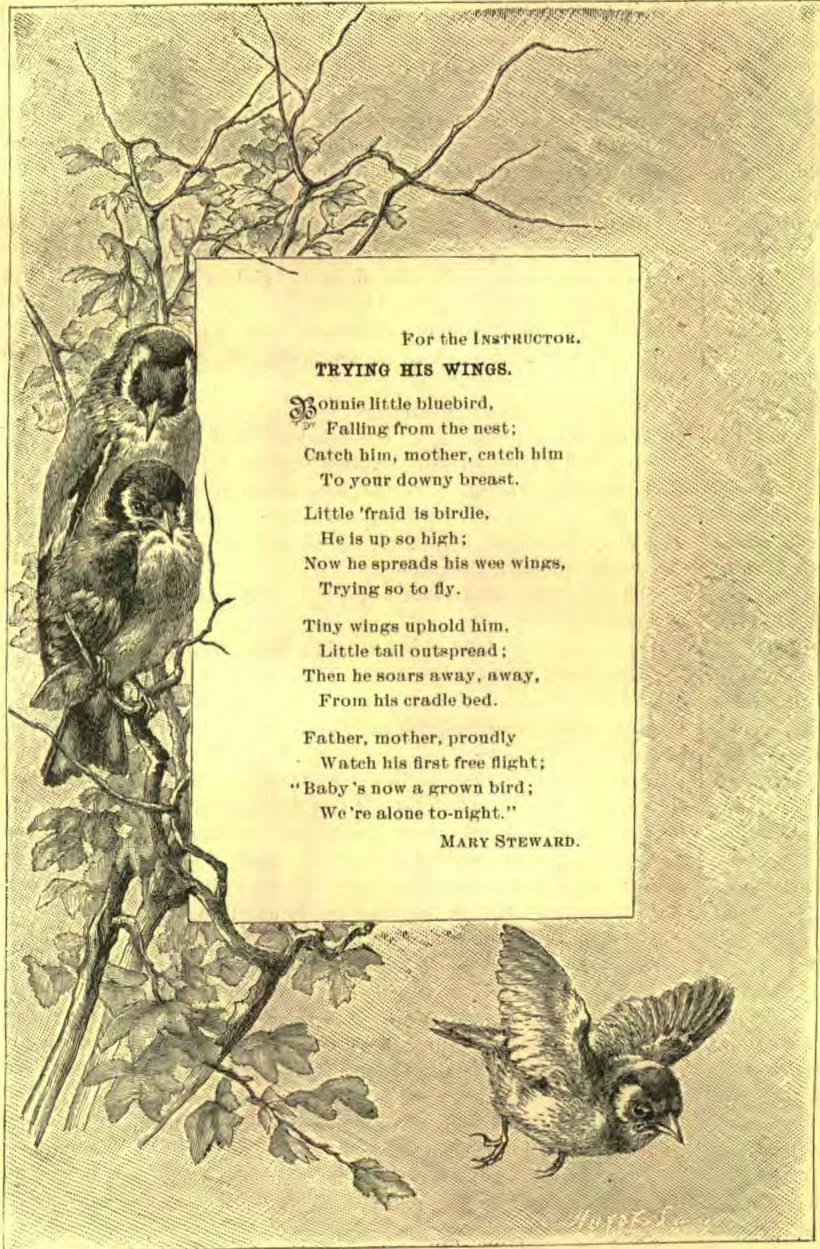
TRYING HIS WINGS

For the INSTRUCTOR.

TRYING HIS WINGS.

Down little bluebird, Falling from the nest; Catch him, mother, catch him To your downy breast.
Little 'fraid is birdie, He is up so high; Now he spreads his wee wings, Trying so to fly.
Tiny wings uphold him, Little tail outspread; Then he soars away, away, From his cradle bed.
Father, mother, proudly Watch his first free flight; "Baby's now a grown bird; We're alone to-night."
MARY STEWARD.

DEEP-SEA FISHING.

There is a fascination about deep-sea fishing that is unknown to the shore fisherman. Deep-sea fish vary in weight from one hundred to two hundred pounds, and, at great depths, the bite of even the largest can hardly be perceived, because of the strong under-current. About nine miles to the southwest of the island of St. Helena, for instance, is one of the finest fishing banks in the world, upon which can be caught over ninety varieties of deep-sea fish, but owing to the danger of being unable to return to the island on account of head winds and contrary currents, no boats are sent out from there.
Among the fish caught is the “soldier,” bright scarlet and gold, a beautiful fish, and delicious eating; but woe to the luckless fisherman who has his hand punctured by the deadly back fin! The agony from the poison is simply intense. This fish is found only in deep fissures of rock, or “soldier holes,” as the fishermen call them. If the fisherman happens to drop his sinker into one of these, he can often catch fish freely, while a companion may fish all day outside, and not have a bite.
There is generally a miserable little fish in all deep-sea fishing-grounds. It is called a “sea worm,” and is like a scorpion. It winds around the bait, leaving on it fine hairs, something like the down on thistles, and then no fish will take the bait, no matter how tempting. Novices are often puzzled at seeing others catch fish while they never receive a nibble, but “old salts” suspect the trouble at once, and renew the bait.
Then there are the speckled conger, bird’s-eye conger, and green conger, always found on rocks at good depths. Their prey is the beastly octopus. A deep-sea fisherman is always glad to catch a conger, because at any moment he is liable to hook an octopus, or Devil fish, which, when it is hauled in, will, if possible, throw its arms around the bottom of the boat, and hold on so firmly that the line must be cut, or the hook broken, to get rid of it. A conger is a terror to an octopus; for the teeth of the conger are sharp as razors, and it pursues its prey, and cuts its arms off even and smooth with its body. If a conger, dead or alive, is fastened to a line, and lowered overboard, the octopus will let go quickly, and send off at the top of his speed.
The cod is another deep-sea fish, and with the albicore and bonito, well known to sailors, is among the best table fish if caught off of “soundings,” but is apt to be coarse if caught at sea. On rocks or soundings, these fish feed on mackerel, and then their flesh is extremely sweet and tender, and they can be fried in their own fat. They migrate in pursuit of the flying fish, which they chase for hundreds of miles. While feeding on these, their flesh grows coarse, dry, and unpalatable. The writer has seen thousands of albicore and bonitos chasing millions of flying fish for days, so that the sea would be literally alive with fish in every direction, so far as the eye could see.
About three months in the year the pretty red fish with a very large eye, called the bull’s eye, frequents the coasts near the equator. It feeds only at night, and a light must be used. It is very delicate and highly prized.
Mackerel fishing is practised more with hook and line than with net, and in some places, as in the banks of St. Helena, the waters sometimes literally swarm with them. One party caught fifty dozen in one night. Most of the places where these fish and the cod abound, are dangerous spots for small vessels, hence net fishing has not come into general use. The fishing banks of St. Helena alone are mines of wealth to enterprising fishermen, but for fifty years since their discovery no one has attempted to utilize them, though they excel the fishing banks of New Foundland. W. B. C.

COWARDS

“I THINK Indians are cowards; and I don't want to read anything more about them; so there!” And with a bang, Harry shut the book he was reading, and his eyes flashed scornfully.
“Why, what is the matter now?” said his astonished sister Bess, looking up from her sewing. “I'm very sure that a boy of my acquaintance walked half a mile through the rain yesterday to borrow that very book.”
“I know I did,” he replied, “and it is interesting enough, but it makes me vexed to read about the Indians torturing their prisoners. It seems to me that if they had had any manhood or true courage, they would never have done it. I tell you, Bess, one's strength should be used to protect the defenseless, and not to injure them; and no one but a coward would abuse helpless beings entirely within his power.”
“Right noble sentiments,” said Bess, “and I am proud of my brother for expressing them. But are you sure you really think so?”
“Why, surely I wouldn't say so if I didn't mean it.”
“I suppose not,” said his sister. “But will you oblige me by committing that last statement of yours to writing?” and as she spoke, she took from the table a pencil and sheet of paper, which she handed him.
“Why?” he asked, in surprise.
“Oh, just to please me. I think your words were, ‘No one but a coward would abuse helpless beings entirely within his power.’ Write them down, please.”
“Certainly, if you wish it, but I haven't the least idea what it is for.” He took the pencil, and dashed the words off onto the paper.
“Thank you,” said Bess, folding it, and putting it in her pocket.
Harry was very fond and proud of Bess; and since she had come home from college, he looked up to her as knowing almost if not quite everything. But he thought she had some queer notions, “girl's notions” he called them.
A few days after this, as Bess was strolling through the garden, she heard shouts of boyish laughter issuing from the orchard where Harry and a companion were playing. She smiled as her ear caught the glad sounds, and she turned her steps in that direction. But the expression on her face suddenly changed, as she saw the cause of their merriment.
The boys had caught a rabbit, and tied a string to its leg, the other end of which Harry held in his hand. When the frightened animal ran to the end of the string, Harry would pull it back again, and then the operation was repeated. It stood there, the personification of terror, its eyes almost starting from its head in fear, while its body quivered with the beating of the agonized little heart.
“Now, Bess,” said Harry, as he caught the look on her face, “you needn't preach. We're not hurting him a bit; only scaring him a little.”
“I don't intend to preach this time; I shall just read to you”; and she took a paper from her pocket, and read: “No one but a coward would abuse helpless beings entirely within his power.”
“Well, but you see, Bess, you're on the wrong track this time; for we're not abusing him.”
“Do you remember,” was the reply, “telling me about the man whom the Indians captured, tied to a tree, and fired at? You said that each Indian shot as near him as he could without hitting him. They did not intend to hurt him at all, simply to frighten him. I remember how your eyes flashed, and your cheeks burned with anger, as you told me the story. I think you said you thought that only low, brutal natures could take pleasure in a thing like that.” Harry stood motionless, not knowing what to say; for he had used those very words. He wished Bess hadn't quite so good a memory. He was really ashamed of himself, but, boy-like, was determined not to show it.
“I'll tell you what,” said he at last, “If you won't make any more fuss about it, I'll let the rabbit go this time;” and so saying, he cut the string, and with one bound the animal disappeared from sight.
Thus it came to pass that whenever Harry tormented the cat or plagued the dog, the paper was produced, and he was condemned by the words he himself had written. It set him to thinking; he had never dreamed before that he was so much like the savage Indians, of whose cruelties he could not even bear to read; but the more he thought it over, the more striking did the resemblance seem. They abused their helpless victims; so did he, only his victims were weaker and more helpless than those of the Indians.
Finally he said to his sister, “If you will throw that paper into the stove, I will promise never to tease a dumb animal again. It is not exactly pleasant to be called a coward, especially when a fellow has it in his own writing.”
“Agreed,” said Bess, tossing the paper into the fire, “but remember, Harry dear, that cruelty and cowardice always go together.”
He made no reply, but in his heart he knew that it was so. VIOLA E. SMITH.

LEND A HAND.

“Look up and not down!” Do you see how the tree-top rejoices in sunshine denied to its root? And hear how the lark, gazing skyward, is flooding the world with its song, while the ground-bird is mute?
“Look out, and not in!” See the sap rushing outward! In leaf, bud, and blossom all winter it lay, imprisoned, while earth wore a white desolation; now nature is glad with the beauty of May.
“Look forward, not back!” ’Tis the chant of creation, the chime of the seasons as onward they roll; ’tis the pulse of the world, ’tis the hope of the ages, ’tis the voice of our God in the depths of the soul.
“Lend a hand!”—Like the sun that turns night into morning, the moon that guides storm-driven sailors to land. Ah, life were worth living with this for the watchword, “Look up, out, and forward, and each lend a hand!”
—Selected.

JESSIE'S IMPORTUNITY.

“Mamma, what does importunity mean?” Jessie looked up from her Bible lesson, and waited for mamma’s reply.
“Importunity means urgent request; continual asking for a thing,” replied the mother.
The puzzled look on Jessie’s face lifted a little, and she read, “‘I say unto you, though he will not rise and give him because he is his friend, yet because of his importunity he will rise and give him as many as he needeth.’ Does that mean because he asks over and over?”
“Yes, dear, it means that if the man wanted the bread very much, he would ask earnestly, and his friend could not resist the pleading.”
“I suppose like papa, when I ask him for things,” said Jessie; “he can’t say ‘no,’ when I want things very much. This morning when I went to the office to ask for some money for skates, he was writing, and when I spoke to him, he kept right on writing. I said, ‘Papa,’ and he never looked up; then I said louder, ‘Papa,’ and he kept on with his writing; then said, ‘Papa! will you give me some money to buy a new pair of skates?’ but he didn’t look up. Then I shook the table just a little, and I could see a funny little smile that didn’t show much, but I knew if I kept on, it would come out, and it did. Papa just leaned back and laughed, and said:—
“‘What a persistent little girl you are!’ Then he gave me the money. Was that the same as if he had said, ‘because of your importunity’?”
Mamma smiled upon her little daughter. “Yes, Jessie; I think you understand what importunity means as well as any little girl I know of.”
“Then Jessie turned back to her Bible, and read: ‘Ask, and it shall be given you.’ Mamma does that mean that God will give us whatever we ask, if we ask in earnest?”
“Read on a little,” said mamma.
And Jessie read until she came to the verse, “If ye then, being evil, know how to give good gifts unto your children, how much more shall your heavenly Father give the Holy Spirit to them that ask him?”
“But, mamma, you have told me to ask for other things, and I have a great many times, for something that I wanted very much, and God has given things to me when I have asked.”
“Yes, dear, Jesus taught us to ask for our daily bread, and that means all of our needs, and he does hear and answer us; but I think he means to teach us that we may ask for the gift of the Holy Spirit to lead us, and if we ask earnestly, we shall certainly receive it, for it is according to his will.
“When we ask for other things, we do not certainly know that what we ask for will be good for us, and we ought always to say in our hearts, ‘if it be thy will.’ Sometimes we wonder why God does not hear and answer us, and give us the things we have been asking for; but perhaps we have been asking for something that would harm us, and so God withheld the gift out of love.—Selected.

The Art of Forgetting and Overlooking

The art of forgetting is a blessed art; but the art of overlooking is quite as important. And if we should take time to write down the origin, progress, and outcome of a few of our troubles, it would make us so ashamed of the fuss we make over them that we should be glad to drop such things and bury them at once in eternal forgetfulness.

Who Likes the Rain?

“‘I,’” said the duck. “I call it fun; For I have my little red rubbers on. They make a cunning, three-toed track In the cool, soft mud—quack, quack!”
“I!” cried the dandelion. “I! My roots are thirsty, my buds are dry.” And she lifted a towzeled yellow head Out of her green grass bed.
“I hope ’twill pour! I hope ’twill pour!” Purred the tree-toad at his gray bark door. “For with a broad leaf for a roof, I am perfectly water-proof.”
Sang the brook: “I laugh at every drop, And wish they never need to stop, Till a big, big river I grew to be, And could find my way to the sea.”
“‘I,’” shouted Ted, “‘for I can run, With my high-top boots and rain-coat on, Through every puddle and runlet and pool I find on the way to school.”
—Mrs. Clara Doty Bates.

TOMMY'S DREAM.

Tommy had been to the school treat, away out from the dirty, crowded, hot streets in which he lived, into the beautiful, green, fresh country.
And Tommy had enjoyed the treat; but I am afraid that many of the butterflies and other insects, and some of the birds, too, had cause to grieve that Tommy and his mates had been there to a treat—it was none for them. A great part of the day Tommy had spent in what he thought good fun. He had chased beautiful butterflies, but after he had caught them, he could do little with them. They were a source of amusement to him for a short time, and then he let them flutter away, with spoilt and broken wings. He had tried to capture the large bees which he saw flying about, but as he laid hold of one, it stung him; so, thinking himself badly used, he let go. Then he had frightened many of the birds by throwing stones at them—only, fortunately, he aimed badly, and never hit his mark! And when he and some of his companions, wandering through the green fields, had come across a large scaly beetle, he had seized it, and in spite of its struggles, had put it in his pocket.
And now Tommy was back from the treat and in bed.
He had not long fallen asleep when he seemed to be again in the fields in which he had played all day. But all the butterflies, and bees, and beetles, and birds seemed to have changed places with him in point of size; for they appeared as large as boys, and he as small as a beetle, and Tommy was terribly frightened.
“Oh!” he thought, “I must hide under the sticks, or those great creatures will catch me! Oh dear, I wish I were at home!” for Tommy was frightened.
So he quickly hid under some small sticks, until all the butterflies and other things should go away, but it was no use. Soon he felt the sticks lifted, and heard something scream out; he did not know what the thing was at first, for he dared not look up.
“Oh, oh! come and look; here's such a funny thing. Four legs, and it only walks on two of them! and such a funny head!”
Then Tommy felt himself snatched up and pinched; and, screaming and struggling, he looked up at the thing that held him. It was a beetle, of gigantic size, it seemed to him.
“Oh!” screamed the beetle again, “come and see what I've caught! Such a funny thing; whatever is it?”
“What have you got?” asked a butterfly, about one hundred times Tommy's size, flying up.
“Why, look here! I don't know what it is.”
“Oh!” said the butterfly, “it's only a boy. They are common enough. If you didn't live so much under the ground, you'd know a boy when you saw him. That's only a little one, but I've seen big ones, and I've good cause to remember them, too; they've chased me often enough.”
The butterfly spoke very fiercely for such a gentle creature, and Tommy trembled.
“A boy!” shrieked the beetle—“a boy! I know something about them, only I didn't know this was one. Ugh! you little brute,” shaking Tommy, “you are a boy, are you? I'll pinch you.” And the beetle did, and Tommy screamed and kicked; but the beetle held him tight.
“What's on here?” asked a passing bee. “What have you got?”
“Oh, only a boy,” said the butterfly, “and we're only going to pinch him to see him kick.”
“Oh, oh!” screamed Tommy, “you cowards! You wouldn't dare to do it if I were not so small;” but the insects took no notice of his cries.
“Here, hand him over to me,” said the bee; “I owe boys a grudge; let me sting him.”
“Wait a bit,” answered the beetle; “let's have some fun with him first. You'll kill him if you sting him.”
“Not I. Besides, boys can't feel.”
“They can! they can!” shrieked Tommy; but no heed was paid to his words.
Just as the bee was about to sting its shrieking victim, a linnet (to Tommy it seemed about the size of an eagle) flew up. The butterfly flitted away sharply, and the bee suddenly became impressed with the necessity of going also, and went. Only the beetle remained, holding Tommy tightly still; for the beetle knew that its scaly coat would protect it against the linnet. But the bee and the butterfly had not such protection.
“What have you got?” asked the linnet.
“A boy. I owe boys a grudge, so I am pinching him;” and the beetle squeezed Tommy again.
“Will you give him to me? I'd like to take him somewhere,” said the linnet.
So the beetle dropped Tommy, who was now quite sore, and the linnet lifted him in its beak.
Dreams are funny things. The linnet seemed suddenly to be in the room of a house, and Tommy saw it was his own bed-room.
“What's the matter?” squeaked a funny voice. It was Tommy's white mouse speaking; for Tommy kept a white mouse.
“Why,” said the linnet, and it seemed quite friendly with the white mouse, “I've caught a boy. What shall I do with him?”
“A boy! Let me look,” said the white mouse, and added fiercely, “why, it's Tommy!”
“Yes, please, Mr. Mouse,” said Tommy, “it's me. You know me, don't you?”
Tommy was afraid of the white mouse, it seemed.
“Know you?” screamed the mouse. “I've good reason to know you! Yes! and now I'll make you know me.”
“Please, Mr. Mouse,” began Tommy; but the white mouse interrupted him.
“Know you? You're the boy that fastened me in a cage without any food, and I was hungry. Worse! I was thirsty, and all the water was dried up. My cage has been left unclean for weeks. Know you? Yes! and now you shall know me!”
The white mouse rushed fiercely at Tommy.
But suddenly Tommy awoke, and he was lying in bed.
“Dear me!” he murmured, “what an awful dream I've had! I declare, I'll never hurt anything again. And when I get up, I'll feed my white mouse. I forgot him yesterday.”
For Tommy had been so full of the treat the day before that the white mouse had been neglected. In fact, Tommy often neglected it.
Then he dressed, and went to the cage to attend to the little creature. But the little mouse was dead.
“Oh, dear,” cried Tommy, “I must have forgotten it for two days! I'll never be so cruel again to anything.”
And he kept his word.—English Band of Mercy.
Continue reading: THE LOST CHILDREN'S ROOM