The Youth’s Instructor, Vol. 38, No. 25.

A SPRING MORNING
Earlier text: A SPRING MORNING

THE LOST CHILDREN'S ROOM.

On the top floor of a great building in New York is a pleasant room. It has a row of little beds all along one side, and a row of little chairs along another, and there are a few toys and some birds in cages, and the sun streams in at the windows all day long. And there lives one of the pleasantest, cheeriest, kindliest old ladies that you ever saw. Her name is Matron Webb, and this is the “Lost Children's Room,” of New York City.
None of you were ever there, I am sure, and I hope that none of you ever will be, pleasant though it is; for it is not pleasant to be lost, and only lost children go there.
But when a little child does get lost, is it not a very happy thing that there is such a pleasant place for them? Little Robbie MacGregor found it so one day, as I am going to tell you.
Robbie and his mother had only lately landed in New York. They had come in a great ship all the way from Scotland to join Robbie's father, who had come to America a year before. He had sent money for Robbie and his mother to come, and had promised to meet them at the steamer.
Robbie did not know who was that strong, kind man who came to meet them when the ship landed; for a year is a long time to a little Scotchman of three, and Robbie had forgotten how his father looked. But when he saw his mother spring forward, and throw her arms around him, he knew then that it must be his father, and he was very glad to have the kind-looking man take him up in his arms, and carry him off the ship.
Robbie's father took them to their new home. It was only two rooms in a great house, but the rooms were clean, and had pretty furniture in them, and there was a beautiful hobby-horse in the corner for Robbie. So the little man felt very happy.
But he was very tired, too, and the day was very warm; so his mother soon took off his clothes and put on his little plaid wrapper, and laid him upon the bed to sleep.
When Robbie waked up, he was all alone; for his father and mother had gone to the ship for the baggage. Robbie did not know where they were, and he thought he would go and look for them; so he climbed down from the bed, and went to the door. It was locked, and the key was gone; but when Robbie went to the other room, there was the key in the door, and the little fellow turned it, opened the door, and went down the stairs and out into the street.
It was very strange in the street, but Robbie was a brave little man, and he trudged along, looking into every face to see if he could meet his dear mother's loving eyes or his father's pleasant smile; but though the streets were full of people, not one of them was father or mother, and after awhile Robbie was tired.
He sat down with his back to a wall to rest. He did not cry, not he; but oh, how he did wish that mamma would come! But she did not come, and Robbie's poor little heart began to ache very hard.
Then a big policeman came and spoke to him. “What is your name, little fellow?” he asked, “and where do you live?”
“My name is Robbie Gregor,” said the little boy, “and I live in D'umfee's Lane.”
But the policeman did not know of any such street. Why should he, when it was way across the sea, in Scotland? And so he picked up the little fellow, and carried him to Mulberry Street, and into the great house, and up the stairs, and gave him to good old Matron Webb.
How kind the old woman was to the little boy! She gave him nice bread and milk, and bathed his little hot, bare feet, and showed him the birds, and gave him pretty things to play with. But little Robbie's heart was still heavy.
“I think I'll go to mother now,” he said at last, when sleepy-time came, and Matron Webb was turning down the sheets of a pretty little white bed.
“Bless his little heart!” said Matron Webb; “I wish you could go to her.”
There was a sound of feet in the passage, and the door opened, and there were mother and father! What a great bound Robbie gave, and how quickly he was in his mother's arms!
“So you knew where to look for him,” said Matron Webb, smiling, but looking sharply over her spectacles at Robbie's father.
“Yes,” he said, “I've been in America long enough to have heard of the Lost Children's Room, and of Matron Webb, too; and so, when we reached home, and found our little lad was gone, we lost no time, but came straight here. We are very thankful that there is such a place as this in this great crowded city.”
Now little Robbie has learned to stay quietly at home when mother goes away and leaves him.—The Child's Paper.

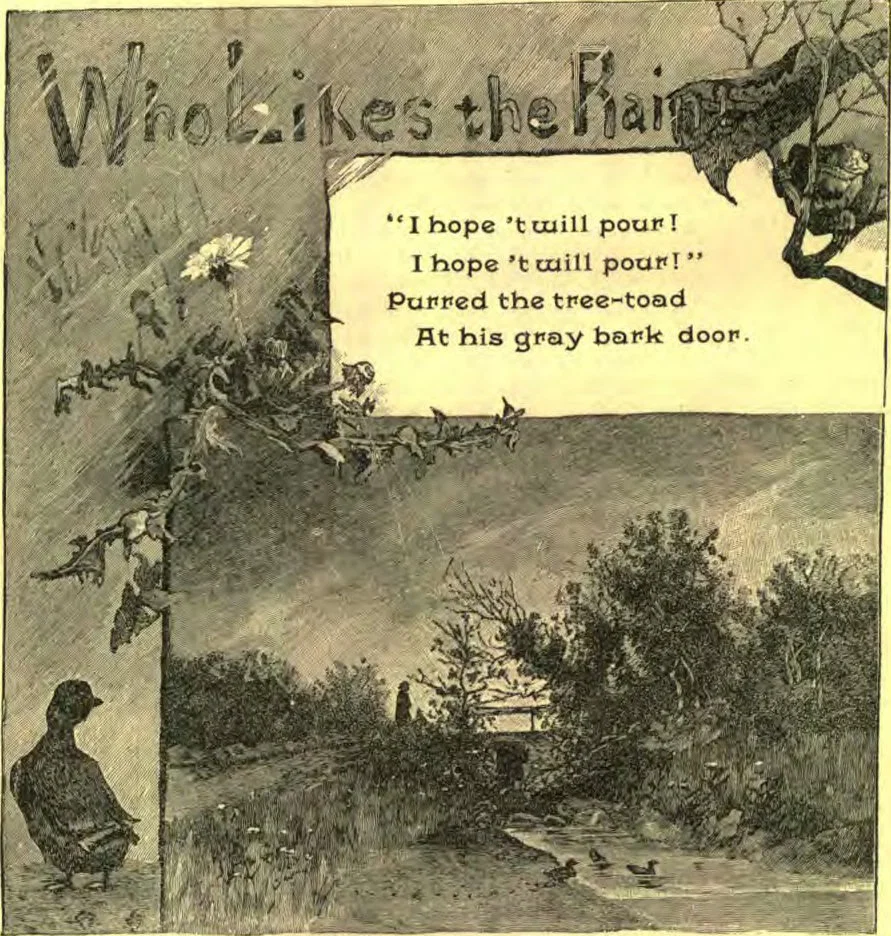
The Tree-Toad's Hope for Rain

“I hope ’twill pour! I hope ’twill pour!” Purred the tree-toad At his gray bark door.

DUTCH CURE FOR LAZINESS.

DURING a morning walk, a merchant who was detained by business in Amsterdam, came to a group of men standing round a well into which a strongly-built man had just been let down. A pipe, whose mouth was at the top of the well, had been opened, and a stream of water from it was flowing down into the well and beginning gradually to fill it. The fellow below had quite enough to do, if he did not want to be drowned, to keep the water out by means of a pump which was at the bottom of the well. The merchant, pitying the man, asked for an explanation of what seemed a cruel, heartless joke.
“Sir,” replied an old man standing near, “that man is healthy and strong; I have myself offered him work twenty times, nevertheless he always allows laziness to get the better of him, and will make any excuse to beg his bread from door to door, though he might easily earn it himself by work if he liked. We are now trying to make him feel that he can work. If he uses the strength which is in his arms, he will be saved; if he lets them hang idle, he will be drowned. But look,” continued the old Dutchman, as he went to the edge of the well, “the fellow finds out that he has got muscles; in an hour we shall let him out with better resolutions for the future.” Such was the case, and the cure was effectual.—Selected.

Korean Hats.

The author of “The Land of the Morning Calm” has a very interesting chapter on hats, from which we extract the following facts: Every Korean lad longs for the time to come when he can wear a hat. It is an important step, marking his entrance upon manhood. Before this, the lad’s coarse black hair is braided, and hangs in a single long queue down his back, the tip being tied up with black ribbon. The unhatted Korean boy looks like a girl, and is constantly being taken for one by foreigners, who do not know that Korean girls and women are not allowed to appear in public after seven years of age.
At seven years of age the boy may have his long tresses shorn off, and, twisting what remains “round a stick of coral or amber, that it may stand upright, he encases it safe, even from soap and water, within its nest of hats.” Seven is the earliest limit, but this change usually takes place before the boy is fourteen. It is the step into manhood, as was the donning of the toga virilis at Rome in ancient times. Another step, of little moment from the Korean stand-point, goes with the preceding act, namely marriage. To the boy this is the gateway of life. We will not say what it is to the girl, who merely passes from practical imprisonment in her father’s house, to still closer seclusion and absolute isolation from her mother in the house of her husband.
Having put on his hat, the Korean does not take it off. If he washes his face, his hat stays on. If he enters a house, he leaves his shoes outside, but his hat keeps its place. If he goes to bed at night, his inner hat, which is really a black silk skull cap in pyramidal form, cleaves close to his head. The outer, every-day hat is made of fine, split bamboo and silk. Its broad, circular brim is some eighteen inches across, and its conical crown is about four inches high, diminishing from five inches in diameter at the base to four at the top. This hat is of a glossy black color, and is kept in place by broad, black ribbons, tied under the chin. —F. H. Kasson.

SABBATH-SCHOOL LESSONS.

Beginning with the next quarter, July 5, 1890, the senior classes in our Sabbath-schools will again take up the study of Old Testament History, commencing at the point where we left off one year ago. The lessons for the quarter will embrace the following subjects:—
  1. The Death of Moses.
  2. Joshua Chosen and Set Apart.
  3. The Spies and Rahab.
  4. Crossing the Jordan.
  5. The Fall of Jericho.—Two lessons.
  6. Ai and Achan.—Two lessons.
  7. The Blessings and the Curses.
  8. The League with the Gibeonites.
  9. The Miracle at Gibeon.
  10. Israel in their Inheritance.
  11. Joshua’s last Words to Israel.
These lessons have been carefully examined by the Lesson Committee and many leading brethren, and are sent forth with the hope that they will be a means of accomplishing much good. As can be seen by the subjects announced, they cover a very interesting portion of Old Testament History.
In addition to copious notes, the attention of the student is frequently directed to Mrs. E. G. White’s latest work, entitled “Patriarchs and Prophets.” This book has just been published, and should be placed in the hands of every Seventh-day Adventist at once. Next to the Bible, the student will find this book the best help in the study of these lessons. The chapter on the “Death of Moses” is alone worth the price of the book.
The lessons will be published in pamphlet form as No. 59 of the Bible Student’s Library, uniform in size and style with the last series. Price five cents per copy, post-paid. Orders should be sent in at once.
Address Pacific Press Publishing Co., Oakland, Cal., or your State Tract Society.
C. H. JONES.

SPECIAL NOTICE.

SABBATH-SCHOOL LESSONS IN FOREIGN LANGUAGES.

At the last session of the International Association it was voted to publish the Sabbath-school lessons for senior classes in the foreign languages in pamphlet form, thus making them uniform with the lessons in English.
For the first two quarters of this year the lessons were published in that form, and handled by the Tract Societies, but the sales being so light, and the expense of translating and printing the lessons in this form so heavy, the International Association has already lost over four hundred dollars by the operation. It will therefore be absolutely necessary to make some changes at once.
Several plans have been suggested, but the most feasible one, and the one which we think will give the best satisfaction, is this:— 1. Publish the lessons as we do in the English, quarterly, without cover, charging five cents per copy, post-paid. 2. Call it a “Quarterly Journal,” and have it registered as second-class matter in order to save postage. 3. Take it wholly out of the hands of the Tract Societies, and let the subscriptions be taken and forwarded to the Sabbath-school officers without commission. 4. Print from type, making no plates or matrices. 5. Furnish the European from the American edition, and thus save the expense of plates.
In this way all commission will be saved, and the Association will receive the full price of the pamphlet.
A committee was called together in Battle Creek, Mich., May 19, 1890, to consider this question, and the above plan was unanimously indorsed.
Now we propose to give it a thorough trial, and hope to have the hearty co-operation of all those interested in the question. Unless this does succeed in reducing the expense very materially, then we shall be obliged to return to the old plan of publishing the lessons in the foreign periodicals.
The lessons for the next quarter in Danish, Swedish, French, and German, will be published at the Review and Herald Office, Battle Creek, Mich., to which all orders should be addressed. Price, five cents per copy, post-paid.
Each school desiring lessons in any of these languages will now order direct from the Review and Herald Office, sending the money with the order.
C. H. JONES.

Letter Budget

This week's mail brings us a letter from some of the INSTRUCTOR family in Cape Town, South Africa. The senders are, HUGH, KATIE, ERIE, and EVA HOWARD, MAY and VAUGHN STEEL, LOUIE and MARION WILLIS, KIRSTEN, RALPH, and VICTORIA SOUTHERLAND, and JAMES and EDNA SYMONS. They say: “We hope that you will be glad to hear from the INSTRUCTOR family at Cape Town, S. A. We attend Sabbath-school at the Mission Home, and receive the INSTRUCTOR, which we like very much. We always read all the letters. We have missionary meetings; then we fold, wrap, and address our INSTRUCTORS, and send them to the children who live in the light-houses along the coast of Africa. We who are old enough write letters to them, and we have received some nice answers, in which they say that they like the papers. Some have sent us money and stamps to help pay the postage on the letters and papers that we send out. Sister Druillard told us of many ways that we could earn money, and we have been trying the plans, and all, even the youngest, have had success. We hope that the missionary ship will come into Table Bay harbor sometime. We will be so glad to see and visit our ship, and we will pray that no harm may come to it, but that it may take books and papers to many children who live in the far-away islands, that they may learn of Jesus, and that he is coming soon. We all want to be good, so that Jesus can own us as his children. The oldest of us is fourteen, and the youngest four. It is our first letter to the Budget, and if it is printed, we will write again, and tell how we earn our money, and more of our work at our missionary meetings. Love to all the INSTRUCTOR family.”
You may be sure, dear children, that the INSTRUCTOR family in America are glad to hear from you. We hope that as soon as this reaches you, you will write again, telling us how you earned your missionary money.
LONA JAMES, of Boone Co., Ark., says: “When I wrote to you before, I was only seven years old; now I am nearly ten. I am in Book No. 4. There are eight in my class at Sabbath-school. I go to day school. I study complete geography, large grammar, practical arithmetic, and history. I have got to time measure in the arithmetic. Mamma hopes there will be a chance to send me to Battle Creek when I am twelve years old. Black Silk, my missionary hen, is yet alive, and as full of tricks as ever. I have another pet now; it is a calf. It is at grandma’s. I live in town. I have a little sister five years old, whose name is Verdie. I wish Fannie Bolton would write again about the missionary ship. I want to correspond with some little girl who lives near where the ship is being built, so I can hear all about it. I want the ship’s name to be the Morning Star. The INSTRUCTOR is a welcome visitor. I love to read the Budget. I want to be a good girl, so that I may walk the streets of gold in the new Jerusalem.”
EVA E. and MINNIE JAMES write from Greeley Co., Nebraska. Eva says: “I am fourteen years old. We have taken the INSTRUCTOR ever since I can remember. We came from Iowa to Nebraska about three years ago. We have a farm of 160 acres. We have not had any Sabbath-school to go to since we came out here, until this spring. One was organized at North Loup. There are five S. D. Adventist families at this place. We live about ten miles away, and do not go very often. I have a father, mother, two sisters, and two brothers. We all keep the Sabbath. I am glad that Union College was located at Lincoln. We want to move down to Lincoln if we can sell our place, so we children can start to school when it opens. I hope to meet you all in heaven.”
Minnie writes: “I am a little girl eight years old. I go to day school, and read in the third reader. I study arithmetic, geography, grammar, and spelling. I have got the most head-marks in my spelling class. We have to go two miles to school. I have a cow, a colt, and a kitten. I call the cow Cherry, my colt Hero, and my kitten Blue. I study in Book No. 2 at Sabbath-school. I am trying to be a good girl.”
EDNA EDWARDS, of Kokomo Co., Ind., says: “I am a little girl eleven years old. I have no sisters or brothers. I go to Sabbath-school, and study in Book No. 3. I go to day school. I have a free-will offering box. I have two birds for pets. I have twenty-five chickens. I am going to sell some of them, and put the money in the box. I like to read the INSTRUCTOR. I am trying to keep all the commandments.”

You have reached the end of this edition.

The Youth’s Instructor · Jun 18, 1890