What Would It Profit the Church if She Could Compel Every Man to Attend Church on Sunday?
By
Hampton W. Cottrell
HOWEVER frequently it may be denied, the fact remains that Sunday legislation is religious legislation; and as such, it is in the interest of the "salvation of the day," of its supposedly sacred character, and not in the interest of overworked employees of mines, logging camps, factories, railroad construction camps, et cetera, as is so frequently contended by its advocates when they appear in the daily press in favor of such legislation and compulsory Sunday closing.
The enforcement in Oregon, at the present time, of the 1854 territorial Sunday blue law, as finally amended December 18, 1865, is the outgrowth of the spirit of religious bigotry that dominated the prevailing religious sect during the medieval ages. Some men now have a theoretical knowledge of God, as did some then; but these now do not understand, as those then did not, that the only source of influence to make sinners Christians is the power of God's grace in the heart of the offender, at the personal choice of the individual. "Whosoever will" may come.
The apostle Paul, prior to his conversion, believed in compulsory religion; but after his grace-wrought change, he said, "The love of Christ constraineth us" to "persuade men," rather than to compel by civil law, as now obtains under the Oregon Sunday blue law.
Respectable Business Men Arrested
LAST fall, in the city of Portland, and in several other cities and localities in Oregon, various business men were arrested, and dragged before the courts, because they were not acting on Sunday as a few other men thought they should act on that day.
Through the judicial skill of Judge Gantenbein, the schemes of the religious dictators of other men's conduct were put to sleep throughout the county of Multnomah, until November. Then, at the state election, the people will have opportunity to decide whether they will have a state Sunday blue law, which demands that every man be religious on Sunday, or at least act as though he were, and defines the character of his religion for that day each week.
The Field of Civil Government
CIVIL government was ordained of God, with human authority to be expressed in its laws. Primarily, it was to protect every man in the enjoyment of his inherent rights. These rights include that to be religious, or not to be religious, as he may elect, and also choice of the sect with which he will affiliate. Secondly, civil government was to punish the invader of said rights for the transgression of the law, which is crime.
The divine government has its eternal laws, the transgression of which is sin. It directs the individual wholly in matters of conscience and religion, with which the state, of right, can have nothing to do. After the state has punished the criminal for his crime, he is still accountable to God for his sin.
Paul says that "every one of us shall give account of himself to God" for his violation of conscience, which may be manifest in matters of religion or otherwise.
Jesus Christ said, "Render therefore unto Cæsar [civil government] the things which are Cæsar's; and unto God the things that are God's."
The Sabbath is surely religious; for we read, "The seventh day is the Sabbath of the Lord thy God." It must therefore be rendered to God, not to the state; for civil government can, of right, have nothing whatsoever to do with duties which the individual owes to God only.
Sunday Laws and Heathenism
MODERN Sunday laws and forced rest had their origin in heathen religion, in the days of Constantine. In the year 321, he issued his memorable religio-civil edict, in which he said, "Let all judges and all city people and all tradesmen rest upon the venerable day of the sun." The act then makes the following exemptions: "But let those dwelling in the country freely and with full liberty attend to the culture of their fields; since it frequently happens that no other day is so fit for the sowing of grain or the planting of vines; hence the favorable time should not be allowed to pass, lest the provisions of Heaven be lost."
The character of Constantine's law is seen in its promotion and exaltation of a pagan religious institution, a memorial of the greatest of heathen gods,—the sun,—from which the day received its name, "sun's day." From pagan Rome under the rule of Constantine, Sunday observance was introduced into the professed Christian church and Christianized by the papacy. Sunday, together with other religious tenets, was forced upon the world's inhabitants by that then dominant power, the professed church of Christ, until the world was stained with the blood of many million martyrs.
The Thumbscrew and the Fagot
THIS unprecedented shedding of innocent blood was the natural result of the unholy alliance of church and state. When the church, through the state, attempted to enforce its religious tenets upon dissenters, it was driven, by its unholy course, to establish the now historic religious Inquisition. And as religion is a condition of heart, and not simply a question of outward acts, the church was further compelled to establish the stocks, the thumbscrew, the fagot, and the block, in order to wrench from the dissenter a confession of the motives of the heart.
It is clear to all, that the pagan Sunday law was not enacted to meet the supposed need of a pretendedly-believed-in but unknown physical law, that all men require one day of rest in seven in the best interest of their physical well-being; for the city people, the tradesmen, and the judges have no more physical need than do the country people, who were, by the exemption, required to proceed with agriculture on that day.
The pagan church and state were united, and persecution followed, and millions of Christians were put to death for conscience' sake. The English church and state formed a union, and from it our forefathers fled to the New World. They hoped to establish here individual freedom of choice in matters of religion or of no religion, provided only that in the personal carrying out of one's ideas, the equal rights of others should not be invaded.
Well meaning as our forefathers were, soon religious legislation began in the eastern and the southeastern colonies; and under similar unfair and unjust laws, Baptists, Quakers, and Roman Catholics suffered persecution, and were banished, whipped, imprisoned, or hanged.
Sunday Laws Are Religious
SECTION one of the Sunday law of England reads: "All and every person and persons whatsoever shall, on every Lord's day, apply themselves thereon in the duties of piety and true religion, publicly and privately." Is this a religious law? The Oregon Sunday blue law, and Sunday laws in other states, are just as religious in character as are those of Rome, England, and Russia, and are steps looking toward the union of church and state in this country.
Dr. Joseph Cook, of Boston, a prominent National Reformer, is quoted as saying, "The experience of centuries shows that you will in vain endeavor to preserve Sunday as a day of rest, unless you preserve it as a day of worship."
Henry Collin Minton, D. D., LL. D., president of the National Reform Association, at a convention held at Oakland, California, July 27 to August 1, 1915, speaking of Sunday legislation, said: "We are facing the great question in this Congress only as we see it as a religious day. . . . Primarily and essentially it is a religious day."
Tightly Closed on Sunday
WHILE the city of Portland and the entire county of Multnomah are resting under judicial injunction until the November election, the counties of Washington, Lane, Linn, and others are under the ban, so that newspapers, cigars, gasoline, or refreshments cannot be secured on Sunday. The law forbids the opening of any place of amusement on Sunday except theaters.
If this law is technically enforced, newspapers cannot be printed, sold, or delivered on Sunday. All picnic and pleasure resorts12(Continued on page 16)
Blue Laws and Hypocrites
(Continued from page 11)
of every character must close on Sunday if any charges are connected therewith.
An apparent change has taken place in the mind of the superintendent of the Pacific coast Sunday forced rest league, who has formerly held that a “civic” Sabbath was what he desired. He now says: “A law of this kind should be based upon public conviction that Sunday is a divine institution. . . . It will require more than a civil law to save the day. The church and the state must each do its part.” The doctor then expresses himself as looking forward to a time of “state-wide prohibition of Sunday business and Sunday amusement.” (Pacific Christian Advocate, July 5, 1916.)
The Theater Exempted
THE state exempts theaters under the law. A city ordinance in vogue in the city of Dallas forbids the opening of theaters on Sunday, except between the hours of 2 and 5 P. M. On July 27, 1916, O. C. Smith, proprietor of the Orpheum Theater, stood trial for violation of this ordinance. A demurrer was entered by Attorney Oscar Hayter, on the plea that the city Sunday closing ordinance was inconsistent with the state law; but the demurrer was overruled, and Mr. Smith was fined. The case was taken to the circuit court on a writ of review. On August 5, it was tried before Judge H. H. Belt, who decided that the city ordinance was in conflict with the state law, releasing Mr. Smith from the fine.
It is said that forced Sunday rest is a necessity because of unfair competition in grocery trade. If a man has conscientious convictions that he should rest on Sunday, can he not cease his labor when Sunday comes, and rest, just as one hundred and twenty-five thousand Seventh-day Adventists and ten thousand Seventh-day Baptists do when Sabbath comes? They do not appeal to the state for its support of their Christian faith, under guise of “unfair competition in business,” and pathetically declare: “It will require more than a civil law to save the day. The church and the state must each do its part.” The word of God will save any day for which He declares, without assistance from the state.
If men desire, let them rest on the day of their choice. To do so will not invade the rights of any one.
Compulsory Sunday rest advocates assert that “science” has demonstrated that every man should “rest regularly one day in every successive period of seven days, beside the nights, for his best physical good.” But there is no law of physical being that requires the stalwart man of thirty years to rest as many consecutive hours in a week as the delicate woman of eighty, but rather that each rest when weary. Any benefit one may derive from a weekly day of rest, more than secured at other periods, is because of the religious character of the institution; and then it must be from the free choice of the individual, and from conscientious motives.
A Misnomer
THE assertion is frequently made that it is a “civic” Sunday rest that is desired. But there can be no such thing as a civil Sunday rest law or a “civic” Sabbath; for the man who mows his lawn on Sunday, or hoes in his garden, or sells bread from his bakery (which is allowed by the existing law), or sells bread from his grocery (which the law forbids), is just as civilized as he would be were he forced by “state police power” to go to church, be baptized, partake of the communion, or lead the choir, on that day. Sunday laws and Sunday compulsory rest have therefore nothing whatsoever to do with one’s civilization.
Religion and the Police Power
THE “police power” of a city cannot, by civil right, exceed its grant from the state; nor can the state’s “police power,” in equity, exceed its grant of power from the federal constitution; and this should be so acknowledged in its laws. And the federal constitution says, “Congress shall make no law respecting the establishment of religion, or prohibiting the free exercise thereof.” In turn, the “police power,” or rights, of a nation cannot, of right, exceed its grant bestowed by God, which confines it to the realm of civil questions, and equally separate it from the realm of conscience and religion. Said the late President Ulysses S. Grant, “Keep the church and the state forever separate.” In the interest of liberty, vote “Yes” on repeal bill No. 312, and abolish the unjust statute intended to enforce religion by law. No. 312. Vote “Yes.”
Killed
By William H. Martin
by a Sunday Law
Good Citizens Imprisoned
Others Suffer Death
By William H. Martin
“Enough potatoes for dinner.”
It is oftentimes stated that there is no danger of any one's suffering through the enactment of religious laws; that we have passed the age of persecution.
It was the writer's lot to live in a state where there was a rigid Sunday law, and to experience and observe its workings.
The Dangerous Law Enacted
IN the year 1885, the legislature of Arkansas passed a stringent Sunday law; and what follows is a brief record of some of the things that occurred in the two years before it was modified.
My father, William Martin, was an elder of the Seventh-day Adventist Church in the little town of Springdale, in the northwestern part of the state of Arkansas. Previous to his accepting the Adventist faith, father was not a Christian; but he was converted under the preaching of two Adventist ministers, in the year 1884. He then set up the family altar. The current of his life was changed, and he became a devout Christian. The change in his life was recognized by his neighbors and friends, among whom he was highly respected. Each Sabbath morning, he would take his family, and drive from the farm, one and a half miles out of town, and worship in the little village church, with his brethren.
Religious Bigot and Spy
ONE Sunday morning, after having kept the Sabbath according to the commandment, father and I took our horses and plows and went into the cornfield, half a mile from any public road, and were quietly working.
A neighbor left his home that morning, came through a quarter of a mile of woods, then another quarter of a mile along a rail fence opposite the field where we were working, saw us about our business, and the next day went before the justice of the peace and swore that our working "disturbed" him.
My father was tried as a criminal before the law. This shows that it is a dangerous thing to put power into the hands of a religious bigot, thus enabling him to persecute his fellow men.
Dug Potatoes and Was Put in Jail
ANOTHER elder of the church, J. A. Armstrong, went into his garden one Sunday morning to dig enough potatoes for the family dinner. A neighbor of his, whom he had many times befriended, passed by his house that Sunday morning, saw him in the garden, and indicted him before the mayor of the town. Mr. Armstrong was tried, convicted, and taken to prison by a drunken deputy sheriff with two six-shooters buckled around him, and compelled to lie in jail four and a half days, for the simple act of digging, on Sunday morning, enough potatoes for dinner.
He was a good citizen and a good Christian, yet he was branded a criminal.
All history testifies that religious laws enacted at the behest of those who make a profession of Christianity have operated to the great disadvantage of those who are really devout Christians. Sunday laws are no exception to this rule.
Belonging to this same Seventh-day Adventist Church was a man named Swearingen. This man was one of the deacons of the church. After having worshiped with his family on the day which he thought was pleasing to his Master, he and his son were hauling wood to their home one Sunday morning.
Squirrel Hunter Convicts Him
A NEIGHBOR of his came strolling through the woods with his rifle, shooting squirrels. He came upon Mr. Swearingen and his son, and stopped for a while to converse with them, then passed on. A few days later, this neighbor was called before the grand jury to testify concerning violations of the Sunday law. Of course, he told the incident of having seen these men at work. A bill was found against them by the grand jury, they were tried in the court at Bentonville, the county seat of Benton County, were convicted, and sent to prison, where they served a term of twenty-six days.
It was the writer's privilege to go into that foul-smelling jail, spend a little while with these men, and then bow in prayer to the God who always hears the oppressed and the persecuted.
Took His Horse and Cow
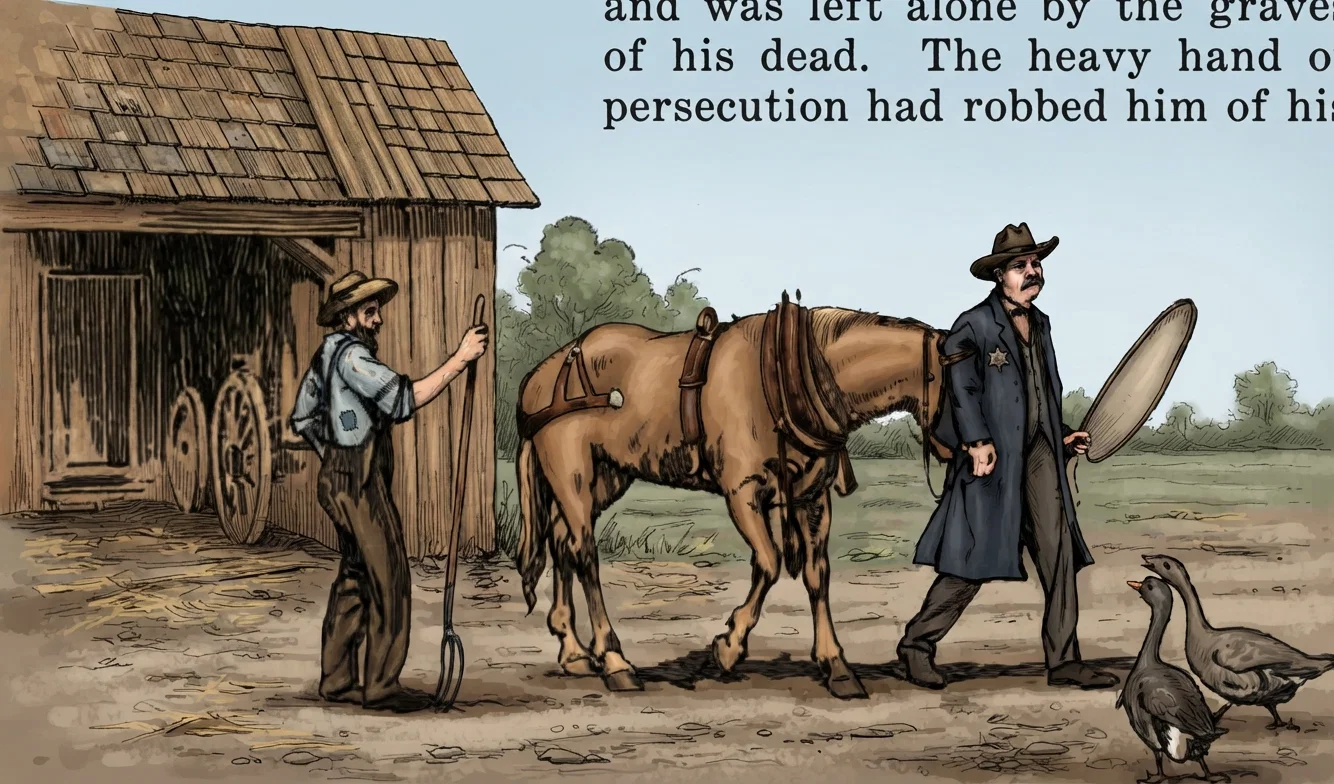
WHEN the prison term was up, Mr. Swearingen and his son went home, thinking they were free men, and that the demands of the law had been met. A few days later, however, the sheriff of the county rode up to the gate, called Mr. Swearingen from the house, and presented to him a bill for the board of himself and son while in prison. The old man stated that he had no money; so the sheriff levied on his horse, led it away, and sold it. The bill was not yet paid; and the sheriff, returning, levied on the only cow, and was intending to sell it; but kind neighbors
So the sheriff levied on his horse.
paid the fine, and the cow was saved to the family. If there was ever persecution during the Dark Ages, this was persecution that was brought upon this godly man, causing him to suffer imprisonment and the loss of his goods. The God who marks the sparrow's fall has written this all down; and sometime, some one will have to answer for it. These cases all came under the direct observance of the writer of this article.
When the legislature convened again, in the year 1887, honest-hearted men were tired of such proceedings; so a bill was introduced by Senator Robert H. Crockett, grandson of the noted David Crockett, intended to place all citizens of the state on an equality before the law. In his argument for the passage of his bill, Senator Crockett told not only of these cases mentioned, but of others just as true. We have taken pains to verify the following, as given by Senator Crockett:
A young Seventh-day Baptist and his wife, newly married, came from a northern state and settled in Arkansas, there to make their home. They were God-fearing, humble people, industrious and honest. In course of time, a sweet babe came to their home, and their cup of joy was full. This young man believed that the God who commanded him to rest on the seventh day gave him the privilege of working six days. A neighbor saw him at work in his field on Sunday, and indicted him before the grand jury. He was tried, convicted, and sentenced to prison. Persecution with its venom had entered his home, and a deep shadow fell across his household. The wife was deprived of her husband, and the babe of a father. A good citizen was counted as a criminal.
His Baby and Wife Killed by a Sunday Law
A FEW days later, the baby sickened. The young wife called a messenger, and sent him to prison with a request that her husband be allowed to come home, as the doctor had said the baby must die. The hard-hearted jailer said "No," that the man must serve his prison sentence.
That night, the baby died, and kind neighbors carried it to the cemetery for burial. The wife came home broken-hearted, and took to her bed. Again a messenger was sent to the prison to ask that the husband be permitted to come home, as the wife was dying; but again the request was met with a refusal. When the next morning broke, the young wife's life was gone out, a victim of the persecutor's misguided zeal.
The following day, when the neighbors were gathered in that humble home, the husband and father, having completed his sentence, was released, and came to the spot made sacred by the presence of his wife and baby, but over which now deep gloom was spread.
He followed the remains of his wife to the cemetery, and there saw the flowers, scarcely withered, on the grave of his baby. Bowed down with grief and sorrow, he saw his wife lowered into the earth, heard the few simple words spoken by the minister, and was left alone by the graves of his dead. The heavy hand of persecution had robbed him of his dearest treasures on earth, and had ruined his home, just as religious legislation has always done in the past and will always do in the future.
The only safe rule is, to leave the question of how and when man shall worship, to the individual and his God, and adhere to the true American idea that the state should have nothing whatever to do with the control of the religious belief of its citizens.
Some Freaks
By Charles S. Longacre
of
Bigotry
Only the Church or the Cemetery for
Sunday — Compelling People to Be
Pious — Travesties upon Justice
By
Charles S. Longacre
THE object of every Sunday law has been to compel people to be pious and religious on Sunday. Nearly all the Sunday laws in European countries that had a union of church and state compelled people “to attend divine service on Sunday.” The early American colonies copied their Sunday laws from England, which made religion a part of the state. The Puritans of New England compelled all people, whether religious or nonreligious, to support the established church; and all were fined “ten shillings for nonattendance at divine service on Sunday.”
Men and boys were put into the stocks for laughing and whistling aloud on Sunday. Husbands were fined for kissing their wives on that day. All people were prohibited from walking or traveling on behalf of business, pleasure, or recreation. If they walked or rode at all, it had to be on a road that led directly from their premises either to the church or to the cemetery. The Puritan’s idea of proper Sunday observance was to compel all people to find the rest that the inhabitants of the cemetery enjoyed.
Go to Church or Else Stay Home
THE Puritan prohibited, by the power of the civil magistrate, all unnecessary work on Sunday. When a man was not attending church, he had to remain at home, and was practically compelled to sit in an easy-chair the rest of the day. He could not even twiddle his thumbs, according to the strict interpretation of the law, without being guilty of unnecessary labor.
Should We Prosecute the Cider Barrel?
PEOPLE were fined for picking a few apples from a tree or gathering a few vegetables out of the garden for a Sunday dinner. Cats were caged up till Monday morning, for fear that they might work by catching mice and rats on that day. Bees were imprisoned in their hives, so that they could not gather honey on Sunday.
If a barrel of cider began working on Sunday, the Sunday blue law Puritan would roll it out of his cellar, and outside the gate of his premises, until Monday morning, and then would promptly roll it back, and allow it to resume operations again at the same old stand.
As defined in colonial times, “any sin committed with an high hand, as the gathering of sticks on the Sabbath day, may be punished with death. when a lesser punishment might serve for gathering sticks privily and in need.”—“Records of Massachusetts Bay,” volume 2, page 93.
Many of these drastic Sunday laws, forbidding recreation and all unnecessary work, are still on the statute books in some of the states of the Union; and occasionally a modern Pharisee, in a spasm of super-righteousness, attempts to revive these blue law relics of colonial and medieval times, when people thought it was proper to live under the old régime of a union of church and state, and to enforce religion by the power of the civil magistrate.
Recently a court official of Linden, New Jersey, fined an aged woman five dollars and costs for carrying in her apron seven apples, which the owner of a neighboring orchard had given her permission to take. “Even if she did not steal the apples,” said the judge, “she ought not to have been carrying them on Sunday,” and he promptly imposed the fine and costs.
A few weeks before this incident occurred, the same judge “fined John Sepp, an ice dealer, for giving away on Sunday ice that was needed for a sick baby.”
In Chain Gangs Through a Sunday Law
THIS travesty upon justice and common sense was committed by an American court, in the year 1915; and it was the logical outcome of the operation of a modern Sunday law, which gave the court the authority and privilege to decide what constitutes “proper Sunday observance” and “unnecessary labor on Sunday.”
Recently in Pennsylvania, under the drastic Sunday laws enacted in 1794, grocers were fined, at the instigation of a committee of clergymen, for selling bread to the hungry, ice to cool the fevered brow of the sick, and fresh milk to quench the thirst of suffering infants.
Scores of Seventh-day Adventists have been fined, and imprisoned for months in filthy dungeons, and compelled to work in chain gangs with murderers, for no other crime than doing a few trifling things on Sunday, after they had conscientiously rested on the seventh day of the week. They had committed no outrage, nor disturbed the peace of any one; but because they refused to reverence Sunday as a religious institution, they were treated as criminals.
Just recently five Seventh-day Adventists were haled before the court at Gallatin, Tennessee, for the merest trifles. The prosecutor charged that he had seen Robert and Ralph Ashton in their potato bin on Sunday, picking over a few bushels of decayed potatoes, while he was passing by in his automobile, himself on a business errand. A Mr. Templeton was accused of having violated the Sunday law of Tennessee by digging a mess of potatoes out of his garden for dinner on Sunday. A Mr. Robinson was prosecuted for mending a broken screen door, to prevent the flies from coming into the house, and for quietly working on an unfinished chair in his chair shop. Another man was prosecuted for picking a few peaches from a tree for a Sunday repast. The trial developed the fact that religious prejudice was at the root of the indictments.
Exemption Clauses Are Worthless
THE state of Oklahoma has a Sunday law that exempts those who observe another day than Sunday as holy time; yet in the face of this statutory exemption, two upright Seventh-day Adventist citizens of Hitchcock, Oklahoma, were recently convicted for quietly displaying goods in their own store on Sunday. The case is now pending before the supreme court of the state. If the higher court sustains the decision of the lower court, it is conclusive proof that exemption clauses in behalf of those who observe another day than Sunday are utterly worthless. The record of the trial shows that religious prejudice was the prime cause of these prosecutions. Religious organizations promoted the instigation of the indictments.
A Bloody Bludgeon for Bigots
RELIGIOUS legislation knows no limitations and no mercy. Sunday legislation has always been promoted by religious organizations, and has trampled upon the most sacred rights of humanity. Sunday laws have been a bloody bludgeon in the hands of religious bigots, to coerce dissenters. Not only is the Sunday institution unscriptural, but the methods of enforcing its observance are contrary to justice as well as to gospel principles.
The law of the state, the prison, fines, and the chain gang are not Christ’s instruments for promoting religion. Civil laws and carnal weapons were never employed by Christ to advance His cause. Nothing but the power and love of God can transform human hearts. It is in the secret closet of prayer, and not in the chain gang, that we conquer our enemies. It is spiritual regeneration, and not civic reformation, that transforms the evildoer.
Not the Methods of Christ
THE Man of Galilee did not try to reform the government, but to convert the individual. What this sinning world needs is more of the love and gentleness of the Christ of Calvary manifested by those who claim to walk in His steps. He requested His followers to worship God in spirit and in truth, at the altar of love and mercy, and not through the civil government, at the altar of force.
Un-American in Principle
THE only Christian and American attitude of American citizens toward a Sunday law, in a state which separates religious dogmas from civil enactments, is to vote religion out of politics when they have an opportunity to do so, as they will have in Oregon at the next general election.
All people ought to observe the day they believe to be holy time, from conscientious principles; but they should never be forced to observe it, by the power of the civil magistrate. Every citizen should enter his protest against all proposed legislation in the interest of the compulsory observance of Sunday, Saturday, or any other day of the week. Compulsory religion is un-American in principle.
The Gospel and the State
"It is the purpose of the gospel to win souls for the kingdom of God. It is the province of the state to protect men in the exercise of their rights. The spheres are distinct, and their legitimate operations do not conflict."