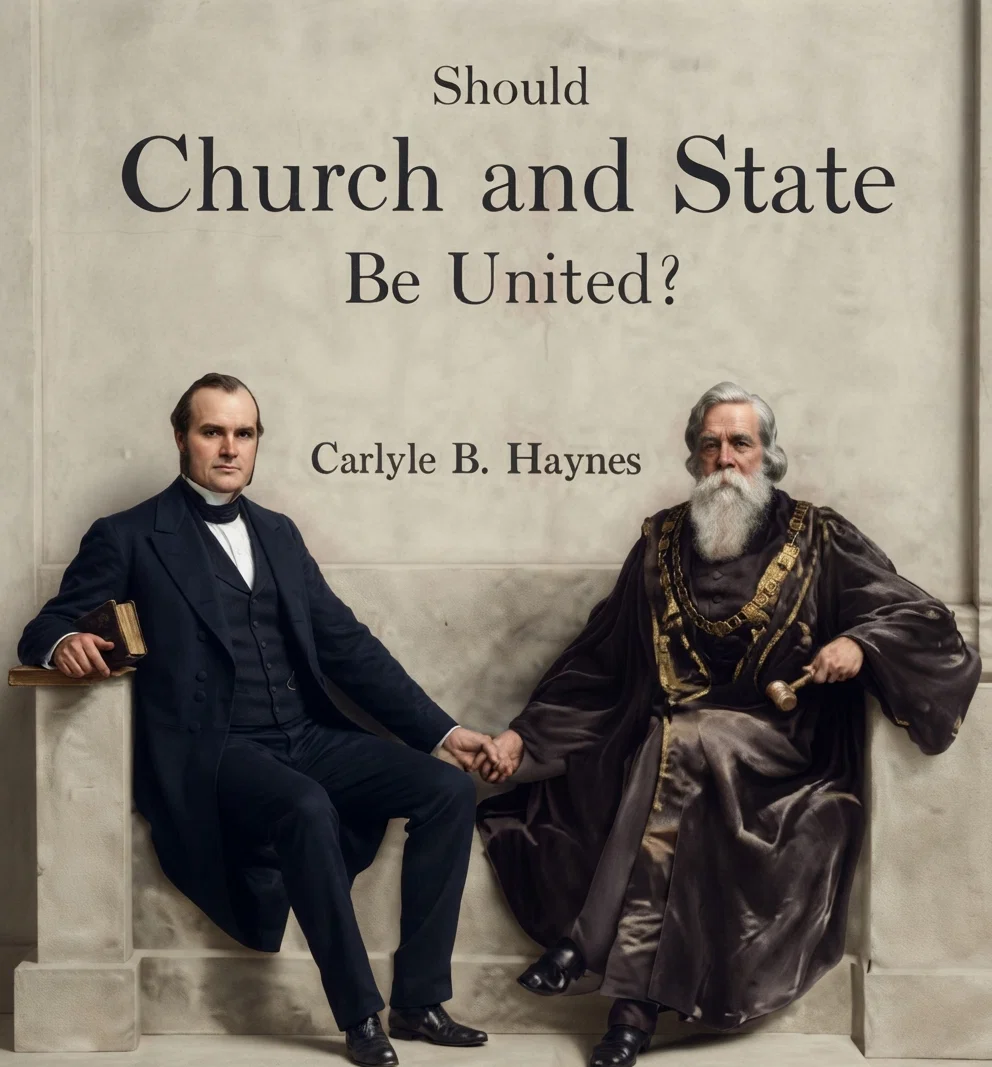
They Are Not One, but Two; and No Attempt Should Be Made to Have Them Act as One
BOTH the state and the church are ordained of God. The church has a divine commission to do its work of preaching the gospel, and that commission is recorded in Matt. 28: 18-20. The state also is divinely commissioned to do its work of securing and maintaining the rights of men, and punishing for the violation of those rights. Of the state in this legitimate sphere, God says, "The powers that be are ordained of God." Rom. 13: 1.
The very fact that both church and state are ordained of God is sufficient evidence to prove that they should operate in different spheres, for God would not create two different institutions to perform the same work.
The church has a sphere of action all its own, and in that sphere it has complete freedom to operate, and the state should not interfere with it. The state also has a sphere of action all its own; and while it is operating in that sphere, the church should not interfere with it. When either of these institutions goes beyond its sphere, they are bound to come into conflict with each other. Such is the unvarying testimony of history.
The proper sphere of the church was defined by Christ Himself at the time of the giving of the gospel commission: "Go ye therefore, and teach all nations, baptizing them in the name of the Father, and of the Son, and of the Holy Ghost: teaching them to observe all things whatsoever I have commanded you: and, lo, I am with you alway, even unto the end of the world." The church, then, is in this world for the purpose of propagating the religion of its divine Author, and the chief end of that religion is the salvation of the souls of men. And the church should confine itself to this work of preaching the gospel.
To Protect the Rights of All
THE proper sphere of the state lies within the realm of justice, that realm which covers the relations of men with their fellow men. The true purpose of civil government may be seen if we consider what conditions would prevail did civil government not exist. The strong would oppress the weak. The weak would have as much right as the strong to life, liberty, property, and happiness; but, being weak, they would be unable to secure to themselves these rights. They would be deprived of their rights by the strong. Without the restraining hand of civil government, anarchy would prevail.
The state, therefore, is organized to secure for all their rights. It should protect the majority in their rights; it should protect the minority in their rights; it should protect one lone man in his rights. In fact, its special purpose is to secure for the minority and the weak their rights,—rights which they could not secure for themselves, because of being weak and in the minority.
The primary purpose of the state, of civil government, is made wonderfully clear in the Declaration of Independence, in the words, "That to obtain these rights [life, liberty, and the pursuit of happiness], governments are instituted among men."
A further purpose of the state is to protect all in the exercise of the rights which the state has secured for them. The object of civil law is to protect life, liberty, limb, and property, and to restrain evildoers from violating these rights. It also regulates civil conduct.
And another purpose of the state is to punish for the violation of human rights. It is to punish incivility and crime. The purpose of the state is not to make any one good. It is to restrain evil deeds, and, if unable to restrain and prevent, to punish them.
Thus the church operates in the realm of a man's relation to his God, and the state operates in the realm of a man's relation to his fellow men.
The moment a government attempts to regulate an individual's conduct with reference to things which do not concern the rights of others, it does just the opposite of what it was instituted to do; it invades, not protects, the rights of men.
Is Sabbath Keeping a Civil Duty?
THE keeping of a Sabbath is a religious duty, a duty which man owes to God, and not to his fellow man. It lies, then, in the sphere of religion, and not at all within the sphere of civil government. The keeping of a Sabbath is not a civil duty. The Sabbath is not a civil rest day. It is a divine institution, coming to man directly from the hands of his Creator.
Jurisdictions are observed among the nations and the states. Only within the confines of its own territory can a state or a nation enforce its law. God has committed to men the making of laws regulating the nations of the earth, but He has never committed to men the making of laws for the kingdom of God. Such laws, if man should dare to make them, would be void for want of jurisdiction. In making such laws, legislatures go beyond the power conferred upon them, and their laws are not binding. For man to legislate concerning the Sabbath, a religious institution, would be for the state to invade the realm of religion and conscience, in which it has no right and no authority; and such laws would be void, without jurisdiction, and binding upon no one.
The rest of the Sabbath is not a civil rest, but a spiritual rest. For a human government to legislate on the matter of a weekly rest day is to assume the power and authority which belongs solely to God.
And the state cannot compel its citizens to distinguish between days of the week for religious worship, without enacting religious legislation.
All Sunday laws, then, are wrong, and are void for lack of jurisdiction. In enacting them, the state steps out of its rightful sphere into the sphere of religion, of one's duty to his God, in which it has no right and no authority. It assumes the power to regulate the relations of men to their Creator. But it has no such power; and the laws regarding religion, regarding Sunday observance, which it makes on this wrongful assumption, are bad laws.
All such laws, including all Sunday laws, should be repealed, not enforced.
The Church in the Wrong Pew
By Phil. C. Hayward
When the Church Enters the Political Arena, She Divorces Herself from Her Divinely Appointed Sphere
By
Phil. C. Hayward
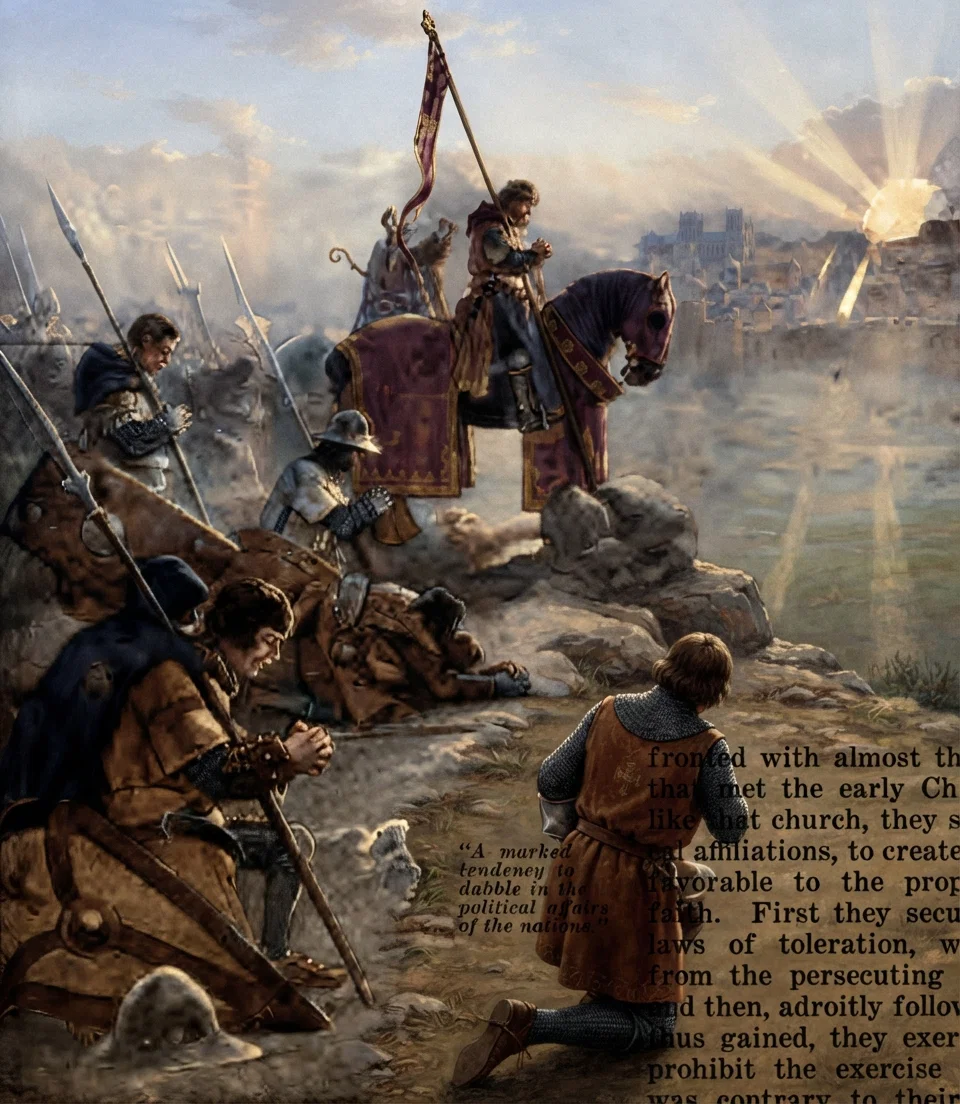
WHEN the Christian church enters the field of politics, she is evidently out of her place; for her Master has said, "My kingdom is not of this world." But unmistakably plain as is the meaning of this assertion, the church, very early in her history, developed a marked tendency to dabble in the political affairs of the nations with which she came in contact. This was probably due to two primary causes: first, an honest desire, on the part of some, to create an environment more favorable to the propagation of the Christian religion; and second, the ambitions of a worldly-minded, power-loving bishopric.
Of the two, however, the latter very early became by far the more important factor; and under the conditions favorable for growth which were created after the Roman Empire became Christian in form, the bishops of the church sought political preferment, obtained political offices, wielded political power, secured political sanction for their dogmas and decrees; and soon, by these perfectly natural steps, they dominated the affairs of the nation.
It was through these influences that the ecclesiastics were able to induce Constantine to propagate the first "Christian" Sunday law the world ever knew. Also it was under these influences that pagan philosophy began to control the teachings of the Christian schools. And these influences, with their corrupt practices, led the world into the midnight of the Christian church.
The Footprints of Intolerance
SUCH were undoubtedly the effects, upon the Christian church, of her adulterous union with the civil power. But what was the result to the state with which that union was formed? For a nation to allow itself to be dominated by a church is as fatal as for a church to allow itself to be dominated by the civil power; and the immediate effect of this union, upon the state, was the complete ruin of the Roman Empire. It is more than a coincidence that the days of the greatest political power on the part of the Christian church were the days of the decline and complete dismemberment of the Western Empire of Rome.
When the morning star of the Reformation had dawned, the Protestants were confronted with almost the identical conditions that met the early Christian church. And, like that church, they sought, through political affiliations, to create an environment more favorable to the propagation of the true faith. First they secured the enactment of laws of toleration, which protected them from the persecuting hand of the papacy; and then, adroitly following up the advantage thus gained, they exerted their influence to prohibit the exercise of any religion that was contrary to their own conceptions of what the true faith was.
Under these influences, bitter controversies sprang up, between the different Protestant bodies, as to what form these religious laws should take in the several countries. The Lutherans, the Catholics, the Zwinglians, and the Calvinists were each the persecutors in their own country, but were the persecuted whenever they might chance to be in a country whose laws happened to favor some other creed or form of faith. Because of this, much bitterness and hatred was engendered between the German, the British, the Netherlands, the Swiss, and the Scandinavian countries. And the conditions thus created were fatal to the progress and prosperity of those countries for more than two hundred years.
Duplicated Atrocities of the Dark Ages
AND as to the effect of these conditions upon the church, the great historian of Protestantism, D'Aubigné, well said of the work of Zwingle in Switzerland, "The Reformer, deserting the paths of the apostles, allowed himself to be led astray by the perverse example of popery." He himself "resolved to be at one and the same time the man of the state and of the church. . . . This double, this triple part of the Reformer was the ruin of the Reformation and of himself." "Zwingle played two parts at once — he was a reformer and a magistrate. But these are two characters that ought no more to be united than those of a minister and of a soldier. We will not altogether blame the soldier and the magistrate in forming leagues and drawing the sword, even for the sake of religion; . . . but we must decidedly blame the Christian minister who becomes a diplomatist or a general."
And this principle of mixing the religion of the church with the politics of the nations impeded the Reformation throughout Europe, and made possible atrocities that rivaled those of the Inquisition. Of the persecution of the Anabaptists, which was general among all the Protestant nations, Mosheim says, "It is true that many Anabaptists suffered death, not on account of their being considered rebellious subjects, but merely because they were judged to be incorrigible heretics."
It was because of these conditions that the Pilgrim Fathers left the Old World and came to the wild American shores, that they might establish "a church without a pope," and a state which would make possible the free exercise of religious belief. But in their zeal to protect themselves in this sacred right, they forgot to protect others in the same right, and there followed fines, foggings, imprisonments, banishments, burnings, and the most barbarous tortures, inflicted upon men and women because they dissented from the state religion of the colonies.
"Leave Politics Alone"
IT was to guard forever against the possibility of a repetition of these conditions, that the American constitution was amended to read, "Congress shall make no laws respecting an establishment of religion, or prohibiting the free exercise thereof." The founders of this republic jealously guarded these rights, and handed them down to bless the generations that were to come.
But their work was not without opposition. Zealous clergymen were ever anxious and alert for an opportunity to bind the church upon the back of the nation. Upon one occasion, General Washington is reported to have said to an English Wesleyan minister who was meddling in politics: "Mr. Wesley I respect; but Mr. Wesley, I presume, never sent you to America to interfere with political matters, but to preach the gospel to the people. Now go and mind your own proper work, and leave politics alone."
It would be well indeed if all our lawmakers to-day could have the courage to say the same thing to the political preachers who646come to them with a great burden to have laws enacted favorable to their own particular brand of religious belief.
More than sixty years ago, such a law was fastened upon the people of Oregon, not for civil purposes, but for religious. The only reason why those laws have done no particular damage to either the church or the state during all these years is that they have not been enforced. If they had been enforced according to their letter, they would have worked great hardship upon a vast majority of the citizens of the state, and many would have been fined and jailed, "not on account of their being considered rebellious subjects, but merely because they were judged to be incorrigible heretics."
Increases Federal Problems
THE truest and best citizen in the state of Oregon to-day could be thrown into prison or fined if he should open his grocery store and sell a loaf of bread to a hungry neighbor on Sunday. But what benefit could possibly accrue to the state or to the church from such a course? It would be but to make an honest citizen a criminal in the eyes of the state, and a heretic in the eyes of the church. By the state, conviction for crime is usually regarded as sufficient grounds for divorce.
The enforcement of this law of the church, instead of helping to solve the great moral problems with which both the state and the church are confronted, would add to those problems by making children fatherless, disrupting homes, depriving families of their rightful support and protection, and taking from the path of honorable industry men whose only offense was selling a loaf of bread, or quietly engaging in an honest, inoffensive, and productive vocation, upon the first day of the week.
But that is not all. If Oregon's present Sunday laws were to be enforced according to their evident intent, thousands of our citizens would be convicted, fined or imprisoned, and robbed of their citizenship, and of the right to help in the affairs of their state and community — and all because of the state's trying to enforce a religious law of the church. This would surely be disastrous to both the state and the church. They would both go down under such a régime, just as they always have in the past under like conditions.
This being true, it is doubtful whether there is a thinking man or woman in the state of Oregon to-day who would vote for a literal interpretation and a strict enforcement of the Sunday laws that are now upon our statute books. But if these laws are not to be so interpreted and enforced, why should they exist at all? Why not adopt the policy of true Americanism and of true Christianity, and repeal these laws, and have here a church patterned after Him who said, "My kingdom is not of this world," and a state whose recognized office it is to protect each individual in his constitutional and inherent right to work lawfully or to worship peacefully, as his own conscience shall dictate?
Why not support the repeal measure at the polls November 7, that we may be free to be religious or not to be religious, without having our citizenship tested by our relations to any church?
" 'CIVIC righteousness' is exemplified in nothing so much as in the conduct of citizens toward each other, each recognizing and respecting the rights of his fellow men. In nothing is the lack of this 'righteousness' so surely demonstrated as in the efforts of one class of citizens to bring another class of citizens to their mode of religious conduct by the compulsion of civil law. That is 'civic un-righteousness' and religious tyranny."
“A marked tendency to dabble in the political affairs of the nations.”
A Relic of the Dark Ages
By H. G. Thurston
Shall We Sow the Seeds of Oppression? Let Oregon Be Free!
By H. G. Thurston
A Relic of the Dark Ages
Shall We Sow the Seeds of Oppression?
Let Oregon Be Free!
By
H. G. Thurston
AMONG the many questions to be considered in Oregon's coming election, none can possibly be more important than that which involves the very existence of the state as a free republican institution. The voters of this commonwealth will then decide whether or not the deadly coals of despotism shall longer remain upon our statute pages. If it shall so continue, some favorable moment will come when they will burst into a flame of oppression, with no power to check it. The bigot's hand is even now stretching forth to fan that flame. The fanatic's zeal is among us, and already has tried to inflame the passions of men so that honest toil performed upon the first day of the week shall brand an honorable, industrious citizen as a criminal, worthy of fine and imprisonment.
We say, then, that the religious law of 1854, which protects a religious institution, has in it the essence of despotism, and belongs to the list of undesirable relics of the ages of darkness and superstition, when men suffered martyrdom for conscience' sake. Its wicked harvest was seen in New England when attendance at religious worship on Sunday was enforced by law, and he whose convictions of right did not lead him in the way trodden by the majority, was made to feel the keen edge of persecution, or live in hypocrisy—pretending to be what he was not.
Hatching the Egg of Oppression
IN principle, this evil has existed since unholy Cain foully murdered righteous Abel—the first effort against freedom of conscience and worship. Had not that same egg of oppression and crime against mankind been hatched by the emperor Constantine in enacting the first "Christian" Sunday rest law, March 7, 321 A. D., and the offspring been fostered and adopted by the church of that century and the next, the darkest chapters of history could never have been written; for those sickening deeds of violence in religion's name could never have been.
The despotic germ that has developed a tyranny more cruel than war, is the union of church and state, by means of Sunday legislation, which was used by the church of the fourth and the fifth century to further her aims. This went on with increasing strictness and severity until fines, imprisonment, and death were the awful harvest.
Had that first Sunday law never been enacted, and had no other religious legislation followed, persecution's ugly, venomous head could never have had power among those professing the name of Jesus. If that first religious legislation to protect a human institution had never been enacted, no one would ever have suffered for performing honest toil upon the first day of the week. That first bad example set by Constantine has been followed almost everywhere since, when church institutions were thought in danger. When religious people appeal to human laws to support their doctrines and institutions, what is the conclusion of every thoughtful, logical mind?—Simply this,—that God is unable to care for His own, or the institution is merely human, and of course must have earthly support or perish.
If God has ever claimed a day as His own, He can surely care for and protect it, without the assistance of human laws. God does His work in the heart of the individual, and does not seek nor accept earthly support to enforce His institutions. Sunday legislation, and all other religious laws, are strictly forbidden by the plain terms of our national constitution; and many of the most prominent men of our nation have so affirmed.
Is there not, then, a serious question about the propriety of allowing this dangerous relic of the dark and dismal past to remain among us?
Many thousands of our very best citizens, believers in religion as well as unbelievers, discern a grave and ever menacing danger in permitting the Sunday "blue law" to continue as a part of our legislative code.
Let Oregon Be Free!
IN conclusion, we quote Madison's words as most appropriate for the crisis in Oregon: "Ye states of America which retain in your constitutions or codes any aberration from the sacred principles of religious liberty by giving to Caesar what belongs to God, or joining together what God has put asunder, hasten to revise your systems, and make the example of your country as pure and complete in what relates to the freedom of the mind and its allegiance to its Maker, as in what belongs to the legitimate object of political and civil institutions. Strongly guarded as is the separation between religion and government in the constitution of the United States, the danger of encroachment by ecclesiastical bodies may be illustrated by precedents already furnished in their short history."
Vote "Yes" on repeal bill 312 at the Oregon election on November 7. Let Oregon be free!
Satan's Offer Accepted
By William M. Healey
Christ Refused the Aid of the Civil Power
The Church Now Eagerly Seeking
What Her Lord Rejected
By William M. Healey
THE eternal principle and power by which God rules His kingdom is love. And it not only fills His whole kingdom, but permeates His own being; for "God is love." Those who do not possess this love have no acquaintance or connection with Him. "He that loveth not knoweth not God; for God is love." 1 John 4:8.
This love is not animal excitement, neither is it emotional nor sentimental feeling. It is an eternal principle, which underlies the law and the gospel of God, and when manifest in mankind, is a "willing mind" to obey the great principles of right, justice, and truth, even to the exercise of mercy, through which God gave Jesus Christ to die for sinners, that all who choose the way of God may be like Him, and share in His blessings. "Whosoever will, let him come."
No Sunday law, nor other religious law, will ever be forced upon others by those who love their neighbor as themselves. The very act of enforcing one's beliefs and dogmas upon another proves an unwillingness to accept the other's doctrines; and no one can be willing to be compelled to do that which he himself is unwilling to do. Therefore he is not doing to others as he would have others do to him.
From "Great Controversy"
No Appeal to Civil Power
THIS law of love was drawn out, by Christ, into two commandments. "Thou shalt love the Lord thy God with all thy heart, and with all thy soul, and with all thy mind. This is the first and great commandment. And the second is like unto it, Thou shalt love thy neighbor as thyself. On these two commandments hang all the law and the prophets." Matt. 22:37-40. These same commandments of love were taught by Moses. See Deut. 10:12; and Lev. 19:18.
That mankind might better comprehend the meaning of the words "Love thy neighbor as thyself," Christ said, "Therefore all things whatsoever ye would that men should do to you, do ye even so to them." Matt. 7:12.
Christ never appealed to civil government to compel people to follow Him. He made no effort to conquer by force. When accused before Pilate of claiming to be a king, He admitted the charge, but said: "My kingdom is not of this world: if My kingdom were of this world, then would My servants fight." The result of such a fight, the mob could easily conjecture by calling to mind their experience of a few hours previous, when Christ stepped toward them in the darkness, restraining His power, that He might be able to give Himself into their hands, and even then they staggered back, and "fell to the ground."
Kingdom Suffers Violence
THE disposition to compel people, by law and force, to be religious, is not the Spirit of the "meek and lowly Nazarene." It is the spirit of oppression and violence. Jesus said, "The kingdom of heaven suffereth violence, and the violent take it by force." This spirit manifested itself among the disciples of Jesus as they were passing through a Samaritan village, and the people refused to entertain them for the night, because they were going up to Jerusalem to worship, and the Samaritans held that Mount Gerizim was the proper place for the temple and for public worship.
The disciples were so incensed over this treatment, all on account of their religion, that Peter and John asked permission to call fire down from heaven, and burn up those people who differed from them in religious belief. To this request Jesus answered, "Ye know not what manner of spirit ye are of." Luke 9:55.
Between the Jews and the Samaritans it was a question of which place was sacred. To-day it is a question of which day is holy; and now, as then, the rebuke of Christ rests upon all who would use force to punish those who differ from them. It is not the Spirit of Christ that prompts the demand for a law to punish people for not observing a day as holy. "Now if any man have not the Spirit of Christ, he is none of His." Rom. 8:9.
Probably the greatest temptation offered Christ was, to accept the power of civil government to support the church. When Christ came forth, weak and emaciated, from His forty days of temptation, the devil asked Him to show His creative power, if He was Christ, by making the stones into bread. "Jesus refused, because there was no "word of God" for it. Next the devil took Him up to the dizzy heights of the pinnacle of the temple, and said: "It is written, He shall give His angels charge concerning thee: and in their hands they shall bear thee up, lest at any time thou dash thy foot against a stone." Then he asked Him to cast Himself down from the temple, and trust in the angels to take care of Him, if, as He claimed, He believed in the "word of God." Jesus replied, "It is written again, Thou shalt not tempt the Lord thy God." Matt. 4:6, 7. God had not promised His care and protection for those who would do presumptuous things.
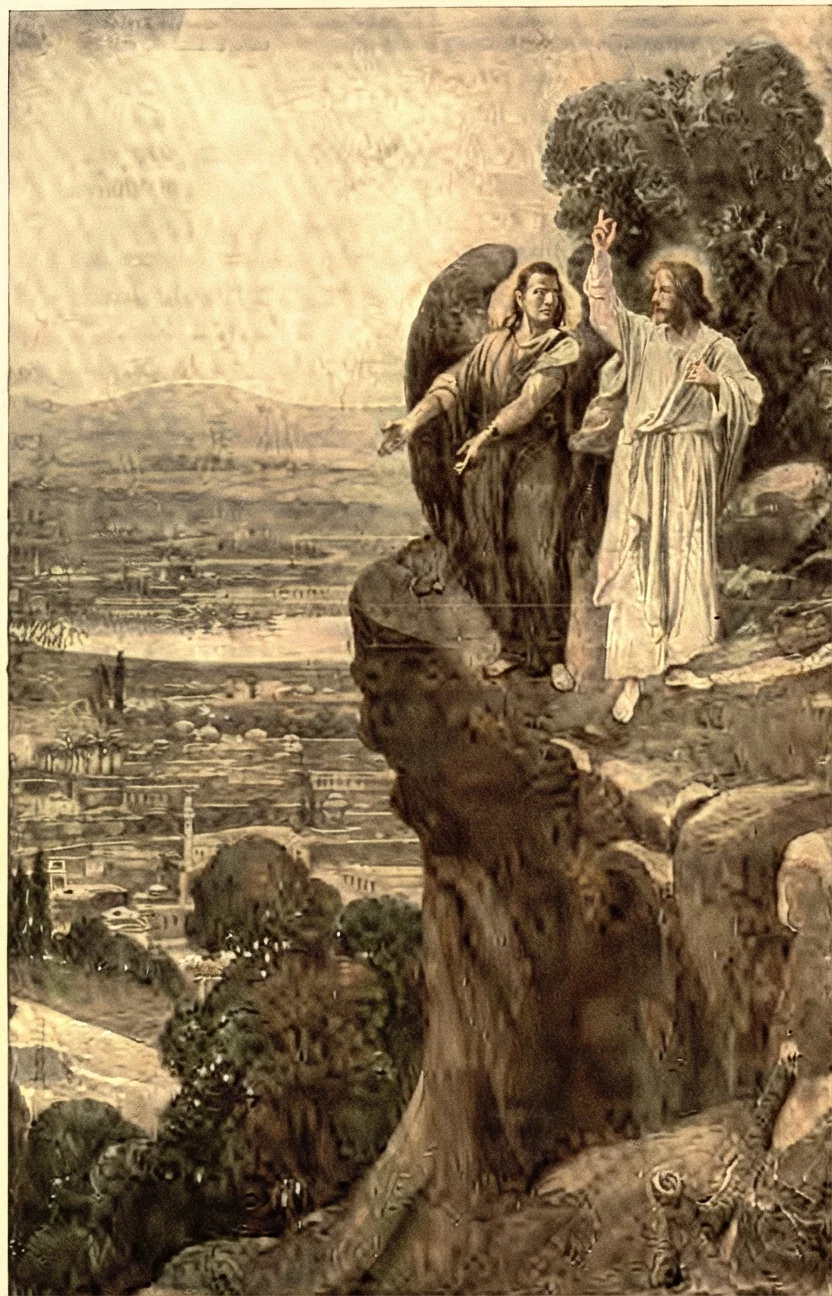
Lastly the devil took Him to the top of a high mountain, to present his greatest temptation, and "showed unto Him all the kingdoms of the world in a moment of time. And the devil said unto Him, All this power will I give Thee, and the glory of them: for that is delivered unto me; and to whomsoever I will I give it. If Thou therefore wilt worship me, all shall be Thine." Luke 4:5-7.
A Disastrous Union
JESUS had come to redeem a lost world, and He well knew the trials and sorrows that awaited Him and those who should follow Him. He foresaw the church rejecting Him, and its intrigue with civil authority for power to put Him to death. He beheld the wars and desolations that would come on the earth. He saw the millions of faithful martyrs that would suffer indescribable torture and death for His sake, by the church using civil law to enforce its creed.
How much better it would seem to be if Christ would accept this offer, and use earthly kingdoms to support His church, instead of having them arrayed against Him! This opportunity to stop the wars and strife among nations must have appealed to the sympathetic heart of the loving Saviour.
But there was a reservation clause in Satan's offer. He had not agreed to complete abnegation of his kingdom, but was determined to retain a place in it. Jesus spurned the offer, because such a union would destroy the church, taking from it the spirit of love, and adding the power of physical force.
The church afterward accepted that which Christ had rejected,—the aid of civil power to enforce its teaching,—and soaked the earth with the blood of millions of martyrs. They began the union of church and state in the time of Constantine in exactly the same way they are beginning it now, by enacting a Sunday law contrary to God's law, opposed to the gospel of love, and in violation of the principles of liberty.