The Youth’s Instructor, Vol. 65, No. 27.

The Birth and Growth of the Red Cross Movement
Earlier text: The Alps

A Call for Missionary Volunteer Enlistment
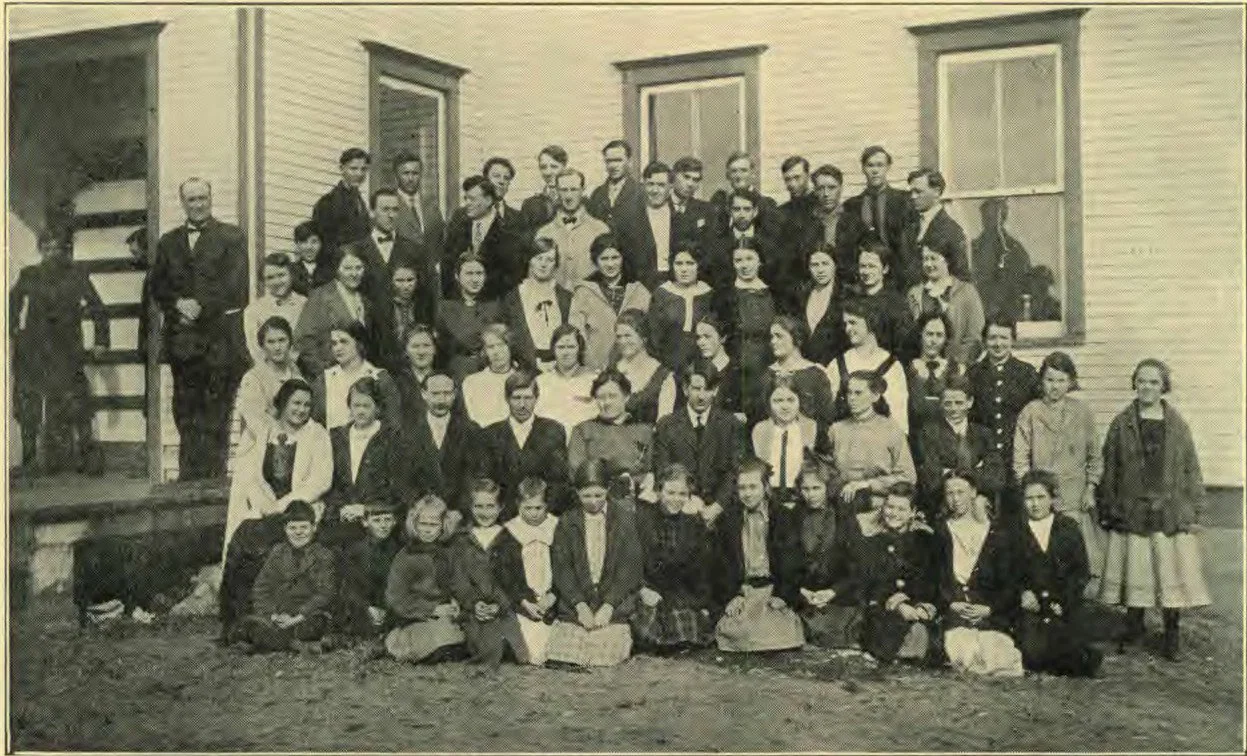
SENIOR AND JUNIOR MISSIONARY VOLUNTEERS OF THE ALBERTA INDUSTRIAL ACADEMY
THE very first work for which the art of printing was used after its discovery, crude though the machinery, was the printing of the Word of God. Prior to that time (the fifteenth century) the comparatively few believers in God’s Word worked for months writing out by hand portions of the Scriptures. These they faithfully passed on to whomsoever would receive and read them.
The Reformers saw in the establishment of the printing press a power which would infinitely multiply their efforts in spreading a knowledge of the truth. They could now use the time in circulating the printed page which formerly had been spent in secluded places writing out the Scriptures by hand.
Luther, while confined in the Wartburg castle, wrote Biblical tracts and pamphlets, which the believers circulated throughout Germany so thoroughly that in every village and out-of-the-way place the Bible truths were taught. History records that Reuchlin, a noted Reformer and writer, so appreciated the power of the press that on a mission to Rome he purchased all the Greek and Hebrew manuscripts he could find. This he did with a view to employing them as so many torches to increase in his own country the light already beginning to appear. Ulrich, while taking refuge in the castle of Ebenburg, “composed those works intended to be read and understood by the people, which inspired all the German states with a horror of Rome and with a love of liberty.” Such was the influence of the printed pages of truth in the days of these Reformers.
Today our publishing work is fulfilling the same purpose. We have a publishing organization which is yearly putting into circulation over a million dollars’ worth of tracts, periodicals, and books teaching the third angel’s message, and the Lord assures us, through his servant, that “our books and periodicals are God’s appointed means of keeping his message continually before the people. . . . Let every one professing the name of Christ act a part in sending forth the message. . . . Our publications should go everywhere. The circulation of our periodicals should be greatly increased.”
To meet this important phase of literature circulation, we have conducted a special campaign to enlist students and other young people in the sale of our magazines,—Signs of the Times, Life and Health, the Watchman, and some of the small books, such as “The World War.” We now have an army of one hundred and five students from our colleges and academies in the Pacific Union (mostly young women) who are just getting into action, and we look for a record in magazine sales this summer. Many experiences might be related to show that those already engaged in the sale of these publications are enjoying the choicest blessings which God deals out to his workers, and it has been proved that a large per cent of these workers fit naturally into places of greater responsibility in times of crisis, when the tried and trusted recruit is needed.
The sale of our magazines should be considered from a missionary rather than a commercial viewpoint. If Satan can cause a young man or woman to regard this work on the same basis as that of the newsboy, street peddler, or retailer of popular fiction, he will have accomplished his purpose of causing defeat where a rich and glorious experience might have been obtained. In vast contrast is the work of disseminating our Spirit-filled literature. We are intrusted with a message which should call into use the highest faculties, and should never permit the standard of this work to be lowered.
Many more young people in this country, especially in our cities, should be encouraged to enter the magazine field. Write your Missionary Volunteer secretary or the home missionary secretary of your conference, enlisting for this service now, and share in the rich experiences enjoyed by the bands of magazine workers this summer. ERNEST LLOYD.

When to Use the 6-8-10 Rule

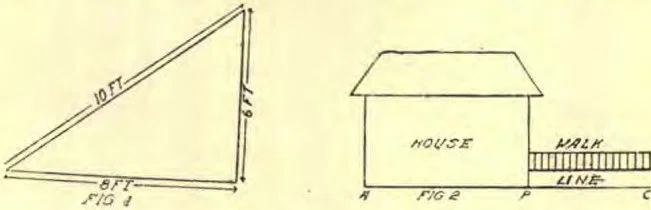
In laying out a rectangular plot of ground for any purpose—the foundations of a house, a tennis court, etc.—the beginner soon finds out that it is almost impossible to get it square by the use of the carpenter’s steel square. Carpenters, when confronted by a similar problem, proceed according to what is known as the “6-8-10 rule.” This rule is based on the fact that the sum of the squares of two sides of a right angle equals the square of the hypotenuse. In practice, the carpenter first determines the position of one of the corners, then measures six feet from it in one direction and eight feet in the other. Between these two points is, if the corner is square, just ten feet. (Figure 1.)
If you have no steel square and want to square a board, you can proceed in about the same way, only measuring inches instead of feet. Using your foot rule, draw a line across the board, making it as nearly square as you can. Then measure six inches along the board, and eight inches along the line. If the line is square, the distance between these two points should be ten inches. If the board is wide, instead of 6-8-10 inches, you may use 12-16-20 inches.
There is another problem that the amateur carpenter sometimes runs up against in laying out the lines for a fence or walk. Suppose you wish to build a walk to line up with a house, as shown in Fig. 2. Stretch a cord from A to C. Make sure, by moving it back and forth, that the line just touches the building at B. Fasten the line to a stake. Now if, at the point B, the distance from the corner of the building to the edge of the walk is two feet, make the distance between the line and the walk at C two feet, and your walk will line up with the building. Of course, you could get the same results by the use of the 6-8-10 rule, but this last method is often preferable.—Charles D. Myers.

Why? (Poem by Christina G. Rossetti)

Why?

LORD, if I love thee and thou lovest me, Why need I any more these toilsome days; Why should I not run singing up thy ways Straight into heaven, to rest myself with thee? What need remains of death pang yet to be, If all my soul is quickened in thy praise? If all my heart loves thee, what need amaze, Struggle, and dimness of an agony?
Bride whom I love, if thou too lovest me Thou needs must choose my likeness for thy dower; So wilt thou toil in patience, and abide Hungering and thirsting for that blessed hour When I my likeness shall behold in thee, And thou therein shalt awaken satisfied.
— Christina G. Rossetti.

For the Finding-Out Club

[Every one who sends in a correct list of answers to this or any future set of questions will be entered as a member of the 1917 Finding-Out Club, if the list is received within three weeks after the date of the paper containing the list. Membership lists of answers to be accepted must follow the rules given below:
  1. The list must be written neatly.
  2. Pen and ink must be used.
  3. Writing must appear upon only one side of the sheet of paper.
  4. The answers must reach the editor’s desk within three weeks after the date of the paper containing the questions answered.
  5. All lists must be folded and not rolled.
  6. The questions must not be repeated in the list of answers.
  7. Each answer must bear the same number as the question it is intended to answer.
  8. Every list must give the date of the INSTRUCTOR containing the list of questions being answered; for example, “Answers to questions in INSTRUCTOR of December 8.”
  9. Every list must bear at the bottom the name of the one sending in the list.
The number of lists that one has successfully answered is indicated by the small figure at the upper right-hand corner of the name.
Failure to heed any one of these rules is sufficient to bar one from membership in the Finding-Out Club. Let us watch the 1917 membership grow.—Ed.]
  1. Who played the harp before Saul?
  2. Why does an apple fall to the ground?
  3. What is the Venus of Milo?
  4. What is the Sistine Madonna?
  5. What is an octogenarian?
  6. What is the motto of the United States?

Make New Friends, But Keep the Old

“MAKE new friends, but keep the old; Those are silver, these are gold; New-made friendships, like new wine, Age will mellow and refine. Friendships that have stood the test— Time and change—are surely best.”

The Bible Year

Senior Assignment

July 8: Psalms 140 to 144. Prayer for protection.
July 9: Psalms 145 to 150. God’s goodness and power.
July 10: Proverbs 1 to 3. The benefits of wisdom.
July 11: Proverbs 4 to 7. Instruction of a father, etc.
July 12: Proverbs 8 to 11. The call of wisdom; a false balance.
July 13: Proverbs 12 to 15. Wise maxims; a soft answer.
July 14: Proverbs 16 to 19. Moral virtues and their contrary vices.
For notes on this assignment, see Review for July 5.

Junior Assignment

July 8: Isaiah 39. Hezekiah’s failure.
July 9: Isaiah 40. The gospel message.
July 10: Isaiah 42. The work of Jesus.
July 11: Isaiah 43. Comfort and reproof.
July 12: Isaiah 58. Blessing on those who honor the Sabbath.
July 13: Isaiah 60. The gospel to the Gentiles.
July 14: Isaiah 63. Jesus’ power to save.
As you continue to read from the wonderful prophecies of Isaiah, remember the story of this hero as given last week. We have gone through the history of the Old Testament, have read some of the Hebrew poetry, and now we are reading what the prophets wrote. To find Isaiah’s place in history go back to 2 Kings 16 to 21 or 2 Chronicles 26 to 32. Isaiah prophesied in the days of Uzziah, Jotham, Ahaz, and Hezekiah. Some of this history in Kings and Chronicles is repeated in Isaiah almost word for word. Compare 2 Kings 19:6, 7, and Isa. 37:6, 7.
Isaiah is thought to have belonged to a family of rank. There is a story that he was cousin to King Uzziah, but we do not know that to be true.
Isaiah has been called the king of the Old Testament prophets, because he was such a great man. He has been compared to the apostle Paul. He was a good writer and also an orator. Some of his writing is in the form of poetry, as you will see by looking at the Revised Version of 12:1-6; 25:1-5, etc.
The Lord used Isaiah to present great truths to the Hebrew people and to the people of all time. We can study the book of Isaiah as long as we live, and always find something new and interesting. M. E. K.

Prayer for Guidance

(Texts for July 8-14)
OUR party had never been down the river before; others had spoken of it as a treacherous stream; but we had decided to go to Chicago by boat, and that plan included a trip down this river. So about four o’clock we boarded the tiny little steamer that was waiting at the bend.
The old captain knew his business; he knew every curve in that river; and he knew how to keep his boat in the deep channel. With him at the helm, we had no fears, but enjoyed the ever-changing landscape that glided by on either side of the winding stream. One thing: we never interfered with the captain’s plans, but let him carry them out in every detail; so we reached the lake wharves safely in time for the night boat for Chicago.
Today as I recall this pleasant little outing, it brings with it a very good lesson. Every day you and I are traveling down an unknown river; it is a treacherous stream; many have made shipwreck on it; there are hidden rocks, sandbars, whirlpools, and many other dangers along the edges of the water. There is only one Captain that can take us safely down; we must make the journey, but let us not make it without the Captain; and when we have once taken passage on his boat, let us remember that our safety demands that we do not interfere with the Captain’s work. Should we attempt to assume control for even one moment, our unskilled hands might cause shipwreck.
Yes, we need guidance. But the spirit of adventure runs high in young blood. We do not want to be guided; we refuse to learn from the bitter experiences of others; we rebel against the charted course and strike out for ourselves. We run big risks and suffer failure a hundred times. We make a dash for some fancied Eldorado, and then sit down to drink the dregs of bitter disappointment. O “what fools we mortals be”! How long will we refuse to heed God’s great danger signal hung up for the ages to read: “There is a way which seemeth right unto a man, but the end thereof are the ways of death”?
Young friend, you and I cannot change the unchangeable laws of the universe. God is right and true, and if we are not guided by him, we must ultimately fail utterly. Happy the young person who learns this great lesson before he has squandered his youthful energies. And when we once learn how futile it is to try to guide our own lives, and how very possible and safe it is to trust all guidance to our heavenly Father, we shall have solved one of life’s hardest problems, dropped one of her greatest worries, and laid hold of the pearl of great price.
How sweet is the thought that God will guide you and me. His promises of guidance are like a cool hand upon a fevered brow. We read them and sink into quiet, peaceful rest. Prospects do not count with him. The Red Sea may be before us and the Egyptians behind; but we are not to fret. We are to trust and obey. If we do this, he will guide and deliver.
Just how God will choose to guide you, I do not know; but if you have decided to follow God, remember if he guides at all he must guide in all things and at all times. God cannot guide us if we insist on having our own way in certain matters.
If God guides you, you will not fail. His guidance spells success. He does not always tell you why he is sending you certain experiences, but you may be sure he is using them for your good. And if you faithfully follow your Guide, you will be trained to every duty that awaits you, equipped for every emergency that arises, and skilled for seizing every opportunity you meet for helping others.
There is success, there is efficiency, there is joy for those who are guided by God. But let us not forget that there is only one path that leads to heaven,—a rugged path,—and in this path they tread who follow God. It is stained with the bloody footprints of our Saviour and of those who have followed in his train. You will have to give up some things to walk in it; but it is the only path that brings genuine success, lasting happiness, and eternal life; and happy are they that choose it.
MEDITATION.—Yes; I want to be guided in all things by my heavenly Father; but how am I going to let him guide me in the emergency that I have been facing this week? Well, I have told him all about it. I am desirous that his will be done without regard to loss or gain to me. I have been sorely puzzled to know just what to do; but Gideon’s experience helps me. I have told the Lord what I thought he wished me to do and to do within a week; and I have asked him that if I was mistaken please to hinder my carrying out the plan today. This hindrance has not come yet, so I am going to believe that he has guided me by putting it into my heart to do this little piece of anticipated missionary work; and I go forward bravely, trusting him for results. O, I am so glad that he will guide me!
SPECIAL PRAYER.—Father, I thank thee for thy precious promises of guidance. I thank thee that they are mine. Guide me in all things today. Guide my mind to think good, pure, inspirational thoughts; guide my lips to speak kind, cheery, helpful words; guide my hands to fill the moments with loving deeds; and guide my feet to follow thee in unselfish service. O Father, guide me every day; guide me so that I shall at last hear the words, “Well done.”
M. E.

Missionary Volunteer Society Programs for Week Ending July 14

THE programs for this date, with notes, illustrations, and other helpful material, will be found in the Church Officers’ Gazette for July.

II—The Christian Life

(July 14)
MEMORY VERSE: “Watch and pray, that ye enter not into temptation.” Matt. 26:41.

Questions

1. When we confess our sins and God forgives them, what do we become? 2 Cor. 6:18. .
2. As sons and daughters of our heavenly Father, how will we show our love? What promise is made to those who obey? John 14:23. .
3. As babes in Christ what should we desire? What will a knowledge of his Word enable us to do? 1 Peter 2:2.
4. What did Jesus say concerning the Scriptures? John 5:39.
5. How earnestly should we search the Scriptures? Prov. 2:4, 5. .
6. What did David say the study of the Word of God would do for him? Ps. 119:11.
7. What experience did Jesus have that showed his familiarity with the Scriptures even when a young lad? Luke 2:42, 46, 47.
8. What faithful worker for God was carefully taught the Scriptures when a child? 2 Tim. 3:15; 1:5.
9. What else is necessary if we would grow as Christians? Phil. 4:6. .
10. When should we pray? Luke 18:1. .
11. What did Jesus often admonish his disciples to do? Memory verse. (Take a concordance and find at least four other similar texts.)
12. What test did Daniel once have in the matter of prayer? See Daniel, chapter 6.
13. In studying the Scriptures and in praying, what should we constantly guard against? Heb. 3:12. .

Honoring Christ Above Our Own Honor

The Christian’s first duty is to honor his Master. He must be willing to sink himself out of sight in order that the name of Christ may be magnified. It is not always possible to honor Christ and yet to honor ourselves before men. Sometimes the wreath on our own brow must fade if we would keep the wreath for Christ beautiful and green. Sometimes we must decrease that Christ may increase. Sometimes we must be willing to fall into the shadow, that the full light may be cast upon his face. Sometimes we must be ready to suffer loss that the cause of Christ may be advanced. But all this decrease, if we are true at heart to our Master, is only seeming. The honor on our brow is never so bright as when we have willingly stripped off the stars from ourselves to bind them on the brow of Jesus.—J. R. Miller.

Bible Picture Cards Free

THE Review and Herald Publishing Association has on hand a large quantity of old, out-of-date Memory Verse Cards. Rather than throw these away we prefer to give them to those who will use them. They are excellent for use in mission Sunday schools, and hospital and other missionary work where there are children. Send five cents in postage stamps for mailing and wrapping, and an assorted lot of about 500 cards will be mailed to you, as long as our stock lasts. Send direct to Review and Herald Publishing Association, Takoma Park Station, Washington, D. C.

Home Nursing and Simple Treatments

THIS is the title of a series of lessons based on Amy E. Pope’s “Home Care of the Sick,” and Dr. G. H. Heald’s “Colds: Their Cause, Prevention, and Cure.” They have been examined and indorsed by the General Conference Medical Department. They are designed to meet the needs of mothers in the home, and of others who wish to do missionary nursing, but are unable to take a full course of instruction at one of our sanitariums. The total cost, including textbooks, is $5.50. Those who are interested should write at once for full particulars to The Fireside Correspondence School, Takoma Park, D. C.

Important to Fireside Correspondence School Students

Hereafter all books and supplies for Fireside Correspondence School courses of study should be ordered from the school instead of the Review and Herald Publishing Association, New York.
C. C. LEWIS, Principal.

War Prohibition Now!

The argument for prohibition is clean-cut, simple, and direct.
The drinking of alcohol never produced for any normal individual positive good—in health, efficiency, power, or happiness.
The drinking of alcohol does produce for countless individuals and for society positive evil—in disease, loss of efficiency, impairment of power, vice, crime, and unhappiness.
The best that can be said for the drinking of alcohol is that it affords pleasure, gratification, and sociability. The evils that it produces constitute too heavy a price for the community to pay for these epicurean benefits.
This is the story in time of peace. In time of war the indictment against alcoholic liquor becomes tremendously graver. In such times as now confront the world the emphasis shifts from the effect of the drinking of liquor to the effect of the making of liquor.
The cold fact is that liquor is made from food; and in this day of the world every people which is at war is suffering for lack of food. Here and now the question becomes one, not between indulgence and abstinence, between pleasure and self-denial, between personal liberty and tyranny, between virtue and vice, between health and disease, but between food and drink.
Shall the many have food, or the few have drink? That is the question.
Last year there were used in the United States in the making of distilled spirits thirty-two million bushels of corn, three million bushels of rye, four and a half million bushels of malt, made from barley, and one hundred and fifty-two million gallons of molasses. These are the official figures. A careful estimate made by prominent professors of economics in Harvard and Yale Universities shows that there were used last year in the manufacture of fermented liquors in the United States thirteen million bushels of corn, fifty-four million bushels of malt, and seventeen million bushels of barley.
If as much as one sixth of the grand total of these foodstuffs were to be used in the manufacture of alcohol for industrial purposes, the saving in foodstuffs would be sufficient to supply the energy required of seven million men for one year.
Cutting off one half of our production of distilled and fermented liquors would save enough foodstuff to provide eleven million loaves of bread a day. [Why not cut off the other half also, and save twenty-two million loaves a day?]
What are we going to do about it? Are we all to suffer for lack of food in order that some may continue to get pleasure out of drink?
A time of national crisis like this is a time for national and individual self-sacrifice. We shall all make sacrifices, not so much because we must as because we will. The spirit of the American people is right. But the sense of the American people must be kept right also. To sacrifice bread for beer, food for whisky, would be utter folly and wickedness.
Let us follow England’s example and cut down immediately the number of pounds of foodstuffs that we permit to be made into drink.—The Independent.

God Requires Exact Obedience

GOD does not consult our convenience in regard to his commandments. He expects us to obey them, and to teach them to our children. . . .
Some will urge that the Lord is not so particular in his requirements; that it is not their duty to keep the Sabbath strictly at so great loss, or to place themselves where they will be brought in conflict with the laws of the land. But here is just where the test is coming, whether we will honor the law of God above the requirements of men. This is what will distinguish between those who honor God and those who dishonor him. Here is where we are to prove our loyalty. The history of God’s dealings with his people in all ages shows that he demands exact obedience.
. . . We are not to follow our own will and judgment, and flatter ourselves that God will come to our terms. God tests our faith by giving us some part to act in connection with his interposition in our behalf. To those who comply with the conditions, his promises will be fulfilled; but all that venture to depart from his instructions, to follow a way of their own choosing, will perish with the wicked when his judgments are visited upon the earth.—Mrs. E. G. White, in “Historical Sketches of S. D. A. Foreign Missions,” pp. 215-217.

Our Acts Make or Mar Us

ACTS make or mar us. We are children of our deeds.—Victor Hugo.
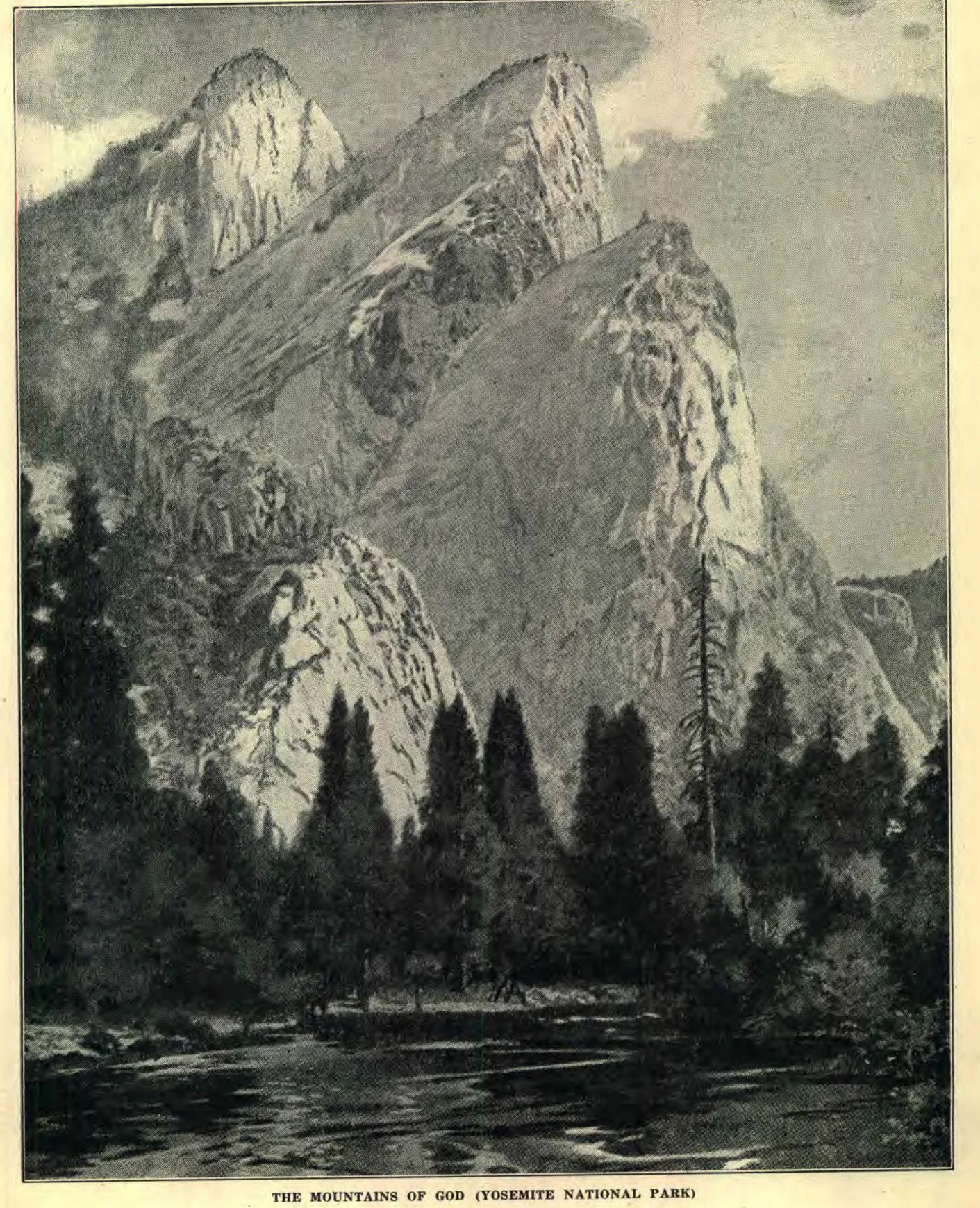
THE MOUNTAINS OF GOD (YOSEMITE NATIONAL PARK)
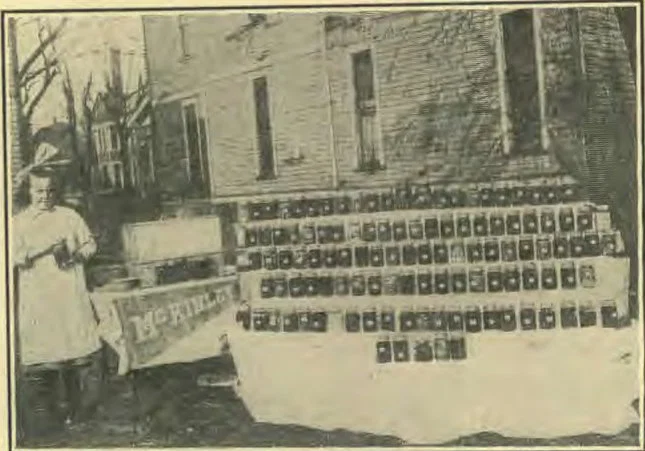
Home Canning Club Champion for 1915, Lucile Helphinstine, Illinois. Lucile's display consisted of 119 varieties of canned fruits, vegetables, greens, soups, and meats.
THE EARLY MORNING OFTEN FOUND JESUS IN SOME SECLUDED PLACE, MEDITATING, SEARCHING THE SCRIPTURES, OR IN PRAYER

You have reached the end of this edition.

The Youth’s Instructor · Jul 3, 1917