The Youth’s Instructor, Vol. 29, No. 7.

HUNTING THE DEER

The Youth’s Instructor

Feb 16, 1881

S. D. A. Publishing Association · Battle Creek, Mich. · Feb 16, 1881

HUNTING THE DEER.

The subject of hunting is one which has ever had a peculiar interest for the people of all countries. Under the old Roman government, it was established as a law that, as the natural right of things which have no master belongs to the first possessor, wild beasts, birds, and fishes were to be the property of him who could take them first. Consequently all were free to hunt when and wherever they chose. But the Roman government was afterward subverted by northern barbarians, who had a stronger love for the diversion of hunting, and whose chiefs began to appropriate the right of hunting; and instead of a natural right, to make it a royal one. And thus in the Old World the right of hunting belongs to the king and those who derive it from him. In this country the natural right is still recognized, although the game is protected during certain portions of the year by very stringent laws.
Of all the wild beasts that roam through the forests of this country, and that are so eagerly sought by the hunter, the deer stands among the first. Not only is he hunted for the sport of it, but for his value. Every part of him is utilized in some way.
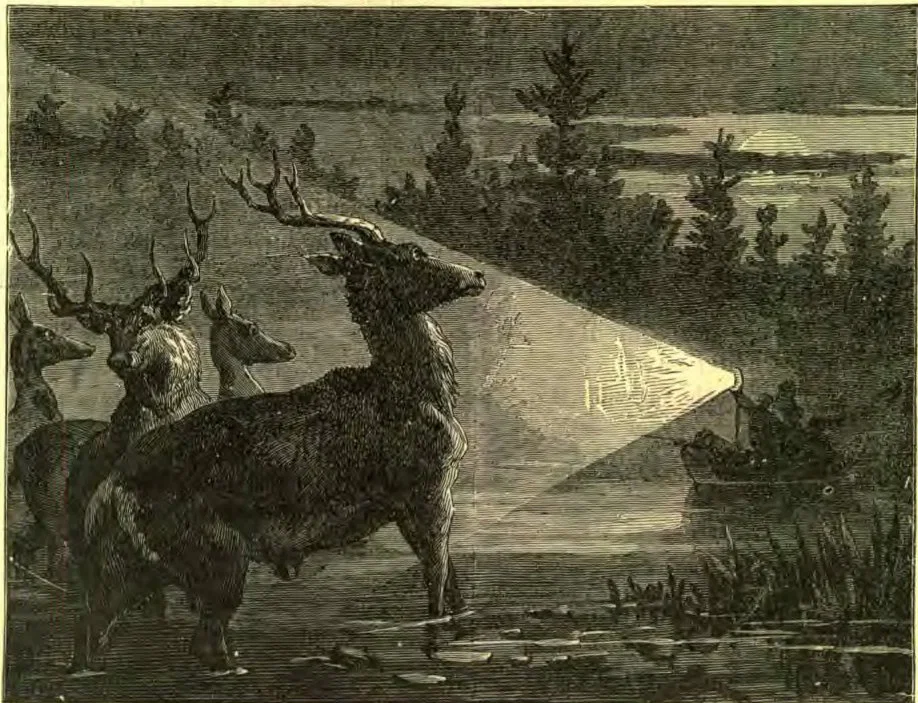
There are many different methods of hunting him. Our engraving represents a party of hunters “stalking” deer by night, when the deer frequent rivers or lakes, standing or wading in the water, to rid themselves of troublesome insects. The hunter watches for the deer, and by throwing a bright light upon them from a lantern or torch, dazzles their eyes, and moving carefully in a boat, can easily approach within gunshot of them. In this way many are easily secured.
Many different species of this beautiful animal are found in different parts of the globe. The smallest species known is found in Ceylon. It is a lovely little creature, and of beautiful form. When full grown, it is only ten inches high, fourteen long, and weighs five pounds. Its throat, head, and neck, are all white; its body is gray, striped with black, and spotted at equal distances with yellow. Although very timid, it can be tamed; but when angry, it kicks and stamps violently. A certain traveler says he saw one which had been domesticated, and was very tame. It was placed on a table at dinner-time, and ran about among the dishes nibbling the fruits. Several years ago, one of the little creatures was brought to England, but, unable to stand the climate, it soon sickened and died.
J. W. B.

A WONDERFUL CLOCK.

You have all no doubt heard of the quaint old city of Strasburg in Germany and its famous cathedral, which contains a time-piece counted as one of the wonders of the world. This curious clock was made over four hundred years ago by a German, who worked upon it forty years; and when the task was completed, it is said that cruel men put out his eyes with red-hot irons, so he could never make another clock like it. He begged to be allowed to place his hands once more upon the work which had become almost a part of his being. He was permitted to do this, and in revenge for the cruelty inflicted upon him, he removed or misplaced some of the delicate machinery, and for one hundred years the clock remained motionless. A skillful clock-maker at length repaired the damage, and this great work of art may now be seen in Strasburg.
This clock is about thirty feet high, and tells the time of day, the month, day of the month, day of the week, phases of the moon, and many things about the heavenly bodies. It is beautifully carved and gilded. The top section is in the form of a Gothic Chapel, with a small door on either side and a large one in the center. Above the dial is a key-stone, with a small door in the center. At twelve o’clock every day is heard the ringing of a bell, and the door of the keystone opens, showing the figure of Death. Soon after, the right door of the chapel opens, and figures representing the twelve apostles come out in procession, while the center door opens and the Saviour comes in sight. As the apostles reach him, they pause, and one by one, except Peter, turn toward him and bow. The bow is returned by our Saviour. A Roman sentinel on the left turns on a pedestal and appears to ask Peter if he is not Christ’s disciple. Peter turns his back to Christ in denial. A cock perched on the right corner flaps his wings and crows. Satan appears and disappears in the balcony above.
As Judas passes by, Satan again appears and seems to exult over him. The Roman sentinel turns around, and the left door closes the scene.
I have now something still stranger to tell you. Some years ago a poor lad in Germany, named Fritz Von Engle, was apprenticed by his father to a watch-maker. He was a faithful boy, and worked hard to learn the trade. Day after day he visited the cathedral, and his spare moments were spent in examining the wonderful clock. The sexton, a kind old man, let him look at the machinery. His mind became filled with the idea of reproducing the work. For seven long years he toiled, and at last succeeded in making a facsimile of the original. When the last weight was adjusted and the whole thing accomplished, his mind failed him. The anxiety, the toil, and the brain labor proved too much, and with the completion of his work the light of reason went out forever, and in six months he died, at the age of twenty-five years.
The clock was purchased of the heirs by Capt. J. Reid, an American agent in Europe. It is now in America. Not long since, I had the pleasure of examining it. It is one-third the size of the original, and so arranged that the apostles come out every half hour during the day and evening, and can be produced seven times each hour besides. It contains a music box and a wonderful chime of bells, that add greatly to its attractions. It is certainly an intricate piece of mechanism, and its curious history renders it most interesting.
ELIZA H. MORTON.

LEND A HAND.

LIFE is made of ups and downs— Lend a hand; Life is made of thorns and crowns; If you would the latter wear, Lift some crushed heart from despair— Lend a hand.
Crowns are not alone of gold! Lend a hand; Diamonds are bought and sold; But the crowns that good men own, Come from noble deeds alone— Lend a hand.
Many crowns that many wear— Lend a hand; Never in the sunlight glare; Diamonds never in them shine, Yet they hold a light divine— Lend a hand.
Hold a light that ne’er shall fade— Lend a hand; Beauty, art hath never made; For these crowns that good men wear, Everlasting are, as rare— Lend a hand.
Would you own so bright a crown? Lend a hand; When you see a brother down, Lead him from the deep, dark night, Place him in the morning light— Lend a hand. —Selected.

THE BIBLE.

The Bible, composed of the Old and New Testaments, was written by inspiration. The Old Testament, containing thirty-nine books, was written mostly in Hebrew; the New Testament, containing twenty-seven books, was written wholly in Greek.
The first English Testament was translated by Tyndal, and printed in the year 1526. And strange does this edition seem to the reader of the present time. The first part of the last chapter of Revelation reads as follows: “And he shewed me a pure ryver off water off lyfe pure as cristall: procedynge oute of the seate off God and of the lambe. In the myddes off the strete off hit and off ether syde off the ryver was there wode off lyfe: which bare xii manner off frutes: and gave frute every moneth: and the leves off the wodde served to heale the people with all.” The first complete English Bible was printed in 1535; and in 1611 our present Bible was translated by order of King James the First.
About the middle of the twelfth century it required the earnings of a day-laborer for fifteen years to purchase a single copy of the Bible. Now, a copy may be had for the earnings of a few hours.
Perhaps one of the most remarkable movements of modern times is the effort being made by different societies to circulate the Holy Scriptures. Over fifty millions of Bibles and Testaments have been issued and circulated by two societies alone. At present the Bible is published in about 230 different languages. “Its voice has gone out through all the earth, and its words to the end of the world.” Being of divine origin, it is a true guide for all men. It is a history, a counsellor, a comforter, and a revealer of secrets. Men of all ages have revered its holy pages. The wise have studied it for wisdom, the learned for its beauty, and the poor for its riches. It tells of our Maker and Redeemer, our origin and destiny. How then ought we to study its sayings and obey its commands?
The Bible is written in the purest and simplest language. Often do we find the whole of a vast subject expressed in a few simple words. In no other book do we find so many beautiful thoughts, so clearly expressed. It contains some of the finest figures of rhetoric, and the most sublime writings in the English language,—yet so clear and plain that even a child may read and understand. What other book do the ignorant and unlearned so well like to hear read? Would that thousands more could study and read its sacred pages; for truly it is “a Book of books.” It is the child of love, and the parent of civilization and refinement. It breaks the power of sin, and lifts man from his lowest degradation.
Oh! Book of awful majesty, in whose sublime pages we see Jacob wrestling with the angel of God; or David playing on his harp and singing the song, “Praise ye the Lord; for he is good, and kind are all his ways; His precepts too are kind and true; and ever shall remain;” or Daniel, three times each day, in his chamber, with his face toward Jerusalem, praying to his God. Yes, we can see Jesus stilling the tempest, or walking on the waves of dark Galilee; healing the blind, or weeping over the grave of Lazarus; and John, alone on the isle of Patmos, beholding that great city, the New Jerusalem, descending from Heaven, having the glory of God.
Its pictures are bright to the good, and dark to the ungodly. Thou Book of love and beauty, that melts the heart with reverence, that shines, the light of the widow and orphan’s home, the glory of the Christian’s cot, the beacon of a sinful race,—thou, time-honored Book of Jehovah, shalt “be our guide even unto death.”
E. B. MILLER.

ETHEL'S DAY-DREAMING.

Ethel Lansing was a bright, intelligent girl, but instead of making the most of present moments in performing little loving deeds of kindness, she was somewhat of a day-dreamer. To snuggle up in a great arm-chair and plan what she would do if she were rich or a little older, was, with her, a favorite way of passing time.
“What, cuddled up in the arm-chair and not doing anything!” said Mrs. Lansing, as she passed through the sitting-room. “You would better go and help Nora amuse the baby, or get your work.”
“O mamma, I was wishing so much that I could do some real brave thing—was rich and could scatter lots of money among the poor, or was old enough to go off upon some foreign mission, as Mrs. Wright is now preparing to do, and everybody talking of her self-sacrificing spirit. Wouldn’t it be splendid, if I could do something of the kind?”
“Again day-dreaming, I see, Ethel, and forgetting present duties,” replied her mother, with a grave shake of the head. “Don’t you think the best way is to improve your present opportunities for doing good?”
“Why, you surely don’t call amusing the baby or finishing Kittie’s apron doing good?”
“Anything that can add to the happiness of those about you, my child, is more commendable than looking forward to an uncertain future to better yourself, as you imagine. Shall I tell you an Indian legend?”
“An Indian legend?” asked Ethel, in wondering surprise. “Yes, mamma. I always like your ‘illustrative stories,’ as you call them.”
“There was once a beautiful Indian girl upon whom one of the good geniuses wished to bestow a blessing. He led her to the edge of a large field of corn, where he said to her:—
“‘Daughter, in the field before us the ears of corn, in the hands of those who pluck them in faith, shall have talismanic virtues, and the virtue shall be in proportion to the size and beauty of the ear gathered. Thou shalt pass through the field but once, and pluck but one ear. It must be taken as thou goest forward, and thou shalt not stop in thy path, nor shalt thou retrace a single step in quest of thine object. Select an ear full and fair, and according to its size and beauty shall be its value to thee as a talisman.’”
“The maiden thanked the good genius, and then set forward upon her quest. As she advanced, she saw many ears of corn, large, ripe, and beautiful, such as calm judgment might have told her would possess virtues enough; but in her eagerness to grasp the very best, she left those fair ears behind, hoping she might find one still fairer. At length, as the day was closing, she reached a part of the field where the stalks were shorter and thinner, and the ears very thin and shriveled.
“Winnona now regretted the grand ears she had left behind, and disdained to pick from the poor show that surrounded her, for here she found not an ear which bore perfect grain. She went on, but alas! only to find the stalks more and more feeble and blighted, until in the end, as the day was closing and the night coming on, she found herself at the end of the field, without having plucked an ear of any kind.
“No need that the good genius should rebuke her for her folly. She saw it clearly when too late, as how many, in all climes and in all ages, in the evening of life, have sadly and regretfully called to mind the thousand golden opportunities forever lost because they were not plucked in season.”
Ethel readily saw the point to her mother’s illustrative story, and at once exclaimed:—
“You think I am going through the field like Winnona, seeking for something better, and by-and-by will be sorry that I did not pluck some good ear of corn near at hand.”—JOSIE KEEN, in Child’s Paper.

IT MAY NOT BE.

It may not be our lot to wield The sickle in the ripened field; Nor ours to hear on summer eves, The reaper’s song among the sheaves.
Yet where our duty’s task is wrought In unison with God’s great thought, The near and future blend in one, And whatsoe’er is willed is done.

TWO GOOD HANDS.

WHEN I was a boy, I once became especially interested in the subject of inheritance. I was particularly anxious to know what my father’s inheritance was; so one day, after thinking about the matter a good while very seriously, I ventured to ask him, and this was his reply: “My inheritance? I will tell you what it was,—two good hands and an honest purpose to make the best use in my power of my hands and of the time God gave me.” Though it is many years since, I can remember distinctly the tones of my father’s voice as he spoke, with both of his hands uplifted to give emphasis to his words.
Many a boy does not receive a large inheritance of money or lands; but every one has a pair of good hands, which are better than thousands of money. And the good purpose to make the best use of them is in every boy’s power. Remember this wise injunction, “Whatever thy hand findeth to do, do it with thy might.”

WORN OUT.

PASSED a boat to-day on the shore, That will be launched on the sea no more.
Worn and battered—the straight keel bent, The side like a ruined rampart rent;
Left alone with no covering, For who would steal such a useless thing?
It was shapely once, when the shipwright's hand Had laid each plank as the master planned;
And it danced for joy on the curling wave, When first the sea's broad breast it clave;
And it felt the pulse of the well-timed stroke, That rang on the thole-pin of tuneful oak.
Oft has it carried home the spoil Of fishers, tired with night-long toil;
And often, in summer days, it knew The laugh of a pleasure-seeking crew;
Or launched by night on the blinding waves, It has rescued a life from the sea's dark caves.
It is useless now, as it lies on the beach, Drawn high beyond the billow's reach;
And none of all it has served in stress Remember it now in its loneliness.

SYMPATHY

An eminent clergyman sat in his study, busily engaged in preparing his Sunday sermon, when his little boy toddled into the room, and holding up his pinched finger, said, with an expression of suffering, “Look, pa, how I hurt it!” The father, interrupted in the middle of a sentence, glanced hastily at him, and with the slightest tone of impatience, said, “I can’t help it, sonny.” The little fellow’s eyes grew bigger, and as he turned to go out, he said in a low voice, “Yes, but you might have said, ‘Oh!’” Alas! how many of us “children of a larger growth” have gone away hugging our hurt, with a sadder hurt in our hearts for lack of one little sympathizing word. To most of us, in the great trials of life, sympathy comes freely enough; but for the small aches and hurts, the daily smarts and bruises, how many a heart hungers in vain for the most meager dole. “It is such a briery world!” as a little girl said the other day, while making her way through a blackberry thicket. The briers meet us at every turn, and there is nothing like sympathy to ease their pricks and stings.

SELF-CULTURE

The great means of self-culture, that which includes all the rest, is to fasten on this culture as our great end; to determine deliberately and solemnly, that we will make the most and the best of the powers which God has given us. Without this resolute purpose, the best means are worth little, and with it the poorest become mighty. You may see thousands, with every opportunity of improvement which wealth can gather—teachers, libraries, and apparatus—bringing nothing to pass, and others, with few helps, doing wonders; and simply because the latter are in earnest, and the former are not. A man in earnest finds means, or, if he cannot find, creates them. A vigorous purpose makes much out of little, breathes power into weak instruments, disarms difficulties, and even turns them into assistances. Every condition has means of progress, if we have spirit enough to use them.—Channing.

LESSONS ON NEW-TESTAMENT HISTORY.

LESSON 17.—MIRACLES BY THE SEA OF GALILEE.

WHILE our Lord had his home at Capernaum, he often walked by the sea of Galilee, looking over the bright water, and watching the busy fishermen at their labor. On one occasion, when the people who had come out to see and hear him were so numerous as to make it inconvenient for all to reach him, he stepped into a fishing-boat and asked the owners of it to push out a little way from land. When he had gained a position where all could easily see and hear him, he began to teach “the waiting people on the shore.”
Now the boat in which Jesus sat, belonged to Simon Peter and his brother Andrew; and when the Lord had finished his discourse, he said to Simon, “Launch out into the deep, and let down your nets for a draught. And Simon answering said, Master, we have toiled all the night, and have taken nothing, nevertheless, at thy word I will let down the net.” Now when the net was cast, it was filled with such a multitude of fishes, that Simon and Andrew could not draw it in, but were obliged to call for help; for the net began to break. John and James, who were in another boat, came at once to the assistance of their friends, for they were partners with Simon and Andrew. So great was the draught of fishes that both boats were filled to the point of sinking. The fishermen were greatly astonished, and knew that their Lord had worked a miracle.
These men had been with Jesus before, and had seen him work miracles; but this miracle was different from those they had seen wrought. They were with him at the passover when the money-changers were driven out; they had journeyed with him through Judea, Samaria, and Galilee; but now they had returned to their former occupation, and were earning a livelihood by toiling on the sea. Jesus was about to call them to leave all and follow him, and it may have been especially for their encouragement that this miracle was wrought. They had toiled all the weary night and had taken nothing; but now, at a time undoubtedly regarded by them as most unfavorable, they had, at the word of their Lord, taken more than they could well care for. Thus he taught them how easily the Lord can provide for the temporal wants of those who give themselves to his service. Then he told them that if they would follow him, he would make them fishers of men.
And they went into Capernaum, and on the Sabbath-day, when he taught in the synagogue, all were astonished, “for his word was with power.” And there was present a man who had the spirit of an unclean devil, and cried out, saying, “Let us alone; what have we to do with thee, thou Jesus of Nazareth? art thou come to destroy us? I know thee, who thou art, the Holy One of God!” And Jesus rebuked him, saying, Hold thy peace, and come out of him. And when the devil had thrown him in the midst, he came out of him, and hurt him not. And they were all amazed, and spake among themselves, saying, What a word is this! for with authority and power he commandeth the unclean spirits, and they come out! And the fame of him went out into every place of the country round about.”

QUESTIONS.

1. What was our Lord accustomed to do while he had his home at Capernaum?
2. What expedient did he employ on one occasion when the people pressed upon him? Luke 5.
3. Who owned the boat in which he sat while preaching?
4. When his discourse was finished, what did he tell Peter to do?
5. What reply did Peter make?
6. What was the result of casting the net?
7. Who came to the assistance of Peter and Andrew?
8. How great was the draught of fishes?
9. What effect did this miracle have upon the fishermen?
10. How did this miracle differ from others that these men had seen Jesus perform? It was a miracle that aided them in providing for the necessities of life, and they could the better appreciate it because it took effect in the business with which they were so well acquainted.
11. How had they been associated with Christ before this?
12. How had they lately been employed?
13. What was Jesus about to do?
14. For what especial purpose may this miracle have been wrought?
15. What circumstances made this miracle impressive?
16. What did it teach them?
17. When their minds and hearts had been thus suitably impressed, what did he tell them?
18. How were the people of Capernaum astonished by his preaching in the synagogue on the Sabbath-day? Mark 1:21, 22.
19. How were the services interrupted? Luke 4:33.
20. Repeat the words of the demoniac. Verse 34.
21. How did Jesus rebuke the evil spirit? Verse 35.
22. What followed?
23. How did the people give expression to their amazement? Verse 36.
24. How did this miracle add to the fame of Jesus? Verse 37.

THE SEA OF GALILEE.

THE sea of Galilee! We speak it reverently; for what place in all the Holy Land is so inseparably connected with the life and teachings of our Saviour? In the cities and villages around it, he performed most of his mighty works; from a boat on the margin of this sea, he taught the assembled multitudes; over its clear waters he often sailed; on them he walked, and hushed the tempest to a great calm; in a desert place on its shore he twice fed the gathered multitude with a few loaves and fishes; and on its hallowed shores it was, that, after his resurrection, he kindled the fire of coals on the sand,—“on the wet, wild sands by the sea,”—and bade his tempest-tossed disciples come and dine with him there,—
“Where Peter, girding his fisher’s coat, Went over the nets and out of the boat, To answer, ‘Lov’st thou me?’ Thrice over, ‘Lov’st thou me?’”
But why enumerate farther in a place whose very mention calls to mind some miracle or word of Him who “spake as never man spake”? Honored above all others be those waters which so often bore on their bosom the Lord of glory!
“The sea is a beautiful sheet of limpid water lying in a deep, depressed basin, and shut in by rounded hills, which rise steeply from its margin.” The river Jordan enters it at the northern end, and passes out at its southern end, the bed of the lake being simply a lower section of the great Jordan valley. Says Dr. Fish, a traveler in the Holy Land: “The sight is very lovely,—a clear, blue expanse of water, in oval form, fourteen miles long and half as wide, and almost completely embosomed in hills, with the Jordan flowing in at one end and out at the other,—a sparkling diamond suspended by a silver thread.”
Some travelers describe the scenery of this lake as tame and monotonous, having neither the romantic boldness of that around the Dead Sea nor the softer beauties of our western lakes. But others who have visited it in the spring-time, when the hills around were covered with grass and flowers, are almost entranced with the “quiet beauty” of the little lake. Mr. Prime is enthusiastic in its praise. He says:—
“Of the beauty of the scene I cannot say enough, nor can I imagine where those travelers carried their eyes, who have described the scenery of the lake as tame or uninteresting. The first great characteristic of it is the deep basin in which it lies. This is from three to four hundred feet deep on all sides except at the lower end, and the sharp slope of the banks, which are all of the richest green, is broken and diversified by the wadys and water-courses which work their way down through the sides of the basin, forming dark chasms or light sunny valleys. Near Tiberias these banks are rocky, and ancient sepulchres open in them, with their doors toward the water. They selected grand spots, as did the Egyptians of old, for burial places, as if they designed that when the voice of God should reach the sleepers, they should walk forth and open their eyes on scenes of glorious beauty. On the east, the wild and desolate mountains contrast finely with the deep blue lake; and toward the north, sublime and majestic, Hermon looks down on the sea, lifting his white crown to heaven with the pride of a hill that has seen the departing footsteps of a hundred generations.”
Surely no one can visit the sea of Galilee, even in imagination, without appreciating, as never before, the beauty and aptness of the Saviour’s parables and the reality of his teachings. Yet what a feeling of sadness comes over the traveler as he sees how different are all things from what they were in the time of our Saviour! “All around the sea silence and desolation reign; rarely is a human being met with in one’s travels.” The towns that once crowded the shores of the lake are gone, and of some of them even the ruins cannot be identified. The fish still inhabit the sea, but there are no fishermen to spread the net.
“Oh, how lonely are we As we walk by the sea Where the Master so often has stood! Yet, thou dear Galilee! We would linger by thee, Where the voice of our Lord stilled the tempest’s loud roar; And his servants are we, Whom he comes now to see, As he stands in the morning on the shore.” E. B.

SCENES IN THE LIFE OF CHRIST.

LESSON 4.—REVIEW.

  1. Give the chief events from the creation to the flood.
  2. How old was the world when the flood destroyed its inhabitants?
  3. How old was Noah when he died?
  4. How long did he live after the flood?
  5. What was the most important event of that period?
  6. What noted patriarch was born two years after the death of Noah?
  7. How long was it from the birth of Abraham to the time when Jacob, with all his family, went into Egypt?
  8. How long did the Israelites remain in Egypt?
  9. How were they treated there?
  10. How were they delivered?
  11. Where did they receive the ten commandments?
  12. How many years were they in the wilderness?
  13. How long was it from the time of leaving Egypt to the time when Saul began to reign?
  14. How long was it from the beginning of Saul’s reign to the close of Solomon’s?
  15. How was the kingdom divided?
  16. How long did the kingdom of Israel continue?
  17. How much longer did the kingdom of Judah last?
  18. Give a brief account of the captivity of the Jews in Babylon.
  19. Tell something about their return, and the rebuilding of the temple.
  20. Tell who were the principal prophets, when they lived, and what they did.
  21. Who rebuilt the temple a short time before the birth of Christ?
  22. What name is given to the country where most of the things happened that we have learned about in our Bible lessons?
  23. Describe the situation of the Holy Land.
  24. Describe the route from our country to the Holy Land.
  25. Describe the route from Joppa to Jerusalem.
  26. Tell some things that we would see in passing by Jerusalem on the west side.
  27. Describe the road from Jerusalem to Bethlehem.
  28. Describe Rachel’s tomb; Bethlehem.

SECURING ATTENTION.

To secure attention, the teacher must not only bear in mind those things which help to prepare him for his work, but he must consider the wants of his pupils. His treatment of them affects his measure of success. There are three things to which the teacher should appeal:—
The Scholar’s Curiosity.—The inquisitiveness of a child should be regarded by the parent and teacher as a hopeful feature. These little inquiries are like so many rootlets reaching out for new ideas, grasping new trains of knowledge that are to build up the mind, give it life, vigor, and expansion. The love for the new and strange are legitimate and wholesome aspirations, of which the teacher must avail himself in securing the attention of his pupils. The human mind is constructed so as to relish, and, indeed, to require variety, if it is to be directed, or its attention gained. Adults are no less fond of what is new and interesting than are children.
Nature appeals to our curiosity in its endless beauty and variety. There is variety in the landscape we enjoy; hills, valleys, rivers, and lakes, to say nothing of the charms in the vegetable and floral kingdoms, spread themselves in rich profusion for our attention and admiration. God has, in his realm of grace, equally consulted our nature, and spreads truth at our feet, not gathered en masse and classified abstractly, but in bountiful profusion, scattered and diversified through his revealed word, clothed in freshness and beauty.
Praise God, Christian teacher, for his rich grace, in giving us the visible, that thereby we may grasp the invisible; that by the known we may be made acquainted with the unknown.
The Scholar’s Confidence.—This is a plant of slow growth, and needs careful culture. Guard it with great care. Nurse it tenderly, and allow nothing to hinder its steady growth. Every teacher will know how to value it. Without it, little can be done in teaching; and certainly attention will be wanting, if confidence is absent.
The teacher needs the scholar’s confidence in his personal piety. His daily walk will strengthen or weaken the scholar’s respect for him. How can the teacher plead with his pupils successfully, if they doubt his sincerity, his character, or his Christian fidelity! His tears are vain, and his words fall lifeless on their ears.
So live, teacher, that you may win the love and unwavering confidence of the precious souls placed in your charge. It will help to secure attention.
The Scholar’s Conscience.—As it may be developed, lay hold of it, and appeal to it appropriately. As the moral sensibilities become manifest, the teacher should, by well-directed efforts, secure for the truth not only a patient and attentive hearing, but a prompt and hearty obedience. The teacher cannot afford to omit the cultivation of his pupil’s conscience. Keen sensitiveness must be encouraged. The higher the sense of right and wrong, the more pliable will be the attention of the scholar.—E. D. JONES, A. M., in Aids to Sunday-School Workers.

Enthusiasm, Courage, and Faith in Teaching

YOUR success in teaching, as in life, will depend very largely on how you work at it. Enthusiasm, courage, faith, and integrity, will win.

CHARITY

GIVE! let the gift be ever so small; Better do little than nothing at all; An act of kindness, a word, a prayer To lighten the burden of sorrow and care.
Little hands, little hearts, their little may do,— Little words of advice, so kind and so true; Little errands of mercy and actions of love; Little prayers prayed in earnest for help from above.
The cheerful giver is loved of the Lord, And charity never shall lose its reward; E'en the poor widow's mite was better than all— 'T was best she could do, though the gift was small.
Continue reading: ONLY A FLOWER TO GIVE