The Youth’s Instructor, Vol. 30, No. 19.

BUCKINGHAM PALACE

The Youth’s Instructor

May 10, 1882

S. D. A. Publishing Association · Battle Creek, Mich. · May 10, 1882

BUCKINGHAM PALACE.
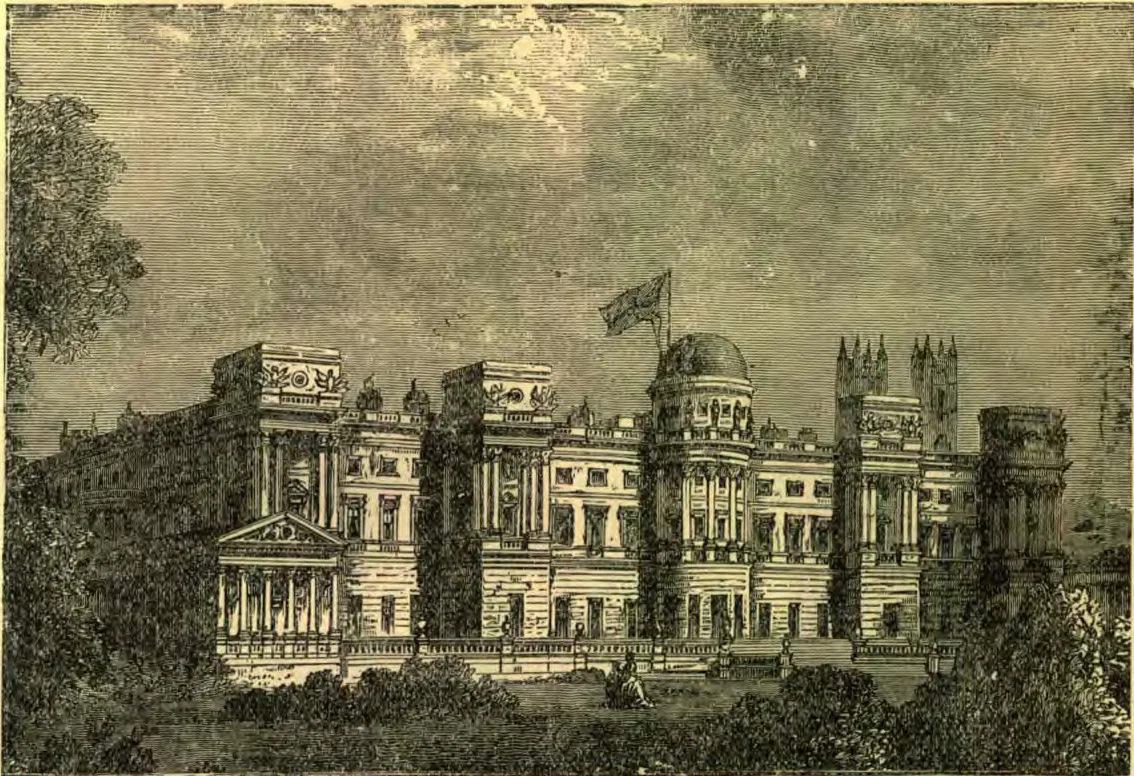
UCKINGHAM Palace, the eastern side of which is shown in our picture, is the London residence of Queen Victoria. It was built in the reign of George IV., and is considered by architects to be a very inartistic structure. There are seven distinguished apartments in the palace, known as—the Green Drawing-room, the Throne Room, the Picture Gallery, the Yellow Drawing-room, the Saloon, the Ballroom, and the State Dining-room.
The Picture Gallery is well worth visiting, as its walls are covered by rare paintings from numbers of the old masters. When the Queen is absent at Windsor Castle or others of her residences, travelers are allowed to visit this room and spend hours in feasting their eyes on the grand old paintings. The Throne Room is said to be the richest in the palace. Its walls are of plate glass, the pavement and pillars of polished marble, and the furniture gorgeous. All these, with the light that is thrown so artfully over all as to bring out every feature of the richness, combine to make this a very dazzling room.
The Queen has another palace in London known as St. James’s Palace, where she holds her balls, parades, and other public entertainments, but Buckingham is the domestic home of the royal family when in London, where they live for several months of the year. The Queen’s favorite residence, however, is said to be the Osborne House, on the Isle of Wight. E. B.

RED MEN CONVERTED.

Before the English came to this country, there were no white persons living here. The whole land was occupied by wild and savage Indians. These Indians were very numerous; they belonged to different tribes, and spoke different languages. Some of them lived in light tents made of the bark of trees or the dried skins of animals, and others in huts made of clay. They obtained their living by hunting and fishing and raising a little corn. They were very warlike and revengeful, and when they captured any of their enemies, were accustomed to torture them in the most cruel manner, and then put them to death.
One object which our forefathers had in view when they came to this country, was to enlighten these poor benighted heathen, and make known to them the way of salvation through the Redeemer. As soon as they could learn their language, they commenced instructing them in the truths of the Bible. Some of the ministers became missionaries among the Indians, and were the means of inducing many of them to give up their savage customs, and become followers of the lowly Saviour. One of the first converted was a woman. She lived at Nowatum (now Newton), in Massachusetts, where Rev. John Elliot, one of the missionaries, was accustomed to hold meetings. At these meetings the Indians were allowed to ask questions of the missionary, on various religious subjects. The women were allowed to make inquiries through their husbands or an interpreter. This woman, at one of these meetings, and probably before her conversion, asked the following question, which shows both her ignorance and her thoughtfulness. “When my husband prays,” said she, “if I say nothing, and yet my heart goes along with what he says, do I pray?” That was an important question; how would you answer it?
This woman learned to spin, and became distinguished for her industry and the good management of her family. She loved her Maker, and was submissive to his will. She was finally attacked by a very painful disease, which resulted in her death. During her illness the missionary visited her and prayed with her. She said to him, “Me still love God, though he let me be sick; and me will pray to him as long as me live. Me be willing to die, and believe me will go to heaven at last and live happy with God and Christ there.” And so she died.
The Indians are very fond of figurative language. Here is an instance of the manner in which one of them showed his willingness to be a Christian. His name was Wannatancet. After listening to a sermon of Mr. Elliot’s, whom he had heard preach many times before without believing, he said to the missionary: “You have been pleased in your abundant goodness, for four years past, to exhort me and my people with much persuasion to pray to God. I acknowledge that I have been used all my life to pass up and down in an old canoe; and now you wish me to make a change, to leave my old canoe and embark in a new one, to do which I have been unwilling. But now I give myself up to your advice, enter into a new canoe, and do engage myself to pray to God hereafter.” By his “old canoe” he meant his old heathenish religion, and by the “new canoe” he meant the Christian religion.
One of the company who was present asked Mr. Elliot to say to Wannatancet that while he went in his old canoe, though the stream was quiet, the end would be destruction; but now that he had embarked in the new canoe, though he might meet storms and rough passages, yet he must take courage, and persevere; for the end would be everlasting rest.

MAY VERSES.

Do you hear the wild birds calling? Do you hear them, O my heart? Do you see the blue air falling From their rushing wings apart?
With young mosses they are flocking, For they hear the laughing breeze, With dewy fingers rocking Their light cradles in the trees.
Within Nature’s bosom holden, ’Till the wintry storms were done, Little violets, white and golden, Now are leaning to the sun.
With its stars the box is florid, And the wind-flower, sweet to view, Hath uncovered its pale forehead To the kisses of the dew.
While thousand blossoms tender, As coquettishly as they, Are sunning their wild splendor In the blue eyes of the May!
In the water softly dimpled, In the flower-enameled sod, How beautifully exampled Is the providence of God!
From the insect’s little story To the fartherest star above, All are waves of glory, glory, In the ocean of his love.
—Alice Cary.

TOWZER'S EAR OF CORN.

The farmer had just closed and locked the door of his granary, when some one pulled at his sleeve, and, looking down, he saw a small boy holding an ear of corn.
“I found it in your field, and I guess it fell off from a load; so I brought it to you.”
“Why didn't you keep it?” asked the farmer, looking sharply at his companion.
“Because it didn't belong to me.”
“But it is only one ear; I should never miss it. It wasn't worth while to bring it.”
“Mother says it is always worth while to be honest, and I never stole as much as a pin in all my life. I wouldn't do it, either. I learned the commandments when I was a little bit of a fellow; so I know better.”
“I am glad of that. Now, what would you do with that ear of corn if it was yours?”
“Plant it next year, if I had any place, and then, perhaps, I should get a good many; then, if I kept on planting every year, after a while I should have a whole barnful of ears.”
“So you would. That is pretty good calculating. What is your name? When I talk with a boy, I want to know what to call him.”
“My name is Thomas Ayer, but you can call me Towzer; that is what everybody used to call me where we came from, because, you see, my hair is always all towzed up. It is so curly it won't keep straight; and, besides, my comb is an awful poor one.”
“You look as though you belonged to an ‘awful poor’ family.”
“I do, but we are going to be better off some time. Father's hands are all drawn up, so he can't do much; and that makes him discouraged, and mother too. But I am the oldest of the children, and I am going to work. If I can only get a start, I can keep right steady at it.”
“That is true, Towzer; and I will give you that ear of corn, with land enough to plant it next year. What do you think of that for a start?”
“I think that is a good deal better than I expected. I thank you ever and ever so much.”
“All right! I guess I can afford it. You can go into the house, and maybe the woman in there will give you some milk to carry home.”
“Will she let me do some work to pay for it? And please, sir, will you let me pay for this ear of corn too?”
“How long are you willing to work for it?”
“As long as you want me to.”
“I guess it won't take a great while. But there are most always chores to do, and I guess we can keep you busy for an hour or two.”
So Towzer was set to bring in wood and rake up leaves in the front yard, working busily until called to receive his wages. When he started for home, he carried not only an ear of corn, but a pail of milk and a bag of potatoes—the pail and bag to be returned the next day. As he trudged along, he found his burden somewhat heavy, but the thought that he had fairly started in a life of independence gave him courage.
His parents were poor and discouraged, yet there were some merry shouts in the house that evening; and the next morning, when he started to return pail and bag, his mother bade him a cheerful “God bless you!” His father was not a drunkard, and that was something for which to be thankful.
“Better have crooked fingers than drink whisky,” said Towzer to his new friend when they were talking together. “It has been real hard for us to get a living; but father and mother looked happy last night, and we are going to be better off some time.”
“I believe you will,” was replied. “If you do the best you can, you will come out all right.”
All through the autumn and winter Towzer worked as he had opportunity. In the spring he shelled his ear of corn, saving the large, full kernels for seed, and feeding the rest to his pet chicken. He calculated the exact number of hills he could plant. A piece of ground was measured off for him, and this he managed to enrich without spending any money or accepting anything in charity. Never was a garden more carefully hoed and seeded, and seldom are work and care so well rewarded, while Towzer made sure that he paid full rent for the land occupied.
The experiment was repeated the second year with like encouraging results, and thus Towzer was started in life. Of course, so industrious and conscientious a boy was no laggard in school, and people learned to respect him for his intelligence no less than for his goodness and energy.
He is still called Towzer by those who know him best, although he is now the owner of broad acres and well-tilled fields. Every year he gives to some poor boy the same offer which was made to him when he carried to its owner the ear of corn left from the harvest, and many have profited by his kindness. With courage, industry, honesty, and trust in God, even an ear of corn may prove the foundation of a fortune.
Who of my readers are so poor that they cannot command as much as this?—Mary Dwinell Chellis.

NATURE'S UNDERTAKERS.

How often do we hear the query, “What becomes of all the dead birds?”! The secret of their mysterious disappearance was but just now half told by the buzz of those brown wings, and the other half is welcome to any one who will take the trouble to follow their lead. This beetle is one of man’s incalculable benefactors. It is his mission to keep fresh and pure the air we breathe. He is the sexton that takes beneath the mold not only the fallen sparrow, but the mice, the squirrels, and even much larger creatures, that die in our woods and fields.
Beneath that clump of yarrow I found just what I had expected,—a small dead bird, and the grave-diggers were in the midst of their work. Already the rampart of fresh earth was raised around the body, and the cavity was growing deeper with every moment as the busy diggers excavated the turf beneath.
These Nature-burials are by no means rare, and where the listless eye fails to discover them, the nostrils will often indicate the way; and to any one desirous of witnessing the operation without the trouble of search, it is only necessary to place in some convenient spot of loose earth the carcass of some small animal. The most casual observer could not fail soon to be attracted by the orange-spotted beetles.
I am always glad of the opportunity to watch the progress of these meadow-burials; and had you accompanied me on that morning walk, you would have looked with interest at these little undertakers—seen that feathery body toss and heave with strange mockery of life as the busy sextons worked beneath it, digging with their spiked thighs, shoveling out the loose earth with their broad heads and pulling down the body into the deepened cavity.—Harper's Magazine.

MAY

May! welcome May, blooming and bright, Coming to bring us beauty and light.
May! rosy May, tender and soft, Hanging green banners in garlands aloft.
May! blushing May, fair as the dawn, Weaving soft carpets for meadow and lawn.
May! sunny May, calling the flowers, Spring-birds and dew-drops, sunlight and showers.
May! golden May, treasures complete Fond Mother Nature has laid at her feet.
May! scented May, balmy each room, Fragrant with apple-buds bursting in bloom.
May! pearly May, peach blossoms too Lend us their fragrance, dripping with dew.
May! laughing May, pleasant to see; Clothing with delicate garments each tree.

SPRING SONG.

O hope of the world that risest again New-born from the clod, O life that brightens on meadow and fen With the breath of God, O daffodils brave whose banners fly At the snow’s retreat, O sweet warm winds of the South that sigh O’er the springing wheat, O birds that tell in the branches bare Of the summer days,— Read me your lesson; teach me your prayer; Fill my soul with your praise. —Sunday Afternoon.

REMEMBERING THE MOTHERS.

I KNOW a person who sometimes sends presents to old ladies because they have brought up such good children. Do you ever, when enjoying the friendship, love, and assistance of dear, kind friends, think how much you owe to some aged, gray-haired, and worn-out mother, for rearing such good children? Do you ever show your thankfulness to the old mothers?
F. Binns tells, in the Christian Era, about a Fiji Islander who did not forget the missionary’s mother.
Two Christian missionaries landed on an island in Fiji. They knew well the character of the people, but the people did not know their character. The savages came down, naked, clubbed, and scowling, ready to destroy the missionaries. One of the missionaries went up to the chief and bowing to him, said, “My love to you;” turning to the next, he said, “My love to you;” and so on to all. Very soon, the clubs were down, and friendly intercourse began, and the missionaries remained and preached in the island. A few years after, as one of these missionaries was leaving the island, a native followed the boat, and holding out a pretty little thing he had made, said: “Wait, wait, I want you to take this home to your mother. Great is my love to your mother. This is not much, but I made it with my own hands. Carry it home to your mother. Tell her that before you came I was a cannibal, and killed men and ate them; but now the love of God is burning in my heart; and if your mother had not loved me, and let you come to tell me that Jesus died, I should have been a cannibal to this day. Great is my love to your mother. Take this home to your mother for me.”—Well-Spring.

Few Know How Much They Must Know

Few know how much they must know in order to know how little they know.

SCENES IN THE LIFE OF CHRIST.

LESSON 68.—JESUS TEACHES HIS DISCIPLES.

While Jesus was talking with the scribes and Pharisees, a great multitude of people had gathered to hear him, so many that they trod upon one another. And he began to talk, as if to his disciples. After cautioning them against being deceived by the hypocrisy of the Pharisees, he showed them that what he taught them privately they were to proclaim publicly to the people. He said, “What I tell you in darkness, that speak ye in light; and what ye hear in the ear, that preach ye upon the housetops.” And he bade them to fear not men nor their persecutions, but rather to fear God, who is able either to save or destroy eternally.
Then to show how tender a care God has for his children, he said, “Are not two sparrows sold for a farthing? And not one of them shall fall to the ground without your Father [without your Father's notice]. But the very hairs of your head are all numbered. Fear ye not therefore, ye are of more value than many sparrows.”
And Jesus said, “Whosoever therefore shall confess me before men, him will I confess also before my Father which is in heaven. But whosoever shall deny me before men, him will I also deny before my Father which is in heaven. He that receiveth you receiveth me, and he that receiveth me receiveth him that sent me. He that receiveth a prophet in the name of a prophet shall receive a prophet’s reward, and he that receiveth a righteous man in the name of a righteous man shall receive a righteous man’s reward. But beware of men; for they shall deliver you up to the councils, and they will scourge you in their synagogues; and ye shall be brought before governors and kings for my sake. . . . But when they deliver you up, take no thought how or what ye shall speak, for it shall be given you in that same hour what ye shall speak. For it is not ye that speak, but the Spirit of your Father which speaketh in you.”
“And one of the company said unto him, Master, speak to my brother, that he divide the inheritance with me. And he said unto him, Man, who made me a judge or a divider over you? And he said unto them, Take heed, and beware of covetousness; for a man’s life consisteth not in the abundance of the things which he possesseth. And he spake a parable unto them, saying, The ground of a certain rich man brought forth plentifully; and he thought within himself, saying What shall I do, because I have no room where to bestow my fruits? And he said, This will I do; I will pull down my barns, and build greater; and there will I bestow all my fruits and my goods. And I will say to my soul, Soul, thou hast much goods laid up for many years; take thine ease, eat, drink, and be merry. But God said unto him, Thou fool, this night thy soul shall be required of thee; then whose shall those things be, which thou hast provided? So is he that layeth up treasure for himself, and is not rich toward God.

QUESTIONS.

1. What happened while Jesus was talking with the scribes and Pharisees? Luke 12 : 1.
2. To whom did the Saviour begin to talk?
3. Against what did he caution the disciples?
4. How were they to make known to the world what he taught them privately? Matt. 10 : 27.
5. What did Jesus say to them about fearing men and their persecutions?
6. How did he illustrate the tender care which God has for his children?
7. What did Jesus say should be the reward of those who would confess him before men? Verse 32.
8. What will be the fate of those who deny him?
9. By receiving Christ’s followers whom else do we receive? Verse 40.
10. What did he say about those who should receive a prophet or a righteous man because they were the servants of the Lord?
11. What persecutions did Jesus tell the disciples they must suffer from men for his sake?
12. How were they to know what to say when they were brought to answer before kings and councils? Verse 19.
13. Who was really to speak through them?
14. When Jesus had done speaking, what did one of the company ask him to do? Luke 12 : 13.
15. What answer did the man receive?
16. What did Jesus say about covetousness, to those who listened?
17. What way did Jesus take to teach them that a man’s life and happiness do not depend upon the abundance of his riches? Verse 16.
18. How was a certain rich man troubled?
19. What did he finally decide to do?
20. What did he say to his soul, meaning himself?
21. How did God see fit to change the plans of this proud man?
22. Whose course is likened to that of this rich man?

NEW-TESTAMENT HISTORY.

LESSON 81.—THE PARABLE OF THE TALENTS.

It seems that many of the followers of Jesus thought his reign was immediately to begin; and as he drew near to Jerusalem, he began to teach them that he must first go away to a “far country,” but that he would afterward return, and reward all his servants who would prove faithful. This instruction was the more necessary from the fact that he was about to make a triumphal entry into Jerusalem, and many might suppose that he intended to establish his kingdom at once.
In order to make the stronger impression upon the minds of his disciples, and perhaps in order that those who had scorned his teaching might not understand, he clothed his instruction in the following parable:—
“For the kingdom of heaven is as a man traveling into a far country, who called his own servants, and delivered unto them his goods. And unto one he gave five talents, to another two, and to another one; to every man according to his several ability; and straightway took his journey. Then he that had received the five talents went and traded with the same, and made them other five talents. And likewise he that had received two, he also gained other two. But he that had received one went and digged in the earth, and hid his lord’s money. After a long time the lord of those servants cometh, and reckoneth with them. And so he that had received five talents came and brought other five talents, saying, Lord, thou deliveredst unto me five talents; behold, I have gained beside them five talents more. His lord said unto him, Well done, thou good and faithful servant: thou hast been faithful over a few things, I will make thee ruler over many things; enter thou into the joy of thy lord. He also that had received two talents came and said, Lord, thou deliveredst unto me two talents: behold, I have gained two other talents beside them. His lord said unto him, Well done, good and faithful servant: thou hast been faithful over a few things, I will make thee ruler over many things; enter thou into the joy of thy lord. Then he which had received the one talent came and said, Lord, I knew thee that thou art an hard man, reaping where thou hast not sown, and gathering where thou hast not strawed; and I was afraid, and went and hid thy talent in the earth; lo, there thou hast that is thine. His lord answered and said unto him, Thou wicked and slothful servant, thou knewest that I reap where I sowed not, and gather where I have not strawed: thou oughtest therefore to have put my money to the exchangers, and then at my coming I should have received my own with usury. Take therefore the talent from him, and give it unto him that hath ten talents. For unto every one that hath shall be given, and he shall have abundance; but from him that hath not shall be taken away even that which he hath. And cast ye the unprofitable servant into outer darkness; there shall be weeping and gnashing of teeth.”
Luke, in the nineteenth chapter, relates a parable which is evidently intended to teach the same lesson as the one given above. By many, it is thought to be the same parable told in a somewhat different manner.
“And the Jews’ passover was nigh at hand; and many went out of the country up to Jerusalem before the passover, to purify themselves. Then sought they for Jesus, and spake among themselves, as they stood in the temple, What think ye, that he will not come to the feast? Now both the chief priests and the Pharisees had given a commandment, that if any man knew where he were, he should shew it, that they might take him.
“Then Jesus six days before the passover came to Bethany, where Lazarus was which had been dead, whom he raised from the dead. There they made him a supper; and Martha served; but Lazarus was one of them that sat at the table with him. Then took Mary a pound of ointment of spikenard, very costly, and anointed the feet of Jesus, and wiped his feet with her hair; and the house was filled with the odor of the ointment. Then saith one of his disciples, Judas Iscariot, Simon’s son, which should betray him, Why was not this ointment sold for three hundred pence, and given to the poor? This he said, not that he cared for the poor; but because he was a thief, and had the bag, and bare what was put therein.”
“And Jesus said, Let her alone; why trouble ye her? She hath wrought a good work on me. For ye have the poor with you always, and whensoever ye will ye may do them good; but me ye have not always. She hath done what she could; she is come aforehand to anoint my body to the burying. Verily I say unto you, Wheresoever this gospel shall be preached throughout the whole world, this also that she hath done shall be spoken of for a memorial of her.”
“Much people of the Jews knew therefore that he was there; and they came not for Jesus’ sake only, but that they might see Lazarus also, whom he had raised from the dead. But the chief priests consulted that they might put Lazarus also to death; because that by reason of him many of the Jews went away, and believed on Jesus.”},{

THE LITTLE BIRD.

A LITTLE bird, with feathers brown, Sat singing on a tree; The song was very soft and low, But sweet as it could be.
And all the people passing by, Looked up to see the bird, That made the sweetest melody That ever they had heard.
But all the bright eyes looked in vain, For birdie was so small, And with a modest dark-brown coat, He made no show at all.
“Why, papa,” little Gracie said, “Where can this birdie be? If I could sing a song like that, I’d sit where folks could see.”
“I hope my little girl will learn A lesson from that bird, And try to do what good she can, Not to be seen or heard.”
“This birdie is content to sit Unnoticed by the way, And sweetly sing his Maker’s praise From dawn to close of day.
“So live, my child, all through your life, That, be it short or long, Though others may forget your looks, They’ll not forget your song.” —Selected.

OVERCOME EVIL WITH GOOD.

One Friday morning Lettie sat on the portico steps, learning her Sabbath-school verses. Over and over, to fix it in her memory, she repeated the words, “Be not overcome of evil, but overcome evil with good.” Not far from her, Dallas, her brother, was busily engaged in trying to make a kite from a collection before him of pink tissue paper, sticks, and strings. His face was very red, and his forehead was drawn into an ugly frown as he impatiently exclaimed:—
“Pshaw! what is the matter?”
“I’ll tell you what’s the matter, Dallas,” answered Lettie. “Your paste is too thin, and you have not cut your sticks fine enough.”
“What do you know about it? Girls do not fly kites;” and Dallas made an ugly face at his sister.
“But I am sure the paste is not right,” Lettie said. “I watched mamma making fire-screens the other day, and yours is not like what she used. Let me fix it for you,” and coming to his side, she stooped to pick up the paste-cup.
But Dallas was thoroughly out of humor,—angry with himself for not being skillful enough to make the kite, and angry with his sister for presuming to teach him.
“Oh yes! you think yourself very smart, don’t you?” he spitefully exclaimed, and gave her a push which knocked her over.
When he saw what he had done, he plunged his hands into his pockets and walked off whistling into the orchard.
Lettie got up, her arm hurt by the fall, and her feelings still more hurt by such rough treatment, and called out after Dallas:—
“Oh, you rude, naughty boy; I shall tell mamma how you have acted, and she will keep you in this afternoon.”
She looked after him for a moment, and then sat down and began again to learn her verse. As she studied, the words, “Be not overcome with evil, but overcome evil with good,” seemed somehow to grow in meaning to her mind. She ceased their repetition, and remained quiet for awhile, her head resting on her hand, and her blue eyes looking very thoughtful. Then she arose from her seat, put away her Bible, picked up the paste-cup, and went into the kitchen. There she took some flour out of a firkin, thickened the paste, cooked it awhile on the stove, and then went back to the porch and began to work on the forsaken kite.
Meantime, Dallas walked on through the orchard in a very independent manner, taking no notice of Lettie’s words, although he heard them very distinctly. He crossed the meadow, sat down on a stone beside the brook, and tried to amuse himself by throwing pebbles into the water. But he got tired of that, and began to be sorry that he had been so naughty to his sister. He wished he had let her help him with the kite, for he wanted one very much. His cousins were coming to spend the afternoon with them, and his mother would keep him in as a punishment for his rude conduct. He felt very uncomfortable. He stayed there a good while thinking about it. He was every moment more convinced that he had behaved badly and foolishly. He walked slowly to the house, and on reaching the porch, was surprised to see his sister’s curly head bent over her work on the kite. She looked up as he came toward her, with a sly glance, as if she were not sure he would be pleased; then rose and handed Dallas the kite—and such a kite! It was covered with pink, and trimmed with tassels and fringe of white tissue paper, and dotted with gilt stars, which Lettie had fashioned from her paper doll dresses.
“O Lettie!” Dallas exclaimed, “how could you do all that for me, when I was so naughty to you?” and he put his arms around her neck and kissed her.
So Dallas enjoyed his holiday flying his kite with his little cousins, and Lettie learned the blessedness of overcoming evil with good.—The Myrtle.

A REMARKABLE CROW.

WHILE at Coopersville, in Ottawa Co., Mich., I met with the great surprise of hearing a crow talk. The bird is a handsome, large, two-year-old crow of more than usual intelligence for such a creature. He will imitate the cackling of the hen as well as various other noises, so naturally as to deceive even the most critical ear. But his imitative freaks are not confined to the sounds of the lower animals, but as skillfully as a parrot he will repeat certain phrases which are current among men.
He seems to help himself in his articulation by partially spreading his wings and making a motion somewhat as he would if he started to fly, when he will shout lustily, “Boys! boys! boys!”—three or four times in rapid succession. Then he will, in the same way, with somewhat irritated tone of voice shout, “Dry up! dry up! dry up!”
The most perfect imitation of the human voice from all I heard him say was the following call which he uttered in a rather subdued tone: “Come watch! come watch! come watch!”
The bird has his favorites. Only these are allowed to stroke his bill by way of caress, and for these alone he seems inclined to talk. His chief favorite is the bright five-year-old boy of the owner, for whom he will repeat, by the hour, any one of the phrases he has learned which the little fellow may choose to call to him.
One day a crow from the woods alighted on the barn where this, his apparently much better endowed fellow-crow, was just then sunning himself (having been allowed to leave his cage); the stranger crow walked up to him, probably with the intention of addressing him in the common crow-dialect, and may actually have made his opening remarks, when a peremptory “Dry up! dry up! dry up!” not only nonplussed the unsophisticated rustic, but put him to rapid flight.
Some years ago I had heard that crows could be taught to say certain words by having an incision made into their tongue. I was therefore curious to know whether some ingenious operation on the tongue of this remarkable creature had made him what he was. But upon inquiry I learned that nothing of the kind had been done to the bird, but that he picked up what he had learned of his own accord while kept in a cage.
I tell this story because I thought some of the younger readers of the YOUTH’S INSTRUCTOR would be interested to hear what a crow can do. If you would like to know how highly the owner values the bird, I can tell you what he told me, that he would not sell him for fifty dollars.
A. KUNZ.

“GOD BE WITH THEE.”

It is related by travelers, as an instance of how little the customs of Eastern nations have changed during many hundreds of years, that in the fields of Palestine the very same words may be heard now as in the days of Boaz and Ruth. When the master enters the harvest field, he salutes his reapers, just as Boaz did, “The Lord be with you;” and the peasants respond always in the words, “God bless thee.” It is a happy custom that may well see no change. We should all do well to use from the heart this ancient salutation, “The Lord be with thee.”

Early Impressions Shape the Course of Life

EARLY impressions usually mark the course to be taken through life. Take a fresh molded brick, and impress a leaf upon it; subject the brick to the kiln, and it will come back with the impression ineffaceable. Build it in a house, and you may see it across the street. The child's mind is the moist brick. Delay not to bring the truth of God in contact with it.

You have reached the end of this edition.

The Youth’s Instructor · May 10, 1882