In spite of all the Boxers and fighting and massacres, the Chinese seem more eager than ever to read God’s Book for themselves. During the first eight months of this year more than three quarters of a million volumes were sent out from the British and Foreign Bible Society depot at Shanghai into all parts of China.
A MOHAMMEDAN artillery officer in Morocco was won to Christ through reading the Scriptures. He became a colporteur, and worked diligently to circulate the book among his countrymen, who denounced and persecuted him. At last he was attacked by a band of fanatics, and maltreated so severely that he died last August. His relatives tried their utmost to persuade him, before his death, to return to the Moslem faith, but in reply to their entreaties “he spoke only of Jesus.”
AN English lady missionary, writing of Chinese schoolgirls, says their games are exactly like games at which English children play, except that in “battledoor” they use their feet instead of their hands. “Knuckle bones” is played exactly as boys play it in England, only they use stones. “Hunt the slipper” is also just the same. The Chinese, too, have the most beautiful swings—and such kites! They know no end of riddles, both spoken and written, and they have all kinds of puzzles.
A MISSIONARY in the Zanzibar district tells of the simple faith of the native Christians. During a time of great drought last December the chief called a meeting of the people to pray for rain. There was a company of three hundred and sixty persons gathered together, including the chiefs of two villages. After singing and an explanation of the conditions of prevailing prayer, the chief, who was a Christian, offered the first prayer. He was followed by two pagan chiefs. There was great solemnity throughout the entire meeting. On the morrow the clouds gathered, and an abundant rain fell in the course of the next two days.
NOT many boys and girls at the age of ten have advanced very far in the work of translation; but in an old report of the Bible Society, two children are mentioned who assisted in translating the Bible. They were the children of a missionary who translated the Bible into the Accra, or Gâ, language, spoken on the Gold Coast, West Africa. In writing to the Bible Society, this missionary said that he was assisted by his two children, a boy of eight and a girl of ten, in the final reading and comparing of the manuscript of his Gâ translation with the original Hebrew and with the English. The boy, he says, had just managed the Hebrew reading, though he could only read slowly, and both the children were very much interested in the work as book after book was prepared.
Queer
A CLOCK can run, but can not walk;
My shoe has a tongue, but cannot talk;
A comb has teeth, but has no mouth;
A north wind blows the smoke straight south.
Bottles have necks, but have no heads;
And pins have heads, but have no necks;
And needles have to hold their threads
Right in their eyes — how it must vex!
If I were needle, comb, or shoe,
I never should know what to do.
My head is really in a whirl;
I'm glad I am a little girl.
— Exchange.
Her Dream
By Ida Fischer
“ONLY two more hats to make,” sighed a little half-starved native, as her fingers deftly wove the palm back and forth; “then I shall have a few days’ rest until tio (uncle) comes back from the city.”
For weeks nine-year-old Neena had been working early and late to finish the task left her when her uncle went away. For weeks she had had scarcely enough food to sustain life; for they were very poor, and the uncle felt that he was more than burdened by having to care for her at all. Most of his time was spent over the gambling-table, and his earnings and hers generally went for tobacco and rum.
At last her task was finished, and she sighed again, this time with satisfaction, as she viewed the large pile of beautiful straw hats in the corner of the bohio. She was bright enough to know that if the dealers treated them fairly, her work would bring a neat little sum.
“But there,” she exclaimed, “what’s the use of thinking about being treated fair? They believe in getting all they can, and uncle does, too.”
After eating a crust of bread and a banana, she curled up in her hammock and went to sleep.
While she slept, she dreamed that she was being carried to the seashore. As far as her eyes could see was the blue ocean, and tossing upon its waves were many vessels. In the distance was a reef. Many of the vessels were sailing toward it; and as they struck the rocks, they were dashed in pieces. Others approached it, but their guides turned them aside in time to save them.
In the midst of the dream her uncle called her to get up and prepare for a journey. This was a surprise; for she had never been away from the mountain village. She rose obediently, however, gathered up the hats, and mounted the pony, with her uncle. After traveling the rest of the night, and part of the following day, they entered a city on the coast. For the first time, she saw the beautiful ocean, the vessels large and small, the reefs, and the huge billows, as in her dream. Only one thing was lacking — she did not see the vessels driven upon the rocks.
After a deal of quarreling on the part of the seller and the buyer, the hats were disposed of, and the coins tied up in an old handkerchief; then, leading the little girl by the hand, the uncle started out to beg. Under threat of punishment, she was compelled to shut her eyes, while he led her from house to house, crying, “Ciego” (“blind”)!
Finally, after laying in a supply of rum and tobacco, he prepared to start for home; but when he looked for Neena, she was not to be found, so he went on without her. But where was Neena? — She had found friends to whom she opened her heart, and a home was found for her among Christian people. One day as her mistress was telling her the story of the “Storm of Galilee,” when Jesus spoke to the waves, saying, “Peace, be still,” she related her dream in the mountains.
Then the Christian woman saw an opportunity to impress a lesson upon the mind of the child, and told Neena what she saw in the dream for her. And Neena seemed to understand, and to wish to guide her life away from the rocks of sin.
Surely God has had a care for the little native girl! MRS. IDA FISCHER.
An Unhistoric Dark Day
By Bertha E. Bush
THEY were sitting before the fire reading. “Candles were lighted in the houses,” read Jimmy. “The fowls retired to roost; the cocks were crowing all around as at the break of day; objects could not be distinguished but at very little distance; and everything bore the appearance and gloom of night.”
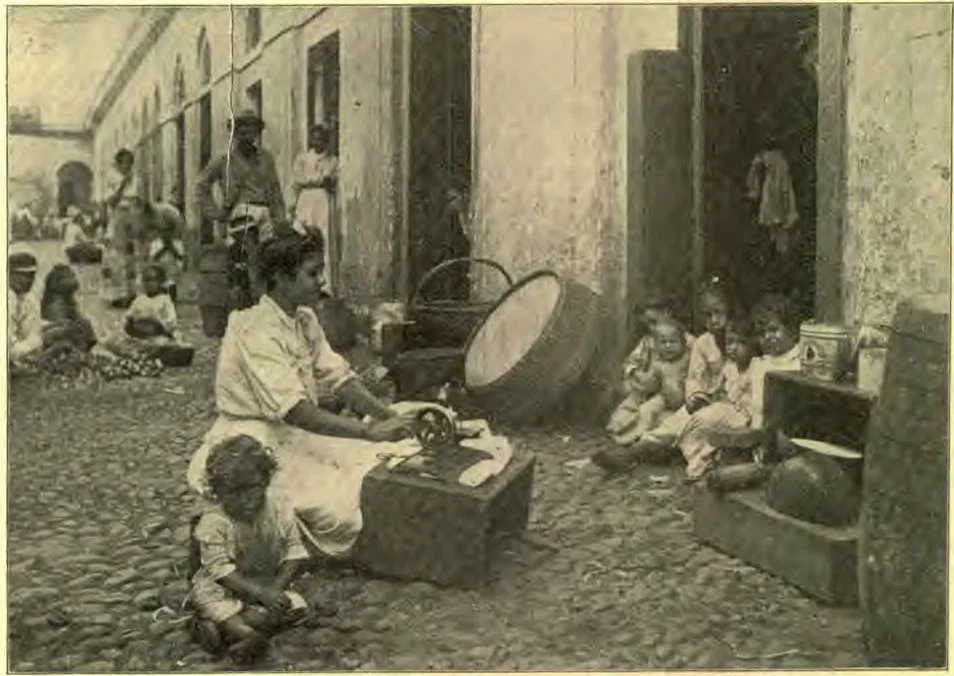
SOME LITTLE FOLKS IN PORTO RICO
“Well, so they do every night,” said Jennie. “That’s not wonderful.”
“Oh, but this was in the daytime!” said Jimmy. “The darkness began about ten o’clock in the morning, and lasted all day long. The histories all tell of it, and call it the Dark Day. It was May 19, 1780.”
Jennie’s only answer was a great yawn, for she did not care for history as Jimmy did. The two were keeping house alone. Father and mother had gone to stay all day and all night. Jimmy and Jennie had celebrated by sitting up very late.
“How jolly it will be not to have anybody call us in the morning!” said Jimmy. “Let’s sleep as late as we want to for once.”
“Oh, no, let’s get up early. There’s lots to do, and we don’t want father and mother to think we neglect things,” said conscientious Jennie.
Fifteen minutes later they were both sound asleep, and only the old clock was left to make a noise in the farm kitchen. But the clock was not so faithful as usual. Something was wrong with it. In the middle of the night it stopped, and no ticking was heard for five hours. Then, without any apparent reason, it began again, as watches sometimes do.
The house was very still in the morning and the two children slept heavily. Jennie woke up first, just in time to hear the clock strike.
“Jimmy, Jimmy, wake up!” she cried. “It’s seven o’clock.”
They had always been early risers at the farm, and seven o’clock seemed very late to them. Jimmy jumped up like a shot. He hurried to do the chores, and Jennie hurried to get the breakfast. It was a dull, cloudy day, and not a glimpse could they get of the sun. Jimmy went to his weeding, like the faithful farmer boy he was, and Jennie was very busy about the house till the clock struck twelve. Then she called Jimmy in to dinner. They were very merry at dinner, and ate a long time.
“How dark it is!” said Jennie, when the meal was fairly over. “It must be going to rain.”
They hastened out to scan the sky, but no rain-cloud was to be seen, only the gray mist that had covered the sun all day.
“Why! Why-ee!” cried Jennie, in astonishment. “The chickens are going to roost. Jimmy, it’s another Dark Day!”
Jimmy ran into the house, and brought out the book. He had to hold it close to his eyes to see in the dim light.
“Yes!” he cried excitedly. “It’s just the way it was then. We’re having another Dark Day. Hooray! Go and look at the clock.”
“A quarter past one,” reported Jennie. “Jimmy, we’ll have to light a lamp. Oh, I wish—I wish—that it was night, so that mother would come.”
“Nonsense!” said Jimmy, although his own hands trembled queerly. “It’s only living history over again. Don’t be a coward, Jennie. Just think how grand it is to be alive on such a wonderful day.”
“Don’t go out to weed again!” begged Jennie. “Stay in the house with me.”
So Jimmy stayed, and although he wouldn’t have liked to own it, he was glad to stay. He even wiped the dishes, “for company,” he said. At two o’clock a rattle of wheels was heard, and a buggy drove into the yard.
“It’s mother!” cried Jennie, joyfully, and ran out, dish-cloth in hand. Mother got out with her arms full of packages and a beaming smile. But she looked at father queerly when she saw what the children were doing.
“Why, Jennie,” she said, “haven’t you got your supper dishes done yet?”
“Supper!” cried Jimmy and Jennie. “Why, ma, you mean dinner! Did you come early because you thought we’d be afraid? We might have been if we hadn’t read about the other382Dark Day in the history last night,” they finished, cheerfully.
“Early! Dark Day!” Mother looked up in astonishment. “What are you children thinking of? What time do you think it is?”
“Two o’clock in the afternoon,” chorused Jimmy and Jennie, pointing to the clock.
Then mother laughed. Oh, how she laughed! The table fairly shook till all the supper dishes rattled.
“It’s almost eight o’clock at night! The old clock must have stopped. O father, father, did you ever hear of anything so funny?”
But Jimmy and Jennie did not think it so very funny. It was not till years after that they saw much amusement in their unhistoric Dark Day.—Bertha E. Bush, in Youth’s Companion.
A Neglected Opportunity
ONE who has recently visited the Philippines, and taken note of the religious condition in the islands, has written the result of his observations, making a strong appeal to the Protestant churches of America to awaken to the situation, and send out an army of workers to carry the light of the gospel to the natives. The article appeared in the Northwestern Christian Advocate of October 22. After speaking at some length of the dangers that threaten liberty of conscience, of religious assembly, and of religious opinion, he says:—
“The solidarity of Rome must be broken. It is now much disturbed, but this condition will not be permitted to continue long. This is the moment for the Protestant Church to hurry its forces into the field, and hold the ground for civil and religious liberty. The door will soon close. The world will have a right to demand of American Protestantism why it did not hold the Philippines for religious and civil liberty, if it fails to measure up to the situation.”
“Conditions are rapidly forming for Rome’s supreme hour. This will come when the people are enfranchised, and led by the priesthood to the polls and voted solidly to carry out the dictates of the Archbishop of Manila, who has always ruled the Philippines, and will effectually do so again when the civil government is turned over to the natives. The régime of the past to smother liberty is one of the darkest pages in human history. Ostracism, dungeons, confiscation of property, banishment, secret murders, false accusation, and execution on trumped-up charges,—all have been common in the Philippines to intimidate those who were disposed to drift away from Rome. At this time these ignorant and superstitious people are confronted with the awful curses of excommunication, refusal of marriage and holy sepulcher, to intimidate them and keep them in line. Those who hunger for liberty have no leaders, none to bring to them the consolations of religion, no support in their tendencies to become truly liberty-loving people, and so Rome will soon be able to drive all those who are hoping for something better than this strong hand back again into helpless and hopeless bondage.”
The writer asks, “What are the Protestant churches doing to meet this situation?” and answers, “Almost nothing.” In Manila there are a383few missionaries, but “out in the provinces there is not one to a million natives.” He says, further:—
“All northern Luzon, the region having people of the highest racial development in the archipelago, including the Tagalogs, and of the highest material development, comprising probably three millions of people, there is only one missionary outside of Manila. . . . Southern Luzon has been given to the Presbyterians and the Baptists, together with the southern islands. But in all those multitudes, . . . there is not one missionary to millions of natives.”
The situation set forth in these paragraphs is one that ought to awaken in the hearts of the young people who truly love the hope of the soon coming of our Lord Jesus, a desire to do something to give this message to our neighbors in the Philippines,—not in the hope of breaking “the solidarity of Rome,” but of giving to all an opportunity to become free in the Lord, and to prepare to welcome him with joy at his appearing.
The Book
The book I love in winter-time is printed black and white,
A book to read before the fire upon a chilly night;
A tale of high adventuring, a tale of woe and joy,
With many pictures intermixed, the kind that suits a boy.
A ship, a cruise, a lad at sea, a purpose to defend,
And everything to come aright before the story's end.
But when the summer-time is here, I love another book,
Not told upon a printed page, but gurgled by a brook,
And whispered by the eager pines, and thundered by the sea,
And gossiped in a dialect by every passing bee.
There is no story in the world which I have ever seen
To equal nature's volume, where the leaves are all of green.
The book is ever open at the most exciting page,
To suit the reader old or young, of any taste and age;
The pictures are in colors fair, the plot is ever new—
However wild or wonderful, you know it all is true.
The book will last a lifetime long, and best of all, my friend,
Each summer 'tis “continued,” and it never has an end!
—Selected.
How to Lose a Situation
THE boy who cultivates the following habits is sure to lose his place in a short time, and be out on the street looking for another job:—
Get down to business twenty minutes or half an hour after the rest of the clerks are there, and the work of the day is in full swing.
When sent on an errand, waste as much time as you can on the way, and do not get back to business again any sooner than you can possibly help.
Do not take any interest in your work, and never try to do anything quickly and neatly.
When instructed respecting your duties by your employer, be rude in your answers.
Watch the clock instead of your work, that you may be ready to quit on the first stroke of the bell.
When serving a customer, let him see by your inattention and careless manner that you do not care whether he makes a purchase or not.
Watch your employer; and when his back is turned, waste your time.
Spend your evenings on the streets and in the saloons rather than in study and self-improvement.
Ask for an advance in wages at the end of the first month.
Impress the head of the firm with the fact that you know how to run the business a great deal better than he does.
If a few of these rules are followed, you will get your discharge at the end of three months,— Selected.
Memory Verse: “They shall cry unto the Lord because of the oppressors, and he shall send them a saviour, and a great one, and he shall deliver them.” Isa. 19:20.
(The chapter given as the Lesson Scripture is the lesson to be studied. Read this every day, and think over it until you know just what it teaches. Then the following notes, which should be read several times, will help to a fuller understanding of the lesson. Lastly, go over the questions carefully, and be sure that you can answer each in the words of Scripture.)
God told Abraham not only that his seed should go into Egypt, but also how long they should stay there, and what would happen to them during that time. He said: “Know of a surety that thy seed shall be a stranger in a land that is not theirs, and shall serve them; and they shall afflict them four hundred years.” He also said to Jacob, when he was on the way to Egypt, “There will I make of thee a great nation.”
Our lesson this week shows how these words of God came to pass. For the children of Israel increased abundantly, and multiplied, and waxed exceeding mighty; and the land was filled with them. This led the Egyptians to fear them, and afflict them, as God had said.
But this did not lessen their numbers; for “the more they afflicted them, the more they multiplied and grew.” Hard work does not kill people, but makes them strong and healthy.
So Pharaoh tried a different plan: he made a cruel decree that every baby boy should be thrown into the river. But God used this very decree to work out his own purpose, and raise up a deliverer for Israel.
The eleventh of Hebrews tells us that “by faith Moses, when he was born, was hid three months of his parents, because they saw that he was a proper child; and they were not afraid of the king’s commandment.”
During their long stay in Egypt many of the Israelites had left the worship of the true God, and now worshiped the idols of Egypt. But there were still some faithful ones among them, who loved and trusted God, and waited in faith for him to bring them out of their hard bondage, and take them to the promised land. These were looking for him to raise up a deliverer for them.
When Moses was born, and his parents saw that he was an unusually fine child, they hoped and trusted that he was the one chosen of God to deliver Israel. His mother did at last put him in the river, but in such a way that he could not be drowned. And God sent Pharaoh’s own daughter to find him, and opened her heart to the beautiful boy, so that his life might be spared. Then his mother was able to bring him up openly without fear, and money was given to her to provide for him. How precious were those few years that Moses spent in his mother’s home, and how carefully she must have taught him of the God of his fathers, and of the work that was in store for him as the deliverer of Israel!
Moses stayed in the court of Pharaoh until he was forty years old. He was a great man, “learned in all the wisdom of the Egyptians, and was mighty in words and in deeds.” He might have sat upon the throne of Egypt, and ruled over that great kingdom. But he looked for a better country, the land that God had promised to his fathers. This, we have learned, is the beautiful new earth, for which we also look. “By faith Moses, when he was come to years, refused to be called the son of Pharaoh’s daughter, choosing rather to suffer affliction with the people of God, than to enjoy the pleasures of sin for a season.”
Moses at first made the same mistake that Abraham and Jacob had made. He tried to get for himself what he knew God intended for him. He knew that God had chosen him to deliver Israel; and so, when he saw an Egyptian taskmaster ill-treating a Hebrew slave, he killed the Egyptian. Then, thinking that his brethren understood that God had set him over them, he interfered when he heard two of them quarreling. But they were angry, and said, “Who made thee a prince and a judge over us?” just as Joseph’s brethren said when he told them his dreams.
The life history of Moses, like that of Joseph, is an object-lesson of Christ. What things in the life of Christ does this week’s lesson bring to your mind? Satan knew that the time was drawing near for God to deliver his people from Egypt, and he expected that he would raise up a man to lead them out. So he put it into Pharaoh’s heart to kill all the baby boys, just as he afterward moved Herod to kill all the infants so that Jesus should be slain. But all that Satan can do only helps forward the work of God.
Questions
1. How long did God say that Abraham’s seed should stay in Egypt? Gen. 15:13. What did he say should be done to them there?
2. What did God tell Jacob he would do for his seed while they were in Egypt? Gen. 46:3. How was this promise fulfilled? Ex. 1:7.
3. Of what was the king of Egypt afraid when he saw their numbers? What did he first do to try to keep them from increasing? Verse 10. What was the result of this? Verse 12. What does this show about hard work?
4. What command did Pharaoh afterward give? Verse 22. Who had a son about this time? Why did she not do as the king commanded? Ex. 2:2.
5. What did Jochebed do with Moses when she could not hide him any longer? Verse 3. Who found the child? Verse 5. Tell how he was given back into his mother’s care. Verses 7–9.
6. Where did Moses go to live when he was old enough? Verse 10. Why did he, when he was grown up, refuse to be called the son of Pharaoh’s daughter?
7. How did he try to help his brethren? Verses 11, 12.
8. What happened the next day? Verses 13, 14. To what place did Moses flee?
9. Tell what parts of the life of Jesus were foreshadowed in the life of Moses.
XI—Taking Away the Real Presence
(December 13)
LESSON SCRIPTURES: In Synopsis.
MEMORY VERSE: “But this man, after he had offered one sacrifice for sins forever, sat down on the right hand of God.” Heb. 10:12.
Synopsis
In Jesus all the services of the sanctuary found their fulfillment. “The whole worship of ancient Israel was a promise, in figures and symbols, of Christ.” Every time one of the people brought his offering to the priest, he showed by that very act his faith in the promised Messiah. So that the service itself was a promise to the people that the Seed, about which we have already studied, would come in the fullness of time, to make an offering of himself for sin. All their services pointed them to this event.
Jesus himself associated the temple with his own body. John 2:19-21. He is the eternal Priest, or a priest forever. Heb. 5:4-6; 7:24. He is the real sacrifice. Heb. 7:26, 27; 9:28. There came a time in the history of the Jewish people when Christ was lost out of their services; these then became mere formalities, and were an offense to God. Isa. 1:10-18.
From our last study we learned that the service of the sanctuary was a continual service. This continual service found its fulfillment in Christ, who is a priest “after the order of Melchisedec” (Heb. 5:10), whose priesthood was a continual priesthood. Heb. 7:1-3.
In the ancient service the priesthood changed (Heb. 7:23); but in the fulfillment of the type, Jesus is the only priest, because he continueth forever. Heb. 7:24. The same is true of the offerings. In the type the priests offered continually and repeatedly the same kind of offerings; but Jesus made one offering, or a continual offering, for sins, when he offered himself. Heb. 10:1, 11, 12. The very fact that the priesthood and sacrifice of Christ are continual, is the assurance that he is able to save to the uttermost all that come unto God by him. Heb. 7:24-27.
In the Revised Version, Dan. 8:11-13, instead of “daily sacrifice” we find the expression “continual burnt-offering.” But “burnt-offering” is a supplied word, probably inserted here because the expression “the continual burnt-offering” occurs so frequently in the directions concerning the sanctuary service. From our study thus far we find that the word “continual” in the eighth chapter of Daniel has a broader meaning than simply the burnt-offering. It includes the essential feature of the whole service; and that essential feature is a present Christ, a living Saviour, our continual high priest and our continual offering for sin, “the Lamb slain from the foundation of the world.”
To offer up such a sacrifice demands that union with Christ which we have already studied—the union of divinity with humanity, “the mystery of godliness,” Christ manifest in the flesh,—whereby the church becomes the body of Christ (Eph. 1:22, 23), and each individual a member. 1 Cor. 12:27. Now, in taking away the continual (Dan. 8:11-13), which the papacy was to do, we have a temple without Christ (1 Cor. 3:16), a priesthood without Christ, a sacrifice without Christ, and a church without Christ. But this changes the worship of God into idolatry, and substitutes paganism for Christianity, while retaining the names and forms of Christianity. This is just what the little horn, the papacy, has done.
Questions
1. In whom did the services of the sanctuary find their fulfillment?
2. What in reality, then, was the worship of ancient Israel?
3. How did the people show their faith in the Messiah?
4. How did Jesus associate himself with the temple?
5. Who is the real Priest represented by the priests of the earthly sanctuary?
6. Who is the real Sacrifice?
7. What made the service of the sanctuary an offense to God?
8. What kind of service was maintained in the sanctuary?
9. In whom did it find its fulfillment?
10. How does the priesthood of Christ differ from the priesthood of the sanctuary service?
11. How do the offerings differ?
12. What assurance do the continual priesthood and the continual sacrifice give us?
13. What is the significance of the expression “the continual” in the eighth chapter of Daniel? What does it include?
14. How only can we offer up such a sacrifice?
15. What is the result of this union?
16. What does the church thus become? What does the individual become?
17. What, then, is the result of taking away the continual?
18. What does the worship of God thus become? What is substituted for Christianity?
19. What power has exactly fulfilled these specifications?
SOLID THROUGH TRAINS OF WIDE VESTIBULE COACHES and PULLMAN SLEEPING CARS BETWEEN
“Battle Creek and Chicago, Buffalo, New York, Philadelphia, Toronto, Montreal, Boston”
For time-tables, descriptive matter, and information, apply to any representative of the company.
Immigration to the United States Rises Sharply
IMMIGRANTS to the United States for the last year numbered 730,798, as compared with 562,868 for the preceding year.
To the Regions Beyond
By E. H.
THE last Sabbath but one in November was a memorable day in the missionary history of Seventh-day Adventists. The Lord has set his seal in a most remarkable manner to the effort to enlist the sympathies of this people in giving the message quickly to all the world. One conference after another has given liberally of its surplus tithe, until it is coming to be the sentiment that the larger part of the funds should be used in fields most densely populated, or in other words, our workers should be allowed to go to labor where the people are, and there be supported.
In the past the United States, with her seventy-eight million people, has had a monopoly of the laborers, while the fourteen hundred million outside of the United States have had only a paltry few. But this is to be reversed; and we thank the Lord for the privilege of living to see this time. The California Conference has set the pace in this revival, by giving her laborers the privilege of going to the needy regions beyond, where fields are ripe to the harvest, but where there is none to reap. And they will still be California workers, supported by the California Conference.
The event which made November 22 memorable was the missionary meeting conducted in the Tabernacle, in Battle Creek, Michigan, in which twenty-two persons who were to sail for the regions beyond took part. It was not a sad farewell service, but a joyous going forth to do the work that will speed the dear Saviour’s return, and forever end “Good-by.”
The larger number of the party were young people, young men and young women in the bloom of youth,—hopeful, buoyant, and full of courage, ready to spend and be spent that they may preach the gospel where Christ is not named. There is a deeper significance to this outgoing than that such destitute fields as Italy, Spain, Ireland, England, Africa, and India are to be supplied with laborers—far deeper! It means the beginning of that work which will speedily bring the end. It is a summons to those who are young to arise and gird themselves for service. “There shall be delay no longer.” This little company that took passage on the steamship “Majestic” on the last Wednesday of November, 1902, is but an earnest of the army that will soon be hurrying to and fro among all the nations, announcing the glad tidings of the nearness of the advent of the Lord.
Who will be among this army? — Young people have an important part to act in this closing work. In the annals of modern missions, the young men and the young women have stood at the front. Indeed, our Saviour himself, while yet a young man, completed his earthly mission. Daniel, and the three Hebrew captives; Samuel, David, Paul, and Timothy were all young men. With the “love of Christ constraining, and the influence of the Holy Spirit quickening their impulses,” is it strange that when God chooses to pour out his Spirit upon all flesh, the first manifestations are through the sons and daughters?
When the young preacher, teacher, and shoemaker at Moulton had his own heart stirred with the needs of the unevangelized millions, we find him, courageous in his convictions, startling a meeting of ministers by asking, “Have the churches done what they should for missions?” And that forbidding reply, “Sit down, young man. When God is pleased to convert the heathen, he will do so without your help or mine!” Carey did not sit down, but with undaunted courage we find him next urging: “Expect great things from God; attempt great things for God.” And with this one thing in mind, he pressed forward, overcoming opposition and discouragement, until he had, under God, achieved stupendous victories in heathen lands. A young man of twenty-two when the first missionary impulse stirred his heart, that impulse has arisen, and that influence spread, until he may indeed be called the “father of modern missions.”
Adoniram Judson was but twenty-two years old when he resolved to devote his life to foreign missions. With a bright career of prominence, from a human point of view, held out to him as colleague to the pastor of a large church in Boston, he declined it for the purpose of carrying the gospel to the heathen in Burma. Jacob Chamberlain was nineteen years old when he turned his attention to the dark regions beyond. Livingstone was twenty-one when he determined in his heart to devote his time and talent to foreign mission work. When a mere lad, scarcely twelve years old, Coley Patterson was stirred to the very depths of his young nature by a sermon on the needs of Melanesia; and it was no surprise when, at the age of twenty-seven, he gave himself to that field, where he labored until life itself was yielded up for the people he loved. And so Robert Morrison at twenty-two laid his life on the altar of missions, although urged to look upon the special opportunities he had for usefulness in the home field. And there are hosts of others—pioneers in the work of missions.
Will this be less marked in the closing work of the gospel? Young people of every denomination are organizing for this very service, and the blessing of the Lord attends them; for we find the brightest and best of Christian young people offering themselves, refusing promising opportunities at home, that they may go to those who sit in darkness. Shall we do less?—No! The little party just sailed is but the first-fruits of an outgoing to the fields that will quickly encircle the earth with the last message of mercy, which will lighten the whole world with its glory.