The Youth’s Instructor, Vol. 50, No. 48.

At the Burning Ghat

The Youth’s Instructor

Dec 4, 1902

Review and Herald Publishing Company · Battle Creek, Michigan · Dec 4, 1902

At the Burning Ghat

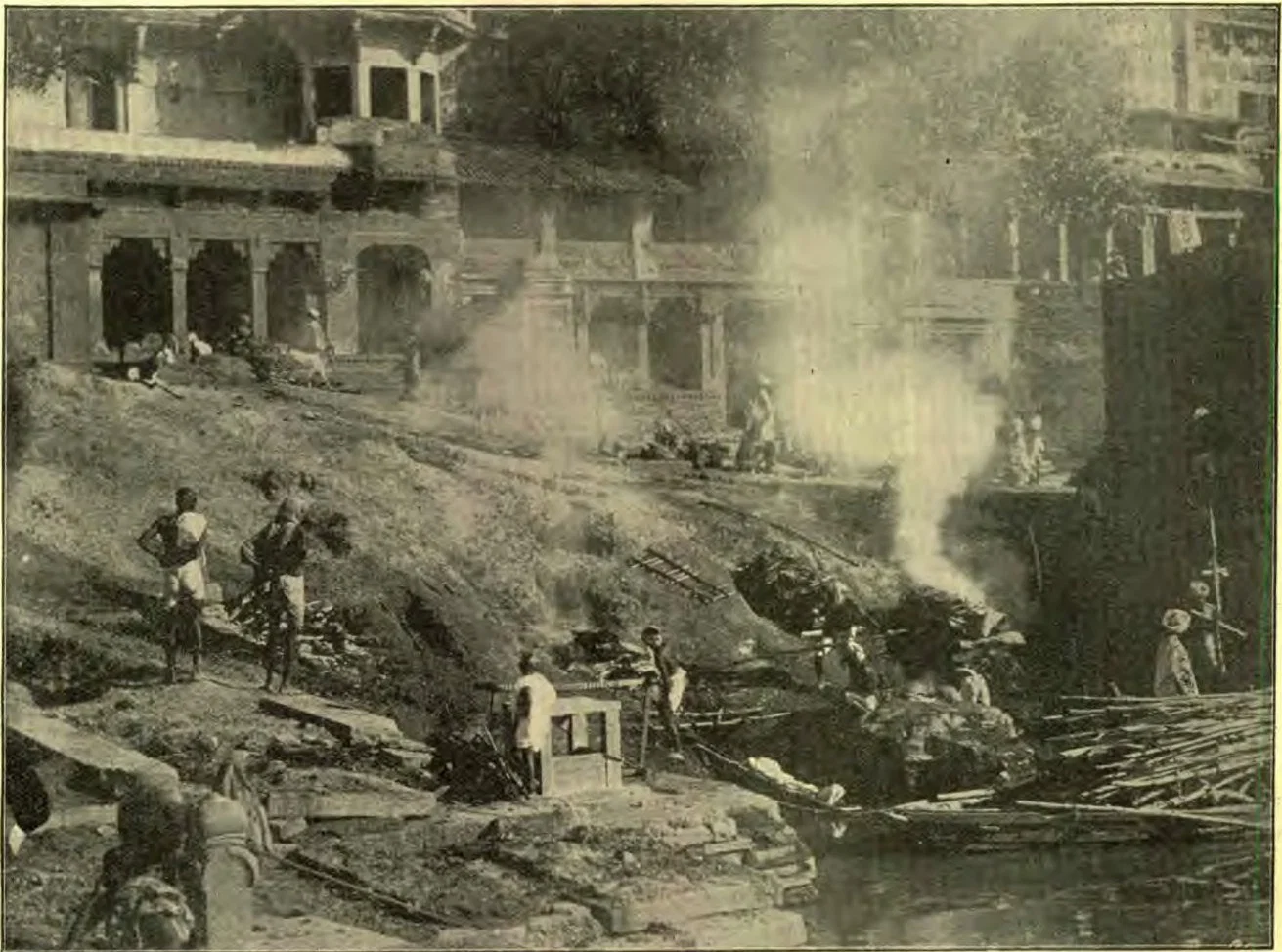
ONE may see the smoke ascending almost constantly, day or night, from the Hindu gehenna, near any of the large Indian cities. Like the gehenna of the Jews, it is a place of total destruction, only here the bodies of the human dead are consumed into ashes. The Jews practiced burial, and only the carcasses of animals, and the bodies of criminals, were cast into the fires of gehenna, always burning beyond the city walls. The Hindu burning ghat is usually by a river-side. Special sanctity attaches to the Ganges and the Brahmaputra, and I am told that the dying are often carried long distances in order that the last rites may be performed on the banks of the sacred streams.
No more favored closing of a life could be wished for, according to Hindu tradition, than that the end should come within the mystic boundaries of Benares, the holy city, and that the ashes should be scattered upon the breast of Ganga Ma,—Mother Ganges. One may see the old and infirm, with the light of life fading from the eyes, waiting their turn to pass out into the darkness. It seems all so gruesome, and yet so business-like. When the end comes, the body is covered with the grave-cloth, and borne to the place of burning on a stretcher, or charpoy,—a corded couch that serves as a bed in life and death. It is then placed upon a pile of faggots, and covered with bundles of wood, and the torch is applied. The watchers may have to feed the flame with fresh fuel from time to time in order to complete the work.
The Benares burning ghat is said to be always a busy place. In times of special sickness, in all the great cities of India, the disposition of the dead is a pressing question. During one such time I visited the chief Calcutta ghat, in the Nintollah district, and was surprised to find how small an area it comprised, and how expeditiously the work could be done. With friends bringing in bodies of those who have died of all manner of diseases, waiting their turn for the performance of the last rites, one marvels that disease is not more generally spread among the living.
The Mohammedan in India buries his dead. The Parsee exposes the body to the vultures on the towers of silence.
In joy or grief, the Oriental is more demonstrative than his Western brother. It is indescribably saddening to me to hear the wailing cry of sorrow from some home darkened by death, when I know that the mourner knows nothing of Jesus and the hope of the resurrection. All the world is a house of mourning, but death seems ever nearer in the stricken East. While millions are dying every month in the darkness, no one who knows and appreciates the Light of Life can be indifferent to the needs of these distant fields.
W. A. SPICER.

Our Antipodes

In many ways the Chinaman, by the mere accident of being born on the opposite side of the earth, seems a being full of contrariety. In forecasting what he would do and say, one is most safe in judging that he would speak and act just the opposite of what we ourselves would. What he says would never occur to us to say, and what we would say would be entirely foreign to him.
SCENE IN THE BENARES BURNING GHAT
Who of us would think of laughing, as a Chinaman does, when he tells of the death of his father, or mother, or brother, or sister? and what American bride would think of wailing as if for the dead, as does every genuine Chinese bride at her nuptials? We say, “How do you do?” when greeting a friend; the Chinaman asks, politely, “Have you eaten your rice?” and so it may not seem strange that he regards his stomach as the seat of his intellect. Instead of shaking your hand, he clasps and shakes his own; and while you, upon entering, remove your hat, he puts on his to receive you. If he hands you anything, his etiquette dictates that he use both hands. Instead of good-by he says, “Walk well,” or, “Walk slowly,” while the departing guest replies, “Please be seated.”
The Chinese book begins where ours ends, and ends where ours begins. He reads from top to bottom. His “footnotes” are at the top of the page, or in the body of the text, while the title is put into the margin. The edges are uncut; and are supposed to remain so, since the paper is printed on only one side, the interior pages being left blank. In bookkeeping, his debit and credit accounts are not side by side; but one above the other, each occupying half the page.
Neither men nor women wear gloves, but their sleeves are so long, falling over the hands, as to be used as muffs in cold weather, and often so large as to answer for pockets. Both men and women wear their hair long, but the men shave the front part of the head. The women as well as the men wear jackets and trousers. Many men also wear long robes. We blacken our shoes, while the Chinamen blackens only the top and whitens the sole.
Black is mourning with us; with the Chinese, white, gray, and blue. Red is to them a sign of rejoicing, and is used on wedding and festal occasions. Babies are carried on the back, and a Chinese gentleman or lady readily accepts the same position on being landed from a boat through the mud. Most of the small boats are “manned” by women. Women smoke with the men, and men fan themselves the same as the women do.
The needle of the Chinese compass points to the south, and instead of saying northwest, etc., the Chinaman, true to his contrariety, says west-north, etc. His names are turned backward, a surname such as Mr. John Brown appearing as Brown John Mr. He turns his fractions upside down, and reads sixths four, instead of four sixths. With him man is the beast of burden, and a coolie may often be seen carrying a load of pigs.
But with all these differences, seemingly so great, one God is Lord and Father over all. For both the same sun shines, and the same heavens pour forth their blessings. The world's waves of sorrow, sin, and woe beat against them as against us. Our need is theirs—the Son of man, the Saviour of the world. Let us live and act in the consciousness that by creation and redemption all men are the children of God, and that we have a divine commission to seek and save those who are straying from the Father's home.
J. N. ANDERSON.
Hongkong, China.

What Travelers Are We!

WHAT travelers are we— The homiest of us— Each night far worlds to see! To be transported thus, Without a thought or care Of danger anywhere, Through spaces all aglow With suns we do not know, With worlds created new Just shining dimly through The mysteries of blue!
You may have seen Cathay, I may have seen Japan;— But what are these, I pray, To travelers who can Sweep nightly through the skies With this old world we know, And lift bewildered eyes Where worlds by thousands show!— To Jupiter and Mars, To bright, surpassing stars, To our attendant moon Shining its silver noon, To deeps that have no bound That any ship can sound— To sail through such a sea, What travelers are we! —Mary A. Mason.

Unquestioning Faith

In the city of Capernaum a nobleman’s son lies sick unto death. In vain his father has tried to save him. A messenger comes with hurried steps to the mansion, and asks to see the nobleman. He tells him that he has just come from Jerusalem, and that there is in Galilee a prophet of God, declared by some to be the long-expected Messiah. His work has awakened an intense interest in the city of Jerusalem, the messenger says, and crowds follow him wherever he goes. It may be that he can heal the child.
As the nobleman listens, the expression of his countenance changes from despair to hope. Determined to leave no means untried to save his child’s life, he decides to go himself to see this prophet. The hope born in his soul strengthens as he prepares for his journey. Before the day dawns, he is on his way to Cana of Galilee, where Jesus is supposed to have gone. The journey is long and the road rough, but nothing can deter the anxious father.
Finding Jesus, he beseeches him to come to Capernaum and heal his son. “Except ye see signs and wonders, ye will not believe,” Jesus answers. To a certain extent, the nobleman did believe, else he would not have taken the long journey at that critical time. But Christ desired to increase his faith.
With heartbroken entreaty the father cries, “Sir, come down ere my child die.” He fears that each passing moment will place his son beyond the power of the Healer. But his faith is yet imperfect. Desiring to lead him to perfect faith, the Saviour replies, “Go thy way; thy son liveth.”
“And the man believed the word that Jesus had spoken unto him, and he went his way.” Assured that the death he has dreaded will not come to his son, the nobleman does not ask any question, nor seek any explanation. He believes. Over and over again he repeats the words, “Thy son liveth.”
And the power of the words of the Redeemer flashes like lightning from Cana to Capernaum, and the child is healed. The nobleman shows his faith by not insisting on the presence of Jesus, and immediately the power of Satan is rebuked. The dying boy feels the joy of restoration.
The watchers by the bedside mark with bated breath the conflict between life and death. And when in an instant the burning fever disappears, they are filled with amazement. Knowing the anxiety of the father, they go to greet him with the joyful tidings. He has only one question to ask, When did the child begin to mend? They tell him, and he is satisfied. He believed when he turned his face homeward; now his faith is crowned with assurance. A holy atmosphere surrounds him, and as he looks upon his son, healed of all disease, spiritual life sanctifies his soul. He is converted. With the simple faith of a little child he receives the great gift of the kingdom of heaven. The same power which restores the child to health, banishes unbelief from the father’s heart.
What a witness Christ has in this nobleman! He had asked for the life of his son, not expecting to receive anything himself. But he realized that a great power had taken possession of his soul. He recognized Christ as the physician of the soul as well as the body. Overjoyed, filled with peace and gladness, he exclaimed, To-day is salvation come to this house. Spiritual life, with all its transforming power, was breathed into his soul, and he proclaimed in Capernaum the wonderful power of the Saviour.
In our work for Christ, we need more of the unquestioning faith of the nobleman. “Faith is the substance of things hoped for, the evidence of things not seen.” By faith we behold God in his promises, and are armed with stability. The Christian knows in whom he has believed. He does not only read the Bible; he experiences the power of its teaching. He has not only heard of Christ’s righteousness; he has opened the windows of the soul to the light of the Sun of righteousness. He has a knowledge which can not be wrested from him. The one who trusts his Saviour implicitly finds the gates of heaven ajar and flooded with glory from the throne of God. MRS. E. G. WHITE.

“Ma, I Must Speak!”

A BUSINESS meeting was being held in a certain place (no matter about State), and the party spirit ran very high. Those present accused one another and justified themselves in a quite unbecoming manner. There were present in the meeting a Christian lady and her little daughter, a child of some four or five years, who had been brought up in the truth.
As the meeting continued, and charges and counter-charges were made by the contending parties, this little girl grew restless, and turned to her mother, and whispered, “Ma, I must speak!” The parent immediately hushed the child; and told her it was no place for her to speak, and that she must keep still. On this the child quieted down, while the accusing element in the meeting seemed to rise higher and yet higher.
Shortly the child turned again to her mother as if to rise to her feet, while she repeated her request with greater emphasis, saying, “MA, I MUST SPEAK!” The mother, now in a very decided manner, told her that she must keep quiet; that this meeting was no place for a little girl like her to say anything. And so for the second time she was compelled to remain silent.
But the wrong spirit that ruled in the house had full sway, and there was no little excitement and confusion. The child now for the third time pulled her mother’s arm, and with greater earnestness than before urged her request, saying, “MA, I MUST SPEAK!” The mother, now feeling that the Spirit of the Lord was moving on the child, dared object no longer, and she answered by saying, “Well, you may speak.” The little girl immediately arose to her feet, and spreading out her hands, as if entreating those present, said, in a clear voice, “Let brotherly love continue,” and then at once sat down.
The result of this little speech was like suddenly turning on a number of electric lights in a dark room. The meeting immediately broke up, and the contending element left the house reproved and ashamed. All felt that they had seen a beautiful fulfillment of the scripture, “And a little child shall lead them.”
G. W. AMADON.

Ice-Flowers

AMONG natural formations which have attracted general attention because of their beauty, says Pearson’s Magazine, snow crystals will well repay a close examination; and nowhere are they to be seen in more perfect and varied form than in the Engadine, where they are popularly known as ice-flowers.
They bud, if I may so express it, with the first sharp breath of frost, casting their fragile tendrils into a hundred delicate forms wherever a suspicion of humidity can be transformed into a glittering jewel.
The first effect of frost everywhere is in the form of an ice-flower, so that these delicate structures are to be met with at home under many conditions, and notably in the beautiful tracings of frost on window-panes, where, however, the flower is not able to achieve individual perfection. On tree and bush the effects are much more satisfactory, and ice-flowers, beautiful and varied in form, can be examined at leisure.
But, after all, these give us but a faint idea of the beauty and delicacy of the ice-flowers of the Engadine, where the air is clearer and purer, and where conditions conspire to favor their growth. Indeed, what strikes the observer at once is that nature has been to them a kind and skillful horticulturalist, displaying their beauties to the best advantage by a charming setting of mountain-girt lake, under calm and cloudless blue skies.
Probably few persons realize how much of the beauty of the surface of the snow in the Engadine is due to the enrichment of the network of crystals which covers it.
But a mist for a few hours is absolutely necessary to their formation, and I know few sights more lovely than this gray curtain first covering everything, and then gradually dissolving, leaving a landscape glittering with hoarfrost.
One of the delights of the Engadine is to take a walk in the morning, and watch the growth of the ice-flower. This is always quite possible when there is a suspicion of moistness in the air; for then you can see the icy particles—floating, iridescent, feathery points—in the clear light of the morning; and settling here and there, on any projecting point, on the snow-carpet of the ice-crust, forming the first fairy-like foundation—a skeleton of crystal—of the flower, which grows so rapidly that one can watch it taking shape and attaining perfection.

A Remarkable Story of Conversion

(In a recent number of the Christian Endeavor World, Katherine Stephanova Tsilka, the native Christian who was kidnapped with Miss Ellen M. Stone by brigands in Bulgaria, gave the following graphic account of her conversion. It is suggested that selections from the story might be profitably read at the Missionary Sabbath (December 13) meeting of the various Young People’s Societies.)
I WRITE this at the request of Dr. F. E. Clark, who thought that the story of my conversion may be of help to those who labor for the salvation of the lost ones in sin.
The history of missionaries shows us how many and various ways God uses in bringing the sinners to himself. The following incident explains how God saved me, and through me the whole family.
Bansko, the town near which Miss Stone and myself were captured by brigands, is the place where my parents live, and where I was born.
In the days of my early childhood, father was considered by the natives an educated man, because he knew how to read and how to write. Being a priest’s son and also one with whose singing the Greek church prided itself, he was highly esteemed by the ignorant and pious villagers. No matter what he did, it was considered all right because it was done by him.
One day I heard him talking to a group of men the following: “Yes, it is time that our women should begin to learn something. I want my daughter to become a learned woman, to know how to write her own letters to her husband when she is married, and not go to the priest to write them for her, the way women do here. I want to open her eyes into a new world, a world of knowledge and education, that she may bless me when I am dead. Next fall I have decided to send her to school. Folks may make fun of her now, but O, when she comes out with an erect head, how they will envy her! Yes, she goes to school next fall.”
Early one morning in the month of October I started for school with a piece of wood under my arm (for it was the custom that each child should bring a stick of wood every morning, and thus keep the fire going in the schoolroom) and a slice of bread in my hand. Father and mother stood at the gate, and with pride in their hearts watched me disappear. I never before was in a schoolroom, and wondered what it was like.
On reaching the big, clumsy gate of the school, I heard the yells and screams of the boys playing in the yard. I stood outside and feared to enter, for I was as afraid of boys as I was of buffaloes. My cousin, who also was playing, happened to spy me. He walked to me, and with an air of protectorship led me through a crowd of boys, who now stopped playing in order to see who I was, and what was my business in a boys’ school.
I was taken in to the teacher, but he, instead of giving me a welcome, looked at me in disgust.
“Want to be a learned woman, eh?”
After making a few more similar remarks he seated me on a bench already filled with dirty, giggling boys, who, in order to make room for me, had to squeeze so hard that the little ones among them began to squeak like mice.
Here I stayed for many days in perfect misery. In the absence of the teacher the rogues would pull my hair, tear my book, and tease me in many other ways known only to mischievous boys. And in the presence of the teacher I was not any better off, for his manners and appearance used to make me shiver.
On reciting our lesson he would seat himself on the back of a bench (for there was no chair), with a book in one hand and a stick in the other. “Now,” he said, addressing me, “let us see how many sticks you deserve.”
Of course, at such an encouragement all the knowledge of the lesson deserted me.
“Pruss, pruss,” went the stick over my body.
After putting my bruised fingers into my mouth, and soothing them with the warmth of my breath, I would start to recite again, only again to fail.
I then thought to myself, “Oh! the way to knowledge is very thorny.” And in my childish mind I thought I was to blame, and each day made new resolutions that if I passed over to-day’s lesson fifty times, over to-morrow’s I shall pass a hundred. I did so until the lips of my mouth would chatter off the lesson like a windmill.
In this tedious way I succeeded to recite before the teacher (though I had no idea what I was reciting), but still the hateful man refused to be satisfied. He seemed to be on the watch all the time to find some accusation against me.
One time in his absence he left an older child to write down on his slate the names of all who did not behave. When the teacher returned, the slate with the names was handed him.
He read one name at a time and giving the punishment. Some of the faulty were put to stand on one foot; others were whipped with the ruler, and to others he pulled the ears. Was I not thunderstruck on hearing my name among the names of the culprits? I knew I was as quiet as a kitten, for I was afraid of the boys.
The teacher waited not for justification; he at once ordered the whole school of boys to come around me and spit at me.
Now this was too much. I endured beating, endured threatening and bad words; but such a disgrace, and that undeservingly, I shall not stand. I was aflame. My whole nature rebelled. I felt my eyes quiver in their orbs. The boys were coming nearer and nearer; and, while the teacher was urging them to hasten, I took advantage of his distraction, and like a tigress jumped over benches, boys, and out of the door I flew.
Once on the street, I was safe. I ran and ran, where, I knew not until I found myself in the market-place. Here I sat down and rested. My heart was jumping like a frightened bird. I waited here until it was time for the school to let out, so that my parents may not suspect me of running away from school.
That night I went early to bed, not to sleep, but to think. “To that fiendish place I don’t go, even if I have to die. I can’t make my feet enter that place anyway, even if I tried. Father may carry me there by force, but can he do it every morning? What shall I do? Now I must choose between going back there or remaining an ignorant woman all my life.”
In the midst of such cloud and darkness a thought flashed through my mind,—“Is not there a school up-town, where Maria and Landra go, and they say it is like heaven there? O, but it is a Protestant school, and people say that all the Protestants will go to the ‘bad place’ when they die. I wish they were not called Protestants. Anyway, I shall go there to-morrow, and see what it is like; but I must be on the watch that they don’t stamp my forehead.” It was believed that the Protestants put an invisible stamp on the forehead on any one they could get hold of, and in the next world claimed him their own.
According to my plans, the next morning I started for school as usual. Not knowing where the Protestant school was, and fearing to ask anybody, I stood on the main street, and watched to see some Protestant child going to school. Very soon a little boy came along, and I followed him from afar.
On reaching the humble little building, I said to the boy, “As you go in, tell the teacher to come out; I want to see him.”
Presently, squeaking shoes were heard and a masculine cough, and then a smiling face of a young man appeared before me.
“What do you wish, little girl?” he said in the most gentle and sweet way, as he bent down to me.
I was stunned, I was dazed, at such kindness. He appeared before me like an angel. I loved him all at once.
After recovering from the shock I said, “I want to come to your school.”
Taking me by the hand, he led me into the schoolroom, gave me a book, explained what was to be my lesson, and then seated me in a desk next to a girl.
Here I felt at once at home. As to the name “Protestants” and the stamp business, they entirely disappeared from my mind.
I could not put my mind to study right away, for there were so many interesting things about the room to be inspected. There was an iron stove, such a wonderful thing, for I never saw one before. At one end of the room stood a table and a chair for the teacher. The table was covered with a Turkey-red calico, which took my fancy. There were many windows, which made the room light and sunny. The teacher was dressed differently from our Bansko men, and he also used a different dialect from that of ours.
After inspecting him from head to foot, “Who is he?” I whispered to the girl next to me.
“Don’t you know? He is Mr. So-and-so, and is sent here by the missionaries to teach us how to read, to write, and how to be good.”
“Yes,” I said in my heart, “this place is like heaven—everybody looks so cheerful,” and I myself felt so happy that I could hardly keep quiet in my place.
When the little bell on the table tinkled, and the children stood up all in a row to walk out home, I was awakened as from a pleasant dream into a dreadful reality. All my joy disappeared.
“What shall I do now? People know whose child I am. I must not be seen walking with Protestant children, for then everybody shall know where I have been.” So I took a roundabout way, and went home. I said nothing to my parents that night, nor the next, nor the third; but tell I had to, and the sooner the better, for they will find it out for themselves, and then where would I be?
I broke the news first to mother, for I feared father.
She opened her eyes wide, bit her lips, and said: “Child, what have you done? Your father will chop off your head if he knew it. Don’t you know that you are ruining his reputation and good name by mingling with Protestants?”
I felt sorry, but not in the least repentant of what I had done; for the very thought of the Provoslov teacher made me shiver.
“Mama,” I said, “kill me if you will, but to that tyrant I don’t go. And as to that heaven-like place up-town, I shall die if you don’t let me go.”
The next morning she told father of my adventure, and he became furious!
“Am I not the boss of this house? How dare she do such a thing without my permission? Oh, oh! whipping, whipping for such a head like yours.”
“Father, but it is very, very nice there. I can learn so easy and quickly there I feel like it, and the teacher—”
“Sst! My word is law,” interrupted he. “I say you shall not go, and you are not to go.”
A low, square table was placed on the floor, and the family called to dine. I refused to go, but the strong arms of my father brought me there by force. All began to eat except I.
“Eat,” said father, “eat.”
“I can’t; my heart is broken,” whispered I.
Supper-time came. Again I refused to eat.
“I shall beat you; do you hear?”
“Beat me,” I said; “beating is not worse than death, and I shall die; I prefer to die than live such a hard life.”
The next morning I remained in bed, for I felt weak; and again I refused to eat. The same thing followed, and the next day.
Now my mother was alarmed, for I heard her pleading with father to let me go.
“Please let her; this won’t make her a Protestant. She is only a child. You see, she has just as strong will as you have; she is your daughter. She is making herself sick; she will die; and then you will never forgive yourself!”
“Oh, oh!” he groaned. “We shall suffer from that girl; she is so wilful! Let her bury her head,” meaning, “Let her go, but with a curse.” “Yes, let her go there; but, if I see you walking on the street with a Protestant or bringing one home, you shall remember it.”
At this I jumped out of bed; I was no longer sick. Taking a piece of bread in hand (for I could not wait to eat), I ran to school. That day I was one of the happiest girls in the world.
The teacher lost no time. Through me he saw his chance in influencing the whole family, which was very opposed to the true Christianity. He often talked to me, and one time said that he was coming to see my parents. “Please, please, don’t; father won’t let me come to your school if you come to our house.” He only smiled at that.
One holiday morning the gate opened, and both mother and I looked to see who it was. Seeing that it was the Protestant teacher, we both flew and hid. The poor man knocked several times, and, having no answer, walked into the room, and sat himself by the fire.
Very soon father’s voice was heard.
We trembled; we feared for the young man.
Father was stunned on finding such a man in our house, but before he could get angry, the teacher had won him by his gentle ways. On parting, father even invited him to come again; and he did come, and often, too.
The young teacher now felt that as long as I remained under the family influence and superstitions, I shall never become a Christian. So he began to work very tactfully to send me to a missionary boarding-school.
“Yes,” he said; “it is beautiful there. You become a nice, educated woman, and, more than that, pleasing to God.”
But there was father again; he would not consent to let me go three days’ journey away from home; and besides, it was not customary for girls to go away from their own town.
In spite of these difficulties I lost no hope in getting his consent. I worked hard three months. I shed tears. I tried to be good. I prayed, for the teacher told me that I must pray about it.
With the convincing words of the teacher and my own pleadings finally I succeeded. One beautiful morning in September, after a long and rough ride over mountains, the boarding-school was reached. Teachers as well as pupils looked so nice, and spoke very kindly to me. The building looked like a palace. I was bubbling with inward joy.
“Such good souls I never saw before,” I often thought to myself. Somehow I could not understand why were they called Protestants when they were so good.
Prayers were held morning and night. The girls would get up and speak of the joy and love of God in their hearts. I began to feel uneasy, wicked, a craving to be good. I would often hide myself, and make the sign of the cross over and over again, and pray to God to make me good.
The teachers would often talk to me on religious things; but somehow I stood stiff, for I thought they wanted to make me Protestant. But the Christian living of those young women was convincing me day by day that their religion was a religion of power.
One day, while in class in the recitation-room, in walked an old, gray-haired man, a missionary. He talked to us, and after that asked us to kneel down and pray. The Spirit of God must have inspired that prayer, for then and there I gave myself up to God. My heart was now burdened for my dear ones at home. I wanted to write to them, but somehow felt I could not express myself. So I sent them all the pamphlets of Christian truths given to me. Having no books whatever in the house, mother devoured those booklets. There were only three women in the town who knew how to read, and mother was one of them.
Yes, my mother read them over and over again. The Spirit of God did the blessed work, and soon after that she was persecuted most bitterly by father for her Christian stand. She prayed for her younger children, and now every one of her family is a child of God, some of them already in the field, and some preparing for the ministry.
All this, dear friends in America, is a result of your prayers and pennies. You have sent us missionaries to lead us to God and to life eternal.

A Hospital Experience

THREE years ago a few of the young people employed by the Pacific Press Publishing Company began semimonthly meetings at the county hospital, or infirmary, twelve miles distant. At the beginning of this year these were discontinued; and as I had been away from the city almost constantly since, I had no opportunity of visiting the place or renewing my acquaintance with the inmates. Last Sabbath I took a bundle of papers and started out. After distributing the papers, and finding but few familiar faces, I was about to leave, when I saw one gentleman whom I had often met, and who at once recognized me. I went up to him, and after a little talk began to question him in regard to those whose faces I missed.
My first question was, “Where is Mr. M.?” This gentleman had been the librarian of their little reading-room when we first began meetings, and it was always his delight to keep things clean, and prepare for our services to the best of his ability. The reply was, “Mr. M. is dead.” As he told me this, I thought of the growing weakness of the poor man; how he had given up his work as librarian, and had been taken to a ward in the hospital department, where the dear Lord had used a few texts of Scripture and a broken prayer to lead him to accept his Saviour.
I then asked for Mr. R., who all his life had been an irreligious man, and yet had at times given evidence of a real conviction of sin, and had requested prayers. For more than a year he had been reading the Signs of the Times regularly. At first he did not care for it because it came in a club with others, but when it was sent to him personally, together with a letter from a missionary-hearted sister, his attitude toward it was entirely changed, and the last time I saw him, he told me that he was living a Christian life. He is also dead.
I then asked for Mr. S. This gentleman had been led to renew his consecration to the Saviour two years ago. The reply was that Mr. S. also had gone to his long home. How glad I was that my last talk with him had been about his soul’s salvation, and that he had expressed an anxiety to meet his Master.
As I listened and pondered, my heart was led to praise our dear Father for the blessing he had added to the feeble efforts put forth at the county hospital, and the thought occurred to me, How many of our young people would gladly enter upon such work if they knew how easy it is! We are commanded to sow by the side of all waters. Dear young friends, is not here an opportunity for you? H. H. HALL.

Reasons for Thanksgiving

WHEN I call to mind how deep down in sin I have been, and that I have been rescued through the instrumentality of a mother's prayers, and saved from a sinful, selfish life,—renewed, physically, mentally,—I believe I have great cause for thanksgiving. After this wonderful experience, God guided me into the medical missionary work, and led me, after only about one year's training, to the consideration of the Mohammedan field. He gave me many evidences by which I knew that he had a work for me there, among which was the privilege of associating with those who were able to help me in preparing for work in that field.
Another thing for which I am truly thankful is that God gives me the desire to carry the gospel to those who have never heard it. For he has said, “Go ye into all the world, and preach the gospel to every creature.” We can not meet all classes of people by remaining at home, so we must go where they are,—in prison, in the slums, and in the distant and difficult parts of the world.
Early in the past summer the Battle Creek Young People's Society took into consideration the support of a worker in some needy field. As I had signified my desire to go to Syria, my support was suggested, and finally decided upon. This has been a great encouragement to me; for I am sure the prayers of the young people in this church will follow me, and this gives me much more courage and enthusiasm than remaining at home would.
My earnest prayer is that I may be used of God to the salvation of souls in every walk and condition in life. We can not be too reserved and ethical in the work of God, but must be humble and obedient in the Master's hands. Then we may be able to take those by the hand for whom Christ died, however steeped in degradation and sin, and lift them up by giving them a knowledge of the truth as it is in Jesus.
I sincerely hope that other Young People's Societies may be encouraged to assist in the work for the many needy fields by their prayers and means, and thus hasten the coming of Jesus to this sin-darkened earth.
J. M. KEICHLINE, M. D.

December Study of the Field

Suggestive Program for Young People's Meeting

(December 7-13)
1. Singing, No. 716, “Christ in Song.”
3. Season of prayer in which several take part in short, earnest petitions in behalf of missions and missionaries. Ten minutes.
4. Singing, No. 510, by children.
5. Synopsis of Protestant Missions in China. Five minutes. (See Review of October 28.)
6. Needs and Possibilities of Porto Rico. Three minutes. (See Review of October 28.)
7. Tongan Manners and Customs. Five minutes. (INSTRUCTOR of November 13.)
8. Singing, No. 664, “Behold the Bridegroom,” two stanzas.
9. A Doctor’s Experiences in Africa. (See “Story of Our Matabele Mission,” in INSTRUCTOR of November 6.) Told by some younger boy or girl. Five minutes.
10. A New Era in Adventist Missions. (See “Story of Our Matabele Mission,” in INSTRUCTOR of November 6.) Let some older member of the Society give the places entered since 1895, especially those recently entered by our workers (see Review of November 25 and current number of the INSTRUCTOR), while several boys and girls, previously selected, step to the map in turn, and locate the places.
11. Collection.
12. Singing, No. 390, “I’ll Go Where You Want Me to Go.”
13. Benediction.
Note.—Whenever practicable, bring the younger boys and girls into the Young People’s meeting, and give them some part in it. This will interest them, and will early inspire them with a love for mission work. Children always enjoy a map exercise, and this may be made a pleasing feature of the program if well planned beforehand. This suggestion applies to those Societies that do not have a junior department. And where such a department exists, the two may be brought together occasionally. If preferred, the leader may substitute for the children’s exercise, interesting anecdotes from Sister Anderson’s articles, “A Trip to Canton” (see late numbers of the Review), or instances showing that the earth is ripe for the gospel message (gleaned from reports in the Review). Selections from the article, “A Remarkable Story of Conversion,” on page 379 of this paper, may be used in place of any of the other topics, if so desired. Let those taking part in five- or three-minute talks make thorough preparation, so as to confine themselves to the limited time.
CAROLYN A. HATHAWAY.
Continue reading: Mission Notes