WHY THE BATTLE CREEK COLLEGE CAN NOT CONFER DEGREES.
By Edward Alexander Sutherland
The question is frequently asked, Why does not Battle Creek College confer degrees as formerly? The reasons are various.
Our college claims to be a training-school under the supervision of Christ himself. If Jesus Christ has direct control of the school, it can not be in harmony with worldly ideas of education any more than his teaching harmonized with that of the rabbis while he was on earth. Education from heaven has never been received cheerfully by the world, nor will it ever be. Of Christ it was said that never man taught as he did, and yet he was regarded by the popular educators as ignorant, because he had not learned under them. They would not place their seal of approval upon his educational system. He has plainly said that his disciples also would be considered straight-laced extremists, and it would therefore be unreasonable to expect the world to place its seal of approval upon scholarship that is the result of an educational system, the standard of which, to them, seems low and narrow—in fact, like utter foolishness.
Granting degrees is the result of an educational system that attempts to measure the mind of man, which God alone can do. Degrees at one time were licenses, or testimonials, granted by the church to serve as a protection, both to the holder and to the people. However, no one who felt that he was called to work was denied the privilege of trying his talent, even if he had not taken the training required by the church. This plan is still practised by God’s people. In time the papacy felt that it was necessary to restrict all from teaching or preaching who did not hold licenses. In order to be certain that the teachers or preachers were orthodox, it was necessary to keep them in school a number of years, which led to a course of study from which modern school courses have been largely drawn.
“A complete university course was represented by four degrees,—bachelor, master, licentiate, and finally doctor,—which last was usually taken at the age of thirty or thirty-five. . . . That the bachelorship was taken very young, we know from the history of many universities. In the seventeenth century a statute was passed at Oxford University, fixing fourteen as the youngest age for matriculation; and centuries before this, twelve years of age had been fixed as a minimum at Paris.”—Laurie, “Rise and Constitution of Universities,” pages 229, 230.
The church had such a monopoly of education that “men have studied from twenty to forty years, and have learned neither Latin nor German.”—Painter, “History of Education,” page 38.
This system was a gigantic monopoly of education, the object of which was to compel the students to study the ideas of men so faithfully that they would become obedient slaves to one man, the pope. All independent and original thinking was destroyed by the long years of study of man’s thoughts. It would have been impossible to make this system a success without a prescribed course of study; for otherwise there would have been freedom in selecting the studies required for the best development of the individual mind. A course of study enslaves by compelling the student to obey a lifeless machine in the hands of a tyrant whose entire happiness consists in breaking the will and spirit of his victim, making him a mere automaton. Papacy and paganism could never exist without this system to reduce the minds of men to abject slavery by the long-drawn-out process of studying men. The thought is shackled, and the completion of the course of study and the obtaining of the degree are signs that the individual is a servant of the one who controls the system.
We have heard of tests between persons to see who could eat or drink the most. Many have died as the result of such gluttony. Is not this cramming and stuffing the mind even worse, as much worse as the mind is more delicate than the stomach? The brain is crowded to the point of congestion by the hardest kind of mental effort in preparing for examinations to complete a course, the end of which is a degree. The result is weakness, not mental vigor. Students could not be induced to do this if it were not for the final reward—the degree. They are led to believe that their whole success in life depends upon taking the prescribed studies, passing their examinations, and receiving a degree.
A degree is measured by the value of the seal upon it. At present the seal is placed there by the state. The state says by this act that it approves the system of education which grants the honor. In other words, the state says that the work represented by the degree has been done as satisfactorily as if it were done by a state institution. Whenever a Christian school asks the state to place its seal upon its work, it virtually says to the state, “We do our work as you do yours. We teach the same things that you teach. Our one object is to train men and women as the state trains them, and the end of our educational system is the same as that of the educational system of the state.”
At once the question arises, Is the educational system of the Seventh-day Adventists the same as that of the state? If we follow the word of God and the Testimonies, we know that there is no more similarity between our educational work and that of the world, than there is between our religious work and that of the popular denominations. In fact, there is not so much; for the educational system of the state is supposed to be secular, to be entirely separate from religion, while there is in the popular denominations a great deal with which we are in harmony. But when education is stripped of Bible religion, what is it? Seventh-day Adventists can answer the question; for they know the history of the papacy and its formation.
All the facts taught in the worldly schools are arranged to prove that man can work out his own salvation. The system has been separated from Christ’s teaching, and is united with a belief of what is popularly known as evolution, the center of modern religion. There is no need of Jesus, righteousness by faith, nor wisdom by faith: all perfection can be reached and truth discovered by study. It differs as much from the educational system revealed to Seventh-day Adventists as light differs from darkness, Christ from Satan. This does not mean that there are no facts taught in the worldly schools that are true; but the facts are linked to theories that lead away from truth. These theories become so subtly interwoven in the minds of students that they are not conscious of their presence; and the danger is that the very elect shall be deceived.
When we say to our people that our education is in harmony with Christ, and at the same time ask the state, which is opposed to Christ’s educational system, to place its seal of approval upon our work, it shows weakness somewhere.
When Christ was on the earth, there were times when the learned doctors of the Jewish schools offered to bestow upon him the master’s degree. But he kindly yet firmly refused this honor; for he could not be honored by worldly men and also by God. For several centuries the church was firm, and refused to conform to worldly methods of education. But unconverted men came into the church with their pagan ideas of education, and encouraged young men to receive the culture and learning of the pagans, in order to do more efficient work for the pagans. The years of hard study in the pagan learning fixed pagan principles in their minds, through which in after-years they read and interpreted the Bible.
Pagan education in the minds of professed Christians created “the beast.” The result of this union was the adoption of pagan institutions, chief among which was Sunday. Professed Christian young men in pagan universities were continually striving to interpret the word of God to harmonize with pagan wisdom.
In time, institutions of learning were founded by the church, and the first degree was granted by a pope. The Catholic Church has always believed that it should control the educational system of the world. The Jesuits are devoted to counteracting the educational reform of the sixteenth century, under Luther. They have one great object, to establish the Catholic educational system wherever the Protestant system has been planted. They have succeeded in doing this in every country in Europe. Germany has become, educationally speaking, completely Catholic. Our country is patterning after the European universities. Its educational system is Catholic and medieval. The idea of courses, the conferring of honors, degrees, etc., have all been adopted from Catholic institutions of Europe, which they borrowed from the pagans. A degree with the state seal upon it represents a certain amount of education that is worldly, not Christian.
In this time, when darkness is covering the earth, and gross darkness the people, and when all the world is again wondering after the beast, is it possible for God to place his seal of approval upon an educational system that is approved by the state? He longs for that which will bring the outpouring of the latter rain, the baptism of his Spirit. This is placing his seal of approval upon the true educational system.
Do we not see that Seventh-day Adventists are just as much in danger of receiving the mark of the beast as any one else? Can we not see that the professed Christian world has made the image in the same manner that the “beast” was made? We should come completely out of Babylon (the popular churches) and Egypt (the worldly educational system). E. A. Sutherland.
THE WORK IN ENGLAND.
By William Warren Prescott
AFTER the close of the General Conference and the meetings held in connection therewith, I returned to England early in April, accompanied by Dr. D. H. Kress and Brother W. E. Cornell and their families. About a month later six brethren and their families, who had been recommended to this field, arrived in London; and a ten-days' meeting of all the workers, old and new, was held in North London. Special attention was given to the consideration of the gospel as the gospel of health for soul, body, and spirit, and to the best ways of presenting the message from this standpoint. Dr. Kress usually occupied an hour in the morning, and Mrs. Dr. Kress an hour in the afternoon. The instruction which they gave was heartily received. The evening lessons were upon the first half of the book of Daniel, and the experience of Daniel and his companions was seen to have the closest connection with their loyalty to the true principles of healthful living, as set forth in the first chapter. There was thus a unity in all the instruction given at the meeting, which contributed toward the attainment of some definite results. Meetings were held for mutual consultation in regard to plans and places of labor, and then the workers left for the different places selected.
I then prepared for the first general meeting, which was held in Belfast, Ireland, June 23 to July 2. The attendance of Sabbath-keepers was not so large as at the meeting held in the same place one year ago, but a most encouraging interest was developed in the school of health, which was a leading feature of the meeting. A daily demonstration was given in healthful cookery by Mrs. Dr. Kress, and this was followed with an evening lecture by Dr. Kress in which the gospel principles were presented, and their practical application in the common experiences of life was made clear. At the close of these meetings we were assured that we might be certain of a large audience, if we would come again, and the results which have since appeared indicate that a foundation was laid for a permanent work.
After reading the instruction sent to the General Conference, that it is better to hold more small meetings than to concentrate all in one gathering, the Conference Committee decided to hold two general meetings this year in England, instead of one, as last year. The first one was held at Bristol, August 4–13, and the large tent recently purchased in America for this purpose, was pitched in a pleasant field adjoining a thickly settled portion of the city. There was a general attendance on the part of the Sabbath-keepers in the south and west of England, and the interest was excellent. A steadily increasing number of strangers came in to the evening meetings, and on the last Sunday evening the large tent was full. There were some marked cases of immediate response to the light given on proper habits of living. Several who had never heard upon the subject before, left off the use of tea, coffee, tobacco, flesh foods, and condiments, and adopted right principles of diet at once. Arrangements were made from the first to continue the meetings upon the same grounds, and Brethren Washburn, Armstrong, Davies, and Nickels remained for this purpose. In recent reports they have spoken encouragingly of the results thus far and of the outlook for the future.
The second general meeting was held at Liverpool, August 25 to September 3, and the general features of the work were the same as at Bristol. The attendance of Sabbath-keepers was much smaller, as the majority of our churches and companies are656in the southern part of England, but I was gratified to see the number who did come. There was an equally good interest among the people of that part of the city where the tent was pitched; and although the weather was rather unfavorable, the number attending regularly was encouraging. Both at Bristol and at Liverpool, Brother Loughborough, who came to England in July, spoke each day upon the rise of this message and his experiences in connection with it, and upon the gift of prophecy as manifested among this people. His testimony was received with much interest, and many were strengthened and encouraged by it. It has afforded much satisfaction to have Brother Loughborough unite with us in the work here, and I believe that his labor will prove a blessing to all our people. The grounds at Liverpool were secured for the whole of September; and after the close of the general meeting the evening services were continued by Brethren Andrews, Altman, and Harris, who were already at Liverpool. They have reported a continued interest and good attendance.
This is the first time for several years that tent work has been attempted in England, and it is a step in advance for this new Conference to have three tents in the field, but the success attending each effort is encouraging. The third tent is pitched at Leytonstone, on the east side of London, where Brethren Champness, Bernstein, and Meredith are now. I confidently expect to see a good company of Sabbath-keepers brought out at each of these places.
For some time we have been looking for a suitable place in which to begin the manufacture of health foods, as there has been a largely increased demand for these products during the last few months. A good place about twenty miles south of London has been secured, and we shall proceed at once to put in the machinery that was received from America several weeks ago. In a short time we hope to be supplying the trade with goods of our own make. Dr. and Mrs. Kress have taken a large house near the factory, where they will be able to receive a few patients, and to carry forward to better advantage the work of training nurses, which they have already begun. Much interest has been shown in the plan to open a sanitarium in this country, and several are now anxious to avail themselves of the benefits of such an institution. By taking a large house, provision is made for a few until more permanent arrangements can be made.
The short visit of Dr. Kellogg, in June, was a means of much encouragement and help to the work here. By invitation of the leading vegetarian organizations, he delivered public addresses in London, Manchester, and Birmingham, which resulted in largely extending the circle of our acquaintance among those who are interested in reform movements. We also had an opportunity to counsel together concerning the best ways of advancing the work, and one of the immediate results was the decision to begin the publication of a monthly health journal. The first number appeared in August, and has been well received by all. It consists of twenty-four pages and cover, the size of Good Health, and is called Life and Health. We hope it will be the means of bringing blessings to many who are now perishing for lack of the knowledge of the gospel of health.
The general outlook for the work in this country is encouraging. The annual financial report submitted to the Conference showed an increase in the tithe of $831.89, although there had been a slight falling off in some other directions. The total amount of income in this field for the year ending June 30, 1899, was $11,958.87, which is considerably in advance of any previous report. The membership is about eight hundred. The Lord is blessing the labors of the workers, and in addition to the tent work previously mentioned, Brethren Hutchinson and Haughey are having an excellent interest in their work near Belfast. They have been obliged to enlarge their portable tabernacle, in order to accommodate those who desire to attend their meetings. The average circulation of our weekly paper, the Present Truth, for the year ending June 30, 1899, was 13,310. This is a considerable increase over any previous year since the paper was established. We had hoped that the fund opened in the REVIEW for the benefit of this paper would enable us further to extend its circulation during the coming year, but the response seems to be very small thus far.
While we are able to give an encouraging report, and to see good results from the efforts put forth, yet in view of the extent of the field, what is being done seems but a mere beginning. Our force of workers and the resources at our command are inadequate to the work of giving this message to the forty millions of people in the United Kingdom, and we are constantly praying that the Lord of the harvest will move upon the hearts of some of his stewards to provide the money, and will open the way that the truth may go more rapidly among the people of this country.
W. W. P.
THE NEBRASKA SANITARIUM.
By A. N. Loper
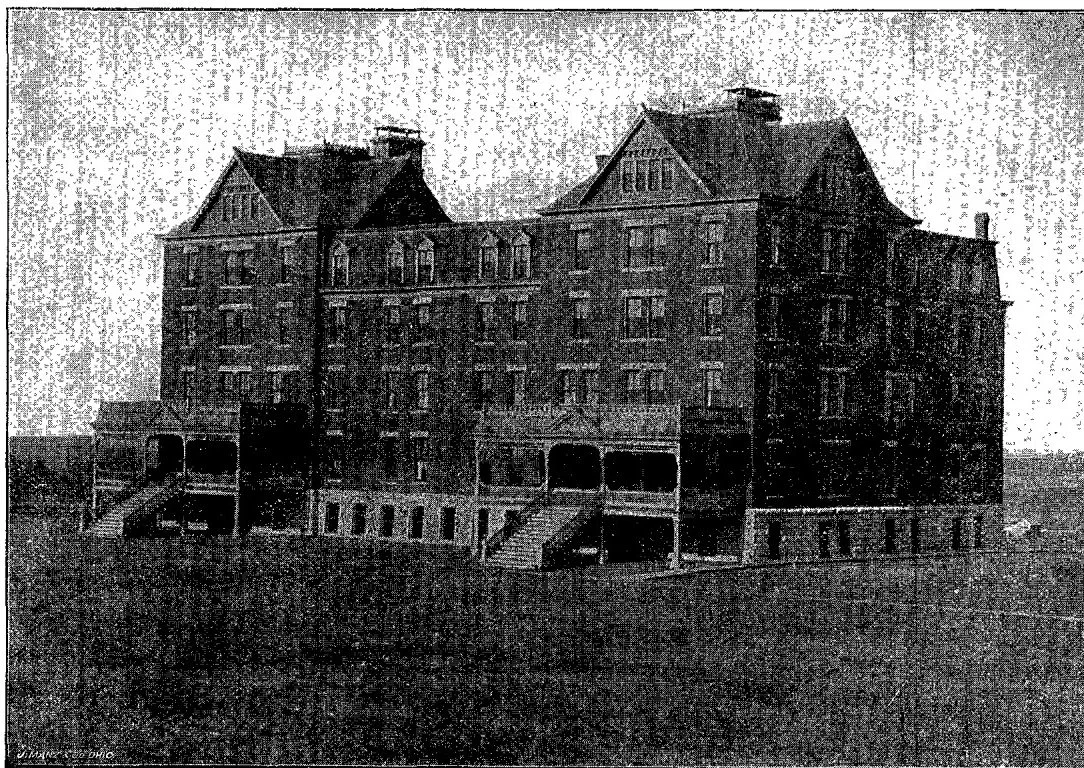
The Nebraska Sanitarium was opened to patients early in the year 1895. It consisted of a comfortable dwelling-house, with barn, the latter being renovated to serve as a storeroom, etc. A small addition was made to the house, and the work was started with only one patient. The corps of helpers consisted of one physician; one lady nurse, who also acted as matron; one gentleman nurse, who acted as bookkeeper; and one cook, who attended to the laundry and numerous other duties. The nurses’ training-school was started with only one student. But as the work grew and prospered, it was necessary that the buildings and their equipments should grow likewise.
NEBRASKA SANITARIUM, MAIN BUILDING.
It soon became apparent that four or five rooms for patients could not long accommodate the increasing patronage, and an addition of eight rooms for patients, two office rooms, and a pharmacy room was made. This may have seemed to some to be rather a hazardous expenditure, but it proved to be a safe investment. As the number of patients increased, it became necessary to add to the corps of helpers, and it was found that the capacity of the building was again inadequate to meet the demands made upon it; so a few rooms were secured in one of the dormitories of Union College, known as North Hall, a large brick structure, easily accessible, being only a few steps south, on the college campus. Here the overflow of patients found a convenient retreat; and the sanitarium work, through the blessing of God, continued to increase to a remarkable degree.
In time the question of water facilities became a serious one, when the one well, with an ordinary windmill, of which these facilities consisted, proved rather an uncertain source of supply, owing to the increase in demand. It was not long, however, before the windmill, dependent wholly upon a favoring breeze, gave place to a steam apparatus, which could be utilized as occasion required; and “dry treatment” was no longer a necessity because of a lull in the breeze. Two wells have since been added, and now the water-supply is abundant, and of the purest quality.
The work still enlarged amid many perplexities and the lack of facilities in every direction; and again, in 1897, the question of more room confronted the management, and one half of North Hall was devoted to sanitarium purposes. For the time being this seemed ample to supply the needs in this direction. The increase in patronage required a constant outlay of money in the renovating and furnishing of rooms. The kitchen and dining-room were transferred from the original sanitarium building to the commodious basement of North Hall, and the rooms formerly thus occupied were added to the ladies’ treatment rooms, which had become so crowded as to call forth many requests from nurses, who were trying to do duty amid cramped facilities.
These changes were much appreciated, but brought satisfaction for the time being only; for again the question of more room presented itself for consideration — more room for patients and helpers, and greater bath-room facilities. Early in the present year, 1899, it was decided to lease to the sanitarium the entire North Hall, thus affording additional room for every department of the work.
The doctors’ offices were removed from the sanitarium building proper, which since that time has assumed the name of hospital, the surgical ward occupying the entire upper story, and the first floor being given over to treatment rooms, and recitation rooms for the nurses’ training-school, this missionary enterprise having increased in membership until it numbers four alumni, fourteen seniors, and fifteen juniors. The present medical staff includes one lady and two gentlemen physicians. Five graduated nurses from the Battle Creek Sanitarium, and several others engaged in various lines of work, complete the corps of helpers.
The refitment of the college dormitory for sanitarium work has necessitated a large outlay of money, including a new engine-house, a steam-heating plant, an electric-light plant, an elevator, etc. The increasing demands of the public necessitated the fitting up of commodious bath-rooms in the basement of North Hall. All these improvements are being added the present season.
It is a source of encouragement to those who have watched with interest the progress of the work from its beginning, to see how a kind Providence has ruled over it all, and to realize that while many who have shared in its benefits have cheerfully helped defray the expenses connected therewith, the worthy poor have not been forgotten; but many of these have received help, both physically and spiritually, which has brought returning health and enjoyment. Much of the time the institution has been blessed through the services of a chaplain, who has found this to be truly a mission field. It is a blessed work to point the invalid to the Great Physician, who alone can restore the sin-sick soul. Many who have come to the Nebraska Sanitarium without a clearly defined hope for the future have gone away in the enjoyment of a true Christian experience. The corps of helpers connected with the institution are seeking to shed an influence that will point sinners to Christ, and all the results of their efforts in this direction will be known only in eternity. Enough is revealed from time to time to give renewed courage, and the helpers’ meetings and Sabbath-school are both interesting and profitable.
The bakery and health food department connected with this institution is doing a larger business than ever before, finding customers in every direction, who highly appreciate having access to this manufactory of foods suited to the building up and the maintenance of health. And it is a comfort and a satisfaction to see the increasing interest manifested on the part of the public in the principles that underlie the sanitarium work in general.
Patients come to this institution from every direction, many recognizing the value of the medium altitude between the Mississippi and the Rockies. The marked difference between the atmosphere of the Great Lakes and the Mississippi region and that of Nebraska becomes very apparent to one suffering from catarrhal troubles, rheumatism, nervous troubles, various forms of digestive disorders, etc. Experience has proved that a change from a low to a high altitude should be made slowly, and with due precautions by those who are out of health. A very high altitude is often found to be a detriment instead of a benefit, especially to those suffering from some peculiar forms of heart and nervous troubles. The Nebraska Sanitarium, situated657on a picturesque elevation overlooking the capital city, has an elevation of about thirteen hundred feet, and an atmosphere largely free from the miasma of disease. Here health seekers find a restful home fitted up with all the best modern conveniences and the most approved appliances and facilities for the care and treatment of the sick, and many return to their homes grateful for the benefits received in this new institution, and ready to recommend it as a place where honesty, true Christian principles, and effectual means are combined for the relief of the suffering public.
A. N. Loper, M. D., Supt.
News and Notes
For Week Ending October 7, 1899.
—London, October 6.—The Paris correspondent of the Daily Mail says: “I learn that Germany is about to hand over documents that will lead to the quashing of the Dreyfus verdict.”
—Owing to the rapid growth of public opinion in England in favor of cremation, the convocation of the Church of England has petitioned the house of bishops for a revised burial service, or a new form, suitable for cremation services.
—Of the 7,759 Wesleyan churches in England, seven observe the Lord’s Supper once in two weeks, 1,647 once a month, 580 once in six weeks, 13 once in two months, 4,729 once in three months, 68 once in six months, 37 once a year, the remainder not regularly.
—In France any sect with 100,000 adherents is entitled to a grant, in proportion to its number. The government grants to the Catholic Church this year 41,085,923 francs, about $8,000,000; and to the Protestant churches, 1,495,100 francs, or nearly $300,000.
—Manila, October 6.—The U. S. transport “Siam,” which left San Francisco, August 19, with over 330 valuable mules for use in the Philippine campaign, arrived this morning, and reported that all but nineteen animals had been lost in two severe typhoons.
—London, October 7.—“A sensation has been caused here by the report that the Orange Free State has commandeered 800 tons of coal belonging to the Cape government, which was traversing the Free State. Such a seizure would naturally be regarded as an act of war.”
—Signor Guglielmo Marconi, originator of the Marconi system of wireless telegraphy, is now in New York City, where he will report the results of the Columbia-Shamrock yacht races, sending his messages from sea, through space, to New York, by means of his new system of telegraphing without wires.
—October 2 Bishop John Spalding addressed the graduates of the University of Chicago, on the occasion of its thirtieth convocation. There was a large attendance of “Roman Catholic laymen and clergy, attracted by the attendance of the principal speaker.” Bishop Spalding, it is said, is “the first prominent man in his creed to perform this function upon such an occasion.”
—A special despatch from Newcastle, Natal, South Africa, dated October 4, says: “The Boers have left the laager at Volkrust, and are moving toward the frontier. The situation is most critical. The magistrates and municipal officers have assembled in the town hall to concoct measures for the defense of the town against an expected attack. All the women and children have been ordered to leave for the interior of Natal.”
—Thursday, October 5, President Theunis Steyn, of the Orange Free State, declared publicly that “his country would fiercely defend its rights if the British crossed the border.” He was elected to his present position three years ago, and is only forty-two years old. He is said to be one of the ablest men in South Africa, and a warm friend of President Kruger, of the Transvaal, who helped to elect him. Steyn was educated in England and Holland, and is a native of the Orange Free State, and became its justice of the supreme court at thirty-two years of age. He is said to be “the political idol of the Boers in his native state,” and his tremendous influence imparts a significance to his utterances in the present crisis between England and the Transvaal.
—It is now estimated that 1,500 persons perished in the earthquakes in Asia Minor, around Aidin. The first shock occurred at four o’clock in the morning of September 20, and lasted forty seconds. The effects were appalling, whole villages being destroyed. The shocks were felt as far as Scio, Mitylene, and Smyrna. Men, women, and children were buried in the ruins of their dwelling-places before they realized their danger. About 500 persons were killed at Sarakeni, and the same number at Denizli. Since the earthquake, it is found that the level of the Aidin district has subsided two yards. Sulphurous springs burst out in the valley of Noander, and the country between Aidin and Denizli became full of crevices, out of which rushed black, muddy water, with sufficient volume to wash away a flock of one thousand sheep.658
—In West Virginia 40,000 men are still idle, owing to the miners’ strike. Many men have returned to work at the old price.
—It is said that the Catholic priests of Belgium have secured the passage of a law compelling parents to give to their children no names except those in the calendar of saints.
—All are intently watching the actions of England and the Transvaal. War may be declared at any moment. Both sides are mustering their forces, and fighting is looked for soon by both the British and the Boers.
—Most of the bishops of the Church of England have issued letters to their various dioceses, ordering the archbishop’s decision in regard to ritualistic practices to be held in abeyance. Many of the clergy, it is said, frankly announce that they will not do so.
—Ex-Congressman Jerry Simpson was hooted off the platform at Wichita, Kan., recently, while addressing a local G. A. R. reunion. Mr. Simpson said: “I glory in the spunk of Aguinaldo’s men. They are simply fighting to regain the land the Catholics took from them.”
—The Mission to Lepers was organized in 1874 for work in behalf of the outcast lepers and their children, and has made such progress that now the society is working in fifty-three stations in India, China, and Japan. At the end of last year the society reported that as many as 4,000 lepers and their children were wholly or partially supported by the society, and that 1,500 of those were professed Christians.
—In the Venezuelan boundary dispute and arbitration deal, England seems to have come out ahead. She “substantiated almost all her extreme claims. All the valuable plantations and gold-fields are now indisputably settled within British territory. On the other hand, England may be obliged to relinquish about 30,000 square miles of land, which she had formerly claimed. It is said upon good authority that ‘the judges acted like diplomats,’ and that ‘they have settled an affair of state with political compromise, not with judicial firmness.’”
—An Italian newspaper has published a list of the various persons, and their nationality, who have been canonized or beatified by the Church of Rome during the last 400 years. It is as follows: 76 Italians, 28 canonized and 48 beatified; 66 Spaniards, 17 canonized and 49 beatified; 37 Portuguese, 1 canonized and 36 beatified; 14 French, 6 canonized and 8 beatified; 13 Dutch, 12 canonized and 1 beatified; 5 Belgians, 4 canonized and 1 beatified; 4 Germans, 2 canonized and 2 beatified; 2 Poles, 1 canonized and 1 beatified. It will be noticed that neither Great Britain nor the United States has furnished any saints.
—Dr. Lyman Abbott, editor of the Outlook, is authority for the following statement: “If Adam were in truth born six thousand years ago, and were now living, and if every day of his life had been spent in honest toil, resting only on the Lord’s day, and he had, in addition to supporting his large family, been able to lay aside as the result of his toil $100 every day,—the idea of interest not having been conceived,—in all this six thousand years of accumulation, Adam to-day would not be worth as much as Mr. Rockefeller, Mr. Vanderbilt, or Mr. Gould, who had nothing, or whose fathers had nothing, comparatively, a few years ago.”
—October 2 Filipino envoys again called upon General Otis, at Manila, for the purpose of coming to some understanding. As usual, the demands of the natives were ignored. One of the envoys said: “We wish an honorable peace, but we will fight until death for our institutions. Admiral Dewey promised me in Hong-Kong that at the termination of the war with Spain the Filipinos would be given their independence. Dewey was our best friend, but we understand now that he will not be permitted to keep his word with us. We know what the United States newspapers say. We believe that a few men, whom you call politicians, are waging this war, and that the people of the United States will soon change in our favor.”
—The United States is now planning for vigorous warfare in the Philippines. Upon the advice of Admiral Dewey, just returned, several war-ships are to be despatched at once to Manila, and also more troops. Admiral Dewey recommended that the “Brooklyn” and many other vessels be sent to the Philippines at once; and the Navy Department has ordered several of these vessels to be put in readiness immediately. When Admiral Watson’s squadron is re-enforced by the additional war-vessels, he will then have command of one battle-ship, one armored cruiser, two monitors, two protected cruisers, and twenty-four gunboats, besides supply ships, etc. All this re-enforcement is “to convince the insurgents (?) of the intention to compel their recognition of the sovereignty of the United States,” and for “the effect of the presence of such a formidable squadron upon the world at large.”
—Dr. Nehemiah Nickerson, of Meriden, Conn., in an interview declared that “where a person is suffering from an incurable disease, and a diagnosis by competent physicians results in the verdict that there is no help for the patient, there is no reason why the sufferer should not be given chloroform, if he requests such action, and be assisted to pass out.” It appears that this doctor, according to an editorial in the Chicago Times-Herald “not only claims this right, but has been exercising it to the best of his ability for many years during his practice, which has extended over a period of thirty-five years.” This statement of Dr. Nickerson, following the declaration of Judge Simeon E. Baldwin, of the supreme court of Connecticut, that “a man’s right is to die as he pleases, whether by suicide or drugs administered by a physician through request, in a case where recovery is impossible,” is greatly interesting medical circles. We should think it would!