Would the Pope Be the Logical Head of the Proposed United States of the World?
By SANFORD B. HORTON
THE first ten verses of Revelation 13 bring to view a system of sovereignties, the center of which is a power to whom the dragon — symbolizing primarily Satan, and secondarily pagan Rome — gives "his power, and his seat, and great authority." John sees this power receive a deadly wound; but "his deadly wound was healed; and all the world wondered after the beast." Moreover, "they worshiped the dragon which gave power unto the beast: and they worshiped the beast, saying, Who is like unto the beast? who is able to make war with him?"
John is called to write that "there was given unto him a mouth speaking great things and blasphemies; and power was given unto him to continue forty and two months. And he opened his mouth in blasphemy against God, to blaspheme His name, and His tabernacle, and them that dwell in heaven. And it was given unto him to make war with the saints, and to overcome them: and power was given him over all kindreds, and tongues, and nations. And all that dwell upon the earth shall worship him, whose names are not written in the book of life of the Lamb slain from the foundation of the world."
THE ENTIRE WORLD WONDERS
Protestant commentators agree that the papacy is the "head" that received the deadly wound. This is the same power that Daniel tells of in the seventh chapter of his book, notably verses 8 and 24-26. The apostle Paul also refers to the same power in 2 Thessalonians, second chapter, verses 3-8. In this article, our purpose will be to consider only that feature of the prophecy in which the statement is made, "All the world wondered after the beast."
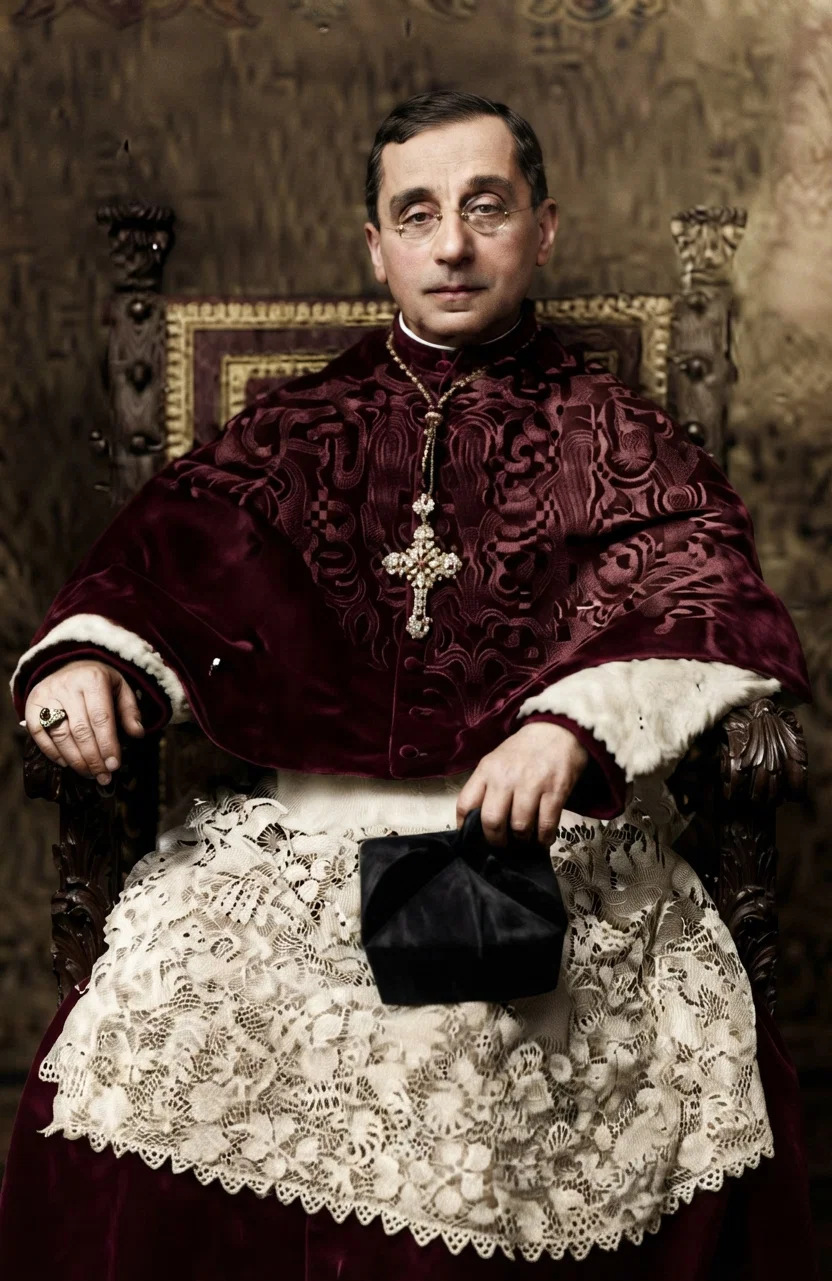
In his very first encyclical, Pope Benedict XV said that one of the causes of the war was "disregard of and for authority," and recommended religion as the only safeguard of authority, saying: "Let princes and rulers bear this in mind, and bethink themselves whether it be wise and salutary that public authority should divorce itself from the holy religion of Jesus Christ, in which it may find so powerful a support. Let them seriously consider whether it be politically wise to banish from public instruction the teaching of the gospel and of the church. Experience teaches, only too well, that where religion is away, public authority falls."
In this encyclical, the pope gives as another correlated cause of the war, that the temporal power having been taken from the pope, he was not free in the exercise of his apostolic ministry, and would demand, as did his predecessors, that "the abnormal condition in which the head of the church finds himself, and which in many respects is highly injurious to the peace of the peoples, should cease."
DIPLOMAT OF EXCEPTIONAL BRILLIANCY
A series of facts in connection with the pope’s desire to exert an influence upon the warring nations is significant at this juncture. The New York Times of January 31, 1915, contained an article from the pen of a "Veteran Diplomat," in which he stated, among other things:
"Benedict XV, unlike his immediate predecessor, Pius X, is not only a statesman of the type of Leo XIII, and of Cardinal Rampolla, but also a diplomat of exceptional brilliancy and experience. . . . Thanks to this blend of statecraft and diplomacy, Benedict XV has already succeeded in securing his acceptance by all the belligerent powers as a friendly intermediary. . . . Indeed, Benedict XV has met with so cordial a response from all the belligerent powers, who have shown a readiness to accept his intervention, as to create the conviction at Rome and in other foreign capitals that he is destined to become the principal intermediary in all the negotiations among the warring nations looking toward peace. . . . Benedict XV therefore remains, by reason of these conditions, the most suitable and acceptable intermediary to all the belligerents."
PAPAL COURT ENLARGING
By no means the least significant diplomatic move in connection with the world war was the dispatching of Sir Henry Howard by Great Britain to the Vatican as its representative. This move produced a profound impression, because it threw to the winds the precedents of several centuries, and aroused the ire of those known in England as the ultra-Protestants.
BENEDICT XV
The mikado of Japan followed soon after with his embassy to Rome. In fact, the entente between the papacy and such nations as Russia and Bulgaria has been reestablished; and many reasons are presented by Romanist, as well as by Protestant, urging the United States to send a representative to the pope to join in bringing about peace. The bishop of Limerick, in a pastoral quoted in the Catholic Mind of July 8, 1915, said:
"Already we have read with great interest and satisfaction the pronouncement of some distinguished English Protestants that a general council of the church should be summoned by our holy father, the pope, to find some means of ending this abominable war. . . . They feel the want of some moral authority in the world; of some one raised above the rivalries of nations, who could speak in behalf of God and His holy religion. . . . Essentially it is a Catholic ideal: one church, one fold, and one shepherd."
The bishop evidently had in mind the Rev. Reginald J. Campbell, one of the most prominent Congregationalists in London, and minister of the City Temple, who was quoted in a London dispatch of January 6, 1915, as saying, "There is only one person, namely, the pope, who could, with any chance of success, call such a conference."
Sermonizing upon the subject of the temporal power of the pope, Archbishop Glennon, of St. Louis, on December 7, 1913, the year before the war, as quoted in the Western Watchman of December 11, said:
"We may utter the hope that Christendom would, as it did in the Middle Ages, re-create as a court of last resort the supreme spiritual head of Christendom. Such a court would obtain a more historical setting than the one now established at The Hague, to which the nations appeal and sometimes don’t. It would be more in the order of Christian development that the last word of justice and right should be spoken by the head of the church that has the Just One as its founder. Such a court would be free from prejudice, and would not be affected by a desire for an extension of power."
REGAINING ITS FORMER POWER
From all these significant statements and facts, to which might be added many more, it must appear logical that the one potentate whom the nations would presently place at the head of a peace congress, or as the presiding officer of the United States of the World, is the pope. There does not seem to be in sight any political ruler of sufficient neutral stature to fill such position. The Roman Catholic Church has been cast out from the influence it once exercised in Europe; but it survives, and now seems to be on the road to resuming its wonted position among the nations. Macaulay, in his "Miscellaneous Writings," page 403, has this to say about the papacy:
"Four times since the authority of the Church of Rome was established in Western Christendom has the human intellect risen up against her yoke. Twice she remained completely victorious. Twice she came forth from the conflict bearing the marks of cruel wounds, but with the principle of life still strong within her. When we reflect on the tremendous assaults which she has survived, we find it difficult to conceive in what way she is to perish."
Had Macaulay been familiar with the prophecies relating to the papacy, he would have found — not as the Church of Rome has so often claimed, that she is the body of which the Saviour said, "The gates of hell shall not prevail against it," but that she is in very truth the power of which Daniel said, "I beheld then because of the voice of the great words which the horn spake: I beheld even till the beast was slain, and his body destroyed, and given to the burning flame."
Is it too much to say, in view of all that is referred to herein, that in Mr. Kingsley’s panacea for the world war, and the fundamental change necessary to bring about a united world authority, we are moving in the direction of fulfilling the prophecy, "All the world wondered after the beast"? And is not the time near when, according to prophecy, Rome will say, "I sit a queen, and am no widow, and shall see no sorrow"?
Next week, Mr. Horton will show that professing Protestantism has failed to carry to completion the work so triumphantly begun by the Reformation.
The Future Belongs to God
By Josef W. Hall
WHEN I speak of the future, I feel that I am encroaching on sacred ground. The future is God’s, and anxiety about it is nothing less than trespass on God’s property. “No trespassing!” — JOSEF W. HALL.
IN CONQUEST FOR A CROWN
By MRS. E. G. WHITE
By the late MRS. E. G. WHITE
MORE clearly than we do, we need to understand the issues at stake in the great conflict in which we are engaged. We need to understand more fully the value of the truths of the word of God, and the danger of allowing our minds to be diverted from them by the great deceiver.
The infinite value of the sacrifice required for our redemption reveals the fact that sin is a tremendous evil. Through sin the whole human organism is deranged, the mind is perverted, the imagination corrupted. Sin has degraded the faculties of the soul. Temptations from without find an answering chord within the heart, and the feet turn imperceptibly toward evil.
As the sacrifice in our behalf was complete, so our restoration from the defilement of sin is to be complete. No act of wickedness will the law of God excuse; no unrighteousness can escape its condemnation. The ethics of the gospel acknowledge no standard but the perfection of the divine character. The life of Christ was a perfect fulfillment of every precept of the law. He said, "I have kept My Father's commandments." John 15: 10. His life is our example of obedience and service. God alone can renew the heart. "It is God which worketh in you both to will and to do of His good pleasure." But we are bidden, "Work out your own salvation." Phil. 2: 13, 12.
THE WORK OF A LIFETIME
Wrongs cannot be righted, nor can reformations in conduct be made, by a few feeble, intermittent efforts. Character building is the work, not of a day, nor of a year, but of a lifetime. The struggle for conquest over self, for holiness and heaven, is a life-long struggle. Without continual effort and constant activity, there can be no advancement in the divine life, no attainment of the victor's crown.
The strongest evidence of man's fall from a higher state is the fact that it costs so much to return. The way of return can be gained only by hard fighting, inch by inch, hour by hour. In one moment, by a hasty, unguarded act, we may place ourselves in the power of evil; but it requires more than a moment to break the fetters and attain to a holier life. The purpose may be formed, the work begun; but its accomplishment will require toil, time, perseverance, patience, and sacrifice.
A BATTLE AND A MARCH
The life of the apostle Paul was a constant conflict with self. He said, "I die daily." 1 Cor. 15: 31. His will and his desires every day conflicted with duty and the will of God. Instead of following inclination, he did God's will, however crucifying to his nature.
At the close of his life of conflict, looking back over its struggles and triumphs, he could say : "I have fought a good fight, I have finished my course, I have kept the faith: henceforth there is laid up for me a crown of righteousness, which the Lord, the righteous Judge, shall give me at that day." 2 Tim. 4: 7, 8.
The Christian life is a battle and a march.
In this warfare there is no release; the effort must be continuous and persevering. It is by unceasing endeavor that we maintain the victory over the temptations of Satan. Christian integrity must be sought with resistless energy, and maintained with a resolute fixedness of purpose.
No one will be borne upward without stern, persevering effort in his own behalf. All must engage in this warfare for themselves. No one else can fight our battles. Individually we are responsible for the issues of the struggle. Though Noah, Job, and Daniel were in the land, they could deliver neither son nor daughter by their righteousness.
MUST DISCARD LIFELONG TRAINING
There is a science of Christianity to be mastered,—a science as much deeper, broader, higher, than any human science, as the heavens are higher than the earth. The mind is to be disciplined, educated, trained; for we are to do service for God in ways that are not in harmony with inborn inclination. Hereditary and cultivated tendencies to evil must be overcome. Often the education and training of a lifetime must be discarded, that one may become a learner in the school of Christ. Our hearts must be educated to become steadfast in God. We are to form habits of thought that will enable us to resist temptation. We must learn to look upward. The principles of the word of God,—principles that are as high as heaven, and that compass eternity,—we are to understand in their bearing upon our daily life. Every act, every word, every thought, is to be in accord with these principles. All must be brought into harmony with, and subject to, Christ.
The precious graces of the Holy Spirit are not developed in a moment. Courage, fortitude, meekness, faith, unwavering trust in God's power to save, are acquired by the experience of years. By a life of holy endeavor and firm adherence to the right, the children of God are to seal their destiny.
NO TIME TO LOSE
We have no time to lose. We know not how soon our probation may close. At the longest, we have but a brief lifetime here, and we know not how soon the arrow of death may strike our hearts. We know not how soon we may be called to give up the world and all its interests. Eternity stretches before us. The curtain is about to be lifted. But a few short years, and for every one now numbered with the living the mandate will go forth:
"He that is unjust, let him be unjust still: . . . and he that is righteous, let him be righteous still: and he that is holy, let him be holy still." Rev. 22: 11.
Are we prepared? Have we become acquainted with God, the Governor of heaven, the Lawgiver, and with Jesus Christ, whom He sent into the world as His representative? When our life work is ended, shall we be able to say, as did Christ, our example:
"I have glorified Thee on the earth: I have finished the work which Thou gavest Me to do. . . . I have manifested Thy name"? John 17: 4, 6.
WINNING A CROWN
The angels of God are seeking to attract us from ourselves and from earthly things. Let them not labor in vain.
Minds that have been given up to loose thoughts need to change. "Gird up the loins of your mind, be sober, and hope to the end for the grace that is to be brought unto you at the revelation of Jesus Christ; as obedient children, not fashioning yourselves according to the former lusts in your ignorance: but as He which hath called you is holy, so be ye holy in all manner of conversation; because it is written, Be ye holy; for I am holy."
The thoughts must be centered upon God. We must put forth earnest effort to overcome the evil tendencies of the natural heart. Our efforts, our self-denial and perseverance, must be proportionate to the infinite value of the object of which we are in pursuit. Only by overcoming as Christ overcame shall we win the crown of life.
Victory Through Submission
By A. M. Dart
"SUBMIT yourselves therefore to God. Resist the devil, and he will flee from you." James 4: 7.
I can see no defeat for the one who complies with this instruction. But we must carefully consider it. I rise in the morning and submit myself to God. It is not hard to do. I am encountering no adverse influences. But this may not be true through all the day. The time of test and trial comes. Conditions arise that call forth the unlovely in my nature. Hereditary and cultivated tendencies to evil are clamoring for recognition. Now it is not so easy to submit myself to God; but victory for Christ depends upon it.
If I do not submit myself to God, I will submit myself to the enemy. The greatest of all battles is raging — the battle with self. I must make my choice. If I submit myself to God, the victory is won; for in submission, I come in contact with His power, which is all-sufficient. How interested heavenly intelligences must be in my case just now, anxiously waiting! But not one thing can be done for me till I choose. God Himself will not interfere with my power of choice.
Webster defines "submit" thus: "To yield; to surrender; to comply." And when once this is done in God's favor, how quickly the victory is won! A. M. DART.
FREDERICK BULPITT
By Frederick Bulpitt
THE refined taste revolts against a continual round of fare. One of the greatest necessities in preparing meals is that they shall be appetizing. The surest aid to a good digestion is the pleasure and satisfaction excited by well cooked food served in a savory manner. To have variety in the meals, one does not need to depend so much on different articles of food as on the way in which it is served. The pleasing appearance of the table will lend a relish to any meal.
FREDERICK BULPITT
Character Building Takes a Lifetime
Character building is the work, not of a day, nor of a year, but of a lifetime. . . . Without continual effort and constant activity, there can be no advancement in the divine life, no attainment of the victor's crown.
Unlocking the Hidden Treasures
By C. C. Crisler
The Life Story of a Noble Pioneer
By C. C. CRISLER
Title page of Joseph Mede's "Works" on the prophecies, published in 1677.
In these days of prophetic enlightenment, but few pause to consider the prodigious labors of the early expositors of prophecy. In the words of Scripture, "Other men labored, and ye are entered into their labors." Sketches from the life stories of six of the forerunners of prophetic interpretation will be presented in as many articles by Clarence C. Crisler, beginning with this issue.
AMONG the marked providences preparing the way for the great advent movement was a revival of interest in the study and exposition of prophetic portions of Holy Writ. While the desire to understand prophecy seemed strongest during the first few decades of the nineteenth century, yet the search after the hidden things of God's word was prosecuted with vigor for a century or more before the long-locked treasures of truth in the book of Daniel were opened to the understanding of all who sought for a knowledge of the times and the seasons in which they were living.
AGE-OLD PERVERSIONS OF TRUTH
The earlier fathers of the Christian church had a correct understanding of the general features of the prophecies of Holy Scriptures concerning the second advent, the resurrection of the righteous, the millennium, and the final destruction of Satan and his host. But these truths were spiritualized by Origen, Augustine, Jerome, and other expositors of Scripture during the fourth and fifth centuries.
"The doctrine of Christ's reign on earth," says Gibbon, "was first treated as a profound allegory, was considered by degrees as a doubtful and useless opinion, and was at length rejected as the absurd invention of heresy and fanaticism. A mysterious prophecy (the Apocalypse), which still forms a part of the sacred canon, but which was thought to favor the exploded sentiment, has very narrowly escaped the proscription of the church." ("Decline and Fall," chapter 15, paragraph 21.)
"It was not till the church had learned to Platonize," says Dr. Horatius Bonar, in his comments on the twentieth of Revelation, "or had taken lessons in the school of Origen," that they could condemn the doctrine of the coming and kingdom of the Redeemer as revealed in the Apocalypse, "without disputing the inspiration of the Revelation."
During the centuries that followed, to the time of the Reformation, there were but few who held to the Scriptural doctrine of the second advent. In the time of the crusades, one of the most learned of the expositors of those days, Joachim, a Calabrian abbot, lifted his voice in protest against the prevailing tendency to spiritualize away the meaning of revealed truth. He had the privilege of lecturing on the Apocalypse before Richard Cœur de Lion while that valiant knight was passing through Messina on a crusade to the Holy Land.
Two centuries later, there occurred in all portions of the then known world a series of "calamities, more tremendous than any which had lighted on the earth since the great plague which made the reign of Justinian so disastrously memorable." (Le Bas, "Life of Wycliffe," pages 105, 106 — Harper's edition, 1832.) Wycliffe, who later became "the morning star of the Reformation," was then a young man of about twenty-five. All around him were many whose hearts were failing them for fear, and who were inquiring concerning the meaning of these things.
Wycliffe's thoughts turned toward the writings of the learned abbot, Joachim, to whom had been given the spirit of wisdom, of discernment, and of a sound mind in the study of prophecy; and Wycliffe became convinced that in pestilence and earthquake and flood, as well as in conditions prevailing in the social world, he could discern the signs of the times; so he was impelled to write his first tract, entitled "The Last Age." In this, he attempted to interpret the meaning of the signs of his times, and to urge the importance of preparation for the day of Judgment to come.
In the teachings of the Waldenses, also, may be traced a knowledge of God's purpose as revealed in prophecy. Thus the way was preparing for the larger work of the Reformers of the fifteenth and sixteenth centuries. But not until the seventeenth century, when the beginning of "the time of the end" foretold by Daniel the prophet was drawing on apace, did learned men of God's appointment give special attention to the exposition of prophetic Scripture in the light of history, as a means of determining approximately the time of the second advent.
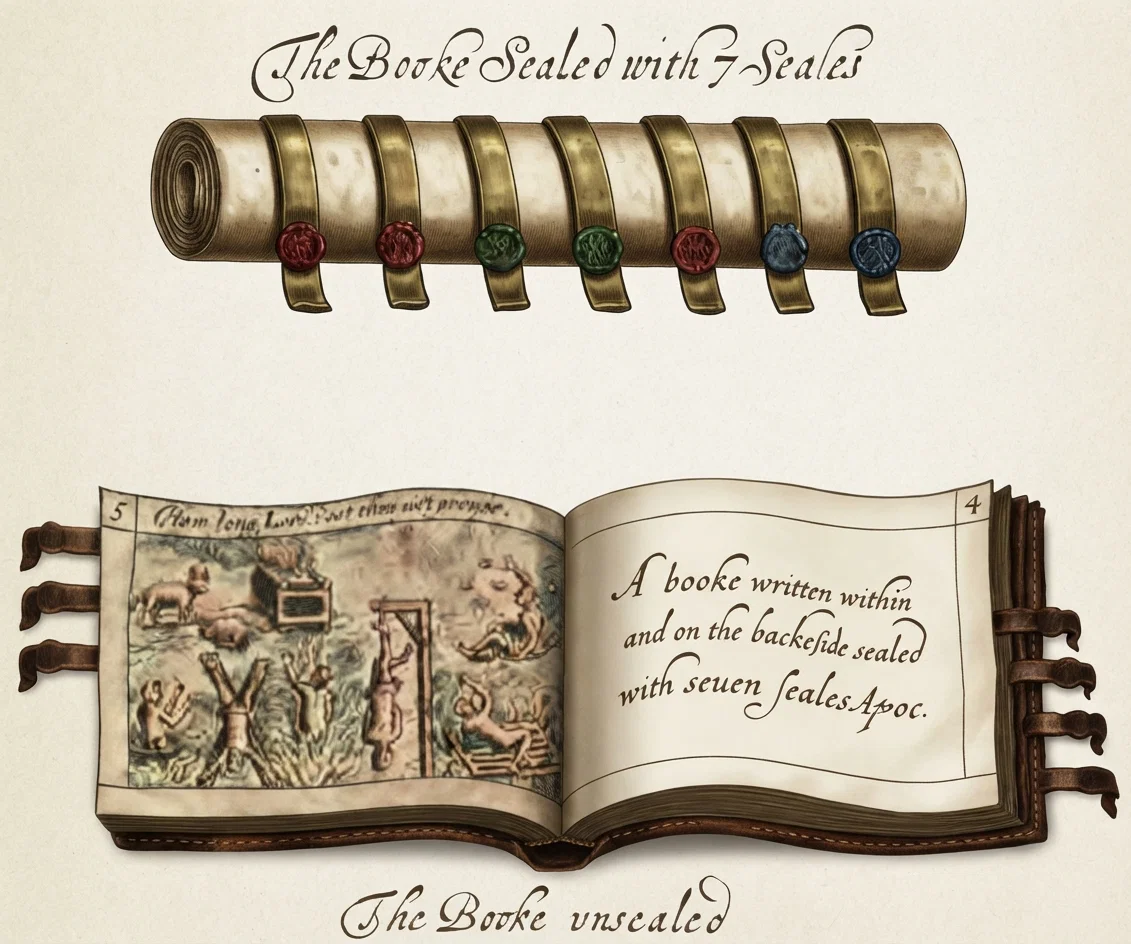
Mede's conception of the appearance of the book sealed with seven seals.
THE FATHER OF MODERN PROPHETIC INTERPRETATION
Among the more prominent of these seventeenth century expositors is Joseph Mede, B. D., of Christ's College, Cambridge University. It was Mede who made the discovery that several of the prophecies in the book of Revelation are synchronous. For this reason, declares Dr. Worthington, the editor of his published works, "shall the present and succeeding ages owe a great respect and veneration to his memory."
And truly the hand of God is revealed in the conscientious and painstaking labors of this "pious and profoundly learned man," as he is quaintly characterized by Dr. Worthington on the title page of his collected "Works." During his study of the Apocalypse, Mr. Mede wrote to a friend "that it was his daily desire and prayer to God that he might not be led away with delusions"; and he earnestly requested his friend to pray for him. As he advanced in the preparation of his exposition of the book of Revelation for publication, he wrote again to this same friend of his: "I am conscious of my weakness and unworthiness. . . . But if it be found the least means of farther light, to the Father of lights be the glory." (See the general preface to his "Works," folio edition, London, 1677.)
Of his published works, Mr. Mede's "Clavis Apocalypticae" ("Key to the Apocalypse") is generally conceded to be his masterpiece. His "Commentary on the Apocalypse," which appeared in 1632, together with the "Key," earned for him the title "The father of modern prophetic interpretation."
"COMPARING SCRIPTURE WITH SCRIPTURE"
In large measure, Mr. Mede's success as an interpreter of the apocalyptic visions is due to his "accurate and judicious comparing of scripture with scripture, and observing the proper and genuine use of the like words and phrases in several passages of Scripture." (Idem.) He found, says the editor of his "Works," that "the word of God is a lamp unto our feet and a light unto our pathway, not only as to the guiding of our life and practice, but also as to the directing our spirit in the safest and clearest method of interpreting itself; and that such comparing of places is as needful for our conduct in the more solitary and dark passages of Scripture, as that burning pillar of fire was to the Israelites in their journeyings through a waste and desolate wilderness, which God gave them to be both a guide of the unknown journey, and an harmless sun by night." (Idem.)
Mr. John Tudor, the editor of the Morning Watch, a quarterly journal on prophecy published in London from 1829 to 1833, wrote thus of Mr. Mede's labors:
"He entered upon the study of prophecy with the deliberation and calmness of one whose aim is not distinction, but to know the will of God; and seeking this first, all other things were added unto him. He soon perceived that the Apocalypse is the key to all the other prophecies, and that it is also the scale by which they are to be adjusted: then, reasoning by analogy, and concluding that the scale must be well understood before it could be applied with advantage to any other thing, he endeavored to adjust the structure of the Apocalypse from the book alone, and independently of any interpretation. A very important principle this, which serves as a good test of modern commentators, who, we believe, have never succeeded in their interpretations except in proportion as they have adhered to this principle."8—Editorial on "The Gradual Unfolding of Prophecy," Morning Watch, December, 1829.
Mr. Mede brought to his study of prophecy a mind enriched with a vast store of learning. During his long residence at Cambridge as a teacher in the university, he spent much time in the study of history, Jewish antiquities, and sacred chronology. "When foreigners traveling into England came to visit the University of Cambridge," declares his biographer, "they would carefully seek him out, and endeavored to gain his acquaintance, as much as many others then more eminent in place." (See "The Author's Life," in "Works," page 7.)
Among his learned contemporaries with whom he corresponded more or less regularly, was Archbishop Usher, the author of the "Annals of the Old and the New Testament," embodying the system of chronology adopted by the publishers of the Oxford editions of the King James Version of the Holy Scriptures.
"HIS WORKS DO FOLLOW HIM"
The untiring labors of this illustrious Church of England divine did much to prepare the way for the advent movement, to which so many honest-hearted men of every creed have given their noblest efforts. The spirit of his labors is beautifully set forth in a prayer left on record by Dr. Worthington at the close of the general preface to his "Works":
"He who is the Father of mercies and the God of all grace, that giveth power to the faint, and reneweth their strength who wait upon Him, who worketh both to will and to do, and to continue patiently in so doing unto the end; to His name alone (not unto me, not unto me) be the glory and praise for His mercy and for His power's sake. The same Father of lights, who commanded the light to shine out of darkness, shine into our hearts, unveil our eyes, that we may behold wondrous things out of His law; purify our souls from prejudice and passion, from every false principle and corrupt affection, that we may receive the love of the truth, and know the mysteries of the kingdom of God; that being filled with all wisdom and spiritual understanding, we may walk worthy of the Lord unto all pleasing: to whom be blessing, and glory, and wisdom, and thanksgiving, and honor, and power, forever and ever, Amen."
Religious Liberty Overridden in America
By C. S. Longacre
ONE way to set aside the guaranties of religious liberty in the federal and state constitutions is to repeal the privileges and immunities granted to its citizens. But this mode of procedure is not so easy, and the enemies of religious liberty seldom attempt the overthrow of the constitution in this way.
There is an easier but a more effectual way to deprive citizens of the enjoyment of their constitutional right to worship God according to the dictates of their own consciences, or not to worship; and that is by overriding the constitutional guaranties by statutory legislation or by judicial interpretations of law. The danger of losing our most sacred, inalienable, God-given rights is not by statutory repeal, but by the overriding of these privileges pertaining to the minority.
The Roman republic held to its republican forms long after it had lost the real spirit of the republic, under the domination of tyrants and despots of the worst type. Even so it is possible for the American republic to depart from its fundamental principles of civil and religious liberty, and in practice deny every theory of our guaranties of constitutional liberty for the individual citizen.
It is well to remember that America was not always free, and that once upon a time, men were persecuted and put to death for daring to differ, in their religious teaching and practice, with the tenets and opinions of the established religion. The successors of the old régime are not dead to-day, but have greatly multiplied, and are loudly clamoring for a resumption of the old order of things.
WHERE IS OUR BOASTED FREEDOM?
Those who dare to differ with the teaching and practices of the popular religion of the present day are still incarcerated in prisons and chain gangs in some of the states of the Union. Hundreds of Seventh-day Adventists have been fined and imprisoned for worshiping God in harmony with the fourth commandment of the Decalogue.
With all our boasted freedom of individual rights and equality of rights in religious matters before the law, some states and some courts require Seventh-day Adventists to observe Sunday after they have already conscientiously observed Saturday as the Sabbath, thus compelling them to observe two days each week.
Just now there are two cases pending before the courts of Oklahoma, and five cases before the courts of Tennessee, in which states Seventh-day Adventists are prosecuted for doing private work in their own dwellings or on their premises on Sunday.
Scores of other men, not Seventh-day Adventists, had done similar work from time to time on their private premises as actual necessities, but only Adventists were indicted. Notwithstanding the fact that those who observe Saturday as the Sabbath are exempted, by the statutes of Oklahoma, from being compelled to observe Sunday also, yet the district court at Watonga, Oklahoma, denied the defendants the right to offer as defensive material the constitutional guaranties granting religious freedom to all citizens alike, as well as the right to plead the immunities of the exemption statute enacted by the legislature for their special benefit and protection in case of prosecution. The guaranties of religious liberty for the individual so magnificently set forth in both federal and state constitutions, some of our courts mock at, and regard as empty platitudes. These guaranties are set aside by being overridden.
Unless juries, lawyers, and judges recognize the purport and spirit of the constitutional guaranties and immunities granted to the individual citizen, we can look, in the not far distant future, for a repetition, in America, of the bloody persecutions of medieval Rome. Such a travesty upon justice and liberty ought to awaken the press of the country, and stir the public conscience to the last degree.
The fact that the courts override the constitutional guaranties, and the public quietly acquiesces without protesting, serves as a striking testimony that the American republic is retrograding to the old order of things, and that the United States is fulfilling a prophecy uttered nearly 1,900 years ago. Read Rev. 13:11-18, and you will find a divine statement as to how far the American republic was to depart from its lamblike origin.
C. S. LONGACRE.
E. H. M
By E. H. M.
THE sanctuary, God's dwelling place on earth, in days of old was "all glorious within." It was a figure of the true tabernacle, God's dwelling place in heaven. Heb. 8:5. It also faintly shadowed forth the human heart cleansed from its natural defilement, and made by the presence of God's Holy Spirit "all glorious within." To be thus is the high privilege of human beings.
E. H. M
Too Wise to Ask Wisdom
By Daniel Hartman Kress
THERE never was a time when earnest prayer was needed more than at present, and probably there never has been a time when prayer was more neglected. God is ready and willing to do great things for His people, but they "ask not." This is sad indeed. Men feel too wise to ask wisdom of God, and are too self-confident to feel their need of divine help. The form of prayer, it is true, is still kept up; but there exists no spirit of prayer. Prevailing prayer—how seldom is it heard! One of the essentials of prayer is to know and understand ourselves. A knowledge of our weakness leads to prayer.
"Teach me first to feel my weakness,
Then to plead for strength divine."
When the news came to Jehoshaphat, "There cometh a great multitude against thee," he "set himself to seek the Lord," and "Judah gathered themselves together, to ask help of the Lord." When he had acknowledged his helplessness and utter dependence upon God, God undertook the battle for him. *Then came the words to Jehoshaphat from the Lord: "Be not afraid nor dismayed by reason of this great multitude; for the battle is not yours, but God's." "Ye shall not need to fight in this battle."
TRUTH IS NOT AN OPIATE
The Lord next told them how to go out against their enemies. He requested that they appoint "singers unto the Lord, and that should praise the beauty of holiness, as they went out before the army, and to say, Praise the Lord; for His mercy endureth forever. And when they began to sing and to praise," the Lord sent confusion into the camp of their enemies, and "every one helped to destroy another." Judah needed not to fight, for their enemies destroyed themselves.
God desires to-day to fight the battles for His people. He does not want them to fight. "They that take the sword shall perish with the sword." On the other hand, when their enemies arise, they are not to settle down at ease, and say, Well, the work is the Lord's, and He will take care of it; or, He has His hand on the lever of circumstances, and works everything after the counsel of His own will. While all this is true, this truth should not act as an opiate, and lead to inactivity and a false trust. It should stimulate men to do as did Jehoshaphat and all Judah—"ask help of the Lord."
D. H. KRESS.
Climbing Into God’s Presence
By M. A. H.
As Moses climbed up Mount Sinai—a rough, hazardous, precipitous ascent—at last to stand before God, so we, by a similar climb, rough though it may be, may at last come into the very presence of God.
M. A. H.
The Sweetest Bird Builds Near the Ground
"THE sweetest bird builds near the ground; the loveliest flower springs low."