The greatest of gifts, says the apostle, “is love.” This has been revealed to us by the Father through the Son, “for God so loved the world, that he gave his only begotten Son, that whosoever believeth in him should not perish, but have everlasting life.” “Love is of God; . . . for God is love.” 1 John 4:7, 8. Therefore he who truly loves, “is begotten of God, and knoweth God.” And why?—Because he partakes of the character of God.
True love freed from all selfishness, is the most desirable trait of character that one can possess, for it is the most godlike; it is that which can not be resisted. It may be repulsed; it may be ignored; but finally it wins, as in the case of the apostle Paul, who “before was a blasphemer, and a persecutor, and injurious,” but later said, “The love of Christ constraineth us.”
Love led the Saviour to give up his own life for a world lost in sin, “having no hope and without God in the world,” weak and ungodly sinners. Eph. 2:11, 12; Rom. 5:6-8. This he did because in so doing he saw their future happiness, and in this he gloried. Isa. 53:11. “He shall see of the travail of his soul, and shall be satisfied.” “A bruised reed will he not break, and a dimly burning wick will he not quench: he will bring forth justice in truth. He will not fail nor be discouraged, till he have set justice in the earth; and the isles shall wait for his law.” Isa. 42:3, 4.
This blessed fact is clearly made known in the attitude of the father toward the prodigal son. Although a wanderer, a squanderer of his goods, a riotous liver, and worse than all, a complainer and murmurer against his father's kindness, yet the moment he began to feel his own unworthiness and sinfulness, the father saw him a great way off, “and was moved with compassion, and ran, and fell on his neck, and kissed him. . . . But the father said to his servants, Bring forth quickly the best robe, and put it on him; and put a ring on his hand, and shoes on his feet: and bring the fatted calf, and kill it, and let us eat, and make merry: for this my son was dead, and is alive again; he was lost, and is found.” Luke 15:11-24. You will notice the difference in the father's love and that of the Pharisee. Verses 25-30. “Like as a father pitieth his children, so Jehovah pitieth them that fear him. For he knoweth our frame; he remembereth that we are dust.” Ps. 103:13.
That degree of the love of God which we possess, is best seen by our love one to another as Christians, and as brethren in the remnant church. Christ says: “A new commandment I give unto you, that ye love one another; even as I have loved you, that ye also love one another.” John 13:34. It is by this experience in our lives that we show to the world that we are Christians. “By this shall all men know that ye are my disciples, if ye have love one to another.” Verse 35.12
The true measuring rod of our love is not in word, neither with tongue, “but in deed and truth” (1 John 3:18), and that we love our neighbor as ourself. This is the fulness of the love of God revealed according to the law. Matt. 22:36-40; Rom. 13:8-10.
There are some very plain texts of Scripture concerning brotherly love which we all need carefully to consider and obey; to neglect means death. “If a man say, I love God, and hateth his brother, he is a liar: for he that loveth not his brother whom he hath seen, can not love God whom he hath not seen.” 1 John 4:20. “And this commandment have we from him, that he who loveth God love his brother also.” Verse 21. “But if ye bite and devour one another, take heed that ye be not consumed one of another.” Gal. 5:15.
These are very solemn words, and mean much to us as a people. There is probably no other people on the earth to-day that the devil tries so hard on this point as he does Seventh-day Adventists. We are told by the spirit of prophecy “that brethren do not love brethren.” How often this is found to be true! For some trivial offense, or perhaps a real offense, brethren become alienated and so separated in their feelings that they can hardly say a good word for each other. Sometimes a brother or sister is made an offender for a word unwisely spoken, and out of it grow the most bitter feelings. “My brethren, these things ought not so to be. Doth the fountain send forth from the same opening sweet water and bitter? can a fig-tree, my brethren, yield olives, or a vine figs? neither can salt water yield sweet.” James 3:10-12. To the writer's mind there is some real cause for this, and doubtless the first cause is a lack of conversion and consecration, and a second is a supreme love for one's self, a third and very widespread cause is love for office. I doubt whether a greater cause than the third exists among us. It is first seen in the home, then in the church, and finally in the conference. No more dangerous responsibility can be laid upon any one than office, and this is spoken of in connection with the work of the ministry: “Not a novice [one newly come to the faith], lest being puffed up he fall into the condemnation of the devil. Moreover he must have good testimony from them that are without; lest he fall into reproach and the snare of the devil.” 1 Tim. 3:6; see also chapter 6:1-5.
“Who is wise and understanding among you? let him show by his good life his works in meekness of wisdom. But if ye have bitter jealousy and faction in your heart, glory not and lie not against the truth. This wisdom is not a wisdom that cometh down from above, but is earthly, sensual, devilish. For where jealousy and faction are, there is confusion and every evil deed. But the wisdom that is from above is first pure, then peaceable, gentle, easy to be entreated, full of mercy and good fruits, without variance, without hypocrisy. And the fruit of righteousness is sown in peace for them that make peace.” James 3:13-18. Let every one cultivate the wisdom that is from above, and all will be well.
Will Rome Change Her Policy?
By John O. Corliss
J. O. CORLISS
It has been the proud boast of the papacy that her methods have never abated in any degree from those first established. How true this is history can well testify, but the unbroken continuation of these has at last brought about a crisis which students of prophecy will take interest in watching.
It seems that the controversy in France about the separation of the church from the state, has emboldened other nations to come into the open with direct statements upon the same point. This has called forth an expression of views from Pius X which reiterate the sentiments formulated in the twelfth and thirteenth centuries.
For some years past the notion was obtaining that the papacy was modifying its views regarding heretics, when suddenly, about three years ago three leading lights of the “system”—Abbé Loisy, Abbé Houtin, and Abbé Denis—were condemned for heresy, on the ground that their writings breathed sentiments of toleration not to be permitted by the faithful. But the principles of religious liberty had become so much a part of the education of some others that they did not, or could not, refrain from giving expression to them, and these, too, fell under the ban of the pope, in April of this year.
The serious offense of this occasion is stated by a correspondent of the London Times to have been disclosed in a personal letter written by the pope to Cardinal Ferrari, Archbishop of Milan, in which he condemned the sentiment found in a pastoral on “The Church and the New Times,” written by Mgr. Bonomelli, Bishop of Cremona. The particular point with which fault was found in this production, was the advocacy of religious toleration in practise, and the statement that in the circumstances of the modern state, the separation of the church from the state was often better for the church. The pope declared this to be “modern liberalism which the church will never accept.” So strongly did the pope push this matter, it is said, that strong protests from America (and perhaps from other parts) were made the buffers between the pope and the bishop, which saved the latter from disgrace, and the faithful in America from embarrassment.
Decrees were also published in the Osservatore Romano of April 7, placing on the condemnatory list a booklet by M. Paul Viollet, in which was advocated the idea that a “syllabus” from the pope is not necessarily infallible, but that when any one of these condemns modern civilization, religious toleration, etc., it is not to be taken literally. The same decree condemned two works on philosophy by Abbé Laberthonnière, a philosopher of wide reputation, because these did not sustain the dogmas of the church.
These high-handed acts have aroused great indignation among the educated classes of Europe, and have called forth some very sharp things from authors. One Il Santo, an Italian novelist, went so far as to say in one of his productions that, if Christ were to return to earth, he would receive from the Vatican the same treatment that he met at the hands of the Sanhedrim. It is also said that now the church in Italy has become distracted by the position the pope has taken against the “Christian Democrats.” It seems that for some time the pope has tried to suppress this organization, and to force its members to take their political orders from the bishops. This effort of the pope has been met with open defiance, and he will have to choose between wholesale excommunication, or acceptance of defeat.
From these cases it seems that modern ideas have made much headway in Europe, and to some extent threaten the unity of the papacy. These are, however, but the prelude to an impending stroke at intellectual religious theories in Europe, and perhaps in America as well. A far-reaching syllabus is looked for to emanate very soon from the Vatican, in which every phase of supposed heresy will be condemned. Great pains are being taken, it is declared, to make this an exhaustive edict. Books and papers (some of them non-Catholic) of every language are being overhauled, to find compromising sentiments.
To some this is significant as an indication of the nature of the controversy just before those who “fear God and keep his commandments.” It certainly savors of that period when a mark will be set upon those who will not worship the beast and his image. It also points to a complete separation between these and others who yield to the demands of the Vatican, not only in America, but in Europe as well. It will pay to watch the unfolding of matters now engaging the attention of the papacy, and be ready to meet the issue with unflinching loyalty to the truth which has been committed to this people.
Mountain View, Cal.
Example of Individualism
ONCKEN was a servant, bookseller, and tract distributor. With six others he organized a church in a shoe shop. He went forth visiting every part of Germany, scattering Bibles and tracts, and gathering converts into churches. In twenty-five years this was the result of his work: Sixty-five churches and 750 stations, from 8,000 to 10,000 members, 120 ministers and Bible readers, Bibles and scattered tracts by the million, and 50,000,000 had heard the gospel.
Give us 250 such men as Oncken, and in a quarter of a century we can not only organize 16,000 churches, with 2,500,000 members, but may preach the gospel to every soul on earth.—Selected.
A Well-Balanced Dietary
By F. O. Raymond
F. O. RAYMOND
While striving to obtain that incorruptible crown of righteousness, we must be temperate in all things; but in so doing it is our privilege and duty to heed the injunction, “Eat ye that which is good, and let your soul delight itself in fatness,” doing all to the glory of God.
When a reform is demanded, the enemy of our souls may try first to make us indifferent and careless; but if he fails in this, his purpose is just as surely gained if he can drive us to the opposite extreme. “Changes should be made with great care; and we should move cautiously and wisely. We want to take that course which will recommend itself to the intelligent men and women of the land.” “Two classes were presented before me: first, those who were not living up to the light which God had given them. . . . Some can not be impressed with the necessity of eating and drinking to the glory of God. The indulgence of appetite affects them in all the relations of life. It is seen in their family, in their church, in the prayer-meeting, and in the conduct of their children. It has been the curse of their lives. . . . Another class who have taken hold of the health reform are very severe. They take a position, and stand stubbornly in that position, and carry nearly everything over the mark.” “They must eat just such an amount and just such a quality, and confine themselves to two or three things.” “I have been shown that many take a wrong view of the health reform, and adopt too poor a diet. They subsist upon a cheap, poor quality of food, prepared without care or reference to the nourishment of the system.”—“Testimonies for the Church,” Vol. II, pages 367-369.
“I saw that God does not require any one to take a course of such rigid economy as to weaken or injure the temple of God. . . . Those who labor with their hands must nourish their strength to perform this labor, and those also who labor in word and doctrine must nourish their strength; for Satan and his evil angels are warring against them to tear down their strength.”—Id., Vol. I, pages 205, 206.
“The one who prepares the food that is to be placed in our stomachs to be converted into blood to nourish the system, occupies a most important position. The position of copyist, dressmaker, or music teacher can not equal in importance that of the cook.”—Id., Vol. III, page 158.
Suggestive Menus
Breakfast
Boiled Rice with Cream or Fruit Sauce
Baked Potatoes Scrambled Eggs
Hot Milk
Bread and Butter Zwieback
Apple Sauce
Dinner
Vegetable Soup Mashed Potato
Pease Patties with Tomato Sauce
Corn Bread Zwieback
Fresh Fruit and Nuts
Recipes
Boiled Rice
Take 1 cup of best head rice, wash in several waters, put into a saucepan, add 2 quarts of cold or warm (not hot) water, salt well, and boil rapidly for about twenty minutes. Just as soon as the kernels are tender, but not broken or mushy, remove from the fire, and pour into a colander to drain, reserving the water for soup. To remove any excess of starch and still further to separate the kernels pour more water over the rice in the colander, cover and keep hot. Serve with cream or any suitable fruit sauce, avoiding the very acid fruits. Other methods of cooking rice will be given in future lessons.
Scrambled Eggs
To each cup of milk allow 4 eggs. Measure the milk, and scald in a pan or basin on the stove. Break the eggs into a bowl, and with a spoon stir just sufficiently to break the yolks, then turn into the milk, salt, and as fast as the egg cooks, keep it scraped off the bottom and sides of the pan until the whole is thickened, then remove at once from the stove. If cooked too rapidly or allowed to remain a moment too long, they will become watery.
Vegetable Soup
Take ½ of a small turnip, 2 onions, 4 potatoes, 1 tablespoonful of rice, 2 cups of strained tomato, 2 bay leaves, salt, 1 tablespoonful of butter.
Cut the vegetables quite fine, add the rice, and boil in one quart of water. When nearly done, add tomato, bay leaves, butter, and salt, and water to make at least two quarts of soup. Other vegetables, such as cabbage, carrots, celery, okra, green peas and corn, may be used, and the soup strained through a colander if preferred, adding a little minced parsley before serving. The rice water and some of the boiled rice left from breakfast may be very nicely utilized here.
Pease Patties
Soak overnight 1 cup of Scotch or English peas. In the morning remove to fresh water, and gently boil until tender. When the peas become softened and in danger of scorching, cover and remove to the oven until thoroughly cooked and quite dry, then pass through a fine colander to remove hulls. If necessary stiffen the pulp with toasted bread or cracker crumbs, season with salt, and if liked, add a little rich cream, dairy butter, or nut butter. Form into patties, and brown in the oven. Serve with a simple sauce consisting of strained tomato slightly thickened with corn-starch or flour, and seasoned to taste.
Similar cakes may be made of beans, lentils, or peanuts. They are simple, practical, inexpensive, and from a health standpoint have scarcely a superior as a meat substitute.
Corn Bread
Take 2 cups of corn-meal, 1 tablespoonful of sugar, boiling milk or cream, ½ teaspoonful of salt.
Sift meal with sugar and salt. Pour over this enough boiling milk or cream to make a stiff drop batter. Stir constantly, that the meal may not lump. When perfectly smooth, drop in large spoonfuls on a cold buttered baking sheet, and bake in a brisk oven. The cakes should be browned on top. If milk can not be obtained, rub a large spoonful of cooking oil into the meal, and use boiling water.
In our last lesson we learned of the various food elements, most important among which are the proteids, carbohydrates, and fats. Carefully conducted experiments have demonstrated that the human economy requires six or seven times as much of the carbonaceous elements—the carbohydrates and fats—as of the nitrogenous or proteid elements.
In this country people generally depend mainly upon flesh-meats for their proteids, so in changing to a vegetarian diet, unless other proteids are supplied, the diet will be impoverished or lacking in those elements so necessary for the nourishment of the tissues, and there will be an unsatisfied craving for meat or something to take its place. If, on the other hand, these elements are taken in excess, there may be an accumulation of uric acid in the body, giving rise possibly to gout, rheumatism, or Bright’s disease.
The above menus are well balanced because they provide the required elements in about the right ratio—one part of proteid to six or seven parts of carbohydrate and fat.
For breakfast the starchy or carbohydrate rice and potatoes are balanced by the albuminoids or proteid milk and eggs. For dinner the potato is balanced by the proteid peas and nuts. The necessary fat is found in cream, butter, and nuts. Bread, zwieback, and most other preparations of wheat, corn, oats, and barley are well-nigh perfect foods because they supply the necessary elements14in about the right ratio to meet the requirements of the system.
The topic of this lesson is one of the most important of any which we shall have to consider. We shall recur to it again and again in future lessons.
The Better Way
DON’T worry. Do the best you can,
And let hope conquer care;
No more is asked of any man
Than he has strength to bear.
The back is fitted for the load;
Your burdens all were planned;
And if you sing along the road,
Kind fate will lend a hand.
—Selected.
Child Culture
By Mrs. Jessie H. Warren
MRS. JESSIE H. WARREN
The subject of child culture is one which should be of interest to every one, but more especially to parents, as they are the ones upon whom the responsibility of child training principally falls.
Let us consider for a moment the meaning of the word “culture.” One definition is: Attention and labor given to growth, especially with a view to improvement. It also means to educate or refine. Culture, then, includes both teaching and training. A child must be taught what he does not know, or that which is beyond himself; and he must be trained to develop the principles taught, and also to develop and control his natural faculties and powers. As parents, our endeavor should be to teach and train our children in the right direction; for they will learn evil as easily as good, and be trained in the wrong way as well as in the right. Proper training will subdue the evil tendencies, and develop and improve the good.
The one great principle in the training of children is to prepare them for their life-work—to enable them to become strong, independent, and self-reliant men and women. In order to accomplish this, it is necessary to teach them self-control, self-denial, and the necessity of the performance of duty, and courage to do what duty requires. Then train them according to this standard.
Self-control is of the utmost importance all through life; and unless we learn it in childhood, we are indeed unfortunate. A child should be taught not to give way to tears for every little pain, or for every childish sorrow. Teach him that such things will happen many times, and that he must learn to bear them patiently. But let us never ridicule the sorrows of childhood, for they are as real to the child as are our own to us, but with sympathy help the children to control their grief. A child should not be allowed to display anger. How often we see small children kick and scream because they can not have their own way! And how often, too, do parents laugh at these demonstrations! But what a serious mistake! Children should not be allowed to show their anger by passionate outbursts, but be taught to control the temper and bring it into subjection.
Self-denial is another thing hard for a child to learn, but if learned in childhood, the way through life will be made much easier. A child who is indulged in every way—in dress, in appetite, and in pleasures, and who has no wish ungratified (though the parents may think they are doing the best they can for their child)—is poorly prepared for the disappointments of after years, which will certainly come. Better to train him in youth to deny self for the sake of others, and for his own welfare.
We hear much about breaking the child’s will, conquering him, and making him to know who is in authority. But we would say rather, bend or train the will in harmony with the parent’s will. Teach the child to will to do right instead of wrong. It is best never to force a direct issue with a child. That is only a conflict of wills in which one or the other must win, and whichever way it terminates, is a sad failure. It is only a question of brute force. If the parent conquers the child, he has broken its will, but no good has been accomplished. A child’s will is his power, his personality, his individuality. It should be guided, not broken. When once broken, he has lost to a great extent his power and personality. If we have a vine which we wish to have climb or run on a trellis, what do we do? We bend and twist the twigs until they begin to grow in the direction we desire to have them. But if, instead of this, we should break off every twig that started in the wrong direction, what would we have? Surely not the beautiful climbing vine we so much admire. Then how much more should we be gentle and tender in the training of the little human plants which God has entrusted to our care!
To train a child in the way he should go, we must furnish proper environments—good books, good companions, and proper amusements and recreations. We must teach him courtesy to all, and especially to the aged. In no way can this better be done than by our own example.
There is one place in the training of children where must should have a part, and that is in the performance of duty. Teach them that duties which devolve upon them must be performed, whether the task is pleasing or not.
A few words now in regard to punishments and rewards. It is well to give a child the chance to choose, to exercise his own free will. He may choose to do right, and thus win our approval; or he may choose to do wrong, and receive our disapproval. Punishments should be administered only as a penalty for wilfully doing wrong. This is God’s method in dealing with us, his children. He says, “I have set before you life and death, blessing and cursing;” also, “Choose you this day whom ye will serve;” and, “The wages of sin is death; but the gift of God is eternal life.” He has created us equal and with free wills to choose for ourselves whether we will do right and have eternal life, or do evil and receive eternal death.
Let us strive as far as possible to deal with our children as God in his wisdom deals with us; and if led by him, we shall not err in the principles of true child culture.
The Need for Sympathy
“THERE are many hearts in this world which are pining away for want of sympathy which others have in their power to bestow and do not. It is lack of sympathy as well as lack of hope that makes the world sad.”
Advisability of Eating More Fruit
RECENT experiments conducted under the auspices of the Department of Agriculture at Washington throw interesting light on the food value of fruit. From an editorial review in The Medical Record (New York) we learn that the data contained in the official report show that fresh fruits are in general dilute foods containing a large proportion of water compared with the total amount of nutritive material. The carbohydrates are the chief food constituents, and the proportions of sugars and acids vary greatly. For instance, there is only one to two per cent of acid in such fruits as apples, pears, plums, strawberries, etc., and as high as seven per cent or more in lemon-juice. Says the writer:—
“Studies were made with persons who had subsisted on a fruit diet for many years, and with persons who were accustomed to a vegetarian and to an ordinary diet. The individuals were of different sexes and ages. The results obtained from the first series of studies, which were made on women and children, . . . show that, while they were too limited to warrant the foundation of any very definite conclusions, the statement might be confidently made that fruits and nuts should not be looked upon simply as food accessories, but should be considered a fairly economical source of nutritive material.”
Experiments conducted by Professor Jaffa, of the California Experiment Station, to determine the digestibility of fruits, show clearly, he thinks, that they are thoroughly digested, and have a higher nutritive value than is popularly attributed to them. Apparently stomach digestion is influenced by the nature of the fruit and its stage of ripeness. Apples are viewed, from an economical and nutritive standpoint, as the best of all fresh fruits, especially when uncooked, while of dried fruits dates and raisins rank the highest. To quote further:—
“The conclusions reached as a result of the studies were that in general it may be said that fruits are wholesome, palatable, and attractive additions to our diet, and may be readily made to furnish a considerable part of the nutrients and energy required in the daily fare. Fresh fruits are dilute foods, and closely resemble green vegetables in total nutritive value; but dried fruits and many preserves are much more concentrated, comparing favorably with some of the cereals and other dry vegetable foods in the amount of total nutrients and energy which they supply per pound. Characteristic chemical constituents of fruits are carbohydrates, and so they are naturally and properly used in a well-balanced diet to supplement foods richer in protein, such, for example, as cereal grains, legumes, nuts, eggs, dairy products, meats, and fish. Intelligently used, fruits constitute a most valuable part of a well-balanced diet, and may profitably be eaten in even larger quantities than they are at present by the majority of mankind.”—Literary Digest.
L. R. CONRADI
By L. R. Conradi
Abyssinia
L. R. CONRADI
Abyssinia has probably come into the foreground as much as any of the strange, virgin lands, during the last few years. It has recently been the object of a number of extraordinary political missions, for not only the great nations of Europe, but even the United States of America, tried to come into contact with the people, and gain admission for their commerce. In the early part of the present year, Dr. Rosen was sent by the German government to wait upon Emperor Menelek, and also to travel all through that country.
Abyssinia has about one hundred and fifty thousand square miles, and contains a population of about four and one-half millions. The vaguely defined dominions of Menelek stretch from near the equator to the fifteenth degree north latitude, or as far as from Cairo to Khartum, or from Hamburg to Madrid.
The word Abyssinia is derived from the Arabic Habash; the inhabitants call themselves Ithiopavians, or Ethiopians.
On account of its high mountains, the region now included under the name Abyssinia, has been very properly called the African Switzerland. The average height of the plateau is about nine thousand feet above sea-level, everywhere intersected by deep ravines, and dominated by lofty snow-capped peaks. The desert stretches from the Red Sea to the base of the mountains, which rise very abruptly to the region of eternal snow, and slope gradually to the west. The climate is temperate, in the main, but of course in the ravines it is hot, as in the basin of the Dead Sea, while on the heights it is cold. The people are chiefly engaged in agriculture, stock raising, and hunting. The hides of the cattle are especially valuable. The land is fertile. They have no less than sixteen different kinds of barley, and twenty kinds of wheat and maize. There are plenty of legumes, and cotton, and coffee, which even grows wild in the primeval forest. Malaria is unknown.
The Abyssinians are skilled only in working in leather and metals; and their other industries are carried on in the home. Although their country is rich in mines, yet they have not done anything to develop them.
Religious Life of the People
What naturally interests us most is the religious life of the people. The Abyssinians form a part of the Coptic Church, and they are under the Patriarch of Alexandria. In their traditions they say that the queen of Sheba came from their country; while there is no proof of this, yet we do know that Christianity took root in that land some time in the fourth century, and since that time, in view of its isolated condition, has been preserved there. Their translation of the Scriptures into the Ethiopic dates from the fourth century. Upon this book rests whatever power Abyssinia had in its best days.
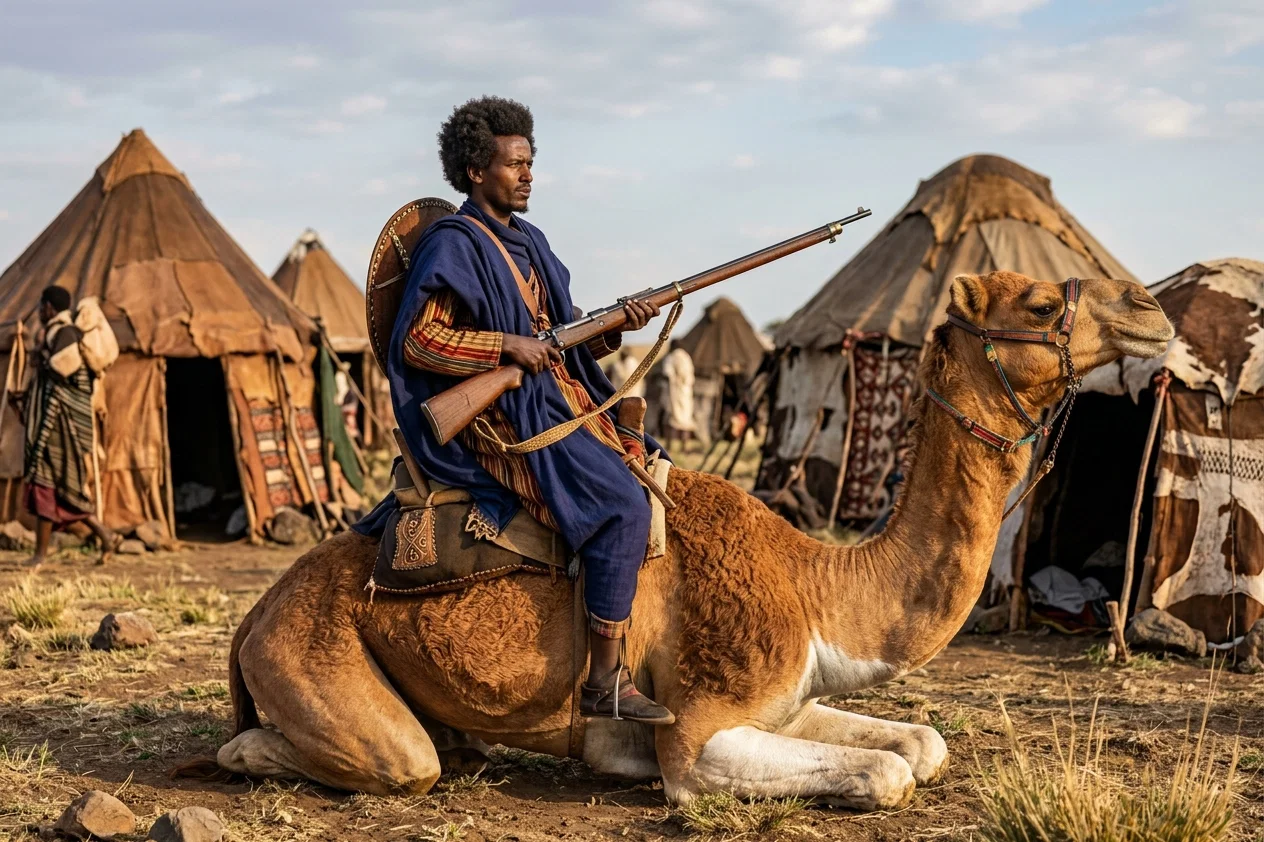
Personally, I made the acquaintance of some Abyssinians en route from Beirut to Jerusalem; they were on a pilgrimage to the holy land, but on account of quarantine, had been carried to Beirut, as there is no quarantine station at Jaffa. They are a tall, slender, well-built people. As to intelligence, they are surely above the negro population.
AN ABYSSINIAN SOLDIER
Their church at Jerusalem is not very far from our medical mission in that city. Their church buildings are round structures, with cupolas on top; and they have services here Friday evening, Sabbath, and Sunday. At the present time they observe the Sabbath, and practise circumcision. They also own a part of the court room in the Church of the Holy Sepulcher at Jerusalem; but their quarters are very poor, if compared with the richly furnished apartments of the Coptic Monastery.
While the Abyssinians were able to withstand the encroachments of the Mohammedans, and even seemed lost to the world for a while, yet they were rediscovered in 1490 by Portuguese naval officers. The Portuguese tried hard to get the country into their hands, and thousands of people were killed. The Jesuits were finally expelled. They made another attempt in 1621, and a third effort in 1750.
Protestant Missions
In 1830 the Church Missionary Society sent out Messrs. Gobat and Kugler to this field; other missionaries followed. The Jesuitical cloud again appeared, and in consequence, all the missionaries were expelled from the country in 1838. But the missionaries remained on the border of Abyssinia, until 1859, when they again returned to the capital; they were imprisoned, and remained in confinement for a number of years — until 1868, when they were freed by the English military force.
In 1868 the Swedish Evangelical National Society began work at Massawa, in what was then Abyssinian territory, but what has since been converted into the Italian Colony of Eritrea. This colony contains about thirty thousand square miles of territory, and about three hundred thousand inhabitants. It lies along the Red Sea shore. The Swedes now have five stations, occupied by eighteen missionaries, and thirteen native helpers. They have a printing house, and schools, and about three hundred communicants.
It is a cheering fact that not only do the Abyssinians have the old version of the fourth century, but the Scriptures are translated and issued by the British and Foreign Bible Society in the languages of the people to-day. The Amheric edition was issued in 1875; in 1899 the Galla Bible left the Basel press; the Society has also reprinted the Ethiopic New Testament. The New Testament is printed in the Tigre, as well as in the Tikrinya language. Not only has the blessed Word been printed in these various tongues and dialects, but it is being circulated.
The following was received by the British and Foreign Bible Society in the summer of 1901:—
“The conquering Lion of the tribe of Juda, Menelek the Second, Emperor of Ethiopia by the will of God.
“Peace and health from God to the Honorable Mr. Alfred Cooper.
“The two copies of the New Testament, which were sent from the Society by the hand of the Englishman, were duly received, and I tender my best thanks for them. If you send a quantity of these books to Adis Abeba by a person, bearer of a letter from you, they will be received with pleasure, and I16will see that they are distributed, and that a good price is paid for them.
“Written at Adis Abeba on the twenty-third day of Tonba, 1893 [1901 A. D.].”
We might remark that besides the Abyssinians, who belong to the state church, are the Zalans, a nomadic people who consider themselves Israelites, but who should be described as Christians. And there are also quite a number of Jews and Mohammedans.
The French also have territory in this region, as they have acquired possessions in Somaliland, with about two hundred thousand inhabitants. There is now in process of construction a railway from Jibuti to Harar. A little farther to the south and east is British Somaliland. On the western side of Abyssinia is the Sudan. As we have already a Coptic ordained minister in Egypt, we could surely do something from that side. Thus we see a great territory is open to us for missionary work all around Abyssinia, among probably two million people. Quite a number of Abyssinians live and conduct business outside of Abyssinia proper.
We are thankful to know that our brethren in Scandinavia have now definitely decided to dedicate their First-day offerings toward opening up the work in this interesting field. During the recent local conferences, about one hundred dollars was contributed as First-day offerings toward the enterprise. The German field has also received about five hundred dollars as gifts for this enterprise, so a small beginning has been made. We have felt that if our Scandinavian brethren in America could see the importance of this work, they might also be glad to contribute liberally toward it. We ought to have at least two or three thousand dollars to begin with, and then a constant income after the mission has been opened. Who will feel it a privilege to help us in this work?