The Youth’s Instructor, Vol. 30, No. 15.

JOHN MILTON

The Youth’s Instructor

Apr 12, 1882

S. D. A. Publishing Association · Battle Creek, Mich. · Apr 12, 1882

JOHN MILTON.
NEARLY three centuries ago, in a comfortable dwelling in one of the suburbs of London, was born that great master of epic poetry, John Milton, so well known as the author of “Paradise Lost.” The din of the great city into which he came was in striking contrast to the quiet reserve of the life which followed.
The parents of Milton were people of some culture. The father, a student of Christ College, was noted for being a firm believer in the Protestant faith, which was then very unpopular in England. For this cause he was disinherited by his family; but although he was now obliged to make his fortune by his own energies, he was still, in the intervals of his business, a busy student, being unwilling, as he said, to give up his liberal and intelligent tastes “to the extent of becoming altogether a slave to the world.” He also wrote verses, and was an excellent musician. His wife was a most exemplary woman, well known through all the neighborhood for her benevolence. Thus we see that in his childhood and youth Milton had every encouragement toward the high and refined tastes for which he was so remarkable, even when a child. He partook largely of the noble spirit of his parents, and through all his life remained an unbending advocate for freedom. His childhood is said to be well described in one of his poems:—
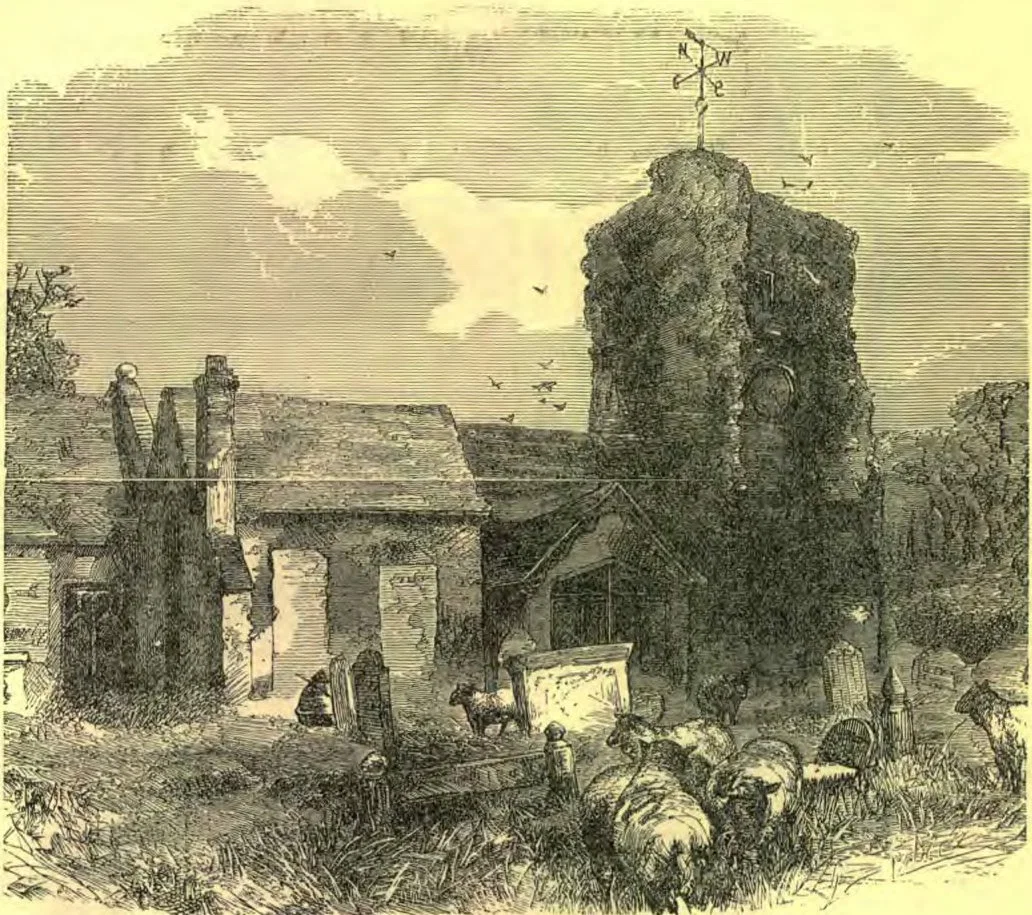
THE OLD CHURCH AT HORTON, ENGLAND.
“When I was yet a child, no childish play To me was pleasing; all my mind was set Serious to learn and know, and thence to do, What might be public good; myself I thought Born to that end,—born to promote all truth, All righteous things.”

His father spared no pains in his education. He was a diligent student, and it is related that before the age of ten he had a very learned teacher, “a Puritan, who cut his hair short;” and at twelve, in spite of weak eyes and severe headaches, he often studied till midnight.
After a time he was sent to Christ College, Cambridge, where he made rapid progress in his studies, especially in the classics. While here, he wrote his celebrated hymn, “The Nativity.”
In 1632 he left school, having taken his degree M. A., and went to the village of Horton, which was now his father’s home. In the accompanying picture may be seen the old church at this place, which is still standing. Here he remained several years, improving his time in study, and in writing several poems, the best known being “Comus.”
In 1638 he left his father’s home, and made a tour through Italy and France, where he was received with considerable honor. He returned home when England was distracted by political strife and religious dissension, and engaged actively in public affairs till the Restoration.
His close application to study and much use of “midnight oil” had severely taxed his eyesight, and near the close of the year 1652, his light went out in utter darkness,—Milton was hopelessly blind. Yet with a fixed resolution and a will undaunted, he continued to study and write till the close of his life.
Says an eminent writer, in speaking of his habits and personal appearance, “He studied till mid- day; then, after an hour’s exercise, he played the organ or the bass violin. Then he resumed his studies till six, and in the evening enjoyed the society of his friends. When any one came to visit him, he was usually found in a room hung with old green hangings, seated in an arm-chair, neatly dressed in black; his complexion was pale; his hair, of a light brown, was parted in the midst and fell in long curls; his eyes, gray and clear, showed no signs of blindness. He had been very beautiful in his youth, and his English cheeks, once delicate as a young girl’s, retained their color almost to the end. His face, we are told, was pleasing; and his straight and manly gait bore witness to his intrepidity and courage. Something great and proud breathes out yet from all his portraits; and certainly few men have done so much honor to their kind.”
It was during this period, when persecuted on account of his bold defense of liberty, and deserted by his friends, his home cheerless on account of domestic troubles, that he could see with his inner sight what his mortal eyes had failed to behold,—those glorious visions of a lost world redeemed by the sacrifice of One Infinite. The outgrowth of these high conceptions was “Paradise Lost,” which is perhaps the most widely known of all Milton’s works. It is related that Milton showed this poem to a friend, who, upon reading it, said, “Thou hast said much of paradise lost; what hast thou to say of paradise found?” whereupon Milton replied nothing, but fell to musing, and as a result, produced a sequel poem, “Paradise Regained.”
His life was simple and majestic, his writings approaching the sublime. He stands out alone in the corrupt age in which he lived, the next greatest poet of his time,—a man seeking after simplicity, purity, and holiness.
His remains lie in the church-yard at St. Giles, where a small monument marks his last resting place.
W. E. L.

AN OLD COUNTRY CHURCH.

I stopped to rest in the grass-grown yard To gather the autumn blooms, And lazily dream on the velvet sward That mantles the sunken tombs. The raspberry briars obscure the words Affection has carved on the stone; With ripening blossoms and bees and birds, Forgotten, they sleep alone.
And all the men who wore this path Or the threshold of yonder door, To hear of a Father's love or wrath, Are found on the earth no more; And spiders lazily spin their threads Secure from intruding feet, While autumn its leaves o'er the pulpit spreads, And the listener's sunken seat.
I close my eyes, and I seem to hear Some sacred old hymn arise, Or the pastor inviting, in accents clear, To “mansions above the skies;” Or I hear the bearers, with reverent tread, Their charge to the chancel bear, And their murmurous sigh for the honored dead Floats out on the autumn air.
Then the call of the robin dispels my dreams; So, rising with bated breath, I mark where the sun through the casement gleams, As life in the midst of death. “He careth for sparrows;” I thank thee, Lord, For a temple not made with hands, And a love that unto the least affords A gift from thy outstretched hands.

SCENES IN THE LIFE OF CHRIST.

LESSON 63.—PARABLE OF THE GOOD SHEPHERD; THE RETURN OF THE SEVENTY.

Jesus now began to talk to the people who were about him, and had heard the conversation between himself and the man to whom he had given sight. He told them that he had come into the world “for judgment,” that they which saw not, might see, and those which saw might be made blind. In other words, he had come to judge, or decide, between the false and the true, the right and the wrong, and thus show the people what they ought to believe. The result of this would be to give light, or sight, to those honest ones who really wanted to do right, but had been deceived, or made blind, by the Pharisees. These wicked men really had a chance to see, or know what was right; for they had the law [that part of the Bible then written] to read, and this privilege was not given the common people. They now had a chance to receive more light, but would not have it. They did not do the duties then known to them, and so did not want Jesus to tell them any more. So they were made blind by the very light that gave sight to those who received it; for in thus hardening their hearts, they lost the power to understand the truth that had already been given them.
Now some of the Pharisees heard these words, and they said unto Jesus, “Are we blind also?” He told them that if they were really blind,—had not had light,—then they would not be guilty of sin; but since they were satisfied with what they had, saying, “We see,” their sin remained; that is, it was unpardoned, because they were so proud and willful that they would not repent of it. He then went on to illustrate the duty of a leader, or guide, of the people by relating a parable about the good shepherd, in which he compares the people of God to a flock. The Pharisees claimed to be the guides, or shepherds, of the people, while at the same time they would not hear the instructions of Christ, the great Shepherd of his sheep, to whom all under-shepherds are responsible. In this parable, by setting forth the character of a true shepherd, he clearly shows that these proud Pharisees have no right to the name, and are entirely unfit for such a place of trust.
And there was a division among the Jews because of these sayings of Jesus. And some of them said, “He hath a devil, and is mad; why hear ye him.” Others said, “These are not the words of him that hath a devil”; and remembering the miracle he had just done, they asked “Can a devil open the eyes of the blind?”
About this time the seventy disciples returned,—those whom Jesus had sent out to preach just before he went to the Feast of Tabernacles. They seemed very much pleased with the success of their tour, and told the Saviour how they had even been able to cast out devils through his name. He then told them that he had given them power over all the power of the enemy, Satan; that they should be able to tread on serpents and scorpions without harm to themselves; and that nothing should by any means hurt them. Yet Jesus would caution his disciples against any feeling of pride over the power given them; and he bade them to rejoice not because the evil spirits were subject unto them, but rather to rejoice because their names were written in heaven.
And Jesus rejoiced in spirit, and thanked his Father in heaven that he had revealed to the poor and humble the truths of his gospel, which had been hid from those wise with the wisdom of this world. Then he spake to the people these precious words of comfort, “Come unto me, all ye that labor and are heavy laden, and I will give you rest. Take my yoke upon you, and learn of me, for I am meek and lowly of heart, and ye shall find rest unto your souls. For my yoke is easy, and my burden is light.”
And he turned to his disciples, and said privately, “Blessed are your eyes, for they see; and your ears, for they hear! For I say unto you that many prophets and righteous men have desired to see those things which ye see, and have not seen them; and to hear those things which ye hear, and have not heard them.”

QUESTIONS.

1. For what did Jesus say he had come into the world? John 9: 39.
2. What did he mean by this?
3. What would thus be shown the people?
4. What would be the result of all this?
5. In what way had the Pharisees had a chance to know what was right?
6. How were they now offered more light?
7. Why did they refuse to accept it?
8. How could they be “made blind” by the truths which gave light to others?
9. What question did some of the Pharisees ask Jesus when they heard him talking about the blindness of those who would not listen to his teaching?
10. What did he answer them? Verse 41.
11. How did they show themselves satisfied with their present condition?
12. Why would their sin remain unpardoned?
13. How did Jesus go on to illustrate the duty of a leader of the people?
14. What did the Pharisees claim to be?
15. How did they show themselves unfit for such a place of trust?
16. What did Jesus set forth in his parable?
17. To whom are all under-shepherds responsible?
18. What caused a division among the Jews? John 10: 19.
19. What did some of the Jews say?
20. How did others of the people feel about it?
21. What question did they ask?
22. Who returned to Jesus about this time? Luke 10: 17.
23. When had these disciples been sent out to preach?
24. How did they feel about the success of their tour?
25. What did they tell the Saviour they had been able to do?
26. What power did he say he had given them?
27. How was this power to be manifested?
28. What did he say to caution his disciples against a feeling of pride over the power thus given them?
29. What did he say should rather be a reason of rejoicing?
30. For what cause did Jesus rejoice in spirit, and thank his Father? Verse 21.
31. From whom had these truths been hidden?
32. What words of comfort did he speak to the people? Matt. 11: 28-30.
33. How were the heavy laden ones to find rest?
34. What kind of spirit will those be likely to have who learn of Christ?
35. How did he tell the disciples that they were especially blessed? Matt. 13: 16.
36. Who did he say had greatly desired to see and hear the things which the disciples now saw and heard?
37. What men can you name from the Bible who expressed such a desire?

HOW TO BEHAVE AT THE TABLE.

“I wish my mother would never have company. A fellow can’t get enough to eat when people are staring at him.”
As I was visiting Frank’s mother at the time, I thought this remark was rather personal. I suppose I blushed. At any rate, Frank at once added, “Now, Aunt Marjorie, I did not mean you when I said that; I meant strangers—like ministers, and gentlemen from out West, and young ladies.”
“Oh!” said I, “I am very glad to be an exception, and to be assured that I do not embarrass you. Really, Frank, it is an unfortunate thing to be so diffident that you cannot take a meal in comfort when guests are at the table. I suppose you do not enjoy going out to dine yourself!”
“No,” he said; “I just hate it.”
Perhaps one reason why boys and girls do not feel so comfortable and so at ease as they might on special occasions at the table, is because they do not take pains to be perfectly polite when there is no one present but the ordinary home-folks. In the first place, we owe it to ourselves always to look very neat and nice at our own tables. Nobody should presume to sit down to a meal without making a proper toilet beforehand. Boys ought to be careful that their hair is brushed, their hands and face clean, their nails free from stain and soil, and their collar and tie in order before they approach the table. A very few moments spent in this preparation will freshen them up, and give them the outward appearance of little gentlemen. I hope girls do not need to be cautioned thus.
Then there are some things which good manners render necessary, but about which every one is not informed. Of course you know that you are not to eat with your knife. Fifty years ago people frequently ate with their knives, and it is quite possible that now and then you may see some old-fashioned person doing so; but it is not customary now, nor is it safe or convenient. When you send your plate for a second helping, or when it is about to be removed, you should leave your knife and fork side by side upon it.
It is not polite to help yourself too generously to butter. When individual salt dishes are not furnished, salt should be placed on the edge of the plate, never on the tablecloth. Do not drink with a spoon in the cup, and never drain the very last drop. Bread should be buttered on the plate and cut a bit at a time, and eaten in that way. Eating should go on quietly, and not hastily. Nothing is more unpleasant than to see one make a noise with the mouth while eating, and swallow food with noticeable gulps.
Do not think about yourself, and fancy that you are the object of attention to your neighbors. Poor Frank’s unhappy state of mind was caused by his thinking too much about himself, as well as by a little uncertainty as to what were precisely the right things to be done.—Harper’s Young People.

APRIL-TIME

Bleak and bare, in the morning gray, Lie the uplands and hills to-day; Over their tops the clouds hang low, Black and heavy with rain and snow.
Here and there, by the sheltering wall, Grow and brighten the grasses small; Here and there on the larch are seen Slender tassels of softest green.
Over the brook the alders swing Tawny blossoms to greet the spring; Thickly gemming their branches low, Yellow catkins the willows show.
Beautiful tokens! all in vain, Down from the black cloud starts the rain; Deep in the earth, beneath our feet, Warm as summer the pulses beat.
You may count their throbbing in streams that leap, With rush and ripple from silent sleep, In the flash of wings through the maples bare, And the bluebird's note on the morning air.

WHO ARE YOUR COUNSELLORS?

Most persons, especially young people, like to ask counsel of some one before beginning any undertaking. It becomes, then, an important question whom they shall ask, and whose opinion they shall follow. Many children and young people seldom consult with any except those of their own age and with as little experience as themselves. Perhaps this is because they only wish to confirm their own opinion, and so have their own way in the matter.
And very often, if counsel is asked of older persons, it is set aside for that of young people. Many follow the example of a certain king who lived many years ago, and acted in the same way. This young man had a very wise father; indeed, some say he was the wisest man that ever lived. After his father's death, all the people came to make this young man king; but before doing so, they wanted to know whether he would be kind and just, or whether he would be unkind and cruel. After the case was laid before him, he asked counsel of the old men who had counselled his father. They told him if he would speak good words to the people and lift their heavy burdens, they would be his servants forever. But this young man, like many in our own day, forsook the counsel of the old men, and advised with those of his own age, who had been brought up with him. They told him to add to the burden of the people, and to make their yoke heavy. This advice followed out, took from him the greater share of his kingdom, and caused him much trouble.
So it always has been and always will be. In any case where we are in doubt as to what course we ought to pursue, it is better to ask the advice of those who by their age and experience are likely to know more of life and its temptations than we. Usually the best counsellors that you can have are your own father and mother. They know you better and are more interested in your welfare than any one else will be, and so are better fitted to give you good advice.
We seldom hear any one regret having followed the advice of parents; but how often do we hear expressions of sorrow and regret for having disregarded their commands and counsel. We may also consult with our Father in heaven. To him we may always go, whether old or young. He has said that if we acknowledge him in our ways, he will guide our path. The best way to direct your course is to take heed thereto according to God's word. VESTA J. OLSEN.

NEW-TESTAMENT HISTORY.

LESSON 77.—THE IMPORTUNATE WOMAN.

Jesus continues the discourse commenced in our last lesson, setting forth the condition of society near his second coming, as follows:—
“And as it was in the days of Noah, so shall it be also in the days of the Son of man. They did eat, they drank, they married wives, they were given in marriage, until the day that Noah entered into the ark, and the flood came, and destroyed them all. Likewise also as it was in the days of Lot; they did eat, they drank, they bought, they sold, they planted, they builded; But the same day that Lot went out of Sodom it rained fire and brimstone from heaven, and destroyed them all. Even thus shall it be in the day when the Son of man is revealed. In that day, he which shall be upon the housetop, and his stuff in the house, let him not come down to take it away; and he that is in the field, let him likewise not return back. Remember Lot’s wife. Whosoever shall seek to save his life shall lose it; and whosoever shall lose his life shall preserve it. I tell you, in that night there shall be two men in one bed; the one shall be taken, and the other shall be left. Two women shall be grinding together; the one shall be taken, and the other left. Two men shall be in the field; the one shall be taken, and the other left. And they answered and said unto him, Where, Lord? And he said unto them, Wheresoever the body is, thither will the eagles be gathered together.”
“And he spake a parable unto them to this end, that men ought always to pray, and not to faint; saying, There was in a city a judge, which feared not God, neither regarded man: and there was a widow in that city; and she came unto him, saying, Avenge me of my adversary. And he would not for a while; but afterward he said within himself, Though I fear not God, nor regard man; yet because this widow troubleth me, I will avenge her, lest by her continual coming she weary me. And the Lord said, Hear what the unjust judge saith. And shall not God avenge his own elect, which cry day and night unto him, though he bear long with them? I tell you that he will avenge them speedily. Nevertheless when the Son of man cometh, shall he find faith on the earth? And he spake this parable unto certain which trusted in themselves that they were righteous, and despised others: Two men went up into the temple to pray; the one a Pharisee, and the other a publican. The Pharisee stood and prayed thus unto himself, God, I thank thee that I am not as other men are, extortioners, unjust, adulterers, or even as this publican. I fast twice in the week, I give tithes of all that I possess. And the publican, standing afar off, would not lift up so much as his eyes unto heaven, but smote upon his breast, saying, God be merciful to me a sinner. I tell you, this man went down to his house justified rather than the other; for every one that exalteth himself shall be abased, and he that humbleth himself shall be exalted.”
“And the Pharisees came to him, and asked him, Is it lawful for a man to put away his wife? tempting him. And he answered and said unto them, What did Moses command you? And they said, Moses suffered to write a bill of divorcement, and to put her away. And Jesus answered and said unto them, For the hardness of your heart he wrote you this precept. But from the beginning of the creation God made them male and female. For this cause shall a man leave his father and his mother, and cleave to his wife; and they twain shall be one flesh. What therefore God hath joined together, let not man put asunder.”
“And they brought young children to him, that he should touch them; and his disciples rebuked those that brought them. But when Jesus saw it, he was much displeased, and said unto them, Suffer the little children to come unto me, and forbid them not; for of such is the kingdom of God. Verily I say unto you, Whosoever shall not receive the kingdom of God as a little child, he shall not enter therein. And he took them up in his arms, put his hands upon them, and blessed them.”

QUESTIONS.

1. By what two figures did Jesus teach that the greater part of the inhabitants of the earth will be wholly absorbed in the affairs of this life when he shall appear in the clouds of heaven? Luke 17: 26-29.
2. How does he show the danger of turning our attention too much upon worldly interests when we are warned to escape the wrath that is to come upon the earth?
3. How does he illustrate the separation that will be made between the righteous and the wicked?
4. What strange question did the astonished disciples ask him? Verse 37.
5. What figurative reply did he give them?
6. To what end did Jesus speak a parable to his disciples? Luke 18: 1.
7. What persons were introduced in the parable?
8. What was the character of the judge?
9. What request did the woman make?
10. How was the request at first received?
11. What did he afterward say within himself?
12. How did the Lord call attention to these words? Verse 6.
13. What question did he then ask?
14. Did he ask this question for the purpose of obtaining an answer?
15. Why, then, did he use this form of expression?
16. How does it appear that but one answer could be consistently given to the question?
17. Why, then, does he proceed to answer it himself?
18. How does he intimate that such faith will be rare upon the earth at the time of his second coming?
19. To whom did he then speak a parable? Verse 9.
20. What characters are here introduced?
21. Repeat the prayer of the Pharisee.
22. How did the publican put up his petition?
23. What did he say?
24. What remarks did our Lord make on this parable? Verse 14.
25. What question did the Pharisees ask concerning divorce? Mark 10: 2.
26. How did Jesus reply to them? Verse 3.
27. What was their answer?
28. What cause did Jesus give for there being such a precept in the law of Moses? Verse 5.
29. What did he say of God’s original design in creating the sexes? Verse 6.
30. How did he set forth the intimate and inseparable relation that should exist between husband and wife?
31. For what did the disciples rebuke the people? Verse 13.
32. How did Jesus regard this action on their part?
33. What admonition did he give them?
34. What did he say about the way in which the kingdom of heaven must be received?
35. What did he then do to the children?

NOTES.

They did eat, they drank, etc.—They were busy in the affairs of this life, as if nothing was about to happen; they carried things which were in themselves proper and right, to such an excess that they absorbed their entire attention, and thus led them away from God.
Wheresoever the body is, there will the eagles, etc.—This our Lord gives in reply to the question just asked by the disciples, “Where, Lord?” or, In what place shall these dreadful evils fall. The answer is a figurative one, the application of which he leaves them to make for themselves. Where the dead carcass is, there will be the birds of prey—where the sin is, there will the punishment be.
It is thought by many that from the 31 verse onward, reference is made to the events connected with the destruction of Jerusalem; which took place some forty years after the crucifixion of Christ. By this answer, then, their minds may have been directed to Jerusalem, as being the seat of the wickedness and bigotry of the Jewish nation, and hence the place where these calamities might be expected to begin.
But while the calamities about to come upon Jerusalem may be referred to, it is evident from the passage and its connection, both in this chapter and in Matt. 24, that the Saviour has also in mind the closing scenes of probation. The mass of the human family, because of the rejection of light and the prevailing corruption and wickedness, become like a putrid carcass. The judgments of God in the seven last plagues, Rev. 16, fall upon them as birds of prey upon the dead body, rending and devouring till utterly destroyed, God’s people having in the meantime been caught away to the Father’s mansions above. John 14: 1-3.
Shall not God avenge his own elect?—A question used in this way is called a figure of interrogation. It is not asked for the purpose of obtaining an answer, but to make a stronger impression of a truth than could be made by a direct statement. It is put under such circumstances as to admit of but one answer, and that answer must declare the truth which the speaker wishes to impress. In this way, the hearer, in answering the question, is compelled to testify to the fact which he is called upon to admit. If this unfeeling judge, who feared not God, nor regarded man, could in any way be induced to administer justice in favor of the widow, certainly God, a being of infinite love, will without unnecessary delay, give help and protection to his own elect, whom he regards with such tender compassion. Nevertheless, to remove all doubt, and perhaps for the purpose of adding another thought, our Lord proceeds to answer the question himself.

Teaching Others Brightens Our Own Light

THE ancients found out, long ago, that the light of a taper was not dimmed by lighting another. Our intellectual and moral light is made more brilliant by the study, labor, and prayers, that we give to fit us for the duty of successful teachers here, and to save the souls of those under our charge. We grow out of self into the likeness of the Son of God, by forgetting self in our work for others.

NOTED FOR CROOKEDNESS.

A large box of sand stood in the yard. It was intended for use in improving the flower-beds, but in the meantime the children were improving their opportunity. They had found it damp enough to mold easily into shape, and they had made ovens, houses and sand-gardens with great satisfaction, until Milly suddenly remembered the picture she had seen the evening before.
“Oh, let’s make that Tower of—of—that pretty tower in Italy that leans ’way over, don’t you know?” she said. It was the “Leaning Tower of Pisa” of which she was thinking.
“We can’t. If we don’t build it straight, it will fall right over,” answered Georgie. He was busy digging a well just then, and did not want to try anything else. But Milly was not so easily discouraged.
“Why, the real one don’t,” she urged.
“Well, that’s because—because— Anyway, people can’t build any more like it,” said Georgie, accounting for the wonder as clearly as have many older persons, and atoning for his uncertainty on that point by his positiveness on the latter one.
“I’m going to build one anyway,” insisted Milly, “and I’m going to make it real high.”
“You can’t have much sand to do it with, then, because I want all this half for a great wall ’round my well,” declared Georgie, marking off a very large portion with his hand.
“It isn’t your sand.”
“I began to build my well first, and you haven’t any right to take sand enough to spoil it.”
That was the beginning. In a minute or two the voices were so quick and loud that one might have thought it was the Tower of Babel they were talking of building instead of the Tower of Pisa. The sound drew grandpa from his book and easy-chair under the great apple-tree, with the words,—
“What is the matter? Two children actually quarreling over a box of sand!”
The small faces under the hat and the sun-bonnet flushed, but Georgie explained, rather indignantly. “Of course we couldn’t do what Milly wanted,” he concluded.
“I guess you might have tried,” said Milly, with her little sandy hands thrust into her apron-pockets.
“What’s the use of trying, when you can’t do it? Nobody can build anything like that leaning tower now; can they, grandpa?”
“I’m afraid,” said grandpa, shaking his head, “that there is a great deal of that kind of building. There must have been some defect in the foundation of that great tower at Pisa, and though it was probably unthought of or unknown at first, it is the one thing about it now that shows most plainly to all the world. Costly material, beautiful pillars, fine designs went into that building, but it is not for those that it is noted. Everybody knows it by that fault in the foundation; it is the Leaning Tower of Pisa. And there are people in the world whose characters are built in very much the same way, Georgie. They may have many good qualities, but some fault in the foundation has warped and twisted the whole until they are more widely known by their crookedness than by anything else—their meanness or selfishness or ill-temper, or something of that sort. Be careful while you are building in the sand, that you are not building crookedly somewhere else, children.”
Georgie slowly filled up his well as grandpa turned away, and Milly, after watching him a moment, patted the beginning of her tower flat again.
“Georgie,” she said, “let’s put it all together again, and build a great big orphan ’sylum to make good children of folks.”—Kate W. Hamilton, in S. S. Visitor.

SONG OF SPRING.

Invisible hands from summer lands Have plucked the icicles one by one; And shy little lifters, away from the sun, Laid hold on the roots of the grass in the sands; And oh, and oh, Where is the snow? For the crow is calling, And showers are falling.
Ho, willow and weed! Each secret seed Is up, and out of its garments gray; The music of waters is heard in the mead, And limping old winter is whither away? And oh, and oh, Where is the snow? For the bird is singing, And flowers upspringing. — Wide Awake.
Continue reading: FANNY'S CUCKOO CLOCK