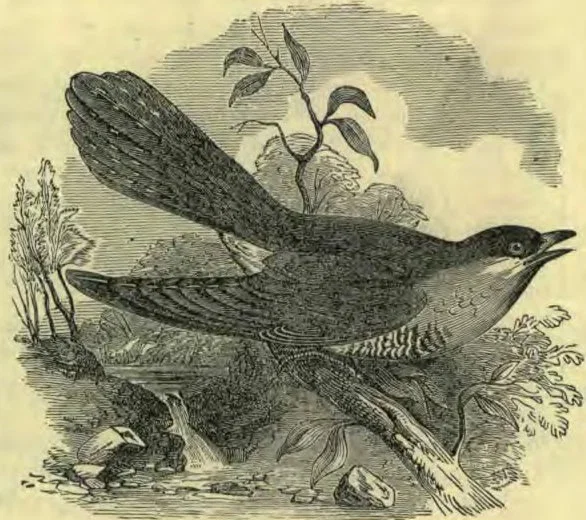
Fanny May was six years old. On her birthday she opened her eyes very early in the morning; and what do you think she saw? Right opposite her bed was the prettiest clock she ever saw,—a real English cuckoo clock! The cuckoo, you know, is an English bird. It doesn’t sing, but it says “Cuckoo, cuckoo,” just as plain as you can say it.
Fanny’s clock is called a “cuckoo” clock because, when it strikes the hours, it says “Cuckoo!” At one o’clock it calls “Cuckoo” once, at two o’clock twice, and so on. At twelve o’clock a little door on the top of the clock flies open, and out pops the cuckoo himself. He bows his head politely, and “cuckooes” twelve times. Every time he says “Cuckoo,” he opens his mouth and flaps his wings. Then he hops back into his little parlor, and shuts the door behind him.
This was a real pretty birthday present that Fanny’s father gave her. It was a useful one, too. Fanny was a very wide-awake little girl when she was awake. But sometimes it was dreadful hard work to get her eyes open in the morning. They would shut down again so quick, she said. But she made up her mind, as this was her sixth birthday, that when her little clock “cuckooed” six times, she would get right up, whether her eyes were open or shut. When little girls, or boys either, make up their minds to do anything, and are in real earnest, they are pretty sure to succeed. After two or three mornings, Fanny found it easy enough. She said her eyes “opened of themselves” when her little cuckoo called her at six o’clock. And so her cuckoo clock made Fanny an early riser.
—Our Little Ones.
The Heart and the Issues of Life
If you take care that the heart is right, it will take care of the life; for out of the heart are the issues of life.
THE SWALLOW.
By Charlotte Smith
THE welcome guest of sunny spring,
The swallow, too, has come at last;
Just at sunset, when thrushes sing,
I saw her dash with rapid wing,
And hailed her as she pass'd.
Come, blithesome visitant, attach
To my reed roof your nest of clay,
And let my ear your music catch,
Low twittering underneath the thatch,
At the gray dawn of day. —Charlotte Smith.
A QUEER MAN.
By Charles T. Jerome
Many hundreds of years ago there lived a very strange man whose name was Diogenes. His home was in the city of Athens, in Greece. The people of Athens were very polite; but this strange man took pleasure in being very impolite. He made himself very disagreeable.
People stared at him and laughed at him. This was just what pleased Diogenes. Many people called him a great man. This pleased him more yet. He was so odd, and behaved so strangely, that after awhile a good many tried to imitate him and to act as strangely as he did. This pleased him, perhaps, most of all.
Sometimes Diogenes slept in the sand, and sometimes on the verandas of houses or in doorways. Sometimes he used to take a tub around with him. When night came, he would curl himself up like a kitten, and go to sleep in the tub.
One bright, sunny day, when the city was full of people, he took a lighted lantern, and walked down the street. He looked as if he were hunting for something. “What are you looking for, with your lantern, in this bright daylight?” the people asked. “I am looking for an honest man,” growled Diogenes.
At this time there lived a great warrior and emperor who had made himself more famous than any one else in the world. Great crowds followed him, and threw up their hats, and cheered. His name was Alexander. Perhaps he was really the greatest man in the world. So he was called Alexander the Great.
One day Alexander marched by where Diogenes sat sunning himself in the sand. The people were cheering as usual, and making a great noise. But Diogenes sat quite still, caring nothing about the emperor. When Alexander passed before Diogenes, he noticed this. He wondered why this poorly clothed man paid him no attention.
Then he turned to Diogenes with a frown, and said in a very haughty manner, “Do you know that I am Alexander?”
Everybody thought Diogenes would turn pale, and be very much confused. But he only looked up, and answered with as much pride as if he were an emperor himself, “Do you know that I am Diogenes?”
Perhaps we may all admire his independence as much as Alexander is said to have done. Diogenes always lived this queer sort of a life. He was an old, old man when he died.—Charles T. Jerome.