Your ShelfYour Projects

Review and Herald, Vol. 87, No. 39.

Be Glad
Earlier text: AT THE GREAT CAMP

Mission Homes in China

H. W. MILLER, M. D.
AMERICANS and Europeans, and especially missionaries, residing in the interior of China, have come to look upon the hot, tropical summer with dread, doubtless due to the intensity of heat, coupled with the insanitary conditions surrounding them, over which they have no control. The older missions have come to see the great importance of endeavoring to avoid the serious ills resulting from residence in native houses, which has so often necessitated returning to the home land efficient and valued laborers. We have, doubtless, carried forward our work with the fewest facilities of any mission in China, and have the most to show for it. But it is now recognized that our past methods of working and living, which have no doubt been the best possible considering our circumstances, will not prove wise policy for the future.
We have lived in mud-walled houses with thatched roofs, which usually contain hibernating vermin, representing several species, such as scorpions, centipeds, lizards, etc. The fear of vermin and harmful insects, and the intense heat in closed walls, cause us to look forward to the summer months with no little anxiety. Through all the inland provinces of China, the only houses to be rented are the native houses, and not the best class of these can be rented by foreigners. The men of wealth who own the best houses fear they will lose their dignity should they rent to a foreigner. Only a few houses are procurable, and quite often these are made undesirable for renting by the natives, because of some superstition that is attached to them.
In planting mission stations it has been necessary to rent native houses, and make them as habitable as possible, by repairs and alterations. It usually takes from one to two weeks to find a house. During this time we have to stop in a Chinese inn, where for a bed we have a rice-straw mat spread on the floor, and a narrow bench for a chair. If there is any other furniture, it is a small table, on which stands a tiny vial of native oil, with a little wick hanging over one edge, to give a dim light. Often one is required to occupy the same room with animals. When at length a house is found, there is seemingly an endless round of negotiations to go through, and a number of interested persons to be seen. After the negotiations are completed and put in written form, a feast must be arranged for, to which all the interested parties are invited. After this is over, the owner of the property passes you the deed of rental, and you pass him the money. The arrangements are thus completed.
The next step is to look over the débris of tile and sun-dried brick, with the view of altering and repairing it for use as a home and mission station. In a very short time come rumors that the house, owing to its being haunted, has stood empty for the last two years, because there were two deaths in the family who last lived there. This one can readily believe, owing to the insanitary state of things, and wonder that the rest survived. Glad as we are to secure even such a foothold, we are not discouraged at these rumors, and at once set about to arrange the mission station, uninviting as it is.
In one instance, the only respectable building of the whole compound was the one facing the street, which had been used for a store. This we chose as our street chapel. Back of this were two rows of thatched-roofed buildings built of sun-dried brick, facing each other, and separated by a narrow court. All the windows and doors, such as they were, faced this court, the outside walls being solid, admitting no light nor air. As there is no circulation of air in the enclosed court unless there is a very strong wind, it is impossible to get any air through the stuffy, low houses, with windows only on one side, facing the court. As the thatched roofs leaked, the dirt walls in places were crumbled down, and small puddles of water had accumulated on the floor. Several of the rooms were black with soot, because the house had no chimney, and the courts were filled with accumulations of water, due to lack of drains.
With this view before us, we were forcefully reminded of a few important principles of sanitation; namely, that a free circulation of air is required; that all insects, or most of them, may be carriers of disease; that the bite or sting of vermin is very poisonous; that in such a humid climate it is unhygienic to sleep on the ground floors; that stagnant pools of water breed malaria, and mosquitoes in countless numbers, and therefore drains are a necessity; that the free admission of light is requisite to disinfect the rooms and protect them from mold and mildew; that verandas are necessary in hot climates to prevent the heating of the walls; that garbage and all other wastes must be properly disposed of in hot climates. So we set about fixing up the dilapidated compound according to our knowledge of sanitation, a host of masons and carpenters being employed.
After two or three hundred dollars have been put into these undesirable quarters, and enough time and energy spent to build a new house, and we have done our best at sanitation, we have nothing very desirable. Shut in from the air on all sides, with windows and doors on only one side, the rooms are still damp. The base-boards at times are covered with fleas, and not infrequently scorpions and centipeds make their appearance. The little air that might find its way down into the court is interfered with by the nets and screens used to protect the sleeping-rooms from mosquitoes and other dangerous insects. It is only natural that one should occasionally feel that he would like to go for a little stroll into the country outside of the walled city, but as soon as he makes his appearance upon the street, he is surrounded by a multitude of both old and young. The result is that the stroll is taken as a duty rather than a pleasure, and so is not indulged in very often. Thus missionaries in these lands take altogether too little exercise.
I have briefly stated a few of the conditions as we find them to-day existing at all our inland stations. We have only rented Chinese houses, which have been repaired as stated above, and there are many conditions that could be remedied were we able to procure land and erect suitable buildings for mission use and for residence of the foreign workers. It is no wonder that those conversant with conditions in these fields should call for funds from the $300,000 Fund for the construction of mission premises and houses in these great heathen countries. Our brethren at home can now perhaps better appreciate the reason we at times seek refuge in a mountain home, to avoid the heat of the summer days.
For the first few years we were compelled to remain during the summer months at our rented stations, and many are yet obliged to stay at their posts during these months, to promote the interests of the work. But it has been a heavy tax on the health and strength of the laborers to do so. Of these it can truly be said, “They loved not their lives unto the death.”
We are greatly encouraged in the belief that relief is soon to come, through the enthusiasm being aroused at home in the raising of the $300,000 Fund, by which homes will be provided, thereby insuring some degree of sanitation and hygienic surroundings, safeguarding the health and life of those laboring in the hot, sultry tropical lands.
Mokanshan.

To All People

THE world’s best-selling book is the Bible. The total sales of the works of all the most popular authors of the day would not equal the yearly sale of the Holy Scriptures. Each year there are printed seventeen million Protestant Bibles, Testaments, and “portions,”—such as the Psalms or the separate Gospels,—in more than five hundred languages and dialects.
Of these Bibles, ten millions are published by Bible societies, are sold far below cost, and return no financial profit to anybody. The remaining seven millions are printed commercially, and yield a profit to the publishers. Of the ten million Bibles and parts of Bibles printed and distributed by charity, almost two millions are issued by the American Bible Society, and over seven millions more by similar organizations in Great Britain and Ireland.
These millions of Bibles and Testaments, sold at a nominal price so that charity is called on to supply the funds for printing them, go to every part of the world. They are issued in every language. They are sold among followers of every faith, and of no faith.
Western civilization has frequently been represented as advancing upon the heathen with the Bible in one hand and a sword in the other. As a matter of fact, the Bible has quite as often gone on ahead, far in advance of Western civilization. In the mystic recesses of China, in the mountains of the Philippines, in the wilds of Africa, the missionary comes to find that the Bible has preceded him.
In this work of pushing out the frontiers of Christendom by means of the printed Word, the actual workmen are almost always natives, who have been first converted to Christianity. They are Biblical book-agents, with a mission. Often they are heroes. And the stories of their work, of their labors and hardships and humiliations, make the annual reports of the Bible societies read like a romance. They are Siamese, Chinese, Japanese, Arabs, Armenians, Turks, Slavs, Mexicans, natives of Cuba, of the Philippines, of Peru, of the islands of the sea. They are also Americans, working among the immigrants, in city slums, at the mines.
They are called always by the same name,—colporteurs. And the story of colportage is a story of faith, devotion, and tireless labor.—Walter Prichard Eaton.

The German Advent Message

Editorial

“For who hath despised the day of small things?” Zech. 4:10. Not those, certainly, who have understandingly observed and studied the development of the cause of God.
Now we are thankful for the part that the German tongue is acting in the spread of the advent message. Next to the English, it is the tongue most widely diffused commercially over the world, and in it is now printed also, next to the English, the largest volume of our literature. It was amid many difficulties, however, that the beginning was made.
IN the REVIEW of April 24, 1856, Jesse Dorcas, of Ohio, called for a German tract on the Sabbath; and in an editorial note Elder U. Smith quoted the words of Rev. 10:11, “Thou must prophesy again before many peoples, and nations, and tongues,” adding, “Is it not high time we were about this work?” In the paper of May 8, Elder R. F. Cottrell, of western New York, reported some Germans in his vicinity, and said:—
O that some German who understands English and is capable of teaching, would embrace the truth and teach it to others!
THE next month it was announced that the General Conference had appointed a committee to arrange for the preparation of a pamphlet to be translated into German, and later into Norwegian, as the way opened. In November a last-page call was made, “German Tract-Translator Wanted.” The tract was J. H. Waggoner’s “Nature and Obligation of the Fourth Commandment.” Long they waited for the translator; then, eleven months later, it was announced that the editor of a Jewish paper in Cincinnati had been secured to translate and make plates. Money was called for to meet the cost, as there was “nothing in the treasury.” “Remember the German people,” Elder James White wrote, “and help us send the truth to them.”
FINALLY, Jan. 28, 1858, the first German pamphlet was ready for circulation. But, on May 6, came the cruel word that it had been discovered that the translation was so unsatisfactory that the pamphlet was “not fit to circulate.” Brother J. Clarke, of Ohio, assisted by two Germans, had made corrections, however; the Review Office had ordered its own German type; and it was announced:—
Brother Amadon has set the type for two of our works in French, and he can learn, with a few lessons and a little study, to set German type. . . . Our misfortune in the German translation should not discourage any, but should stir all friends of truth to lend a helping hand as we now start upon a plan to publish present truth in other languages.
And it was stated, “In the ranks of Sabbath-keepers are those who speak German, French, Norwegian, Swedish, and Dutch.”
A CONFERENCE held just at this time, May 21, 1858, appointed J. White, U. Smith, and C. Smith a committee to look after “the publication of works in other languages.” And in the REVIEW of June 16, 1859, at last appeared the cheering announcement, “The German tract is now ready.” Truly, great changes have come in our German publishing work since that day of small things. That first seedling has grown into a great tree.

The Message in Greater New York

The Sabbath day of special prayer and fasting in behalf of the work in the cities will surely be answered by a stronger flow of means and workers into the centers of population, and by an added power in the work of witnessing.
In many a city center, we may be sure, the hearts of the believers gathered courage at the thought that throughout the churches special prayer was being offered for the work in the great cities.
So it was, at any rate, that Sabbath in Jersey City, where the four churches—two English, and the German and Swedish—gathered in union meeting, to dedicate themselves anew to service. While calls are being made to the churches and conferences Westward to throw heavier resources of men and means into the populous Eastern centers, the believers in the East are not quietly waiting. They are determined to meet the call of the hour by greater activity and devotion than ever before. Brethren W. G. Kneeland, J. G. Hanhardt, and A. O. Lund had good reports of the English, German, and Swedish work, though having few facilities with which to lead the campaign. As the work for Greater New York is strengthened, Jersey City must share in the benefits; for it is really only one division of the great metropolis.
The Lord was in the midst of the company gathered in the one small tent operating in Jersey City. Some were just beginning to keep the Sabbath, and old and new believers, and others making a new surrender, gave themselves with one heart to seek God. Apparently every soul under the tent received the special blessing of the Lord that Sabbath.
I report it here, as it is a token to the believers in the stronger conferences from which help must come, that, as the help flows Eastward, the believers already raised up in these populous centers will stand loyally at their post to co-operate. They believe thoroughly that a great work is to be done, in a short time and by simple means, through the power of God.
Next day in New York City I saw and felt the same spirit among workers and people. With Brethren R. D. Quinn and O. O. Bernstein, I attended Sunday afternoon meeting in Elder J. K. Humphrey’s tent, pitched in the heart of a fine district, where thousands of colored people reside. In the morning Elder Humphrey had baptized twenty-six more believers, and it was good to hear the joyous testimonies of the new converts and the old in the afternoon meeting. Altogether over fifty have been baptized from these services, and still the interest is keen, and the believers are praying and working in expectation of many more coming fully out on the side of truth. Elder Humphrey knows that the special power of God has worked to bring the people out, and send conviction to their hearts as he has gone forward, presenting night after night the plain, straightforward themes of the third angel’s message. It is only another evidence that the set time and the new time has come, when every unworked and populous field must hear the message.
In the evening I met with the brethren in the large hall on Washington Heights, in which was opened the first Sunday evening meeting since the taking down of the big tent where Elder Bernstein has held his meetings. There was a splendid congregation in the hall, and the Spirit of the Lord was present. At the close of the meeting, Brother Lewis Klebahn, elder of church No. 1, presented to the congregation the financial side of the plan for the winter campaign, and three hundred dollars was at once pledged to cover three months’ rent of the new meeting-place.
About a hundred have already been baptized this season in Greater New York; a goodly number of others are keeping the Sabbath; and all the old believers are encouraged and revived to take hold of the work as never before. There are a thousand Seventh-day Adventists in Greater New York, witnessing to the truth; and somehow, the brethren know, the force of workers will be increased, and the message be given.
Over in Brooklyn the foreign department has secured quarters in which to open a city mission training-school the moment means can be provided. It quickens the pulse to see the stir and animation and expectancy among the brethren in this largest American city, the second city in the world. They believe in the plan which the General Conference Committee has been urging, and which has brought special blessing to the field in the last year. And New York does not ask for any undue share. All the populous Eastern belt, where the greater body of the people are, and where our work has the fewest representatives, must share in the movement. Japan won in its conflict with Russia, military authorities say, not because it had the most men, but because it had the most men in the right place. Let us seek God to know how to distribute the forces to fit the calls of greatest need, and so to finish the work.
W. A. S.
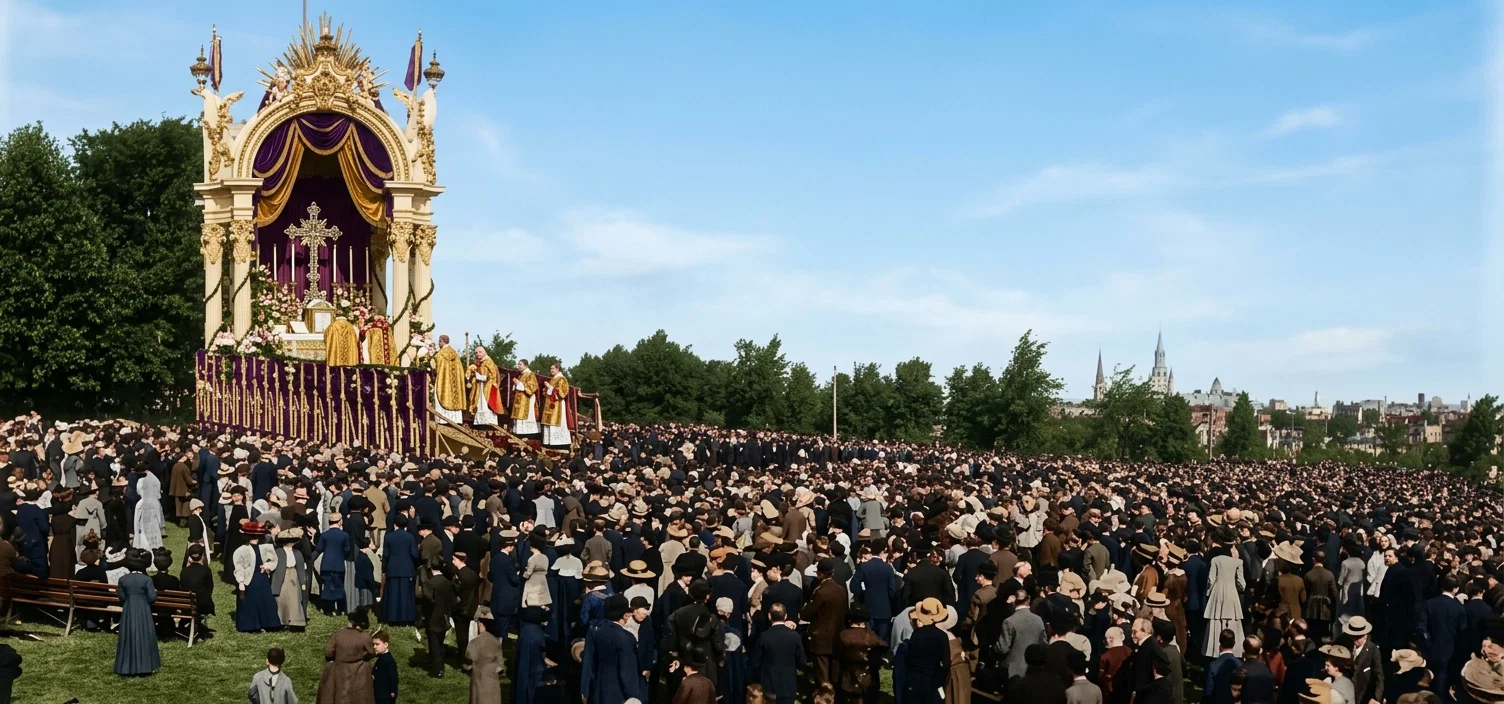
A CATHOLIC AUDIENCE ATTENDING OPEN-AIR MASS IN FLETCHER'S FIELD, MONTREAL, ON SABBATH

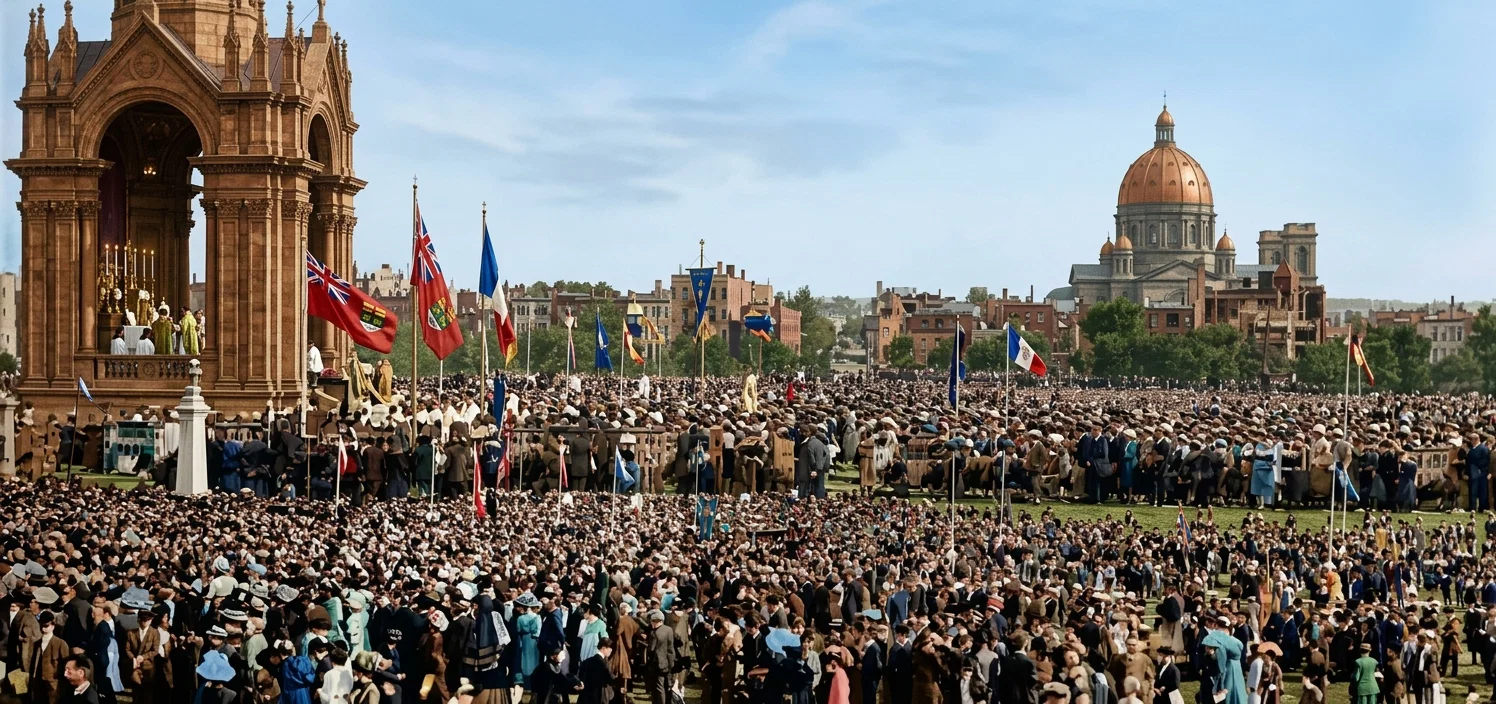
The Roman Catholic International Eucharistic Congress

ONE of the most imposing spectacles that was ever witnessed in North America—or perhaps in the world—was the great procession of the eucharist in Montreal, Canada, on Sunday, September 11. Nothing that money could procure to make it spectacular was omitted, and nothing that the spectacular could do to impress the world with the power and glory of the church was left undone. The idea of the leaders was that Jesus Christ, in this eucharistic celebration, was the guest of Montreal, and of course nothing was too good for his entertainment.
A SMALL PORTION OF THE GREAT CROWD WHICH WITNESSED THE EUCHARISTIC PROCESSION ON SUNDAY AFTERNOON. THE AVENUE OF FLAGS AT THE RIGHT TO THE REPOSITORY, THEN DOWN THE AVENUE
Preparations for this event had been going on for months; and when the day arrived for the opening of the congress, the city was in gala-day attire from steeple to basement window. The ecclesiastical and the civil were united in this in Montreal; for with the overwhelming Catholic majority in that city, Rome has her way in the administration of the municipal government. There is only one professed Protestant on the board of aldermen of the city, and it is hardly necessary, perhaps, to state that Rome had what she wanted.
SEPTEMBER 10. MASS IS BEING CELEBRATED IN THE REPOSITORY AT THE LEFT OF THE PICTURE
The Canadian premier, the premier of Quebec, the mayor of Montreal, and the city council of Montreal were as one man in the determination to permit nothing to stand in the way of making the twenty-first International Eucharistic Congress of the Catholic Church the greatest event, if possible, in the history of that church in the western hemisphere. There is no question of their success in this matter; for in pomp and pageantry, in sacerdotal ceremony and state assistance, in length of procession and loyalty of kneeling worshipers, in repudiation of the Reformation, and in public claims to everything tangible and intangible on earth and in heaven,—the twenty-first International Eucharistic Congress of the Catholic Church stands without a peer.
THE ARCHED STRUCTURE AT THE RIGHT OF THE CENTER IS THE REPOSITORY OF THE “HOST.” THE PROCESSION PASSED UP ON THE LEFT TO THE “HOTEL DIEU” NUNNERY, WHERE THE “HOST” WAS DEPOSITED
Canada by profession is a state without a church; but the province of Quebec on this occasion demonstrated to the world that there is a church which has its way in that state, as verily as a church ever had its way in the truest days of church and state union. From highest official to lowliest subject, all stood ready to do the bidding of the Catholic hierarchy.
When preparations for the congress were actively begun in Montreal, it was proposed to devote fifty thousand dollars of the public money to the purposes of the congress. There was a strong protest against this by the Protestant portion of the population, and the project was finally abandoned, outwardly. There is a strong belief, however, on the part of many, that in some way the project was accomplished, and that the money of the general public was used in contributing to the success of the Eucharistic Congress.
In open council this much was done: money to the amount of ten thousand dollars was voted at one council meeting from the funds of the city, raised by general taxation, for the entertainment of the eucharistic delegates. At another meeting, two thousand dollars more was voted for the same purpose. This being used for the entertainment of the city's guests, there was not so much protest against the appropriation as against the use of the fifty thousand dollars for arches, decorations, etc.
To provide the finances of the congress, the city was districted, and collectors were placed over each district, who were to see to it that a certain specific sum of money should be raised in each district. The public contribution list was headed by a professed Protestant with a contribution of five thousand dollars. There were no questions asked as to “tainted money.” Every one who would give was given the opportunity to do so. Estimates by the public press of Montreal place the cost of the congress at between one and two million dollars, and this evidently does not include the cost of repairing and paving the streets along which the procession was to march. This street work along the route of the procession was one of the marked examples of the city's willingness to tax itself to add to the splendor and success of the congress; for streets which bear little of the burden of the city's traffic were paved for the marchers of the eucharistic procession, whereas other streets, on which the procession did not pass, but which were sadly in need of repairs, that the city's daily traffic might be accommodated, were left untouched.
Mgr. Archbishop Paul Bruchesi, under whose directions all the arrangements for the congress were made, in speaking of the assistance received from Protestant sources, said:—
The encouraging messages and liberal donations from friends and well-wishers, near and far, from the American hierarchy in particular, and even from non-Catholics, have impressed us more than words can convey. The press, both English and French, has been most friendly, and will continue so, I trust, to the end.
He was particularly well pleased, he stated, with the expressions of sympathy and encouragement which he had received at the hands of the non-Catholic population of the city, and was glad to say that the leading Protestants of the city had been most generous in the assistance which they had given.
It is certain that the type of Protestantism which contributed to the success of this glorification of a Roman Catholic dogma was not the type which was dominant in the days of the Reformation. The eucharist is declared by Roman Catholics to be the heart and soul of their religion. It stands for the transmutation of a piece of bread into the very body of Jesus Christ, when the priest has said over it the words, “Hoc est corpus meum” (“This is my body”); and then for the worship of that piece of bread when exposed or elevated for the adoration of the faithful. Every Protestant who contributed of his means for the success of the Eucharistic Congress, helped to fasten that idolatrous worship and belief upon the people.
It was not merely the city of Montreal, nor the province of Quebec alone, that paid such handsome homage to the Catholic “Host” and the ecclesiastical dignitaries who were to bear it. The federal government of Canada was also represented, and through its officials paid homage to the pontifical delegate, and to the papal dogma he had come to glorify.
There was a magnificent demonstration at the city of Quebec when the papal legate, Vincenzo Cardinal Vannutelli, reached that place on his way to Montreal, also at Three Rivers, one of the oldest Catholic stations on the St. Lawrence. It was not left for the cardinal legate of the pope to come to Montreal as ordinary individuals come; he must come with all the pomp and ceremony and acclaim that could be offered one of earth's greatest rulers. To carry out this purpose, the Canadian government steamer, “Lady Grey,” was despatched to Quebec to meet the papal legate, and bring him up the river to Montreal, a distance of about one hundred fifty miles; and during the latter part of the trip this boat was accompanied by many other vessels. Nothing but the furious storm raging at the time prevented a fleet of sixty-one yachts from joining the cardinal's river procession.
A special wharf, seventy-five by one hundred feet, had been constructed for the cardinal to land upon, and a gorgeous throne was built at the wharf, upon which he was to sit while hearing the mayor's address of welcome, and from which he was to read his reply. Prayers had been offered that it might be a propitious day when “His Eminence” should arrive. The mayor in his official robes was at the wharf at the appointed time, the throne and the wharf were ready; but instead of the fair weather prayed for, the worst storm of the season was raging. The open-air reception planned for, and the use of the specially constructed wharf and the gorgeous and expensive throne, were abandoned. The government steamer, with the papal legate on board, and the papal flag flying, docked at the regular wharf on the afternoon of September 3, amid the screaming of steam whistles and the flapping of rain-soaked bunting. Every vessel in the harbor was flying its full quota of flags, and on shore the same display was manifest.
Because of the evident impossibility of carrying out the open-air program, the papal legate was ushered into the mayor's carriage, and quickly whisked away to the city hall, where the ceremonies of the reception took place. The “one thousand gentlemen,” consisting of cabinet ministers, consuls, senators, members of Parliament, ecclesiastical dignitaries, and prominent citizens, who waited at the wharf in the wet to add dignity and honor to the welcome of the pope's representative, hurried to the city hall through mud and rain.
At the city hall, on an improvised throne, the papal legate was seated, with the mayor on his right, Archbishop Paul Bruchesi on his left, and the highest dignitaries of the church, the monsignori, grouped around.
The mayor's address of welcome, prepared beforehand, and anticipating a day of sunshine for the reception, opened thus:—
YOUR EXCELLENCY: In the lives of men there are certain days when the sun arises with more wondrous glory, shines with more vivifying ardor, and touches all things beneath its rays with beauty and benediction. Such is this day, when to our shores you come invested with sacred rights, representing our Holy Father Pius X, to open the first great Eucharistic Congress in America. With joy we hail you! Welcome! Ten thousand times welcome! And while I who am signally honored, speak these words, they are wafted from lip to lip throughout our beloved Canadian land, through all the vast expanse of this great continent, where a Catholic heart beats, or a Catholic knee bends before the Adorable Sacrament of our altars.
He referred to Montreal as the Rome of the New World, illumined by the light of the infallible church, and closed his address by applying to the papal legate the words which the Bible applies to our Lord: “Hosanna in the highest!” “Blessed is he that cometh in the name of the Lord!”
The formal opening of the congress did not take place until the evening of the sixth. It is impossible to deal with this, or with the incidents and utterances following it, in this article. Suffice it here to say that no more royal welcome could have been given the king of the realm than was accorded the papal legate by both ecclesiastics and civil officials. Wherever he appeared in public, he was seated upon a throne, with cardinals and archbishops in gorgeous robes on either hand, and bishops by the score grouped around. No matter in what company he appeared, no second place was ever his; and as representing the church, he might reasonably have been led to think, in the words of Scripture, as he viewed the display and the veneration, “I sit a queen, and am no widow, and shall see no sorrow.” But the one who is familiar with the history of this organization, its character, and its tendencies, and knows the meaning of the infallible prophecy concerning the Papacy, must tremble for her when the times comes for Heaven to lay its hand on her high pretensions.
The notable utterances and events of the congress will be considered in another article.
C. M. S.

Jehovah, the Only Saviour

Says Jehovah: “I, even I, am the Lord; and beside me there is no Saviour”.

Christ in the Home

The need of the world is for a living, practical Christianity. There is much excellent preaching, there are many beautifully written articles, and the graces and blessings of the gospel are set forth in pleasing phrase and figure. All this is well, and fills a necessary place in the promulgation of Christian principles; yet it can not fill the place of the practical exemplification of Christ in the every-day life. The apostle Paul speaks of those who are living epistles, “known and read of all men.” It is this class of Christians, and this phase of Christianity, which accomplish the most for God.
The first manifestation of Christian living should be in the home, but here is where many fail. They feel that their mission is to the church or to the world. It is safe, however, to say that God will extend to no man or woman the call to general ministry who can not exemplify the divine character, in the more humble circles of every-day life. The one who has become a minister of light and Christian living to those within his own family circle, may expect to be called of God to a broader sphere, and to see the circle of his influence extend and widen.
How necessary it is that those who profess faith in the closing gospel message should show in their lives the fruit of this home Christianity! Connected with this movement are those whose companions or children are not members of the household of faith. What evidence are these believers giving to their unconverted wives, husbands, or children of the power of the gospel? If the truth they profess does not keep them from uttering fretful and impatient words, or manifesting a spirit of uncharitableness and criticism, with what courage can they recommend the truth to those who know it not? The unbeliever judges of the truth by the fruit it bears in the lives of those who profess it. What conviction does your life carry in your home? Have you been praying for long years for the conversion of a wayward son, an unbelieving husband? Has the influence of your life united with the operations of the Spirit of God in opening their hearts, and drawing them to the Lord? These are practical questions, to be earnestly considered in this connection.
If you have failed in any particular, then confess the failure to God, and to those in your family concerned, and resolve that from this time forth your life shall show forth the conviction and power of the blessed gospel. From your life forever banish strife, wrangling, and irritation. Exercise the spirit of meekness and sweetness in all your associations with your loved ones. God will give you strength to do this. Cast yourself at his feet, reaching out for divine aid. He will not deny your earnest petition, but will give you power to live for him. The record says, “As many as received him, to them gave he power to become the sons of God.” John 1:12. That poor, fainting heart, is for you. Poor, discouraged brother or sister, burdened by mistakes and failures of the past, buffeted by the enemy of your soul, take hold of the strong hand of the mighty One, that is reached down to succor you. Surrender to him. Throw upon him your burden of anxiety. Ask him to guide in all your affairs, and then pray that he will rule and reign in all of life's experiences. He is interested in your every plan, and longs to give you help.
Having made this surrender every morning, go forth with the consciousness of his presence in your life, humbly and patiently submitting to every circumstance, trusting him to guide in it all, and to bring everything out just right in the end. This experience, in a life of consecration and trust and victory, is for every praying soul. And this is made possible by the grace which Christ will bestow. Victory may take the place of defeat, and songs of praise succeed the tears of regret. Through Christ we may be victorious.
F. M. W.
Continue reading: The Age of the Earth