The Youth’s Instructor, Vol. 48, No. 47.

NATURE REVEALS THE LOVE OF GOD

The Youth’s Instructor

Nov 29, 1900

Review and Herald Publishing Company · Battle Creek, Mich. · Nov 29, 1900

NATURE REVEALS THE LOVE OF GOD
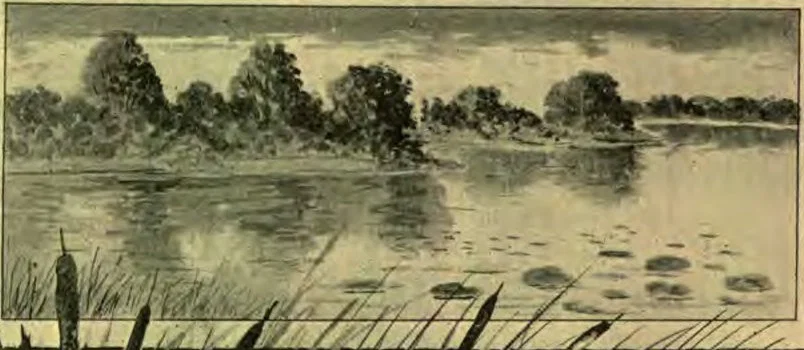
No harmonious soul can come in contact with nature, and not feel an influence that helps and elevates. In her own peculiar way she speaks to the heart of man. The secret of her power is not difficult to learn: nature reveals her God.
In the old heathen times, men thought the universe peopled with innumerable gods. There were gods of the sea and gods of the land, gods of the plain and gods of the groves, gods of sum-
mer and gods of winter, gods presiding over every function and aspect of nature,—countless gods, each ruling over some part of the world, and exercising power for good or ill.
Those days are now in the past, thanks to the triumph of the truth that there is only one true God. We no longer think of Neptune ruling over the seas, or of Jupiter hurling thunderbolts from the heavens. These gods have all fallen from their imaginary thrones, and have perished amid their worshipers.
In this enlightened age, however, to many there is in nature nothing to take the place of the old idol-worship. To such, nature is supreme, self-existent, and self-acting. Gigantic as is this task of seeking to show nature as self-sufficient, nearly all scientists attempt it. By fallacious reasonings and beggings-of-the-question they strive to dispense with supernatural power as a factor in creation.
There are seven great facts of physical life that scientists acknowledge are not accounted for by the commonly accepted theories. And insufficient as these theories have proved to be, scientists still rigidly adhere to them, in the fond hope that by closer study and longer-continued thought their theories will grow large enough to cover the facts.
At the risk of being called wise above science, as it is commonly known, let me say that, with these theories, scientists will never be able to account for some of the most vital, fundamental truths of nature. There is no possibility of explaining them, save by the great truth that a personal God is at work in nature.
For instance, scientists can not explain the beginnings of life in a seed. True, they are perfectly familiar with all the process of germination, from the moment the seed is deposited in the soil until the sprout emerges above the sod. But to tell how a thing is done is not to tell why it is done. To show how many wheels, so to speak, and what sized wheels, how many cogs in each, how many revolutions they make each minute, and exactly how many there are, is not of itself an explanation of the power that drives the wheels. To speak plainly, a description of germination is not an explanation of the cause of germination.
And so the great mystery remains a great mystery to such, simply because they will not acknowledge God as creator and ruler of the earth. Refusing to give God the glory, they are brought to confusion.
Nevertheless, God is at work in nature. “The same creative energy that brought the world into existence is still exerted in upholding the universe, and continuing the operations of nature. . . . He [God] covers the heavens with clouds, and prepares rain for the earth. He makes the valley fruitful, and ‘grass to grow upon the mountains.’ It is through his power that vegetation flourishes,—that the leaves appear, and the flowers bloom.”
That it is God who works in nature is the fundamental truth of all Christ’s parables. Upon this as a foundation, all his lessons from nature are built. Speaking of the glory of the lilies, he says, “If God so clothe the grass,”—if God does all that for nature, what will he not do for your soul? Now if it is not God who thus clothes the grass, where is the force of the parable?—It is lost forever.
Referring to the fowls, which neither sow nor reap nor gather into barns, he says, “Yet your Heavenly Father feedeth them. Are ye not much better than they?” And again, as an assurance to our faith, he declares that not one sparrow, common and despised as the sparrows are, is forgotten before God.
If it is not God who is at work in nature, these parables of Christ are actually misleading; for they teach and encourage false hopes. But on the other hand, if God is at work in nature, the parables are true, and for our everlasting consolation and help.
What an inspiration there is in the study of nature, when we realize that material things are, in fact, a manifestation of God! Then as we study the works of creation, we see what the Lord does, and become better acquainted with his character. As we look at earth’s vegetation, we can say, If God does this for grass and weeds, what will he not do for my soul? God does not forget the lowliest of his creatures; am I not of more worth than they?
Then, turning from the sights and sounds of nature, to gaze upon the full-orbed glory of the cross, there come to us answers as to how much God will do for us,—answers as to the worth of our souls.
Looking to the cross, where hangs the wounded, bleeding, dying Son of God, we are lifted to the realization of the high, holy, enduring truth—that truth which nature never could tell completely, yet ever seeks to reveal; that truth which our hearts throb to hear, and our souls hunger to receive—the great, grand, glad truth that God so loved us that he gave his only Son to save us, thus making us forever heirs of his own matchless glory, sharers in his own spotless character. L. A. REED.

EVENING

BEHOLD! behold! a sky of gold! You western sky—how fair! The sunlight thrills above the hills, And glory hovers there!
The treasures of the parting day Seem all to linger still To look once more through farewell door, And linger on the sill.
Rest perches on the bending bough— O weary, weary day! Tired backs have bent, on toil intent, As long hours crept away.
But now the roseate glow proclaims The time of labor past, And weary feet at day’s retreat May find their rest at last.
What lullaby in glowing sky! No artist brush could paint So brilliant scene as sky serene, To cheer the weak and faint.
Farewell, thou day of steady ray! Adown the western hills The sunbeams raise their psalm of praise, And glory leaps and thrills.
B. F. M. SOURS.

THE WORLD'S HARVEST

LAST week we noticed that in the Saviour's impressive parable concerning the sower, the various steps necessary in raising a crop of wheat illustrate the progressive work of the gospel in the different acts performed by our Lord in the plan of salvation.
In the first place it was necessary that Jesus should be born into our world as a babe. This event is mentioned in Luke 2:11: “For unto you is born this day in the city of David a Saviour, which is Christ the Lord.” He was born a Saviour; but because he was born a Saviour, would your salvation and mine be sure and complete?—No; something more was necessary. He must not only enter this world an innocent infant, but he must live a blameless life as our example, meet temptation as we have to meet it, and present to the Father a spotless life-record, to be substituted, through faith, for our sinful record. He became sin for us, but not a sinner. The extent to which he became like us is forcibly explained in the following words: “He is our example in all things. He is a brother in our infirmities, but not in possessing like passions. As the sinless One, his nature recoiled from evil. He endured struggles and torture of soul in a world of sin.” “He was a mighty petitioner, not possessing the passions of our human, fallen natures, but compassed with like infirmities, tempted in all points even as we are.”
Christ partook of our infirmities, our weaknesses, but not of our passions. He knows all about our temptations; but while our natures are to a greater or less extent attracted by evil, his nature recoiled from evil, because he did not have the depraved passions that we possess.
This is what fits him to be such a mighty Saviour to help us out of our trouble.
So Christ's life here on earth was a necessary event in fulfillment of the plan of salvation. “By the obedience of one shall many be made righteous.” “We shall be saved by his life.” Rom. 5:19, 10.
But was anything more necessary for the accomplishment of this plan? The disciples could not realize that there was; but Jesus told them “that he must go unto Jerusalem, and suffer many things of the elders and chief priests and scribes, and be killed, and be raised again the third day.” “In due time Christ died for the ungodly.”
It was unavoidably necessary that Jesus should die. But when he had died, was that all that was needed?—No; a dead Saviour was not what was needed; Christ must rise from the dead. This is very forcibly expressed in 1 Cor. 15:17: “And if Christ be not raised, your faith is vain; ye are yet in your sins.” Then was that enough?—It was not. “It is expedient for you that I go away,” he said. John 16:7. He must ascend to heaven to act as our High Priest. We must have a mediator. “He ever liveth to make intercession for us.” What more is necessary in carrying out the plan of salvation?—One thing more is absolutely necessary. Jesus must come again to gather the harvest of the earth. “Unto them that look for him shall he appear the second time without sin unto salvation.” Heb. 9:28. “The harvest is the end of the world.” Matt. 13:39.
The frugal farmer never regards his work as complete till he has the harvest reaped and safe in the granary. The plowing, cultivating, sowing, watering, and all the other work involved in raising a crop would be in vain without the harvest. So with the work of our Saviour. His birth, life of obedience, sufferings, and death would all be in vain unless he rose from the dead. Even that would not be sufficient: he must ascend to heaven; and then, to secure the results of his work, he must come again.
The harvest is the most important event in the farmer's work, and so it is in the Lord's work. The world's harvest, so soon to be reaped, will be the greatest event of all ages. Will each one of us be a sheaf in that heavenly harvest?
F. D. STARR.

TWO RACES FOR LIFE

ONLY the other day, in New York, the passengers on a trolley car, on the outskirts of the city, were much interested in a young fellow on a bicycle, who began to race with the car. At first he shot past it easily, calling out, with a laugh: “Why, say, this is a cinch!” But the motorman, who had a clear track ahead for half a mile, took up the challenge, and the car began to speed along so fast that the wheelman had to stop laughing, and pedal with all his might.
It was a foolish thing to keep up the race, although the road was as smooth as a cinder path; for the sun was warm, and the trolley car was whizzing forward as only electricity could send it. Yet the young wheelman would not give up. He set his teeth, and put his whole strength into the effort. For a quarter of a mile, perhaps, he kept even with the motorman; then, inch by inch, the car began to gain. The rider, pale and determined, made a desperate spurt to regain his place. He went forward a couple of feet—another foot—another—and then suddenly, without warning, he plunged headlong from his wheel. He was going so fast that he was thrown twenty feet away, while his bicycle ran in under the car, and was crushed to scraps in an instant.
The motorman stopped at once. The passengers jumped out, and ran back to the prostrate wheelman. He was lying quite still, with the blood pouring out of his mouth and ears. One of the passengers was a doctor, and his verdict was short and decisive. “Dead. Overdid himself, and brought on heart failure.” Though he had not known it, nor meant to do it, the young fellow had thrown away his life in that useless race, not worth the trying, not even worth the winning if he had won it.
Not long after, also in New York, a motor-car on one of the elevated roads took fire on the rails; how, nobody ever knew. It was a terrible moment for all in the car. If it stopped, so that the passengers could leap out, the next train, not far behind the curve, would inevitably run into it, and a flaming wreck would follow. The motorman remembered that there was a switch below. Burned and bleeding, he stuck to his post, guided the lever with his blistered hands, ran the train onto the switch, and stayed at the motor until every passenger was saved. But by that time the fire had done its work on him, and he lived only a few hours after he was finally rescued. He had known his danger, and had meant to meet it, in that race for the lives of others. It was worth winning, and he won. His life was not thrown away; it was given as a heroic sacrifice.
Is there not a lesson for us in these two races, each costing a life, yet one an ignoble and foolish race, and the other a noble and glorious one? Each of us has a life—just one life. We can spend it with low aims, we can live it with high ideals,—throw it away, or make it a beacon light of heroism,—as we choose. We may not mean to waste it—the young wheelman never dreamed that his life was the forfeit of his mad race. We may not know when any crisis will come—the brave motorman did not know, five minutes before, that death held the track ahead of him. But we can have either the careless spirit or the heroic one; and according as we carry this spirit into every task, every event, every day of our life, our life will be a wasted or a victorious life. Which shall it be? Each one of us must make answer to this question, and abide by the result.—Well Spring.

THE BRAIN AND THE NERVES

I

THE nervous system is automatically and physiologically distinct from all other systems and organs of the body. It is the medium through which all impressions are received, and therefore has most to do with the spiritual condition. The Bible says that in the day a man dies, his thoughts perish. Why?—Because thought can not exist independently of the brain, the organ of thought.
The Spirit of God tells us that “the brain nerves, which communicate with the entire system, are the only medium through which Heaven can communicate with man, and affect his inmost life. Whatever disturbs the circulation of the electric currents in the nervous system, lessens the strength of the vital power, and the result is a deadening of the sensibilities of the mind.” “The brain is the capital of the body, the seat of all nervous forces, and of mental action. The nerves proceeding from the brain control the body. The senses are the avenues to the soul. A calm, clear brain and steady nerves are dependent upon a well-balanced circulation of the blood.” From a careful study of these words, we see the importance of knowing something about the brain and nerves, also of remembering the thoughts presented in the study on the blood and its circulation.
Who would wear tight, unhygienic clothing, and eat improper food, when we know how such things affect the heart and blood, and thus the brain and nerves, by which our inner life, or the spirit we manifest, is largely controlled? No wonder so many are cross, impatient, selfish, and unlovely, when God’s temple is so terribly abused and defiled!
The nervous system animates all movements, voluntary or involuntary, and regulates all the functions and processes of life. Nerve-tissue consists of cells, and fibers, or tubes. Cells generate nerve-force, or stimulus; fibers act as conductors of force. Several fibers leading out from one cell, and running together, are called “nerve-trunks.”
The nervous system has two divisions,—the cerebro-spinal and the sympathetic. The former comprises the brain, spinal cord, and the cranial and spinal nerves. These control sensation, intellect, and the special senses,—sight, smell, touch, taste, and hearing. The sympathetic division has to do chiefly with the functions relating to nutrition.
The brain has five parts,—the cerebrum, cerebellum, medulla oblongata, pons Varolii, and central ganglia. The brain is in the skull, and is the largest mass of nerve-tissue in the body, the average weight being from three to five pounds. It is covered with layers of membrane, with fluid between, and is not sensitive to pain. The deep furrows in the brain are called “convolutions.” There are about one billion two hundred million cells in the brain. The action of these cells produces thought.
The cerebrum has two hemispheres, and lies in the upper front part of the skull. Here is the seat of the mind. Here resides that which determines character. These wonderful cells, which produce thought by their action, control the eternal destiny of the individual.
The cerebellum lies at the base of the skull, and also has two hemispheres. It is sometimes called the “little brain,” and is the seat of motion. The drunkard staggers when the cerebellum is paralyzed. Both cerebrum and cerebellum are covered to a depth of one sixteenth of an inch with layers of nerve-cells, the color of which is gray. Underneath the gray is more brain-tissue, composed of glistening white fibers.
The pons, or bridge, is fibrous, and joins the two halves of the cerebellum with the medulla. It lies at the base of the brain in front of the medulla.
The medulla oblongata is the upper enlarged part of the spinal cord, at the base of the cerebellum. The gray matter is inside, the white outside, the reverse of the cerebellum and cerebrum. This portion of the brain controls respiration, heart action, and the regulation of the blood-vessels. It is the vital part of the brain, and is called the “vital knot,” because a puncture here would cause instant death.
The central ganglia lies just under the cerebrum. Ganglion is singular. It means a group of nerve-cells, which make a nerve-center. Several of these nerve-centers are called ganglia. These centers regulate the different organs, control muscles, the function of perspiration, etc. The brain is made up of nerve-centers. They perform acts; that is, the cerebrum first senses, and passes the idea to the central ganglia, when action occurs. Thus the central ganglia are servants of the cerebrum. Piano-playing, writing, walking, etc., are performed by the central ganglia as a result of the reflex action of the cerebrum.
MRS. M. D. Mc KEE.
(To be continued)

CIGARETTE SMOKING

Dr. C. A. Clinton, of the San Francisco Board of Education, has made a special study of the effects of cigarette smoking among the public-school children of that city, and this is what he says about it:—
“A good deal has been said about the evil of cigarette smoking, but half the truth has never been told. I have watched this thing for a long time; and I calmly and deliberately say that I believe cigarette smoking is as bad a habit as opium smoking. I am talking now of boys.
“A cigarette fiend will lie and steal, just as a morphine or opium fiend will lie and steal. Cigarette smoking blunts the whole moral nature. It has an appalling effect upon the system. It first stimulates, and then stupefies, the nerves. It sends boys into consumption. It gives them enlargement of the heart, and sends them to the insane asylum. I am physician to several boys’ schools, and I am often called in to prescribe for palpitation of the heart. In nine cases out of ten it is caused by the cigarette habit. Every physician knows the cigarette heart. I have seen bright boys turned into dunces, and straightforward, honest boys made into miserable cowards, by cigarette smoking. I am not exaggerating. I am speaking the truth,—the truth that every physician and nearly every teacher knows.”

A FAITHFUL SERVICE

Not to be always wanting Some other work to do, But cheerfully to take the task Which Christ has set for you, And to bear the little crosses Of humble daily life With that same dauntless courage You meant for nobler strife; And to share the yoke with Jesus, Wherever he may lead— Whether in pleasant pastures His tender flocks to feed, Or whether upon the mountains His blood-stains mark your way, Only to follow him meekly, And to follow all the day. So, Soul, you'll be the winner, When this day's work is done, And better fitted for labor When to-morrow greets the sun. — Silver Cross.

LESSON 5—LIGHT AND SHADE

In pen-and-ink work, or, in fact, when working with any other medium, it is a good plan to begin with the shadows and shadow sides of objects, leaving all the lighter sides to be treated last. In this way it will soon become apparent how little detail is needed after the main shadows are expressed; while if the case is reversed, and the light parts of the picture are treated first, there is apt to be so much elaboration of detail that all contrast of light and shade is lost by the time the darker parts receive attention.
Objects in the shadow do not appear as solid, nor show so much detail, as those in the light.
Distance should be treated very simply. It is a fact in nature that the more distant the object, the less detail is seen. There is much less contrast of color and of light and shade in the distance than in the foreground: air comes between, and tones down the lights, and makes the shadows gray.
FIG. I
FIG. I
Notice how, in nature, strong light falling upon an object often robs it of its local color. While the uneducated eye requires, for a drawing of foliage and grass, that which will show the object as green in color, the close observer knows that a strong light falling on them makes them look so sparkling that they appear almost white to the eye.
FIG. 2
FIG. 2
FIG. 3
FIG. 3
FIG. 4
FIG. 4
While there is no outline in nature, in pen-drawing an outline is often made. These lights should be represented by the white paper merely separating them from everything else by a broken outline,—separating the foliage from the sky, and the grass from the ground. Objects in nature are not bound by firm lines, and consequently the student should endeavor to work by masses of tone and value; but often by a well-drawn outline one can render more of what is interesting in a subject than in any other way.
Many objects can be fully represented by drawing only the shades. This is illustrated in the two words above. One has been drawn in outline, in the other only the shaded side has been indicated; yet it will be seen that the lower word has a more pleasing effect to the eye than the upper. This method of expression should be carried throughout one's work: whenever the shade, or shadows, can be used to indicate an outline, no real outline should be drawn.
Relief is one of the effects that may be pictured by light and shade, and your first study should be to become familiar with relief in nature.
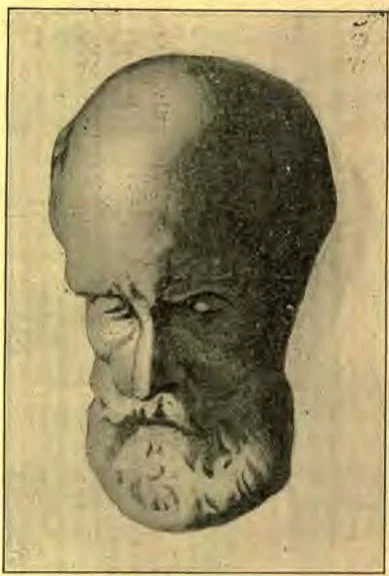
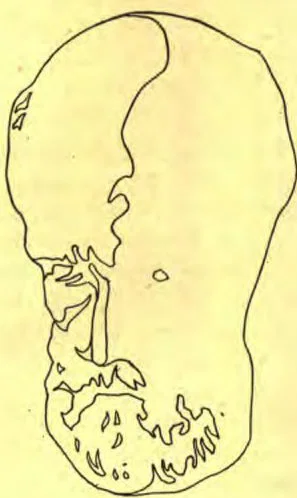
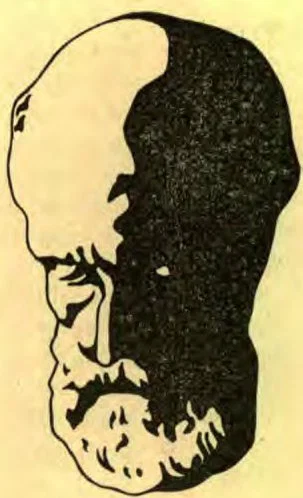
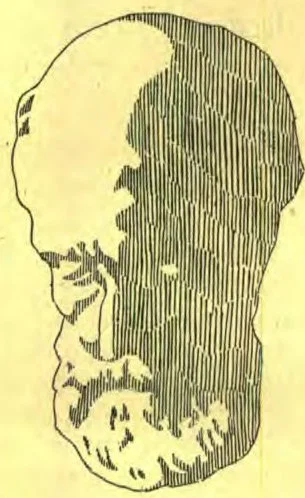
An excellent way to study light and shade and to gain an understanding of massing of shades, is to draw some object, and picture the shades and shadows only. In the accompanying drawings of a cast this study is explained. First we have the cast portrayed with its numerous shades. In the next (Fig. 2), the shadows are all carefully outlined; and in the third the shadows are filled in with black, leaving simply the black and white, or light and shade. Instead of black, a half-shade may be made to indicate the shadows, as in the last drawing (Fig. 4).
All shades that contain more dark than light should be made perfectly dark; those that are lighter should be omitted, thus leaving only the light and shade of an object. After the student has worked this way a short time, from objects, he will be able readily to see the correct relation of light and shade, and simplify his shadows. Many students can draw an excellent outline; but when they attempt shading, they ruin the picture, only because they do not simplify their shades and shadows. Slight lights and shades, as well as lines which are unessential to the character of the object, should be entirely omitted, as they will only confuse the principal shades.
By half closing the eyes, the student will be surprised to see how simply the values take their places in a landscape, and what large sections can be represented by the same degree of color, or light and shade. PEDRO LEMOS,

Keep the Head Cool and Feet Warm

“THERE are a million health hints; but if you keep the head cool and the feet warm, you will not need many of the other 999,998.”

(December 2–8)

DECEMBER STUDY OF THE FIELD IN SUMATRA; AMONG THE RUSSIANS; HINDRANCES TO ARGENTINIAN PROGRESS; ARGENTINE'S PROSPERITY; THE MOTHER OF THE ANTILLES

(December 2–8)

Early Missionary Effort in Sumatra.—The Island of Sumatra is of peculiar importance to the missionary, as it not only affords access to a great number of heathen, but is a central location, in which some acquaintance with the numerous languages spoken in the Eastern Archipelago may be gained. Appreciating this, the Baptist Missionary Society began labor there as early as 1820, workers being sent from Calcutta and London at the same time. These came fully equipped to translate and publish in the native languages. In 1821 schools were opened and conducted, much after the order of our own school now in progress there. Although they heartily supported the school, these people were slow to respond to the message of truth, and seemed averse to everything that required diligence, attention, or mental exertion. This was especially manifested in the efforts of the missionaries to secure a native to act as typesetter and compositor in their printing establishment. As soon as the applicants discovered that any mental effort on their part was required, they left. In less than five years these faithful laborers were compelled to abandon their field, partly because of the obstinate prejudice which had developed among the natives, and been sanctioned and sustained by European government officials to the extent that they imposed restrictions upon the direct promulgation of the gospel, and partly because of the political state of the island. But their work was not without results, the full extent of which only eternity will reveal. The Gospel of John was translated, and later the New Testament; a dictionary of the English, Malay, and Battak was compiled; and a number of religious tracts were published. A missionary who visited this field in 1892 thus describes the scene which he beheld, in contrast with that met by the early workers: “After staying all night at a mission station which is in charge of a native Battak preacher, I resumed my journey until 3 P. M., when I came upon one of the prettiest valleys I ever beheld. The sight was all the more appreciated when I realized that the people of this valley were the same who, on June 28, 1834, had slain and eaten two of their missionaries. When six o’clock came, and I heard the ringing of the church bells calling the people to cease work and come to prayer, and saw a number of men, women, and children coming together to the evening worship, my heart was filled with gratitude to God, and I realized with clearness that the Almighty God reigneth. Truly ‘the isles shall wait for his law.’”
The Commune System in Russia.—Many regard the commune system of Russia to-day as practically a system of serfdom as that which existed prior to the emancipation of the serfs in 1861. Be that as it may, this condition has something to do with the progress of the third angel’s message in that country. A brief review of existing conditions will no doubt be read with interest. Up to the year 1858, over forty-seven million one hundred thousand persons, or more than half of the population of European Russia, were serfs. Half of these were the property of private owners, to be bought and sold at will. As the owners must be reimbursed in some way for their loss, upon their emancipation the serfs were required to pay to their masters a certain sum proportionate to their value. One fifth of this was immediately paid by the serf; the remaining four fifths was advanced by the government, to be repaid by the freed peasants in installments extending over forty-nine years. To secure this repayment, the government established what was known as the Mir, or Commune, and made all the householders of a village, collectively and individually, responsible for the entire sum, by charging each commune with a share of the redemption dues proportionate to the number of males in its census list. The affairs of the commune are managed by an assembly consisting of heads of households elected by ballot, one being elected by every five houses. The entire management of the affairs of the village rests with this assembly, which fixes the date of beginning all harvest-works, such as plowing, sowing, reaping, and mowing; and divides the land among the householders, in some parts giving each family a number of shares, in others allotting them according to the working power of the family. No one can leave the village without the permission of the assembly. As an idle, profligate, or drunken householder is an injury to the whole community, the assembly determines what shall be done with him. After exhausting all other means, he may be turned out of the commune. It is affirmed by some writers, although denied by others, that the commune may, by a decree and without formal trial, have any of its unruly members transported to Siberia. This system, together with the tyrannical power exercised by the head of the household over the younger members, frequently makes it very difficult for the people to obey the truth for these days.
The Island of St. Kitts.—Missionary work was begun in this island as early as 1777, missionaries having been invited there by planters who desired that religious instruction should be given their slaves. Although the negroes attended the preaching in considerable numbers, the progress of the gospel was very slow at first; and at the end of seven years, scarcely forty converts were reported. The first church was completed in 1789, and these five years showed more rapid progress, as there were then two hundred and seventy-nine baptized members of the church, to nineteen of whom the ordinance was administered on the day of dedication. The negroes were earnest, and not only assisted in the erection of their church by manual labor, but gave of the little money they were able to earn. In five years more this congregation had grown to two thousand five hundred persons. At the end of fifty years the reports showed an aggregate, in different parts of the island, of four thousand three hundred and fifty communicants and those under instruction. As early as 1890, canvassers bearing the seeds of present truth went to this island, and Sabbath-keepers were reported, but only in the last year has ministerial labor been put forth. A church building has recently been erected, and a church of eighteen members organized.
Continue reading: Caleb Cobweb