I BELIEVE in appreciation. There is far too little of it in this selfish world. But appreciation means rating a man at his real worth, and letting him know it. Not every one has the insight for that, and still fewer have the courage. No one has a right to any gift of God unless he means to make the most possible out of it; and to reject or avoid unfavorable criticism is either to say that you do not care to improve, or that you are perfection already, neither of which positions is likely to be assumed in words, however we may assume them in reality. So let us thank God for the critics, even the cantankerous ones, and ask him to give us grace to be grateful for them, and to send us more of them.—
Caleb Cobweb
“ONLY A BOY”
THERE is a striking story of a certain missionary, who was sent for, on one occasion, to go to a little village in an out-of-the-way corner of India to baptize and receive into church fellowship sixty or seventy adult converts from Hinduism.
At the beginning of the proceedings he noticed a boy about fifteen years of age sitting in a back corner, looking very anxiously and listening very wistfully. He now came forward.
“What, my boy! do you wish to join the church?”
“Yes, sir.”
“But you are very young; and if I were to receive you into fellowship with this church to-day, and then you were to slip aside, it would bring discredit upon this church, and do great injury to the cause of Christ. I shall be coming this way again in about six months. Be very loyal to the Lord Jesus Christ during that time, and if, when I come again at the end of the half-year, I find you still steadfast and true, I will baptize and receive you gladly.”
No sooner was this said than all the people rose to their feet, and some, speaking for the rest, said, “Why, sir, it is he that has taught us all that we know about Jesus Christ.”
And so it turned out to be. This was the little minister of the little church, the honored instrument in the hand of God of saving all the rest for Jesus Christ.—Selected.
A LOST OPPORTUNITY
By Genevieve Hale Whitlock
I slept, and dreamed, and then a voice I heard,
So sweet and low:
“Lift up thine eyes, look forth upon the fields,
White as the snow.”
“Behold, my child, how white they are, how full!
The stalks, how high and fair!
The grain will fall unpicked — my people know —
Why pause they lingering here?”
“And thou, wilt thou not go?” the voice went on,
In tones so strong yet mild;
“Thy work is there; it calls, it calls to thee;
Wilt thou not go, my child?”
I gazed upon the fields; so hot they seemed,
The workers worn with toil;
Why should I leave my peaceful, quiet vales
For stain and moil?
Then answered, “Lord, I am so happy here,
My dear ones nigh;
Others who’d better serve will heed thy call,
But why need I?”
My heavenly Guest but bowed his thorn-crowned head,
He said no more;
Then silently he left me. I awoke:
The dream was o’er.
And now — how strange it is, how sad and strange,
To feel like this!
Why should I be dissatisfied, unblessed,
Having my wish?
Having my dearest wish, my heart’s desire, —
Ease, dear ones nigh, —
Yet thinking always on those white, white fields,
I can but sigh;
Ah, gracious Visitor, shouldest thou return
With plea for service meet,
I’d count it sweetest, aye, divinest joy,
And cast self at thy feet.
For something heavily weighs my spirit down,
And tears my heart.
The grain will all be gathered — that I know —
But oh, my part!
— Genevieve Hale Whitlock.
Polly’s Birthday
Polly was a dear little girl who lived on a large farm with plenty of chickens, cows, and horses; but Polly never thought much about how nice all these were, for her father and mother were always hard at work, and Polly and the rest of the children had to help. Polly’s two brothers worked with their father; her sister helped her mother in the house; and Polly washed the dishes, scoured the knives, fed the chickens, and ran errands for the family, and for all the summer boarders besides.
One of the boarders, Miss Cary, was watching Polly shell peas one morning, and thinking that she did a great deal of work for such a little girl. Finally she said, “How old are you, Polly?”
“Seven,” Polly answered.
“You’re almost eight,” said her mother.
“When is her birthday?” Miss Cary asked.
“Why, let me see; it’s this month some time — the seventeenth — yes, the seventeenth of July. I declare, I’d have forgotten all about it if you hadn’t a’ spoke.” And Mrs. Jones went on with her work again.
“What’s a birthday?” Polly asked, shyly.374
“Why, Polly,” exclaimed Miss Cary, “don’t you know? It’s the anniversary of the day you were born. Didn’t you ever have a birthday present, Polly?”
“No,” said Polly, looking puzzled.
“We never have much time for those things,” Polly’s mother said. “It’s about all I can do to remember Christmas.”
“Yes, I know,” Miss Cary said; but she resolved that Polly should “have a birthday.”
When she came down to breakfast the next morning, Miss Cary met Polly in the hall, and, putting a little purse into her hand, said, kindly, “Here, Polly, is something for you to buy birthday presents with.”
Polly opened the little bag, and found in it eight bright silver quarters, and she ran as fast as she could to tell her mother.
“Land sakes, child!” her mother said, “that’s too much money for you to spend. Better save it. It will buy you a pair of shoes and a warm hood this winter.”
Almost any child would have cried at this, and Polly’s eyes did fill with tears; but, as her mother wanted her to help “put the breakfast on,” Polly took the plate of muffins into the dining-room. Miss Cary noticed the wet lashes, and said, “Mrs. Jones, please let Polly go down to the store to-day, and spend her birthday money.”
Mrs. Jones could not refuse this request; so, after she had put the baby to sleep, Polly was allowed to go down to the store, which was a good two miles away; but the happy little girl would have willingly walked five miles to spend her precious two dollars.
It was late in the afternoon when she came back; and the boarders were lounging about, waiting for the supper-bell to ring. They all smiled at the little-figure toiling up the road, with her arms full of bundles. Polly smiled radiantly through the dust that covered her round little face as she called to Miss Cary, “Oh, I’ve got such lots of things! Please come into the kitchen and see.”
“No, it’s too warm there,” Miss Cary said. “Come into the parlor, where it’s cool, and we can all see.”
So they went into the house, and Polly began to unwrap her packages and exhibit her purchases.
“There,” she said, as she tore the paper from a queer-shaped bundle, “this is for ma,” holding up an egg-beater, “‘cause it takes so long to beat eggs with a fork.”
The boarders looked at each other in surprise, but Polly was too busy to notice. She fairly beamed as she held up a green-glass necktie-pin for inspection. “Isn’t it lovely?” she said. “It’s for pa, so he’ll wear a collar. Of course if he wears the pin, he’ll have to wear a tie, and then he’ll have to wear a collar.”
“This isn’t much,” she continued, opening a small bundle; “only a rattle for baby. It cost five cents.”
The boarders looked on in silence as the busy little fingers untied strings. No one knew whether to laugh or feel sorry.
It was wonderful what two dollars would buy, and not strange that the little girl had spent a whole half-day shopping. There was a blue tie for brother Dan and a pink one for Tim, a yellow hair-ribbon for sister Linda, some hairpins for grandma, a small bottle of cologne for Jake, the “hired man,” and then there was but one package left. Polly patted this lovingly as she opened it.
“This is the nicest of all, and it’s for you,” she said, as she handed Miss Cary a box of pink writing-paper. “It seemed too bad that you only had plain white paper to write your letters on, when you write so lovely. So I got you this. Isn’t it pretty?”
“Why, it’s beautiful, Polly, dear,” Miss Cary said; “but what have you bought for your birthday present?”
“Why, these,” said Polly — “these are all my presents. Presents are something we give away, aren’t they?” And Polly looked around, wondering why all were so still.
“It is more blessed to give than to receive,” said one of the ladies, softly. The gentlemen looked out of the windows, and Miss Cary put her arms around Polly, and kissed the hot, dusty little face many times.
“It’s been a lovely day,” Polly said, as she distributed her last gift. “I never had any presents to give away before, and I think birthdays are just lovely.”
The next month, after Miss Cary returned to the city, she had a birthday; and there came to Polly a most wonderful doll, with beautiful clothes, and a card saying, “For Polly, on my birthday, from Lena Cary,” which, by the way, immediately became the doll’s name.
And Miss Cary was not the only one who caught Polly’s idea of a birthday; for the rest of the boarders remembered Polly’s presents, and through the year, as each one’s birthday came, Polly received a gift to delight her generous little heart.
When the seventeenth of July came around again, though Miss Cary was not on the farm, she sent Polly a little silk bag with nine silver quarters in it, and Polly still thinks “birthdays are lovely.” —Ladies’ Home Journal.
GOD’S STOREHOUSE
By Edith E. Adams
How many of you have been nutting in the woods this autumn? Did you know that the ripe brown nuts you gathered and ate were little cradles in which baby trees were snugly wrapped up?
The infant plant is very small, and the most of what is in the shell is food stored up by the parent tree for the use of its offspring when it shall be waked to life by the spring sunshine, and begin to stretch and grow.
The leaves, which fell from the trees, and made a rustling carpet for the ground, were busy all summer, gathering food from sun and air for the growth and nourishment of the tree. And besides providing for itself, each plant, each shrub, each tree, sets apart something precious, gives out of its own life something for the good of others and for blessing to the world. That which is thus set apart each year, and given up by the plants when the summer’s work is over, and the leaves begin to fall, we call “seed.”
Your little flowering plants that have ceased to bloom, have made provision for next year’s blossoms, whose sweetness is wrapped up in the little seeds you have perhaps gathered from them, to plant in the spring season.
In the seed we call corn or wheat, that has been gathered in from the fields, there is provision not only for our food for a time, but for all future harvests while the world shall stand.
And in the nuts, the seed of the tree, sleep the young trees that shall refresh the earth, sweeten the air with their green leaves, and give us food in coming years.
For the beginning of all that we see in the earth to-day, we must go back to the very first plants that God planted in paradise, to the seed from which they all came, the word of God. For it was this that produced all things, as you know. “He spake, and it was.”
And this word of power, this wonderful storehouse from which all good things come to us, is the Lord Jesus Christ, the same Word that was “made flesh, and dwelt among us.” He who came forth out of Bethlehem, which means “the House of Bread,” is the One who from his own fullness is giving us this day our daily bread.
In the yearly harvest yielded by all nature, God wants us to see his Word working, to see the Lord Jesus Christ doing just what he did in the beginning, when he commanded the earth to bring forth trees and plants bearing fruits and seeds.
Everything that God made he commanded to “be fruitful, and multiply, and fill the earth.” So, from the first man, Adam, whom God placed in the first garden that he planted, has come a great multitude that no man can number, scattered in every part of the world.
And from the first trees and plants that he put perfect into the earth, the whole world has been made to bud and bring forth fruit, and has been filled with gardens for the children of Adam to inhabit, and with food to sustain their lives. All this has been but the unfolding of the seed, the working of the Word that was “in the beginning.”
God made this world for man, and all that he put into it was for his use and pleasure. “Pleasant to the sight and good for food” were all the trees in the garden of Eden.
See in what pleasant ways our Heavenly Father feeds us! He makes the food that he provides pleasant to the sight, fragrant to the smell, and sweet to the taste. He puts delicate and beautiful flavors into it in such variety that we need never become tired of the same taste.
When we take only what God has provided for us, in just the way he gives it to us, we get the most pleasure and the most strength; for he who made us knows just what we need, and we may be sure that he has provided it in the very best way.
So remember, dear children, when you take the beautiful fruits, grains, and nuts, that you are coming to the Lord’s table,—to the House of Bread,—to Jesus, the Storehouse, “in whom all fullness dwells.” Remember that you are feeding from him who came that you might have life, and who is giving out his own life to you in all the food that he provides for your daily needs.
EDITH E. ADAMS.
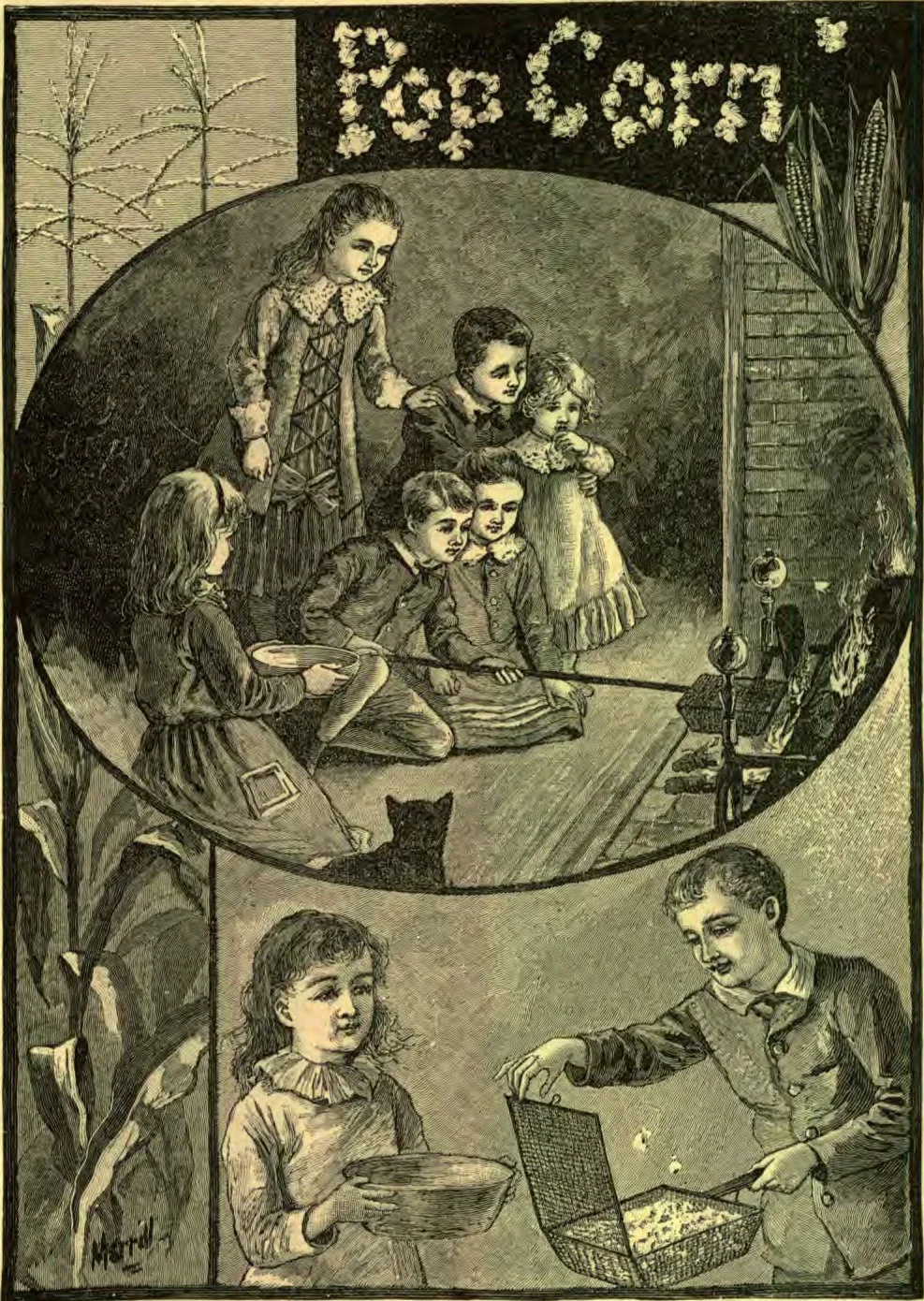
THE POP-CORN BALL
By Eudora S. Bumstead
They were sound asleep in rows and rings,
All quiet as quiet could be,
But Susie said: “You queer little things,
You’ll find your feet and you’ll find your wings
To-night when I set you free.”
Then she opened the door of an airy hall,
And made them ready to go to the ball.
They had worn their silks out long ago,
When the summer days were bright;
But now, as they danced in the firelight glow,
Like drops of rain that are changed to snow,
They burst into dazzling white;
And they spread their robes till they filled the hall.
“Oh, see!” said she, “what a lovely ball!”
They hopped so high, and they tripped so true,
In the firelight steady and clear,
Almost like music it seemed to Sue,
“And I think it’s a pity,” she cried, “don’t you?
That they can’t possibly hear!
You know there was only one ear for them all,
And that they lost when they came to the ball.”
The pattering ended, the dance was done,
And the hall was emptied, too;
But that was not the end of the fun,
For Susie invited them, every one,
To join a candy-stew.
How could they refuse when she pressed them all
To stay for a while in her pop-corn ball?
In this lesson you may find some expressions whose meaning is not perfectly clear to you; but you need not become perplexed over these. The apostle Peter recognized that there are some things in Paul's writings that are hard to be understood. See 2 Peter 3:15, 16. Do not try to guess what any verse means. Keep your mind open to receive instruction from the Lord, and he will teach you.
QUESTIONS
1. Whom had the Galatians formerly not known? Whom did they then serve? V. 8.
2. Whom did they come to know? By whom were they known? V. 9, first part; note 1.
3. To what had the Galatians turned again? V. 9. What was the evidence that they had returned to these things? V. 10.
4. How did their course make Paul feel toward them? What did he fear? V. 11.
5. What did he beseech them to be? What had they not done to him? V. 12; note 2.
6. Under what circumstances had Paul first preached to them? V. 13; note 3.
7. How did they regard his trial in the flesh? How did they receive him? V. 14.
8. What pointed question does he ask them concerning their former experience? What would they at that time have done for him? V. 15; note 4. What does this show Paul's infirmity to have been? Note 5.
9. What had he told them? What had he not become because of this? V. 16; note 6.
10. How had the Galatians been treated by those who had led them astray? V. 17.
11. How should we always be affected in a good cause? Should we rely upon personal influence? V. 18.
NOTES
1. On the subject of knowing God and being known of him, study the following scriptures: To become acquainted with God brings peace. Job 22:21. To know God is life eternal. John 17:3. What a privilege to be known and acknowledged by God and by the Saviour! See the promise in Rev. 3:5. But the workers of375iniquity the Lord does not know. See Matt. 7:22, 23.
2. Paul was not feeling wronged or hurt because they were rejecting his teachings. It was not a personal matter with him. The gospel that he had preached was from the Lord, and the Galatians were accountable to the Lord for the way they received it. Paul was still zealous for the truth, not for his sake, but for their sake.
3. “Ye know that because of an infirmity of the flesh I preached the gospel unto you the first time.” This is the reading of the Revised Version. Other versions also give the idea that it was because of physical infirmity that Paul had been detained among them. But he did not cease his work of preaching the gospel on this account. Instead, he seems to have been the more zealous; for he gloried in his infirmities. See 2 Cor. 12:5, 10.
4. Paul evidently refers here to their early experience in the gospel. His ministry among them had been greatly blessed. They had seen Christ crucified (chapter 3:1); they had received the Spirit, and miracles had been worked among them (v. 5); they had also suffered persecution for their faith. V. 4. But when they departed from the truth, they evidently lost these experiences.
5. It is quite plain from this and other scriptures that Paul's affliction was in his eyes. At his conversion he was blinded by the light of the heavenly vision (Acts 9:3-8); and though his sight was restored, he seems never to have fully recovered. See also 2 Cor. 12:7-10.
6. How often God's servants have been counted as enemies by those they are sent to reprove! Ahab called Elijah his enemy (1 Kings 21:20); Jeremiah was most shamefully treated because of his testimony of reproof; and the same thing is true of many others. It requires meekness and humility to receive reproof with patience. But God has promised to impart all these graces.
THE TIGER
By W. S. Chapman
TIGER is a name indiscriminately applied by settlers and sportsmen to the leopard of Africa and several other large specimens of the catlike animals; but the name properly belongs exclusively to the Felis Tigris of Asia, whose home is from the River Euphrates along the southern shore of the Caspian and Sea of Aral by Lake Baikal to the Sea of Okhotsk. The most northern range is Amur, and the most southerly the islands of Sumatra, Java, and Bali, westward to Turkish Georgia and eastward to Saghalin.
The tiger is a true cat on a large scale, and with the exception of the skin and its covering, is, in size, shape, and conformation of the skeleton, teeth, and claws, exactly like the lion.
In India the principal food of the tiger is cattle, deer, wild hogs, and peafowl, and occasionally human beings. The “man-eater” we hear about is merely an old tiger, whose teeth are worn. Because of this the animal prefers to haunt the neighborhood of a village, and attack natives, who are easier prey than the wild animals of the forest.
Tigers never climb trees, unless pressed by fear or a flood; but they take to the water readily, being expert swimmers.
Sir J. Tayrer, in his article on the “Royal Tiger of Bengal,” writes as follows:—
“The tigress gives birth to from two to five, even six, cubs; but three is a frequent number. She is a most affectionate and attached mother. The young remain with her until nearly full-grown, or about the second year, when they are able to kill for themselves, and begin life on their own account. While they remain with her, she is peculiarly vicious and aggressive, defending them with the greatest courage and energy, and when robbed of them, is terrible in her rage; but she has been known to desert them when pressed, and even to eat them when starved. As soon as they begin to require other food than her milk, she kills for them, teaching them to do so for themselves by practicing on small animals, such as deer and young calves or pigs. At these times she is wanton and extravagant in her cruelty, killing apparently for the gratification of her ferocious and bloodthirsty nature, and perhaps to excite and instruct the young ones; and it is not until they are thoroughly capable of killing their own food, that she leaves them.
“Young tigers are far more destructive than the old. They will kill three or four cows at a time; while the older and more experienced rarely kill more than one, and this at intervals of three or four days or a week. For this purpose a tiger will leave its retreat in the jungle, and proceed to the neighborhood of a village, or gowrie, where cattle feed. During the night it will steal on and strike down a bullock, drag it into a secluded place, and there remain near the murie, or “kill,” for several days, until it has eaten it, when it will proceed in search of a further supply. Having found good hunting-ground in the vicinity of a village, it will continue its ravages, destroying one or two cows or buffaloes a week. It is very fond of domestic cattle, which in the plains of India are generally weak, half-starved, undersized creatures. One of these is easily struck down, and carried or dragged off. The smaller buffaloes are also easily disposed of; but the buffalo bulls, especially the wild ones, are formidable antagonists, and have often been known to beat off a tiger, and even to wound it seriously.” W. S. CHAPMAN.
IT DEPENDS ON YOU
HAPPINESS is a matter of choice rather than of chance. There is sunshine if you will take it, and shade if you prefer it. But we have noticed that when lives are spent in the shadow, the flowers of love and sympathy open reluctantly, and the fruits of the Spirit ripen imperfectly. With a sunshiny world to choose from, it is a pity that we should dwarf and destroy the possibilities of our natures by spending our days in shadow.—Selected.
CHICAGO & GRAND TRUNK R'Y
E. W. Meddaugh and Henry B. Joy, Receivers.
CHICAGO & GRAND TRUNK R'Y.
Trains leave Battle Creek.
WEST-BOUND FROM BATTLE CREEK.
No. 9, Mail and Express, to Chicago — 12.15 P. M.
No. 1, Chicago Express, to Chicago — 8.30 A. M.
No. 3, Lehigh Valley Express, to Chicago — 3.50 P. M.
No. 5, International Express — 2.15 A. M.
No. 75, Mixed, to South Bend — 8.30 A. M.
Nos. 9 and 75, daily, except Sunday.
Nos. 1, 3, and 5, daily.
EAST-BOUND FROM BATTLE CREEK.
No. 8, Mail and Express, East and Detroit — 3.45 P. M.
No. 4, Lehigh Express, East and Canada — 8.37 P. M.
No. 6, Atlantic Express, East and Detroit — 2.25 A. M.
No. 2, Express, East and Detroit — 6.50 A. M.
No. 74, Mixed (starts from Nichols) — 7.15 A. M.
Nos. 8 and 74, daily, except Sunday.
Nos. 4, 6, and 2, daily.
W. C. CUNLIFFE, Agent,
G. W. VAUX,
G. P. A., CHICAGO.
BATTLE CREEK.
The MODERN WEBSTER'S Pronouncing and Defining Dictionary of the English Language.
By Editor
SIZE, 5¼ x 4¼ INCHES
This dictionary includes English words in common use, collection of classical and modern words and phrases and maxims, and instruction in proofreading.
In its compact form it has a thoroughness and clearness of its own, and is especially adapted to the use of students, and in the library, office, and home.
We will send the YOUTH'S INSTRUCTOR one year with this dictionary bound in stiff silk cloth, indexed, postpaid, for $1.10; or, we will send the INSTRUCTOR one year, with same book, limp cover, not indexed, for $1.00. This offer applies to both new subscriptions and renewals. Address—
THE YOUTH'S INSTRUCTOR,Battle Creek, Mich.
THE HOUSE WE LIVE IN.
By Vesta J. Farnsworth
By Vesta J. Farnsworth.
This book tells how the human body is made, by comparing its parts to the different parts of a house. It also tells how to care for the body. In doing so, many other interesting things are told in a pleasing way. It is printed in large, clear type, with many instructive pictures. It contains 218 pages, and is nicely bound in cloth, with a home scene on the front cover. Price, 75c.
We offer the YOUTH’S INSTRUCTOR for one year and this beautiful book, postpaid, for $1.25; or, we will send the book, postpaid, for five new subscriptions at 75 cents each. Address—
The Youth’s Instructor,
Battle Creek, Mich.
Subscription Renewal Notice for December 1900
By Editor
DECEMBER, 1900
If the yellow address-label on first page of this paper, or on the wrapper, bears this month and year (John Brown 6-1900), it indicates that the following blank should be filled out by you now, and mailed to the Review and Herald, Battle Creek, Mich., before the end of the month:—
Inclosed find $...... (money-order, express order, registered letter, or bank draft), for which please send....copies of the YOUTH’S INSTRUCTOR....months to above address.
P. S.—If you object to clipping this out of your paper, or wish to forward other subscriptions, please write names and full addresses on a separate sheet, stating amount inclosed for that purpose.