The Youth’s Instructor, Vol. 33, No. 15.

AUSTRALIA

The Youth’s Instructor

Apr 29, 1885

S. D. A. Publishing Association · Battle Creek, Mich. · Apr 29, 1885

AUSTRALIA

Written for the INSTRUCTOR.

AUSTRALIA

Directly opposite to us, and south-east from Asia, lies, between the Indian and Southern Pacific Oceans, a great island, so large that it is called a continent. This is Australia. It contains very nearly as much land as is owned by the United States. The coast line is singularly regular, and it has very few harbors; yet those it does have, on the south-eastern coast, are said to be the best in the world.
The interior and western parts of the country have not been very largely explored, but so far as anything is known concerning them, they present less attractions to colonists than the eastern and southern portions, as the land is often sterile or else swampy. Near the coast, however, the land is very fertile, and the vegetation luxuriant. Here is said to be some of the finest scenery in the world. The mountain scenery in the south-eastern part is peculiarly striking, tall, ragged cliffs rising to a great height, crowned with forests.
There are very few rivers that have a full stream of water during the whole year, so that, although the streams are innumerable, they do not irrigate the soil very well. After flowing in a full volume for a distance, many of them lose themselves in a marsh or quicksand.
The climate is hot, but dry and healthful, and is said to be favorable to Europeans. In the northern part, where there are fewer streams, the heat is oppressive; but the rainy season, lasting from November to April, redeems the country from the desert.
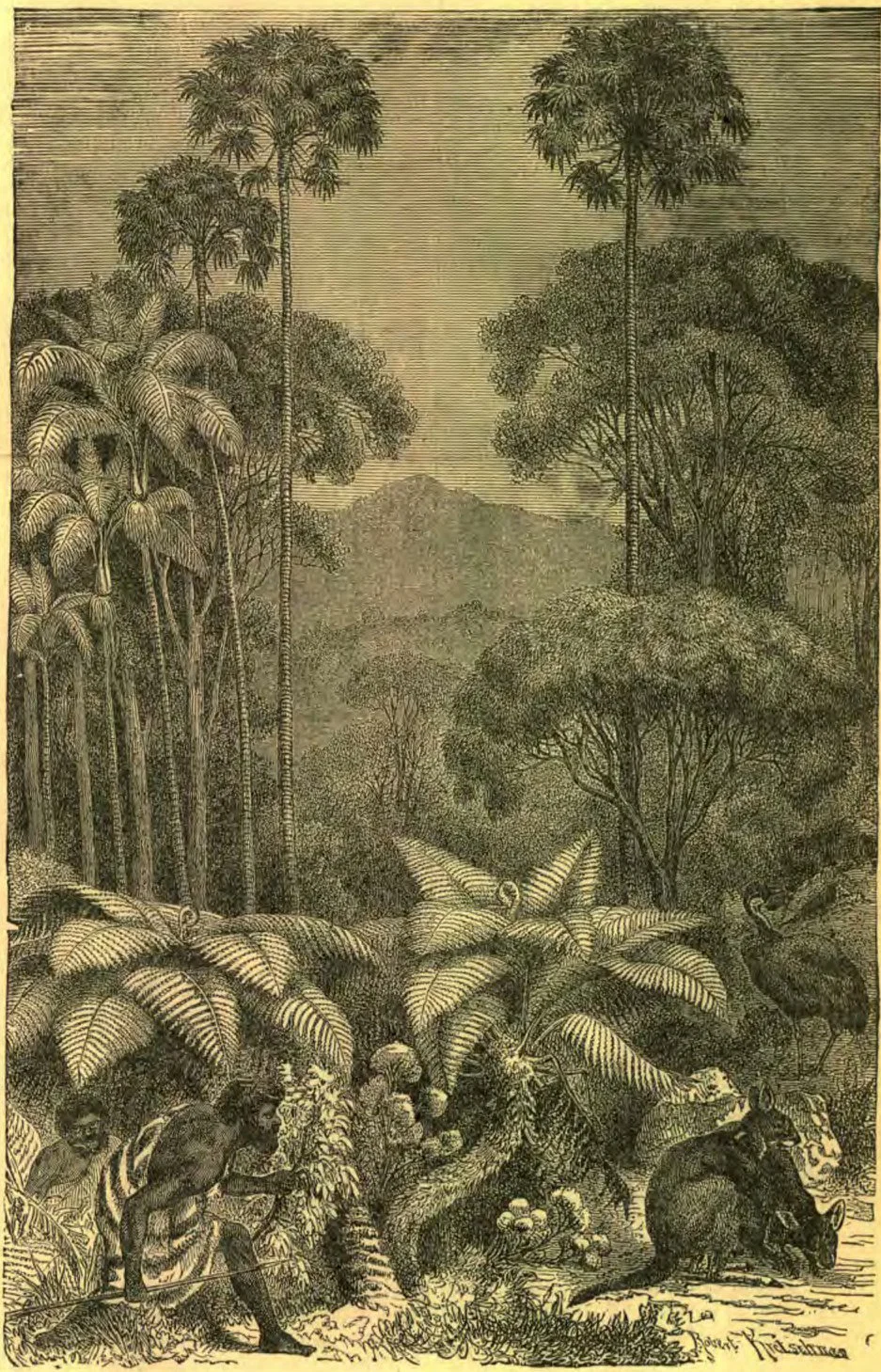
The flowers are brilliant, but as a rule they are not fragrant. The shrubs and trees are of kinds unknown to us. One of these curious plants is a gigantic fern that grows as large as a tree, and puts out branches ten or twelve feet long. Fruit trees, though not natives of the soil, grow here very readily, and garden produce is abundant.
The animals are as strange as the vegetation. Birds of brilliant plumage, orioles, parrots, and birds of paradise, flit in and out among the tall trees. Those animals that are best known in other countries are not found here. One of the most peculiar animals is the kangaroo. In the picture on this page we see the natives engaged in hunting it.
It is a wary animal, and difficult to approach. On hearing an unusual noise, it raises up on its hind legs, six feet in the air, and takes a survey. When frightened, in retreating from danger, it often makes surprising leaps of fifteen feet at a bound. It is not disposed to trouble others, but becomes formidable when hard pressed.
He measures seven feet from his nose to the tip of his tail, which is itself three feet long, and very large and heavy. The fore legs are short, and are used as arms. The female is very much smaller than the male, and is not so swift nor courageous. When fiercely beset, she often dies from fear. The young are not larger than a mouse; and the mother carries them around in a warm pocket, where they thrive until they are about eight months old, when they are turned out to shift for themselves.
The kangaroo is much valued for his skin and for his flesh, and a hunt is entered upon with zeal. The natives hunt him with the spear, which they are very skillful in handling, throwing it with almost unfailing accuracy at a distance of seventy or eighty yards.
When closely pressed by dogs, the animal makes his way to the water, and wading in a short way, waits for them to come up. Seizing the first dog, he plunges him under, and holds him there until he drowns. If another one comes up before the first one is dead, he puts his large hind feet on the first one, and reaches out for the other. When no water is available, the kangaroo backs up against a tree, so as to be free from attack behind. If the dogs should come in reach of the powerful claws on the animal’s hind feet, the kangaroo would make short work of them. In desperate cases, he sometimes attacks the hunter himself. The kangaroo would more often escape than he does, if he did not look around in his flight to see what was behind him. In this way he frequently leaps against trees, causing his instant death. It seems a pity that any creature capable of manifesting so much reason as does the kangaroo in trying to defend himself, should ever be killed out of mere sport and wanton cruelty.
The natives of Australia are brown-black, with curly but not wooly hair. Their faces are broad, and their lips are less protruding than those of the negro. They are not very strong, but they have great endurance. They do not build huts, but content themselves with a strip of bark to protect themselves from the wind. Their dead are buried in exactly the spot where they died, and the place is never inhabited again by that tribe. The dead are never spoken of, and if any one living bears the same name, he is obliged to change it. They believe in a good and a bad spirit. Many efforts have been made to introduce Christianity among them, though with little success. Like all savages, they dislike regular labor of any kind. They are rapidly decreasing, and in a short time will be wholly extinct.
D. E. B.

“NOW THE NOISY WINDS ARE STILL.”

NOW the noisy winds are still; April’s coming up the hill! All the spring is in her train, Led by shining ranks of rain; Pit, pat, patter, clatter, Sudden blue, and clatter, patter! First the blue, and then the shower; Bursting bud, and smiling flower; Brooks set free with tinkling ring; Birds too full of song to sing; Crisp old leaves astir with pride, Where the timid violets hide; All things ready with a will,— April’s coming up the hill! —Mary Mapes Dodge.

Avoiding Every Kind of Falsehood

Do not let us lie at all. Do not think of one falsity as slight, another as harmless, and another as unintended. Cast them all aside; they may be light and accidental, but they are an ugly soot from the smoke of the pit; and it is better that our hearts should be kept clear of them, without overcare as to which is the largest or blackest. —Ruskin.

A VISIT TO AN ORANGE ORCHARD.

(One pleasant day during our stay in Southern California, we went to visit an orange orchard in Paradise Valley. The sight of rich fruit brought forcibly to my mind the words of the wise king, “A word fitly spoken is like apples of gold in pictures of silver.”
Here were large trees laden with the golden globes. The first ones I saw I thought must be pumpkin trees, though I had never heard of a pumpkin that grew on a tree. I am sure that an orange on one tree was as large as a man's head. There were fine specimens of the navel orange in this orchard, and also of the blood orange. The blood orange is a beautiful yellow on the outside, and on the inside a blood red.
Everywhere the rich fruit greeted the eye, and under some trees the ground was nearly covered with it. We were told that on account of the low prices, perhaps one-half of this fruit would go to waste. Fine oranges sell in San Diego for ten cents a dozen. I thought that if only a small part of the INSTRUCTOR family could visit this orchard for a short time, this luscious fruit would soon be utilized.
Near by were growing many tropical plants and vines, among which was a rubber tree. We were reluctant to leave such a beautiful place. How delightful it would be to live always among the fruits, and flowers, and singing birds! How happy Adam and Eve must have been in their garden home, where grew every tree that was pleasant to the sight, and good for food! and how sad they must have been when compelled to leave Eden!
But if we follow the perfect Pattern here, we may hope for a home as beautiful as theirs by and by,—a home where they need not the light of the sun, for the Lord God giveth them light,—where the dwellers shall never say, “I am sick;” in the midst of the city and on either side of the river, grows the tree of life, bearing twelve manner of fruits, and the leaves of the tree are for the healing of the nations. H. A. ST. JOHN.

A VERY SMALL CONCERT.

Indeed, it was a small concert; the audience was small, too. The performer was an aged blind man; the instrument, a hand-organ, small and out of tune; the hall, a corner on the pavement of a crowded thoroughfare; the audience, a little boy of three years, in a ragged dress, clinging to the hand of his sister, several years older. Crowds hurried by; none but these children stopped to listen. They had no pennies to put into the empty box, but they made up for that lack in praise.
“That’s pretty, mister,” the little girl cried, as he finished a lively waltz.
He made no reply. Pennies, not compliments, were what he wanted. He played on—waltzes brought nothing in, may be hymn-tunes would. So the next selection was, “When Jesus Comes.” The little girl had learned that in Sabbath-school; and so she joined in, with a sweet, strong voice. The crowd went more slowly by. Here and there one paused.
“No more heart-pangs nor sadness, When Jesus comes. All peace and joy and gladness, When Jesus comes.”
There was quite a group around now, every one with some heart-pang or sadness.
“He’ll know the way was dreary, When Jesus comes. He’ll know my feet grew weary, When Jesus comes.”
Weary feet waited, pausing a moment on the dreary way to hear of the longed-for rest, forgotten by so many.
“He’ll know that grief’s oppressed me, When Jesus comes. Oh, how his arms will rest me, When Jesus comes!”
The old man played the tune over and over, till the long hymn was sung through. Then the crowd moved on.
The little money-box at his side was almost full. The glad tidings had opened many a closed heart; but he cared less for that now.
“Come, Johnny,” said the little girl, “we have no more time to wait. Mamma’ll be wondering where we are.”
“Little girl,” called the old man, “stay a minute. Is that all true you was singin’? I used to hear about Jesus long ago, but I forgot him. I reckon, though, he ain’t forgot me; for he must ’ave sent you to tell me that.”
She had learned the words, and it was all she knew. She looked at him a moment.
“I’ll ask mamma,” she answered. “Come, Johnny;” and they went on.
“Oh, how his arms’ll rest me!” he murmured, leaning wearily against the lamp post. “That’s what she sung: ‘Oh, how his arms’ll rest me!’ I’m tired all these years, an’ a-forgettin’ that.”
He shouldered the hand-organ and moved on, singing the song over in his heart. He was old and friendless, but not forgotten. One had just sent him a message that he knew the way was dreary; that he knew his feet grew weary; but oh, his arms would rest him!
A woman, tired with work and the struggle of poverty, stopped to hear an eager, childish question:—
“Mamma, does Jesus know the way is weary? Will his arms rest you? My song says so. Listen to it.”
The work fell to the floor as she listened.
“O child! did he send you with that message?” she cried, tears springing to her eyes.
May be he did. He saw these weary hearts, these weary feet treading a dreary road, and sent them word that he remembers all their sorrows, and that his arms will rest them.—Selected.

CHARACTER FORMING.

A flock of geese saved Rome, and geese were for centuries honored in that city. A cow did even more for Boston, but she is not honored for it.
I was reading, not long ago, in that charming book of Mr. Butterworth's, “Young Folks' History of Boston,” that a good part of Boston was once the farm of an early settler named William Blackstone, and that Washington and Tremont streets follow the windings of his cow. In going from place to place in search of food, or from Mr. Blackstone's cottage on Beacon Hill to the pasture, the cow took the easiest way, and wound around among the hills and trees. People who wished to go in that direction followed the cow-path, till it gradually became a well-worn path. Carts and wagons soon made it a road; houses were built upon it; fences and sidewalks followed; till at last it became established as a street of the city. So a single cow's thoughtless wanderings, two hundred and fifty years ago, decided where the marble palaces and stores of to-day must be built; where an immense business in the city must be transacted; where the throngs of people must move, and where the horse-car tracks must be laid. No matter how much people may wish to straighten out the curves of those streets, it is now too late to make a change; and through all its existence, a good part of Boston travel and business will follow the windings of William Blackstone's cow.
Do you see that man entering the saloon yonder? He is tattered and ragged. His eyes are wild, his cheeks sunken. He looks sickly and sad. He is a poor, miserable wreck. How did he become so? Once he was as fresh and sunny as the fields of Blackstone's farm. But he took a little wine one day. He felt no harm. On the morrow he took more, but saw no ill effect. But drink followed drink along that seemingly harmless way, till his life became a drunkard's highway. His habits were fixed; and nothing less than a miracle of divine love can save him.
One bad word seems of little account; one base thought is quickly forgotten; one bad act, one disobedience, one selfish deed, leaves no trace; but continue them, and they form your character. It is in just this way that character is formed. Character is a sum in addition. It is the sum of all you have ever thought and said and done. And where one thought has gone, another naturally follows. One deed done makes it easier to do another like it.
Washington and Tremont streets have been changed a little since houses were built upon them. But every year makes it more difficult and more expensive to change.
Men sometimes change the course of their lives; but the younger they begin to go in the right way, the easier it is, and the time comes when it is too late.
In Texas there is a plant which grows four or five feet high, called the compass-plant, because its leaves always point to the north; so that the trappers or Indians could tell, even in the night, which way they were going, by examining the leaves of this plant.
People denied this. They had seen, they said, many of these so-called compass-plants whose leaves did not point to the north.
At last a Mr. Mechan, a very careful observer, found that the young, clean leaves, those standing edgewise to the earth so as not to catch the dust, do always point north and south; but the older leaves get clogged with the dust and stiff with age, lose this power, and point in all directions.
When you are young, it is comparatively easy to set your faces toward God and heaven. But if you wait till you grow old, and become loaded with worldly thoughts and bad habits, it will grow harder and harder to do right and to keep right.—F. N. Peloubet, D. D., in the Well-Spring.

MONEY

Written for the INSTRUCTOR.

MONEY

NEARLY all children receive more or less spending money from their parents and friends. I wonder how many of the INSTRUCTOR family can tell the exact amount received and expended by them during the past year? It is an excellent plan for young people to keep a cash account, and to early form habits of accuracy and economy. How many, during the past year, laid aside one-tenth of all they received, for the Lord? How many spent every cent for themselves?
Business men place their money in the banks, where it will draw interest, and accumulate year by year. It is well for people to save a part of what they earn.
There is a bank where small children can deposit their pennies, and receive the largest interest. Banks sometimes fail, and those who have money laid up in them, lose it all. But this bank cannot fail, because its President owns more gold and silver than the queen of England, and has more capital than the Government of the United States. The name of this wonderful bank is the Treasury of Heaven, and money spent in doing good is recorded in the books above, and credit given to those who thus use their means.
By and by dividends will be made, and those who have money invested will receive much real estate, a beautiful mansion, and everlasting riches.
May the Lord help the children to lay up treasure in this bank!
ELIZA H. MORTON.

THREE GOOD LESSONS.

“One of my first lessons,” said Mr. Sturgis, the eminent merchant, “I received in 1813, when I was eleven years old. My grandfather had a fine flock of sheep, which were carefully tended during the war of those times. I was the shepherd boy, and my business was to watch the sheep in the fields. A boy who was more fond of his books than of the sheep was sent with me; but he left the work to me, while he lay under the trees and read. I did not like that, and finally went to my grandfather and complained of it. I shall never forget the kind smile of the old gentleman as he said: ‘Never mind, Jonathan, my boy; if you watch the sheep, you will have the sheep.’”
“What does grandfather mean by that?” I said to myself. “I don’t expect to have a sheep.” I could not exactly make out in my mind what it was; but I had great confidence in him, for he was a judge, and had been in Congress in Washington’s time; so I concluded it was all right, and went back contentedly to the sheep. After I had got into the field, I could not keep his words out of my head. Then I thought of the Saviour’s words, ‘Thou hast been faithful over a few things; I will make thee ruler over many things.’ I began to see through it: ‘Never mind who neglects duty; be faithful, and you will have your reward.’”
“I received a second lesson soon after I came to New York as a clerk to the late Lyman Reed. A merchant from Ohio, who knew me, came to buy goods, and said: ‘Make yourself so useful that they cannot do without you.’ I understood him quicker than I did my grandfather.”
“Well, I worked upon these two ideas until Mr. Reed offered me a partnership in the business. The first morning after the partnership was made known, Mr. James Geery, the old tea-merchant, called in to congratulate me, and he said: ‘You are all right now. I have only one word of advice to give you: Be careful whom you walk the streets with.’”
What valuable lessons they are,—fidelity in all things; do your best for your employers; be careful about your associates. Let every boy study these lessons well. They are the foundation stones of character and honorable success.—Christian Standard.

ARE YOU GENUINE?

Written for the INSTRUCTOR.

ARE YOU GENUINE?

ARE you what you seem, dear reader? Are you true? This cannot be ascertained of another only by applying some standard measure; and then mistakes are liable to occur; for one cannot read the hearts of others to know their secret motives for action, although it is quite common for persons to attempt this, and to pass judgment upon every person with whom they have intercourse.
The question is not whether your friend or neighbor is true; but whether you, as an individual, are true. One may have a very pleasing address, may put on, for the occasion, a show of honesty, and all the while have hidden beneath it a very dishonest heart. But, fortunately, a very deceitful nature will in time manifest itself.
A genuinely honest person is just as true when no one is looking at him as though the eyes of the world were upon him. He never takes advantage of a mistake in reckoning to add a mite to his own purse. After a kindly greeting, he never smites with the tongue. He treats the unfortunate and poorly clad as if the eyes of the Saviour were upon him; in fact, he does everything with an eye to please the great God, because it is right to do so.
As an instance of genuine honesty, we give it in the character of a simple German woman, whose beauty, if not seen by man, who “looketh on the outward appearance,” will not be overlooked by the Lord, who “looketh on the heart.”
“A passenger entered the cars at a small village. She seemed to pay little attention to anything about her until reaching her destination, a mile or two beyond. The conductor had not yet made his appearance, and our little old German lady was embarrassed, not knowing what to do with her fare, and quite unwilling to leave the car without paying for her ride.”
“Who will take my money?” she said.
“You had better not wait; the train will start,” replied several passengers.
“But I ought to pay; I must not leave; I will go on to the next station.”
“Quick! and never mind the money,” was the reply of some who seemed much amused.
“Oh dear me! I will leave the money here, then,” said the woman; and she placed the fare upon a window-sill and hurried out.
“Just too late the conductor came, and seemed quite incredulous when the money was pointed out. For a moment there was a tendency among the passengers to exchange amused glances and humorous remarks, as though some droll mistake had been made. But this was quickly followed by serious thoughtfulness and a sort of half-expressed appreciation, which led me to suppose that if the occasion had required, there were many in that car who would have intrusted the good woman with whatever valuables they might have about them.
“Sometimes the image of that face—once, perhaps, as fair as any, but wrinkled and much faded since—seems to reappear at the car window or door. The face seems always full of confusion and embarrassment, as it was on that day in July, but the moral beauty of the soul of that little German immigrant never seems faded; and in contrast with her conscientious purpose rather to go to the next station and walk back a dusty mile or two than to retain what justly belonged to another, the “sharpness” of worldly minds seems ugliness and deformity.” M. J. C.

THE ACCEPTED TIME.

WHILE reading the autobiography of a venerable minister, whom I have known from childhood, my mind was forcibly impressed with the significance of these words, “Behold, now is the accepted time; behold, now is the day of salvation.” 2 Cor. 6:2. To this minister’s solemn and impressive preaching I often listened in my youth and early manhood. He was engaged, for some years, quite largely in revival work, when revival meant a work of reformation in heart and life, as it did forty or fifty years ago. By reason of his close connection with God, and his solemn and forcible, yet kind and tender manner of presenting the gospel, he was very successful in winning souls to Christ.
This gentleman relates one instance as occurring during a meeting that he held in connection with the pastors of the other churches of the village where he resided, which so forcibly illustrates the truth of the above scripture that I will give it for the benefit of the readers of the INSTRUCTOR.
He says that one evening, after a very solemn and impressive sermon from the text, “Boast not thyself of to-morrow,” an invitation was given to all who desired salvation, to come forward to the altar for prayer. A sister, who was well known to him, spoke to an accomplished young lady about nineteen years of age, who was sitting by him, and invited her to go forward. She shook her head. The sister asked her if she did not feel that she was a sinner, and needed salvation. She answered, “Yes.” “Well, then, come with me,” said the sister. She replied, “Excuse me this evening, and I will go forward to-morrow evening.” But to-morrow evening never came to her. She went home with another young lady, only a few steps from the church. They retired a little after ten o’clock.
Before going to sleep, her companion noticed that she began to struggle, as though something was the matter. She spoke to her, but received no answer. She sprang out of bed, procured a light, and returned just in time to witness her last gasp. She was dead. Surely, “Now is the accepted time; now is the day of salvation.” “To-day, if ye will hear his voice, harden not your hearts.”
D. P. CURTIS.

NAPHTHA SPRINGS.

Never having had to study or work by a tallow candle, the young readers of the Instructor cannot fully appreciate the great revolution which has been made in artificial light during the last twenty-five or thirty years. But while they are reaping the benefits of this valuable discovery, are they well posted regarding it? What we burn in our lamps now is petroleum, and not kerosene. Do our young friends know how it is procured? One writer says of it:—
“In various parts of the world there are springs or natural sources of inflammable oil. Some of these have been known for thousands of years; but most of them are of recent discovery. The oil which flows from these springs is generally known as ‘petroleum,’ the word being of Latin origin, signifying rock oil; but the more general name is naphtha. By distilling it, the oil we burn in our lamps is obtained.
“The most famous natural deposit of this substance, or anything like it, on the surface of the earth, is in the Island of Trinidad, one of the West Indies. Here it forms a lake of asphaltum and petroleum, called Tar Lake. It is a good substitute for pitch, and is extensively used for coating vessels and preserving their timber.
“The largest supplies of petroleum are obtained in America, but throughout Europe and Asia there are many petroleum wells.”
Another writer, in a late magazine, says:—
“On the western shores of the Caspian Sea, near the city of Baku, there is a large spot of ground where naphtha is procured by digging into the ground only two or three inches. The people dig a hole, and set fire to the oil, or naphtha, and thus cook their victuals. The smell is very unpleasant, yet the natives become accustomed to it. In another place, ten miles from Baku, is what is called the ‘Everlasting Fire.’ Here are several temples built of stone. In one of them, near an altar, is a cave, at the end of which is a flame that the worshipers say has burned forever. Natives of both India and Persia visit this temple, and gaze upon the flame with awe. By the number of the temples it is evident that there were once many worshipers; the number is small at present. It is probable the fire is seen to be nothing more than naphtha in combustion.
“In another place nearer Baku is a rock out of which naphtha exudes and burns. In fact, the entire soil is saturated with this oil for miles around. At Swieten they dig trenches or cisterns, and dip off the naphtha that floats on the top of the water; with this they fill their boats, and carry it to towns on the shores. It is used in lamps without distillation, and makes a very offensive smell.
“In this country, the naphtha, or petroleum as it is more generally called, is obtained from wells often drilled a thousand feet deep. It is carefully distilled, so that the petroleum used in lamps is of a light, transparent color. In the early days of this century, naphtha was found in Seneca county, New York, and sold as ‘Seneca Oil,’ and was thought to be valuable for rheumatism. So numerous are the wells and so large the production, that petroleum is now very cheap [so cheap that it does not pay to manufacture kerosene any more]. Some wells produce 5,000 barrels of oil in a day. The transportation of the oil is a great part of the work of some of the railroads; it is carried in tanks made of iron. There are several lines of large iron pipes running for hundreds of miles through which the oil reaches New York city. The oil for our lamps was once obtained from whales, but now it is obtained from the petroleum, or naphtha, wells.”

IMPORTANT BIBLE SUBJECTS.

LESSON 42.—INHERITANCE OF THE SAINTS.

PROMISES TO ABRAHAM.

CONTINUED.

[NOTE TO THE STUDENT.—Do not consider the lesson learned until you can give at least the substance of every text, with the correct reference for each. The references in black letters indicate those texts that should be committed to memory. A little diligent application each day will enable you to do this.]
  1. REPEAT the promise made to Abraham after Lot had separated from him.
  2. Where is this promise found?
  3. What did this promise embrace? Rom. 4:13.
  4. How great a posterity did the Lord say Abraham should have? Gen. 13:16.
  5. On another occasion, what did the Lord say of his posterity? Gen. 15:5.
  6. Had Abraham at this time any children? Gen. 15:2.
  7. How did he regard this promise from the Lord? Verse 6.
  8. How did the Lord regard his belief? Ib.
  9. How old was Abraham when the Lord next appeared to him? Gen. 17:1.
  10. What part of the promise did the Lord at this time renew? Verses 2, 6.
  11. What name did the Lord at this time give him as a continual reminder of this promise? Verse 5.
  12. What is the meaning of “Abraham”? Verse 5, margin.
  13. What did the Lord at this time say he would give to Abraham and his numerous descendants? Verse 8.
  14. How long did the Lord say they should possess this land?
  15. And how much land have we learned that they were to have?
  16. On what condition was this promise given? Verse 1.
  17. Then to what other promise is this one equivalent? Ps. 37:11.

THROUGH GOD, WHO STRENGTHENETH US.

WHEN we combat any evil, let us appreciate duly the strength we may derive from the sympathetic and helpful presence of the Lord Jesus. Too often he is practically counted out of our reinforcements. The officers of Antigonus were lamenting that their force was not equal to that of the enemy. “How much do ye reckon me for?” inquired Antigonus. In our spiritual conflicts, too often we look around us to see who will give us help, rather than above us to recognize that the Lord Jesus is now helping us. In the reinforcements by way of heaven, lies our realest strength. “I bring you the best aid ever sent to any one, the aid of the King of heaven,” said the Maid of Orleans to a beleaguered host. In our sorest extremity of spiritual battling, we must strengthen our tired columns with the powerful reserves from the heavenly city. Thus only can we be assured of victory.

TRUE RELIGION.

LET men see in us that religion is something real, something more than high-sounding and empty words; a restraint from sin, a bulwark against temptation, a spring of upright and useful action; let them see it, not an idle form, nor a transient feeling, but our companion through life, infusing its purity into our common pursuits, following us to our homes, setting a guard around our integrity in the resorts of business, sweetening our tempers in seasons of provocation, disposing us habitually to sympathy with others, to patience and cheerfulness under our own afflictions, to candid judgment, and to sacrifice for others’ good.—Channing.

LENGTH OF LIFE.

He liveth long who liveth well; All other life is short and vain; He liveth longest who can tell Of living most for heavenly gain.
He liveth long who liveth well; All else is being flung away; He liveth longest who can tell Of true things truly done each day. —Horatius Bonar.

A REMARKABLE LIBRARY.

A NOTED character in Washington, a number of years ago, was one Peter Force, who was born in 1790, and died in 1868. This man’s greatest achievement was the collection of a remarkable library, which the United States Government purchased of him in 1867 for the sum of one hundred thousand dollars, and transferred to the library of Congress. As Peter’s school-days ended when he was ten years old, you may be interested to know how his taste for literature began. As given in a late magazine, it was something as follows:—
“Mr. Force, the father of Peter, had served in the Revolution, in a New Jersey regiment; and after the war was over, his friends often met at his house to talk over their experiences and exploits in the army. Peter was an interested listener, and one evening the thought came to him of writing down what he heard, so that it should not be forgotten. So he began to write ‘The Unwritten History of the War in New Jersey;’ but after he had made considerable progress, the manuscript was destroyed. Then he went into a printing-office, and at twenty-two he was so well versed in this line of work that he was elected President of the Typographical Society of New York. When the war of 1812 began, Peter Force enlisted, and at its close went to Washington, where he spent the rest of his life as printer, editor, publisher, and collector. From 1836 to 1840 he was mayor of Washington. His love of books was so great that he sometimes hesitated between a barrel of flour and a rare book; but the book always won the day.”
“His library consisted chiefly of old volumes relating to American history, whose age and variety made them valuable. He had nine hundred and fifty bound volumes of newspapers, and one-fourth of these were published before 1800. His pamphlets numbered 40,000, and the books 22,000. Besides all the early atlases of any note, Force owned over a thousand maps illustrating the geography and history of America. Three hundred of these were the only copies in existence. His specimens of the art of printing reached from Caxton’s time, and they were arranged in the order of their publication.
“This is only a portion of the contents of this wonderful library which Peter Force spent his life in collecting and arranging, caring for his books with a devotion so great that it is said he would gladly have risen in the middle of the night, and walked ten miles through a snow-storm, to get a rare pamphlet.”

STORY OF AN AFFECTIONATE DOG.

It is not that such a large sum of money was expended in procuring a monument sacred to the memory of a noble animal, that we relate the following story, but as an illustration of the strong attachment the dog sometimes has for his master. Instances are rare that man expresses such devoted attachment to a friend as did this faithful creature to the object of his affections. The S. S. Advocate says:—
“In Gray Friar’s church-yard, Edinburgh, there lie the remains of a Scotch terrier, whose history, as told by the sexton in 1872, is as follows:—
“He was devotedly attached to his master, who died and was buried in this church-yard. For thirteen and a half years this dog stayed on the grave of his master night and day, until he also died, that year, 1872, and was also buried decently in the same yard. Regularly at the firing of the castle gun, at one o’clock daily, the dog left the yard and went to a butcher’s stall in the neighboring street, where for more than six years he was gratuitously fed.
“Baroness Burdett-Coutts was so much impressed with this remarkable instance of canine affection, that she gave orders for the erection of a monument to his memory, costing one thousand pounds sterling.
“The monument to ‘Bobby’s’ memory is in the form of a fountain. It is of red granite, and stands near the Walter Scott monument. The tablet, with an appropriate inscription, and the figure of the dog on the top, are of bronze.”

THE PRESIDENT'S CABINET.

Young people often ask what constitutes the President's Cabinet. The subject is so clearly and fully explained in the following article from Treasure-Trove that the readers of the INSTRUCTOR need not remain in ignorance concerning it. It says:—
“The Cabinet is composed of seven distinct heads: Secretary of Treasury, of State, of War, of Navy, of Interior, Attorney-General, and Postmaster-General. These officers are the choice of the President, and his selections must also meet the approval of the Senate. They are therefore selected from the most eminent statesmen of our country, and they are supposed to be especially adapted by their experience and capacity to fill the offices they are appointed to. They have their business so well systemized that they can, on a short examination, report the exact amount of means they can spare to carry into effect any special measure. The precise condition of public affairs may at all times be found in their offices. It is by means of his Cabinet that the President executes or carries into effect the laws of Congress. The members are at the head of the executive department with the President, who is the head of them all, bringing them into harmony. The Cabinet officers correspond to the ministers of England.
“At regular intervals, the sub-departments report to their heads, who report to the President. He then gives over the reports to Congress, with such arguments and such suggestions for legislation as their knowledge and experience may have taught them is desirable. Each officer is expected to give every thought and to bend every energy to the improvement of his office.
“It has not always been that seven members composed the Cabinet. In the good old times of George Washington the Cabinet had only four members, viz: Secretary of Treasury, State, War, and Attorney-General. While John Adams presided at the White House, the Secretary of the Navy was added. It had only five members down to the administration of ‘Old Hickory’ (Jackson), when the Postmaster-General was made a member. It was at the beginning of Taylor's administration that the department of the Interior was made, and this officer was allowed a seat in the Cabinet. There has been no increase since, but as our country grows and flourishes, it may seem proper to appoint other great heads, so that the state of affairs may readily be known from the head of each office.”

Promise Cautiously and Fulfill Scrupulously

PROMISE cautiously; but when you have promised, fulfill scrupulously.

COURAGE IN EVERY-DAY LIFE.

HAVE the courage to go without that which you do not need, however much you may desire it.
Have the courage to show your respect for honesty, in whatever guise it appear, and your contempt for duplicity, by whomsoever exhibited.
Have the courage to wear your old clothes until you can pay for new.
Have the courage to obey your Maker, at the risk of being ridiculed by man.
Continue reading: A STRANGE FAMILY