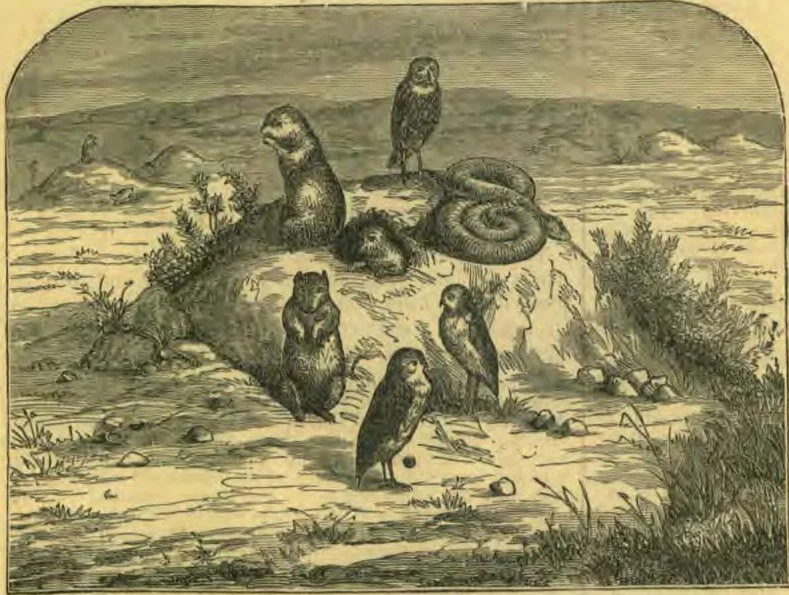
SHOWMEN sometimes put in a cage a group of ill-assorted animals, such as a cat, rat, dog, pig, etc., and call it “a happy family.” Our young readers will think this picture shows such a family. But I cannot imagine how any family can be happy with a serpent in its midst.
These three,—prairie dogs, owls, and rattlesnakes, are said to live together in burrows, or holes in the ground. These burrows have several entrances in the little mounds, as shown in the picture. They are found in great numbers on the plains of the “Great West;” I think in all, or nearly all, the States and Territories west of the Missouri River.
And the INSTRUCTOR invited me to write something about this scene, supposing that I had often seen the reality, as I had so many times crossed the plains. I have to confess that I never saw the like; and I do not regret it, as I am never sorry to miss the sight of a rattlesnake! I am willing to take it on credit. But I have seen many of the mounds, and I have seen many owls and prairie dogs upon them; but, strange as it may seem, I never saw the two together. And as much as I have traveled on the plains, and in the valleys, and climbed the mountains in California, I have seen but one rattlesnake west of the Mississippi. This was a large one in the Yosemite Valley; not exactly in the valley, but about one thousand feet above, on the trail toward the top of the high falls. And while I was trying to break a stick with which to kill him, he escaped in the rocks, and my pony ran off and left me.
There is something rather comical about the appearance of these owls and dogs. The owls sit bolt upright, and will suffer you to come pretty near to them before leaving their perch on the ground. Now walk around one, and see how squarely he keeps his eyes upon you. His head turns, but he seldom moves his body to keep you in sight. And still you walk around, and clear around, and still he keeps his eyes upon you. How does he do it without wringing his head off? If you have a quick eye, and have watched him very closely, you have seen him turn his head in the other direction when you got about half way around; but he does this so suddenly, and sets his eyes upon you so exactly where they were before, that the motion cannot be seen unless he is closely watched.
The prairie dog is a little fellow with short hair, and you might expect to hear him called a prairie squirrel were it not for his yelping noise, very much like the barking of a small dog. He has a round, thick body, but is quick of motion. It is laughable to see him dive into his hole. He does not crawl in, nor run in. He truly dives in, making a leap, and throwing up his hind feet in the air, as you may have seen a swimmer throw his feet in the air as he dives into the water.
If any of you ever cross the mountains, you must not expect to see everything of which you hear and read. And yet you will see many things which you never expected. If you go on the old route, the Union and Central Pacific, you will see many antelopes, perhaps some elks, and may be, but not likely, some buffaloes. It is indeed said they are never seen from the cars. But I saw a herd of buffaloes only a few years ago, in Wyoming Territory. As they were on the crest of a hill, a few miles away, and I had a good glass, I had a fine view of them. On that route, too, you have more mountain scenery than on the more southern routes. I never crossed the mountains on the Northern Pacific, and of its mountains I cannot speak. But when you have traveled the entire length of the “Picturesque Pennsylvania” route, crossed the Nevadas on the Central Pacific, and rounded “the loop” in the Tehachapi pass, then go to Yosemite, and you will feel like confessing that you never saw mountains before. You cannot imagine it, and it cannot be described. It is wonderful, and yet how small a part of the universe created by our God, our Father! J. H. WAGGONER.
WHAT BERTIE LEARNED AT SCHOOL.
LITTLE Bertie Blinn had just finished his dinner. He was in the cozy library, keeping still a few moments after eating, according to his mother’s rule, which she got from the family doctor. Bertie was sitting in his own rocking-chair, before the pleasant grate fire. He had in his hand two fine apples,—one a rich red, and the other green. His father sat at a window, reading a newspaper. Presently he heard the child say, “Thank you, little master.” Dropping his paper, he said,—
“I thought we were alone, Bertie. Who was here just now?”
“Nobody, papa, only you and I.”
“Didn’t you say, just now, ‘I thank you, little master’?”
The child did not answer at first, but laughed a shy laugh. Soon he said,—
“I am afraid you will laugh at me if I tell you, papa.”
“Well, you have just laughed, and why mayn’t I?”
“But I mean you’ll make fun of me.”
“No, I won’t make fun of you; but perhaps I’ll have fun with you. That will help us to digest our dinner.”
“I’ll tell you about it, papa. I had eaten my red apple, and wanted to eat the green one, too. Just then I remembered something I learned in school about eating, and thought one big apple was enough. My stomach will be glad if I don’t give it the green one to grind. It seemed for a minute just as if it said to me, ‘I thank you, little master;’ but I know I said it myself.”
“What had your teacher been teaching you about eating, Bertie?”
“She told us to be careful not to give our stomachs too much food to grind. If we do, she said it would make bad blood, which would run into our brains, and make them dull and stupid, so that we could not learn our lessons well, and perhaps give us headaches, too. If we give our stomachs just enough work to do, they will give us pure, lively blood, that will make us feel bright and cheerful in school. Our teacher says that sometimes, when she eats too much of something that she likes very much, it seems almost as if her stomach moaned and complained; but when she denies herself, and doesn’t eat too much, it seems as if it were thankful and glad.”
“I am interested in what she teaches you, Bertie. Did she tell you anything more about this matter?”
“She taught us a verse one day about keeping the soul on top. That wasn’t just the words, but that’s what it means.”
“Weren’t these the words, my son,—‘I keep my body under’?”
“Oh, yes! that was it; but it means just the same. If I keep my body under, of course my soul is on top.”
“To be sure it is, my boy. Keep your soul on top, and you’ll belong to the grandest style of man that walks the earth.”—Selected.
GOD SEES US.
“God sees us,” little Robbie mused,
Repeating thoughtfully
The verse which on his lesson page
That morning chanced to be.
“God sees us every day and hour;
He knows whate’er we do;
Not only when our deeds are good,
But when we are naughty, too.
“Oh yes, I know, and when I am good,
I'm glad he sees me, too;
But, oh, I'm sorry God must know
Each naughty thing I do;
I'm sure I want to please him, but
It's very hard to be
At every time the kind of boy
The good God likes to see.”
Here Robbie paused a moment, sad,
Then suddenly he cried
Right joyfully, “There is a way
I never yet have tried:
When I am going to do wrong,
‘God sees me,’ I will say;
I'm sure it's just the plan to try,
And I'll begin to-day.”
Oh, think, “God sees me,” children all,
And strive so hard to be
Always the kind of little folks
The good God loves to see!
Such habit formed in early years,
With patience, will grow strong,
And often, in the future days,
Keep you from doing wrong.
—Selected.
WHAT A CENT DID.
A LADY was packing a box to send to missionaries in India, when a child brought her a cent to go to the heathen. With the cent she bought a tract, and put it in the box. After being translated into the Burmese language, it was given to a chief, and was the means of leading him to Christ. He told his friends of the new God he had found, and of his great happiness. They then believed in the true God, and cast away their idols. A missionary was sent there; a church was built, and it is said that seven hundred persons turned from heathenism and became Christians, in that part of the country.
This great work grew out of that child's sending a penny to the heathen. Who cannot do that much? Send it with prayer that God will send his Spirit with it, and if one soul is brought to the love of Jesus, it will be a good reward.
Letter Budget.
CORA C. JAMES, of Coles Co., Ill., a little girl eight years old, attends Sabbath-school. Her next lesson, when she wrote, was, “God speaks to us from Mt. Sinai.” She has a married sister living in Battle Creek. She has a brother who does not keep the Sabbath, and she wants you should all remember him. Let us all keep this in mind.
MINNIE HART writes from Marshall Co., Iowa. She says: “I am twelve years old. I am visiting my cousin Florence now. I went to her Sabbath-school, and I like it very much. My home is in Knoxville, Iowa. We have a Sabbath-school there that I attend. I study in Book No. 4. I think the lessons are very interesting. I have a brother nine years old, and a sister four years old. My papa is not at home now; he is in Battle Creek, in the Review Office. When he comes home, we are going back with him, to live in Battle Creek. I was at camp-meeting at Marshalltown last fall, and I was baptized. I am trying to live right, so as to live with God’s people on the new earth. May I have your prayers, that I may overcome?”
In the same envelope with Minnie’s letter came one from her cousin Florence, whom she was visiting. These girls are both trying to be Christians, and we hope they may have the blessing of God every day. We expect to see Minnie in a few days.
FLORENCE G. HART writes: “I am eleven years old. Cousin Minnie is visiting me now. I am studying in Progressive Book No. 4, but expect to begin in No. 5 soon. I attend Sabbath-school every Sabbath. I attended camp-meeting at Marshalltown last year. My pa and ma attended at Omaha, Neb. I am trying to do right, so when Christ comes, I may be counted with his jewels. This is what I want.”
HARRY TEAL, of Noble Co., Ind., writes. He says: “I am a little boy eight years old. I go to Sabbath-school every Sabbath. I always get an INSTRUCTOR. I love to read it and the Bible. I read all the stories. Mamma tells me the hard words. I am so glad we have such a good paper. I want everybody to read it. When I get mine read, I give it to some one else to read. I send three new subscriptions for it. I want to be a good boy, so Jesus will save me when he comes. I send much love to the INSTRUCTOR family, and hope to meet them in heaven.”
We were glad to send Harry the dictionary. Besides earning the book, he has three new interested readers for the INSTRUCTOR. Should the three induce others to take the paper, and those in turn still others, who can tell where the effect of Harry’s canvassing will cease? We should sow the seed; we cannot tell which will prosper, this or that.
DAISY MITCHELL, of Montcalm Co., Mich., writes: “I am a little girl but six years old, and cannot write like big folks, but I can print; and ma says I may print some for the Letter Budget. I go to school, and am almost through the Second Reader. I love my teacher. Her name is Caviness. I go to Sabbath-school, and get my lesson in Book No. 2. We have a big class of little folks, and we sing a little every Sabbath. Clyde and I, each of us, have a purse, full of pennies, all our own;—enough to last one year; and I want to tell you how we came to get them. Santa Claus hung them on the Christmas tree for us; because we had never chewed gum. Ma says God don’t want his people to make themselves look like animals by chewing their cud, so I never will.”
The little people would all like to see Daisy’s printed letter, which is published, word for word, just as she made it; they would like to hear that big class of little folks sing, too; but, most of all, we feel sure they would like to see a little boy and girl who never chewed gum. Santa Claus ought always to remember any little boys and girls who have never learned this foolish habit. We hope Daisy will never forget her “So I never will!”
Learning of Christ Daily Through Discipleship
If we have become the disciples of Christ, we shall be learning of him—every day learning how to overcome some unlovely trait of character, every day copying his example, and coming a little nearer the pattern.