Signs of the Times, Vol. 4, No. 20.

THE PASSOVER SUPPER
Earlier text: Thoughts on the Book of Daniel

Recreations at Home.

RECREATION is a necessity of our hardworking, overstrained life. Men and women need it and will have it. But should they go from home to find it? Is home nothing but a place to sleep, eat, and drudge in, a place to be escaped from as from a prison, whenever enjoyment is to be sought? Plainly false and injurious as is such a view, it seems to be that which generally prevails among us. The members of our households seek their recreations abroad. Yielding to different tastes, or controlled by different circumstances, they seek it in different places. Husbands and wives, parents and children, thus separate from one another in their associations, the family unity disappears, and the seeds of discord are planted in the home circle. Under this false and fatal idea, that it is necessary to go abroad to seek after enjoyment, society has become a traveling association of pleasure-hunters, as if pleasure could be found by thus hunting for it. And with it is vanishing not only the truest enjoyment, but also the greatest safeguard of our social state. Miserable or guilty is that man who quits his home to find enjoyment. Lost is that woman who does it. Unhappy is the son or daughter who does not find home the happiest spot on earth. The family circle is a misnomer, as applied to the members of households thus separate in their associations and pleasures. With them there can be no golden chain of holy affection, strengthened and kept bright by loving associations, and the communion of the innocent joys and sacred sorrows of the family. Home should be the dearest, happiest spot on earth to every individual. There the weary man of business should find the needed rest. There the wife and mother should find her purest, deepest pleasures. And there children should find attractions stronger than all the world can present.—Ladies Repository.

Make Home Pleasant.

SEEK to make your home most lovely, Let it be a smiling spot, Where, in sweet contentment resting, Care and sorrow are forgot, Where the flowers and trees are waving, Birds will sing their sweetest song; Where the purest thoughts will linger, Confidence and love belong.
See the home is made attractive By surroundings pure and bright, Trees arranged with taste and order, Flowers with all their sweet delight. Such a home makes man the better— Sweet and lasting its control, Home with pure and bright surroundings Leaves its impress on the soul. —Sel.

Boys and Their Mothers.

Some one has written sensibly to the boys in the following manner. Here is a whole sermon in a few sentences: “Of all the love affairs in the world, none can surpass the true love of the big boy for his mother. It is pure love and noble, honorable in the highest degree to both. I do not mean merely a dutiful affection. I mean a love which makes a boy gallant and courteous to his mother, saying to everybody plainly that he is fairly in love with her. Next to the love of a husband nothing so crowns a woman's life with honor as this second love, this devotion of a son to her. And I never yet knew a boy ‘turn out’ bad who began by falling in love with his mother. Any man may fall in love with a fresh faced girl, and the man who is gallant with the girl may cruelly neglect the worn and weary wife. But the boy who is a lover to his mother, in her middle age, is a true knight who will love his wife as much in the sere leaved autumn as he did in the daisied spring-time.”

GOOD HEALTH.

Proper Diet for Man.

COMPARATIVE ANATOMY.

ALL of these principles have been developed by studying the teeth and other alimentary organs of these animals, after their dietetic habits were known by observation. The method of reasoning followed has been purely inductive. With animals in a state of nature, in which condition their appetites are acknowledged to be unperverted, this method is entirely sound and reliable; but we cannot so determine the dietetic nature of men, because we do not find him in that same normal and unperverted condition. In this case, then, we must pursue a different course. We must follow the same plan of reasoning that we should adopt in determining the dietetic character of an extinct race of animals, of whose dietetic character nothing is known by observation, its fossil remains being the only relics left for examination.
As an illustration of the principles upon which this method of reasoning is based, we will suppose that we have found the bones of some animal which has become extinct, so that its natural history is unknown. Upon examination of its teeth, and other alimentary organs as far as practicable, we find a striking resemblance to the corresponding organs of the lion, tiger, cat, and other carnivorous animals. Since these animals subsist upon flesh food, we at once very properly conclude that such was also the natural food of the animals in question. Had the alimentary organs been like those of a sheep, an ox, a horse, or a deer, we should have been obliged to class it as herbivorous. A similar course would have been pursued in relation to either of the other classes had there been a resemblance requiring a different conclusion. The study of animals in this manner is what is termed, “comparative anatomy.”
To ascertain, then, in accordance with the above principles, to which of the several classes man belongs, and thus determine his dietetic character, we must carefully compare the structure of his alimentary organs with that of the corresponding organs of each of the classes of animals referred to. In this examination, we must be constantly on our guard lest we allow ourselves to be influenced in our verdict by prejudice in favor of the diet which we see in such common use at the present time. As we have seen, however, this must be made no criterion whatever; for man, unlike animals possessed of less reasoning capacity, but perhaps, at the present at least, of more fully developed and reliable instinctive impulses, has departed widely, as we shall show, from that state of natural simplicity and normal condition in which the Creator placed him. Whatever we learn, then, from anatomy, of the natural food of man, must be determined by just such a comparison of his organs of alimentation with those of other animals as would be resorted to in order to settle the same question in regard to an animal whose natural history was entirely unknown, nothing being discovered but the fossil remains.
If we can find, then, a class of animals in which the organs of alimentation are like those of the human species, we shall be obliged to place man in that class, dietetically, and shall then have solved the whole problem; but if we find in man a great likeness to one class in certain particulars, and as great differences in others, while the same is true of some other class also, we must not hastily conclude that he partakes of the nature of both. We must consider that, since he is like neither one, we have not yet found the parallel for which we were looking, and so must continue the search until such a one is found. This principle is important, and its truth will become more apparent as we advance in this investigation.

RELIGIOUS NEWS AND NOTES.

—The Church of England’s annual income is $36,000,000.
—The Jewish population of New York is about 80,000.
—The Russian Greek church has 56,500,000 members, and 38,605 churches.
—There are 300,000 Sunday-school teachers and 5,000,000 scholars in England.
—An exchange says: “The income of the Archbishop of York is $50,000 a year, and of the Archbishop of Canterbury $75,000. The enormous salaries paid to church dignitaries is now creating a stir in England.”
—The whole number of the foreign missionaries sent out from Christendom is stated at 2,110. Of these Great Britain furnishes 1,060, Germany 502, the United States of America 460, and the smaller states of Christendom 88.
—The British and Foreign Bible Society printed last year 2,670,742 copies of the Bible. The American Bible Society printed 881,056 copies. During the past year these societies have circulated among the Turks 17,773 Bibles.
—A marble memorial tablet has been placed in Trinity Memorial church, Gunnersburg, England, bearing the inscription, “In memory of John Frith, the Martyr.” He was burned at Smithfield in 1533. The Rev. W. Frith, present pastor of the church, is said to be a descendant.
—The Tobacco Plant calculates that if half of the estimated amount of tobacco annually consumed, 4,000,000,000 pounds, were transformed into roll-tobacco two inches in diameter, it would coil itself around the globe thirty times; and if it was formed into tablets, similar to chocolate tablets, it would make a pile as massive and as high as the third largest of the pyramids of Gizh.
—Bishop Andrews, of the New York Methodist Conference, has decided that the licensing of women preachers is against the doctrines of Wesley. The advocates of the new departure have taken an appeal to the General Conference of Methodists of the whole country in 1880.

The Drunkard’s Son.

A little boy stood in the door of a dilapidated house in the suburbs of a country village. His threadbare dress was of finer texture than seemed appropriate to such a lowly dwelling, and there was an easy gracefulness in the child’s manner that bespoke an early training more refined than the children of poverty usually receive.
Eight summers only had the boy seen; but there was an unnatural thoughtfulness on his brow, and as he stood absorbed in the contemplation of a subject evidently painful, his eye gleamed with a strange light, his bosom heaved, the blue veins in his fair young brow grew swollen and rigid, and the deep flush of anger spread over those beautiful features.
“Mother,” exclaimed he, turning suddenly toward a pale woman who sat busily plying her needle, “I shall run away. I can’t live in this old house and be half starved, and see you work day and night—and all because my father will get drunk. Yesterday the boys got angry with me and called me the ‘son of a drunkard.’ I can’t bear it, mother,—I will run away.”
The mother gazed on her boy, as he stood there with clenched fists and gleaming eye, and the hot tears rained down her cheeks; for she knew how it must be for her sensitive boy to meet the cold scorn of the world. “And leave your mother?” was her only answer. It was enough.
“I will never leave my poor mother,” said the boy, as he threw himself sobbing on her bosom. “They may call me names, if they will; and, mother, if we starve, we will starve together,” he added, sinking his voice almost to a whisper.
“We shall not starve, my son,” said the mother. “He who said, ‘Ye are of more value than many sparrows,’ will take care of us. Can you trust God, my child?”
“Yes, mother,—and I will never leave my dear, good mother.”
Day after day passed, and the high spirit of the boy was often chafed by the scorn and taunts of his companions. The cruelty of an inebriate father, and the wretchedness of a drunkard’s home, imparted no healing balm, no soothing influence. Yet he loved his mother; for her sake he was willing to endure; and the strong restraints of her love kept him from the vices to which he was constantly and fearfully exposed.
We cannot tell his heart-struggles; cannot tell how these aspirations to be and to do, rising, as they do, in every noble soul, did often gild his future with their radiance, only to be shrouded in darkness by the one reflection, the one withering blight—the aspiring boy was a drunkard’s child. Hard indeed is the heart of a drunkard. But we can tell how nobly he clung to that mother in all those years, and how honorably and successfully he fills one of the best pulpits in the land, aided in every good work by that wise, loving and pious mother,—Sel.

Poisoned Sleep.

SLEEP is a boon commonly regarded as priceless; but it may be purchased too dearly. Macbeth murdered sleep; a very large and unhappily increasing number of well-meaning but misguided persons poison it. The medical profession has a keen interest in the growing practice of habitual recourse to sleep-potions, because it is with the connivance of the profession, if not under its specific advice, that these soporific poisons are employed. We think the time has come when some strong means should be taken to clear medicine from the reproach of countenancing the lay use of opium, chloroform, chloral, chlorodyne, and the rest of the sleep-producers. The public should be told that they are playing with poison. If they escape a so-called “accident” which ends in sudden death, they are scarcely to be congratulated, since, if the body does not die, the brain is disordered or disorganized, the mind enfeebled, and the moral character depraved, or evils hardly less deplorable than death are entailed. The consideration may be agonizing, but it is urgent. The sleep produced by these narcotics or so-called sedative—let them act as they may “on the nervous system directly” or “through the blood”—is poisoned. Their use gives the persons employing them an attack of cerebral congestion, only differing in amount, not in kind, from the condition which naturally issues in death. There is grave reason to fear that the real nature of the operation by which these deleterious drugs, one and all, bring about the unconsciousness that burlesques natural sleep, is lost sight of, or wholly misunderstood, by those who have free recourse to poisons on the most frivolous pretenses, or with none save the exigency of a morbid habit. Great responsibility rests upon medical practitioners, and nothing can atone for the neglect of obvious duty.—Sel.

Secular News.

—England pays $30,000,000 annually for imported fruits.
—An earthquake has occurred in Venezuela, by which 600 persons were killed.
—Most of the fruit has been destroyed by frost in the valleys of Pennsylvania.
—Queen Victoria has donated £50,000 to the temperance cause in London.
—An oil tank, at Bradford, Penn., recently burst, causing a loss of 22,000 barrels of oil.
—The London Times estimates that the war with Turkey has cost Russia about five hundred million dollars.
—Two million acres of cultivated land hardly suffice to produce the grain consumed in New York breweries yearly.
—During the performance in a theater at Ahmednuggur, India, the building caught fire and forty persons were burned to death.
—A Chicago paper states that at least twenty-five per cent of the male, and thirty of the female Chicagoans are victims of a confirmed opium habit.
—The annual yield of potatoes in the United States, according to the returns of the last census, was nearly 150,000,000 bushels.
—Letters from Mogadore state that Morocco suffers from a long drought, and that a famine exists in several districts. Wheat has risen to six times the price of last year.
—The largest college library in the United States is that of Harvard, containing 160,000 volumes. Of the 356 American colleges only 16 have libraries of 25,000 volumes.
—The Permanent Exhibition at Philadelphia, which has been closed for some time past to allow of thorough renovation, was reopened to the public on the 10th inst., with appropriate ceremonies. Senators Blaine, Bayard and Wallace were present, and Blaine made an eloquent address.
—There are in Colorado over fifty peaks that rise more that 14,000 feet above the sea level. Blanca Peak, in that State, the elevation of which was determined last year by Hayden’s survey, is probably the highest point within the limits of the United States, being 14,464 feet above the level of the sea.
—The horrors of the Chinese famine continue. In one village nearly half the people are dead. In one family only two remain out of sixteen; the rest are dead, or have been sold, or have fled. In another family there remain three out of eight, while in a third, out of four none remain.
—It has been proved that our people expend annually about fifty million dollars in Europe to pay the expenses of travel. About fifty million dollars are also paid on railroad and other bonds held abroad (about one-half of our debt being in foreign hands), which makes the total amount paid there a hundred millions.
—The number of vessels belonging to, or bound to, or from ports in the United States reported totally lost and missing during the past month is 30, of which 2 were steamers, 3 ships, 10 barks, 1 brig and 14 schooners, and their total value, exclusive of cargoes, is estimated at $710,000. The list shows 13 wrecked, 3 abandoned, 3 burned, 1 sunk by collision, 3 foundered and 1 missing.
—The sale of drink to minors has engaged the attention of the active Christians of Chicago, and a society to prevent such sale has been formed. On Monday, March 25th, the subject was most earnestly discussed by the Methodist Ministers’ meeting of that city. Dr. Reynolds, the temperance lecturer, during his stay in Chicago, has given much attention to this illicit business, with good effect.
—From the volume of statistics of Great Britain for the year 1877, it appears that the pauperism of the Kingdom is, if possible, more formidable than ever. The persons receiving parochial relief in England and Wales average about 800,000. To these may be added about 100,000 for Scotland and 250,000 for Ireland, giving for the United Kingdom a total of 1,150,000. The average is generally put at about 1,000,000.

The Socialists.

The Socialists, or Social Democrats, as they are frequently called, constitute one of the most numerous and powerful social and political organizations in the United States, and one that exercises an extraordinary influence upon public opinion, because so far its principles, aims and policy have been discussed more in the family circle than in public places. There is a German-speaking branch in this city five hundred strong, with a military company as a part of it.
The majority of the Socialists are German-Americans, and the next strongest element is the American, which is increasing rapidly in numbers. The great body of the Socialists are American citizens, and those not such are becoming naturalized. The exact strength of the Socialists in the United States is not known to outsiders, but they are variously estimated at from seventy-five thousand to one hundred thousand. They advocate very radical doctrines. They hold that land is the natural inheritance of man, and as such every citizen should have his proper portion of it. Land monopoly is considered a crime against humanity, and no man should be allowed to rob his fellow man out of a birthright in the soil. They demand that the United States government take possession of the railroads, telegraphs, canals and like institutions, and operate them for the people. The Socialists and the communists are two different bodies, the latter being still more radical than the former. Women are members of and a power in both organizations. —San Francisco Chronicle.

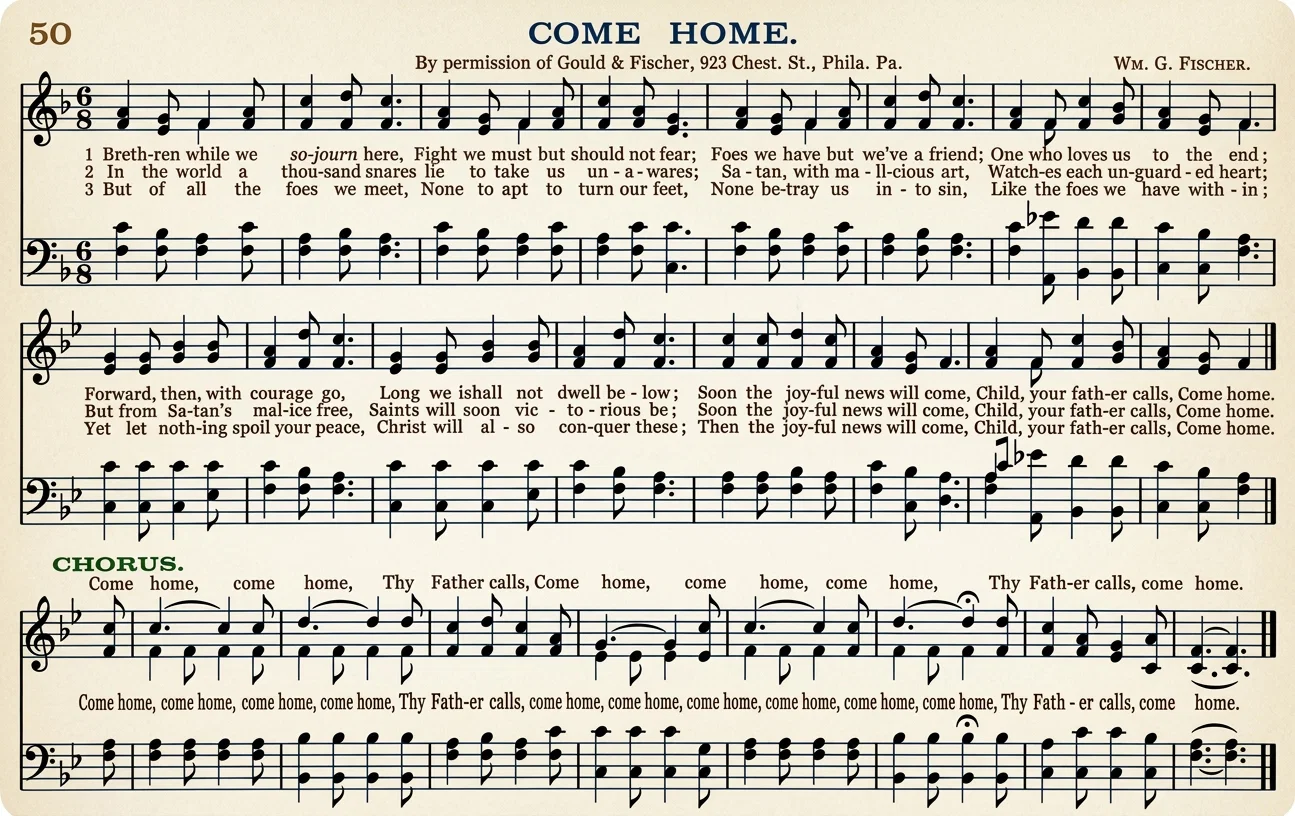
Come Home.

This music to the familiar hymn, ‘Brethren While we Sojourn Here,’ is one among the many excellent pieces contained in the new 64-page singing book, Hymns of Praise, published at this Office. The demand for the book requires a second 5000 edition which goes to press immediately. All the tent companies should be at once supplied, as it adds much to the interest of the lectures to have a book which can be supplied to the congregation at a low price, thus having the help of congregational singing.
Price in paper covers, 10cts. board, 15cts., cloth, 20cts. Address, SIGNS OF THE TIMES, Oakland, Cal.

Tent in San Francisco.

We have now held forty-six meetings in the tent in San Francisco. Sixteen have signed the covenant already, still others are in the valley of decision and we expect they will soon take their stand with us. We shall continue another week at least, laboring in public and from house to house for those interested, and those deciding upon the truth. We expect Brother Israel to join us this week to give himself entirely to the missionary work, and labor in San Francisco. This great city is an important, and ever new, field of labor. May the Lord give wisdom to rightly occupy the ground in our labors. Pray for us.         J. N. Loughborough, W. M. Healey.

Lemoore, Tent No. 2.

Up to date twenty-three discourses have been given in this place. From the commencement a good interest has been manifested, both by professors, and nonprofessors, notwithstanding a strong effort has been made to keep them away from the tent by those that supposed they held an undisputable control over the people. We are happy to find so many in Lemoore who are more in favor of Christianity than Church-anity.
May God bless them, and lead them on to know more of his truth. We have canvassed the questions of the nature of man, reward of the saints, and destiny of the wicked, and are now in the midst of the Sabbath question. Next Sabbath we hold a Sabbath meeting in the tent. May 17, 1878.                                     J. L. Wood,                                                      J. D. Rice.

North Pacific T. and M. Society.

Report of work done by the Tract and Missionary Society of the North Pacific Conference for the quarter ending April 1 1878.
DISTRICTS 1 2 3 Total
No. of Members 45 20 48 113
No. that Reported 21 21
No. Families Visited 20 9 90 119
No. Letters Written 10 3 60 73
No. New Subscribers for Signs 26 8 34
No. New Subscribers for Instructor 6 45 51
No. New Subscribers for Reviewer 4 9 9 22
No. New Subscribers for Reformer 13 9 22
No. Periodicals Distributed—Signs 50 233 283
No. Periodicals Distributed—Review 1 28 29
No. Periodicals Distributed—Instructor 2 8 10
No. Periodicals Distributed—Reformer 4 4 8
Pages Tracts and Pamphlets Dist. 3,706 7,979 7,107 18,792
Books and Pamphlets Loaned 3,982 3,982
MONEY RECEIVED.
1 2 3 Total
Received by Membership $1.00 $2.00 $3.00
Donations 9.10 19.00 28.10
Book Sales 5.70 1.70 7.40
on Signs 52.00 16.00 68.00
Review 8.00 8.00
Reformer 13.00 9.00 22.00
Instructor 3.00 22.50 25.50
Total $88.80 $3.00 $70.50 $162.00
MRS. A. P. VAN HORN, Secretary.
It will be seen by this report as compared with the previous one that there was not as much missionary work done as in the last quarter of 1877.
I suppose however that the workers had so much work of their own to do that the Tract and Missionary work was neglected somewhat. I hope there may be increased activity all through the different districts.
Brethren and sisters of the North Pacific Conference, you must remember that we are yet comparatively few in number. The load seems to go hard, in a financial way at least. But let none be discouraged. You have done well so far, and now arise and take hold of this work in earnest and the load will move. Let every one lift with all the strength they can put forth, and we shall see the precious cause of present truth prospering, and souls for whom Christ died prepared to meet him in peace. Come up, brethren, nobly to the work, and your reward will be sure among the blessed in the kingdom of God.
May 12, 1878.
I. D. VAN HORN, President.

Camp-Meeting Again.

The way is all open now, and favorably too, for our camp-meeting in Oregon. Yesterday I received a letter from the secretary of the O. S. N. Co., Portland, Oregon, granting the privilege to all coming to our meeting over their lines of travel, to return free.
The O. & C. R. R. Co. have granted the same privilege, as before published in the Signs, and they will also stop their regular trains at the camp-ground during the meeting. What could we ask more than this? With these privileges granted us, there should be a general turnout of our people. Who will refuse to come now?
The following directions should be strictly observed by all coming on the railroad to the meeting: All persons coming from Portland and intermediate stations should buy tickets to Salem, and all coming from stations south of Salem should buy tickets to Brook’s station. As the camp-ground is about half way between Salem and Brook’s, all will see the necessity of strictly adhering to these directions.
All coming to the meeting should bring bedding sufficient for their own convenience, so they can be comfortable. I have ordered one dozen camping tents which will be pitched on the ground ready for those to occupy who wish to rent or purchase.
There will be a store and restaurant kept on the ground where all can get provisions at a reasonable rate while the meeting lasts. Board can be had as reasonable as at any hotel. There will also be hay for teams.
We shall have in a book stand on the ground a good supply of all our publications where all can purchase books and tracts as they may desire. Any persons wishing to subscribe for our periodicals, the SIGNS OF THE TIMES, Advent Review, Health Reformer, and Youth’s Instructor, can have the privilege at the book stand. And all who are now taking any of these papers whose time of subscription is out or nearly out can have the privilege of renewing, and should come prepared to do so.
Now let us have as full an attendance at our first camp-meeting as possible. Let us come together prepared to work for the Lord, for the advancement of his cause in this Conference, and for one another’s good. Let us begin in earnest to sound out the warning notes of the third angel’s message in this new field where so little has yet been done. Come to the meeting praying for the revival of the work and power of God among us. Pray that the Lord may meet with us, and that the angels of the Lord may encamp round about us.
With this preparation and help our meeting will be a success. Much good will be accomplished, and all return to their homes and fields of labor with renewed strength and earnestness.
I. D. VAN HORN.
Salem, Oregon, May 16, 1878.

Sending Money.

AGAIN we request that all money orders, drafts, &c., be sent payable to “SIGNS OF THE TIMES.” We have just received one for $350. payable to James White, who is in Healdsburg, California. Before this can be used it must be sent to him for signature.

North Pacific Camp-Meeting.

The camp-meeting of the North Pacific Conference of S. D. Adventists will be held from June 27, to July 2, 1878. The place of meeting will be on the land of Adam Stephens, three miles north of Salem, on the line of the O. & C. railroad.
The second annual session of the North Pacific Conference will be held in connection with the camp-meeting. The proper number of delegates should be chosen by each organized and partially organized church, to represent them at the meeting. The yearly meeting of the Missionary Society of the North Pacific Conference will also be held at this camp-meeting.
Elder J. N. Loughborough of the California Conference will be at this meeting. It is also expected that Mrs. E. G. White, of Oakland, will be present. CONFERENCE COMMITTEE.

Northern Camp-Meeting.

I now design to leave San Francisco, June 10, for Oregon, to assist in arranging for, and attending the North Pacific Camp-meeting, to be held near Salem, from June 27 to July 2.
It is now expected that Sister E. G. White will attend the camp-meeting in Oregon. Let there be a general rally of all our brethren and sisters, both in Oregon and Washington Territory, to this meeting.
J. N. Loughborough.

Camp-Meetings.

CAMP-MEETINGS for 1878 are located and appointed as follows:— KANSAS, Neosho Falls, May 22-27 NEW YORK, East Aurora, May 29 to June 4 WISCONSIN, Madison, “ “ “ “ “ MISSOURI, Appleton City, “ 30 “ “ “ “ Gallatin, “ June 6-11 MINNESOTA, Hutchinson, June 19-25 OREGON, Salem,. June 27 to July 2

BUSINESS DEPARTMENT.

Received for the Signs.

$2.00 EACH. Mrs H M Brown 5-18, D S Heimstreet 5-26, Lucy P Bos 5-20, T Tollfson 5-20, A R Merriman 5-18, Fannie Dimmick 5-1, G A Baker 5-15, Charlie Anderson 5-20, J M Johns 5-15, Mrs H M Marshall 5-7, Mrs M J Foster 5-1, Mary J Foster 5-13, Mrs L A Hanson 5-15.
$1.50 EACH. James Conkling 5-25, John S Conkling 5-25, Mrs M J Sala 5-25, Mrs L B Hardwick 5-1, R H Semple 5-20, Mathew Wing 5-20, W H Moor 5-20, G A Gilbert 5-20, O A Gilbert 5-20, Mrs Millie Wible 5-15, Joseph Williams 5-15, Mrs Mary King 5-15, Rev G A Wilcox 5-15, Stephen Ellis 5-20, Mrs C H Grennell 5-20, Mrs Bina Ash 5-20, Zalman Nicola 5-20, E R Eldridge 5-20, C A Besse 5-18, Ira Christie 5-13, Michael Hunt 5-16, Mary Chandler 5-20.
30 CTS EACH. Christian Krayger 4-32, J P Jorgensen 4-32, Mrs Myer 4-32, Mrs C W Wolf 4-32, Mrs Valentine 4-32, John Eardley 4-32.
MISCELLANEOUS. Mrs Obrock 75c 4-44, Sarah Bowyers $1.00 4-33, W W Conkling (2 copies) 50c 5-9, A S Perrin 1.90 5-12, R Ritchmond 75c 4-44, Mrs H O McDearman (4 copies) 3.00 4-44, Mrs E M McFadden 1.00 4-48, Michael Dearer 12c 4-27, Mrs J G Finch 13c 4-27, Laura P King (5 copies) 3.75 5-19, J W Society Allens Corner Me (44 copies) 33.00 4-44, Lewis Hackett (2 copies) 3.00 5-20, H Potter (8 copies) 12.00 5-9, J N Lund 50c 4-36, Abram DeGraff 75c 4-44, Mrs J A Curtis 75c 4-44, John Donnelly 75c 4-44, Lizzie S Campbell 5.25 4-44, A P Faunce (12 copies) 18.00 5-20, E A Turner (10 copies) 10.00 5-4, I A Olmstead (4 copies) 6.50 5-16, B L Whitney (10 copies) 11.00 5-7, W E Stillman (8 copies) 12.00 5-5, G W Adams (9 copies) 13.50 5-18, S B McLaughlin (5 copies) 7.50 5-20, William Harris (2 copies) 3.00 5-20, Mary A Washburn (6 copies) 9.00 5-20, Mary A Hare (3 copies) 4.50 5-20, Parmelia A Dickey (3 copies) 4.50 5-20, Mary F Conkling (2 copies) 3.00 5-20, R Ashly (6 copies) 9.00 5-18, Thomas Cottle (11 copies) 16.50 5-18, A H Bradford (4 copies) 6.00 5-17, A H Wentworth (5 copies) 7.50 5-19, Ebenezer Scribner (2 copies) 3.00 5-9, Mrs Mary P Cook (2 copies) 3.00 5-17, O Hough 65c 4-19.

Received on Account.

Cal T and M Society $57.40, Maine T and M Society 50.00, New York T and M Society 350.00, Ruel Stickney 11.72.

Tent Fund.

Green Valley $3.90.

California Conference Fund.

Green Valley $2.80, Christine church 227.49.

European Mission

Ruel Stickney and wife $100.00.

JAMES A. SMITH

Obituary.

DIED, near Milton, Umatilla Co., Oregon, April 19, 1878, my beloved wife, Elizabeth Smith, aged 25 years and 6 months and 18 days. Her sickness was painful but she endured her sufferings with much patience and resignation. She embraced present truth eight years ago, under the labors of Brother J. Bartlett, in western Iowa, she was baptized by Brother R. M. Kilgore in the spring of 1874. She lived an exemplary life. Our hearts ache as we see what death's ruthless hands have done, yet we believe she will awake and come forth when the last trump shall sound. She leaves a husband, five little children, and many friends to mourn their loss. Letters of condolence from our absent friends will be gladly received. Discourse by Brother S. Maxon, from Phil. 3:10, 11.
“She sleeps in Jesus! blessed sleep.”

JAMES A. SMITH

Another Addition.

Our friends and patrons will be pleased to know, as we are pleased to inform them, that we have added a new and valuable feature to the SIGNS printing establishment. We have purchased the stereotype and electrotype machinery of Mr. Jas. S. McLaren of San Francisco, and are now prepared to do work in this line in a substantial manner. The former proprietor has covenanted to be one of us, and labor with us; and we have engaged him to take charge of our new enterprise. He is a thorough workman, as we have tested to our satisfaction. Aside from being a business accommodation to the community, this addition to our publishing house will add much to our facilities for spreading present truth cheaply and expeditiously.

Our Sanitarium.

WE give in this week's SIGNS, the report of the dedication of our Sanitarium building at Battle Creek, Mich., and the appropriate address by Elder Canright. We were called to Battle Creek more than one year since to take charge of the general management of the large building. This with other laborious work proved too great a tax upon our strength, and we have been a sufferer for nine months. And not finding all that benefit we hoped by visiting this State we have determined to return to Battle Creek to be under the skillful treatment of Dr. Kellogg, and his fellow physicians. J. W.

You have reached the end of this edition.

Signs of the Times · May 23, 1878