The Youth’s Instructor, Vol. 65, No. 13.

CHEER UP!

The Youth’s Instructor

Mar 27, 1917

Review and Herald Publishing Assn. · Takoma Park Station, Washington, D. C. · Mar 27, 1917

CHEER UP!

[ Let a boy recite this, with the exception of the “Cheer up!” For this, train a company of girls, who will sit in the front row, and come in at the proper places with their birdlike chorus.]
A little bird sings, and he sings all day; “Cheer up! Cheer up! Cheer up!” No matter to him if the skies are gray — “Cheer up! Cheer up! Cheer up!” He flies o’er the fields of waving corn, And over the ripening wheat; He answers the lark in the early morn In cadences cheery and sweet; And only these two little words he sings, “Cheer up! Cheer up! Cheer up!” A message to earth which he gladly brings: “Cheer up! Cheer up! Cheer up!”
He sings in a voice that is blithe and bold, “Cheer up! Cheer up! Cheer up!” And little cares he for the storm or cold,— “Cheer up! Cheer up! Cheer up!” And when in the winter the snow comes down, And the fields are all frosty and bare, He flies to the heart of the busy town, And sings just as cheerily there. He chirps from his perch on my window sill, “Cheer up! Cheer up! Cheer up!” This message he brings with a right good will: “Cheer up! Cheer up! Cheer up!”
This dear little messenger can but say, “Cheer up! Cheer up! Cheer up!” As over the housetops he makes his way — “Cheer up! Cheer up! Cheer up!”
O let us all learn from this wise little bird A lesson we surely should heed; For if we all uttered but one bright word, The world would be brighter indeed. If only earth’s children would blithely say, “Cheer up! Cheer up! Cheer up!” How jolly a world would be ours today! “Cheer up! Cheer up! Cheer up!”
— Amos R. Wells.

Miscellaneous News Items from the Periodical

According to the latest figures from a reasonably reliable source; the European war has cost over $61,000,000,000, or nearly three times as much as the twenty greatest wars, before the present one, in the last hundred years.
Anna Dickinson, who was the pioneer and most distinguished woman public speaker in America, was paid forty thousand dollars by the National Committee to campaign for Horace Greeley, and the same amount to help defeat Grover Cleveland.
A governess once tried to give her pupils some idea of the relative size of certain distant countries by saying, “Cambodia is about as large as Siam.” But when one of the little girls attempted to repeat the information in a written exercise, she put it thus: “My governess says that Cambodia is about as large as she is.”
The Senate, on January 25, passed the House bill to provide a National Leprosarium for lepers in the United States. The United States Public Health Service is authorized by the bill to proceed with the selection of a site and the erection of buildings. It is expected that this law will not alone provide care for the lepers, but will make it possible entirely to eliminate leprosy from the country.
The California big trees are safe, at least from the ax, and probably from fire. By the gift of $20,000, the National Geographic Society has enabled the government to take over the Giant Forest—a table-land about two miles in diameter in the heart of the Sequoia National Park. The tract includes the largest trees in the world, one of them thirty-six and one-half feet through at the base and two hundred and seventy-nine feet high. They are also the oldest living things in the world.
Roquefort cheese, now selling at eighty cents a pound, is a French product. Manufacturers have claimed it could be made of sheep’s milk only, and must be aged in caves of low temperature and high humidity, the process requiring about four months. But our Department of Agriculture, after an eight years’ attempt to produce a product equaling in every way the French cheese, have succeeded in their task. Cow’s milk is substituted for that of sheep, and refrigerators for the caves. The price, too, is about one fourth that of French Roquefort.
“Henry Ford, still healthy, and strong enough to ride in his own automobile, left the farm at sixteen to become a machine apprentice in Detroit. A few years later, when he married, he accepted the gift of an eighty-acre farm from his father, and tried to interest himself in agriculture. But it was no use. He was back in Detroit after a few months, working twelve hours a day as an engineer for $45 a month. In 1898 he organized the Auto Company, and received a salary of $100 a month as engineer; and in 1903 he was able to start the Ford Motor Company, and to increase his salary to $2,400 a year. But always he saved—and the Ford Motor Company is one of the few great industries in the country that have been built entirely out of their own savings, without the aid of borrowed money.”
Wonderfully beautiful effects are secured by the use of marble instead of glass as a means of transmitting light. This has been accomplished by a process devised by an engineer of Hamburg, Wilhelm Engle. He succeeded in making plates of marble no more than three millimeters in thickness, and for the use designated it is available up to twenty millimeters thick. The suitability of marble for this purpose was realized some years ago, but the difficulty encountered was that of obtaining the marble in slabs of sufficient thinness. These plates permit of the passage of a greater amount of light than frosted glass does, and at the same time impart to the rays a much pleasanter color. Most opal glass imparts to the light an undesirable greenish tinge, while the light that passes through the marble has a reddish violet tinge that is much more agreeable. After the marble has been ground down to the desired thinness, it is subjected to an immersion in oil under high pressure. The effects secured in this manner are said to be superior to those attained with the use of stained glass.
The Bureau of Manufactures of the Department of Commerce has gathered information with reference to the industry that has of late sprung up in western Texas for the making of wax from the wild candelilla plant. Experiments in this line were begun on the desert plant in Mexico a few years ago. On account of the difficulty of refining the crude product, its value was not immediately recognized. Not long ago a process was discovered for refining the crude wax, and regular shipments are now being made to New York. The candelilla weed flourishes on land that was formerly deemed worthless, and is harvested by Mexican labor at low cost. The method of extracting the wax is simple and cheap. Large tracts of land owned by Texans are covered with candelilla weed, and firms operating the different factories are now trying to obtain long leases of them. The refined product is used in the manufacture of phonograph records and for various other purposes. It is said to be the highest grade of vegetable wax known.
For the safety of our song birds it is proposed to require owners of cats to pay an annual license tax and to confine or tether pussy at night. “Dr. Frank M. Chapman, of the American Museum of Natural History, New York City, believes that there are 25,000,000 cats in the United States. There may be twice as many; but if we assume that only one fourth of the 25,000,000 cats live in the country and kill only five birds each year, we have 31,250,000 birds killed by cats annually in the farming and forest regions of the United States alone.”

Brain Rust

MRS. M. A. LOPER
A few weeks ago I was forcibly impressed by the protest of the editor of the INSTRUCTOR against being called “Takoma Park Station,” instead of having her mail addressed properly.
Such a protest would be amusing were it not that there is a serious side to it.
There are persons in the world who prize accuracy, and whose work bears that stamp as they go through life. Such persons believe “it is better to wear out than to rust out.” But many who have heard this maxim, have never taken time to comprehend its meaning.
A machine may be very valuable. It may be perfect in mechanism and beautiful in appearance, but if it is never put to service, its polished steel will become rusty, and in time it will become useless.
There are many people the delicate mechanism of whose mental machine is becoming rusty — rusty from inactivity. There are young people who are beginning to show symptoms of mental rust, some of whom would gladly escape the malady if they were properly enlightened in regard to it, while others need to be convinced of the direful consequences if they do not make use of the preventive.
The editor’s protest against not using the mind when real service is needed, awakened memories of a lad I once knew who visited our farm home during the happy days before my father’s death. My father, being fond of honey, enjoyed caring for his own bees. One day he was somewhat nonplussed by the lad’s thoughtless inquiry, “How many bees are in a hive?”
On another occasion the young visitor was out in the grain field, and was attempting the feat of driving real live horses. He was told to drive between two certain shocks of grain. Without comprehending the simple English of the one directing the work, he absent-mindedly inquired, “W-h-i-c-h s-i-d-e?”
As before stated, a machine is kept bright through use. The mind is kept bright in the same manner. Do not be afraid to use it; it is given for that purpose.
It is the rare exception that one uses the mind too much along right lines. The fact is, few minds are kept as bright as they might be.
The faculty of memory is given us for service, and there is no age limit to which it is confined. But how easy it is to be heedless even in the little things of life, and when something has been neglected, to excuse ourselves with the self-condemning statement, “I forgot.”
If the memory is allowed to be largely dormant while year after year passes by, the task of remembering will become more and more difficult. Many among the older people seemingly believe that they are excusable for not memorizing texts of Scripture or other valuable thoughts. They consider the Morning Watch texts a difficult task, so difficult that I fear many do not even read them regularly.
We never feast on mental food that we do not put forth some effort to secure.
God wants these intellectual machines of ours to be used in doing their best thinking and their best memorizing. He wants every one to keep this delicate, divinely constructed mechanism in the very best condition for the most valuable service.
If the mind is permitted to lie dormant beyond certain limitations, it will never become what it might have been if it had been rightly used earlier in life and all along the way.
To use this mental machine ruthlessly, in a way for which it was never designed, is as injurious to its delicate mechanism as mental rust. The brain was constructed by the great Creator for thinking along spiritual, moral, and uplifting lines. Such activity tends to keep it in repair and to prolong its usefulness.
It is a sacred responsibility which rests upon every soul — that of properly caring for his own intellectual machine, which is such an important part of the “temple of the Holy Ghost.” We are told that “the intellect should be cultivated, the memory taxed. All intellectual laziness is sin, and spiritual lethargy is death.”
Life is made up of little things — minutes. All the good one ever accomplishes is done in that infinitesimally small space of time known as the present, which is ever with us, and yet is constantly urging us onward in years, whether we practice mental activity of a high order, or allow our minds to become dull through wrong thinking or rusty through inactivity.
All the self-improvement we ever make, is made in this “little space between two eternities.”
Brain rust is very easy to contract, but very difficult to cure when it has become chronic.
Brain rust is catching — do not forget your responsibility to others.
The preventive and cure (when curable) lie in conscientious Christian activity.

How These Signs Impress Men

Signs of Christ’s Coming — No. 6

How These Signs Impress Men

At the second advent of Christ, human history closes. All the plans and speculations of men suddenly come to naught. The cities of the nations fall, and the whole earth is turned upside down.
Such a tremendous cataclysm as the destruction of the world will not come unannounced. It will not be kept secret. Every one involved in this catastrophe, whether he will be saved out of it or not, will be given an opportunity to know about it.
The signs of Christ’s coming that have been mentioned in previous articles, and many others, are indeed stirring the inhabitants of this world. That is God’s purpose. He would be pleased to have all prepare for that event. But, sad to say, the majority prefer to continue in their own ways, until that day comes upon them as a thief in the night.
There are many explanations of present-day events, and various interpretations of the Bible prophecies in relation to these events. Yet there is a striking unanimity of belief that these things point to the near second coming of Christ.
The premillennial return of our Saviour is a definite doctrine of belief in a number of churches. Men are arising here and there teaching this truth in practically every denomination. Books dealing with this subject are becoming numerous, especially since the great European war broke out. Sermons on the signs of the times are being preached everywhere.

Roman Catholic Testimony

In a clear, definite voice, a Roman Catholic missionary priest appealed to his fellow communicants some years ago. His articles first appeared in several of the leading Catholic papers, and were later published in book form. Speaking of the signs of the times, he wrote:—
“Let us be serious; let us think and reason and speak like men and like Christians. Let us be persuaded that the end of the world cannot be very far. Scripture, tradition, the Fathers of the church, most learned, grave, and pious authors, older and more modern saints, and innumerable servants of God of every age, class, and condition in life, belonging to almost every country upon earth, announce its approach. Famine and pestilence, seditions, revolutions, rebellions, wars, schisms, heresies, the frightful increase of vice and crime in society, charity cooling, iniquity abounding upon earth, earthquakes, destructive conflagrations, terrible accidents on land, shipwrecks on the ocean, sudden deaths, increasing mortality, visions in the sky, disorder in the seasons, spots on the sun,—all nature, in short, announce the pangs of dissolution. But the majority of men affect to be incredulous. This, as we saw above, is an additional sign of the end of the world foretold by our divine Saviour. Let us then believe and act like sincere and devout Christians. Let us place our treasure in heaven and our heart with our treasure. If we are poor in earthly goods, let us rejoice, for we shall leave behind fewer materials as fuel for the universal conflagration.”—The Christian Trumpet, pp. 278, 279 (published 1874).
“Meditation for Advent” is a tract written by a Jesuit, and published by the International Catholic Truth Society. It is circulated at the present time. “One of the signs of the second coming of our Lord being nigh at hand will be that no one will expect it,” says this booklet. “All the world will be satisfied that things will go on as hitherto for many a century, and they will ask: Where is the promise of his coming? . . . The very fact that we think the world has still centuries to run, may be an indication that the end is not far away.”—Id., pp. 17, 18.

Presbyterian Belief

“The Master shamed those who knew ‘how to discern the face of heaven’ yet could not ‘discern the signs of the times.’ What is signified today by ‘signs of the times’ more lurid than any that have dawned on this world for a hundred years? . . . There are, of course, a multitude of Christians who believe this present convulsion to be the veritable fulfilment of what is written in the twenty-fourth of Matthew and the twenty-first of Luke: ‘There shall be signs in sun and moon and stars; and upon the earth distress of nations, in perplexity for the roaring of the sea and the billows; men fainting for fear, and for expectation of the things which are coming on the world.’ To such, what is now happening is, therefore, only the prophesied prelude of the quick return of the Lord in glory. . . . And they may be right. . . . And if such is God’s will for an immediate day at hand, every Christian should gladly cry, ‘Even so, come, Lord Jesus.’”—Editorial in The Continent, Aug. 13, 1914.
In the “Brief Statement of Doctrine by the Southern Presbyterian Church,” the denomination is urged to “toil and pray for the speedy coming of the day when our glorious Lord shall see of the travail of his soul and shall be satisfied.”—United Presbyterian, June 12, 1913.

Methodist Views

A contributor to Zion’s Herald (April 23, 1913) states that “one of America’s most noted evangelists said to me some months ago on the ship in which he was sailing for a foreign campaign: ‘If I did not believe in the soon coming of Jesus, I should give up in utter despair, since church work is now so hard.’”
“The Second Coming of Christ” was a subject for discussion at a western Methodist meeting. We find these words in the Pacific Christian Advocate (April 7, 1915): “We think that Christ can come at any moment. We want to be prepared. It is urgent that every means be employed to tell the glad tidings to all the world and especially to those about us. We have no sympathy with the idea of setting a date for his coming, but he will come soon, and may come any moment.”

Word from a Lutheran

Writing under the title of “Signs in the Sun, Moon, and Stars,” a correspondent in the Lutheran (Dec. 5, 1912) says: “The old church fathers held that there was a spiritual meaning to these signs, besides the literal one, and their interpretation only impresses us the more with our nearness to the Saviour’s second coming. . . .
“When the professed followers of Christ, called Christians after him, no longer do the works of the Master or even proclaim his excellence, how Satan must rejoice, and how near the time be of his downfall, together with this world.”

A Baptist Interpretation of Prophecy

A striking article on “Turkey—Its History and Prophecy,” is found in the Word and Way of Sept. 9, 1915. The writer states that “Christians are peculiarly blessed in having the last days laid bare before them by the prophets.” “By searching the Scriptures, then, we learn that the door of the future hinges upon the Ottoman Empire, or Turkey.”
He rightfully says that “the king of the north—Turkey—will ‘plant the tabernacle of his palace between the seas in the glorious holy mountain,’ and that ‘this can be no place but Jerusalem.’” “When Turkey becomes so hard pressed that she cannot hang on any longer in Constantinople, in Europe, the sultan will take refuge in Jerusalem.” Then, shortly, Michael “will appear on the scene, and after a brief time of unprecedented trouble close the book of time forever.”

The Christian Church

“Why should it be thought a thing incredible that we should live at the end of an age?” asks the editor of the Christian Standard (April 4, 1914). “The assurances of the Lord often point to such a culmination of things, and the developments of past decades, both in race movements and in material development of natural resources, give evidence that mighty forces are at work hurrying on toward a climax of some sort.”

Other Religious Periodicals

The New York Weekly Witness (May 7, 1913) publishes an article on “The Signs of the Times,” in which it is pointed out: “Already we hear in the distance the mutterings of the storm; already in the distress of nations with perplexity, in the lowering of the standard of morality, in the craze for pleasure, in the neglect of God’s house, and the contempt for his Word and commandment, we see tokens of the last great struggle between good and evil which is yet to be waged.”
Under the same title a writer in the Herald of Light (April 24, 1915), appeals to his readers: “Let us pay attention to what our Lord said when he was on earth, recorded in the twenty-fourth of Matthew, twenty-first of Luke, and thirteenth of Mark, and also a few of the utterances of the apostle Paul recorded in 2 Tim. 3:1-4. Many other references could be given, but time and space forbid. As I read the Word of God, I am strong in the belief that night is settling down upon this old world and we are near the closing out of this gospel age. . . . Jesus is coming!”
The testimonies from various persons expressing a belief in the near coming of our Lord, as quoted above, are significant. They indicate that God’s Spirit is working upon men’s minds and hearts, and calling their attention to that wonderful event. Different writers are impressed with different signs, but they all agree that something is about to happen. We are glad to say that the majority believe the signs point to the second advent.
Thousands have read the articles containing these thoughts. How many will be stirred to prepare for his appearing?
Let us look up and lift up our heads, for our redemption draweth nigh. Luke 21:28.
CLAUDE E. HOLMES.

Items from Porto Rico

ONE of our sisters whose husband is a canvasser, cares for her family, and has gathered more than twenty persons into a Sabbath school. Some of these are keeping the Sabbath as the result of her teaching. This shows what can be done by one in a locality where the truth was formerly unknown.
Remote from any one of our faith, a Presbyterian pastor and his wife accepted the truth by reading books sold him by a canvasser.
Another pastor is said to be observing and teaching the Sabbath truth, while still holding his pastorate in the Methodist Episcopal church.
The janitor in one of the city churches studied and accepted the truth, thereby losing his work as janitor. His mother, too, is exceedingly happy in her new-found faith. The man also who succeeded to the janitorship lost the work because he investigated the truth and began keeping the Sabbath. His wife, who was previously unconverted, is now accepting the commandments of God and the faith of Jesus as her rule of life.
When any of the literature sent us from the States is soiled before mailing, or becomes soiled or worn on the journey through insufficient wrapping, so that we do not wish to present it to the people, we place it in a reading rack, when it can be taken by any one wishing to read. One morning a card was found in the rack, asking for literature in Spanish. The address was given, and the family has been visited, with encouraging results.
In the western part of the island are two public school teachers who are living the truth, and give promise of becoming valuable workers. They are doing much in connection with their teaching work. One has already done some translating for us from English into Spanish. We have a Sabbath-keeping printer, and when our prayer that the mission come into possession of the much-needed printing press, is answered, we shall have more literature in the language most needed here.
Pastor Fitch was traveling by railway, and was delayed for several hours by a wreck. The time was utilized in Bible study with the passengers, among whom was a teacher who had been educated a Catholic, but is now a Spiritualist. She became interested to the extent that she consented to receive a Bible, and it has been sent to her. It seems that many Catholics are renouncing that faith to accept of the spiritualistic belief.
The worth of the writings of Mrs. E. G. White is evidenced by the practice of a native pastor who has not yet accepted the truth, but who willingly acknowledges that he bases his sermons on the contents of the book, “The Great Controversy.”
The first license given to a native of Porto Rico to act as a minister of the Seventh-day Adventist denomination, was recently received by Brother Salvador Rivera, formerly pastor of a Baptist church. He has proved his efficiency by helping several others to see and accept the truth.
The superintendent of this field was absent several weeks. On his return it was a joy to present him with several converts. So will it be when Jesus comes. May he help us each to have many sheaves to present to him for his garner.
Mother Benjamin is ninety-one years of age, and is about the happiest Christian in Porto Rico. Though old and lame, she goes about with a wooden tray on her head, selling fruit, and a fruit beverage which she makes in her own home.
Her birthday came a few weeks ago, and she had saved the requisite amount for an offering—a penny for each year she had lived. Very few have occasion to give so much for a birthday offering.
I just met her on the street, and she said, “The Lord has been good to me this week. I have worked four days and have cleared thirty cents every day, and now I am going home.” This was Friday, and she hastened on to get ready for the Sabbath. She aims to have literature with her to give as opportunity presents. MRS. D. A. FITCH.

Beauty and Plainness

AN Indiana reader writes to ask: “Can a poor woman whose face is ugly live that kind of Christian life that brings glory and honor to the name of Christ? Does she ever have as much influence over the unregenerate as does the woman of beauty or the woman who, being less beautiful, has a sizable bank account?”
Neither ugliness nor beauty is merely physical. Either is largely self-made. The most irregular features become beautified by the glow of kindness and spiritual fervor; the most perfectly formed face may be marred and rendered repulsive by coldness or the scowl of greed, vindictiveness or envy. One of the most famously beautiful women now living is horribly pock-marked. The most attractive, most loved, and most influential women of all history have not, as a rule, been known as beautiful.
The power of mind over matter, of which we hear so much, is as nothing compared with the power of the soul over the face. Mere physical beauty has been vastly overrated by the artists and poets. The man who loves his sweetheart or wife simply because of the symmetry of her form and features, and without sounding the depths within, does not know what true love is. Who thinks of selecting one’s friends because of their straight noses? More than that—far more than any outer feature—is essential to friendship worthy of the name. Who does not love a dear old mother, despite perhaps a wart on her nose and wrinkles in her cheeks? A lifelong devotion has generated in her a spirit of real beauty that no physical deformity can shut in. Beauty of face and form is a gift of the gods, maybe; but the beauty of soul which illumines and makes lovely the plain face is a far richer gift still, coming from the true God. The answer to each of the questions above is, Yes.—Christian Herald.

An Aim in Life

THERE is a great question that enters the mind of every thoughtful young man who has begun to think seriously of life: What is my life work? or, What is my aim in life?
These questions are of paramount importance. They are of profound significance, and command the attention of every young person. “What is my aim in life?” This seems to ring constantly in his ears, demanding an answer. Will he give this matter superficial thought? or will he, with solid judgment, consider it with due respect for his personal welfare?
One author has said, “The aim in life is what the backbone is to the body: without it we are invertebrate, some lower order of being.” How evident it is that the great question with every young man is, What am I to be? This aim in life is what an architect's plans are to a builder. A course must be “visualized” before it can be pursued. One must know where he is going before he can get there.
Many people fail, simply because they do not have a clear idea of what they desire. “In the battle of life, those succeed best who can form definite ideas of what they are going to do before they start to do it.” After an architect, on the witness stand, had given an explanation of the difference between an architect and a builder, the opposing counsel hurled this question at him: “Pray tell us, Mr. Architect, who was the architect of the tower of Babel.” The architect replied, “There was no architect, sir; hence the confusion.”
With a definite ideal in mind, one must make it his “insistent desire,” from which nothing but death can separate him. When this spirit is exercised toward the supreme purpose of reaching that ideal, success is inevitable. Failure may come, but “a thousand failures are forgiven and forgotten to him who wins the decisive struggle.” A. E. NELSON.

Visiting Solusi Mission's Outschools: Traveling to Samuel's School

Visiting Solusi Mission’s Outschools — No. 2
WE left Gilbert’s school at ten-thirty Wednesday morning and soon reached the Zuzumba River, down which we traveled several hours. Along this river we saw much small game, such as wild guinea fowl, pheasant, stembuck, and ducker (a larger buck). A little late in the afternoon we camped for dinner, just before leaving the river. After crossing a stony ridge, our road to Samuel’s school took us down into the Godzo River valley. Soon after sundown we camped for the night on the bank of this river. In a short time we had a large pile of wood near the wagon for our night’s camp fire. There are no lions in this part of the country, except as two or three sometimes pass through; but the native keeps his camp fire burning all night, especially if it is the least bit cold.
At this particular place where we camped there were no native kraals near, so this was the first, and, in fact, the only night of the ten we were out that we were left entirely to ourselves. While I did not realize that it interfered with my pleasure or efficiency in the least to have from five to twenty natives and several of their dogs around when I was preparing and eating my meals, yet somehow I believe my supper and breakfast tasted a little better in the absence of thin dogs and extremely dirty babies and children.
One of the accompanying pictures shows half of a group of twelve little girls who came down to our wagon one morning to watch the white man. We were outspanned for breakfast, and they stood near watching my breakfast from the time it came in sight for preparation till it went out of sight for assimilation. It happened to be my morning to shave, and they watched that process with great interest until I suddenly reflected the sunlight into their faces with the mirror, when they scattered like a flock of quail into which a shot had been fired. But most of them soon learned that it was not anything that would hurt them, so they returned. Two, however, I drove all the way home by occasionally throwing the light at them, when they would run a little farther.
Thursday we broke camp at 8:30 A. M., and began the remainder of our journey to Samuel’s, still traveling away from home. We reached there soon after one o’clock. This gave me nearly the entire afternoon to visit with Samuel, and learn what he was doing, and the general facts concerning the people of his community.
At that time Samuel had no school because of the busy harvesting time, when the children are taken from school to help gather the harvest. Yet he was not idle. He puts in full time every Sabbath going round to the kraals, holding meetings and reading his Bible to the people. He takes time during the week to visit the sick and minister to the needy. He told me how he helped a little boy who was bitten by a snake. He was down at the river getting water when he saw a boy running and crying loudly. As soon as he learned that the boy was bitten by a snake, he ran to a store some distance away, where he got some medicine from a white man who told him how to use it. He applied the medicine according to instruction, then carried the boy home on his back. He went to see him every day till he was well.
Samuel is a man who has implicit faith in the promises of God, and he goes forward in his work with a childlike confidence and trust that is in advance of that of many of his white brethren. He told me what he did in another experience he had, and it helped me to realize as never before that if more of the same spirit characterized my own work I should see greater results in my efforts. He was called to see a sick woman whose condition was critical. Because of the nature of her illness there was nothing whatever he could do for her, so he knelt down and prayed for her. He went every day after that to see her, and all he did for her was to pray. He said she was well in a few days.
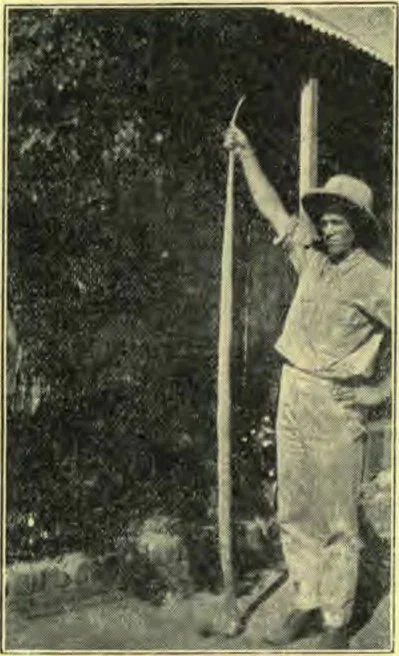
Large cobra killed near the Solusi Mission. Mr. Robinson holds the snake.
I asked Samuel something of his earlier life, and he told me he had been over nearly all of South Africa. He served during the last two years of the Boer War, most of the time driving the mules of a Maxim gun for the English artillery. He speaks English quite well. He came to the mission ten years ago, where he attended school several years and learned the truth. He was baptized, and because of his simplicity of life and earnest Christian experience, he was sent out as an outschool teacher, in which work he has since remained. Today he is one of our most trusted and faithful teachers.
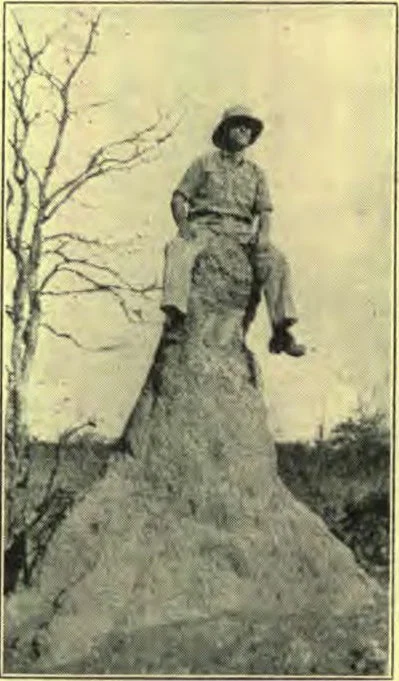
A white ant heap by the roadside.
Because of his earnest efforts in his community he has recently sent three girls to school here at the main station, and two of them are members of our large baptismal class. Other girls say they are going to come to the mission. Two did start, but were overtaken on the road and compelled to return. There are even married women who desire to come here to school, but are held back because of the cruelty of their husbands. The two girls who are members of the baptismal class are quiet and faithful in their work, and manifest every indication of true conversion.
During the evening we spent at Samuel’s, a company of twenty gathered around our camp fire. Samuel read a chapter from the Bible, explaining it as he proceeded; then we had prayer, after which a half hour or more was spent singing our good songs. This company seemed to be those of Samuel’s nearest neighbors, who not only were his intimate friends, but were interested in the truth.
Thursday afternoon Samuel had sent word to everybody to come to the meeting Friday morning. At half past nine we opened the meeting in his front yard, with but thirty persons present from the many kraals around. Human nature seems to be the same in every country and among every people — satisfaction, contentment, and indifference. Samuel said many of the people around him did not care to hear the Bible. But we had a good meeting with those who came.
After the meeting and the usual dispensary work which followed, we were off for Henry’s school at 11 A. M.
RALEIGH P. ROBINSON.

“Take It to the Lord in Prayer”

A DEVOTED and successful young minister was telling of the struggle he had to earn money, to get through his first year at college. He had enough to cover the tuition, and received a little outside help, but even with that aid he subsisted for most of the year on very limited rations.
By spring his meager resources had become exhausted, and he began to feel the pinch of real poverty. He made his great need a matter of earnest prayer, but conditions seemed to grow worse. At length, finding himself with nothing to eat, and unwilling to tell of his plight, he decided to leave college and go to work.
That night, while he was packing up his books, there was a click at the letter slot in the door and an envelope dropped into the room. Opening it, he found a twenty-dollar bill. That bill tided him over the turning point in his life, for it gave him courage and help to complete the school year. He has never discovered who gave him the money. Up to the time he received the gift, it was his thought that no one knew of his need.
It pays to stay and pray.
ERNEST LLOYD.
Continue reading: Prayer Is More Powerful Than Gunpowder