Mr. Moody once said, “Prayer is more powerful than gunpowder.” “How do you know, Mr. Moody?” a friend inquired. “Well,” he said, “during the Civil War I was holding a meeting in Nashville, Tennessee, when a young soldier came to me with a letter in his hand, trembling from head to foot. ‘Mr. Moody,’ he said, ‘I want you to pray for me. I have just received a letter from my sister, and she tells me that this very evening, as the sun goes down, she is on her knees in prayer to God for my salvation. I don’t know why it is, but I have been trembling like a leaf ever since I received this letter, and I am afraid that something dreadful is going to happen unless I am converted.’ The prayer was offered, and the soldier was saved. This young man, with all his bravery before the cannon’s mouth, was at heart an infidel. He did not believe in prayer or in Christianity, but his sister’s prayer of faith, six hundred miles away, made him tremble from head to foot with the ague of conviction, which the dangers of battle could not do. Therefore I say that prayer is more powerful than gunpowder.”
A Poor Man
A MAN is poor when he has lost the confidence of his friends, when people who are nearest to him do not believe in him, when his character is honeycombed by deceit and punctured by dishonesty. He is poor when he makes money at the expense of his character, when he does not stand clear out, supreme in his idea. When this is clouded, he is in danger of the worst kind of poverty. To be in the poorhouse is not necessarily to be poor. If you have maintained your integrity, if your character stands forth square in the world, if you have never bent the knee of principle to avarice, you are not poor, though you may be compelled to beg bread.— Queensland Freemason.
Live Today: Tomorrow Never Yet Rose or Set
“LIVE, live today. Tomorrow never yet On any human being rose or set.”
Peter’s Death
By R. S. Owen
IN the early light of morning gray, The watchers at the prison say That Peter now must meet his doom, And meet it in the prison tomb. The word is passed from guard to guard, From court to corridor and yard; Then out upon the streets it goes Into the ears of friends and foes, That Peter, who his Lord denied, Today is to be crucified.
Throughout that Roman city there, A hundred hearts hold Peter dear; A hundred knees are lowly bent, A hundred prayers to heaven are sent. The throne of deity is sought That Peter may not be forgot, That Peter, who his Lord denied, May faithful prove when crucified.
About God’s throne there stands a horde Of mighty angels of the Lord; Anxiously they wait the word. The Father speaks, command is given, And angels leave the court of heaven. The gates of heaven now open swing: Hark! how the heavenly arches ring. Hark! what a joyous song they sing. On wings of light they speed away To be with Peter on this day; For Peter, who his Lord denied, Today is to be crucified.
But Peter, agèd, worn with care, Is sleeping all unconscious there, Because he thought how once before, An angel came to his prison door, And led him out into the street, And sent him forth his friends to greet, And bade him preach “the word” to men, That Christ our Lord is risen again. And since that Christ is living still, He sleeps submissive to his will.
In dreams he’s led once more to see His fisher home in Galilee,— The nets, the boats, the grassy shore, The youthful faces as of yore; And again he hears that strange report Of a prophet of the ancient sort. So midst the multitude he goes, To grassy banks where Jordan flows, And hears that prophet strange declare, “Messiah stands among them there.” The hope of Israel has come To manifest himself to men.
Responding prompt to Andrew’s call, He meets the mighty Lord of all; And again as his disciple, he Tramps o’er the hills of Galilee. He hears the dumb chant glad refrain, And sees the sick made whole again, And sees the lame leap as a hart. He sees the grateful teardrop start; He sees the multitudes in love Follow the Saviour’s every move. He hears the Master’s “Peace, be still;” Lo, wind and waves obey his will. He sees the maniac so wild, Become submissive as a child. He sees the leper—loathsome one— Kneel lowly to God’s holy Son, Then, joyful, hasten to his home, From whence he was condemned to roam. He sees a life, so full and sweet, Poured out the needs of man to meet.
Beside all this, in strange contrast, He sees his life from first to last,— Ambitious for self, forward to speak, Proud, boastful, inclined the best to seek. Impulsive, ready and quick to act, Then just as ready to retract. He sees the palm branch waving now, And sees the throng on Olive’s brow. He hears the lisping ones proclaim Their blessings on that holy name. To Zion now has come her king, Today let all rejoice and sing. He sees within the upper room The thirteen sit in darkening gloom. He hears the Master as he saith, “As emblems of my coming death, This wine and broken bread I give: Take, eat and drink, and live.”
Before him lies the garden now. He sees the Saviour’s pallid brow, And he himself so fast asleep, When asked one hour a watch to keep. He sees the sword, the severed ear, He hears the mocking rabble cheer. He sees the soldiers and the maid, He sees the fire where coals were laid. He sees the Pharisee’s proud scorn, He hears the cock’s shrill clarion, He hears his words, oh! dreadful thought, “I am not he! I know Him not.” He sees that look of love so true Which cleft his traitor heart in two.
Mistakes, mistakes, how thick they stand Throughout his life on every hand. Still, as he views those record leaves, With gratitude his bosom heaves. For o’er it all, he sees there written, And sealed with blood by the King of heaven, The precious word, “Forgiven, forgiven.” Like the balm of Gilead ’tis poured on his heart, By the angels which stand in that prison court. Still Peter, who his Lord denied, Today will sure be crucified.
He is roused from sleep by the commanding tone Of one who says, “Your time has come. You’re only a Jew, and so the decree Says you must die on the prison tree.” As Peter beholds that cross of wood, He contrasts himself with the Son of God. “My brow which oft hath worn a frown, Might fitly wear a thorny crown; My feet that went so far astray, Might well be pierced with nails today; These hands which failed to do the good, Might well be nailed to a cross of wood; This heart so false and so untrue, Deserves a spear to pierce it through; This Peter, who his Lord denied, Is fit but to be crucified.
“Unworthy, unfitting that I should be Thus crucified the same as he. This head that has led my feet astray, Shall be humbled in the dust today; But these feet which have been by the Saviour led Shall be lifted up near the Saviour’s head. Thus let me die, head toward the sod, Where I must sleep till the Son of God Shall call me forth in glory bright, To reign with him in realms of light.” So Peter, who his Lord denied, On an inverted cross was crucified.
— R. S. Owen.
For the Finding-Out Club
Answers to Questions in “Instructor” of February 20
1. NEW ORLEANS is called the Crescent City, because years ago it was built along a bend of the Mississippi River. Because the town grew along this bend its form at that time was like a crescent. The Mississippi River is known as the “Father of Waters,” from two Indian words, miche, sepe.
2. On Ellis Island in the harbor of New York more foreign people are landed than at any other port in America.
3. About one thousand men and women are employed on Ellis Island to help the foreigners that land. “All of them are under the control of the commissioner of immigration. It costs about four dollars to care for each person that lands on the island. This money is raised by taxing every one that comes to make his home in the United States.” There is an excellent hospital on the island, in which all the sick immigrants are cared for.
4. A person who is a criminal, or one who has no money, is not allowed to enter the country as an immigrant. As soon as the foreigner lands, his money is counted, and he must be told where and how to go to the places he wishes to find.
5. President Wilson vetoed the immigration bill because he does not think immigrants should necessarily9be debarred from entering the country because they cannot read or write.
Answers to Questions in “Instructor” of February 27
1. The Rock of Gibraltar is located on the southern coast of Spain at the entrance of the Mediterranean Sea. The southern extremity has an elevation at Sugar-loaf Point of 1,439 feet. England has so strongly fortified the rock with guns and soldiers that if she objects, it would be very difficult for ships to either enter or depart from the Mediterranean Sea. There is a signal station to the north of the rock, through which the names and messages of passing ships are cabled to all parts of the world. There is also an inclosed harbor in which a fleet can safely anchor secure from the attack of torpedo boats.
2. The greatest rock in America is Plymouth Rock. This was the first landing place of the Pilgrims, Dec. 21, 1620. It is honored as a place where religious freedom was brought to America. The rock was moved in 1775 to Liberty Pole Square, where it remained until July 4, 1834, when it was moved to a spot in front of Pilgrim Hall. In 1880 it was taken back to its old home on the “sea-beat shore.”
3. The first English settlement was at Jamestown, Virginia. It was founded in 1607.
4. Independence Hall is in Philadelphia. It bears this name because it is the building in which the independence of the American colonies was declared.
5. The wooden bridge across the Concord River, twenty miles north of Boston, has become famous because in the fight near this little bridge, the war, which lasted eight years, really began. “Near one end of the bridge is a bronze tablet on which it is stated that in the battle fought here in 1775, the first blood was shed in armed resistance to the English king. Here is where the American colonists began their struggle for independence. It is not quite true that the first blood in the struggle for independence of the colonies was shed here,” as “before this time men had given up their lives in New York City, in North Carolina, and elsewhere, fighting for their liberty.”
6.
Princeton University, Princeton, New Jersey.
Dartmouth College, Hanover, New Hampshire.
Cornell University, Ithaca, New York.
Harvard University, Cambridge, Massachusetts.
Yale University, New Haven, Connecticut.
Amherst College, Amherst, Massachusetts.
Mt. Holyoke College, South Hadley, Massachusetts.
Smith College, Northampton, Massachusetts.
Tufts College, Somerville and Medford, Massachusetts.
Vassar College, Poughkeepsie, New York.
Columbia University, New York City, New York.
Oberlin College, Oberlin, Ohio.
Radcliffe College, Cambridge, Massachusetts.
George Washington University, Washington, D. C.
Bryn Mawr College, Bryn Mawr, Pennsylvania.
7. West Point is noted for its military academy, and Annapolis for its naval academy.
8. A mile north of San Antonio, Texas, the United States has one of its largest military posts, that of Fort Sam Houston, named after Sam Houston. It is located on a hill, and from the tower in the center of the quadrangle of the post, one obtains a splendid view of the city and of the San Antonio River which winds in and out for thirteen miles within the limits of the city.
9. The Alamo, a building or group of buildings within the limits of San Antonio, Texas, is sometimes called “The American Thermopylæ” and the “Cradle of Texas Liberty.” “Remember the Alamo” was the battle cry adopted by the Texans because of the heroism and bravery of about 180 men who defended unsuccessfully the Alamo when it was besieged by some 2,500 Mexicans. The expression was heard even in songs, and was often used to arouse men to face difficulties boldly.
The Correspondence School
THE Fireside Correspondence School enrolled during 1916 three hundred and eighteen new students. Its goal for 1917 is three hundred and fifty. With the variety of subjects the school offers, the moderate tuition charged, and the efficient service rendered, this goal will surely be reached. There were eighty-six subjects completed last year, and 5,381 lessons corrected.
Prof. M. S. Reppe, of the Danish-Norwegian Seminary, Hutchinson, Minnesota, writes of the work of the school:—
“My eyes have been opened to the great value of this school to our people. There is certainly no excuse for any one to complain because he does not have the opportunity of getting an education. The school is within reach of all. The tuition is reasonable, and one can study at home or while on a journey.”
Similar to this is the experience of Prof. R. B. Thurber, who has been principal of the Holly Academy, Michigan, and of Elk Point Academy, South Dakota. For several years he was principal of the Meiktila Technical School, Burma. He is now on the faculty of Emmanuel Missionary College, Berrien Springs, Michigan. Writing from Rangoon, Burma, he said:—
“I am fully satisfied with the good I have received from the study of church history. I want to emphasize my appreciation of the strength of the courses, and the good judgment shown in the selection of the textbooks which put the powers of the student to the stretch. You may quote me as a missionary who says, ‘I believe the establishment and successful work of the Fireside Correspondence School is the most important advancement our denominational educational system has made in recent years.’”
“I have thoroughly enjoyed these psychology lessons. I have studied them at spare moments during busy days and exacting labor, on the trains and in public places, and under the cool and restful shade of the pine trees of the Shan Hills. I bid good-by to these lessons with regret.”
After the foregoing was written, he completed the course of study in logic.
Those who are interested in the plans of the Fireside Correspondence School for advanced study are invited to write to C. C. Lewis, Principal, Takoma Park, D. C.
Qualities of Good Manners and Quiet Conduct
By Oliver Wendell Holmes
Good dressing, quiet ways, low tones of voice, lips that can wait, and eyes that do not wander; shyness of personalities except in intimate communications; to be light in hand in conversation; to have ideas, but to be able to talk without them; to belong to the company you are in and not to yourself; I should say that this was a fair capital of manners to begin with.— Oliver Wendell Holmes.
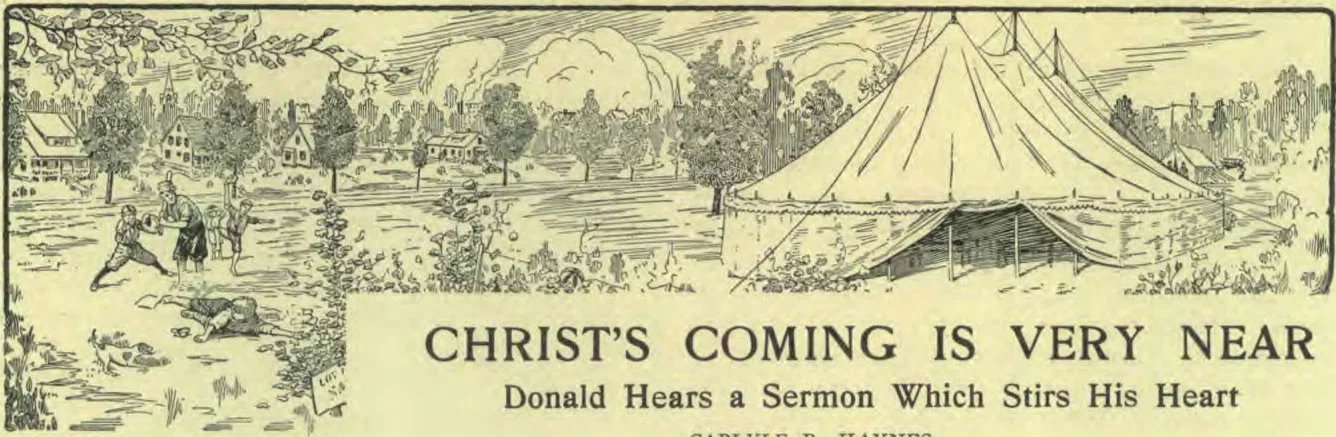
CHRIST’S COMING IS VERY NEAR
By Carlyle B. Haynes
Donald Hears a Sermon Which Stirs His Heart
CARLYLE B. HAYNES
CHRIST’S COMING IS VERY NEAR
Donald Hears a Sermon Which Stirs His Heart
If I live to be threescore and ten I do not expect to die.” The quiet voice of Brother Harris reached out over an audience of six hundred people who were moved with profound interest as he finished his sermon on “The Signs of the Times.” He had made them realize that “your Lord may be here very soon.”
They sat as if turned to stone by a thought too big for emotion. There had been no exhortation, no playing on fearful hearts, in that sermon.
There were hardly any emotion-stirring periods. It was just as if this man were assembling facts which others had not read—as if he were bringing to their attention things they never knew, as he marshaled his reasons why Christ is soon to come.
He did not pretend to set time. In fact, he deplored altogether the fanaticism which heretofore had surrounded the preaching of the second coming of Christ. He talked quietly and calmly in a conversational tone, which was very impressive, and made Donald Hunter, who was there with his parents, feel very solemn. He submitted passage after passage of Scripture to his audience, and read to them from these passages what he called “the signs of the times.”
“I believe the coming of Christ is so near that my own life span will compass it,” he told them.
As he talked, the coming of Christ seemed very near to his hearers. The passages he read from the Bible made it seem so. And there were many there that night who were stirred as they had never before been stirred by religious things. There were many who decided that they must get ready at once to meet the Lord in safety when he should come. Among these were Donald Hunter and his mother, father, and sister.
Brother Harris began by reading Matt. 16:3. He pointed out that just as the Jews were given many evidences of the Messiahship of Jesus, and of his first advent, so God would give the people today signs of the nearness of the second coming of Christ. He said:—
“In Dan. 12:4 it is predicted that at ‘the time of the end . . . knowledge shall be increased,’ and ‘many shall run to, and fro.’ These words were spoken about twenty-five hundred years ago. Here ‘the time of the end’ is clearly marked by an unparalleled running to and fro and an increase of knowledge. Go to any railroad station and see the fulfilment of this. There is more travel today than ever before in the history of men. They are running to and fro by the million. And we now have methods of transportation that were unknown a century ago. The passenger train, the steamship, the electric street car, the automobile, the aeroplane, the bicycle, were not known one hundred years ago. Men traveled then by means of some beast of burden, just as Abraham did thousands of years ago. This is an age of great running to and fro, of unparalleled travel.
“And knowledge has increased in other lines. The time has come when the prophecies are fulfilling, and increased knowledge of the Bible makes them clear to us today. Knowledge in all realms has increased,—in religion, science, invention, mechanics, industry, and the arts. The increase of knowledge during this past century has been unequaled. Therefore it is plain that this is ‘the time of the end.’”
“In Luke 21:25, 26, we are given other signs of the Lord’s return. We are told that there will be ‘upon the earth distress of nations, with perplexity; the sea and the waves roaring; men’s hearts failing them for fear, and for looking after those things which are coming on the earth.’ This is fulfilled today before our eyes. There is ‘distress of nations, with perplexity,’ which has been brought about by the terrible war in Europe. ‘The sea and the waves’ have been roaring in tidal wave and flood. When men look forward to the inevitable crash which is coming between capital and labor, and contemplate the fearful consequences of the rapidly advancing cost of living, their hearts do fail them for fear, and ‘for looking after those things which are coming on the earth.’”
“Even this strife between the rich man and the poor man is pointed to in the Bible as a sign of the near coming of Jesus Christ. In James 5:1-8 we find a correct description of the present conditions in the industrial world, given nearly two thousand years ago. Here we are told that the last days will be days when there will be an unparalleled heaping together of treasure, of great fortunes, which have been created by defrauding the working man, the poor. No one needs to be told that this prediction points unerringly to the days in which we are now living. The relations between capital and labor are becoming more and more strained. The rich are becoming richer and more oppressive, the poor are becoming poorer and more desperate; and even the most conservative are predicting a terrible struggle. What does it mean? The eighth verse of this chapter answers: ‘The coming of the Lord draweth nigh.’”
“There is another sign of the last days given by Paul in 2 Tim. 3:1-5. Here is a catalogue of a long number of sins which will be especially prevalent in the last days. It is a terrible list. It reads: ‘Men shall be lovers of their own selves, covetous, boasters, proud, blasphemers, disobedient to parents, unthankful, unholy, without natural affection, truce breakers, false accusers, incontinent, fierce, despisers of those that are good, traitors, heady, high-minded, lovers of pleasures more than lovers of God; having a form of godliness, but denying the power thereof: from such turn away.’ And these sins are very noticeable today. But11they are not said to be the sins of the world. Worldlings have always indulged in these things. But this is a picture of the conditions of God’s professed people, the churches of today. Instead of the world’s being converted by the church, the church in the last days will be converted by the world, and will engage in worldly things, and fall into worldly pleasures.
“Now,” continued the speaker, “I have no wish to make any lengthy comments on this prediction. I will leave it to this audience if this is not a good likeness of the conditions which prevail in the churches today. Notice especially the statement that church people in the last days will be ‘lovers of pleasures more than lovers of God.’ Is that true today? Is it true here in this city? Let me tell you an excellent way to find out. Tomorrow is Wednesday, prayer meeting night. Let some one tomorrow evening visit every prayer meeting in this city and count the number of church members present; then visit every moving picture show and theater, count the number of church members present in these places of worldly amusement, and then compare the results. I think if this is done, he will have a good comment on the fulfilment of this prophecy.
“Christ is coming. There is no doubt about it. All the predictions in the Bible regarding his coming are rapidly being fulfilled before our eyes. I plead with this audience that you give up your sins, turn away from the world with its allurements, and give your hearts completely into the keeping of Christ, that you may meet him in peace when he comes.”
Donald was greatly stirred by the sermon, and he felt a sense of guilt when Brother Harris mentioned moving pictures, for he loved to go to them. In the question-and-answer service he sent up a question which read, “Is it wrong to go to moving picture shows?” He felt a conviction that it was wrong for any one who was looking for Christ to come to go to such shows, but he wanted Brother Harris to say so.
“Yes,” replied Brother Harris when he reached this question, “it is wrong to attend the ordinary moving picture show. These shows are giving our youth an education in crime and sin and infidelity. They are worldly amusements, and their tendency is downward, not upward. They are of the world, and God says, ‘Love not the world, neither the things that are in the world. If any man love the world, the love of the Father is not in him. For all that is in the world, the lust of the flesh, and the lust of the eyes, and the pride of life, is not of the Father, but is of the world. And the world passeth away, and the lust thereof: but he that doeth the will of God abideth forever.’ I John 2: 15-17.”
Donald was very quiet on his way home from the meeting. There was one thing he had discovered about being ready for the Lord to come, and this was that he must give up moving pictures. He was thoroughly convinced of it. He saw that to be looking for Christ and spending one’s time in worldly amusements is not consistent. If he was to go with Christ when he came, he must break away from the things which held him to the world, and which would pass away with the world, and fix his affections upon the things of Christ. But it was a sacrifice, and he did not feel like talking about it; and when Margaret asked, “Will you go to any more shows, Donald?” he replied, “I don’t know.”
Very seriously he went to his room, and lay tossing about for a long time before he finally fell asleep. He almost decided not to attend any more of the meetings, they made him feel so uneasy. But he was fully convinced that Christ’s coming is very near at hand.
It Pays to be a Good Father
THIRTY years ago a little Irish boy, riding his bicycle through the streets of Belfast, complained of the bumps. His father, J. B. Dunlop, was a veterinary; but he set to work to please his little son, and the pneumatic tire was the result.
“Sausage tires,” as manufacturers called them, did not find a welcome, says Tit-Bits. There was fierce opposition to putting them on the market. Only when an Irishman named Du Cros and his six sons came over to England, and with the Dunlop tires beat all the other amateur racers, did the public show any interest in pneumatic tires. Even then Dunlop could raise less than $75,000 to start his industry, and that mostly from cyclists like Du Cros, and his personal friends. He employed only six workmen.
In less than six years the business sold for $15,000,000. It now employs 30,000 men. In the United States, pneumatic tires produce yearly $350,000,000. It is probable that the world sale amounts yearly to $650,000,000.
And all because a little Irish boy didn’t like to be bumped.—Every Week.
Government Ownership and State Health Insurance Proposals
When Senator La Follette proposed that the government build railroads in Alaska, the suggestion created an uproar. Today we have the Postmaster-General proposing that the government buy every telegraph and telephone line in the United States; and the proposal creates hardly a ripple of surprise. The governor of rock-ribbed Massachusetts proposes State health insurance and pensions; and even the most conservative newspapers praise his statesmanship. The Union Pacific Railroad announces the insurance of all its employees; intelligent observers predict national health insurance within a year or two.
The sneezewood tree, a native of South Africa, yields a wood which is invaluable in building docks, piers, and jetties, for it remains unusually sound under water. Sneezewood is so bitter that even the worms refuse to have anything to do with it. Something in the make-up of this peculiar wood causes those who handle it to sneeze violently—hence its peculiar name.
Fifty years ago visitors to a tenement found Mary Ellen screaming behind a door. She was covered with welts where her mother had beaten her. The visitors brought Mary Ellen into court, and out of the turmoil which her bruised body created came the Society for the Prevention of Cruelty to Children, which in New York alone has helped and protected 218,715 children.
There are nine men who never vote,— the Justices of the United States Supreme Court. Of course they cannot vote in Washington, but they never go to their home States to vote. The law does not prevent their voting; it is simply a tradition of the court, an unwritten law.
The Rumanian government charges that the Germans are deporting all male Rumanians between the ages of sixteen and sixty-seven into the interior of Germany for internment, and has made a protest to neutral nations.
Our American Knight
He was not born in a castle, our American knight; no, indeed, far from it. He was born in a little log cabin in the wilderness. He was not clothed in shining armor; nor did he ride about on a great horse. No, he was dressed in a homemade suit,—the shirt was of homespun, while the coat, trousers, and moccasins were of deerskin,—and on his head he wore no helmet, but a cap of raccoon skin, with the tail of the animal hanging down his back. He had no shield or spear or sword with which to defend himself, and he was born into a fighting life of hardship in those pioneer days in the wilderness.
But he had great strength, and he used this strength for the good and the right.
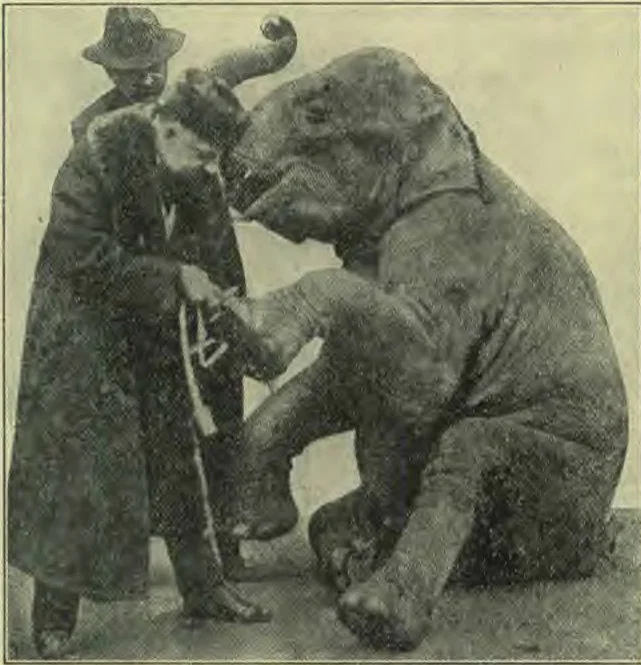
MEASURING CHIN CHIN FOR SHOES
It is not the shining armor or the castle home, however, which makes of man a knight; it is rather the spirit of knighthood—the feeling of brotherly love and tenderness for all those who are in sorrow or distress, the courteous care for those who are weak and oppressed, the desire to right their wrongs and protect them in every way. And this knightly spirit was early shown by him when he was but a boy in the backwoods.
A story is told of how one morning in the school yard a group of his playfellows were torturing some poor turtles by placing red-hot coals upon their backs to make them crawl faster, when suddenly our young knight came into their midst. He was only one among many; but he forced those boys to brush away the coals and let the turtles go.
And later, when he went into the schoolroom, he wrote his first composition on “Showing Kindness to Dumb Animals.”
At another time, when he was helping his father to move the family over into the wilderness of Illinois, in the excitement of crossing a stream swollen by the ice and snow his little pet dog was forgotten. Suddenly they heard a loud barking from the bank opposite. “Yer, yer, yere; don’t leave me here!” yelped the poor doggy. It was too much for the strong young knight; but his father refused to recross the swollen stream with his oxen and heavy load.
“Then I must go!” said the young man, and, pulling off his shoes and socks, he waded through the icy water. Shaking with the cold, he returned triumphant, holding in his arms the poor little shivering dog.
When he put the dog down upon the ground, the little fellow bounced about, wagging his tail and trying to lick the feet and hands of his friend, as he barked his thanks. Long afterward, in speaking of this experience, the young man said:—
“His frantic leaps of joy, and other evidences of a dog’s gratitude, amply repaid me for all the exposure I had undergone.”
Later we hear of our young knight, no longer as the pioneer backwoodsman, but as a young lawyer. One time, when he was dressed in his best clothes and was riding from one country town to another in order to make a speech, he suddenly heard by the roadside a pitiful squealing, and as he looked he saw a poor pig sinking in the mud.
“Eee-eee-eee!” cried the poor pig. As much as to say: “Aren’t you going to help me out?”
“I really am sorry for you, piggy,” said the young man to himself, “but I cannot help you, for I am dressed in my best clothes.”
He started to ride on, but the feeling of pity for anything in trouble came to him; so he jumped from his horse, waded out in the mud, and pulled the pig from the mire. When his friends teased him as they heard the reason for his mud-stained condition, he said:—
“I couldn’t help it. I just had to do it. I could not stand the look in that pig’s eyes as I rode by. It seemed to say to me: ‘There goes my last chance.’”
Another time, when he was riding with a party of friends, he was missed, and as they turned to look for him there was the tall, ungainly knight bending over in the road. When he rejoined his friends, they asked impatiently: “What caused your delay?”13
The kind knight smiled gently upon them and answered: “Two young birds were blown by the wind from their nest. I could not have slept unless I had restored those helpless little creatures to their mother.”
The hand that lifted the baby birds and restored them to their nest was the hand chosen to lift up a broken people and free them from the curse of slavery. Truly, when we read his life story, we know of no knight of old who ever gave to the world more deeds of valor or showed a more heroic devotion to the cause of duty than has our American knight, Abraham Lincoln.—Selected.
Things the Pastor Sees from the Pulpit
1. SOME folks always coming in punctually late.
2. Others always in the same place, where they seem to belong.
3. Some irreverence at the beginning of the service; not much, but some, and some is too much.
4. Strangers without any hymn books, and no one offering them any. It makes him feel nervous. How would you feel?
5. When the offering baskets are passed, some folks look at them as if they had never seen them before, and wondered what they were.
6. Once in a while a few people come in after the baskets are passed. I do not think they do it on purpose.
7. There are faces that are a benediction to look at; and a few, only a few, that seem to be mourning over the money they lost yesterday.
8. Once in a while a man, now and then a woman, who seems to be asleep; but appearances may be deceptive.
9. Folks he has baptized, and married, and laughed with, and cried with. He does not always see them distinctly.
10. And many other things he sees from the pulpit; and let us hope that most of the things he sees help him to preach when he rises to give his message.—From Dr. Charles M. Sheldon's Church Calendar.
The Sunny Side and the Dark Side
I WAS thinking this morning of the difference between the sunny side and the dark side. I was up quite early, and am sorry for those of you who missed the beauty of a glorious morning.
I went first to the shady side of my house. The wind was coming from the northwest, over the snowy fields of the mountain region, and I felt a sense of chill and gloom. But when I went to the other side of the house, I found it very warm and genial; for the sun coming up out of his chambers was shining there, and no wind was blowing.
Most things in this world have a sunny side, and almost everything has a dark side. I suppose there is a sunny side even to going to the dentist’s. There was a man who had to go there, and he stayed on the dark side of it for quite a while, thinking how much he must suffer. But it occurred to him to get on the sunny side of the matter; so he thought how much better it would be for his health and his comfort, and then he was quite ready to go. Afterward he laughed to think how little it hurt him, after all!
I once knew a man who made the acquaintance of his neighbor, and thought that he was a very shady sort of man, particularly because his neighbor did not recognize him sometimes. But he went around to the sunny side of the neighbor, and found that he was nearsighted, and more than that, that he had a very kind heart. It all lay in getting around to the sunny side, you see.
And I take it there’s a shady and a sunny side to ourselves. Sometimes we look at the dark side of ourselves and see what mistakes we make and how naughty we are, and we get discouraged and are about ready to give up. But suppose we just get around on the sunny side, where the love of God is shining upon us, and where his beams glow with warmth; then we shall begin to think differently even of ourselves, and we shall get new comfort and heart to try again.
Suppose we determine to try to find the bright side of ourselves, of the people we know, and of the great world. When it is dark, there is always some place where the sun is shining, and where it is bright and cheery and warm. Let us send our minds there, even if we can’t go ourselves!—Selected.
Chinese Girls' Club Pledge Against Unknown Marriages
Mrs. Daly, in writing of the Chinese custom of girls' being married to unknown men, says: “Of late years a number of progressive young Chinese women formed a club, the members of which were pledged to commit suicide rather than marry a man of whom they knew nothing. About one hundred young women have actually fulfilled this pledge.”
On Guard
By J. G. Lamson
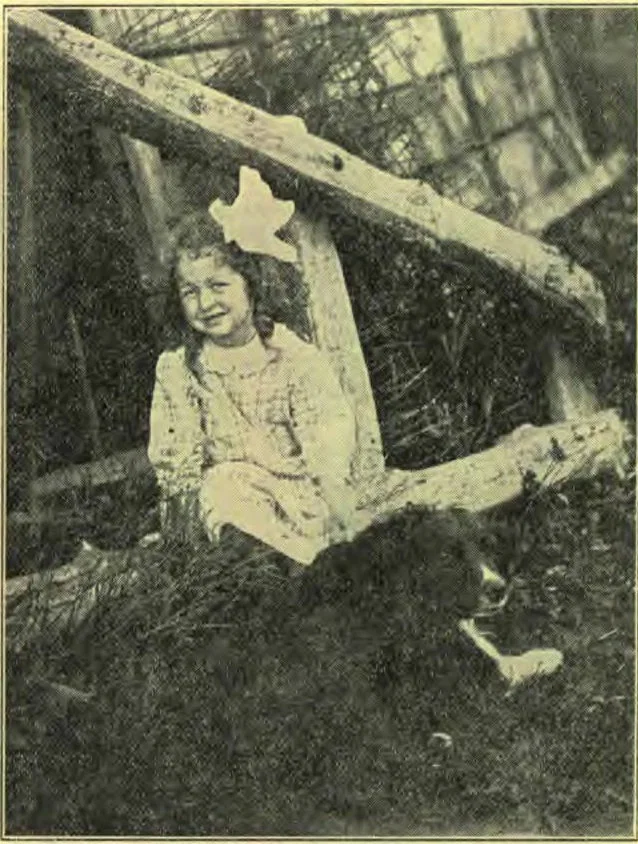
GR-GR-R-R! What you want 'round here?
Gr-gr-r-r! Don't you see I'm near?
Better not come very close;
While I'm not at all morose,
I'm on duty now, and you had better fear.
How did you find out my name is “Span”?
Better not come up too close now, Mister Man.
I was sent with “Little Miss;”
Told to watch her just like this.
So you keep a proper distance,—that's the plan.
So you're Little Miss's uncle? Maybe so,—
She is not so very fearful of you, though;
But if everything's not right,
You can just expect a fight,—
Gr-gr-r-r! I will growl a little low.