“From numerous and extensive experiments made by Professor Paterno and reported in La Tribuna (Rome), it appears,” says the American Inventor, “that by adding to impure water, even that containing pathogenic microbes, an extremely small quantity of chlorid of silver there is accomplished the complete disinfection of the water. For this purpose two milligrams, or at most two and one-half milligrams, of the chlorid are sufficient, absolutely, to sterilize a liter of water and to eliminate every danger of infection. The process is so simple that one can not expect any improvement upon it in the future; it may be used by any one and in any condition of life, the sterilization being complete after a few minutes—ten at the most—and no apparatus being necessary beyond a small vial with a solution of chlorid of silver. The water keeps its flavor and all of its properties without modification, only undergoing a slight whitening, which disappears after a few hours of repose.”—Literary Digest.
DRUNKARD’S SONS.
Of the 420 boys committed to the Industrial School at Lancaster during the past year, 120, or nearly one-third of the whole, had intemperate fathers; five had intemperate mothers. Of boys without either father or mother there were 31, and of those with father dead there were 93, while 82 had lost a mother, and 10 knew nothing of either parent. There is food for abundant reflection in these cases cited. There is no single cause, it appears, which sends a boy to the bad quicker than an intemperate father. This sort of parent is worse than none at all, according to the statistics.
The records of the hospitals, asylums, prisons, reformatories, all show that the man who indulges in liquor is unfit to be a father. The drinker’s children are cursed with parental taints, which crop out in insanity, imbecility, vice, and crime. Even tho a line of good ancestry, and the opposing power of purity in the mother shield the children of a drinking father from the worst of his traits, the evil influence of the drunkard in the home yet mars the masterpiece. The boys and girls of a drunken father or mother go to the bad in appallingly large proportion.
The worst of the drinking habit is its cumulative effect. The father may, because his father and mother were temperate be able to drink with impunity, apparently, but his son has a greater craving and less vitality. The evil that the drinking man does to his energies impairs the powers of his offspring, and they fall easy victims to the liquor habit. — American Issue.
A SIBERIAN BLIZZARD.
The following account of a Siberian blizzard, taken from the Youth’s Companion, is of interest just now, as it gives an idea of the terrible cold and storms to which the Russian soldiers are exposed, and from which some have died, as they are hurried across the plains to the seat of war:—
“A blizzard on the Siberian desert is a dreadful thing. An author tells of being overtaken by a severe snow-storm. The dogs lost sight of the trail, and the snow came down so heavily they could hardly see the leading dogs, and it was deemed the safest thing to stop and endeavor to protect themselves as much as possible from the storm.
“With our snow-shoes we dug down six feet to the ground, making an excavation about eight feet square. Placing the three sledges around the edge of the hole, we banked them in with snow. Then we took a tarpaulin from one of the sledges, and with walrus-hide rope improvised a sort of roof over our dugout.
“The dogs dug holes in the snow, and settled down comfortably to sleep. They were almost immediately covered with snow.
“At this time the thermometer stood thirty-five below zero. We could not tell whether it was actually snowing, or whether the snow was only being driven by the wind; but at any rate the air was filled with it, and the prospect was anything but exhilarating. We lined the bottom of the hole with furs, got out our sleeping bags, and prepared for a long siege.
“As we were without fuel, we had to eat cold food. Frozen reindeer meat taken raw is not an appetizing dish; but this, together with hard bread and pounded soup-ball, formed our diet for the next few days. In this snowy prison we were held for four days, and we were obliged to climb out every three or four hours, and relieve the tarpaulin of the weight of snow. Our furs were damp, caused by our breath, which congealed, and thawed again from the warmth of the body. To say the very least, we were extremely uncomfortable.
“At last it got so bad that I gave orders to burn one of the sledges, and that day we feasted on hot tea.
“To while away the tedious hours, I gave my Arctic friends some lessons in astronomy, using snow-balls as object-lessons.
“I told them all about elections, telephones, phonographs, and railroads, and gathered from their expression that they thought I had gone mad from the cold and exposure. They looked at one another and muttered, ‘Duroc! duroc!’ which is Russian for crazy.”—Selected.
THE COST OF A “PLAIN DRUNK.”
The following graduation of penalties for a “plain drunk” seems to indicate that higher civilization is more tolerant of intoxication than benighted communities, or communities so considered:—
In this country, $2 and costs.
In Persia, 80 lashes on the soles of the feet.
In Turkey, the bastinado to a more severe extent.
In Albania, death.
In the three latter instances the extreme penalty is given above. Before the officials give a man up as confirmed in his cups they lecture him. In Persia they put him on the blacklist first, and forbid him the bazaars except in certain hours, and then under police supervision, and also places of amusement and worship.
In Turkey the offender receives an admonition, and is fined for the first offense, and the bastinado is applied afterward if the crime be repeated.
Among the mountaineers of Albania and Montenegro, drunkenness is regarded as a political offense, and for that reason is considered more serious than if it were a moral one.
Among the mountaineers fighting and drinking are not considered to go together, and to be able to fight is the first duty of a citizen. Therefore the drunkard is harshly dealt with. At first they try moral suasion with the festive tippler, but when that fails, and he persists in making the mountain peaks ring to his Montenegrin substitute for “We don’t go home till morning!” he is declared to be a danger and a disgrace to his tribe and his country, and is quietly assassinated by order of the local chief.—The National Advocate.
WOMAN'S SLAVERY TO THE DRESSMAKER.
Mrs. Julia Ward Howe, the author of the “Battle Hymn of the Republic,” in a public address, thus depicted woman's attitude to the demands of fashion and fashionable dressmakers:—
“The fashionable woman says to the dressmaker, ‘Do what you will with me; make me modest or immodest; tie up my feet, or straighten my arms, till use of them becomes impossible; deprive my figure of all drapery, or upholster it like a window-frame; nay, set me in the center of a movable tent, make me a nuisance to myself and everybody else, but array me so that people shall look at me, and so that I shall be in the fashion.’”
CARBOLIC-ACID ANTIDOTE.
The recent discovery of Mr. Allen, a Dublin veterinary surgeon, that ordinary turpentine is an antidote to carbolic acid, is one of the most important discoveries which have resulted more or less from accident. Mr. Allen had in his establishment some horses which were suffering from carbolic poisoning, and he asked for oil to be given as an antidote. It was only the unexpected success of the treatment which caused it to be discovered that a happy mistake had been made, and that turpentine had been administered instead of oil. A few days later a blacksmith, who was unconscious from carbolic poisoning, was similarly treated, with satisfactory results.—Chicago News.
Finding an Appetite in Fresh Air
A LADY once asked a physician where she could get an appetite. “Out in the fresh air,” he said; “just go out and get one. Nature has thousands of appetites to give away. All that she asks is that you come after them yourself.”
TIBET AND ITS BORDERLAND.
By Sarah Douglass McMahon
[Sarah Douglass McMahon, in The Independent.]
For hundreds of years Tibet, now about to be brought under British influence through the expedition of General Younghusband, has been an object of baffled curiosity to Europeans. It is an extraordinary fact that the earlier explorers were far more successful in their quest than recent travelers. The Englishman Manning in 1811 set foot in Lhassa, was admitted to the royal palace, and, presenting gifts, kowtowed thrice before the Dalai Lama, a smiling child of seven, who, as the incarnate god of the Buddhists laid hands on the clean-shaven head of the daring visitor and inquired wonderingly how he had overcome the difficulties of the journey. Manning won the favor of the Holy Boy and his courtiers by a diplomatic reply; he said he had had troubles indeed, but they were amply compensated for by the happiness of entering into the sublime presence of the Sacred One. The attendants gave him tea and a present of dried fruits. He was received and dismissed with every mark of civility. He says:—
The Lama's beautiful and interesting face and manner engrossed all my attention. He had the simple and unaffected manners of a well-educated, princely child. His face was, I thought, poetically and effectingly beautiful. He was of a gay and cheerful disposition, his beautiful mouth perpetually unbending into a graceful smile which illuminated his whole countenance. I was extremely affected by this interview; I could have wept through strangeness of sensation.
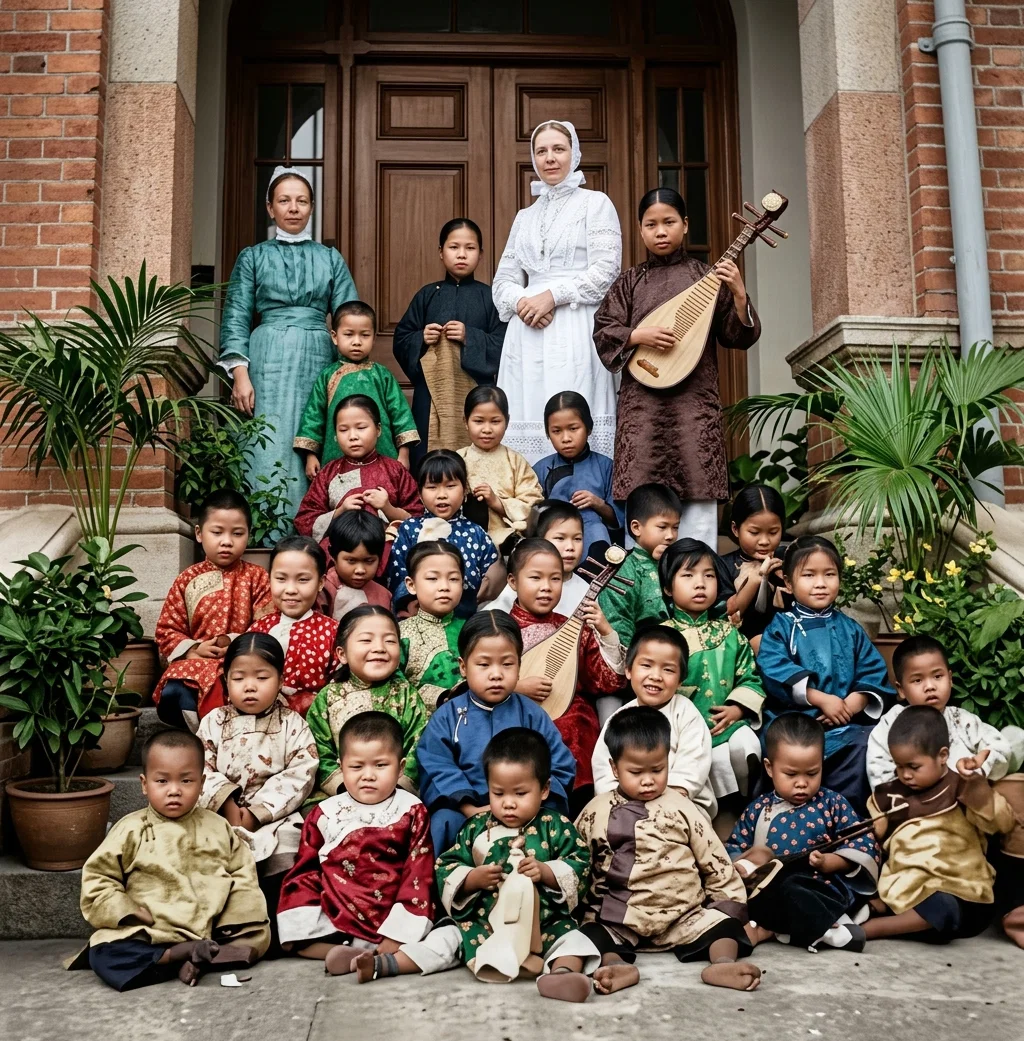
Pupils and instructors of a Christian school for Chinese blind girls in Hongkong.
Before Manning, near a score of Roman Catholic priests, and after him Fathers Huc and Gabet, in 1846, penetrated to the capital of Tibet, which it is now sacrilegious for a foreigner even to approach. The French Fathers spent two months in Lhassa before being expelled. No white man living can boast of having entered the sacred city and gazed upon the Grand Lama. Clever, bold, and resourceful as have been the later travelers, including the Russian Prejevalsky, the Englishmen Bower, Littledale, Landor, and Welby, the Frenchmen Bonvalot and Prince Henry of Orleans, the missionary Miss Annie Taylor, and the great American authority on Central Asia, William Woodville Rockhill, the Tibetans have succeeded in turning each and all back several days' journey from Lhassa. If they have not penetrated to Lhassa, these travelers have in their several hundred mile journeys added much to our knowledge of the country and its inhabitants.
Tibet is more than the Switzerland of Asia. It is literally, as geographers are fond of terming it, the Roof of the World. Conceive an enormous table-land 1,600 miles in length from east to west, and 500 miles in breadth from north to south, elevated from 10,000 to 20,000 feet above sea-level, an alternation of desert steppes, frowning peaks and fertile river valleys; so cold that the inhabitants live like denizens of the Arctic Circle; so rich in mineral resources and other wealth that China, Great Britain, and Russia dispute it as a prize; so inhospitable that wild animals, as well as beasts of the caravan, perish of starvation; traversed by Mongol nomads in its northern portions, inhabited throughout its fertile southern region by a priest-ridden, filthy, and superstitious race; owning a more or less shadowy allegiance to China, but hating English and Russian interlopers with equal bitterness, and you have a succinct idea of the Forbidden Land now opening to the avenues of civilization.
The Tibetans are degenerate, first because of their climate, and second on account of their religion. Ethnologists have often remarked that mountain races quickly differentiate themselves from dwellers of the plains in features, frame, habits, and customs. The high civilization of surrounding Europe has kept the Swiss from reverting to savagery. Not so with the Tibetans. Cold and poverty oblige them to be dirty. The frightful face of nature encourages superstition. The hard life has made them squat and muscular; it has dulled their moral sense as well, so that brigandage, drunkenness, and polyandry are common evils. In appearance these mountaineers are square-headed, with small eyes, high cheek bones, prominent noses, and large mouths. The men are clean-shaven, and the women daub their faces with a brown pigment and wear their hair in strands almost innumerable, which are taken down and cleaned but once a month, with results that may be better imagined than described. A common garment of the country is the whole skin of a sheep with the wool turned next to the skin. The women are often clad in a single garment of dark-blue serge, which is without fastenings, but is folded over in front and kept on with a girdle. Many of the Tibetans live in tents the year around, while the inhabitants of the more prosperous river valleys enjoy the squalid comfort of huts of brick, stone, or mud, as the absence of timber in this wild land makes wooden dwellings impossible. The Tibetans are born traders. They get tea and silk from China; broadcloth, rice, grain, and tobacco from India. They export silver and gold in quantity, likewise wool and salt (the staples of the country), yaks' tails, borax, musk, and ponies. All the trading is done by means of caravans, which come by slow stages several months' journey from Pekin, and in three to five weeks from the Indian border. Horses, sheep, and yaks (the latter an enormous mountain ox) are employed as beasts of burden. Caravans must be large in number, or well-armed to withstand the attacks of brigands, who often belong to a religious sect, and cover their depredations with the show of piety.
After all, religion, rather than commerce, is the key-note of the Tibetan character. The primitive rite of the mountaineers was devil-worship. Demons lurk in every pass, work their sorcery of disease and death on whole villages, entrap the unwary traveler into crevasses or raging mountain torrents, or destroy him with cold and hunger. Buddhism came in A.D. 638 and spread like a veneer over the ancient superstition. The Lamas or monkish holy men of the Buddhists simply took over the entire apparatus of magic and sorcery and converted it to their own uses. As the centuries passed, they consolidated their power and secured a terrible grip on the minds, persons, and fortunes of the people. The simple doctrine of the real Buddha or Sakya-muni13the ascetic founder of the religion more than five hundred years before the birth of Christ, was changed into a belief in the incarnation of six Buddhas or Grand Lamas, each the head of an important monastery, and each supposed to be the incarnation of the Deity in the human form. From this it was but a step to the belief in the Dalai Lama of Lhassa as the supreme living Deity. The monasteries or abodes of the Buddhist monks are scattered all over Tibet. They are by far the most conspicuous structures—sometimes containing as many as three thousand devotees—as the monks are likewise the greatest landholders, and levy from the people both in state taxes and all manner of fees for the propitiation of devils. To the European the mode of worship seems compounded of mummery and magic. Ceaselessly-revolving prayer wheels, in which is written a holy text or sentence, confer on the believer great merit both in this life and the life to come. There are also prayer flags, rosaries, idols, scapulars, and chortens, or mounds of sacred stones. So similar are the rites and practices of Tibetan Buddhism to some of those of the Roman Catholic Church that Jesuit priests traveling in Tibet have guessed them to be borrowed from the church of Peter.
(Concluded next week.)
LOOK UP, MY CHILD.
By S. Hudson Carter
BY S. HUDSON CARTER.
Tho all the joys of earth have flown
And all is lost that made life dear,
Tho thou should'st wander here alone
And all the world seem sad and drear;
Thy Father still will care for thee;
To thee He reaches out His hand,
And whispers softly "Come to Me,
I'll guide thee to a better land."
Earth's flowers fade, earth's fruits decay,
The friends we trust oft prove untrue;
The joys of Heaven ne'er pass away—
They're constant, changless, ever new.
Thy Saviour calls to thee to-day,
"O come, My child, I wait for thee;
Dear weary heart, why wilt thou stray?
Come now, and find thy rest in Me."
O land of Beulah, wondrous fair,
The blessed hope is given to me,
That in thy glories I may share
Through all the glad eternity.
O pearly gates! O golden street!
’Mid all thy glories, rich and rare,
'Tis there my Saviour I shall meet,
And dwell with Him forever there.
Darby, Pa.
BLIND GIRLS IN CHINA.
By Edwin Hines Wilbur
BY EDWIN HINES WILBUR.
It is said that, in proportion to the population, there are more blind people in China than in any other country in the world.
In Chinese towns it is a common sight to see blind men and boys begging in the streets. But the condition of the blind girls is far more distressing. They are counted of little value, and are often sold to a life of shame. Cruelly treated by their keepers, many become weary of their hard lot, and commit suicide. To prevent this, every precaution has to be taken to remove from the bed-rooms of the girls knives, cords, the ties with which their clothes are fastened, and everything which might possibly be used as an instrument of self-destruction. When we think of the countless thousands of these poor creatures in China, we can but ask, Is it not time some one came to their rescue? I am glad that true hearts in other lands have been touched, and that a beginning has been made to help these poor unfortunates.
A Christian school for Chinese blind girls was opened in Hongkong seven years ago. At first only four pupils were taken, but now they have a fine, new building and about forty blind girls in the school-home. I have just had the privilege of visiting this school, and, through the kindness of the lady in charge, Miss M. Postler, the SIGNS readers can also have a view of this happy family.
Indeed they are a happy company of children, for God has given them a pleasant home and kind instructors. The girls are taught to do housework, knitting, and sewing. We were shown some beautiful garments that they had made. All who are old enough are taught to read and write by the Brail system. It is indeed interesting to hear these little blind girls reading Bible stories in their own language, and to hear them singing Gospel songs, while one of their own number plays upon the organ. Surely this is a noble work. There ought to be hundreds of such schools in China, but where are the teachers? Miss Postler is a German lady, and was formerly for several years a hospital nurse. She enjoyed that work very much, and was loath to give it up. It seemed at first almost like burying her talents to come out to China, and give all of her time to a few poor, blind girls, but God has used this humanitarian effort as a means of touching many hearts in the “home lands,” and of vivifying the churches, as she herself could not possibly have done in any other way.
Hongkong, China.
LETTER FROM TRINIDAD.
By W. A. Sweany
We have just returned from our conference in Trinidad. You may be sure it was a joy for us, and dear ones there, to meet once more. The conference was an epoch-making one. The study, devotional, and business sessions were held during the day in our church, and were all characterized by the spirit and wisdom of God. Each evening during the fortnight, a public service was held in the opera house, which seats about eight hundred. It was packed to the doors every night, and hundreds had to be turned away. The vital truths of the message were presented by the conference laborers, and the Spirit of God attended it with power. The closest attention and deepest interest was manifested throughout. The very best class of people attended in large numbers, and the collections more than paid for the expenses—rent, light, and daily advertising.
Ten were baptized, and nearly as many more are preparing for baptism. Many are deeply stirred, others are convinced, and some almost persuaded. Plans were laid to push the work with vigor in all parts of our field this year, including the Dutch, French, Spanish, and aboriginal portions. We completed a ten weeks' tent-meeting here, just before going to conference. At least a dozen have accepted the message, and the interest is still good. Our literature sales and collections have been exceptionally good—more like the old times. We hope to firmly plant the message here by organizing a church, and erecting a house of worship, if we can raise means enough. I expect to spend a few days in Demerara soon with Brother Haysmer, looking after the interests of the work there. We are all well, and of good courage. Yours in Christ Jesus,
W. A. SWEANY.
No. 9, St. Joseph Street, Arima, Trinidad.
Ponoka, Alberta
By J. W. Boynton
FROM ALBERTA, CANADA.
I WILL write a few lines that others may see what our silent preachers are doing. We have been told that we should scatter our publications like the leaves of autumn. Believing this to be true, I usually carry a supply as I drive through the country.
I take a SIGNS, with two or three tracts on the second coming of Christ, the Sabbath, or other topic, and fold them together; then I wrap and paste them, and, as I meet people or pass houses, I hand them out. A letter received a few days ago from a brother said: “My nearest neighbor came to me a few days ago, and said that he was keeping the Sabbath for the first time in his life. He said that he had read the paper and tracts I had left him, and had asked God to show him the truth. So now he is fully convinced that the seventh day is the Sabbath, and he is going to observe it.”
June 12 I met with the brethren at Edensville, where I baptized two precious souls. Several more there expect to be baptized in the near future.
We now have our new tent pitched, and are holding meetings every night with a fair attendance. Our camp-meeting was held here July 12-17 in connection with the tent work. This was the first tent and camp-meeting ever held by Seventh-day Adventists in Alberta.
We long to so represent Christ that we may have fruit of our labors. J. W. BOYNTON.
Ponoka, Alberta
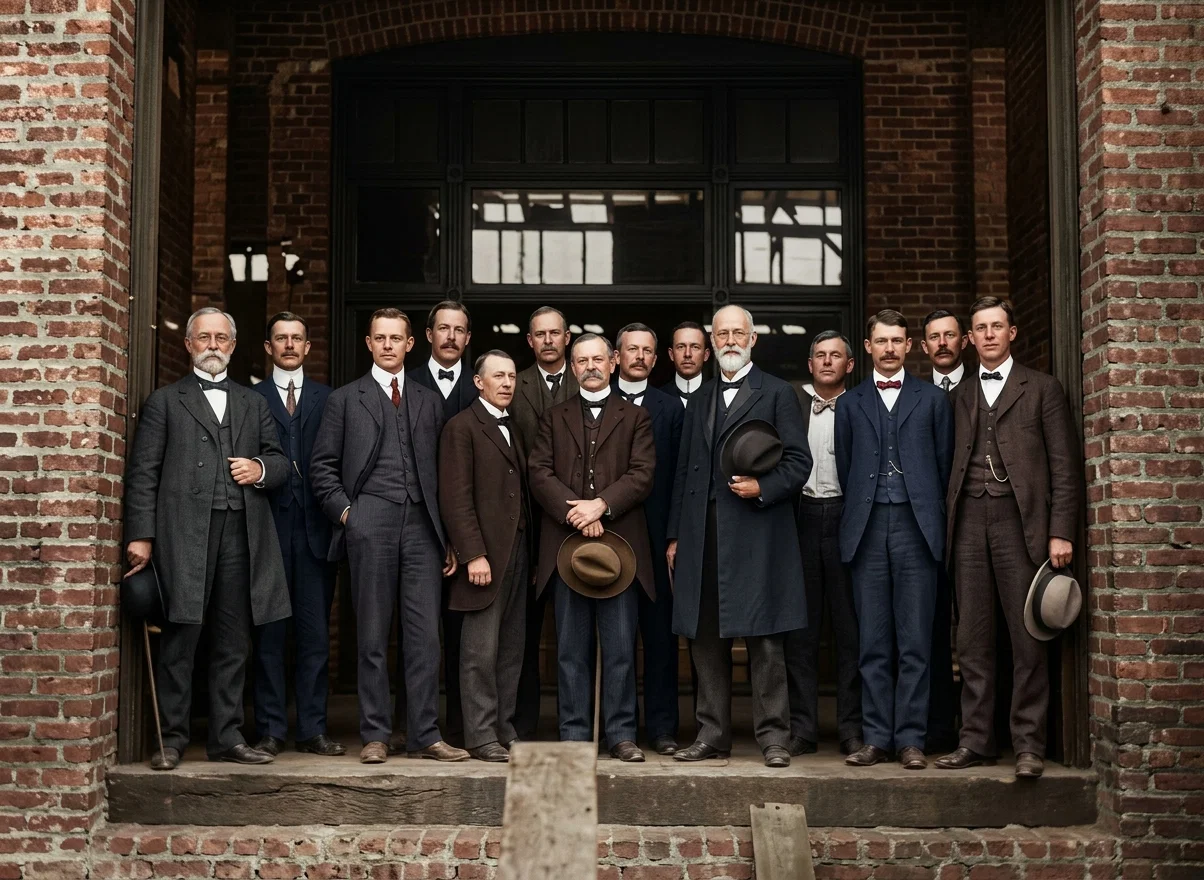
July 7, 1904, the Pacific Press Publishing Association, a membership corporation, was organized in the town of Mountain View, Cal. The following are the incorporators: A. S. Kellogg, H. H. Hall, A. O. Tait, J. O. Corliss, E. A. Chapman, M. C. Wilcox, W. T. Knox, W. N. Glenn, D. T. Fero, W. E. Whalen, O. H. Jones, F. H. Gage, Wm. Saunders. This is the order in the above picture beginning at the right, with the exception of the second from the left. Mr. Gage could not be behind the camera and in front of it at the same time. A. J. Bourdeau stands next to Wm. Saunders. The board elected and officers chosen by the board after the incorporation are as follows: W. T. Knox (President), O. H. Jones (Vice-president), E. A. Chapman (Secretary and treasurer), M. C. Wilcox, H. H. Hall, A. S. Kellogg, and W. B. White.
OUR WORK AND WORKERS.
At Palisade, Col., June 18, eight candidates were baptized.
A church of nineteen members was recently organized at Glen Elder, Kan.
Ten persons were baptized at the recent camp-meeting held at Bowdle, S. D.
June 18 the church at Loup City, Neb., was increased by the addition of eight members.
A new house of worship was dedicated at Pueblo, Colo., June 19, replacing the one that had been destroyed by fire.
At the late camp-meeting held at Townsend, Mont., ten persons were baptized in the Missouri River one Sunday afternoon.
The West Michigan Herald notes the baptism of four candidates at Rothbury, by Brother W. C. Hebner, with others deeply interested.
Fifteen Sabbath-keeping Christians have been added to our ranks at Yangan, Queensland, through the labors of Brother E. S. Quinn and some lay workers.
In the Welcome Visitor, Brother J. O. Miller reports the addition of five members to the church at Killbuck, Ohio, by baptism. Brother Miller also attended the quarterly meeting at Newark, July 2, when two candidates were baptized in Licking River.
A report in the South African Missionary from Brother H. J. Edmed notes the baptism of eleven believers at the public baths in Maritzburg; the conversion of three, and a continued interest at Durban, where Brethren Altman and Spearing were holding meetings; the baptism of four candidates in the River Umkomass; and the opening of a tent campaign in Johannesburg.
A letter from Brethren J. W. Beams and R. F. Baer notes the conversion of four persons to the truth at Cuba, Neb. An interesting feature of the work was the meetings for the children and youth. The brethren are continuing their labors from house to house.
July 2, seven candidates were baptized at Bethel, Wis., by Brother P. M. Hanson, local elder of the church. They were all Germans, having accepted the truth through the instrumentality of home missionary work on the part of German brethren. In all, thirty-three persons have recently been baptized at Bethel, the seat of Wisconsin’s industrial school.
On the 29th ult., Brother J. H. Westphal and family sailed from New York for South America. Brother Westphal has had a previous experience of seven years in that great field, but for the past three years has been connected with Union College, at College View, Neb.
Camp-meetings in August are announced as follows: Staunton, Va., August 5-14; Marysville, Ohio, August 11-22; Columbia, Mo., August 11-21; Provo, Utah, August 10-17; Decatur, Ill., August 17-28; Allegan, Mich., August 18-29; Russellville, Ark., August 11-23; Longmont, Colo., August 18-28; Hardwick, Vt., August 18-28; Guthrie, O. T., August 25 to September 4; Oshkosh, Wis., August 30 to September 12.
Reporting to the Welcome Visitor from Akron, Ohio, Sister Ella M. Talmage says: “I am holding more meetings with those not of our faith than at any time since coming to this city. Several are walking in all the light received.” Of the last quarterly meeting she says: “Several met with us for the first time, among them some who have recently commenced to observe the Lord’s Sabbath. We are finding precious jewels here and in near-by towns.”
Of the baptism of two natives at East London, South Africa, Brother I. J. Hankins says, in the Missionary: “One of the candidates, a sister, received a beating from her husband just before she came. He tried to keep her from coming, and said she should not be baptized; but the Lord gave her the victory. Her husband has beaten her several times for keeping the Sabbath, and has frequently turned her outdoors, and told her not to come back. This has caused quite an excitement in the locality, and has led some to inquire into this new doctrine. The other candidate was a Zulu, from Natal. He says he learned the Sabbath truth by his own study of the Bible, but it was not till he came to East London that he found out the truth about Sunday-keeping. He now works for a Jew, who gives him the Sabbath free. He wants to earn enough to pay his fare home, so he can give the truth to his people.”
WANTED FOR MISSIONARY WORK.
(Always prepay postage.)
SIGNS, Life Boat, Little Friend, and tracts. Address, Geo. Sands, Circleville, Orange County, N. Y.
(1) “And it came to pass after many days, that the word of Jehovah came to Elijah, in the third year, saying, Go, show thyself unto Ahab; and I will send rain upon the earth. (2) And Elijah went to show himself unto Ahab. And the famine was sore in Samaria. (3) And Ahab called Obadiah, who was over the household. (Now Obadiah feared Jehovah greatly: (4) for it was so, when Jezebel cut off the prophets of Jehovah, that Obadiah took a hundred prophets, and hid them by fifty in a cave, and fed them with bread and water.) (5) And Ahab said unto Obadiah, Go through the land, unto all the fountains of water, and unto all the brooks: peradventure we may find grass and save the horses and mules alive, that we lose not all the beasts. (6) So they divided the land between them to pass throughout it: Ahab went one way by himself, and Obadiah went another way by himself.
(7) “And as Obadiah was in the way, behold, Elijah met him: and he knew him, and fell on his face, and said, Is it thou, my lord Elijah? (8) And he answered him, It is I; go, tell my lord, Behold, Elijah is here. (9) And he said, Wherein have I sinned, that thou wouldest deliver thy servant into the hand of Ahab, to slay me? (10) As Jehovah thy God liveth, there is no nation or kingdom, whither my lord hath not sent to seek thee: and when they said, He is not here, he took an oath of the kingdom and nation, that they found thee not. (11) And now thou sayest, Go, tell thy lord, Behold, Elijah is here. (12) And it will come to pass, as soon as I am gone from thee, that the Spirit of Jehovah will carry thee whither I know not; and so when I come and tell Ahab, and he cannot find thee, he will slay me: but I thy servant fear Jehovah from my youth. (13) Was it not told my lord what I did when Jezebel slew the prophets of Jehovah, how I hid a hundred men of Jehovah’s prophets by fifty in a cave, and fed them with bread and water? (14) And now thou sayest, Go, tell thy lord, Behold, Elijah is here; and he will slay me. (15) And Elijah said, As Jehovah of hosts liveth, before whom I stand, I will surely show myself unto him to-day.
(16) “So Obadiah went to meet Ahab, and told him; and Ahab went to meet Elijah.”
Golden Text.— “I thy servant fear the Lord from my youth.” Verse 12.
SUGGESTIVE QUESTIONS.
(1) After Elijah had sojourned at Zarephath “many days,” what word came to him? What encouraging promise accompanied the command to go to Ahab? Verse 1. (2) How did Elijah respond to the Lord’s command? What was the condition in Samaria at this time? Verse 2. (3) Who was the steward of King Ahab’s household? What was the character of Obadiah? Verse 3. (4) In what manner was his faith specially manifested? Verse 4. (5) What command did the king give to Obadiah? Verse 5. (6) What arrangement was made for a thorough search of the land? Verse 6. (7) As Obadiah went on his mission, whom did he meet? What great respect did he show to the prophet? Verse 7. (8) How did Elijah reply to this salutation? Verse 8. (9) How was Obadiah affected by this request? Verse 9. (10) What diligent search had Ahab made for Elijah? What extreme measures had he adopted? Verse 10. (11) On the strength of this persistent effort, how did Obadiah again refer to Elijah’s request? Verse 11. (12) How did he repeat his prediction of personal disaster? Verse 12. (13) What did Obadiah suppose had been told to Elijah? Verse 13. (14) How would he further impress his suggestion of Elijah’s inconsistent request? Verse 14. (15) What assurance did Elijah then give that he would appear to Ahab? Verse 15. (16) Then what did Obadiah do? How did Ahab prove the report? Verse 16.
NOTES.
LESSON VII.—THE LAST PLAGUES.
(Study for Sabbath, August 13.)
QUESTIONS.
1. What is threatened by the Third Angel's Message? Rev. 14:10. Whose wrath is threatened? How is it poured out? Into what is it poured?
2. What is contained in the seven last plagues? Rev. 15:1.
3. What decree goes forth before Jesus comes? Rev. 22:11.
4. When the good Spirit of God leaves the earth forever, in what sad condition will its inhabitants be left? Amos 8:11, 12.
5. Will the world be without an Intercessor when the plagues are being poured out? Rev. 15:8. Note .
6. From what holy place do the angels come who pour out these plagues? Rev. 15:5, 6.
7. Describe the first plague. Rev. 16:1, 2. Who are specially seized by the first visitation of wrath?
8. Where is the second plague poured out? Verse 3.
9. Against what is the third directed? Verse 4.
10. During the time of this terrible visitation, who are heard speaking? Verses 5–7. What do they say?
11. What does the fourth plague do? Verses 8, 9. What shows the impenitence of the wicked at this time?
12. What is touched by the fifth plague? Verse 10. What effect does it have upon this kingdom?
13. On what is the sixth plague poured out? Verse 12.
14. What nation does the River Euphrates symbolize? Rev. 9:14. Note .
17. What solemn words come from the throne? Rev. 16:17. How do they affect the earth? Verses 18–20; Joel 3:16.
18. What assurance of protection is given to God's people? Ps. 91:1–11.
NOTES.
THE NORTH-WESTERN LINE RUSSIA-JAPAN ATLAS.
Send ten cents in stamps to R. R. Ritchie, No. 617 Market Street, San Francisco, for Russo-Japanese War Atlas, issued by the Chicago & North-Western Railway, three fine colored maps each 14x20, bound in convenient form for reference. The Eastern Situation shown in detail with tables showing relative military and naval strength and financial resources of Russia and Japan.