Signs of the Times, Vol. 57, No. 46.

ROY F. COTTRELL
Earlier text: MANY HEARTS NEED REPAIR

The Light of the World

EUGENE ROWELL
To the world the birth of Christ has meant illumination. “That was the true Light, which lighteth every man that cometh into the world.” That light did not break suddenly with a deluge of noonday glory flooding the world with sinlessness. Such consummation was left till a yet later time, when the Sun of Righteousness shall rise with healing in His wings. It came veiled in humanity. Lighted first in a humble home in Nazareth, it has shone through two millenniums in the homes of a happier world. It has exalted marriage, sanctified parenthood, blessed the child. It has ennobled every task, and lifted womanhood from chatteldom to full-sharing fellowship in the highest and the best.
Painters on whose canvas that light has glowed have given noblest themes most beauteous form. Poets who have caught its gleam on the heights of inspiration or have seen it in lowly vales glorifying the dew of human tears have left the world its sweetest songs. Sages who have written by its unwavering ray have embodied in purest speech the grandest truth. Statesmen to whom it has been a lamp to guide their feet have been led by surest paths to greatest good.
The birth of Christ has meant to the world its noblest idealization. It has placed above the ancient incentive of self-love and self-indulgence the ethics of self-forgetfulness. Greatness is in service. Power is in love. Joy is in giving. Spiritual good transcends material good. Prosperity is in peace.
The birth of Christ has meant to the world realization. Some will say the world knew all these things of old. Let us remember that Jesus was the Lamb slain from the foundation of the world. The best things known to ancient times, though yet He was but promised, were of Him. Wise men saw Him afar off, and were glad. But in His birth speculation became fact, faith became assurance, prophecy became history. Ideals that had been dimly discerned and regarded as unattainable, actualized in the life of a man who was in all things like unto us, were brought within the reach of all.
Others may say the world has not yet apprehended. Men are still self-seeking. We still have war. Yes. But Christian ethics everywhere condemn baseness. War is deplored. At His coming it was said, “He came unto His own, and His own received Him not. But as many as received Him, to them gave He power to become the sons of God.” He Himself prophesied wars. But in the confusion of those wars, His own may realize inward peace.
To me, His coming has meant eternity. Youth is gone. Its dreams are dead. Years have taught me that I can have no aspiration pertaining to this world but that must fail in years now soon to come. But He abides. His love is imperishable. Heir with Him unto the earth made new, I have in Him a fellowship that shall not pass away.

The Ways of DEATH

The true story of a sailor boy who sowed his “wild oats,” but who before his untimely death, like the prodigal son, found his way back to his Father’s house.
Told by
Erwin W. Thurber
Barranquilla, Colombia
He died the other day, an old man,—so old, in fact, that his wasted body was unable to resist the effects of getting wet in an ordinary shower of rain. He took a hard cold, and died a few days later. The worst of it was that his death was entirely unnecessary at his age. He hadn’t lived so many years as most old men; in fact, hadn’t lived so many years as I have, and I am not yet fifty years of age. Then, why do I say he was old? Because his body was already in the same condition of weakness and lowered resistance as are the bodies of men of seventy or eighty years of age.

BORN IN CHRISTIAN HOME

He was born and brought up in a Christian home. Not so many years ago he was a boy playing around his home in the beautiful fruit belt of New York State, with all the promise of life before him. Before him were those years of manhood waiting for him to fill them with earnest work and noble deeds, so that at the close of his active life he could look back with pleasure upon days made happy by the fulfillment of the duties and the enjoyment of the legitimate pleasures of a well-ordered, respected Christian life.
I do not know where he made the first false steps that led him finally to a life wholly dedicated to sin. I do not know what was the first occasion when he deliberately disregarded the principles of morality that his godly parents had taught him. Only his companions of those days, and the angels who recorded his life’s deeds and misdeeds, know when, where, and why, he made the fatal decision to cast off the restraints that his conscience recognized as proper and plunge into the license of those who believe they are free, but who finally awake to the fact that they are slaves of the worst kind.
He joined the navy to see the world. Of the geographical world he saw some; of the social world he also saw some, but always the lowest part; of the world in its theological sense, as distinguished from the church and kingdom of God, he saw about all there was to see. In the brothels of Panama, where so many young lives have been dragged down to perdition, he wasted his manhood’s powers. Wherever he went the same haunts of vice beckoned, the same temptations were found, and the same sins were indulged. His body, enfeebled by vice, poisoned by cigarettes, inflamed and seared by liquor, no longer responded as in his youth to the demands made upon it by labor and duty. He was growing old. He left the navy in a foreign port, and wandered about in countries of a different language and of different customs from those of his boyhood home. He left the navy, it is true, but he did not leave behind the scenes of vice nor the unholy desires that were dragging him down. Everywhere those who make their ‘living’ by depriving others of life itself in exchange for their ministering to passion and vice were ready to help him on in the downward path. We sometimes speak of these as “human vultures,” but the vultures that I see from my window as I write this only eat corpses—they do not make them.

QUITS USE OF LIQUOR

He left off the liquor. I do not know whether it was the voice of conscience or material considerations that led him to do so. The black coffee was better, but still far from being as good as nourishing food for the body that did not need stimulants but nourishment. He was able to secure work now, but only the kind that gave the poor wages of day laborers in these countries. With such wages it is practically impossible for a man to get enough ahead to have a capital of his own. He did, however, get a few carpenter’s tools, and the day I first met him he was building a small house, the total cost of which was only a few hundred dollars.
There were still the cigarettes. He knew they were hurting him. He knew they were poisoning his stomach and lungs. He wanted to leave them off. He did reduce the number somewhat, but the habit held him in that terrible, merciless grip that thousands of addicts know and fear. He would resolve not to use more, but the resolutions were but ropes of sand. Only help from a higher source could set him free.

A NEW DETERMINATION

It was my privilege to point him to that higher source. I used to visit him in his humble home, but he would never visit me in mine. He would not be recognized by his prosperous fellow countrymen of business and society, even though some of them were no better in character than he. So he felt like an outcast, and it touched a very responsive chord in his heart when I treated him as I would any other neighbor, and showed an interest in his welfare. I urged him to trust in the Lord for strength to free himself from the terrible habit, and encouraged him to believe that he could still be a man among men. The old, dormant impulses began to awaken. He began to read the Bible and religious literature. New ambitions began to form.
Then came a Christian building constructor. He worked under him for weeks, and the conversations with him, and the quiet, godly life, free from cigarettes and black coffee and filthy language, showed him what he might become by the grace of God. He determined that with the Lord’s help he would be free. The struggle was hard. His whole body craved the poison, and it seemed as if he must smoke. Even in his dreams he would see beautiful packages of cigarettes, tied with ribbons, being offered to him, and an almost irresistible desire to accept them would arise, but on awakening he would not reach for them, although he had a package in the closet near his bed. The Lord did help him, even as He has promised to help any other one who is in that terrible condition expressed by the wise man, “holden with the cords of his sins.” As I visited him from day to day, he would say, with a note of triumph new to him in his voice, “I haven’t touched them since that first day that I left them off.”
He gave his heart to the Lord. Like the other prodigal son, he said in his heart, “I will arise and go to my Father.” And our heavenly Father, who looks down with merciful, pitying love on the wrecks of mankind that sin has made, accepted him and gave him the assurance of sins forgiven. A new joy filled his soul, so that he could say with the apostle Paul, “Old things are passed away; behold, all things are become new.” He fully decided to keep the Sabbath, be baptized, and join the church. He was looking forward to a new life of freedom in Christ Jesus,—freedom from those old, degrading habits, freedom from the slavery that had been his lot before, freedom from the condemnation of his conscience, freedom from fear to meet his Maker in the judgment. He would redeem those wasted years by filling the rest of his life with the fullness of Christian manhood.

UNFULFILLED AMBITIONS

Those hopes and ambitions were not to be fulfilled. All the good resolutions could not restore the strength that had been wasted in those former sinful years. Unexpectedly, after a few days’ illness, in which only a part of the time he was confined to his bed, he passed away. As I folded the toil-worn hands over the hollow chest, I thought deeply upon the folly of a young man’s choosing a life of sin, and the fearful results of such a choice. Sin was the only reason why he, hardly my age, should be lying there lifeless before me.
We laid him to rest in the Calancala cemetery. There he will await the resurrection day, when he will come forth, not with that sin-racked body, but with a glorious new one,—come forth to live a life, not of a few short years, as he expected to do here, but a life without end,—a life in which the grandest enterprises can be undertaken, and the highest ambitions fulfilled. It will be, in a far deeper and wider sense, a life of freedom, as he had expected to have here. Perhaps the Lord foresaw the struggles that would have been his if he had lived, on account of lack of work and lack of strength to cope with the hardships of life, and in His wisdom gave him rest.
His experience can be a help to others. If these words fall into the hands of one who is looking backward with regret over wasted years of life, and forward with uncertainty and dread to probable suffering here, and the judgment hereafter, let him remember the gracious invitation, “Seek ye the Lord while He may be found, call ye upon Him while He is near: let the wicked forsake his way, and the unrighteous man his thoughts: and let him return unto the Lord, and He will have mercy upon him; and to our God, for He will abundantly pardon.” Isaiah 55: 6, 7. It is too late to relive those sin-filled years. We cannot undo them if we will, but as long as life is granted to us, it is not too late to accept our Father’s love, and find pardon and peace, like weary children, in Him.
Other young men—and women also—are standing where he stood. Life is still before them, to be filled with something. What shall it be? Voices are calling, inviting, promising pleasure and happiness in a life free from the restraints of religion. They promised the same to him. But they never fulfill their promises. They cannot fulfill them. On the other hand, the Lord, through His word, through truth-filled literature, through His preachers, is inviting the young man and the young woman, not to a living, not to an existence, but to a life. Does any one of us know how much of love, and joy, and happiness, and triumph might be crowded into a life wholly ordered by the Lord? Some of us know some of these things to a certain degree, but as we think of knowing them in their fullness, and during a life stretching out through all eternity, we can see that the Lord is offering us far more than we can now understand. And best of all, thousands in all ages have testified, and thousands in this age can testify, that in so far as their consecration and the time they have served Him, would allow, He fulfills all that He promises, for He is able.

BIBLE STILL UP-TO-DATE

Let no one think that the Bible and its teachings are out of date, even though it is fashionable to-day to believe that they are. It is still true, as Solomon said to the pleasure-loving, thoughtless young people of Jerusalem nearly three thousand years ago, that “the fear of the Lord is the beginning of wisdom,” a wisdom “more precious than rubies. . . . Length of days is in her right hand; and in her left hand riches and honor. Her ways are ways of pleasantness, and all her paths are peace. She is a tree of life to them that lay hold upon her: and happy is every one that retaineth her.” It is still true, as I knew in my soul as I looked upon the dead face of my friend, that “there is a way which seemeth right unto a man; but the end thereof are the ways of death.” It is still true that “the wages of sin is death.” It is still true that the Lord is saying to each one who has not yet accepted Him as a Father, and Jesus as a Saviour, “Choose you this day whom ye will serve,” and that He is waiting and longing for him to leave the “ways of death” and enter those “ways of pleasantness;” for those who have entered can say from the heart as did the psalmist, “In Thy presence is fullness of joy; at Thy right hand there are pleasures forevermore.”
  • (Continued on page 14)*

The Ways of Death

(Continued from page 11)
He sailed the seven seas in search of adventure. When on shore leave he was always to be found where sin flaunts its vices in most brazen forms.

TWICE-BORN MEN

A Godly Life a Spiritual Indwelling ALLEN WALKER
“Why callest thou Me good?” said Jesus to the young man. He then added, “There is none good but one, that is, God.” Matthew 19:17. By this statement Jesus was teaching the great lesson that many are so slow to learn,—that a godly life is not a matter of human effort or attainment; it is God dwelling in the soul temple, and the life that is lived is not to be credited to the human being, but is to be credited to God. Jesus said, “I can of Mine own self do nothing.” In explanation of this He said, “The Father that dwelleth in Me, He doeth the works.” John 14:10. This is what He meant when He said, “Why callest thou Me good?” As a man He was taking no credit to Himself for the goodness that was seen in His life.

GOD’S PROVISION FOR VICTORY

“The Father that dwelleth in Me, He doeth the works.” Here is the secret of the life that wins. Here is unfolded God’s only provision for the victorious life. Jesus came to this world on our human plane. “Forasmuch then as the children are partakers of flesh and blood, He also Himself likewise took part of the same.” Hebrews 2:14. When man was made, he was made a little lower than the angels. (Hebrews 2:7.) So as Christ came to this earth, He too “was made a little lower than the angels.” Verse 9. On His human side Jesus was our equal. Not only in this respect but “in all things it behooved Him to be made like unto His brethren.” Hebrews 2:17. It was in this sharing of our limitations that Jesus said, “I can of Mine own self do nothing.” John 5:30.
In His human nature Jesus stands on our ground. He stood before, and met life’s issues a helpless Man. God came into His life and met its issue for Him. The Scriptures state that God was in Christ. (2 Corinthians 5:19.) God was revealing Himself to a lost world in Christ. In the human body of Christ “God was manifest in the flesh.” 1 Timothy 3:16. So completely was God directing in the life of Jesus that He could say, “He that hath seen Me hath seen the Father.” John 14:9. On this same occasion Jesus said, “I am in the Father, and the Father in Me.” Verse 10. This is why He could say, “The Father that dwelleth in Me, He doeth the works.”
One of the greatest mistakes we can make is to undertake to live the Christ life through human effort. We, in our human nature, cannot successfully meet temptation to sin or in any sense cope with the powers of darkness. Try as hard as we may, we cannot represent God to the world. Jesus declares to us, “Ye can do nothing.” John 15:5. We cannot reveal God to the world; we cannot compete successfully with the powers of sin. Just as God was manifest to the world in Christ and through Christ, so He wishes to reveal Himself to-day in us and through us.

CHRIST IN US CONQUERS SIN

In Galatians 1:15, 16 Paul says, “It pleased God, . . . to reveal His Son in me.” All about us we see the devil revealed in humanity. If the devil can and does reveal himself and his workings through those who are committed to him, cannot God reveal Himself through Christ? When the temple of our body is committed to God as His habitation, it is then that the life of Jesus is made manifest in our body. (1 Corinthians 4:10.) Just as God was manifest in the flesh as He lived in Christ, so the life also of Jesus is to be made manifest in our mortal flesh. (Verse 11.) As Jesus could say, “The Father . . . dwelleth in Me” (John 14:10), so Paul could say, “Christ liveth in me” (Galatians 2:20).
God knows that we cannot cope with sin. He knows we cannot reproduce the Christ life. So He has made provisions to do all this for us through the indwelling Christ. Hence, instead of trying, we are trusting. To try as hard as we can means only weak human effort and total failure. To trust implicitly in faith means the complete committal of our human temples over to the indwelling of Christ and permitting Him to manifest Himself to the world and to conquer the powers of sin for us.

SOUTH INDIA Responds to Christian Education

MRS. E. M. MELEEN Krishnarajapuram, Bangalore District
Here in India the newspapers are full every day of “Noncoöperation,” “Nationalism,” “Civil Disobedience,” “Dominion Status,” “Home Rule,” foreign-cloth-shop picketing, liquor-shop picketing, Hindu-Moslem riots, etc. Young people all over the land are enlisting in the “revolutionary army” and try to further the independent kingdom of Mother India by wearing Gandhi caps and Khaddar; by proclaiming strikes in government schools and colleges; by processions with banners of different slogans (mostly “Boycott British Goods”), by picketing shops selling imported cloth, etc.
Here in Bangalore during the last week we had a hartal. The students in government schools stayed at home. The merchants closed their shops. The people in the markets locked in their vegetables and meats, and went home. If anyone opened his shop, he was urged by pickets to close it as a protest against the arrest of a noncoöperation agitator. We were down town that day, and saw the crowds busily selling tickets (little tags reminding us of tag days in America), the money received thus going to further the cause of Mother India. Mostly young people were engaged in this, and they seemed very enthusiastic about their work, not letting a person escape without a tag.

CHRISTIAN SCHOOLS

Yes, there are schools, dotted here and there over the Indian Empire, nearly a hundred in number, where the students, nearly three thousand strong, never have observed hartal, and never have gone on a strike. Why? Because they are Christians.
Come with us for a visit to one of these schools, South India Training School, near Bangalore, South India. This school is a college, and the students coming from Burma and Ceylon as well as India use the English language well enough for you to understand every word. Ask them why they are in this school instead of being busy with politics like most young people of the day, and here is the answer:

STUDENTS’ TESTIMONIES

Brother John says: “My only object in coming to this school is to prepare myself for the joy of service in this world and for the higher joy of service in the world to come.” John comes from the sunny Eden land of Travancore, where palm groves, rice fields, and sago fields nestle between the ever-winding rivers and backwaters.
Moses, who comes from the same place, has this to say: “I came to South India Training School to learn the great lesson of companionship with Christ in the work of salvation. I came to school for training to engage in service that people everywhere may have the Bible opened to them. The time has come,—the important time when through God’s messengers the scroll is being unrolled to the world. The truth comprised in the first, second, and third angels’ messages is to go to every nation, kindred, tongue, and people, and to the islands of the sea. Finally, I came to this school to learn order, thoroughness, punctuality, self-control, a sunny temper, evenness of disposition, integrity, courtesy, and self-sacrifice, and to gain experience in practical life.”
Joseph says: “Why am I at South India Training School when there are so many other colleges and famous universities where I could study? Is it for the purpose of getting worldly knowledge or to win a great name that I came to school? No. I came for the purpose of getting a sound Christian training that I may not be tossed about by the immoral tides of this world, in uncertainty and fanaticism.”

GREATER KNOWLEDGE OF SCRIPTURES

A young man named Wood, from the famous old Maratha stronghold, Poona, has this to say: “I am determined to have a better knowledge of the Holy Scriptures, so that I may be able to present the message of Revelation fourteen, which is now overdue, to the perishing thousands of India. For this reason I am to-day in this school.”
M. B. Israel of the Telugu country says: “The fear of the Lord lies at the foundation of all true greatness. This fear of the Lord can be obtained only by understanding the true object of education. I believe that God has intrusted to every one of us capacities and powers that they may be returned to Him with a great amount of improvement. Our Saviour’s gifts are granted to us to be used to the best of our ability. He expects us to cultivate our powers, and attain the highest possible capacity for usefulness, that we may do a noble work for God. Every talent that God has given us, whether of mental capacity, money, or influence, is of God, so that we may say with David, ‘All things come of Thee, and of Thine own have we given Thee.’”
“Realizing the importance of the true object of education and the great responsibility that God expects of me in His work, I decided to come to this institution for further development that I may be trained and fitted for the cause of Christ. The principles and the essence of true education are being imparted to us by the devoted teachers of this institution, and it is impossible to obtain such a profitable Christian education in worldly institutions where students are trained to think that one day they will stand upon the summit of intellectual greatness, that they may sit in deliberative and legislative councils, and help to enact laws for the nation. But, they know not God. I am glad that God has separated me from such a set of students whose object is not to suffer for Christ. They will die with the devil.”

DESIRE TO GIVE MESSAGE

Ceylon, the emerald isle of spices, has several representatives here, and this is what one of her sons, R. Wijesinghe, has to say about this school. “I have seen many who have a worldly education, but to-day they are worshiping idols. I thank God for the opportunity He has given me to come to this school; and I pray that He may consecrate me to become a faithful worker that I may carry the message of a soon-coming Saviour to those who are in the darkness of sin.”
Harris, a rather small boy with a big mind, says, “True education is the harmonious development of mind, spirit, and body; in other words, a knowledge of the Holy Scriptures. Such threefold education is received here, and I have here received a longing to see souls saved, a longing to hasten the advent of our Saviour by giving His message of love to those who know it not.”
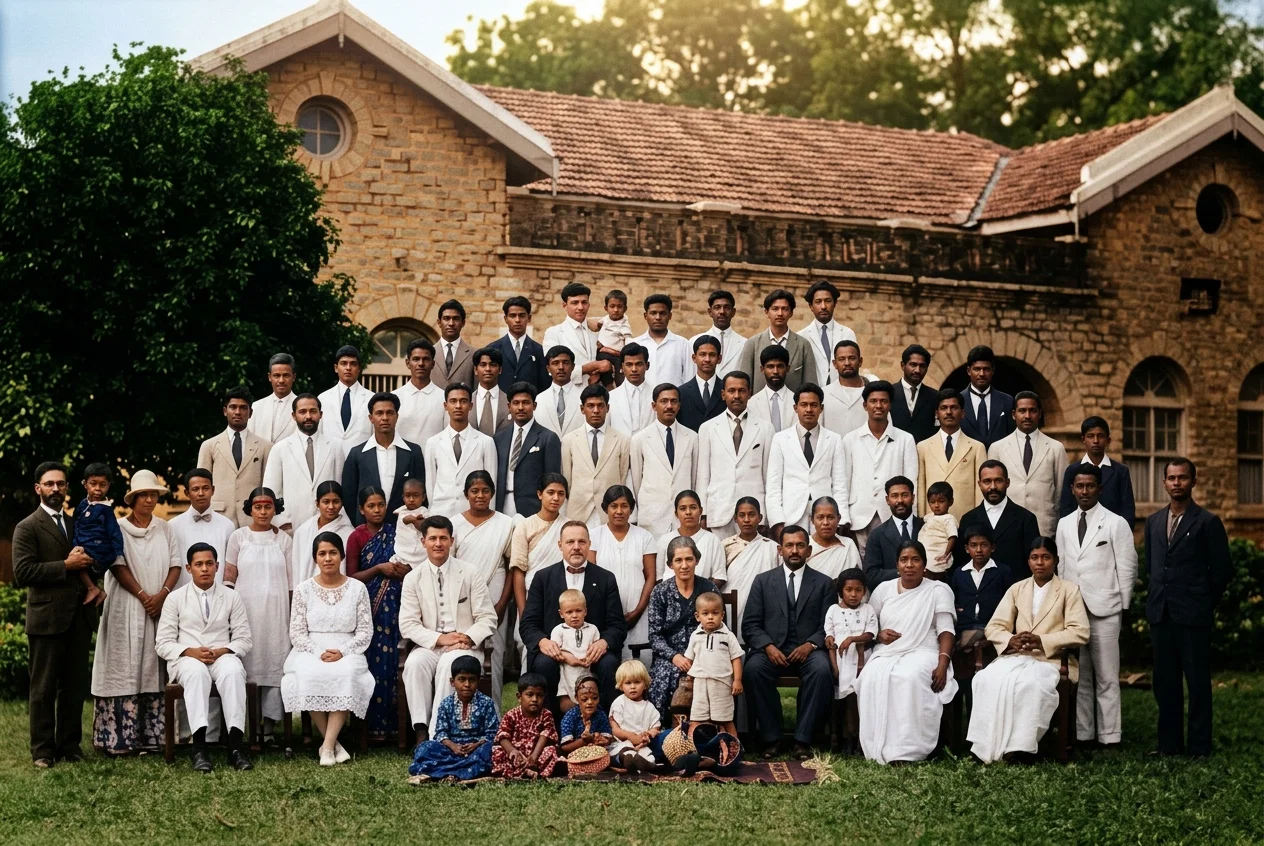
A group of graduates of the South India Training School
These testimonies were written by the students themselves. Do you not think this school and others of its kind in the Indian Empire will exert an influence for God in these days of revolution and crime? And it is verily by faith that these young people have come to us. Throughout the length and breadth of the land India abounds in institutions of higher learning. Graduates and undergraduates of these institutions are busy preaching “civil disobedience.” The government, which has spent large sums of money on these institutions, is now spending an equal amount keeping the products of them in jail. But education without the word of God could lead to nothing else.
God has asked us to search out the jewels for His kingdom. We have gone. We have found them, among the millions,—oh, so few! But it rejoices our hearts to hear their testimonies ring true and to see them stand firm when tempted by worldly opportunities. We tremble to think of the consequences their faith may bring them in the way of persecution. Idol worship is abating and atheism is increasing. The doctrine of Russia finds ready acceptance in many hearts. But rejoice, all these things are only signs of the soon-coming Redeemer, in whose kingdom many from dark India will doubtless find admittance.
A view of the students and teachers of the South India Training School

The Temple Within

RULED the wise king in his temple, Built without the sound of steel; Ours of flesh constructed likewise Holds an unseen King as real.
We may “close the door” and worship Midst the clamor and the din; Any place may be a temple, If His Spirit dwells within.

Any Place a Temple

FANNIE VICKREY DONNELLY
When the daily cares encumber, List! the temple bell chimes clear: “Come apart to Mt. Moriah, Where the Master draweth near.”
Let us learn to light the censer Midst the throng by Mammon led; Breathe its fragrance round us wafting, Bow the heart—if not the head.
We must learn to pray unceasing In this world of doubt and sin; Any place may be a temple If the Master dwells within.

Literature Wanted

The following persons desire late, clean copies of Review and Herald, Youth's Instructor, Present Truth, Watchman, and SIGNS OF THE TIMES, for free distribution:
Augustus Sanders, Route 3, Carlisle, Indiana.
Mrs. A. H. Koenig, El Reposo Sanitarium, Florence, Alabama.
Mrs. Alice Thake, Clear Lake, Iowa, SIGNS and Instructor.
Mrs. B. W. Ellis, 1412 South Fourth St., Camden, New Jersey.
Emma B. Kincaid, 1133 W. 13th Ave., Denver, Colorado.
H. L. Nielsen, Box 95, Castries, St. Lucia, British West Indies.
This piety which is faithful in that which is least, is really a more difficult piety than that which triumphs and glares on high occasions. Our judgments are apt to be dazzled by a vain admiration of the more public attempts and the more imposing manifestations of occasional zeal. It requires less piety, I verily believe, to be a martyr for Christ, than it does to love a powerless enemy; or to look upon the success of a rival without envy; or even to maintain a perfect and guileless integrity in the common transactions of life.—Horace Bushnell.

Justice and Wisdom

THE virtue of justice consists in moderation as regulated by wisdom.—Aristotle.

A NEW BOOK FOR THE CHILDREN

The MALLARDS and their NEIGHBORS

by NEIL WAYNE NORTHEY
This is volume two in a series of four new books for the children, called “Old Homestead Tales.” Each book is a complete story in itself, covering a certain phase of wild life found on the Old Homestead.
In this book is told the story of the Little Wild Creatures that prefer to live near water. It is the story of the Mallards, who lived at the Duck Pond on the Old Homestead, and of the Feathered Friends and Furry Friends who were their neighbors at the Duck Pond and along Little River. While flying northward, Mr. Mallard was shot in the wing, and that was why the Mallards stopped on the Old Homestead. Mrs. Mallard discovered a Sheltered Little Cove at the Duck Pond, and decided to start housekeeping. In a little while Redwing the Blackbird, Longlegs the Heron, Shoveler the Spoonbill, and many other Feathered Friends moved in. Everything would have been peaceful at the Duck Pond if Lutra the Otter, Trailer the Mink, Billy Coon, Snoop the Weasel, and other Furry Enemies had stayed away. And there was Sharptoes the Duck Hawk, who tried to catch the Fluffy Ducklets. What do you suppose Bud Smith, who lived in the Grand Old House on the Old Homestead, did to the Fluffy Ducklets before they left for the Sunny Southland?
“The Mallards” has 180 pages divided into thirty chapters of most interesting stories. It is very fully illustrated with pen drawings, and there are four full-color plates, showing the Little Wild Folk in their natural colors. This book follows “The Bluebirds and Their Neighbors”—the only two of the set of four that are ready at the present time. Order these two new books, and watch for the announcement of the other two numbers.
Order from our nearest representative or PACIFIC PRESS PUBLISHING ASSOCIATION Mountain View California
Price $1.25 Postpaid In Canada, $1.50
Continue reading: Political Upheavals and the R-101 Disaster