What the cigarette is doing for the youth of the country is strikingly demonstrated in schools designed to prepare young persons for entrance to colleges and universities. Those having charge of such schools have been collecting statistics along these lines to guide them in their work. Dr. Fisk, who has charge of the Northwestern Preparatory School, has become so thoroughly convinced of the deleterious effect of cigarette smoking upon youth that he has asked any boy in the school who can not or will not give up cigarettes to leave, and offers to refund to such all they have paid in fees and tuition. The doctor does not deal in generalities or denunciations. The statistics which he has gathered cover a period of several years, and show that of the boys who smoke only two per cent are among the twenty-five per cent who stand highest in class scholarship. On the other hand, thirty-seven per cent of the smokers are among the twenty-five per cent who stand lowest in scholarship. Concerning this showing the Chicago Record-Herald says:—
“At the present time the boys who smoke appear to be entirely incapable of passing examinations or keeping up in their studies. Two out of every nine boys in school confess that they smoke cigarettes, and not one is in good standing in his classes. The proof of the positive deleterious effect of the cigarette upon a boy’s mind appears to be conclusive, Dr. Fisk not being the only educator in this country who has gathered statistics of similar import. School authorities are justified in resorting to every possible device to persuade young boys who are addicted to the cigarette to abandon the habit.”
The cigarette snare has proved one of Satan’s most luring devices to capture souls. It interferes with both the mental and the physical development of the young. It dulls the conscience, and opens the way for the practise of every evil thing. It blunts the edge of every good ambition, and renders the mind incapable of appreciating spiritual things. The most difficult case for an evangelist to deal with in the whole rank and file of the people is the person addicted to the cigarette. A veritable oil of lethargy seems to have been poured over the spiritual perceptions of such an one, and the most precious truths of the gospel flow over it with little, if any, impression. Parents should educate their children and their neighbors’ children to avoid it as they would the most deadly poison, for it is a poison to both body and soul.
C. M. S.
Children’s Rights
There is one among the children’s rights that is very often not respected by their elders. It is their right to be treated with civility and politeness. They are taught—or have been, and ought to be—to be respectful to their parents and teachers and all older people, but the opposite obligation is not often enough insisted upon and practised. If there be more in older persons to call forth respect, there is also with them, or should be, more capacity for showing respect, more knowledge, judgment, and practise in courtesy. Children are quick to follow examples; and to do as they see others do is but natural with the children. The pattern, much to be regretted, is too often but a poor one.
Not only are parents remiss in recognizing and granting this right of children, but teachers in our schools have yet to learn much of what they owe to their pupils. In many instances these teachers, who are paid to look after the deportment of the children entrusted to their care, are grossly discourteous, both as to words and manners, and many of them are in no sense fit to have charge of the little ones to whose impressionable minds they show forth the very rudest manners and most discourteous language. They would not dare to talk to the parents and guardians as they do to the children.
Many parents who are careful of the manners and speech of their little ones at home are at a loss to understand where their carefully guarded children learn such rudeness of speech and such brusqueness of manner as they sometimes display. This is but another reason why parents and guardians should visit the schools and familiarize themselves with the companionship to which they subject these tender charges, and as to the fitness or unfitness of the teacher for the trust and reliance placed in his hands. Teachers are often no more faultless than are the pupils they are supposed to train properly, and, being seldom visited by the parents, they are on their best behavior when “visitors” do appear, and thus the child is more often than not unjustly blamed for offensive manners and speech when he is only “following copy.”— Selected.
A “Baby Pen”
During the hot weather, a mother will often wish to do her work on a cool porch, or under the trees, and baby must go with her. In order to have the baby perfectly safe, comfortable, and yet able to get about, get a piece of poultry fencing (not too wide), tack it onto a light frame of suitable size, lay a strip of carpet, or an old quilt, on the floor or grass, and set the frame over this. Set the baby inside of this pen, pile his playthings about him, and he can see mama, talk to her, and yet be safely out of the way of the often hurrying feet, and not able to stray away into trouble. When tired, he can lie down and take his nap. To protect him from the flies, a piece of mosquito netting can be draped about the frame; or a frame may be covered with screen wire, such as is used for doors and windows; but in that case, the frame should be high enough so that a walking baby may stand upright without his head coming in contact with the wire netting overhead. Such a “pen” can be used indoors, to the great comfort of the mother, as well as of the baby.— The Commoner.
For the Child’s Sake
WHEN the adults of the family have a cold, the children should not be allowed to kiss them nor in any way get their breath. Kissing on the mouth should never be allowed, nor should several members of the family use the same handkerchief; much harm may be done by this custom. If the child breathes through his mouth instead of his nose, he should at once be examined for adenoids and enlarged tonsils, and have them removed before trouble gets started; and if he has an earache, a prompt examination of his ears should be made. When children who inherit such weaknesses have wise care and proper surroundings, in a large percentage of cases they will grow up to be strong and healthy men and women.— Selected.
Among the Waldensians
By Ludwig Richard Conradi
L. R. CONRADI
The early Christian church at Rome, hidden away in the spacious subterranean catacombs, the church in the wilderness, carried on eagle's wings to the lofty heights of the snow-covered Alps, and Babylon the great, with its magnificent palaces and churches strewn over the seven hills of Rome, form a strange contrast. As the writer was able to visit all these places within a week's time, the contrast was all the more vivid to his mind.
After spending Sabbath, April 28, at Gland, where I found about twelve young people in our school, receiving an education for the great Latin Union field, and where there were about twenty patients in the sanitarium, I left Sunday via Geneva and the Mont Cenis Tunnel. Although there was fine spring weather in the valley, Sunday night as we slowly climbed upward toward the Italian border, we found ourselves in the midst of a blinding snow-storm; but when we had crossed into the Italian plain, we found the most perfect spring weather.
Our first stop was at Turin, one of the best-built cities in Italy. Here I called on several of our people, and, as the weather was pleasant, and the atmosphere clear, I improved the opportunity to climb the fine tower of the Ricordo. This building was originally designed as a synagogue; later it was taken possession of by the government, which has changed it into a museum. The tower is about five hundred and forty-five feet high, being one of the highest stone buildings in existence. As beautiful as the art work on this building is, yet it was the hope of beholding a grander scene which inspired me to ascend this noted tower, because from its summit one has a view of the Alps that is unsurpassed, so far as the extent of the vision is concerned. Not only is the whole northern horizon one solid panoramic wall of mountains towering up as high as fifteen thousand feet, but these massive battlements of nature extend from west to east as far as the eye can reach—from France, across Switzerland, and into Austria, forming a mountain chain about five hundred miles long, which was prepared in the very heart of Europe as the “fountains of waters,” a refuge to which God carried his persecuted church, and kept it safely for many centuries during the Dark Ages.
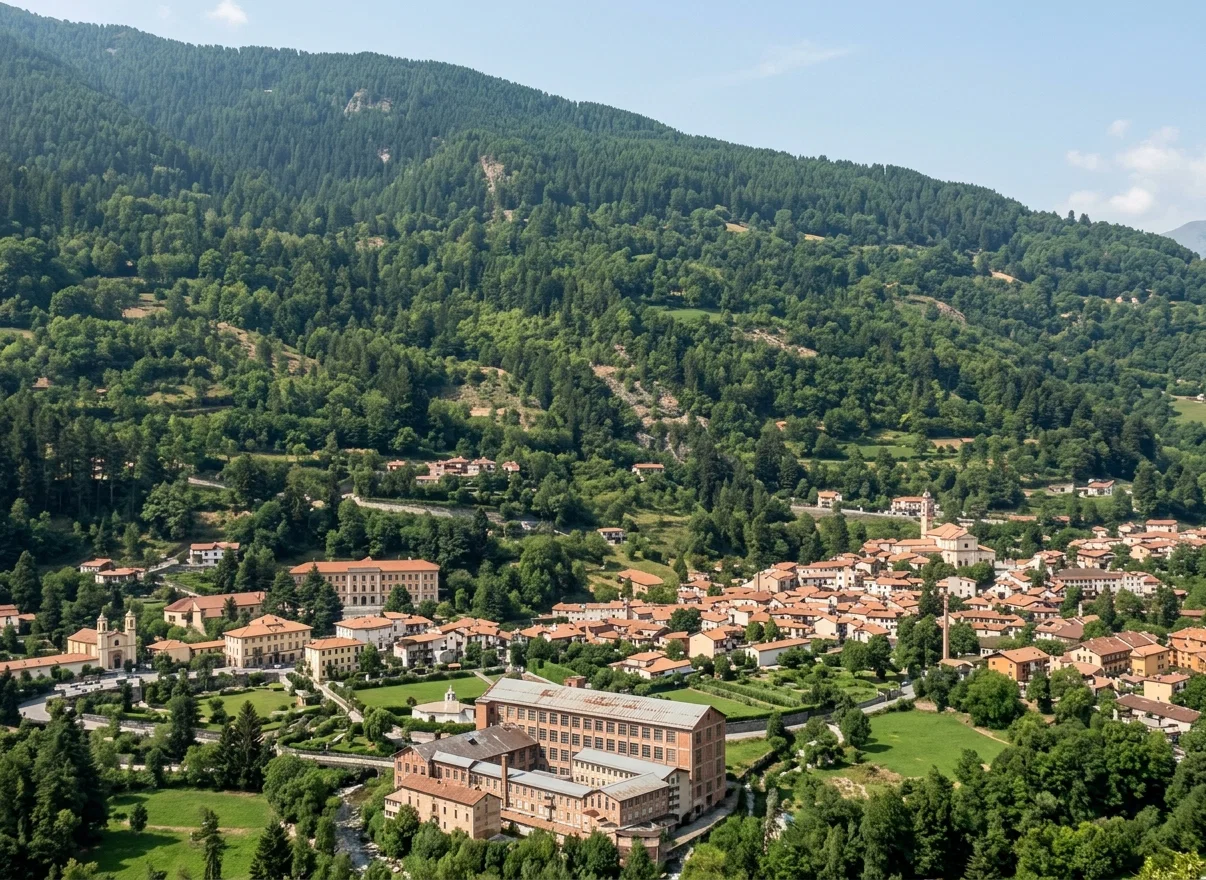
Elder Vuilleumier met me in Turin, and the next day we went to Torre Pellice, in the Waldensian Valleys, about thirty-five miles to the west of Turin. These historic valleys extend over an area about fifteen miles wide and twenty miles long. They are formed by several branches of the Po, chief of which are the Pellice, St. Martin, and Perouse Valleys. They ascend from the Lombard plain to the height of thirteen thousand feet, and form the present border between France and Italy. At the present time the Waldensian Valleys are mostly under the Italian government, but the people still speak a special French dialect. There are to-day seventeen pastorates in these valleys, while they have forty-eight churches and forty-five stations throughout the world.
TORRE PELLICE, IN ONE OF THE WALDENSIAN VALLEYS
Some of their churches are in North and South America, and they have a number of colonies founded in Germany at the time of their persecution.
Torre Pellice is a small town of about five thousand inhabitants, and is beautifully located at the juncture of the Pellice and d'Angrogne Valleys. About thirty of our people live in the neighborhood. There was quite a good interest when Brother Curdy labored here some years ago. Since his departure there has been no regular worker in this field. Five years ago I visited these brethren. They enjoyed having Brother Vuilleumier remain with them for a week, that he might encourage them, and celebrate the Lord's Supper with them. Some of our people live in the town, and some are scattered along the mountainsides. We found Sister Revel, the oldest Sabbath-keeper in the valleys, of good cheer. It is now about thirty years since she accepted the message.
During the day I had the privilege of visiting the headquarters of the Waldensian Church, where they have their conference hall, their offices, and a library of about twenty-four thousand volumes. The librarian had spent some time at the university in Berlin, and had lately visited the Waldensian German colonies, and he very kindly showed us quite a number of interesting volumes. Among these was the Olivet Bible, printed in harmony with the decision of the Waldenses, at Neuchâtel, Switzerland, 1535. In the evening I had the privilege of speaking to about one hundred people in the Baptist church.
As we had ample time next day, we decided on a foot tour up the Angrogne Valley, the most noted valley in Waldensian history. Ascending, our first stop was at St. Laurent, about two miles up the mountains. Here, hidden among the rocks, is one of the most ancient of the Waldensian churches, a building dating from 1555, although it was several times rebuilt and destroyed. Half a mile from the place, we came to a large cliff of rocks where the Waldenses have many times beaten back their enemies. According to our guide-book, we knew there must be some cave among these rocks, in which the inhabitants of the valley had often held their meetings during seasons of persecution. We looked in vain until we hailed one of the farmers near by, who brought us to a cave among the rocks, after a few minutes' walk. We had to creep in on our hands and feet, and when we had entered the small opening, we found ourselves in a cavern perhaps twelve by thirty feet. The light entered through crevices in the roof of the cave. From here we had another ten minutes' walk, and came to the Chanforans; here the noted synod of 1532 was held, in the open air, under a chestnut-tree, where it was decided to print the Bible.
About three more hours' walk, during which time there was nothing left of the valley, save a small, gushing current14and a foot path, we reached the famous entrance to the highlands, which was so often stormed in vain by the enemy, a few Waldensians being able to defend the place against large opposing forces. On either side of the pass are very high and steep precipices, making such a defense possible. The force of the falling water has formed great basins in the bottom of the torrent bed, in many places. In 1561 the Waldenses were able to hold the whole force of the enemy in check at this pass.
After four hours' walk, we reached Pra du Tour, which the enemy vainly tried to take, for centuries. Here the Waldenses had their school that for ages sent forth evangelists who had to brave all sorts of dangers.
The short motto on the Waldensian church is indeed significant—a lighted candle, with seven stars, and the superscription, “The light shineth into the darkness.” While it almost seemed, during the Dark Ages, that the light of God's truth would be extinguished, yet it was then, as in the days of Elijah, in the caves and rocks there were still thousands who in the midst of the darkness caused the light of God to shine brightly.
En route from the valleys to Rome, I stopped in Pisa, a city of about fifty thousand inhabitants. Since spring, two of our workers have been trying to get acquainted with the people in this place through the circulation of literature, thus preparing the way for a course of lectures. Pisa is visited by tourists because of its noted cathedral with the leaning tower, and its celebrated baptistery. These buildings date from the eleventh and twelfth centuries. The leaning tower is about one hundred and eighty feet high. Its first three stories were erected perpendicularly, and then they settled to one side, so that the remaining four stories (especially the last story), were constructed at a slight angle, to prevent the structure from toppling over. In the cathedral, there is a noted chandelier hanging down from above, on which Galileo is said to have observed a slight pendulum-like motion, occasioned by the earth's rotation. The baptistery is famous for its wonderful echo, which is superior to anything I have ever met in any other building. Our attendant, by giving a few musical tones in succession, was able to produce the effect of an organ playing in the distance. We hope the day is not far distant when we shall secure a good foothold in this place, through the efforts of Brethren Benezet and Vaucher, who are laboring here.
I remained in the city of Rome from May 4 to 8, the longest stop I ever made in the “Eternal City.” Here I was met by Brother Everson. We had meetings Sabbath and Sunday in their assembly hall, which they have rented on the ground floor of one of the principal streets of the city. About twelve were at the services. Naturally, there is great opposition from the priesthood in Rome, where the clergy is still very powerful; but we are glad that some have been gained for the truth, four having embraced the message, and others being interested. When I spoke Sunday night, several Catholic priests were at the door, trying to keep the people from entering the hall. I was pleased to find Brother Faund holding on faithfully. He now has a home for ex-priests, but we hope he will soon be able so to arrange his affairs that he may give his whole time to the gospel work. While visiting him, I met a young German Catholic priest from Alsace-Lorraine, whose father is the director of a factory in that district. This young man had been educated in Rome for the priesthood by his father; but from reading the Bible and witnessing what he saw in Rome, the young priest became rather skeptical as to the holiness of the Catholic Church. In spite of the efforts of his father and the endeavors of his coreligionists, he decided to leave the church. The very day he met me, he had had quite an interview with one of the cardinals, and also with his superior, but on that day he had decided to entirely break away from the church. Thus we see there are still honest souls here who by proper effort can be reached.
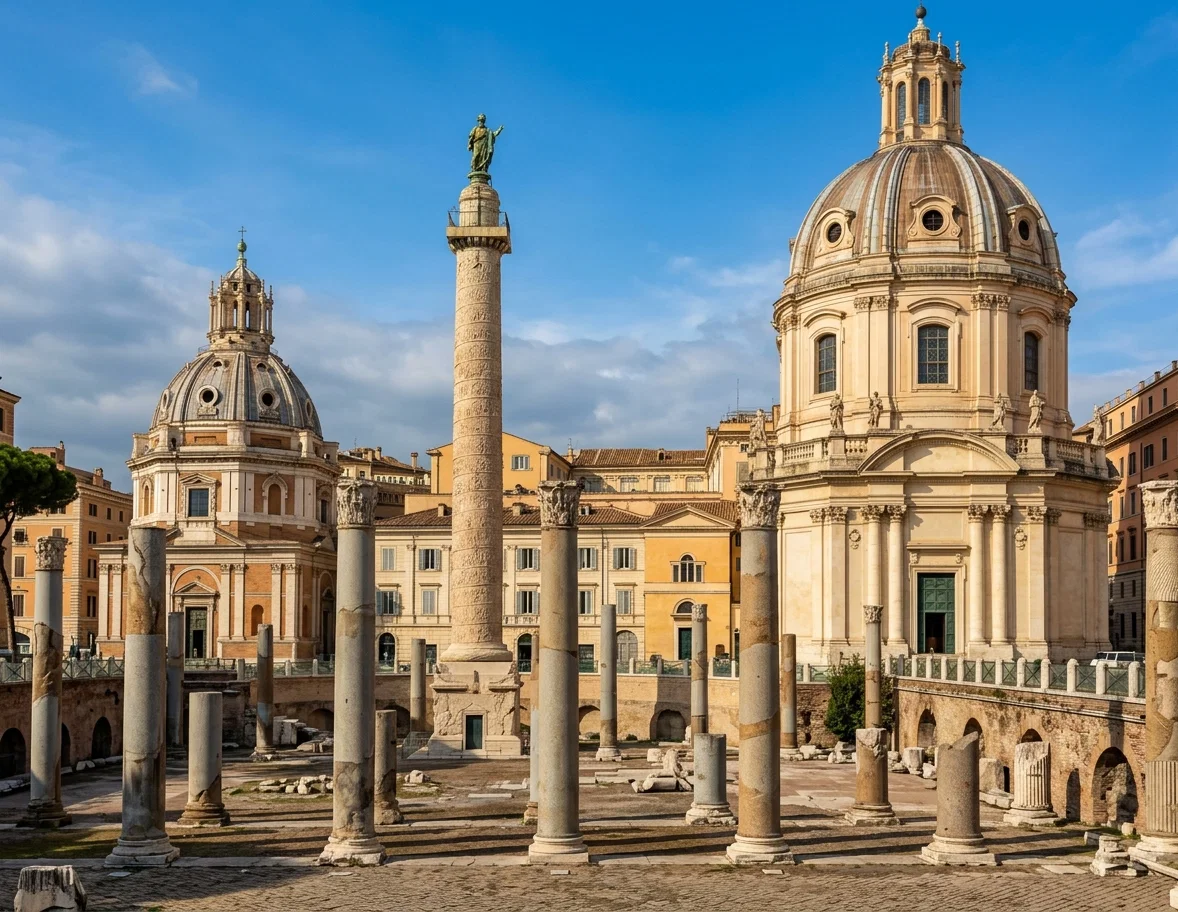
FORUM OF EMPEROR TRAJAN, CONSTRUCTED 114 A. D.
When we remember that there is actually more freedom to proclaim the message in Rome than there is in Germany or Austria, and that the Italians are an intelligent people, we surely would expect that ere long the work here would make the same advancement as is seen in other Catholic lands.
During my stay in Rome we visited the old prison of the emperors, where probably Paul and Peter were imprisoned; then we went to the Palatine Hill, where the Mamertine, the imperial palace, the Forum, and all these things stood. These vast structures of the ancient emperors of Rome are indeed a wonderful sight. We also visited St. Peter's, and noticed a number of intelligent-looking Catholic priests from the States, stepping up to the statue of St. Peter, and kissing his toe as devoutly as any one could.
They were just making preparations for the canonization of two new saints. In carrying out this ceremony large pictures were made, representing the miracles wrought by the priest and the nun who were to be canonized. (Before any person can be canonized, it is necessary that at least two miracles be credited to him.) The miracles of the two to be thus honored as saints, were portrayed on the large painting, which represented some wonderful cures they had performed.
We shall be truly pleased when the day comes that not only in Rome, but also throughout the length and breadth of Italy, there will be representatives of this message, proclaiming the gospel everywhere.
In Cuba
By E. W. SNYDER
E. W. SNYDER
It is with keen pleasure that we note the signs of the progress of the third angel's message among the people of Cuba. The advancement of the work in this island will aid in the hastening of the kingdom. Thus far the efforts put forth have been of the nature of seed sowing, since we must sow before we can hope to reap; but we have the promise that we “shall reap if we faint not.” God is verifying this promise to us here.
Some time ago, on calling upon a native pastor, we were invited to speak to his people on the prophecies. At the close of the first service, he publicly thanked the speaker, and wished to know if they could not have more than one15service a week. This did not last long, however; for after a few weeks the truths presented touched him, and the meetings were closed. But some of the seed sown had already found a lodging place in the heart of one man present. He drank in every word as it was presented, and the following week he made inquiries as to where we lived, and called. He has known the gospel less than a year, and his heart is full of love for it. It has been his custom to spend several hours twice a week in searching his Bible. When Bible readings were suggested, he quickly accepted, and he now comes to our home, walking three miles, three or four times a week, for his lesson. He has kept two Sabbaths, and is eagerly studying every point of present truth.
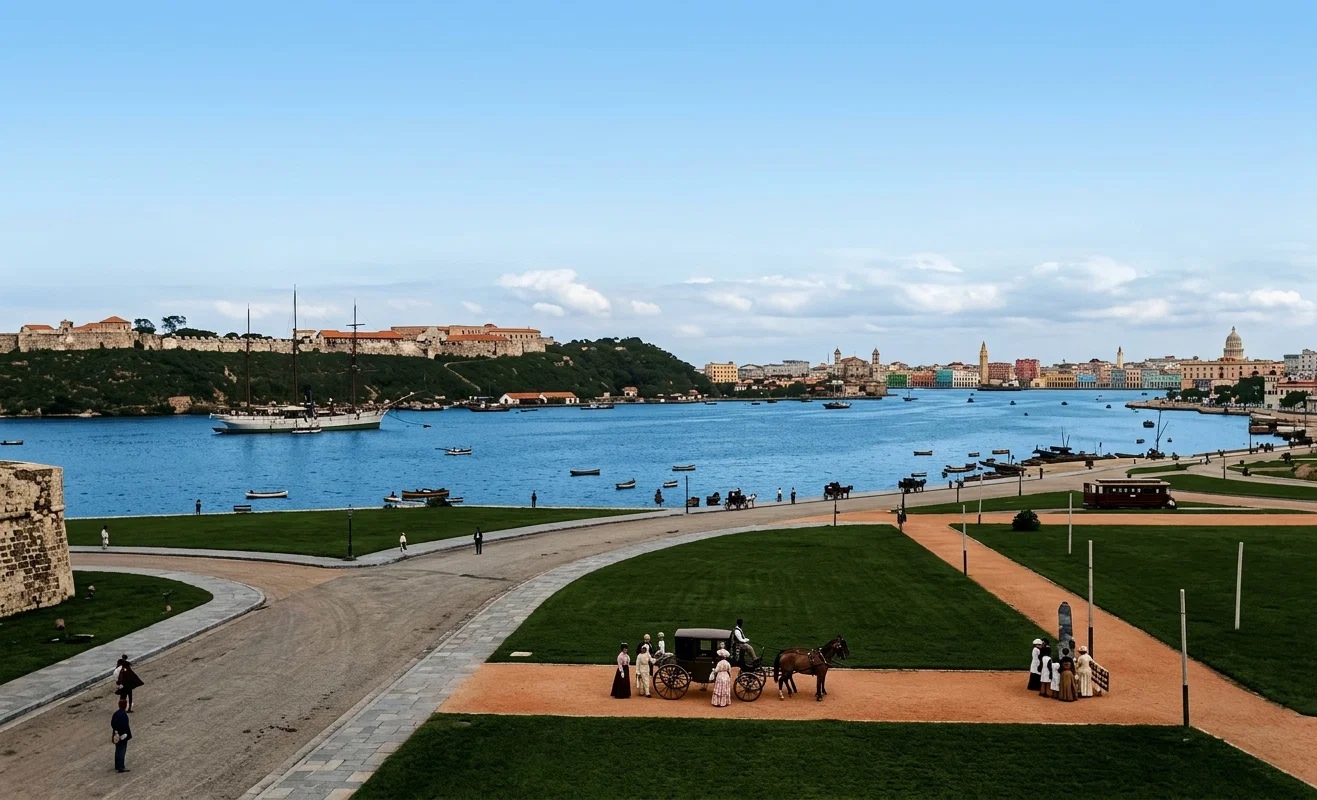
A VIEW OF HAVANA BAY
In his private study, this gentleman found the list of clean and unclean beasts, and it grieved him very much to think that only the day before he had eaten a piece of pork. “But I did not know any better,” he said; “I will ask God to forgive me.” He is having his hardest struggle on the tobacco question. Like all Cubans, he is a heavy smoker, averaging thirty-two cigarettes and from ten to twelve cigars daily. So one can readily understand that his struggle is no small one. But he is gaining the victory. He is studying now with the object of fitting himself to teach the truth to others. He loses no opportunity of talking it to others; for we frequently see him, in front of his barber shop, with open Bible, talking to the men who congregate there.
Returning from a recent trip into the country, we met en route a young Cuban, a mail carrier of Havana. He had formerly made a profession of religion, but had grown cold and indifferent. The study of the Word was suggested to him, and he readily agreed to this. He invites his neighbors in, and at a recent study, at the close of prayer by the leader, he voluntarily followed, thanking the Lord for having sent us among his people, and desiring that their hearts might be opened to receive the light. He is now planning that he may be free to observe the Sabbath.
Who can tell but that God is raising up workers right here from among this people, to aid in spreading the message over this little island republic?
Cuba, as is known, belongs to the family of countries and islands over which the Roman Church has had control for centuries. Added to this is the fact that for four hundred years she suffered under the cruel yoke of Spain. As a nation, she has existed for but four years, so it is not to be wondered at that she is even farther behind in the scale of progress and advancement than are the other Latin-American republics, which freed themselves from the mother country, some of them, a hundred years ago. All this has left its impress on the people mentally, morally, and physically.
It is hard to believe that lying so near the doors of our own fair land there can be found a people practising all the forms of witchcraft and superstition, as dark and hideous as that found to-day in darkest Africa. But such is the case. There are practised to-day in Cuba, in Havana, the capital, all the heathen rites and ceremonies that we have always associated with Africa; and even human sacrifice is offered, in the country districts. Less than a year ago, a white Spanish child was stolen from her family, cruelly murdered, and the heart and blood administered as remedies for certain diseases. All this is done in secret, of course. The perpetrators of this crime were brought to justice, and put to death by the old Spanish method of garroting, or strangling. A book has recently been published here on the subject of “Witchcraft in Cuba,” from which we hope soon to make some translations for the readers of the REVIEW.
These superstitions exist among the negroes, the descendants of the slaves who were brought from Africa and sold in Cuba at the same time slaves were sold in America. When they were sold to the planters in the South in our country, and in Jamaica, Cuba, Porto Rico, and other of the West Indies, they did not fall under the same influences. Those who were sold in the United States and the English islands came under Protestant influences, and we see the results to-day, in the number of these same people accepting the truths of the third angel's message. As one prominent colored writer has expressed it, “They went into slavery pagans; they came out Christians.”
Not so those poor creatures who were sold in the islands over which Spain and the Catholic Church had dominion. They went into slavery pagans, and came out worse than pagans. They have never affiliated with the church. And is it not to the shame of a church that professes to be “the only true church” that a people over whom she has had an influence for centuries should be in a worse condition than when they came to her? Could those so-called Protestants who are so ready to make friends with this same church, know and understand her as she is known and understood in these countries over which she has long had control, they would not be so willing to make the advances they are now making.
As said before, all these influences have left their impress on the people. One writer on the people of Cuba, referring to the fact that all Cuban songs are pitched in the minor keys, even the cries of the street vendors being in the same sad key, says: “Some have asked why these cries are all pitched in the minors. The only explanation is that in all countries where the people suffer, or have suffered under oppression, the folk-songs are always in the minor keys, the sadness of the race finding its way into its music. It is about thirty years since the slaves in Cuba were freed, and their songs to-day reflect the misery of the past. As most of the hucksters are colored, the cries by which they announce their wares are full of pathos.”
All this is true. But we are glad that the truth of the gospel is beginning to find its way into at least a few of these saddened lives; and we know if they will accept it, it will bring joy and happiness into their lives, as it has done in ours, and will change the music in their hearts, at least, from the sad tones of the minor to the more joyous ones of the major key. It does one good, when passing along the streets, to hear floating out from some Cuban homes the words and music of some of the old familiar gospel hymns, as “The Great Physician,” “Sweet hour of prayer,” “The light of the world is Jesus,” “Nearer, my God, to thee,” and others. It is difficult sometimes to recognize the air, it is sung so faultily; but you know that some light has come into their lives, and that they are happier for it.
The leading denominations are all represented here. Protestant churches are being built all over the island; schools are conducted; Bible colporteurs are going over the length and breadth of the island, sowing the seed. As Seventh-day Adventists, we owe much to the16faithful efforts of those not of our faith. Our work is made easier because of theirs. In many cases they have done the sowing, and we the reaping. The leaders and directors of these various societies are always Americans, but each church has also many native helpers.
It is among this latter class that are found at least some who are honest hearted; and having recently come out of the Catholic Church, they are, many of them, looking for more light. One of these is now publicly recommending “Patriarchs and Prophets” to his congregation, and recently sent in an order for six copies, saying he thought he could sell six more. He also gave us an excellent recommendation to another pastor in an adjoining town. Wherever this book is presented among the native pastors, it is gladly purchased. Many of them can read English, if they can not speak it, and so other of our books are finding their way into their libraries. Several copies of “Thoughts on Daniel and the Revelation” have been sold among them. Calling on a young native worker recently, we found him translating, for use in his work, from “Heaven and Hell,” by Swedenborg. When the little “Bible Text-Book,” by Elder Johnson, was shown him, he gladly ordered a copy. We are often asked to bring anything we have that will aid in their study of the Scriptures, but we have little in Spanish.
Up to the present the leaders and pastors of the other churches have shown only the greatest friendliness toward us; but we know, of course, that this will not always last. When the testing truths come to them, some hearts will harden, as did Pharaoh's, while others will be melted, and will be the instruments in God's hands for giving the truth to their people.
A young colored worker would find plenty to do here. While studying the language of the country, he could use his English by working among the American and Jamaican negroes, of whom there are a great many. We find them ready purchasers of Bibles and our English books; and they often speak with regret because of their lack of religious services. We have tried to plan for this class, but up to the present have been unable to do anything for them, owing to our already heavy burdens. Among the colored Cubans, a colored worker would be more favorably regarded than would a white one. This was demonstrated recently. A colored Methodist Episcopal pastor, who speaks Spanish very brokenly, asked us to assist him in a service he desired to hold among the Cubans. Although his Spanish was almost unintelligible, yet they gave him the better attention.
Is there not among our ranks, in some of our schools, some intelligent young colored man who would be willing to come to Cuba and spend himself in helping and serving his more unfortunate brethren? If there is, we would be glad to correspond with him.
Much more might be said of the needs of the people. They are great, and constantly appeal to us. We have entered Cuba none too soon, and our prayer is that the Lord may help his people to forward the work in this island, and thus hasten his coming.
A Prophecy Fulfilling
By L. A. HANSEN
L. A. HANSEN
SINCE we last wrote, our work has been steadily developing. Brother Miller, of Calcutta, made us a visit, which was very much appreciated. He seemed rather pleased with the outlook. We kept busy the few days he was here, showing him the enemy’s camp from the several points where attacks are being made. With the help of God, we shall conquer.
On his way to Ava, Dr. Judson once visited the site of Pugan, a city celebrated in Burman history, it being the seat of a former dynasty. He wrote of this visit:—
“Behold all the country round, covered with temples and monuments of every sort and size; some in utter ruins, some fast decaying, and some exhibiting marks of recent attention and repair. . . . All conspire to suggest those elevated and mournful ideas which are attendant on a view of the decaying remains of ancient grandeur. . . . Here, about eight hundred years ago, the religion of Buddha was first publicly recognized and established as the religion of the empire. Here, then Ah-ran-han, or the first Buddhist apostle of Burma, under the patronage of King Ana-ra-tha-men-zan, disseminated the doctrines of atheism, and taught his disciples to pant after annihilation, as the supreme good. Some of the ruins before our eyes are probably the remains of pagodas designed by himself. We look back on the centuries of darkness that are past. We look forward, and Christian hope would fain brighten the prospect. Perhaps we stand on the dividing line of the empires of darkness and light. O shade of Ah-ran-han, weep over thy falling fanes; retire from the scenes of thy past greatness. But thou smilest at my feeble voice. Linger then, thy little remaining day. A voice mightier than mine, a still small voice, will erelong sweep away every vestige of thy dominion. The churches of Jesus will soon supplant these idolatrous monuments, and the chanting of the devotees of Buddha will die away before the Christian hymn of praise.” (Jan. 18, 1820.)
How remarkable the fulfilment of this ancient prophecy has been, is one of the most entertaining themes for Judson’s successors. The privations these pioneers of the cross underwent is beyond tongue or pen. Behold this noble man, all alone as an apostle of Jesus Christ! His bishopric was fair Burma, his parish Rangoon. Here he stood with willing heart, hands, and tongue, but no one could understand him save his wife. In all Lower Burma no one spoke English. A despot ruled through officer more despotic than himself. No one cared for Judson or his religion; there was no comfortable house for him to live in; no friend here; no mail service with friends at home. All letters were sent and received through the kindness of an occasional visiting captain in an old-time sailboat.
At the markets was no food that a stranger could enjoy with relish, as the roots, leaves, and stems of plants and trees are much used by the Burmans; and often the form and color of fruits are very dissimilar to those of any that grow in the temperate climes. The immediate surrounding of the abode of the strangers was chiefly heavy growth of vegetation, interspersed with such paths as might be made by man and beast, pleasant in the day, but swarming at night with bats and flying foxes, not to mention the numberless mosquitoes, whose sting was quite enough to rob them of the much-needed rest. Such then, but how different now!
Now we have at least three mails weekly from Calcutta, and several from the south. Our markets are well supplied, though expensive, with everything ordinarily wanted. Judson’s humble sayet (study) has long ago been supplanted by stately churches, schools, and even colleges. His scant library is supplemented by well-stocked book-stands, and re-enforced by skilful printers and modern presses. The city is renovated by hygienic measures, and its roads and thoroughfares are made passable in rain or shine by the best road metal. The railroad brings the far-distant Ava and Mandalay, with the many intermediate points, within less than a night’s journey. The English tongue is represented everywhere. Christian churches are reared, and the Name that is so dear has many admirers and faithful servants. What has God wrought!
The third angel’s message is finding some of the loyal hearts in this fair land. Just two weeks ago it was my privilege to witness at Moulmein the baptism of seven Burman Sabbath-keepers. I would our people in America could have seen this rare sight. These were all well along life’s journey, to whom the possible point of novelty was long past—men and women of mature judgment—who followed their Lord into the watery grave, that they might meet him in the first resurrection.
Sometimes the calls for help for mission work, for churches, for support of schools and opening of health institutions, are so frequent that we feel it costs almost too much. Costs too much! God forbid that we should estimate the cross in that light. When the light is eclipsed by the darkness of this world, such a thought may enter, but not while we are out where we can see souls leaving this world for a better one.
At some later occasion I shall tell of some of the experiences of each of these brethren and sisters in this message. Pray for the work here.