Your ShelfYour Projects

Review and Herald, Vol. 89, No. 2.

A Hymn for the New Year
Earlier text: The Price of One’s Soul

The Victor

The Angel's Record—No. 2

The Victor

MRS. S. M. SPICER
In princely halls, a festal scene Shone dazzling o'er a wondering throng; Mid royal purple, golden sheen, Rang loud acclaims of praise and song!
A conqueror, wreathed in laurel crown, Drank long the meed of sweet applause; The crowd, in worship bowing down, Shouted, “Long live the hero brave!” “Immortal honors crown thy name, Which history's page shall proudly bear: The thousand foemen thou hast slain, Their lands and treasures all thine own,”—
So sang the crowd, so flattery paid The servile debt, ambition's due; While far above, the angel stood, From truth's unclouded height to view.
He saw, beneath that laurel crown, Selfish ambition, proudly vain; And on that white, bejeweled hand Of brother's blood the cruel stain. Nor need delay his truthful pen, The victor's name with blood to trace. Though honored, worshiped thus by men. “Thou, conqueror, hast in heaven no place.”
Then quickly sought his angel eye A lovelier sight, a dearer theme; And to the field of strife did fly, Where dead and dying still were seen
He noted: There, unseen by man, The feet of mercy, hands of love, Were swift to bear the soothing balm, And point the dying soul above.
Unsought was wealth; unthought of, fame. Unselfish love, unwearied toil, Relieving sorrow, want, and pain, Illumed the darkly crimsoned soil.
The benefactor meekly heard The dying blessing on his head; While on the angel's book appeared The name, as victor, traced in light.
Takoma Park, D. C.

Types of Papuans

BERTHA S. CHANEY
The study of a native race is one which is likely to prove of absorbing interest. On seeing their curious customs and hearing their strange ideas, one can not but be led into wondering how these customs grew up, and where their unusual ideas took root.
In Port Moresby we have excellent opportunity for seeing many types of the Papuans who live in the different parts of eastern New Guinea. There are many natives at work in and around the port. They are used as day laborers on the buildings being erected; they work in the stores, where they are used as carriers, and for doing the lifting and heavy work; they work on the boats which ply up and down the coast; they work for the blacksmith and the baker; and a great many are employed as house-boys.
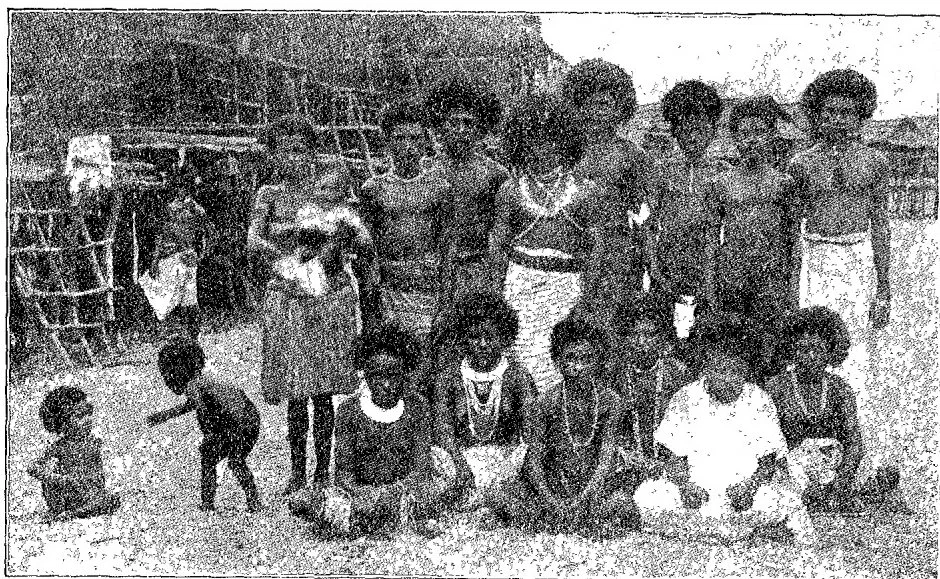
GROUP OF NATIVES AT HANUABADA VILLAGE, NEW GUINEA
Besides these who belong in port, a great many pass through, being brought from the villages along the Gulf of Papua, and indeed for some distance up the Fly River, and from inland. They are brought in, in great squads, to “sign on” for the plantation work, which is making good progress in the inland districts. And again, they must all be brought in to the native labor office to “sign off” at the end of their term of service.
There is a great diversity among them in appearance and color. Those who come from the villages along the coast of hair just over the forehead; and not so pleasant in appearance as those whose villages lie in the vicinity of Port Moresby and to the east. On the street, a few days ago, I passed a large group of men, stringing along behind their white overseer, and never anywhere have I seen a plainer lot of people. Their dark skins were rendered rough and unsightly with the ringworm, which is unfortunately very prevalent. Their features were very irregular. Many had the head shaved except for a small patch of hair just over the forehead; and not a face among them looked bright and attractive. Upon inquiry I learned that they were Kiwai boys, having been recruited from an island of that name that stretches its slender length for miles in the waters which pour out of the Fly River into the Gulf of Papua.
The above description does not fit the coastal natives who live near Port Moresby and to the east. They are lighter in color and have pleasant faces; their features are often very good; they are not so large, but have an unusually erect carriage. Many of the young women are plump and pretty, and seem to be aware of it, as they walk about swinging their grass ramies gracefully as they move. When not spoiled by the ringworm, their brown skin glistens in the sun, and the tattooing in lines and curves on their faces and bodies does not detract at all from their appearance.
The great difference in the eastern and western natives in character, appearance, and language, has led to a theory being propounded of an influx of Melanesians at some time in New Guinea’s history. These Melanesian people have invaded the “great land,” as the Papuans call their country, and, settling along the coast, have forgotten when or why they came. They seem not to pass oral traditions down from father to son, as do the American Indians. The tribes of Papuans proper, who were living along this southeastern coast, were probably driven inland, if not absolutely annihilated by the invaders. There is even now a strong mutual distrust existing between the inland people and the coastal tribes. Brother Carr’s boys are all from inland, several days’ journey beyond the Bisiatabu plantation, and they have a great dislike to being in Port Moresby. Very few of the inland boys will come in to the port to work, and those from the coastal villages have an equal dread and fear of going inland.
These Melanesian tribes, as they are supposed to be, which are wedged in among the more savage Papuans, evidence a higher development and show greater tractability than the aborigines. But even among these there exist great differences, owing to the fact that there was little intercommunication between tribes before the advent of British law and order. Now that they are obliged to live at peace with each other, the villages intermingle much more than formerly.
All the natives love to deck themselves in beads, streamers of paper, shells, and rude ornaments of all sorts. They paint their faces, too, in odd fashions. Sometimes they sketch black rings around the eyes, which give a grotesque suggestion of spectacles. Red paint, which they make from a plant, is in great favor. Our boy takes his sauce-pan of rice out to his quarters; when he has finished his meal, he turns up the pan and uses the black to draw pretty circles around his eyes, and streaks from the corners of his mouth to his ears.
Upon first arriving in port and seeing the natives swarming over the wharf, lazily sitting on its edge, or lying about in their canoes, eating rice and fish from a common dish, chewing the disgusting betel-nut, and passing around the big bamboo tobacco-pipe from one to the other, one can not resist a feeling of repulsion for such an unattractive people. But when one comes to know them, and learns that they have human qualities and feelings; that they love their children; that they mourn for their dead; that they carry burdens of sorrow and care; and that they have some sort of moral standard,—one can not but recognize their savagery and degradation to be the greatest appeal they could make for the help which the gospel can give them.
“If thou art blest, Then let the sunshine of thy blessings Rest on the dark edges of the cloud that lies Black in thy brother’s skies.”

Results of Locating Our Press at Soekaboemi, Java

J. W. HOFSTRA
From the very first of the arrival of the press family, it became evident that God had called us to Soekaboemi. Naturally, Brother and Sister Munson supposed they would be total strangers to every one in this city; but to both their surprise and delight, they found several old acquaintances, especially among the Chinese. Some of them had been pupils of Brother Munson while he was in Singapore. Others were old friends made during their stay in Padang, Sumatra. Thus the Lord had provided beforehand a circle of friends for whom Brother and Sister Munson could work. These friends soon increased. One of the Chinese is already obeying the Lord in regard to the fourth commandment. He is a very intelligent man, and a bookkeeper in a large printing firm. There is not the least objection to his laying aside his work on the Sabbath and working on Sunday. He is studying the prophecies; and the Spirit of God is doing great things for this brother.

Still Another Addition

A very interesting case is that of Brother Brouwer. He and his family had gone to the Netherlands to reside in The Hague. While there they heard Pastor Klingbeil, with the result that all embraced the truth—the father, the mother, and four grown children. The truth planted itself firmly in the hearts of their children, working in them an irresistible desire to become in time actively engaged in the cause. With the consent and support of their parents, all four of them are in our school at Friedensau, Germany, preparing themselves to become workers.
For a long time there seemed to have been some reason which held Brother Brouwer from fully identifying himself with us. Yet that the love of God and the truth had settled deep into his heart, could never be doubted by one who knew anything about him; the very fact of supporting his children in our school, when he always had planned differently for them, would prove beyond dispute his love for the message.
Last year he returned to Java, planning to take up his former work as railroad director. After he had been here for some time, he received an invitation from relatives in Soekaboemi to visit them a while, before taking up his work. Brother Brouwer accepted the invitation, and came to this place, not having the least thought of finding Seventh-day Adventists here. The Lord, however, was watching our dear brother, and from what has followed, it is evident that he sent his angel to persuade Brother Brouwer to come to Soekaboemi. On a certain Sunday he had a desire to hear a missionary who holds services twice a month in Soekaboemi. After the services he and some others remained to exchange a few words with this gentleman. Among those remaining was a good old lady who seemed to be especially burdened, desiring to relieve her mind to this missionary. The subject of her story was that “those Seventh-day Adventists” had come to Soekaboemi; that already some of the most influential Chinese were going to the house of the leader to their meetings. This was simply awful, and she desired that something be done immediately to stop this.
You can better imagine Brother Brouwer’s surprise than I can put it in writing. He inquired indifferently on what street those people had settled, which information was gladly furnished. The next morning he was on his way to the place, finding the press home and family without much trouble. After they had learned who the brother was, their mutual joy was unbounded. This was fresh evidence of God’s providence in behalf of those who are honest in purpose. He has often met with the company, taking a full interest in its welfare, paying his tithes and offerings. It affords us great pleasure to say that he soon decided to identify himself fully with us.

Satan Stirred to Activity

That the devil would not allow us this territory undisputed we full well knew, but that he would be able to use a missionary of the gospel as his agent had not been anticipated. Yet this is exactly what he did. Two nights in succession, a near-by missionary came to visit the press family, desiring, almost demanding, to know all about them, their business, and their plans for the future. He was received with the utmost consideration. Yet I think the Lord warned Brother Munson that this man had evil in his heart.
We have sufficient reason to believe that this man went to the assistant resident of Soekaboemi to poison his mind against us and our work. From there it spread to a higher officer. The saying of Paul, that nothing can be done “against the truth, but for it,” was manifested also in this matter. For awhile things were made hard for us, almost unbearable. The officials forbade us to hold any public meetings; we were not allowed to do any charitable work, to speak of our religion, to sell or give away tracts, nor even to teach English. We obeyed, so no one can say we have shown disrespect for the officers of this land.
When the conditions in Soekaboemi had come to the point that the company there could not live consistent Christian lives, under the existing regulations, we believed our time for action had come, and that the Lord was ready to give deliverance. The restrictions and refusals had come to us from the highest official of that territory. For this reason the only course open to us was to see the governor-general. We therefore wrote his excellency, asking the privilege of an audience, on a certain Tuesday.
On that day, early in the morning, we were on our way to Buitenzorg, arriving at seven twenty-two. After our arrival, I was taken ill. We decided to find a secluded place in the botanical garden of the palace to seek God’s face, to ask him to take away our affliction, and prosper our mission with the governor. Brother Munson and I engaged in prayer, appealing to the One who has always proved himself “a very present help in trouble.” A little before ten we went to the palace. One of the secretaries told us his excellency desired to meet us at ten thirty. We were given chairs, and bidden to “be seated.” We sat down, glad for the opportunity to turn our heart once more heavenward in prayer and praise. At ten fifteen this same officer came again, asking us if we were ready to follow him, stating, “His excellency is ready to receive the gentlemen.” We arose immediately, allowing him to take the lead. As we came to the door of the reception-room, he rapped; and on hearing a voice say “Come,” he opened the door, and bade us enter, closing the door behind us. When we stepped in, his excellency arose, coming a few paces toward us, saying, “Well, pastor, I am glad to see you; how is your health?” Then turning to Brother Munson, “I am glad to meet you.” Pointing toward some chairs, he said, “Gentlemen, be seated;” and he returned to his seat.
His excellency Sir Idenburg is one of those splendid characters seldom met in any walk of life. He is a man of ordinary height, has a fine, well-developed physique, and a splendid, manly bearing. As soon as one touches anything concerning the religion of Christ, and the worship of God, he finds that he is dealing with a man of deep experience in that direction.
After assuming an expectant position, he continued, “What is there on your mind you desired to see me about?” As answer to his inquiry we asked him the privilege of briefly relating to him our story from the beginning, in order that we might place our case properly before him. To this he consented. We then told him the object of our press, and why we had located in Soekaboemi. We told him of the restrictions placed upon us. We told him that this was taking away from us the privilege of living consistent Christian lives; that we had no desire of becoming lawbreakers, and for that reason came to him that he might remove the obstructions placed in our path.
He made no effort to conceal his surprise that such restrictions should have been made; it seemed hard for him to believe it. He next inquired of us if we knew why we had been forbidden to teach English, saying he knew of no laws to forbid this in any place. We told him this was done for fear we might teach religion in that way. His excellency then pressed a bell, which proved to be a call for his general secretary. While waiting for him, he made use of these few moments to inquire concerning the prosperity of our individual labors, and the health of our families, instructing us to carry his cordial greetings to them.
When the governor learned that we were also hindered from public work, he told us how to get out of this difficulty. By this time the general secretary had arrived, and seated himself. His excellency discussed our statements with him, asking him if he perchance knew of some laws on which the actions regarding us were taken, receiving a negative answer. Being satisfied that his own idea concerning this matter was correct, he restored to us the privileges taken from us, giving us liberty to do these things we asked; adding some instruction as to how to proceed in the future. He advised us to send a request to him to do gospel work in one of the most important districts of Java; also much larger than the other districts. “This will place you,” said he, “beyond future interference of any one.” After we had thanked him for granting us an audience and giving us the liberties he had, besides giving valuable counsel, he wished us God’s blessing upon our labors, and let us depart. Thus was the truth once more established, of which we read in Rev. 3:8: “Behold, I have set before thee an open door, and no man can shut it.”
We took the first train home, rejoicing in God for his unbounded mercy toward us. When we told the good news to the company at Soekaboemi, they also praised the Lord with us for the blessings bestowed on his work and children.
Paterson, N. J.

The Folk That Laugh

THE folk that laugh — God bless them! They lighten all the day. They bring the cheer of sunshine clear Though skies be brooding gray. They lift the load of trouble; They ease the grip of toil; They leave less room for grumbling gloom Our precious hours to spoil.
What though they have their sorrows? What though they have their woes? They aim to get the laughter debt The joyous old world owes. And so they make a stranger Of foolish fret and fear, And make each day a happy way Of rich content and cheer.
The folk that laugh — God bless them! What ills do they not mend! For them the rose in beauty glows, And every man is friend, For them the skies grow bluer, For them the stars are bright, Gloom flees away across the day And comfort bides at night.
—Wilburt D. Nesbit.

Advice to Thin Persons

P. A. DE FOREST, M. D.
Thin persons generally enjoy the warmer seasons of the year better than the winter months. They revel in hot weather, when fleshy people are at their wit's end to know how to keep cool, sweltering as they are under the sun's smiling rays.
But their turn comes when the leaves fade, and Jack Frost begins to bite. The thin, bony fingers and toes feel the change. The coat of fat which distresses the person who has just enough or a little too much avoirdupois, comes in very handy in cold weather, as it constitutes an overcoat which is placed just right to protect from too rapid heat absorption by the cold. They have warmer hands and feet, wear less clothing than thin people, and enjoy winter weather much more.
There is a health hint in these facts which thin people would do well to ponder over. A proper amount of adipose tissue (say one to two centimeters) below the skin, acts as a sort of packet or filter which keeps the heat of the internal parts from being dissipated too quickly. Heat is formed principally in the internal organs and muscles in two ways,—by chemico-vital activity and by friction. The body is depressed when the call for heat is too great; and if the person has a dilated stomach or deficiency in intestinal activity or an improper dietary or one that is too difficult of digestion, there will not be enough glycogen stored up in the liver to meet the demand for heat-producing material. Then the body seizes upon that which can most easily be converted into heat, and the adipose tissue gradually disappears. During the winter, if one clothes one's self warmly, there generally is a gain in weight.
The body thrives best when the inner temperature is at 37 degrees centigrade, and the skin temperature about 34 degrees. The chilliness which supervenes when the temperature falls below that point, is caused by vital depression, faulty clothing, etc., and could easily produce congestion of the internal viscera. Persons who habitually have cold hands and feet habitually have low morning temperatures and contract nasal, intestinal, and other catarrhs very easily.
One way to get back the coat of fat which has been lost is artificially to supplement that loss, to clothe one's self warmly twenty-four hours a day. Thin people should distribute their clothing so as to especially protect those parts of the body where the surface is habitually the coldest.
It is interesting to note that the thicker the part, the warmer the skin over that part. This is due to the fact that the amount of heat there generated is greater in proportion to the skin surface than in the thinner parts of the body. This is one reason why the trunk is generally warmer than the extremities. Another reason is that heat being generated principally in the internal organs and in the muscles, the parts of the body directly over those centers of heat are heated more directly, while other parts are warmed mainly by the circulation of the blood. About forty-two per cent of body weight is made up of the muscles, and eight per cent internal viscera; so we have about one half of our weight concerned directly in heat production. The house we live in is comparable to an ordinary house heated by central heating. The warmest corner is naturally the one where the boiler is.
The surface thermometer gives some interesting facts relative to skin temperature. Healthy people of normal weight never have more than 10 degrees centigrade between the highest internal and the lowest external temperatures; but in thin, weak people the skin of the abdomen may be 33 to 34 degrees centigrade, that of the back 32 degrees, knees 26 to 27 degrees, feet 22 to 28 degrees, inner arm 30 to 32 degrees, outer arm 28 to 30 degrees, hand 28 to 30 degrees, ear 28 degrees. The surface temperature in healthy, active young people should not vary over 4 to 5 degrees centigrade from the general bodily temperature, and it is easy to understand that when there is a difference in certain places of 10 to 15 degrees centigrade from the normal internal temperature, or nearly 20 degrees below the highest normal internal temperature, the blood stream will be cooled down too much, and that vital depression will surely follow.
The body loses heat in three ways,—by perspiration, by conduction, and by radiation. Generally for every rise of temperature of one degree centigrade the amount of heat lost is augmented six per cent, and vice versa.
Many people suffer from chilliness, muscular weakness, cold extremities, congestion of internal organs, constipation, catarrhs, without finding a remedy. They feel the cold worst around the chest and abdomen and back, and so accumulate clothing on these parts. Not possessing a warm bath-room, they neglect bathing; the epidermis becomes thickened and dead, and saturated with perspiration which is absorbed by the dead epidermis instead of escaping. Heat is conducted away rapidly by moisture, and so the vital forces are depleted in trying to produce more heat than they are able to produce.
An agreeable bath in a warm room twice a week, with vigorous rubbing to take off superfluous epithelium, is what thin people need, as the dead skin not only holds moisture, but retains organic matter as well, this latter being more or less absorbed if it is not removed.
The clothing of thin people needs most careful attention. Not one woman in a thousand clothes her limbs as she should. The blood-vessels in the extremities are expressly made larger in proportion to those in the trunk so that those parts far removed from the warm center may maintain a normal temperature.
When the skin becomes cold through insufficient clothing, a spasmodic contraction of the capillaries of the skin prevails, which, if long continued, extends to the veins and arteries, and may set up a chronic condition of anemia of the extremities. In these cases there is generally irritation of the sympathetic nerves of the abdominal and pelvic plexus, which produces a reflex effect in the corresponding nerves which control the caliber of the vessels in the limbs. Thus dilated stomachs, irritation of gastric and intestinal nerves, cold extremities, and thinness are but segments of a vicious cycle which generally continues through life when decided measures are not taken.
The essential thing in clothing for warmth is to secure a dry skin, and then place in contact with it an artificial skin which will let the moisture of the insensible perspiration pass through, and at the same time hold back the heat. It must be a poor heat-conductor.
In our way of looking at it there is no material which fills the requirement like wool. This should be knit goods, and not too close. If it can not be worn with comfort, a thin porous cotton or linen undersuit may be worn next the skin. This will keep the wool clean—an important advantage which obviates the necessity of too frequent washing.
Tight clothing must be avoided. Garters, tight stockings and shoes prevent a proper circulation in the limbs and skin. Even the stretching of the skin at the knees and hips in the sitting position, predisposes to coldness of those parts. Knee-warmers, loose felt shoes, and woolen stockings complete the leg-wear in cold weather.
Women, on account of the little protection they receive from flowing skirts, in cold weather should be especially careful to protect the limbs. In winter flannel drawers over combination suits may be used, and it is more logical to add a pair of knit bloomers rather than a heavy skirt when going out in the cold.
The modern bed is not made for thin people. Linen and cotton sheets are clean, but they conduct away heat rapidly, and so to keep warm thin people need flannel or thin cotton flannel night-clothing with a thick woolen night-robe over all; this latter should extend below the feet, or loose warm socks be worn.
Thus equipped, with plenty of warm bedclothes, the thin, anemic person prevents a too rapid loss of heat during the hours of sleep when the windows are open and the cold night air enters the room.
If cold friction baths are taken in the morning, they must be short (five to fifteen seconds), or they may be taken in a warm room, or at least with some one to help rub dry quickly, the person returning to the warm bed for a few minutes to warm up. If these baths reduce weight, they should be discontinued.
As to dietary, dry foods with emulsified fats are the best, especially if dilatation of the stomach be present.
Exercise is essential, and the more it is enjoyed the more good it will do. One must always stop short of fatigue.
The writer hopes that these remarks will be of benefit to the vast army of thin, more or less anemic persons, who need every little assistance possible in the struggle for life.
Gland, Switzerland.

An Armenian Heroine

A. M. BUZUGHERIAN
When I returned from the Friedensau meeting, I began to visit the churches in Asia Minor, telling the people about the conference and the wonderful showers of the Holy Spirit that we had received there.
In one of the churches which I visited was a girl about eighteen years of age who wanted to be baptized. When I visited the church about a year ago, this girl was in the truth, but did not desire baptism. I asked her, “Why were you not baptized last year?” She answered: “I was engaged to an Armenian Gregorian young man, who was against my belief, and I knew there would be hindrances after my marriage, and that I would be obliged to leave the truth. Therefore I was not baptized last year. But whenever I prayed, I was rebuked from God for my wrong policy. I was always sorry and thinking, O, how shall I lose my God and eternal life for the sake of marriage! My conscience was not at ease. I had to separate either from God or from that young man. At last I decided before God to be separated from the young man; and praise the Lord! now I am praying with an easy conscience, and I have great joy in my heart.” I have never seen such joy in any person whom I have baptized. It is true that obedience brings joy, and the desire of my heart and my prayer is that God may grant this spirit to all our young people.
Adam and Eve were created in the image of God, and they had the nature of God. In their home was found peace and happiness, but sin destroyed that happiness; the Son of God came to the earth to restore it, and in the new earth we shall have all the things we have lost here. It is the will of God that we begin to live that life now. Young people, when you think of making a home in this earth, let this be your first thought: “I will make a little pattern of heaven here.” Therefore select such life partners as have ability and character to help you make that heavenly home. Keep always in mind the advice of the apostle Paul, “She is at liberty to be married to whom she will; only in the Lord.” 1 Cor. 7: 39.

Personal Arithmetic

The boy that by addition grows, And suffers no subtraction, Who multiplies the things he knows, And carries every fraction, Who well divides his precious time, The due proportion giving,— To sure success aloft will climb, Interest compound receiving. —Ray Palmer.

Benefits of Yawning

A CELEBRATED Belgian physician says that yawning is generally an exceedingly healthful function, besides having a very salutary effect in complaints of the pharynx and Eustachian tubes. According to the results of late investigations, observes Science Siftings, yawning is the most natural form of respiratory exercise, bringing into action all the respiratory muscles of the chest and neck. It is recommended that every person should have a good yawn, with stretching of the limbs, morning and evening, for the purpose of ventilating the lungs, and tonifying the muscles of respiration. An eminent authority claims that this form of gymnastics has a remarkable effect in relieving throat and ear troubles, and says that patients suffering from disorders of the throat have derived great benefit from it. The yawning is repeated six or eight times, and should be followed by swallowing. By this means the air and mucus in the Eustachian tubes are aspirated.—Weekly Telegraph.

Working for the Colored Race

WE are glad to report that the Lord is blessing the work among the colored people in the great city of Philadelphia. Several have recently been baptized, uniting with the church. To our Heavenly Father be all the praise. His Holy Spirit is impressing the hearts of many of our young people, and bringing them to repentance.
While searching in the streets and lanes for souls that are perishing, I find some who once loved the truth and walked in the light, but became careless and lost their way. Some of these dear ones come back into the church, but others seem satisfied with their present experience. Pray that these lost sheep may hear again the voice of the Good Shepherd, and hearing, live.
The church is at work with the Harvest Ingathering Signs. This is our first effort in this line, and we hope to collect a neat sum for the foreign mission work.
T. H. BRANCH.

Victories in Canvassing

I LEFT Loma Linda, Cal., on November 27, for a long canvassing trip to Arizona. Having sold our Spanish book “Patriarchs and Prophets” twice before in this section, I decided to try our new Spanish work, “Home and Health,” though I still carry “Patriarchs and Prophets” with me, and sell them, too; also “Daniel and the Revelation” and “Ministry of Healing.”
I first decided to try Metcalf, Ariz., near Clifton and Morenci, a Mexican-Spanish town. I looked to God in much prayer for help. He does not fail us when we ask in faith. Ours is a prayer-hearing, prayer-answering God, a loving, kind Father.
The first canvass I made was for “Patriarchs and Prophets” in Spanish. This first man ordered it. Later I went to a mine. Just before I reached there, for the first time I tore the wrapper off my new Spanish “Home and Health” prospectus. The first man I showed it to ordered one in half leather. The next was the foreman of the mine. He also ordered a four-dollar copy. He then persuaded the blacksmith to order one of the books. Then the assistant foreman took one. I put in only a short day’s work, yet the Lord in mercy gave me a little over $40 worth of orders that day for books, outside helps, etc.
The following day I got along nicely. That evening after dark, I secured among the Mexican homes four orders, or $12 worth. The first two days here orders of all kinds amounted to over $86. Friday was a short day, and I did not do much. After the close of Sabbath, in almost no time I secured two orders for “Home and Health,” or seven dollars in value. The first three days here orders of all kinds amounted to over $102.
The Lord hears prayer. Ps. 102:17. I believe our Spanish books will sell well all over the land. God’s angels will go ahead and open the way. “This is the Lord’s doing; it is marvelous in our eyes.”
WALTER HARPER.

India

We now have five village schools in Karmatar, all within four miles of the mission. We visit these schools every week, when we examine the children, and give a special Bible lesson. I am sure the brethren in the home land would rejoice could they hear the scriptures quoted, and the Bible answers given, by these heathen children. We were talking to an uncle of one of the boys in the presence of the child, when the uncle disputed our position on the birth of Christ. The child spoke up, saying, “Uncle, the Christians are right in this; we Hindus are mistaken.”
There is sure to be fruit in our school work, but it is not quickly seen in these heathen lands. Two of the boys are inquiring in a quiet way about Christianity.
The high-caste people of Karmatar, now that we are building and they know we are going to stay among them, are asking for a graded school. This is the first opportunity we have had of doing anything in a special way for the high-caste people here. We are laying plans to begin a school such as will meet their minds, hoping in this way to win some of them. We hold Sabbath-schools in the villages where we have day-schools, thus teaching the children the sacredness of the Sabbath.
With the help of our native workers I instructed a Hindu and his wife for baptism. The day finally came for them to go forward; but upon going to their village for them, we found the enemy “caste” had been at work, and their courage had failed. We then invited them to the home of one of our workers, hoping to persuade them to eat with us, knowing this would free them from the caste bondage. They sat with us as we ate, but could not be persuaded to join us. The village folk, hearing they were present at our dinner and not believing they did not eat with us, put them and all their relatives out of caste. After several village trials, it was decided that the parents of those who wanted to become Christians must give the entire village a feast, amounting to no small amount of money, and thus get back into caste. Our native worker who daily visited these seekers, was told that he would be stoned if he entered the village.
We withdrew for some time, but again we have been called by these people, who say they will now go forward in baptism in the face of all opposition.
While working for the heathen, we have had the privilege of studying with the only English family in our neighborhood. The mother and daughter have taken their stand for the truth.
DELLA BURROWAY.

Forget and Remember

FORGET each kindness that you do As soon as you have done it; Forget the praise that falls to you The moment you have won it; Forget the slander that you hear Before you can repeat it; Forget each slight, each spite, each sneer, Wherever you may meet it.
Remember every kindness done To you, whate’er its measure; Remember praise by others won, And pass it on with pleasure; Remember every promise made And keep it to the letter; Remember those who lend you aid, And be a grateful debtor.
Remember all the happiness That comes your way in living; Forget each worry and distress, Be hopeful and forgiving; Remember good, remember truth, Remember heaven’s above you; And you will find, through age and youth, True joys, and hearts to love you.
— Priscilla Leonard.

Something About Checks

A YOUNG man had kept in his possession for several days a check from his uncle. His uncle died, and he hastened to the bank to cash the check. When he found the bank would not pay the check until it had orders from the heirs or from the courts, he was surprised, and observed to his father that he thought of a check as being so much money if the signature was good.
As a matter of fact, however, a check is merely an order from A to B, who holds some of A’s money, to pay a certain amount thereof to C. It is not money, even if the names on the check are good and well known, and the bank is as solid as the government. Although checks are given in payment of debt, and a receipt is usually given on the spot, yet the passing of a check does not constitute payment of indebtedness until it is paid by the bank.
Nor will the concurrent receipting of the debt for which it is given, change this. If the check is not paid on presentation to the bank, the original claim stands against the drawer or giver of the check. But a certified check constitutes payment on the part of the person who draws it.
Checks may be antedated or postdated; that is, dated before or after the date of delivery. If postdated checks are paid before the day specified, the drawer can recover the money, for the bank has not acted in accordance with any order from him, but on its own responsibility.
If a blank is left for the date, the holder is authorized to insert the true date of delivery, but no other date. The insertion of any other date, or changing the date without the consent of the drawer, makes the check void.—Washington Star.
SEND me anywhere, provided it be forward.—David Livingstone.
Continue reading: Chile