The Youth’s Instructor, Vol. 29, No. 45.

TEA-GARDENS

The Youth’s Instructor

Nov 9, 1881

S. D. A. Publishing Association · Battle Creek, Mich. · Nov 9, 1881

TEA-GARDENS

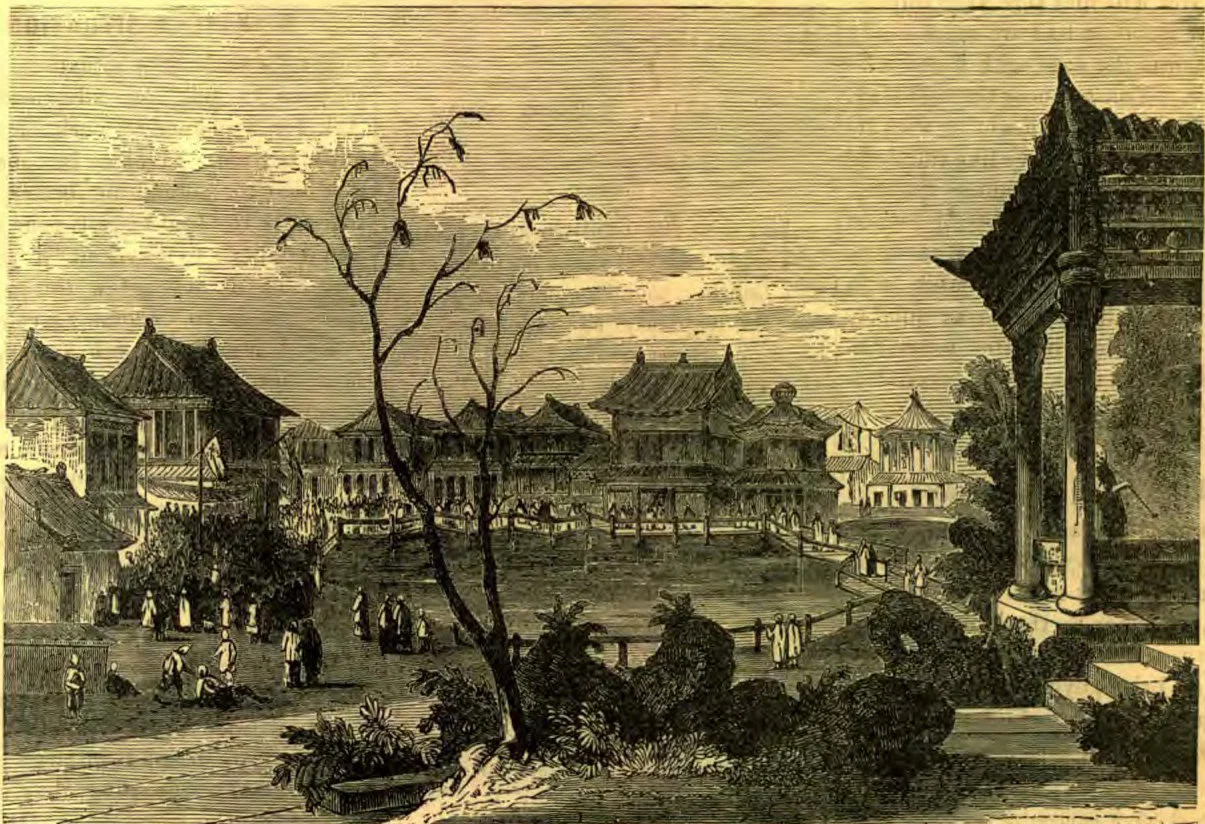
SHANGHAI is a city and sea-port of China, situated on the Woosung River. It is one of the three most important tea ports of the empire. The city stands in a fertile plain, and consists of a walled town and several suburbs. It is entered by six gates, and the streets are narrow and filthy, and the houses poor; but in the center of the town is a large open space, which is laid out in tea-gardens. Here, too, are some fine houses, belonging mostly to the tea merchants. Many people are employed in these gardens, for tea-culture is the principal business of the place.
The tea-shrub is a bushy plant, with numerous leafy branches, and grows to the height of three or four feet, and sometimes higher. The leaves are usually gathered three times during the season, and after going through numerous drying processes, are finally shipped as tea. The first crop makes the choicest tea. It is said that the difference between green and black teas is owing, in part at least, to difference of soil, climate, and age of the leaves, the plants furnishing the black teas being grown in hilly and mountainous places, and the green-tea shrubs being cultivated on the rich, level lands. When in blossom, these tea-gardens are a beautiful sight, for the plants are covered with pure white flowers of considerable size, somewhat resembling those of the myrtle.
A traveler speaks of the numbers of tea-taverns in Shanghai, where the laboring people gather daily, generally in companies of from ten to thirty. For three or four brass “cash”—less than one farthing—they obtain their dish of hot tea; and he remarks that the quietness and peace which seem to reign at these gathering-places is certainly in contrast with the confusion of the wine-saloons in the vicinity. Our picture doubtless represents several of these tea-taverns, with the crowds of people gathered about them. We would not, however, speak of this to encourage the habit of tea-drinking among our readers, for we all know it is a hurtful one; but these few facts in regard to the manner in which this common article is produced may perhaps be interesting.

“IT IS IN TO STAY.”

“Hurrah for Uncle Joseph!” shouted Edward; and Edward’s brother and sister, Arthur and Annie, echoed the sentiment.
According to promise, Uncle Joseph had called to take his nephews and niece to see the pottery works, not far from the place in which they had all taken up summer quarters, Uncle Joseph at the hotel, and his relatives at a comfortable cottage not far away.
It was a fine, bright day, and not uncomfortably warm, so the walk of a mile and a half to the pottery was enjoyed by the whole party. So was the visit itself and the walk home, the latter made lively by a discussion of the many interesting sights which had been witnessed.
TEA-TAVERNS OF SHANGHAI.
The young folks had each brought away with them a souvenir of their visit in the shape of a very ordinary-looking drinking-cup, decorated in blue and brown colors. These tokens they esteemed not for their value in money, but because they had witnessed the manufacture of hundreds like them. They had seen between thirty and forty girls sitting before as many flat plates, which, by the aid of machinery, were kept spinning round at a very rapid rate. Again and again, as occasion required, a workman placed a small lump of clay upon each of these plates, when the operators, with deft fingers, would work them into shape, and fashion out a cup. The form secured, the operator would dip a camel’s-hair brush into the blue or brown coloring matter, as desired, and, with a light touch on the whirling vessel, make the rings upon its surface. Each ring was but the work of a second or so.
The coloring finished, an attendant workman removed the cups from the fast-spinning wheels, or plates; a further supply of clay was placed upon them, and the process was repeated.
The young visitors were exceedingly anxious to learn how the ware was hardened and glazed, and the proprietor of the place very cheerfully showed them the whole process. These soft cups were carried to an oven, which had been raised to a high temperature. Here they were baked with as much caution as a good cook pays to a Thanksgiving turkey or a batch of home-made bread, lest they should harden too speedily. From this oven the cups were removed to a second and hotter one, and from the second oven they were transferred to a third, which was still hotter. In the burning heat of this last oven, they acquired the bright gloss, or glaze, so familiar on the surface of brown stone-ware and pottery generally.
“There, sir,” said the proprietor to Arthur, as he showed him one of the cups that had not yet had time to cool off after its fiery ordeal, “easily as that color was applied, neither you nor I can by any means get it out. It is in to stay. You may break the vessel to pieces, but the color remains firm and fast.”
The young folks examined many of the broken pieces of pottery, and found indeed that the color was permanently burned in. They were assured that neither acid nor alkali would effect a change. There was no agency, however powerful, that could do it.
Much interested, and not a little edified, Uncle Joseph and his small party left the factory and started for home. The journey seemed far too short, so pleasant was the conversation as each spoke of the object that had been to them the chief attraction.
They were almost home when Uncle Joseph said, “There is one thing in connection with our visit which I think I shall never forget. I refer to the words of the proprietor, who made us so welcome. ‘It is in to stay,’ he said; and Annie, Edward, and Arthur, I think our pleasant morning’s trip may be of lasting use to us, if we remember those words and the lesson they suggest. It is almost as easy, I think, to color our character with a bad habit as it was for the operators to color those cups. While you are young, you will find that your impressions for good or bad are more easily made than is the case with those who are older. You are now the soft clay. Your after life in the world, with its varied scenes, will prove like the three furnaces, making permanent the coloring of youth. Many a young person who in youth has given way to some foolish and, indeed, sinful habit, with the idea that it could be as quickly thrown aside, has in after years discovered that it was ‘in to stay.’”—New York Observer.

INDIAN SUMMER.

THERE is a time, just when the frost Begins to pave old Winter’s way, When Autumn in a reverie lost, The mellow daytime dreams away;
When Summer comes, in musing mind, To gaze once more on hill and dell, To mark how many sheaves they bind, And see if all are ripened well.
With balmy breath she whispers low; The dying flowers look up and give Their sweetest incense ere they go, For her who made their beauties live.
She enters ’neath the woodland shade, Her zephyrs lift the lingering leaf, And bear it gently where are laid The loved and lost ones of its grief.
At last, old Autumn, rising, takes Again his scepter and his throne; With boisterous hand the tree he shakes, Intent on gathering all his own.
Sweet Summer, sighing, flies the plain, And waiting Winter, gaunt and grim, Sees miser Autumn hoard his grain, And smiles to think it’s all for him.
—Selected.

ALICE AND PHEBE CARY.

Nearly fifty years ago there lived in the pleasant valley of the Miami River, about eight miles north of Cincinnati, a farmer by the name of Robert Cary, with his wife and a large family of bright-eyed girls and boys. The farm-house in which they lived has been pictured thus:—
“Low and little and black and old, With children as many as it could hold; All at the window open wide, Head and shoulders clear outside, And fair young faces all ablush; Perhaps you may have seen some day Roses crowding the self same way Out of a wilding wayside bush.”
On the north side of the house, was the shaded porch where the farmer and his sons could take their quiet nooning on the hot harvest days; there was the deep, cool well, with its old-fashioned sweep, its moss-covered stones, and its never-failing spring of pure water; the beehives under the peach tree with their cheerful hum all the long summer day; the sweet-briar, where those dear little school girls gathered the garlands for their bright tresses; the old brick school-house, a mile and a quarter away, where the Cary children learned arithmetic, geography, and grammar,—those noble foundation stones for all after excellences.
The father of this household was a tall, sad-eyed man, with a heart full of poetry and love,—love of nature, love of family, and love of God, who went about his work singing hymns and repeating to himself the words of the grand old Hebrew poets; one of those beautiful unassuming spirits that are so little understood in this weary work-a-day world.
The mother, a gentle, blue-eyed woman, capable and true, was one who could supply with her own hands the wants of her large family, and yet find time for reading and reflection. One of her daughters said of her, “In my memory, she stands apart from all others, wiser, purer, doing more and living better than any other woman.”
Of the children, some were so gifted that their names have become household words throughout our land. Others equally gifted died young. Rhoda, who told such beautiful stories to her mates on her way home from school, continuing them on, day after day, her dark eyes lighting up with the inspiration that was upon her; her whole soul longing after the beautiful, and reaching out into the unseen, was the first to be called away; Little Lucy, the “household pet,” with blue eyes like her mother’s, died only a month later. Alice wrote of her in after years:—
“I can see her shining curls All tremendously fair, Like fifty yellow butterflies, A fluttering in the air, My angel little one.”
And then the hard-working mother laid aside her tasks and went to rest; and another took her place, who had not the capacity to understand the hearts of these strangely gifted girls, and only added to the hardships of their lives.
Alice, now seventeen, and Phebe, thirteen, were beginning to write down in uncertain lines the spontaneous songs which from childhood had been singing in their hearts and brains. In their literary pursuits the girls found little sympathy from the hard, uncultured step-mother; but in spite of her persecutions they kept bravely on, studying and writing; for the music was there, and it must have vent. If they must work by day, they could study by night, even though their only light was a bit of rag in a dish of lard. Finally, when they were rewarded by seeing some of their poems published in the newspapers, they were glad even to tears. Phebe said, “When I saw my first verses in print, I laughed and cried over it. I did not care any more if I was poor or my clothes plain. Somebody cared enough for my verses to print them, and I was happy.”
So the years went by, bringing with them; some appreciation for the gifts of the patient singers. At last, in 1850, Alice, broken in health and shadowed with a great sorrow which had almost crushed her young life, but with a will which no difficulty could daunt, left the scenes of her childhood, and started out alone to make for herself a place and a home in the great city of New York. Her sisters, Phebe and Elmina, soon joined her. They hired two or three modest rooms, in an unfashionable neighborhood, and set to work resolutely to earn a living with the pen. Perseverance brings its own reward, but it was only after long years of unpaid effort that these true daughters of song found a place among the poets of the land, and still better, in the hearts of the people; but to the last, though long surrounded by friends and luxuries, theirs was the same busy life. Says one of her friends: “I have never known any other woman so persistently industrious as Alice Cary. Hers was the genius of patience. No obstacle ever daunted it, no pain ever stilled it, no weariness overcame it till the weariness of death. The pen literally fell from her hand at last, and only then, because, in the valley of the shadow of death, which she had already entered, she could no longer see to trace the trembling, uncertain lines.”
§ Their earthly work is ended now; but not until the books in Heaven are opened, will these gentle sisters ever know to how many tired souls they have brought rest, or how many have been made braver, stronger, and more patient, by their songs, so full of child-like faith and trust in a loving Father’s guidance.
E. B.

KEEP good company or none.

THE HAPPY VILLAGE.

As often I pass the roadside, When wearily falls the day, I turn to look from the hill-top At the mountains far away.
The red sun through the forests Throws hither his parting beams, And far in the quiet valley The happy village gleams.
There the lamp is lit in the cottage As the husbandman's labors cease, And I think that all things are gathered And folded in twilight peace.
But the sound of merry voices Is heard in the village street, While pleased the grandam watches The play of the little feet.
And at night to many a fireside The rosy children come; To tales of the bright-eyed fairies They listen, and are dumb.
Then seems it a joy forever To labor and to learn, For love with an eye of magic Is patient to discern.
And the father blesses the mother, And the children bless the sire, And the cheer and joy of the hearthstone Is as light from an altar fire.
Oh, flowers of rarest beauty In that green valley grow; And whether 'twere earth or Heaven Why shouldest thou care to know?
Save that thy brow is troubled, And dim is thy helpmate's eye; And graves are green in the valley, And stars are bright in the sky.
—Scribner's Monthly.

SEEKING A SITUATION.

WHEN seeking a situation, do not propose to take an advanced post. Ask for a chance to work, beginning at the bottom. You may be considered qualified for something better, yet be placed at the foot to test your temper and fidelity—to ascertain if you will be “faithful over a few things,” as a qualification to become “a ruler over many things.” If you sweep, make fires, dust, do anything and everything promptly and cheerfully, you will be advanced so fast as you are seen to have mastered your allotted position. Grumbling at your lot, and asking to be put forward, will disgust your superiors, who are perhaps planning to obtain some one to fill your place, that you may be put forward. Men like to manage their own business—dislike to have boys make suggestions as to their own occupation or pay.
Plants are not put in large pots until, by healthy growing, they seem to have filled the small ones. If a puny plant were to tease the gardener for a large pot, or open air planting, he would wisely say—“Fill the place you occupy first, and thus show your adaptation to a larger one;” or, in disgust, he would jerk out the feeble starveling and put a vigorous successor in its place. Many a boy has lost his situation because he whined for a post of duty beyond his present capacity to fill.
He who, in store or shop, begins at the bottom and learns how to do everything, and is competent to every duty, has his position and ultimate success in his own keeping; and he will be sought after by many, if it is known he is at liberty to accept of a new engagement. We have seen a faithful boy take a selfish man's place in a shop or store, with its increased responsibilities, a more elevated position, and better pay.—Selected.

“HONEST” FRANK.

What boy would not like to merit such a title as that? “Honest!”—you can trust him, he will never deceive you; he will always speak and act the truth. Such was Frank. He was honest; he loved truth so much he would not part with it for any consideration.
Frank was clerk in the office of a rich merchant in New York. One day this merchant received from a customer in another city an order for a large and valuable lot of goods. The next day another letter came from the same customer, recalling the order, and saying they need not send the goods. The merchant handed the note to Frank, with a pleasing smile, saying:—
“Frank, I want you to answer this note. Please say that the goods were shipped before the letter recalling the order was received.”
Frank looked into his employer’s face with a sad but firm glance, and said,—
“I’m very sorry, sir, but I can’t do it.”
“Can’t do it! And pray, why not?” asked the merchant, angrily.
“Because, sir, the goods are in the yard now, and it would be telling a lie.”
“I hope you may always be so particular,” said the merchant, as he turned on his heel and went away. Honest Frank did a bold but a right thing when he took that stand. And what do you think was the result? Did he lose his place? Not at all. The merchant was too wise to turn away a clerk who was so honest that he couldn’t write a lying letter. He knew how valuable such a young man was, and so, instead of turning him off, he made him his confidential clerk.
Boys, learn to say “I can’t do it,” when tempted to tell a lie.—Selected.

SCENES IN THE LIFE OF CHRIST.

LESSON 42.—STILLING THE TEMPEST.

In our last lessons we have been studying some of the parables given by our Lord. These parables were intended to help all people to understand God’s plan for saving men, and bringing them into the kingdom of heaven. It is probable that Jesus gave other parables besides those that are recorded in the Bible, and some that are recorded are not intended so much for youth as for men and women. Our dear Lord seemed very anxious that the way should be made so plain that every one might follow it if he would.
About the time when he was giving the parables that we have been learning, Jesus cried out, saying, “Whereunto shall we liken the kingdom of God? or with what comparison shall we compare it? It is like a grain of mustard seed, which when it is sown in the earth is less than all the seeds that be in the earth; but when it is sown, it groweth up, and becometh greater than all herbs, and shooteth out great branches; so that the fowls of the air may lodge under the shadow of it?”
“And again he said, Whereunto shall I liken the kingdom of God? It is like leaven, which a woman took and hid in three measures of meal, till the whole was leavened.”
“Again, the kingdom of heaven is like unto a net that was cast into the sea, and gathered of every kind; which, when it was full, they drew to shore, and sat down, and gathered the good into vessels, but cast the bad away. So shall it be at the end of the world; the angels shall come forth, and sever the wicked from among the just, and shall cast them into the furnace of fire; there shall be wailing and gnashing of teeth.”
The teaching of Jesus was very different from anything the people had heard before; and they would stand or sit on the shores of the Sea of Galilee from morning till night, listening to the precious words of the Master, who made the truth so plain that a child could understand it. The people were often so interested that it was hard to get them to go home long enough to get food, and take needed rest. They were often unwilling to go away even at night; and Jesus sometimes had to go up into a lonely place among the mountains, where the people could not follow him. This might have been partly because he and his disciples needed rest and quiet; but it was probably more out of regard for the people; for if they became too weary, they could not so well understand and remember the good things he wanted to tell them.
One day, as evening came on, and great multitudes were still pressing around him, he said to his disciples, “Let us go over unto the other side of the lake. And they launched forth. But as they sailed, he fell asleep;” “and behold there arose a great tempest in the sea; insomuch that the ship was covered with the waves.” “And they came to him, and awoke him, saying, Master, Master, we perish. Then he arose and rebuked the wind, and the raging of the water; and they ceased, and there was a calm. And he said unto them, Where is your faith? And they, being afraid, wondered, saying one to another, What manner of man is this! for he commandeth even the winds and water, and they obey him.”

QUESTIONS.

  1. What have we been studying in our last lessons?
  2. Why were these parables given?
  3. Is it probable that Jesus gave any parables that are not recorded in the Bible?
  4. To whom are some of the parables better adapted than they are to children and youth?
  5. For what did our Lord seem to be very anxious?
  6. What did Jesus cry out, about the time that he was giving the parables which we have been learning? Mark 4:30.
  7. What did he then say the kingdom of heaven was like?
  8. How does the seed of the mustard compare with the seed of other herbs?
  9. How does the herb which grows from the mustard seed compare with other herbs?
  10. How can this parable be explained?—Perhaps it means that the seed of truth when first sown in the heart may appear very simple; but if properly cared for, it will grow till it changes the whole character.
  11. What other parable did our Lord give to teach nearly the same thing? Luke 13:20, 21.
  12. What must we do if we would have the good qualities of our character growing stronger all the time?—We must believe in Jesus as our Saviour, try to do his will in all things, and pray that God by his Holy Spirit will help us to carry out our purposes.
  13. Tell the parable of the net. Matt. 13:47, 48.
  14. How did Jesus explain this parable? Verses 49, 50.
  15. Had the people ever been taught as Jesus taught them?
  16. How did the people show their interest in his precious words?
  17. What made his teaching so interesting?
  18. What was it sometimes hard to get the people to do?
  19. How did Jesus sometimes get away from them at night?
  20. What other reason did he have for doing this, besides getting rest and quiet for himself and his disciples?
  21. Why was it necessary to give the people rest?
  22. What did Jesus say to his disciples one evening as the people, in multitudes, were still pressing to hear him? Luke 8:22; Matt. 8:18; Mark 4:35.
  23. What did they then do?
  24. How did Jesus take rest while they were crossing the sea?
  25. What arose while he was thus resting? Matt. 8:24.
  26. How fiercely did the tempest rage?
  27. As they were upon the point of sinking, what did the disciples do?
  28. How did the Master respond to their cry of distress?
  29. What effect did his words have upon the winds and the sea?
  30. What did he then say to his disciples?
  31. As they wondered at the miracle, what did they say to one another?

NEW-TESTAMENT HISTORY.

LESSON 55.—ATTEMPTS TO ARREST JESUS; HYPOCRISY REBUKED.

WHEN the chief priests and the Pharisees heard that many of the people believed on Jesus and were speaking in his praise, they sent officers to take him. But Jesus kept right on teaching; and said, “Yet a little while I am with you, and then I go unto Him that sent me. Ye shall seek me, and shall not find me; and where I am, thither ye cannot come.” Then the Jews began to wonder what he meant by this saying, thinking that perhaps he intended to go among the Greeks, and teach them.
The last day of the feast was considered the greatest, and on that day, when the largest number of people were present, Jesus stood and cried, “If any man thirst, let him come unto me, and drink.” Then he spoke of the influences of the Holy Spirit, which should be given to all who believe on him, and which should be a never-failing source of comfort and refreshing. In speaking of this, he uses the same figure that he had used while instructing the woman of Samaria at the well of Jacob, comparing the Spirit’s influence to a well of living water springing up unto everlasting life.
“Many of the people therefore, when they heard this saying, said, Of a truth this is the Prophet. Others said, This is the Christ. But some said, Shall Christ come out of Galilee? Hath not the Scripture said that Christ cometh of the seed of David, and out of the town of Bethlehem, where David was? So there was a division among the people because of him. And some of them would have taken him.”
Then the officers returned unto the chief priest and the Pharisees who had sent them to take Jesus; and when they were asked why they had not brought him, they said, “Never man spake like this man.” Then said the Pharisees, “Are ye also deceived? Have any of the rulers or of the Pharisees believed on him?”
They claimed that the common people, who believed on Jesus, were so ignorant as to be easily deceived; and seemed to think that the curse of God would rest upon them for not following their leaders. But Nicodemus, the same that came to Jesus by night, said, “Doth our law judge any man before it hear him, and know what he doeth?” But they said, “Art thou also of Galilee? Search, and look; for out of Galilee ariseth no prophet.”
At night, the people went to their houses, or rather to their booths, but Jesus retired to the Mount of Olives. In the morning, when Jesus returned to the temple, the Jews brought before him a woman whom they accused of breaking the seventh commandment; saying, “Moses in the law commanded us that such should be stoned, but what sayest thou?” This they did in the hope of finding an accusation against him; for if he decided that the woman should go free, they would charge him with disregarding the law of Moses; and if he decided that she should be stoned, they would accuse him to the Romans, who claimed the sole right of inflicting capital punishment.
“But Jesus stooped down, and with his finger wrote on the ground, as though he heard them not. So when they continued asking him, he lifted up himself, and said unto them, He that is without sin among you, let him first cast a stone at her. And again he stooped down, and wrote on the ground.”
The woman’s accusers, conscience-smitten at the words of Jesus, “went out one by one, beginning at the eldest, even unto the last; and Jesus was left alone, and the woman standing in the midst.”
“When Jesus had lifted up himself, and saw none but the woman, he said unto her, Woman, where are those thine accusers? Hath no man condemned thee? She said, No man, Lord. And Jesus said unto her, Neither do I condemn thee; go, and sin no more.”

QUESTIONS.

  1. What did the chief priests and the Pharisees do, when they heard that many of the people believed on Jesus and were speaking in his praise? John 7:32.
  2. What did Jesus do?
  3. What did he say? Verses 33, 34.
  4. Could the Jews understand this saying?
  5. What did they think he might mean?
  6. What did he cry out on the last day of the feast? Verse 37.
  7. To what did he compare the comforting and refreshing influences of the Holy Spirit, which he promised to give to all who would believe on him?
  8. On what other occasion had he used this figure? John 4:14.
  9. What did many of the people say, when they heard this saying? John 7:40.
  10. What did others say?
  11. What objections were raised by some?
  12. On what were these objections based?—On false premises: these Jews were ignorant of the facts in the case.
  13. What did these groundless objections cause? Verses 43, 44.
  14. Who then returned to the chief priests and the Pharisees? Verse 45.
  15. What reply did they make when asked why they did not arrest Jesus?
  16. What questions did the priests and Pharisees ask them?
  17. How did these priests and Pharisees regard the common people?
  1. What question did Nicodemus ask?
  2. How had Nicodemus previously become acquainted with Jesus?
  3. What probably caused him to ask this question at this time?—It seems probable that these priests and Pharisees were so enraged at seeing what influence Jesus had with the people, that they contemplated taking his life without giving him a trial.
  4. Did Nicodemus ask this question for information, or was it to remind the angry Jews of their obligations to the law?
  5. What taunting reply did they make?
  6. Where did Jesus go at night?
  7. Whom did the Jews bring before him on his return to the temple in the morning?
  8. What did they say to him? John 8:5.
  9. Why did they ask him this question?
  10. How did they hope to find an accusation against him if he advised leniency toward the woman?
  11. How did they think to entrap him if he decided that she ought to be stoned?
  12. What did Jesus do while delaying to answer them?
  13. What did he say to them when they continued to importune him?
  14. What effect did this have upon their consciences? Verse 9.
  15. What did he do while they were thinking of his words?
  16. What did they finally do?
  17. When Jesus looked up, and saw the woman alone, what did he say to her?
  18. How did she reply?
  19. What encouragement and what admonition did he then give her?

OUR GENERAL SABBATH-SCHOOL MEETING.

At the next session of the General Conference, which is to convene at Battle Creek, Dec. 1, the Sabbath-school work will receive its share of attention. There will be several meetings, giving ample opportunity for not only the ordinary business for our General Association, but for consideration of the work in the different States, and for the formation of plans for future labor. Competent persons have consented to prepare papers on subjects of vital importance. These papers will be read and discussed at the meetings.
It is also desirable that the condition and progress of the work in all localities should be fully presented. We therefore urge those who attend the Conference, Sabbath-school officers and delegates especially, to come as fully prepared as possible to give such information. State Presidents are requested to present a written report, and if they cannot attend the meeting, to forward such report to the General Secretary, Eva Bell, Battle Creek, Mich. Ex. Com.

TEACHING

THE first thing in teaching is to secure the attention of the scholars—of all at the same time. This is no easy thing, even where the scholars are adults. Adopt no method of holding attention that will divert the mind from the lesson to be studied. A funny story may hold eyes and ears spellbound, but the memory of it may destroy all the influence of the teacher's instruction during the remainder of the exercises. An exercise on the tablet, or with pencil on a sheet of paper, an outline of the country where the events of the lesson transpired; these and a score of unmentioned methods may be adopted for arresting and retaining the scholar's attention, and for starting inquiry.
Study the art of asking questions. Lord Bacon says, “A wise question is the half of knowledge.” A Scotch writer remarks that “a key will not open a lock unless it fits it. It needs a good question to secure a good answer.” Some questions are intended to find out what the scholar knows and needs; other questions quietly put knowledge into the scholar's brain; a third class of questions call back the knowledge thus given. Says one of a teacher who successfully adopted this method, “He first questioned the knowledge into the minds of the children, and then questioned it out of them again.” Put your questions in few words, and in clear words. Let them convey some meaning; but do not put the answer, nor half the answer, into any question. Ask your questions spiritedly, and as if you expected an answer to each one from every scholar.—Teacher's Cabinet.
Continue reading: HOW THE CHILDREN PLAY IN JAPAN