THE title of this article would frighten a small child; but it must be remembered, as I have said before, that these articles are not written for children, but rather for those who have to do with their education. Meteorology is that department or branch of science which treats of the atmosphere, especially of that which relates to climate and moisture. Meteorological records are records of the changes which take place in the atmosphere. The study of the last article on clouds would be included in this department of science, and the records which are made will involve an observation (and recording) of different kinds of clouds.
The making of records is of value in itself. It leads not only to observation, but stimulates to accurate observation, and accurate observation is the only kind of observation through which God can reveal Himself. This is so for two reasons: God is a God of system and order, and He can not well show Himself to the careless observer, for such an observer is a thoughtless one. And again, the wonders of nature are not revealed most forcibly on the surface. God manifested Himself in the still small voice on a certain occasion, and so in the works of His hands, he who looks carefully and listens most intently will see that which is most beautiful and wonderful, and will hear the finer harmonies of all His doings. The spirit in which we should always come to the study of God's works is well illustrated by the saying of a noted scientist to his assistant. The two were in their laboratory, and were about to perform an important experiment. The assistant was making some light and careless remarks, when he was interrupted by the scientist's command, "Be still, I want to ask God a question." The great inventor Edison says that often in his laboratories, as he sees the marvelous life and power of God shown in his experiments, he is awed into a fear, for he seems to see all but the very presence of the Omniscient One. Such a reverence on the part of all who study the works of God as these men had, will not allow them to make careless and inaccurate statements concerning those works.
Every man, woman, and child should be interested in something that is growing. God manifests Himself in everything whether animate or inanimate, but it is in plant and animal life that perhaps we most readily see and appreciate the wonders of His work. So if no more than two or three square feet of ground can be obtained in which to plant and watch the growth of flowers or vegetables, the ground should be so used.
The atmosphere has the closest and most practical relation to all the conditions of life. In a former article I made a statement that even a slight variation in the average temperature of a country would, in many cases, completely change the productions of that country. Now, as the atmosphere bears such close relation to life, its study becomes an imperative necessity to all students of the works of God. Many a farmer would be more successful in his farming, did he make a closer observation of the conditions of soil and moisture in their relation to growth. Practical farmers are at times inclined to scoff at the teachings of scientists, and often they have a just occasion; for many of the theories advanced by students of science are of little worth, because they are not practical.
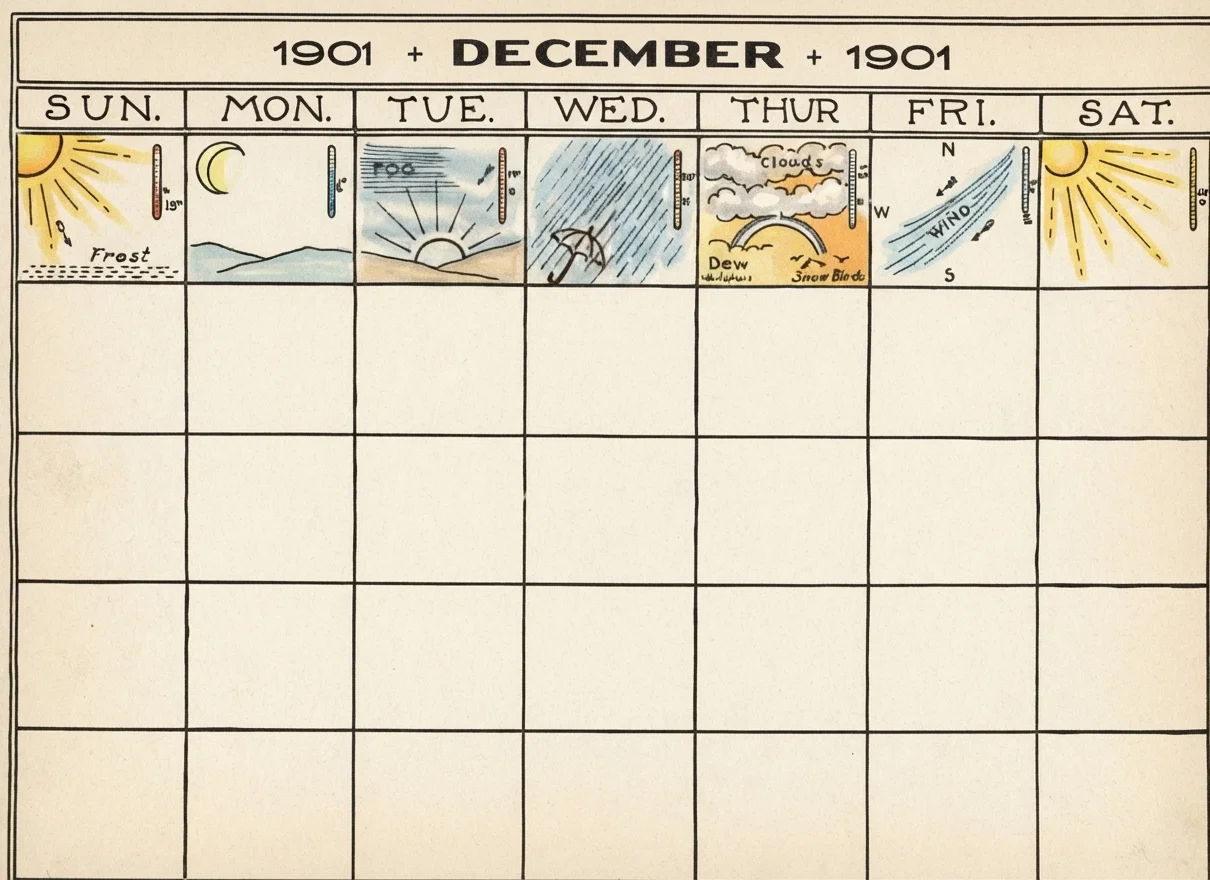
Meteorological records can be very easily prepared. Draw a page into as many squares as there are days in a month, and you have the blank record. One of these pages so marked off may be for the temperature; another for the record of cloudiness; another for dew or frost, or neither; another for the wind and its direction; still others for rainfall, length of day, increase in the day's length, and variations in the rising and setting of the moon.
Now all these records may be well combined in one. Make the spaces large enough so as to admit of all being represented. Then let the children show the weather conditions by drawings in spaces designated to each day. The accompanying illustration will give some hints as to how the conditions of the weather may be represented in a record. This illustration is simply suggestive, and many other ways of showing the weather conditions will occur to the mind of one who is interested in making these records. It does not follow that the records have to be made in drawings as I have here suggested, nor that the conditions of the weather each day have to be gathered into one space; for they can be written in separate records as I have suggested. But the value of having them gathered into one space each day is apparent, for there is graphically and interestingly shown, the conditions of each day. For the child these spaces will have to be much larger than shown in the illustration, and it may be well in some cases to make the record for each week rather than for a month. Let me here again urge the importance of drawing as a feature of education, teaching us, as it does, to see in form and color the beauty which the Lord has made.
Not only that, but it places in our hands a very powerful means of expressing our thoughts. The publications of to-day would be of far less value than they are, had they no illustrations. A picture reveals at once a whole story. This is why I suggest the gathering of these facts concerning each day's weather in this form. The majority of people feel that they have little or no ability in the direction of drawing, and this is true, but this can be developed to a surprising extent. The reason that so many fathers and mothers are wanting in this respect is because, as children, they did not have placed in their hands colored crayons, paints, or pencils. These should be considered a necessity in the education and training of every child. It is rare indeed that a child will hesitate to reproduce anything it sees.
These weather records should be taken at a regular time each day. The record of the thermometer, for instance, will be of little value, if it is not recorded at about a certain time every day. A few moments spent with the children in making these observations, and assisting in illustrating them, will be of profit to parents as well as children, and no parents should be so busy but that they could have a few minutes at least each day to spend with the children in some such way. The development of many children is greatly hindered, because of this lack of time spent with them by parents.
Summaries should be made both weekly and monthly. The value of the record is quite largely in these summaries. The facts to be placed in the summaries can be recorded in writing or by drawing. Such summaries can include the number of dews or frosts, the prevailing wind, the number of cloudy days or clear ones, the number of days on which rain fell, the mean temperature, the length of the longest and shortest days, the increase or decrease of the day's length, and the total variations in time of the rising or setting of the moon.
Children five or six years of age will often comprehend and enjoy these studies with a little help from parents. Many suggestions of value may be obtained from a little pamphlet, entitled "Instructions to Voluntary Observers of the Signal Service," which can be obtained free by sending the request to the chief of the Weather Bureau, Washington, D. C.
Constant reference to the Bible upon all of these subjects will not only stimulate interest, but will greatly strengthen the child's reverence for God in his studies. The heavens declare the glory of God, and the firmament does show His handiwork.
FREDERICK GRIGGS.
South Lancaster, Mass.
RECOMPENSE.
BRAVE little woman, trudging along
Patiently, day by day,
Weaving a garment of shining light
Out of the clouds of gray;
Bearing the burdens and vexing cares
Like one of the saints of old—
Making the best of a dull, hard life,
With its miseries all untold!
Long have I watched her with wondering eyes—
Faithful and sweet and strong,
Doing the work that the Master sends,
Making of sorrow, song;
Questioning never the wisdom that asks
Self-abnegation complete,
Willingly treading the pathway of thorns
That leads to the Master's feet.
Somewhere is waiting a fair, dear day,
Meet for such infinite grace—
Somewhere, O somewhere, fruition shall be
When the angel shall find her place
Close to the Father, and hear Him say,
As He tenderly bids her come:
"Out of the valley of darkness and toil,
My child, thou art welcome home."
—Selected.
Preventing Moths in Woolen Clothing
If tansy is sprinkled through woolen clothing when laid away, they will never become moth-eaten. When moth millers are seen in a closet, it is well to burn a little camphor promptly. If done in the early spring, it will generally rid the closet of the pests.
THE USEFUL LIFE.
“SHE has passed her usefulness.” Did you ever hear that said of one of your dear friends, or did you ever say that about some one? Did you ever stop to think about it, and just what it meant? Have you ever considered the meaning of that word usefulness?—Full of use, full of service, not some service or a little use, but full, important. Now that the once active hands are idly folded, and the eyes are dim, you thoughtlessly say, “She has passed her usefulness.”
What is the tale of the years that are gone? If you will take time for a backward look, you will probably see that at the foundation of her whole life was service, something for others. Many a sleepless night has she spent in caring for the sick, not only in her own household, but in that of her neighbor. Many a one has been helped over hard places by her cheery words or more material assistance. Care not only for her own, but also for the motherless child beneath her roof, has made for her long and weary days. Then, later on, it was usually the mother who thought and planned and went without many a comfort, that her child might receive the education so much desired. These things, and many more, have helped to make the home-maker old.
Do you know one of these mothers who is living in the past and looking forward to a future of rest and reunion with dear ones gone on before? Ask her children if she has ever been of service to them, and they will tell you of the lessons learned from mother. Lessons of truth and uprightness, of thought for man and love for God; lessons that have made them what they are. Ask the neighbors, who have been helped in untold ways so that they have learned how to help some one else. On every side, wherever a life has touched hers, some good has gone out, so that instead of one person who is trying to live a life of quiet usefulness, you have a score of people working out in their lives the lessons that were received from her, who, you say, has passed her usefulness. “Passed her usefulness.” Yes, passed it on into other lives and future years. The good one conscientiously tries to do goes on and on in the lives of those about us. Shakespeare must have had an attack of dyspepsia when he told us that the good is oft interred with a man’s bones. You can not bury it. Good must live, and it does. Coleridge came nearer the truth when he said, “The good man never dies.”—Sabbath Recorder.
"GRUMPY COBE'S" AWAKENING.
By Olive Searing
[By Olive Searing, in the Christian Advocate.]
"There they come," said Grandma Perrit, as she drew aside the white muslin curtain and readjusted her spectacles. "Yes, there is Carrie. Bobbie is running along ahead. How that child—"
Her sentence was interrupted. A sturdy little fellow of about seven years bounded into the room, threw his arms around the old lady's neck, and gave her such a vigorous hug that it almost took her breath away.
It was the custom for grandma's only daughter to make an annual visit to the country homestead. She usually came in the autumn and remained until after Thanksgiving. She said, "The old farm always looks as tho it were arrayed for a merry frolic, with its garlands of red leaves and abundance of ripe fruit." To Bobbie, who had always lived in the city, it was a season of rare pleasure. There were the horses, the cows, and old Bruno the dog, who always seemed to remember and welcome him. The next morning he went to see Farmer Cobe—Grumpy Cobe, as he was called, but he was never cross to Bobbie, who thought him very good and learned. The little fellow was fond of old Jim, grandma's hired man, but he liked old Grumpy better, he knew so much about the crops and the weather. Bobbie and he had become very friendly discussing various points in agriculture.
"What dat chile see in old Grumpy Cobe is a mystery to me," said Dinah, the cook, who stood by the kitchen window, watching the pair of strong little legs flash across the ground. "Dar ain't nobody dat wants to hab any dealin's wid 'im."
"We must remember," said grandma, "that he is a lonely old man. Perhaps if his wife and children were living, he would be different."
"Dar ain't no use holdin' tings up agin de Lord; I reckon de Lord know what's best. De o'her day I say to Grumpy, 'Thanksgivin' 'ill soon be comin' 'long.' Say he, 'What de use habin' Thanksgivin'? I ain't got nuthin' to be thankful fo'.* He am dead in trespassin' and sin, suah."
In a few minutes Bobbie was across the lots where the farmer was planting his winter wheat.
"How do you do, Mr. Cobe?" he said, as he shook hands with his old friend.
"Well! I hardly knowed ye. Sho! how you've growed!" exclaimed the old man. "Come to help me do my farmin', hev ye? Well, I guess ye can handle a hoe better this year."
"Are the crops good this year?" inquired Bobbie. "Grandma said you were complainin' with the rheumatism."
"Crops is poor; I never knew 'em to be wuss. There ain't no corn or no oats. This Virginia climate ain't what it's cracked up to be. Yes, I was laid up with these rickety old legs, and here I am two weeks behind time plantin' this wheat. It looks pretty dark over there. Guess I have to hurry."
For some time Bobbie watched the process attentively. "Let me help you, Mr. Cobe."
"Well, you jest go 'long ahead of me and sprinkle in the grain—so; not too big a handful. That's it. Let 'em down easy and keep goin' on."
"What makes the seeds grow?" asked Bobbie, presently.
"O, there's somethin' in 'em that sprouts up when the sun shines and the rain falls."
"Who put it there?" questioned the child.
The old man paused a minute and leaned on his hoe. "The Lord, who made 'em, I suppose."
The gray clouds that had been gathering in the east grew darker and spread rapidly across the sky. The rain fell silently down on the newly covered grain.
"Well," said Farmer Cobe, mournfully rubbing his right knee, "I'll have to stop this. I don't know as there's much use botherin', anyway. I'll soon be dead and under ground, and that'll be the end of me."
Slinging the bag of grain over his shoulder and picking up his farming implements, he started toward the house.
Never before had Bobbie seen his old friend in such a despondent mood.
"Didn't God put something in you that would make you come up again like the seeds?" he asked gently.
The old man looked earnestly at the child's innocent upturned face. Presently they reached the gate. The dark clouds had rolled on beyond, and the rain had ceased. The farmer leaned on the fence, and watched Bobbie's nimble little limbs as he ran toward home. A vision of the past came before him. His thoughts wandered back to his boyhood. He saw again that dear face, and an eternal brightness seemed to gleam in her eyes as she sung those old hymns. How the words came echoing back through the years!
The rays of the setting sun had cast a crimson light across the sky; the brightness of day had faded; the old man lingered, unconscious of the scenes around him, for he still heard that far voice singing:—
"My soul, revived with sacred love,
God's holy name forever bless;
Of all His favors mindful prove,
And still thy grateful thanks express."
The next morning Bobbie ran across the field with more spirit than usual. The truth was, his grandma had bidden him invite Mr. Cobe to their Thanksgiving dinner. When about to enter his friend's door, he stopped short; the old man was kneeling, his hands clasped before him, while from his lips came murmurings of praise and supplication.
"De lion and de lamb!" said Dinah, some time later, as she beheld Bobbie and his old friend, hand in hand, coming toward the house.
"Yes," said grandma, "'A little child shall lead them.'"
HAVING NOT SEEN.
I WAS standing at a counter in a Chicago grocery store, not long since, footsore, hurried, jaded by the city's uproar and confusion. The clerk was executing my order as quickly as he could, but I was inwardly fuming as the cable cars passed the door on their way toward my longed-for home. So I frowned when the floor-walker stepped up and said to the clerk, "Mr. Thompson, this gentleman wishes to speak with you; he is in something of a hurry."
Mr. Thompson looked up, and to my intense satisfaction merely nodded gravely as he would to any stranger, and went on tying up my package. The gentleman had smiled most cordially, but the smile was lost on the prepossessed clerk.
"You are busy, Mr. Thompson."
The last knot was half-tied, but Mr. Thompson held the string suspended and looked quickly into the speaker's face, evidently puzzled.
"What did you say, sir?"
"You are busy to-day. You do not know me, I see. I—"
Down went my coffee. Gone was the clerical gravity. The busy hand stopped to stretch out cordially across the counter.
"But I do know you! You are Mr. Ellis Morgan. I know your voice, sir! I am very glad indeed to meet you face to face. Yes, indeed, I know you—few men better. I shall be at liberty in one moment, sir."
They were telephone friends who had cordial relations "over the wire."
As the cable car hurried me home, my heart was warm within me, and something sweet was singing in my soul. It was this: "Whom—having not seen—whom having not seen, ye love."
Ah, yes! I know His voice. How often He has spoken to me over the heavenly wires, sending me messages from the throne.
Some good day I will stand before Him, and He will speak to me. Then shall I look up into His face and see the King in His beauty.—Anon.
A DINNER AND A KISS.
"I HAVE brought your dinner, father,"
The blacksmith's daughter said,
As she took from her arm a kettle,
And lifted its shining lid.
"There's not any pie or pudding,
So I will give you this,"
And upon his toil-worn forehead
She left the childish kiss.
The blacksmith took off his apron,
And dined in a happy mood,
Wondering much at the savor
Hid in his humble food;
While all about him were visions
Full of prophetic bliss;
But he never thought of magic
In his little daughter's kiss.
—Anon.
BEWARE OF MISJUDGING.
By Ian Maclaren
PERHAPS it were better for most of us to complain less of being misunderstood, and to take more care that we do not misunderstand other people. It ought to give us pause at a time to remember that each one has a stick of cut-and-dried judgments on his neighbors, and that the chances are that most of them are quite erroneous. What our neighbor really is we may never know. But we may be pretty certain that he is not what we have imagined, and that many things we have thought of him are quite beside the mark. What he does we have seen, but we have no idea what his thoughts and intentions may have been. The mere surface of his character may be exposed, but of the complexity within we have not the faintest idea. People crammed with self-consciousness and self-conceit are often praised as humble, while shy and reserved people are judged to be proud. Some whose whole life is one subtle studied selfishness get the name of self-sacrifice, and other silent heroic souls are condemned for want of humanity.—Ian Maclaren.
The Weight of Suffering
THE burden of suffering seems a tombstone hung about our necks, while in reality it is only the weight which is necessary to keep down the diver while he is hunting for pearls.—Jean Paul Richter.
Giving to the Lord’s Work
"WHEN you have given money to help some needy branch of the Lord's work, does something in your heart want to take it back?"
THE WEAKNESS OF MOHAMMEDANISM.
By E. J. BURNHAM
THE Bible tells us that “righteousness exalts a nation;” but a false religion has no such tendency. On the contrary, it weakens and degrades. This fact is forcibly illustrated by the influence of Mohammedanism on the adherents of that religion, as brought out by Henry Otis Dwight, LL.D., in a recent work, published by Revell, “Constantinople and Its Problems.”
The mental stagnation of the Muslims is simply marvelous. Dr. Dwight says of the peasant Turks of Asia Minor: “The cart of the Turk of Asia Minor is the highest evolution of brain that he has ever seen; but do not think that he invented it. It has not a particle of iron about it, except the iron tires of its narrow-footed wheels.”
To build it, two long poles are laid side by side. At one end they are fastened together with a wooden peg, and at the other end they are spaced apart by a “wooden stretcher about two feet long. The small end of this triangle thus formed is the tongue, to which the long straight bar, which answers for the yoke, is lashed by thongs of rawhide. The broad end of the triangle is the body of the cart, and is filled with a rough network of rope.” The rest of the structure is equally rude.
When the cart is done, two buffaloes are hitched to it. The solid wooden “wheels and the axles revolve together like car-wheels. As they revolve, they give forth unearthly shrieks and groans. A caravan of these carts, carrying produce to the coast, enlivens the mountain sides with weirdly ringing music, and yet no one seems to have thought of diminishing the din by the use of a little grease.”
The inhabitants of the cities are not greatly in advance of their country cousins. Dr. Dwight says of them:—
One meets there Mohammedans who are dignified and commonly courteous officials and shrewd diplomatists. One admires there many patient and brave soldiers. But the Muslim masses are hewers of wood and drawers of water; they are bearers of burdens; they are donkey drivers; they are the smallest of small traders; they are artisans whose hands compete with their tools in clumsiness.
Closer acquaintance reveals the fact that from the beginning of Turkish history very many of the greatest men of the empire have been of Christian origin—men who took Mohammedan names and the Mohammedan religion as stepping-stones to greatness.
To-day the army depends upon foreign Christians for its organization as well as its arms and ammunition, and to a considerable degree for the instruction of its officers. The treasury would go to pieces if Christian counselors were not at the side of the Minister of Finance.
Rarely does a wealthy Turk venture to keep up an establishment without a Christian to manage. A Mohammedan banking-house is almost unthinkable. The most important publishing houses for Mohammedan literature are owned and operated by Christians, and the most influential Mohammedan newspapers are Christian property. No Muslim machinist succeeds, unless he has a Christian for chief. The architect who builds the mosque is a Christian. Turkish steamers are bought abroad; or if built at great expense in Turkey, the man who makes the plan and the builder who follows it are both Christians. The steamers are rarely trusted to Muslim captains; and when they are, they can be recognized as far as they can be seen by their dilapidation and disorder.
A Group of Turks.
The inefficiency and mental stagnation of the Muslims is attributed by Dr. Dwight to three fundamental principles.
1. “God is too merciful to reject any believer for yielding to the impulses of his nature.” The Koran teaches: “God is minded to make your religion light unto you, for man was created weak.” The Muslims feel that they “are not placed in jeopardy by sin, and need no Saviour.”
2. “The moral law is too severe in its requirements for man to attempt to keep it.” The Koran says that God proposed the keeping of His law to all created things in turn, but all refused to be bound by so strict a law. “But man was foolish enough to promise to keep the law, and so fell under sin.”
3. “Ritual forms and observances constitute the obedience required of a Mohammedan by God.” In performing their acts of worship, the order of words, the genuflections, etc., are far more important than heart devotion. Indeed, failure to observe the exact form of the complex ritual spoils the whole worship, and all must be done over again.
These principles bear fruit in the lives of the “faithful.” So effectual is the barrier they raise against the Gospel, that Dr. Dwight is led to say, “Far-seeing purpose to thwart the essential aim of Divine Love could hardly more effectively have fortified the ground against influences which emanate from the Gospel of salvation and new-creation in Christ.”
This is the way he proposes to meet these conditions:—
The whole secret of gaining the respect and approval of Mohammedans for Christianity is contained in the one phrase,—Show them character. Christian character, known through experience, will actually do what controversy can not, what argument is powerless to accomplish, and what mere exposition of doctrine will go far to prevent. What they need is “a society truly Christian, that is filled with the Holy Spirit revealing Himself through righteousness and love.”
And this is the great need of the whole world. To reveal God is what Christians are in the world for.
E. J. BURNHAM.
AMONG THE LAOS TRIBES.
In northern Siam, with its tropical jungles, its picturesque mountain scenery, its fertile plains and narrow gorges, its streams abounding in rapids, and withal its seclusion from many of the commercial advantages and the corrupting influences of modern civilization, dwell the Laos tribes, occupying several provinces tributary to the king of Siam. Buddhism is the religion of the land. The people are described as simple in their style of living, and "affectionate, and domestic in their tastes," loving "not only their own children, but children generally."
Between forty and fifty years ago, missionary work was begun among the Laos tribes. As usual, work in medical, educational, and publishing lines has been given attention. Hon. Hamilton King, U. S. minister resident and consul-general to Siam, recently visited this section of the country, and in a letter to the Independent he gives the result of his observation of the work being done there. He says:—
From the first the medical work has been given a prominent place, and has proved a valuable auxiliary; . . . and untold numbers of lives have been saved during the last third of a century. The loathsome disease of goitre abounds in this country and to the north, and from the infancy of the mission a splendid work has been done in alleviating the sufferings caused by this disease. Work among the lepers, many of whom are found in this country, has been prosecuted for the last seven years, and much good is being done. . . . The missionary physician has free access to every home in northern Siam.
For many years past the medical work has enjoyed the favor of the rulers. . . . Prince Damerong, Minister of the Interior, told Mr. King, "I want to say to you that I have great respect for your American missionaries in our country, and appreciate very highly the work they are doing for our people."
The missionaries have established schools for both boys and girls.
At Chiengmai there is "a well-equipped printing-house; and during the past year over a million and a half pages have been printed by this establishment, and 25,000 books and tracts have gone into the hands of the people. . . . Aside from the influence of the tracts and Scriptures placed in their homes, the missionary has created for this people a printed language, and is laying for them the foundation of a healthful literature."
Mr. King thus describes the influence of these agencies on the people:—
As we approached the city where the work has been longest in operation, it was interesting each day to mark the external evidences that greeted us. Each day the women that we met were more neat and trim in appearance; their clothing was more comely, their faces wore a more hopeful look, and they bore the mark of better things in their lives. The roads were better. Better-tilled fields, better-kept fences, better houses, more thrifty homes, and a general improvement in all that goes to make up a prosperous and thrifty people were evident in this province. The gardens looked more thrifty, water-wheels were doing the work of the hand,13wheeled vehicles were taking the place of the woman's pack, and all spoke of an advance.
This is the true work of the religion of Christ, to elevate and ennoble the character, and to broaden the life, making it fuller and richer, while it gives a sure hope for the future. For "godliness is profitable unto all things, having promise of the life that now is, and of that which is to come."
Among the elements that have made for success in this mission, Mr. King mentions two significant principles: The missionaries "show respect for those things that are sacred to the Siamese;" and, "They have the wisdom to let the Siamese govern their own people."
This is one of the fields that the truth for this time has not yet entered.
SOMETHING EACH DAY.
Something each day—a smile;
It is not much to give,
And the little gifts of life
Make sweet the days we live.
The world has weary hearts
That we can bless and cheer,
And a smile for every day
Makes sunshine all the year.
Something each day—a word;
We can not know its power;
It grows in fruitfulness
As grows the gentle flower.
What comfort it may bring
Where all is dark and drear!
For a kind word every day
Makes pleasant all the year.
Something each day—a thought,
Unselfish, good, and true,
That aids another's need
While we our way pursue;
That seeks to lighten hearts,
That leads to pathways clear;
For a helpful thought each day
Makes happy all the year.
Something each day—a deed
Of kindness and of good,
To link in closer bonds
All human brotherhood.
O thus the heavenly will
We all may do while here;
For a good deed every day
Makes blessed all the year.—Anon.
WHAT OUR FRIENDS SAY OF THE SIGNS.
By Editor
It is cheering to the workers on the SIGNS to know that their efforts in behalf of their readers are appreciated, and that the paper is proving a blessing. The favor with which it is received is very gratifyingly shown by many letters received at this Office. Following are extracts from some of these letters.
Lee T. Bradfield, Belew's Creek, Mo., says:—
I have taken the SIGNS OF THE TIMES two years, and it comes to our house weekly as our most welcome visitor in the way of papers. I consider it the best religious paper printed, and know of no other that keeps so well on Bible lines. Besides, it gives us a great deal of good solid fresh news, that can be depended upon. I read it from front to back, and consider it all strictly first class.
May God bless you in your good work, or rather, may He continue to bless you. Will close with best wishes to you and for the future life of the SIGNS.
Mrs. Maria Ives, Savannah, N. Y., says:—
Words fail to express my gratitude for the SIGNS. Surely God blesses that paper far beyond any other publication issued by our people. I have been a subscriber twenty-four years, and I know that it has enlightened and comforted me more than anything else aside from the Bible. I am one of the isolated ones, and I am using the SIGNS with tracts and books to the edification and salvation of souls.
A minister, writing in October, 1901, says:—
A friend has sent me a few copies of the SIGNS, and yesterday I read the article from Bro. J. E. Fulton in reference to the Fiji Islands; and in that communication he said he needed a launch to go among the islands. I believe the Lord put it into my heart to send you this dollar for that purpose. I am a minister of another denomination and poor in this world's goods, but I want to do what God leads me to do above everything else.
I am not agreed with you in all your doctrines; but you believe them, and I admire your self-denial, self-sacrifice, and zeal in your efforts to get others to believe them. God bless Bro. Fulton, and may he preach Christ to those people, with the power of the Spirit.
Will all who read this offer prayers for me? I have been in the furnace of affliction for nearly a year, and Satan has tried to destroy me, soul and body.