The Youth’s Instructor, Vol. 38, No. 18.

FANNIE'S BROTHER

The Youth’s Instructor

Apr 30, 1890

S. D. A. Publishing Association · Battle Creek, Mich. · Apr 30, 1890

FANNIE'S BROTHER.
“I do think he is the most disagreeable boy that ever lived. He was pleasant enough to you last night and this morning, of course, because you had just come, but wait till you know him!”
“O Fannie! that seems an awful way to talk of one’s own brother!”
“I can’t help it; he is disagreeable! He is always doing the most hateful things. And as to ever being kind and obliging—he don’t know how. You never had a brother like him, Esther, so you can’t be a judge of Harry.”
“No; Albert and I are always doing things for each other. We never have a cross word,” said Esther, and she walked over to the broad window overlooking the large garden of Mrs. Dale’s house, and stood there, gazing out absently, a dreamy expression in her eyes.
Fannie, who was putting things to rights in the bed-room, went on with her work of dusting the bureau.
“Perhaps you don’t treat him in the right way,” said Esther at last, turning around from the window. “How do you mean, Esther? I treat him as well as he does me.”
“Perhaps so; but I have heard mother say that love begets love; and if we love and admire a person, and do all we can to win affection, it is sure to be given to us. Every one feels better for making sacrifices and doing favors. I know that whenever I make any one a little present, I feel light-hearted and happy. Haven’t you felt so, too?”
“I suppose so. I don’t remember,” answered Fannie. “I haven’t money to buy presents very often.”
“I make most of mine,” said Esther. “Last winter I crocheted a little work-basket, starched it and shellaced it, and took it to an old crippled woman whose daughter washes for us sometimes. I had run little blue and red ribbons around it, and you ought to have seen how pleased the old creature was. She said she had never had such a pretty thing before, and she kept it on the window-seat all the time so she could admire it. I was so glad I made it.”
“And do you think I might make a crocheted work-basket for Harry?” laughed Fannie. “I think I see him throwing it out of the window!”
“No; of course not,” said Esther, looking a little hurt.
“Well, it sounded like it, any way. Come, now, I have finished this room; and we’ll go into Harry’s. You’ll see confusion and disorder enough there. He is so careless. I do wish we could afford to keep a girl. I can’t bear to do chamber-work.”
Harry’s room was directly across the hall. It was indeed in a state of wild disorder, and Fannie did not attempt to straighten it. She made up the bed as quickly as possible, and set a chair back against the wall; but that was all.
“Aren’t you going to sweep and dust?” asked Esther in surprise, as Fannie turned to leave the room.
“No, indeed; Harry wouldn’t notice it if I did; and, now I’m all through, we can go down town to see the public library and the greenhouses. I’m not going to work any more than I can help while you are here.”
“O Fannie, then I’ll be sorry I came.”
“Nonsense. You’ll be here only a week, and I need a rest, anyhow.”
“But your mother will complain.”
“Mother is too busy down-stairs to look after the chamber-work. So long as I keep her own room looking nice, she won’t say a word. I don’t think she ever goes into Harry’s; she hasn’t time. Oh, dear! if Harry were only like some boys I know, we could get him to take us to the concert to-night. I’m so fond of music, and yet I seldom go out in the evening, for I have no one to take me. Mother is so tired out when night comes that she isn’t fit to go anywhere, and Harry wouldn’t take me if I begged him on my knees.”
Esther’s face had worn a very thoughtful look while her friend was speaking.
“Why not turn over a new leaf, Fannie? It couldn’t do any harm, and it might do good. Be everything you can think of for him, and see if he wouldn’t want to do something for you. I know he would, if only because he didn’t want to be under obligations to you.”
“It wouldn’t be of any use.”
“Try it, anyhow,” urged Esther.
Fannie still hesitated, but Esther argued so long that she finally consented, rather reluctantly, to try the plan.
Together the two girls put the room in perfect order, sweeping, dusting, and arranging everything to the best of their ability.
“It makes a great change, anyhow,” said Fannie, when the work was done. “He can’t fail to notice it.”
“Now what else can we do for him?” asked Esther.
“I can mend that coat pocket he has been grumbling about for a week,” said Fannie. “It is on the table in the sitting-room, and mother hasn’t had time to touch it.”
The mending of the pocket took just fifteen minutes, and then the coat was hung up in the owner’s closet. This accomplished, the two girls went down town, and Fannie confessed that she did feel happier. It was very pleasant to feel that she had done her duty, at least.
It was one o’clock when they reached home, and Esther ran upstairs to take off her hat and jacket, but Fannie went straight down the hall to the dining-room. As she reached the door, she heard her brother’s voice:—
“Oh, I guess they can get along without going to the concert, mother! You know very well that it is no pleasure for me to take Fannie anywhere. She never gives me a pleasant word. If she chooses to have visitors, she must amuse them as best she can. It’s her own fault if they don’t enjoy themselves.”
Fannie’s cheeks flushed scarlet, and an angry light came into her brown eyes. Her first impulse was to rush into the room and make a sharp rejoinder; but fortunately she restrained herself, and turning around, went upstairs.
When she came down, ten minutes later, she was perfectly calm. She resolved to give the new plan a good trial.
Dinner passed off quietly, and nothing was said about the concert. Harry was very pleasant to Esther, and told her of various places she must visit during her stay; but he did not offer to act as her escort.
“By the way, mother,” he said, as he rose from the table, “did you mend that coat?”
“My dear, I haven’t had time,” answered Mrs. Dale. “I have been busy in the kitchen all the morning, putting up pickles. I will try to do it for you this afternoon.”
“I mended it, Harry,” said Fannie, her color rising slightly, “and I hung the coat in your closet.”
“You mended it!” said Harry, with a look of surprise. “Well, that’s something new. I’m much obliged!”
And he went out.
He came back in a few minutes, wearing the coat.
“You must have had a good streak this morning, Fan,” he said; “was it you who put my room in such apple-pie order?”
“Esther and I together,” answered Fannie.
“It looks fifty times better. There! I’ve forgotten a handkerchief, Birdie,” to one of his little sisters. “Can’t you run upstairs and get a handkerchief from my top bureau drawer?”
“She couldn’t reach up; I’ll get it,” said Fannie, and was out of the room before her brother had time to reply.
He looked at her curiously when she came back with the handkerchief, but said nothing except, “Thank you.”
“I wish you would stop at Miller’s on your way home this evening, Harry, and ask why the rug I bought yesterday hasn’t been sent up,” said his mother, as the young man was about to leave the room.
“It is very much out of my way, mother. If I go there on my way home, you’ll have to wait supper for me.”
“Why can’t Esther and I go down there this afternoon?” asked Fannie quickly, and without looking at her brother. “We won’t have much to do, and the walk will do us good.”
“It would be a great favor to me if you would,” said Harry.
“Then we will go,” replied Fannie.
When Harry had gone, and Mrs. Dale had taken the two little girls upstairs, leaving Fannie to clear off the dinner-table, Esther put her arm about her friend’s waist.
“What do you think of the new plan now, Fannie?” she asked.
“I do feel happier—I like it, if only on that account,” answered Fannie, frankly.
“The longer you follow it, the easier it will be,” said Esther, “and it will become second nature for you to do favors for Harry.”
That evening when Harry came in, he threw three yellow tickets into Fannie’s lap, as she sat at the window, cutting out paper dolls for little Edith.
“Oh—for the concert!” cried Fannie, excitedly.
“Yes. I thought you would like to take Esther,” said her brother, “and I would enjoy going myself.”
“Will you really take us, Harry?”
“Why, of course I will. What did I buy the tickets for, if not to take you?”
Obeying a sudden impulse, Fannie sprang up, and threw her arms around her brother’s neck.
“O Harry, please forgive me for the way I’ve treated you. I’m so sorry.” And then she burst into tears.
Harry patted her shoulder, and looked very uncomfortable.
“I’ve been to blame, too, Fannie,” he said at length. “Let’s be different after this. There, don’t cry any more. I hear some one coming, and Edith looks as if she would cry, too, in half a minute.”
Fannie looked up, and smiled through her tears. “I may be crying, but I’m happy, nevertheless,” she said.
And she had just time to escape from the room by one door before Esther entered by another.
She told Esther all about it, though, that night after returning from the concert.
“I see now it was not the brother that was at fault, but the way I treated him,” she said. “I think brothers must be pretty much alike all the world over, after all.”
And Esther said she thought so too.—Selected.

The Alpine Flower.

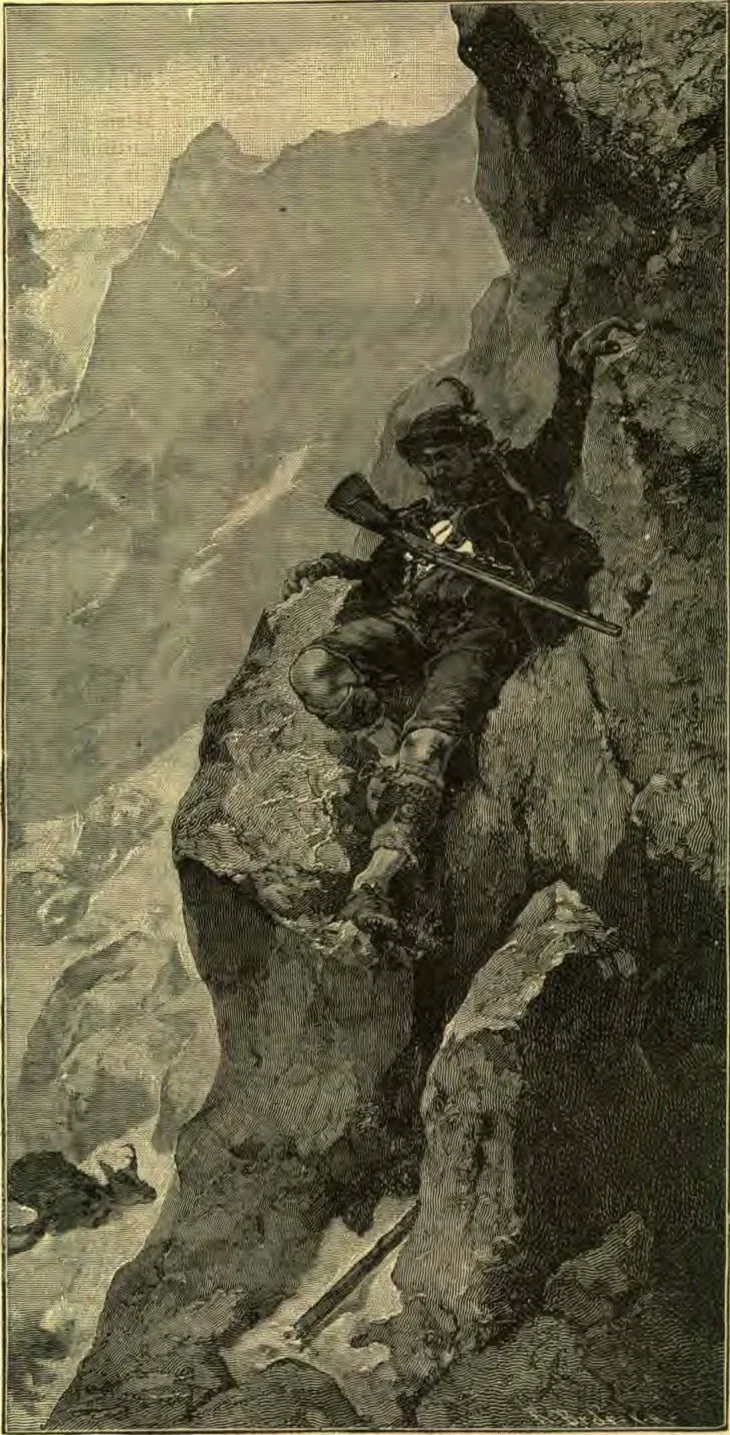
Down, down, o'er rocky ledge, the chamois hunter fell, Till shelving of a fissure chanced his feet to stay. Far, far above him rose the white-capped Alpine heights: A precipice below. Above, the mountain goat With flying feet mocked his despair. The eternal snows, Gleaming in sunshine, winged no prayer to heaven On airy flight or icy spire, but shimmered down Its glory to the depths below, lighting his tomb.
The weary day was folded in its stern repose By dreary curtains of the night. The burning eyes Of myriad stars looked down, the while o'er cloud-flecked blue The moon trailed silver robes. O solitude so grand! Thy speech too deep for human words! Silence, whose hush Startles to fear at distant roar of glacier's sweep, Then vast, profound, as o'er creation's morn held sway.
At last the awful hours sped by, and daylight dawned; And looking up to greet the light, he saw a flower— A little blue-fringed gentian—growing in the rock. Borne by the careless wind, the seed had fallen there In crevice bare; now for him smiled its lovely bloom. “Promise of good! Shall God,” thought he, “Care for the flower and not for me?”
And lifting up his voice, there rang O'er cliff and mountain glade: “God is our refuge and our strength, In straits a present aid.”
Higher than Alpine crags the echoes of that song Moved on and on until they reached a human ear; Or did an angel, listening, swiftly bear the need To Him who hears our lowliest cry of faith and trust? Ah, who may know? But answering shouts rolled down and down, Until the hymn, so like a wailing prayer begun, Rose like a mighty chorus to the sky again.
How cruel seemed thy fate, O flower of Alpine vale, To find a barren rock whereon to rest! And yet thy blue-fringed petals wept glad tears of joy, When, folded to a mother's loving breast, The mission of thy life was told, that saved her boy. And like a precious treasure, to this day, In sacred Bible laid thou'rt hid away!
—Christian Weekly.

BE THOROUGH.

I suppose there is scarcely a boy or girl who has not felt like complaining when compelled to undo a piece of work because it was not done right at first. The boy who has had to hoe a potato patch over because he leveled off the weeds instead of digging them up by the roots, or the girl who has had to pick out a long seam because she set the stitches unevenly, hardly felt at the time that it paid to be so particular. The long hours spent after school in learning some neglected lesson are looked upon as an irksome restraint or as an infringement upon personal liberty. Perhaps even feelings of resentment are often cherished toward the wise friend who insists upon thoroughness in everything. But as the years go by, and these same boys and girls take their place among the world's workers, they will see how important to good work are faithfulness and accuracy in little things, and they will then bless the firm hand that insisted on carefulness when they were too inexperienced to see the need of it themselves.
Too many young people seem to think that if they can only manage in some way to give creditable replies to the questions put to them in school, it will answer quite as well as if they learned their lessons thoroughly, and that no harm is done so long as the teacher does not find out that they are shirking. But the question ought not to be thought of in that way. Boys and girls should remember that a school is not held for the benefit of the teacher, but for the good of the scholars; and that when they fail through negligence, the result will be felt by themselves. All through their lives they will be weaker, not only on account of the facts they have failed to learn, but on account of the careless habits they have allowed themselves to form.
The following letter and comments from an exchange contain a lesson of such importance that, although you may have read it, it will do you no harm to hear it again. The letter was written by a New York firm to a friend of the girl, who was discharged from a good position because she had not learned to be thorough:—
“MY DEAR MADAM: The — company has been compelled to tell — that it has no further work for her. I had to announce this decision to her yesterday, giving her next week's pay in advance, so that she can have a week to re-establish herself.
“It is unnecessary for me to say that Mr. — has tried to give her every help he could to make a place for herself. He has been kindness itself. But although the girl is faithful, steady, regular, willing, and a hard worker, she is altogether incompetent as a stenographer and type-writer. She lacks the ground-work of elementary education, and we must give up trying to educate her. Personally, I have much interest in her, and I should be glad to do anything I can to help her. I have suggested that she call on you to-morrow and get your advice. There is, however, no alternative but for us to part with her; it would be better economy for the — Company to contribute to her support as a matter of charity than to try to carry her longer on its pay-roll.
“I write now because I know you are interested in her.
“Yours sincerely, — —.”
The exchange says: “The young girl discharged had been in the employ of this firm almost a year, though from the first week it was a question whether she would ever be valuable. As the letter states, she was faithful and a hard worker. The faults she had were the result of careless work in school. She could not spell, and she would write a whole letter without a comma. These faults were pointed out to her, and she was told that she would be allowed a half day for study and practice for a month. For a few days she used her time well, but she lacked the first element of business ability, perseverance. At last it became so evident that it was a hopeless case, that she was discharged. What is she to do? She has not the money to support herself while getting the grounding of an education; she probably will never find another employer to give her the opportunity the last one gave her, and, after spending months in learning the stenographic characters and how to read them, and a year in practice in an office, she must find some other business. Earnest work in school would have saved this, and to-day she would hold a position that would grow more valuable each year.”
A wise builder always lays a solid foundation. And in the matter of getting an education those who are wise lay a good foundation by mastering thoroughly the first principles. You recollect, do you not, that story about the foolish man who built a splendid mansion on the sand? When a great wind arose, that tested the strength of the structure, it fell because it had no solid foundation. A like misfortune comes to those boys and girls who are so anxious to appear advanced that they are not willing to master patiently the common branches, or who are too indolent or have too much fun on hand to do so. When the test of practical work comes, they fail because they have not laid a good foundation.
Besides this, there is another reason for well-doing. “One is our Master, even Christ.” If he, the one supremely wise, thought it necessary to finish the most insignificant part of the works of creation with a nicety to which we can never attain, shall we, who profess to imitate him, dare to do less than our best? Will you not let the thought that you are Christ's and trying to follow his example help you to do faithfully and well whatever study or humble task-work may come to your hands to be done?
W. E. L.

FOR HIS SAKE.

“How can we love those who don't love us—much less our enemies?” mused Mollie, as she carefully watered her window plants, thinking meanwhile of the Sunday-school lesson. “Love your enemies, bless them that curse you, do good to them that hate you, and pray for them which despitefully use you and persecute you. I don't see how it can be done. No one uses me despitefully, but if any one did, I am sure I shouldn't love him. I shouldn't even try.”
“How thrifty your plants are, Mollie,” said some one who had heard Mollie's half-audible soliloquy.
“Yes, don't they grow famously?”
“You must be very fond of plants.”
“Why, no, I don't think I am naturally. I used to consider it a trouble to watch and water them every day.”
“What made you do it, then?”
“O auntie! you know they were sister Annie's plants. She loved them, and when she died I took care of them for her sake; but now, somehow, I have grown fond of them too, they seem so grateful, and it is such a delight to discover new buds and leaves day after day. See how full of splendid blossoms this cactus is.”
“Is that the same cactus that poisoned you last spring? I remember your hands were swollen and painful.”
“Yes, it is the same cactus, but it was not the fault of the plant. You see, I didn't know how to manage it; I don't get thorns in my hands now unless I am careless. And really, auntie, I think I am more fond of it than of the other plants, it blooms so magnificently.”
“Is it then impossible to love those who despitefully use you?”
“Why, auntie!” exclaimed Mollie, facing about, a sudden light in her eyes.
“Yes, Mollie, that is the way. You took care of them for dear Annie's sake, and so grew to loving them for their own sake, even the one that despitefully used you. For His sake, Mollie, always for His sake, and the rest will follow.”—Selected.

THE PRAYING LITTLE CRIPPLE.

I once knew a little cripple, who lay upon her death-bed. She had given herself to God, and was distressed only because she could not labor for him actively among the lost.
Her pastor visited her, and hearing her complaint, told her that there from her sick-bed she could offer prayer for those whom she wished to see turning to God. He advised her to write their names down, and then to pray earnestly for them.
Soon a feeling of great religious interest sprang up in the village, and the churches were crowded nightly. The little cripple heard of the revival, and inquired anxiously for the names of the saved. A few weeks later she died, and among a roll of papers that was found under her pillow, was one bearing the names of fifty-six persons, every one of whom had been converted in the revival. By each name was a little cross, by which the little cripple saint had checked off the name of each convert as it had been reported to her.—Moody's Child Stories.

SPRING PLANTING-TIME.

WHAT will you sow, little children, what will you sow? In your garden you wish that sweet flowers would blossom and grow? Then be careful to choose from the myriads of wonderful seeds The caskets that lock up delight, and beware of the weeds! If you sow nettles, alas for the crop you will reap! Stings and poison and pain, bitter tears for your eyes to weep. If you plant lilies and roses and pinks and sweet-peas. What beauty will charm you, what perfumes on every breeze!
Thus it will be, little folk, in the garden of life; Sow seeds of ill-nature, you'll reap only sorrow and strife; But pleasant, kind words, gentle deeds, happy thoughts, if you sow. What roses and lilies of love will spring round you and grow!
Smiles will respond to yours brighter than marigolds are, And sweeter than fragrance of any sweet flower, by far; From the blossoms of beautiful deeds will a blessing arise, And a welcome at sight of you kindle in every one's eyes.
Then what will you sow, my dear children? what will you sow? Seeds of kindness, of sweetness, of patience, drop softly, and lo! Love shall blossom around you in joy and in beauty, and make A garden of paradise here upon earth for your sake.
—Celia Thaxter.

“BLESSED ARE THE MERCIFUL.”

Harry had set some traps down in the pasture, and he could hardly wait till breakfast was over before going to see if he had caught anything. He started off bareheaded, calling for Albert, and of course Tiny wanted to go too. Albert and Harry were brothers, and Tiny was their sister.
Harry didn’t like to “have girls along,” so he spoke up quite crossly, “Tiny’d better go back, for the grass is wet, and she’ll take cold. Besides, it’s no place for a girl, any way.”
Tiny’s lip began to quiver, and Albert hastened to say, “Oh, let her come. Here, Tiny, I’ll carry you over to the pasture, so your ‘toots’ won’t get wet. And as for going to see the traps, I think she has just as much right as we have. Now, then, up she comes.”
Albert was strong, and Tiny enjoyed the ride in his arms. It was a beautiful day, and everything seemed so happy. The blue sky poured out an ocean of light; and the fields were green, thickly studded with dandelions,—“gold dollars,” Tiny said, “scattered out of the sky for poor folks.” The birds were going to housekeeping, and the lambs were frisking around, “playing tag,” Tiny thought.
“It seems as if somebody very good has walked all around the whole world,” said Tiny, “and made everything happy. Hark! hear the bees humming.” And she began singing a school song:—
“Out in the beautiful garden, Say will you come with me now? The oriole swings as he gaily sings High in the maple bough. Come, come, come, Hear the buzz and hum, As if a band from fairy land, Were coming from under the ground.”
“Here we are,” said Harry, stooping down in the pasture to examine his traps, and then exclaiming excitedly, “There’s something in this one!”
“Oh, it’s a little bird!” said Tiny. “I hear its wings beating about. It will hurt itself. Take it out, Harry.”
Harry put his hand inside, and caught the poor little fluttering thing.
“Poor little bird!” said Tiny. “How I wish the birds weren’t so frightened at us. Perhaps it’s a little mother bird. O Harry, what if it is a little mother bird, and has some little birds waiting for her to come? How long do you suppose it’s been in that trap?”
“I don’t know.”
“And even if it isn’t a mother bird,” continued Tiny, not noticing the cross tone, “it’s too bad to frighten it so, and to keep it away from its friends in the sky. Do let it go!”
“Not much!” said Harry. “I’m going to keep it in a cage, and may be I’ll stuff it after awhile.”
Tiny really looked as if she was going to cry.
“O Harry, I’ll give you all the money in my bank if you’ll only let it go. Just think how lonely a cage will be for it! How would you like to have some big giant come and take you away from us, and shut you up where you couldn’t play? All the birds will be sorry if we keep this little one in prison or stuff it. O Harry! Could you kill that dear little bird, that God has made so beautiful? Don’t you know what mamma said about our being careful not to destroy life, because we can never give it back? We can never make the bird sing again.”
Tiny was crying now in good earnest.
“Well,” Harry said, impatiently, “I knew it was no place to bring a girl. S’pose I’ll have to let it go,” and he opened his hand, and away flew the bird toward the golden sky, sending a sweet chirrup of thanks back.
“There’s another flock of birds soaring away, too. ‘Fly away, fly away, fly away home,’” sang Tiny, through her tears.
Albert put his arm comfortably around Tiny, glad that the bird had gone; and as Harry watched its happy flight, he declared he was glad too.
“I guess I’ll take these old traps home,” he said. “There’s no use catching things just to frighten them, and then to let them go again.”
So the children brought the traps home, and told their mother about the bird. She was glad Harry had let it go, and said, “Now, while I pare these apples for a nice turnover for you, you sit down, and I’ll tell you why I’m glad the bird was set free.”
“Everything we do, or think, or say, leaves a mark on our character,” continued their mother, as the children gathered round. “We are writing ourselves all through and through with what we think and do. So each one of us is a book of life.”
“I read of some boys who once found a poor, old, worn-out horse on a city common. His cruel owner had turned him out to die when his days of usefulness were over. The old horse was lying on the common, too feeble to rise, and these wicked boys got some sharp sticks, and poked his poor eyes out.”
The children uttered a cry of horror.
“Yes, that is true. Do any of my children ever want to be so cruel?—No, no. Well, then, when you go along the street, and see a poor bug crawling along, try not to step on it. It is doing you no harm. Don’t shoot the birds, don’t tease the kittens, don’t plague the dogs. In this way you will be writing mercy in your hearts, and the Lord says, ‘Blessed are the merciful, for they shall obtain mercy.’ You will never be like the boys who poked the poor horse’s eyes out, if you will do this. Those boys didn’t get so cruel all at once. They began to do cruel things to bugs and animals, and at last were so like Satan that they could do that awful thing.”
“Let us try to be like God; he is full of love, merciful, and gracious; and if we are like him, and write our lives full of mercy, he says we shall obtain mercy.”
“I want to like God,” said Tiny.
“I’ll never set any more traps,” said Harry, huskily.
And Albert looked up to the sky without saying anything, but his mother read his gentle look, and was satisfied.
FANNIE BOLTON.
Continue reading: MOLLIE’S LITTLE LESSON