THE Christian Cynosure, of Chicago, last week contained this paragraph:—
The Chicago City Council, with its customary effrontery, instructed the Mayor to close all the offices of the City Hall on the 17th of March (St. Patrick's day) and to declare it a holiday; and the Mayor obeyed. At the Baptist Ministers’ meeting on the 4th instant, Dr. P. S. Henson presented a resolution, that “this conference of Baptist ministers imperatively demands that, if the precedent thus established by our City Council is to be followed in the future, St. Andrew shall have a memorial day in deference to the feelings of our Scottish fellow-citizens, and that William Penn shall be similarly honored in deference to the Quakers, and Roger Williams in deference to the Baptists, and John Wesley in deference to the Methodists, and John Calvin in deference to the Presbyterians, and Martin Luther in deference to the Lutherans; and if there be any other race or religion that can claim enough voters to be an influential factor at the polls, then the representatives of such a race or religion shall each have the privilege of naming any patron saint or reverend ecclesiast in whose honor the city offices shall be closed once a year—if there be days enough in the calendar to serve the purpose.” The satire of this resolution is as timely as it is pointed and deserved.
Now that this resolution of the Chicago Baptists has opened the eyes of the Cynosure to the folly of legislation, by city or State, on the ground of religious preferences, perhaps it will have less to say than formerly about legislation in favor of Sunday. And perhaps it will not. How different would it sound if Congress, or any other body with legislative power, should order all places of business, within the limits of their authority, closed on Sunday in deference to the wishes of a certain class of religionists who demand it? Then let some Henson frame a resolution that the same body pass a law that all places of business be closed on the seventh day in deference to the religious preferences of Seventh-day Baptists, Seventh-day Adventists and Jews, and on Friday in deference to the conscientious practices of the Mohammedans, etc. Would not the satire be as timely, pointed, and deserved? When will well-meaning men learn that all religious legislation is class legislation and is a menace to all religious and civil liberty, and so is a direct sword thrust at the foundation principles of our Government?—Sabbath Recorder.
Paternalism in Government.
THE Post, an independent paper of Washington, D. C., has the following article under the heading, “The Cancer of Paternalism”:—
Robert Lees, as temporary chairman of the Democratic State convention of Wisconsin, on Wednesday made what the dispatches call a “remarkable speech” in his opening remarks to the assembled Democracy, and remarkable it was for its vigorous denunciation of the growing spirit of paternalism in the Government, and for the wholesome truths he told concerning a matter that is far too seldom made a topic of public discussion.
Whether Mr. Lees is right in charging our progress toward paternalism wholly to the Republican Party is immaterial; it was but natural that he should do so in addressing a Democratic convention. But wherever the responsibility lies, and both parties are more or less at fault, the evil is the same, and calls for remedy, if the self-respecting people of this country desire to preserve their independence and individuality.
Mr. Lees, who is evidently no believer in the “divine efficacy of law, whether it be in the enactments of Congress or State legislatures,” is verging close upon grave and dangerous facts when he says:—
“We no longer trust the people with any power. We treat them as though they were children and incapable of exercising ordinary discretion in conducting their own personal affairs. If a man is involved in a difficulty with his neighbor, he can only obtain redress by engaging the services of an attorney duly admitted to practice in the courts of the State, and holding the certificate of a commission created by law. He can only be poisoned by a druggist duly licensed, or become intoxicated in a duly licensed saloon. His food has to be examined by State authorities. For fear that he may not know what is wrong with his horse when it is sick, the State steps in and informs him of the nature of the disorder. He is not even allowed to let the ox-eyed daisy grow in his field without incurring the risk of a visit from that latest impersonation of the majesty of the law, a weed commissioner. Ere long, at the present rate of progress, one dare not die without procuring the services of a duly licensed physician, or be buried by any one but a duly licensed undertaker.”
Paternalism he holds to be the natural outgrowth of a greed for power, which threatens to engulf the liberties of the people unless it be checked. Mr. Lees is not to be understood as decrying any of the safe-guards to social order or calling in the name of anarchy for the overthrow of law. His illustrations are simply designed to show the increasing tendency of the times toward dependence of the people upon the Government, rather than the subordination of the Government to the will of the people. It is thus the citizen, who should be the creator and shaper of his own destinies, is fast being made the mere creature of centralized authority.
There is a demand in certain quarters for the conversion of the railroad and telegraph systems of the country into great governmental machines with a gigantic army of operatives to do their bidding.
There are others who would put the utterances of the newspapers under the censorship of the Government, and paralyze the right arm of civil liberty by suppressing the freedom of the press.
There was a large section of the party in power two years ago, and possibly is now, in favor of establishing unrestricted suffrage in the several States by shackling the States themselves with Federal statutes that it would breed a revolution to enforce.
There are still others who would establish a national bureau of supervision, to regulate, through a legion of paid inspectors, spies, and informers, the character of the food we eat, of the beverages we drink, of the medicines we take, as though the States of the Union were so many institutions for feeble-minded children, incompetent to manage their own affairs.
There is a disposition in all directions to shift upon the Government responsibilities and duties that belong primarily to the citizen, and which he can not evade without the sacrifice of everything that gives strength, vitality, and value to his citizenship; a disposition on the part of the legislators to impose the obligations which they are elected and sworn to perform, upon all sorts of commissions, trusts, and subordinate agencies, that are drains upon the treasury and sappers of the public virtue; to establish, in a word, a system of bureaucracy akin to that of Russia, wherein the will of the people becomes a helpless and inappreciable factor, over-sloughed by an autocracy that is fatal to genuine independence and a mockery of popular government.
Such being the situation, and its outlines are in no wise overdrawn, the robust and patriotic philippic of the Wisconsin orator is no less timely than true. It carries with it a weighty admonition. It is a note of warning against the dangers that menace the Republic. It should not fall upon one ear, to lightly pass out of the other. It is a call to arms for the public safety.
The evil of which this article treats is a most serious one. Nor is it confined to one political party. It may be that in certain lines the Republican Party is more inclined to ultra paternalism than is the Democratic Party, but in the main there is little difference, and these two parties are the conservative forces of the Nation. The so-called reform parties are the very embodiment of paternalism.
But neither Mr. Lees nor the Post points out the most serious menace to popular freedom to be found in the paternal tendencies of the times. It is in the various measures of religious legislation that the greatest danger lies.
Women and the World's Fair.
Just now much is being said both for and against the closing of the World's Fair on Sunday, and among the recent utterances in favor of open doors are those of several prominent women, and their arguments display their large knowledge of the world and human nature, as well as their philanthropic motives. They are all deep thinking, intelligent women, women who have the good of humanity at heart, women who take a broad, far-reaching, view of matters, women who do not believe in dipping out vice by the spoonful while so many men are pouring it in by the bucketful, but rather in stopping the cause thereof.
One of these women is Mrs. May Wright Sewell, of the World's Fair Commissioners of Indiana, who at their last week's meeting discussed the matter of Sunday closing of the great Fair. During the discussion, Mrs. Sewell said she thought that the Exposition should be open, since the back doors of saloons and other iniquitous places would be open. She believed that safe and beneficial entertainment should be provided for the thousands who will be drawn to Chicago then, and included among these were the poor who were always there, and who could not afford to6lose time through the week to see the Fair, which should be accessible to all.
Another member of the Board of Commissioners, Mary W. Krout, coincided with Mrs. Sewell, and advocated the opening of the art and similar departments, so that the working classes might enjoy them without losing a day's wages, which they could ill afford. She said that the majority of petitions against opening the Fair came from the small towns and country districts who know nothing about the heartless methods of conducting business which prevails in large cities.
Here are the opinions from two other women, who are not members of any Board of Commissioners, but whose opinions, nevertheless, are good and have due weight and influence. Mrs. Elizabeth Cady Stanton, of New York: “It is said that those who watch the exhibits and serve the public through the week should have one day of rest. As the labors will be transient, only lasting a few months, and as their surroundings will be varied, beautiful and entertaining, the tax on their time and patience would be light compared with the dreary monotony of ordinary laborers’ lives, who spend year after year in dingy workshops and dreary offices, or with multitudes of young men sitting with bent shoulders writing by artificial lights,—a class more to be pitied than those who dig in mines, scarcely ever seeing the light of day. Those who can dispose of their time as they see fit can hardly appreciate what a Sunday at the World’s Fair would be for a large class of their fellow-men. Gifted orators might speak to the multitudes on popular reform or religious questions, for there are no meetings more impressive than those held in the open air.”
Another is Mrs. Clara Bewick Colby, of the Woman’s Tribune, who says editorially:—
To the Tribune the arguments for opening the Fair appear to have the weight of reason, justice, and brotherly kindness on their side. So far as its seeming irreligious or unchristian to open the doors on Sunday, it appears to the Tribune to be carrying out in the highest degree the spirit of him who said, “The Sabbath was made for man, and not man for the Sabbath.” The opportunities for holding the great religious and reform meetings on the grounds will be enlarged on, as it will afford the occasion of the century for bringing spiritual instruction to the masses who never go to church, and for whom no church privileges are provided, or are at present possible. With the best sermons, lectures, and sacred concerts, what might not the blessed day do for the elevation and education of the masses? Jackson Park, one of the two great breathing places of Chicago, the only possible chance for the poor to get fresh air and outdoor life, and of which they have always availed themselves in summer, has been appropriated for the World’s Fair grounds, and if these are closed to them on Sunday it will be positive robbery to the helpless, and great mortality, especially of children, will result. Every consideration of humanity and good order, seems to demand that there shall be even extra inducements to draw people out of the crowded, heated city, and that the grounds should either be open entirely free or at a much reduced price.
Nebraska can well feel proud of her broad and generous Mrs. Colby, who has surpassed all others in outspoken liberality and justice towards the great mass of laboring people in and about Chicago, inasmuch as she would not only open the grounds on Sunday, but would have admission either free or at a reduced price for their benefit. She well deserves the title, “Charity’s Queen,” which was bestowed upon her by White Cloud, the chief of the Chippewa Indians.—Kearney (Neb.) Gazette.
Appropriation for Sectarian Purposes.
By J. J. Hughes
ACCORDING to Judge Brewer’s decision Christianity is recognized by our national Government. The City Council of Omaha, Neb., must have been reading the learned Judge’s decisions, for as reported by the Omaha daily Bee of April 20, 1892, the City Council passed a resolution appropriating the sum of $275 to defray the expense of a reception to be given the ministers comprising the Conference of the Methodist Episcopal Church, to assemble in that city some time in May. The Mayor opposed the resolution as being illegal, and proposed to raise the amount by private donations, and gave his check for $25, as a starter, but the Council imbibing the spirit and theory of National Reform unanimously passed the resolution over the Mayor’s veto, and returned the Mayor his check for $25. Thus as our Supreme Judges recognize Christianity as the religion of the General Government, the City Council of Omaha goes it one better (and a logical step too) and recognizes the Christianity of Methodism as the religion of the great State of Nebraska, and is consistent too, by supporting it out of the public funds by equal taxation. Let every liberty loving citizen of Nebraska protest. J. J. HUGHES,
Brownville, Neb.
Congress Not Likely to Act.
A RECENT despatch from Washington concerning the contest over the question of the opening of the World's Fair, says:
So earnest has become this warfare that an effort has been made to swell the petitions by fraudulent names. A petition came from Michigan claiming to represent the religious bodies of that State in opposition to Sunday opening, which, on investigation, was found to have more alleged signatures than there were residents in the State. Lately, apparently under Colonel Shepard's directions, petitions against Sunday closing have embodied threats to defeat any member of Congress who favored opening the Fair on Sunday. In presenting such a petition yesterday, Mr. Platt, of Connecticut, said that if anything would induce him to vote for Sunday opening it would be these threats to defeat him in case he did so. Mr. Morrill, of Vermont, who is 81 years old, stated in the Senate the other day that these petitions did not frighten him, and that he was in favor of Sunday opening as a matter of justice to workingmen.
The opinion is also expressed that owing to the bitterness already engendered Congress will take no action whatever on Sunday closing. Senate officials estimate that the petitions and memorials so far presented on this subject represent about two million signatures. But as has been shown in the case of the petitions from Michigan and Ohio, many of these so-called signatures are beyond a doubt fraudulent. In the case of the two States named the census returns exposed the pious fraud. But whether exposed or not every petition is fraudulent which assumes to represent whole organizations when only a fraction of the membership have signed the petition or voted in its favor.
The American Sabbath.
A CORRESPONDENT of the Sabbath Recorder, writing from Oroville, Cal., says that there are some very strange ideas advanced concerning Sunday and the World's Fair, and gives for an example this from John V. Farwell, of Chicago:—
As the Fair is national, to which our Government has invited all nations as participants, I think it eminently appropriate that we exhibit an American Sabbath along with our multiform products of labor.
The Recorder's correspondent then comments as follows:—
Now if, as Mr. Farwell says, this is an American institution, it must have been made by Americans. I understand that anything made by Americans as the result of their labor, should by all means have the right of exhibition in this great Fair. He rightly claims that it is purely American; surely the French do not claim it; they never had any hand in its manufacture, and no other nation sets up any claim to having made it. Neither does God set up any claim to it. Then, surely, the thing must be of American manufacture. Then, let the Americans put it on exhibition, place it among the plants as an American mushroom. Why not? I think it would look well there. The idea of an American Sabbath being put on exhibition with “our products of labor!” Surely, if it is one of our products of labor, and is to be exhibited with our other products of labor, then there is no harm in placing it there as a mushroom. There is not, nor can there be, anything sacred or holy about an American made Sabbath. No, let it go on exhibition, and let the Commissioners, by all means, open the gates on Sunday, for an institution thus made would show to better advantage on Sunday than any other day.
It looks to me that this Sunday-closing business is going to seed; it puts one in mind of the boycotting times we had here in California a few years ago, when the Chinese question was to be crammed down our throats at all hazards. I do not know as it would be any great damage if those Christians, or those who are professing to be Christians, should stay away from the Fair as they threaten to do. The thing would probably be a success without them.
Droll Law Makers.
THE New York Legislature is a droll body of lawmakers. It has passed a bill appropriating $300,000 for a World's Fair exhibit, but commanding that the exhibit be closed on Sunday. Immediately after this display of Puritanism the same Legislature appropriated $50,000 annually toward the maintenance of the Natural History Museum in New York City upon the express stipulation that it should be kept open on Sunday. Explanations are in order.—Ottumwa World.
Apropos of the foregoing is the fact that the same Legislature which was zealous for Sunday sacredness in Chicago, legalized fishing in Jamaica Bay, L. I. It is still very naughty to fish anywhere in New York State except in Jamaica Bay. Such facts illustrate the utter absurdity of legislating upon such subjects.
Are There Worse Evils?
By Editor
ACCORDING to the St. Paul Dispatch, of April 25, the ministers of that city have inaugurated a crusade against “the corruption prevalent in official circles.” The meeting was a private one, and “a considerable portion of the morning’s meeting was devoted to injunctions to secrecy and admonitions to ‘keep this out of the papers,’” but “no adequate precautions had been taken, to keep the papers, or their representatives, out of the meeting.” A Dispatch reporter was present. He was, he says, “thoughtfully provided with a chair, and it was not until the meeting began to thoroughly warm up that he discovered that he was not really supposed to be there. He felt a trifle uncomfortable when he first made this discovery, but he stayed on because he was so deeply interested in the meeting, and because he was really gratified to know that it couldn’t be told by his looks that he was the only layman present.” The reporter was honorable, however, and did not reveal the secrets, so we are left to surmise what they were. The fact that such meetings are held, is, however, significant in itself. Another significant thing is that the ministers determined not to make the saloon issue prominent, believing that there were worse evils. They are probably gunning for open fairs and Sunday papers. The saloon always sinks into insignificance beside “Sunday desecration.”
Inconsistency.
INCONSISTENCY can scarcely go farther than it does when those who advocate the Sunday-closing of the Chicago Exposition, say, in one breath, that Christians in general are increasingly lax and inconsistent in their personal habits concerning Sunday-observance, and in the next, that the opening of the Exhibition on Sunday “will outrage the religious sentiment of millions of people.” If Christians will read Sunday newspapers, ride on Sunday trains and steamboats, patronize Sunday camp-meetings, and share the profits with the railroads which make special provision for Sunday worshipers (?); if Christian men will do all this, how is it that the opening of the Exhibition, five hundred or two thousand miles from their homes, is such a sad shock to their piety? —Sabbath Outlook.
Petitions Against Sunday Closing of the World's Fair
THIS Congress has been besieged with petitions from the advocates of religious legislation begging for the passage of the different measures for the enforcement of Sunday observance before it, but more especially that Congress should take some action which would result in closing the World's Fair on Sunday. Congressmen who recognize the impropriety of any such legislation by Congress have asked, “Are there no petitions in opposition to this?” Of late such petitions have begun to be heard, mostly worded as follows, “We, the undersigned, citizens of the United States, hereby respectfully but decidedly, protest against the Congress of the United States committing the United States Government to a union of religion and the State in the passage of any bill or resolution to close the World's Columbian Exposition on Sunday, or in any other way committing the Government to a course of religious legislation.” Those who desire printed blanks can obtain them by writing to A. O. Tait, Corresponding Secretary National Religious Liberty Association, Battle Creek, Mich.
FOUND AT LAST!
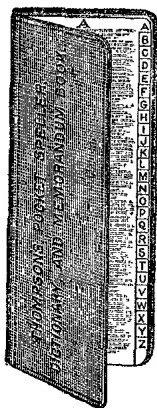
A POCKET SPELLER, DICTIONARY, AND MEMORANDUM BOOK COMBINED.
It gives the right orthography of all words (over 22,800) in common use, and in nearly every instance their definition. It also gives rules for the use of capitals and punctuation marks, abbreviations of names of States and Territories, letters of introduction and recommendation, definitions of commercial terms, forms of notes, due bills, receipts, letters of credit, orders for money, merchandise and goods stored, principal holidays, marriage anniversaries, combination of shades, and carefully selected laws of etiquette in social and business life, also a silicate slate for memorandums.
This Speller gives the most complete list of words in common use; it is a Speller, Dictionary, Handy Companion, and Memorandum Book combined; it is indexed; it prints all words pronounced alike but spelled differently, so they can be distinguished at a glance; it shows where the letter c at the end of a word is to be dropped when adding ed or ing; it gives a complete list of the most practical business forms; it gives the laws of etiquette in social and business life; these rules alone are worth the price of the Speller.
This Speller is bound in leather, is of convenient size to be carried in vest pocket, and its price brings it within the reach of all. American Russia leather, gilt edge, 50 cents. Sent post-paid to any address on receipt of price.
Address all orders to PACIFIC PRESS, 43 Bond St., New York.
Senate Petitions on Closing the World's Fair Sunday
THE Washington Post, of May 10, says that “the usual flood of petitions in reference to the World’s Fair was poured into the regular channel of the Senate yesterday morning.” The Post remarks that the petitions were about equally divided in their requests that Congress should, and should not, take action to close the World’s Fair on Sunday, and suggestively notes that a “mass-meeting of Protestant clergymen, of Tennessee,” arrays itself in favor of enforced religion at the Exposition, and a company of “Sabbath-keepers,” of Vermont, in opposition.
Should Popular Preference Govern Congressional Sunday Legislation?
The Washington Evening Star says, “The question of Sunday closing of the World’s Fair is one which should be decided in accordance with the popular preference.” Does the Star mean to say that whether Congress shall legislate to close it or not should be decided by the popular clamor? Shall Congress give its sanction to any measure, however unconstitutional or vicious it may be, provided only a “popular preference” be expressed in its favor? The Star would do well to consider whether or no principles should not govern in congressional legislation rather than preferences.
Sunday Closing of the Chicago World's Exposition Urged
THE International Federation for the Observance of Sunday, whose office is at Geneva, through their secretary, who was also secretary of the Sunday Rest Congress held during the Paris Exposition, have sent a memorial to the directors of the World's Exposition at Chicago. In this memorial they urge very earnestly that the Exposition be closed on Sunday for the benefit of the large number of employees, who will not only be allowed a time of physical rest, but will be enabled thus to discharge properly their religious duties. They also urge that the decision will have a serious influence upon Europe, where the lovers of Sunday rest are striving by the means of congresses and associations to promote everywhere the wise use of the day.
Senate Debate on Closing World's Columbian Exposition Sunday
IN the Senate, on May 5, when presenting “a memorial of citizens of East Hardwick, Vt., remonstrating against the passage of any bill or resolution to close the World’s Columbian Exposition on Sunday, or in any other way to commit the Government to a course of religious legislation,” Senator Morrill said: “It is clear that this question is a mixed one. If the World’s Fair should be closed on Sunday, it would virtually exclude all the workmen in Chicago from any reasonable opportunity to visit it.” While the Senator’s remark as to the workmen of Chicago may be true, that is not the ground upon which the legislation asked should be refused, but because it is asking Congress to interfere where it has no jurisdiction, and in matters outside the sphere of civil legislation.
Senate Petitions on Sunday Ice Sales in Washington
In the proceedings of the Senate, May 6, is the following:—
“Mr. McMillan presented a petition, signed by the ice companies of the District of Columbia, praying for the passage of Senate bill 2994 to prevent the sale or delivery of ice within the District of Columbia on Sunday, and also praying for the early consideration of the bill by the Committee on the District of Columbia, and the privilege of being heard before that committee in behalf of the bill; which was referred to the Committee on the District of Columbia. He also presented the petition of Rev. W. A. Bartlett, D. D., and other ministers of all denominations in the District of Columbia, praying for the passage of Senate bill 2994 to prevent the sale or delivery of ice on Sunday; which was referred to the Committee on the District of Columbia.”
SAFETY PENCIL POCKET.
NEAT, CHEAP, SERVICEABLE.
It perfectly secures pen or pencil in the pocket, so that it can not fall out when stooping. Can be easily and safely attached to any part of the clothing. A small investment will prevent the loss of a valuable pen or pencil.
Sent by mail on receipt of price. We guarantee these pockets superior in every particular to similar styles formerly sold and still offered at much higher prices.
Address, PACIFIC PRESS PUB. CO., 43 Bond St., New York. Or Oakland, Cal.
FATHERS OF THE CATHOLIC CHURCH.
By Ellet Joseph Waggoner
BY E. J. WAGGONER.
History repeats itself, because human nature is the same in all ages of the world. Hence, he who would know
HOW TO AVOID ERROR IN THE FUTURE
must know how errors have developed in the past. The “Fathers of the Catholic Church” shows the condition of the heathen world at the time of Christ, briefly states the principles of ancient heathen philosophy, and shows how the adoption of these principles by prominent men in the church, and the iniquitous lowering of the standard of pure Christianity, developed the Papacy, which was simply a new phase of paganism. The chapter on
SUN-WORSHIP AND SUNDAY
is alone worth the price of the book. Fine English cloth, substantially bound, contains about 400 pages, and will be sent post-paid for $4.00.
SACRED CHRONOLOGY.
By Sylvester Bliss
BY SYLVESTER BLISS.
This work treats of the Elements of Chronology, the different systems, and the various eras, and gives the chronology of the principal events recorded in sacred history from the creation, till the death of St. John. It also contains a vindication of the numbers of the Hebrew Scriptures. As an aid to investigation it is invaluable. The book has been thoroughly revised, and an entire chapter added, on the
PEOPLING OF THE EARTH.
This chapter is an exposition of the tenth chapter of Genesis, and gives an outline of the beginning of history and
THE ORIGIN OF NATIONS.
No student of history can well be without this book. 300 pages, cloth binding, with side stamp, $1.00.
Presbyterians Urge Boycott of Sunday Fair Opening
The Central Presbytery of Dakota is reported as having memorialized the Presbyterian General Assembly, which meets at Portland, Oregon, that “in case the gates should be opened on Sunday the Assembly should earnestly request all its ministers and people to absent themselves from the Fair.”
The Pittsburg Preachers’ anarchistic brew, the organized boycott, is developing its poisonous ferment far and wide.
Memoirs of Edwin Bainbridge and Missionary Biographies
MEMOIRS OF EDWIN BAINBRIDGE.— The subject of this memoir is the young English tourist who met his death at the dreadful volcanic eruption of Tarawera, New Zealand, on the 10th of June, 1886. 12mo, 160 pages, fully illustrated, cloth extra, 75c.
JAMES CHALMERS, Missionary and Explorer of Rarotonga and New Guinea—By Wm. Robson, of the London Missionary Society. 12mo, 160 pages, fully illustrated, cloth extra, 75 cents.
SAMUEL CROWTHER, the Slave Boy who became Bishop of the Niger—By Jesse Page, author of “Bishop Patterson.” 12mo, 160 pages, fully illustrated, cloth extra, 75 cents.
JOHN GRIFFITH, Founder of the Hankow Mission, Central China—By William Robson, of the London Missionary society. 12mo, 160 pages, fully illustrated, cloth extra, 75 cents.
THOMAS J. COMBER, Missionary Pioneer to the Congo—By Rev. J. B. Myers, Association Secretary Baptist Missionary Society. 12mo, 160 pages, fully illustrated, cloth extra, price, 75 cents.
HENRY M. STANLEY, the African Explorer—By Arther Montefiore, F. R. G. S. Brought down to 1889. 12mo, 160 pages, fully illustrated, cloth extra, 75 cents.
WILLIAM CAREY, the Shoemaker who became a Missionary—By Rev. J. B. Myers, Association Secretary Baptist Missionary Society. 12mo, 160 pages, fully illustrated, cloth extra, 75 cents.
BISHOP PATTERSON, the Martyr of Melanesia—By Jesse Page. 12mo, 160 pages, fully illustrated, cloth extra, 75 cents.
CRUDEN'S CONCORDANCE—A dictionary, and alphabetical index to the Bible. Cloth, $1.25. Sheep, $2.50.
The above named books will be sent post paid on receipt of price.
PACIFIC PRESS PUBLISHING CO.
Or Oakland, Cal. 43 Bond St., New York City.
Why the Churches Need State Help for Sunday
In explaining why the American Sabbath Union was called into existence, the same gentleman, in a lecture delivered at Battle Creek, Mich., April 24, stated that the Sunday Sabbath for some cause or other has come to that pass that “the churches can not handle it alone.” That is to say that these “evangelical” churches, some of which boast of several million members, are not now capable of performing their religious duties and maintaining their religious institutions alone, but just now when they have become numerically stronger than ever before, they must receive assistance from the State; must have some outside force to help them keep the Sabbath they profess to so greatly love and revere. What, again we ask, is the matter with the churches?
If there were not many in these churches who are lovers of pleasure more than lovers of God, who have not the moral stamina to resist the attractions of the world, who, in short, are unconverted, and whose affections are upon the things of the earth rather than on things above, would there be this demand on the part of the churches for worldly assistance? Is not this the trouble with the churches?
THE Christian Advocate, of this city, has in its issue of March 24, this statement by a correspondent:—
A man in this neighborhood, wishing to sell whisky secured twelve persons to sign his petition. Six belong to the Methodist Episcopal church.
It is but fair to say that the statement is merely made as the basis of a question, and that in replying to the inquiry the Advocate says:—
These persons violated the Discipline of the Methodist Episcopal Church. They are subjects for the application of the Discipline.
It might, however, be well for the Methodists, and some other churches as well, to get their own dooryards thoroughly cleaned before they again charge those who conscientiously oppose all Sunday laws with being allies of the saloons. An applicant for a liquor license might search the United States from the Atlantic to the Pacific and from the lakes to the gulf, but he would not find one Seventh-day Adventist willing to sign his petition, yet, because of their opposition to Sunday laws Adventists are classed with about all that is evil.
Church and State Separation in Editorial Commentary
The Manhattan, Kan., Mercury thinks that “the cause of Christ is able to take care of itself,” and that “every true American believes in the separation of Church and State.”
Chicago Saloon Keepers Oppose Sunday Opening of Fair
An exchange remarks that it is significant that every dive-keeper in Chicago who is alive to his “business interests” wants the World’s Fair closed on Sundays. Likewise the proprietors of all the near-by alleged “summer resorts.”
Sunday Law Enforcement in Saginaw, Michigan
An attempt was made on the 1st inst. to enforce the Sunday law in Saginaw, Mich., “but,” a dispatch to the Mail and Express remarks, “it was noticed that there was more excitement and a greater number of ‘drunks’ than usual.”
Churches and the Not-Altogether-Religious American Sabbath Union
Rev. Francis W. Ware, Field Secretary of the American Sabbath Union for the State of Michigan, says that the American Sabbath Union is “not altogether a religious organization,” though admitting it to be a creation of the different branches of the “evangelical” churches. These churches, then, have given birth to something not altogether religious. God’s plan in the beginning was that every tree should bear fruit after its kind, and such is still the invariable law of nature. What can it mean that these churches are evolving something not altogether religious? What is the matter with the churches?
Government Should Neither Foster Nor Oppose Religion
By Editor
SOME weeks ago we said: “Christianity fostered and supported by a civil government ceases to be Christianity.” Upon this one of our country exchanges, with National Reform proclivities, makes this inquiry: “Would you have the civil government and Christianity enemies with one another?” This is evidently intended as a squelcher. It serves, however, only to reveal the colossal ignorance of our querist upon this whole subject.
GOVERNMENT, like marriage, is a divine, but not a Christian institution. Like marriage, all are entitled to share its blessings. It belongs as much to the infidel and the atheist as to the Christian. Government has nothing to do with religion any more than it has to do with Odd-fellowship or Freemasonry. It simply secures to all their natural rights, or rather, the free exercise of those rights. The government knows, or at least should know, neither Jew nor Christian, but only citizens. The ideal human government would neither oppose nor foster any religion, but simply let such matters alone as entirely outside its sphere.
Powderly on Opening the World's Fair Sundays
WHILE in attendance at a meeting of the International Executive Board of the Knights of Labor, at Pittsburg, Pa., Mr. Powderly said to a reporter:—
I think the World's Fair should be as open on Sunday as on any other day, as Sunday is the only day of leisure to a large majority of the working class.
It is a significant fact that notwithstanding the persistent efforts of the Sunday forces to make it appear that organized labor demands Sunday closing, of all the petitions with which Congress has been flooded for Sunday closing of the Fair, but one has been presented representing a body of laboring men.
Keyport Sunday Observance Committee Meets on Steamboat and Produce
The Sunday Observance Committee of Keyport, N. J., held a meeting recently, at which reports from various committees were listened to. The committee to wait upon Mr. Cornell, of the Keyport Steamboat Company to ask him not to run his boat to New York on Sunday, during the summer, reported that Mr. Cornell claimed that the Sabbath committee should see the farmers in reference to the receiving and shipping of produce on Sunday. The committee resolved to enforce the law upon those who had their places of business open the previous Sunday.