Truth never becomes less such by repetition, and repetition is often necessary before a truth makes a due impression upon the minds of men. Referring to an experience in the life of Luther illustrating this fact, D’Aubigné observes that “it is frequently necessary that a truth should be repeatedly presented to our minds in order to produce its due effect.” It is for this reason that we present again and again thoughts upon the important subject of the province and limitations of civil government and man’s relationship thereto, in connection with his responsibility and allegiance to God, his Maker.
Much confusion, suffering, and sin have resulted from a lack of a proper understanding of this question. But He who spake as never man spake laid down a rule which is so simple and plain that none need err in determining where to draw the line between what is duty to God and what to earthly governments.
A test question was once put to Christ by those who sought to entangle him in his talk, and find whereof they might accuse him. The Jews were then unwillingly under tribute to Cæsar. Coming to Christ, they asked, “Is it lawful to give tribute to Cæsar, or not?” Had he said, Yes, they would doubtless have seized upon this as an occasion for taking offense; for, as already stated, they were unwillingly paying taxes to Cæsar. Had he said, No, they would have had grounds upon which to prefer charges against him before the Roman Government. Whichever way he answered it, it would seem, would involve him in difficulty. To the Jews it no doubt appeared that they had propounded to him a question which he could not answer without putting an argument into their hands which they could use against him. But he answered them so wisely, and in a way that appealed so strongly to their reason and common sense, that they marveled, and left him, and went their way. Perceiving their wicked intent, he said: “Why tempt ye me, ye hypocrites? Show me the tribute money. And they brought unto him a penny. And he saith unto them, Whose is this image and superscription? They say unto him, Cæsar’s. Then saith he unto them, Render therefore unto Cæsar the things which are Cæsar’s; and unto God the things that are God’s.” Matt. 22: 18–21.
Thus did Christ silence the Jews, and answer what in their estimation would be to him a most puzzling question. And herein is couched a principle by which, if applied, no one need ever be at a loss to know what he ought to render to God and what to civil government. The first and only thing necessary to ascertain is that of ownership. The only question to be settled is, Whose is it, God’s or Cæsar’s? Let this once be determined, and the duty to obey or not to obey, or to whom obedience is to be rendered, is at once apparent.
To illustrate: Suppose a government should attempt to enforce upon its citizens the ordinance of baptism. While no one would deny that baptism is a Christian ordinance, commanded in the Scriptures, and that its practice is perfectly proper on the part of those who believe in Christ, the enforcement of it on the part of the government would be condemned as quite out of place. And why so?—Simply because it is an institution which does not belong to civil government. Baptism pertains to God. Men are baptized for the remission of sins; but sin is a violation of God’s law, and can therefore be remitted only by God.
Suppose, again, that the government should attempt to compel men to celebrate the ordinance known as the Lord’s supper; this would likewise be regarded as an unwarranted assumption of power, because, as the name of the sacrament itself shows, it belongs to the Lord, and not to the government.
Likewise with the enforcement of Sabbath observance. The Sabbath is the Lord’s, and its observance is to be rendered to the Lord. The principle underlying the observance of this, as well as all other days devoted or set apart for religious purposes, is stated in Rom. 14: 6: “He that regardeth the day, regardeth it unto the Lord; and he that regardeth not the day, to the Lord he doth not regard it.” Therefore, for the government to attempt to enforce the observance of the Sabbath or any other religious institution, or for any ecclesiastical power or organization through the government to attempt to do so, is for it to seek to compel men to render to themselves that which belongs to God. It is usurpation and robbery, and an attempt to compel men to commit idolatry. And any man who observes any such institutions because of such requirements, has no more discharged his duties to God than the man who owes his neighbor a certain amount has canceled the debt by paying the specified sum to another.
It is evident, therefore, that the question of ownership at once determines to whom obedience in any particular case is to be rendered, whether to God or to the government. And if there is to be a distinction made here, it must also be evident that the realms, or jurisdictions, of God’s and Cæsar’s are entirely separate and distinct. While the subjects are the same, the natures of the two governments are entirely distinct. One is civil, the other religious; one is temporal, the other eternal; one pertains solely to this present world, the other to the world to come; one takes cognizance of acts only as they affect the rights of others, the other scrutinizes the acts themselves, and the prompting motives behind them. The only obligations resting upon men with which civil governments have anything to do are those which exist between man and man. With the duties which men owe to God, Cæsar has nothing to do.
Melbourne, Australia.
UNKNOWING
By Mary D. Brine
BY MARY D. BRINE.
A lonely cricket, in my closet hidden, Sent out amid the gloom its plaintive lay, As though it grieved for joys to it forbidden, Nor knew the night had given place to day.
Within my room the sun was brightly shining, O’erflowing from the bounteous skies above, And all sweet nature’s forces seemed combining To render praise for heaven’s tender love.
Yet, whilst I gloried, singing in my gladness, The little cricket dallied in the gloom, Nor heeded that it might have fled from sadness, Thro’ space beneath the door, to my bright room.
“’Tis like our human nature, this delaying” (So thought I, as I heard the sad night song), “This lingering ’mid the gloom, our doubts obeying, And sighing that the nighttime seems so long.
“And all the while the sun of Christ’s own splendor Is shining ’round about us, would we heed The chance he gives to seek his love so tender, And find the light to satisfy each need.”
—Christian Work.
A WITNESS TO THE TRUTH.
In speaking of a tirade against Sunday newspapers, the Chicago daily Inter Ocean, one of the ablest papers in the central west, in its issue of April 23, says editorially:—
The Sunday newspaper is not published or read on the Sabbath day. The Saturday newspaper is published on the Sabbath. The seventh day is that on which Israel was commanded to “do no work.” Sunday is not the Sabbath of the Bible, and every preacher knows it is not. Not only is Sunday not the Sabbath, but it is not a holy day, observed for, or because of, the reasons that bound Israel to Sabbath observance. Of the Sabbath—our Saturday—it was said, Thou shalt keep it holy; for in six days the Lord made heaven and earth, and rested the seventh day; wherefore the Lord blessed the Sabbath day and hallowed it. . . . There is not a passage of Scripture, not one, in which commandment is given for the change of the Sabbath from the seventh to the first. . . . The observance of Sunday is customary with Christians, but, as we conceive, by habit of reverence only. We know of no divine command for the observance of Sunday. We make bold to say that there is no direct divine command for its usage.
Many of the secular papers have echoed the same truth. We are glad that the truth has these witnesses, but it is sad indeed that it is largely left to them. Every Christian pulpit, every Christian periodical, ought to be thundering out the same great truth, “Remember the Sabbath day, to keep it holy. . . . The seventh day is the Sabbath of the Lord thy God.” If they would do this, there would be no demand for Sunday laws or Sabbath laws.
TRIFLING WITH THE BIBLE.
We clip the following from a New York Presbyterian paper of note:—
Archdeacon Farrar, in an address before the London Sunday School Union, speaking of ministers who take fragments of sentences as texts, said: “A distinguished ecclesiastic, recently dead, preached a very famous sermon on the text, ‘Hear the church.’ All of you are well enough instructed to know that there is no such text. It is merely a fragment of a verse. When Archbishop Whately met the dean, he said, ‘You might just as well have chosen: “Hang all the law and the prophets.”’” The incident recalls the unjustifiable use of the words, “Top not come down,” of times gone by. Trifling with Bible in the pulpit is very like sacrilege, and we doubt whether there is any truer name for it. To falsify the message of God’s word is at least a grave misdemeanor on the part of one who claims to be an ambassador for Christ.
Are not the last two sentences of the above just as applicable to the Sabbath question? Again and again we are told that Sunday is the Sabbath; it is read right into such texts as Mark 2:27; Rev. 1:10; Isa. 58:13, every one of which applies to the seventh-day Sabbath. The conclusion of the above quotation is true let it apply where it will.
THE BOY THAT WASHED DISHES.
By Mary G. Crocker
BY MARY G. CROCKER.
“No, sir, he shan’t play with us.” “He shan’t be in this game.” “Get away, girlie.” “Go home to your mammy, Bridget.”
Those were the shouts that greeted a manly-looking boy of fourteen on the playground of the Washington School, one early April day, when all the earth was awakening under the magic touch of the sunbeams, and it was a delight just to exist in such a beautiful world. And that made it all the more cruel that the boys should have combined to fling such dreadful taunts at Phil Foster, who did not look at all like a “girlie” or a “Bridget,” but who was a lad with a frank, honest face and clear brown eyes that looked at you straight and never flinched.
Phil had always been a rather popular boy at school until late this spring and winter, when the tide had suddenly turned against him, and for some unknown reason he became the target of all the foolish and cutting remarks that boys know how to make. At first he could scarcely believe that his old chums could be so ready to torment him, until the day before our story opens, when they had gotten one of the girls’ sunbonnets and stolen a white apron that belonged to Miss Anderson, and compelled him to wear them all noon hour, and called him Bridget, and asked him if he had got his dishes washed and his floors swept before he came to school; and from that time Bridget became his name among the boys; and if you think Phil was a namby-pamby who didn’t mind, you had only to look into his eyes that minute, and you would have seen how much anger and useless rage he was capable of—useless, for the reason that there were thirty boys who went to Washington School, and when the other twenty-nine set upon him at once, of course he was powerless; but the way his eyes flashed showed how his soul was stung, and yet he would not try to defend himself against the tide of unpopularity that had set full against him. He saw the uselessness of that. And after the sunbonnet and apron episode he lost faith in his comrades, and tried but little to regain their favor, and from that time kept much to himself.
But on this particular day, when they excluded him from their games, and yelled, “Go home to your mammy,” “Take your broom along, Bridget,” it was too much; he brushed his sleeve angrily across his eyes, and yelled back angry words at the tormentors, and I think he would have pitched single-handed into the whole twenty-nine, but for one thing. He had just flung off his coat and doubled his fists to pound the nearest boy, crying angrily:—
“See here, you, I ain’t going to stand this any longer,” when Marion Day, who was standing near the partition that divided the boys’ and girls’ playground, said softly:—
“For shame, Phil; have you forgotten your text?”
Marion was a distant cousin of Phil’s, and Phil remembered in a flash that at the beginning of the year he had told Marion of the text his mother had given him for the year, and how he meant to make it his motto, and how the text was, “He that ruleth his own spirit is better than he that taketh a city.” Tom didn’t hear Marion, but Phil did, and it was enough; he drew back, and, bursting into tears, went into the schoolhouse and asked Miss Anderson to excuse him for the afternoon, and as he went he heard the jeer that went up from the boys as they shouted: “See the little girl.” “Won’t fight.” “He is a Bridget.” “Coward.”
Miss Anderson was a wise woman. She knew better than to question him then, but she put up a little prayer in her heart that she might have wisdom to help the lad, and kindness to be patient with him, but even she did not know why it hurt Phil so to be called Bridget. And Phil went away, not home, though; that would have alarmed the little mother, who sat day after day, and had for a dozen years, in her invalid chair, unable to take a single step. No, the mother must not see traces of tears and anger on his face. He went to the woods, and sat down by the noisy brook, that made a pleasant, monotonous music as it purled busily over the stones and away, and somehow he fell to planning on what he would do this summer, how he would mend his fishing rod and try all the best places for fishing in the big meadow brook, and then he fell to watching the minnows darting here and there in the cool water; and the first thing he knew he saw away through the trees that school was out; and when the last boy was out of sight, he went home, thinking of Marion and the text.
“Hello, mammy!” he called cheerily to the little woman in the chair.
“Hello, Phil!” she answered, for the mother was always cheerful.
“Time to get supper, ain’t it? I’m late,” and the lad brightened the kitchen fire, drew out the table, set it for two, and then, tying a big gingham apron around his waist, he made biscuits, plumped them in the hot oven, broiled a bit of beefsteak, got a tiny dish of preserves from the cellar, and wheeled the mother up to as dainty and well-cooked a meal as any girl could have gotten. Now you have the secret, and know why the thoughtless boys had persecuted Phil for a Bridget and a “girlie.” It was just that. His mother was a helpless invalid, and because they could not afford to hire help, Phil did all the cooking and housekeeping that was done in the little cottage, besides taking care of the little mother. Now do you not think he was really as “great as he that taketh a city”?
When supper was over and Phil had washed the dishes and tidied the rooms, he and his mother sat for nearly an hour by the open window, with her white, thin hand on his shoulder; and they talked quietly in the twilight, talked of school, and how he was getting on, and of the summer time, when Phil could wheel his mother out onto the veranda, so she could sit in the sunshine while he was at school; and then, as they often did, they talked of the time when he would be a man and able to gratify his dearest wish, as well as his mother’s fondest ambition for him, and go to college. Those little talks helped him wonderfully for the conflict that was now a daily matter, but down in his heart Phil determined his mother should never know of these conflicts, because it was for her sake, and he loved her.
I said Miss Anderson was a wise woman; well, it was a part of her wisdom that brought about what happened a few weeks after, and its effect on the boys you shall guess for yourself. The plan was this: The boys were on the playground a few weeks later, when Phil, by attracting the attention of those nearest him, finally got the twenty-nine to listen.
“I say, boys,” he began, “I’m going to give a party at my house; I’ll tell you where it is, and you know we haven’t got room for all of you, but you pick out a dozen, and let them come to my house next Saturday, and see if you don’t have a dandy time.”
Some of the boys said, “It’s a fake; he’s going to have his revenge; don’t let’s go;” but others said, “No, he wouldn’t be so mean; we’ll pick out a dozen and send ’em, and they’ll bring back the report.”
Well, so they went, one dozen, and they filled the tiny house, and overflowed into the little front yard where a great lilac tree was just bursting into masses of bloom. They had games and a good time, and everybody was good natured; and then Phil passed around among them dainty cakes and cookies, careful to announce so everyone would be sure to hear: “I made them myself, boys. I do all the cooking, and dishwashing, and sweeping, and everything, because my mother is an invalid, you see, and can’t;” and then some of the lads looked guilty, and murmured something about they “didn’t know,” and “It was meaner’n dirt,” the way they had done, and every boy came up and shook hands with Phil’s mother when it was over, and told Phil what a good time they had had; and when the day was over, and Phil had made his dear invalid comfortable for the night, and had gone to his own room, his heart full of happy thoughts, there, pinned to his pillow, was a tiny note, written by his mother. I think Marion Day had told her something of what had taken place on the playground, for the note said, “I thank God to-night for a son who is ‘better than he that taketh a city.’”—Christian Work.
RELIGION IN THE HOME.
We are not angels; we are only men and women, and we share the imperfection of manhood. We are not perfect apples; we are speckled apples—all of us. I do not care how deep and sweet and tender and accordant love may render the home life, it cannot but happen that in the close contact, in the everyday openness and disclosure of the home, our bad points will come out. No family is made up of perfectly straight sticks, but crooked ones. And when they are piled together in the closeness of home life, the crookedness will appear. The man and woman married the most utterly, married along the whole line of their natures, must yet find some point where there is not complete contact. There is dissimilarity of temper, there has been dissimilarity of education. Before musicians can pour forth a perfect harmony, they must bring their instruments into perfect tune.
Before two hearts can perfectly strike together, they must be keyed to the same note, and that cannot be altogether done before marriage. The exact real self does not appear in courtship. It is the best self, the self dressed in the best wardrobe of manners and sentiment and sacrifice, that appears then. After marriage the self puts on its common habits for what it is. Then each real self11must adjust itself to each real self; then must each bear and forbear. Then must any incompatibility be met and mastered by a mutual charity which suffereth long and is kind, which never faileth. Now it is just here in the closeness and disclosure of the home that religion is most needed. One must enter into the Christian method of finding life by losing it; the soul must possess itself with the sweetness of a Christian love, must put its foot upon the neck of any miserable pride of self-assertion, and keep it there. A Christian confession of wrong must be as quick and spontaneous as the breath. Christ in calmness, in tenderness, in self-sacrifice must dwell in the heart of each. Then shall that home be Christian.—Selected.
AMONG THE WORKERS.
In God's heaven
Is kept a book of names of greatest worth,
And there is given
A place for all who did the Master please,
Though here unknown;
And these lost names shine forth in brightest rays
Before the throne.
O, take who will the boon of fading fame;
But give to me
A place among the workers, though my name
Forgotten be;
And as within the book of life is found
My lowly place,
Honor and glory unto God resound
For all his grace.
—Selected.
TEMPTATIONS TO DRINKING.
By Theodore L. Cuyler
BY THEODORE L. CUYLER, D.D.
NINE-TENTHS of all the articles written or speeches made on the temperance question deal mainly with the saloons and the drink traffic. That traffic is fed and sustained by the drinking usages, and a very large amount of intemperance begins outside of the dram-shop. The habit of using intoxicants is formed, for the most part, not in the accursed saloons, but at home or in social gatherings or in clubs or at the restaurants or elsewhere. The saddest fact of all is that this fatal habit is so often the direct result of temptations that are either carelessly or wantonly presented. The tempter does not intend to ruin his or her friend when the intoxicant is offered.
“But evil is wrought by want of thought
As well as by want of heart.”
For example, the hospitable master and mistress of a house invite an evening company, and spread their table with a lavish provision of meats and drinks. On that table the lady of the house, at the dictate of a sinful fashion, places several choice brands of wine, and on a sideboard stands a bowl of inviting punch. In that company is a young man who is tempted to take his first glass, which, unhappily, does not prove to be his last glass. Among the guests is also a husband, who has promised the wife of his early love that he will never again yield to his awful appetite and turn their home into a hell. That punch bowl is too much for him; he drinks, and goes reeling home with his shame-stricken wife, to awake next morning in the agonies of remorse. According to the good old Jewish law, “if fire break out, and catch in thorns, so that the stacks of corn, or the standing corn, or the field, be consumed therewith, he that kindled the fire shall surely make restitution.” Who kindled the fire in that mansion where a false hospitality put the bottle to a neighbor’s lips?—The master and the mistress of the mansion; and a poor “restitution” can they make for a ruined home and broken hearts. This is no fancy sketch. Some time ago a prominent Christian gentleman in this city gave an elegant entertainment and provided no intoxicants. At the close of the evening a lady came to him, and with tears of gratitude thanked him for one of the happiest evenings of her life. She said, “This is one of the few houses to which I dare to bring my husband; here he is safe from temptation.” In some other houses that poor wife had found that very respectable people could be very dangerous incendiaries.
It is time that all people who claim to have a Christian conscience faced that declaration of God’s Book that it is good neither to “drink wine, nor anything whereby thy brother stumbleth.” This means that no one has a moral right to do anything the influence of which may work mischief to his neighbor. I have a legal right to attend a theater and witness a salacious play; but I have no moral right to go, not merely because I may soil my own soul, but because I am giving my money and the sanction of my presence to what is a slaughterhouse of all purity. On the same principle, not merely of self-preservation, but of its influence on other people, I have no right, as a Christian, to abet the drinking usages. If a glass of wine on my table will entrap some one into an evil habit, then am I thoughtlessly setting a trap for his life. I am his tempter. I give the drink customs my sanction, and to him the direct inducement to partake of that glass, in which the serpent may be coiled. If the contents of my decanter make “my brother stumble,” he stumbles over me. If he goes from my table and commits some folly or some outrage, I, too, am to a certain extent guilty; for I have a partnership in every wrong he may commit, and every wound he may inflict on the hearts of his loved ones while under the spell of my “Madeira” or “Bourbon.” I gave him the incentive to do what otherwise he might have left undone. Nor is it only in directly offering an intoxicant, but in affording the example of drinking, that I may be a tempter. None of us liveth unto himself alone; our influence is as inseparable from us as is our shadow on a sunshiny day. “Why don’t you take a glass of wine with me?” said a distinguished clergyman at a public table to a gentleman who sat beside him. The quiet answer was, “On account of my example.” The minister blushed, and concluded that he had better heed Paul’s precept that a bishop ought not to be given to wine.
In discussing the temptations to drinking we must not confine it to the venders of intoxicants in barrooms and saloons, who deal out death by the dram. The custom of “treating” is fraught with enormous evils. It is said to be increasingly prevalent among business men who wish to win customers, or to compliment a customer after a bargain. All this is playing with fire. I once labored hard to reform an inebriate in my congregation. After several relapses he became perfectly sober, and gave good hope of permanent reform. His wife said to me, “If my husband falls again, it will kill me.” For months all went well, and the dark home became filled with sunshine. One day the reformed man met a business friend who invited him to go and lunch with him. Liquor was furnished, and the entertainer pressed the reformed inebriate to take a glass with him. The unhappy man swallowed one glass and it unchained the demon in a moment. The old habit came back with redoubled power, and the poor slave of the bottle never got upon his feet again. Who was the greater sinner in that wretched transaction?
Human lives turn on the pivot of single acts, which may not at the time seem important.
I have in my possession a most pathetic letter written by a gentleman of good education—in an almshouse. He wrote to me: “All the misery of my wretched life was caused by the first ‘sherry cobbler’ that I ever drank; it was at the solicitation of a Mr. K., at a hotel in Columbus, O., and I drank it under protest. I am the embodiment of the fatal fruits of that one drink.” On the summit of a hill in that same state of Ohio is a courthouse so singularly situated that the raindrops that fall on one side of the roof descend into Lake Erie; those which trickle down on the other side pass into the Ohio, the Mississippi, and the Gulf of Mexico. A faint breath of wind determines the destiny of these raindrops for three thousand miles. So a single act determines often a human destiny for this world and the next. The writer of that pathetic letter had such an experience. A young man who had partially reformed from habits of dissipation was offered a glass of wine by an affectionate but thoughtless sister; in yielding he rekindled a thirst which swept him back into drunkenness. The hand that ought to have sustained him laid him low.
Social drinking customs are on the increase in our country. The decanter is stealing back again onto the dinner tables of people from whom we should expect better things. Intoxicants are more frequently offered at weddings and in social gatherings. Club life is becoming more popular, and there are very few clubs that are under restrictions of total abstinence. Betting and bottles are the two concomitants of the football matches and rowing matches which attract thousands of our college students. To prohibit the sale of intoxicants is bootless business as long as the use of intoxicants is on the increase. We need a tremendous arousing of consciences all over this land to the growing havoc of the drink usages; the saloon keepers are not the only sinners; the parents who offer temptations to their own children and to their guests may be as guilty as they before God. “Woe unto him that giveth his neighbor drink, that puttest thy bottle to him, and maketh him drunken.” Let that thunder over the land.—The Independent.
SUNSHINE
LEARN to laugh. A good laugh is better than medicine. Learn how to tell a story. A good story is as welcome as a sunbeam in a sick room. Learn to keep your own troubles to yourself. The world is too busy to care for your ills and sorrows. Learn to stop croaking. If you cannot see any good in the world, keep the bad to yourself. Learn to hide your aches and pains under a pleasant smile. No one cares to hear whether you have the earache, headache, or rheumatism. Don’t cry. Tears do well enough in novels, but they are out of place in real life. Learn to meet your friends with a smile. The good-humored man or woman is always welcomed, but the dyspeptic or hypochondriac is not wanted anywhere, and is a nuisance as well.—Exchange.
NOW READY
Christ our Advocate:
His Ministry in the True Tabernacle.
An Illustrated pamphlet on the work of Christ in the Sanctuary in Heaven.
The pamphlet was not especially prepared as a “help” to the study of the S. S. Lessons for the first quarter of 1895, and yet it treats on the same subject and will be most valuable for this purpose.
CHRIST, OUR ADVOCATE, is published as No. 128 of Bible Students’ Library, and contains 112 pages, with ten illustrations and diagrams.
Price 10 cents, postpaid.
For sale at all State Tract Society Depositories, or by
PACIFIC PRESS PUBLISHING CO.,
Kansas City, Mo. OAKLAND, CAL.
New York City.
CATALOG OF PUBLICATIONS.
Our New Catalog of English Publications is now ready.
Send stamp for it.
PACIFIC PRESS PUBLISHING CO., OAKLAND, CAL. KANSAS CITY, MO. N. Y. CITY, N. Y.
AFRICAN NOTES.
By Josiah Tyler
BY JOSIAH TYLER.
RICHARD HARDING DAVIS represents various nations as nibbling at the rind of Africa, knowing as little of its people and the countries they have annexed as did Hannibal and Scipio. This is not true of all nations. Great Britain, for instance, which received the richest slice of the African cake, when it was divided among European powers, is thoroughly cognizant of the territory she dominates. Such is her hold of mid-Africa, through the new Belgian treaty, that one has observed, “It is possible to march a regiment from Alexandria to Cape Town, without departing from under the British flag.”
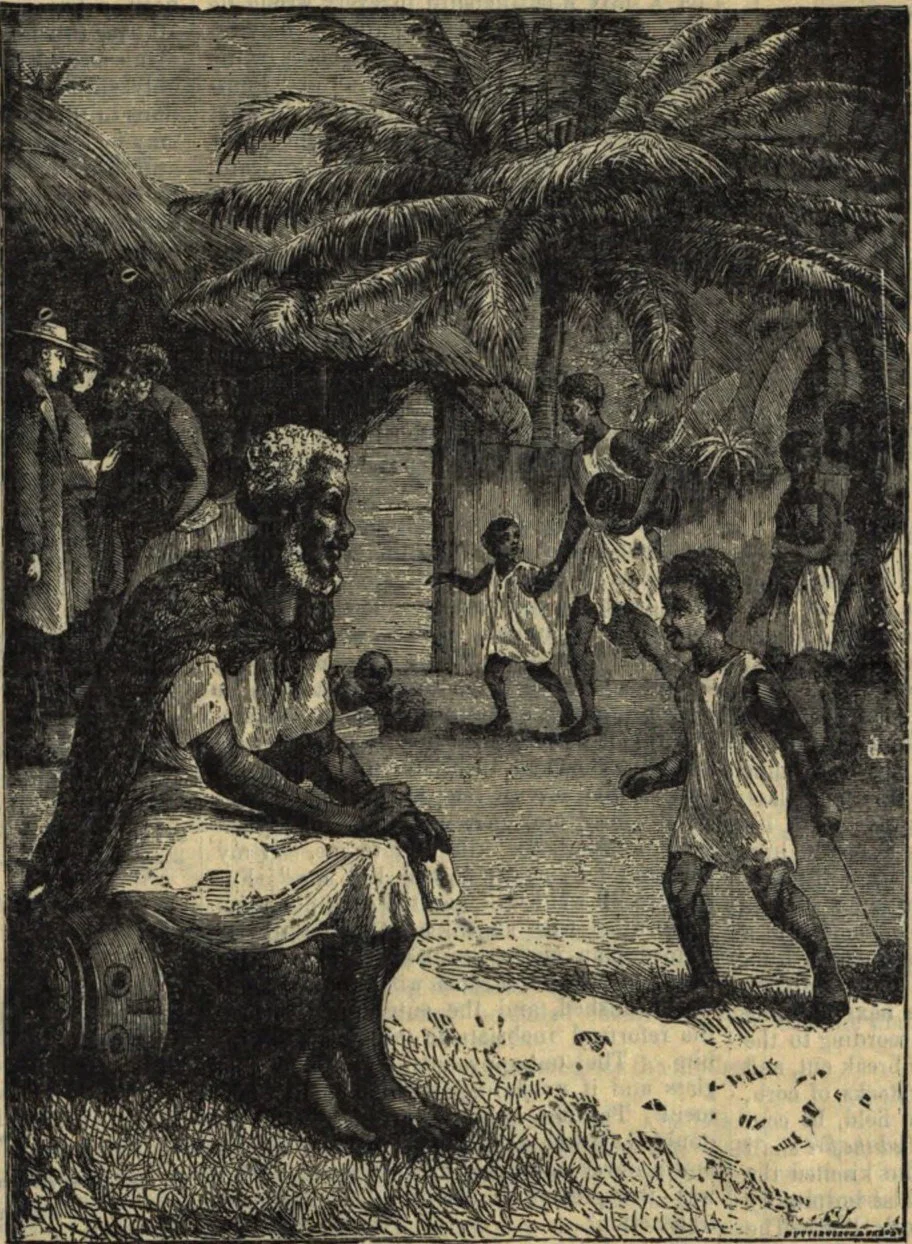
AN AFRICAN HOME.
According to a census of Great Britain, lately published, the population of her African colonies and dependencies is 4,035,669, while that of her protectorates, or spheres of influence, is 25,504,374, making a total of 29,540,043. In Central Africa 4,000,000 square miles of territory are at present unoccupied by civilized people. The main obstacle to European commerce along the Nile is the influence of the Mahdi, but that must soon succumb to superior and civilized authorities. In less than three years telegraphic communication will doubtless be established between Cape Town and Cairo. The wire has already reached Blantyre, in the Shire Highlands, and soon we shall hear of it at Uganda, then on, by the way of Lakes Tanganyika and Victoria Nyanza, to the Nile. Railroads follow telegraphs, and it is not chimerical to predict that some now living will see the day when a railway ticket can be purchased at Cape Town for Alexandria.
Note the rapid development of Southeastern Africa. Dr. Livingstone, when laboring to suppress the slave traffic in Nyassaland about thirty years ago, marked the richness of the soil, products, climate, etc., and pronounced it a fine country for white people. Now there are to be seen in that district large coffee plantations, owned chiefly by Scotchmen, who leave no stone unturned in improving the country. The pluck with which they meet difficulties in transporting their crops to the seaport reflects on them great credit. From Chuide, the best landing place at one of the mouths of the Zambesi, six paddle steamers ascend that river, and into the Shire as far as Katunga, a distance of 150 miles, carrying supplies from Europe, and returning with coffee, groundnuts, India-rubber, cotton, and other products. How different it was when Mrs. Livingstone went out to meet her husband, and was delayed on the Zambesi till seized by malarial fever! A stagecoach line between Blantyre and Katunga is said to be on the tapis. If that region becomes, as is predicted, the “coffee-growing country of the world,” railroads will connect it with the sea, and less than one day will be required to reach Chuide.
Nyassaland has an exceptionally able and energetic magistrate in the person of H. H. Johnson, who has effectually stopped Arab slave raiding, and rules the natives efficiently and humanely. He recognizes in Africans the elements of manhood, and is more optimistic than most British officials in reference to their development. The following is one of his utterances: “In the course of two or three centuries, the negroes of British Africa will differ from their white fellow-subjects only in the color of their skins. . . . We can give them the benefit of our inherited improvements, experience, and experiments in religion, morality, political economy, party government, and brotherly love.” He does not believe, as some do, that a native educated and Christianized is “a native spoiled.” The training school at Blantyre, after the model of Lovedale in Kaffraria, has 300 pupils, some of whom are as good printers as trained Europeans of that occupation. The results of patient missionary instruction are clearly manifest. Livingstonia is another popular institution, for the support of which friends in Scotland have given $450,000.
Look for a moment at the Kongo Free State. Four years ago there was no trade there, except that carried on by Arabs, who despatched gangs of slaves with ivory on their heads, some to Matadi and Boma, on the Kongo, others to Zanzibar. Now we are told that “thirty steamers ply the waters of the Kongo, and innumerable steam launches cleave the waters of the great lakes. There are at present over 1,000 official administrators of the laws of civilization, when three years ago there was but one white man.”
Sierra Leon has an area of 25,000 square miles, with a population of 100,000. The British claim in that district 1,120 square miles, the population of which is estimated at 60,546. Notice the colony of the Cape of Good Hope. Its imports for 1893 amounted to $57,695,000, while its exports were valued at $65,780,000. The custom receipts of Natal for 1893 were valued at $903,540. The revenue for the Transvaal—the “Golden state of South Africa”—for 1893 had an increase of $6,013,380. Its expenditure was $6,510,270, with a balance in its treasury Dec. 31, 1893, of $2,427,250. The increase on customs over 1892 was more than a quarter of a million of pounds sterling.
Would that I could note a decrease in the African liquor trade. Not so much rum goes from this country as in former years, but we read that in the year ending June 30, 1893, 561,365 gallons were exported, valued at the customhouse at $679,357; but who can estimate the mischief it caused to the poor Africans? At the Berlin Conference of 1885, America, England, France, and Italy were in favor of keeping it out of Central Africa, but Germany, Holland, and Portugal overruled those nations, contending that the Kongo basin was consecrated to “free trade.”—New York Observer.
Stundist Movement in Russia and Missions in New Guinea
THE London Christian says: “Those who have read history will be prepared for the statement that the Stundist movement is spreading in Russia. This is the inevitable outcome of religious persecution. All will hope that the influence of increased numbers will lead to toleration being extended to our brethren on the part of the civil and ecclesiastical authorities. So far there is no indication of13this, but news has been received of fresh administrative measures to combat Stundist dissent from Greek Church orthodoxy. Let us pray for our brethren in Russia, that, until full liberty of conscience is afforded them, they may have grace to suffer in the name of Jesus.”
Of the Missionary Society’s effort in New Guinea, inaugurated in 1871, Rev. Edward Morrow, of Brighton, England, says: “Christianity had so triumphed in many islands and converts had proved themselves such reliable pastors and evangelists, that two experienced missionaries and a number of native volunteers were appointed to begin a new mission, or rather a series of missions, on the southeast coast of New Guinea, the largest island in the world with the exception of Australia. The climate is unhealthy and the people are degraded and treacherous, and a large number of the Polynesian evangelists have been invalided, died of disease, or been slain, but volunteers have been found to occupy even positions of peril, and now 111 native agents, with 7 European missionaries, are spreading light and truth from many stations and with marked success.”
Many readers of the SIGNS will remember the story of the journey (alone) of Miss Annie Taylor through Thibet, some two years ago, extending even to the capital. On her return a mission was organized, consisting of over a dozen men and women, which was to make Darjeeling, on the Indian frontier, the center of a movement toward Thibet, as soon as the way should be open. Of the outcome the May issue of the Missionary Review says: “We greatly regret to learn that the mission has been entirely broken up, the members having become dissatisfied with the leadership of Miss Taylor. The qualifications necessary for leadership in a foreign mission composed of many persons, are possessed by few, and the outcome of this Taylor Mission is not surprising, in view of what human nature is. Experience has shown that, in the long run, missions can be conducted better by the whole body of laborers, the majority ruling, rather than by personal leadership.”
"HOLD UP YOUR LIGHT."
By Rosa A. Young
BY ROSA A. YOUNG.
Hold up your light; be not ashamed
Your Master's cause to own;
'Tis thus you best can glorify
The goodness he has shown.
Hold up your light; it may not seem
To blaze with luster rare,
Yet if it burn with steady glow
Some heart will feel its power.
Hold up your light; so shall its beams
Shed radiance on the road,
Guiding some wanderer who has strayed
From happiness and God.
Hold up your light; your duty is
To let your light so shine
That men by your good works may see
The Spirit's power divine.
If thus your light is daily held,
Its brightness will be shed,
O'er some dark pathway, and will fall
In blessing on your head.