The American Sentinel, Vol. 9, No. 46.

Adventist Jailed for Sunday Hoeing in Maryland
Earlier text: Adventist Jailed for Sunday Hoeing in Maryland

“The Hebrew Republic.”

WE publish in this issue under “Significant Paragraphs” a quotation from a New Jersey editor who professes to speak for the People’s Party. His views of the mission of the People’s Party will delight National Reformers, who are working so earnestly and successfully for the establishment of a theocracy in America, modeled after the theocracy of Israel. He regards the People’s Party as the agent in the creation of the government represented by the stone cut out of the mountain without hands, of Dan. 2:47. The “Ancient of Days,” referred to in Dan. 7:13, is also interpreted to refer to a representative form of government such as the People’s Party are to make out of the American Republic. Here is his argument:—
The name [Ancient of Days] alludes to the fact that it is to be a government modeled after the Hebrew republic in which the masses chose their rulers, and Moses instructed them to “choose men who fear God and hate covetousness.”
Now there are about as many errors in the above statement as are to be found in the average National Reform Association utterance of the same length. The following are some of the mistakes:
1. The “Ancient of Days” does not refer to a form of government, but to God, the Father, who delivers to the “Son of man” a kingdom. Dan. 7:9, 10, 13, 14. Rev. 11:15. Luke 1:31-35.
2. There never was such a thing as a “Hebrew republic.” The government of Israel was a theocracy. I Sam. 8:6, 7, also 10:19. Moses was chosen of God. Ex. 3:16.
3. The “masses” did not choose their rulers in the theocracy of Israel. Ex. 18:25, 26.
4. Moses did not instruct them to choose rulers. Ex. 18:17, 21, 22.
5. Moses himself chose the seventy rulers. Ex. 18:25, 26.
6. The editor has misquoted the scripture he here misapplies.
7. The scripture is quoted as the words of Moses to the masses, when in fact they are (when properly quoted) the words of Jethro addressed to Moses. Ex. 18:17-23.
There are enough errors in this paragraph, and of a suitable kind, to recommend their author to a place among the vice-presidents of the National Reform Association.
Our excuse for noticing this matter is that the utterances of this professed spokesman of the People’s Party are exactly in harmony with the views of that combination of churches, masking under the title of Sabbath Associations, and National Reform Association, which is attempting to force upon men a day not the Sabbath, and which has worked, and is working, to deform the nation, and establish a man-made theocracy in the image of the papacy.

Decidedly Pertinent.

A PENNSYLVANIA judge, on a test case, has decided that Roman Catholic nuns in uniform may teach in the public schools, that the children may call them “sisters,” and call the visiting Roman Catholic priests “fathers,” but the Roman Catholic catechism may not be taught in the schools.
“ ‘One cold night, as an Arab sat in his tent, a camel gently thrust the flap of the tent aside, and looked in.
“ ‘I pray thee, master,’ he said, ‘let me but put my head within the tent, for it is cold without.’
“ ‘By all means, and welcome,’ said the Arab cheerfully; and the camel, moving forward, stretched his head into the tent.
“ ‘If I might but warm my neck, also,’ he said, presently.
“ ‘Put also your neck inside,’ said the Arab. Soon the camel, who had been turning his head from side to side, said again:—
“ ‘It will take but little more room if I place my fore legs within the tent. It is difficult standing without.’
“ ‘You may also plant your fore legs within,’ said the Arab, moving a little to make room, for the tent was very small.
“ ‘May I not stand wholly within?’ asked the camel, finally. ‘I keep the tent open by standing as I do.’
“ ‘Yes, yes,’ said the Arab. ‘I will have pity on you as well as on myself. Come wholly inside.’
“So the camel came forward and crowded into the tent. But the tent was too small for both.
“ ‘I think,’ said the camel, ‘that there is not room for both of us here. It will be best for you to stand outside, as you are the smaller; there will then be room enough for me.’
“ ‘And with that he pushed the Arab a little, who made haste to get outside of the tent.’”—The Red Man, Carlisle, Pa.

Disciples Depart From Protestant Principles.

ONE of the most striking examples of the fall of American Protestantism from the principles of complete separation of Church and State is to be found in the Christian or Disciple Church. Alexander Campbell, the founder of that church, as early as 1820, combated certain “moral societies” of Western Pennsylvania,—the ancestors of the National Reform Association,—whose principal object was the enforcement of Sunday laws, in the following forcible style:—
There is no precept or command in the New Testament to compel by civil law, any man who is not a Christian to pay any regard to the Lord’s day, any more than any other day.
Therefore to compel a man who is not a Christian to pay any regard to the Lord’s day, more than any other day, is without authority of the Christian religion.
The gospel commands no duty which can be performed without faith in the Son of God. “Whatsoever is not of faith is sin.”
But to compel men destitute of faith to observe any Christian institution, such as the Lord’s day, is commanding duty to be performed without faith in God.
Therefore, to command unbelievers, or natural men, to observe in any sense the Lord’s day, is anti-evangelical or contrary to the gospel.
Speaking of his motive in opposing these compulsory Sunday observance societies, he said:—
I wrote from principle; I had no object in view but one; viz., the suppression of an anti-rational, anti-scriptural, anti-constitutional confederation, that I conscientiously believe to be dangerous to the community and inimical to civil and religious liberty. And while I am able to wield a pen, I will oppose everything of the kind, from the same principles, that comes within the immediate sphere of my observation.
When the movement was inaugurated, by which the churches compelled Congress to enact a law closing the World’s Fair on Sunday, the denomination of Alexander Campbell repudiated the principles of its founder, and joined in the movement. A small minority vigorously protested, calling attention to the principles so persistently advocated by Mr. Campbell. These arguments were declared by Dr. D. R. Dungan, a leading light of the denomination, to be “streaked with insanity,” and one of the organs of the denomination characterized those who maintained these views as “evangelical preachers out of color.”
The following from the pen of one of the dissenting minority, Dr. J. L. Parsons, pastor of the First Christian Church of St. Louis, published in the Christian Oracle of Chicago, July 13, 1893, is worthy a place by the side of the noble utterances of Mr. Campbell:—
I am opposed to Sunday legislation. It is contrary to our Constitution and to the New Testament. On the same principles I am opposed to the American Sabbath Association (Union). It is itself anti-American and anti-evangelical. It is the same thing in principle that Mr. Campbell opposed in the moral societies of Washington County, Pennsylvania, seventy-five years ago. I stand by the principles of this great man on this question. In respect to seeking the aid of the State in maintaining its pet notions and institutions, Protestants are scarcely a whit better than Catholics. In seeking the aid of the national legislature to prevent worldly men from “desecrating the Sabbath,” Protestants are doing the same thing they condemn in Catholics. Both Protestants and Catholics are wrong in this regard, and if either party succeeds, it will bring ruin to both our civil and religious liberties. May God defeat them both. Let us fight out the question of religion and of observing holy days, and especially the Sunday question, with the “sword of the Spirit, which is the Word of God,” and not with the sword of Cæsar.
Another Christian minister, Dr. James A. De Moss, writing in the Christian Standard, of Aug. 12, 1893, offers the following courageous protest against the part his denomination took in securing the law closing the World’s Fair on Sunday:

What have we done?

Our plea for apostolic Christianity, our plea for Christian union, our work and labors throughout the whole restorative movement for Christianity pure and unalloyed, our fights upon all things that bear the marks of Romanism, are marred by our action in the Sunday question that has been under agitation, and will be agitated for a few years yet to be.
It seems now that we list to the misapplied Sabbath-day,—misapplied by the “infallible pope,” and received as righteousness by the sectarian world. We excuse this action by differential statement, designating it the “civil Sabbath.”
What has constructed or made a “civil Sabbath”?—Law. Who makes law?—Man. Who made the Sabbath?—God. For whom did he make it?—For man. Can man make it for himself?—No. Then we bow before the force which takes the affairs of God into its own hands. Who is “above all that is called God”?—The papacy. To whom and to what do we bow in this question of the “civil Sabbath”?—To the pope and to Romanism.
There can be no doubt that this legislation upon the Sunday (Sabbath) question is a “mark of the beast.” As a people who have vied in the creation and enforcement of this “Sabbath law,” we have received upon our foreheads and upon our hands the “mark of the beast.” We have not too much evidence that the first day of the week is the Lord’s day; while we have conclusive evidence that the first day of the week is not the Sabbath day.
If, as we infer, the first day be the Lord’s day, then what authority have we to enforce the Lord’s day upon the world, or expect its recognition by legal force? Or by what authority do we assume to exact from other brethren by legal force the rights of honest, conscientious worship on the only day embodied in the divine law? Church and State should not be combined. Our glorious brotherhood must not assist in combining them.
If we engraft (it has been engrafted) in law the first day “Sabbath,” then, indeed, as all law, it must be enforced. Besides injustice to very good and honorable people, we should know we have no right to enforce God’s law upon the people that dwell in the earth, presuming it to be the Sabbath day, which we all know quite well it is not. As well might we exact a law to compel all men to be baptized, or fix in law what may constitute a Christian, or by law create Christians.
A person out of Christ is no better by respecting, or being compelled to respect, a day of worship; for he is not spiritually or otherwise in the realm of worship, and therefore beyond the reach (jurisdiction) of God and the Church; still this carnal law, when enforced (and enforced it will be sooner or later), has gotten higher than God.
What now is “higher than all that is called God”?—Why, it is papal authority, unmistakable and certain. And the “saddest of all sad things” is that the Church of Christ has stultified itself in its actions in this matter, and taken one step backward toward Romanism.
We have brethren who thoroughly understand this question, and this line of prophecy now under fulfillment, and know well these are facts we must confront.
For shame! May not the general convention further compromise our position upon these questions, by indorsing our national legislation upon the subject, or giving support by resolution or otherwise to a “national Sabbath”—the beginning of the union of Church and State in America.

How Roman Catholics Treat Converts From the Church of England.

THE following letter from the Rev. A. Lambert, formerly a priest of the Roman Catholic Church, and now engaged in what is called the Pauline Mission, of this city, is of important interest, not merely as a confirmation of Cardinal Vaughan’s statement, that no true Catholic recognizes the validity of the orders of the Church of England, but because of the names quoted:—
60 W. 106 St., New York City Oct. 4, 1894.
Editor Christian Advocate: I have read your article, “The Measure They Mete Measured Unto Them,” in The Christian Advocate of to-day. I am at a loss to understand how Episcopalian ministers can be so little posted in modern Church history as to believe that Rome recognizes the validity of Anglican orders. To quote but a few names—Newman, Manning, Oakeley, Faber, Garside, Bonus, Marshall; Bowden, St. John, Hutton, Oratorians; Spencer, a Passionist; Anderdon, a Jesuit; Lockhart, a Rosminian Father. Coffin, Bridget, Hall, Urquhart, Redemptorists; Baker a Paulist; Preston, the vicar general of Cardinal McCloskey—who were once Episcopalian ministers, were not only reordained, but nearly all, if not all, rebaptized, when they joined the church of Rome. They received “first tonsure,” and went through the whole line of Romanist orders—porter, exorcist, lector, acolythe, subdeacon, deacon—before being ordained priests of the church of Rome.
Yours fraternally in the Master,
A. LAMBERT.
This process of Romanizing goes on constantly in the city of New York.—Christian Advocate.

Significant Paragraphs.

[We publish under this heading paragraphs more or less significant, without either approval or dissent, and without comment. The careful observer of the signs of the times will readily discern the pertinent facts and opinions, and will know how to turn them to account in the great controversy between truth and error.]

“Higher Criticism” Leads to Rome.

NOTHING is nearer my heart than Christian unity. Not only is the present pope earnestly looking forward to the time when Christian unity may come, but we see in the utterances of cardinals, archbishops, and bishops that the unity of Christendom is weighing on their hearts. There is nothing in the New Testament that prevents all of us from coming together. For some years I have agreed with the authorities of the Catholic Church to a certain extent in the interpretation that they place upon the words, “Upon this rock will I build my church.” Peter was the first Christian to be put in place after Christ. Others follow after. Many of the terms in the Testament are really synonymous. They all teach Christian unity.—Dr. Briggs, quoted in Presbyterian Observer, in an address on Christian Unity.

National Reformism and the People’s Party.

THE prophet Daniel, standing on the mountain peak of prophecy, saw the great empires of earth (Dan. 2) come up and go down in succession, until a form of government came on the stage that was to “stand forever.” In this second chapter the permanent government is called the little stone cut out of the mountain without hands. In the seventh chapter the prophet had a view of the same governments of earth rising and falling in succession, until a permanent one came on the stage which is called the “Ancient of Days.” This name alludes to the fact that it is to be a government modeled after the Hebrew republic in which the masses chose their rulers, and Moses instructed them to “choose men who fear God and hate covetousness.” This “Ancient of Days,” the prophet tells us to be a government in which the “people of the saints of the Most High should take the kingdom (government), and possess it forever and ever.”
We are now witnessing in this closing decade of the nineteenth century what the prophet saw ages ago. The people are moving everywhere in the civilized world, to take the governments. The principles of the Omaha platform are in perfect harmony with the ten commandments and the sermon on the mount, while it is equally true that no man can vote for either of the old parties without thereby voting to sustain mammon worship.
Therefore, my fellow-countrymen, the lines are drawn, the issue is before you. You cannot dodge it. Whom will you serve, God or mammon? The time is here when the God of heaven is going to set up a kingdom (Dan. 2:41) that shall never be destroyed. Will you aid in this heaven-ordained work?
We are living in the most interesting period of the world’s history.
This conflict between the true worship of God and some form of idolatry has raged through all the ages.
Mammon worship is the last form of idolatry. It is the most refined, the most subtle, and most world-wide, and withal, the most powerful form that ever existed. But its end is near. It will die hard, but it must die. Reader, don’t you want to have a hand in killing it? It is the greatest of all curses, the most blighting enemy of the human race. The sooner it dies the better. The People’s Party is its only enemy, and it is the duty of every voter to vote for humanity and God.—Vineland (N. J.) Independent, Nov. 9.

Drifting Romeward.

THE Cardinal Archbishop of Westminster, Cardinal Vaughan, has been speaking upon the reunion of Christendom, and is heartily in favor of it. The method which he proposes is simple and perspicacious: let every one come into the Roman Church; and there you are. As an argument toward this consummation, he urges that the divine origin of the Roman Church is certified by the unity into which it brings “men sharply divided by policies, national rivalries and aspirations.” He compares this unity with the lack of unity in the Anglican Church. There are, he says, two bases of reunion. First, compromise, or mutual recognition. This is inconsistent with the divine constitution of the church. There remains only, second, submission,—that is, individual or corporate absorption. “Our hopes of a gradual submission by an ever-increasing number of Anglicans rest on evident facts,” among which are the following: “The growing appreciation of Catholic doctrines and devout practices. The doctrines of the Catholic Church have been re-examined and taken back, one by one, until the Thirty-nine Articles have been banished and buried as a rule of faith. The real presence, the sacrifice of the mass, offered for the living and the dead, sometimes even in Latin—not unfrequent reservation of the sacrament, regular auricular confession, extreme unction, purgatory, prayers for the dead, devotions to our lady, to her immaculate conception, the use of her rosary, and the invocation of saints, are doctrines taught and accepted, I am told, with a growing desire and relish for them, in the Church of England. A celibate clergy, the institution of monks and nuns under vows, retreats for the clergy, missions for the people, fasting, and other penitential exercises—candles, lamps, incense, crucifixes, images of the blessed virgin and the saints held in honor, stations of the cross, cassocks, cottas, Roman collars, birettas, copes, dalmatics, vestments, miters, croziers, the adoption of an ornate Catholic ritual, and recently an elaborate display of the whole ceremonial of the Catholic pontifical,—all this speaks of a change and a movement toward the church that would have appeared absolutely incredible at the beginning of this century.”—H. L. W., in the Baptist Examiner, Nov. 15.

Rome Unchanged.

HAS Rome changed? Has she become the friend and advocate of religious freedom? In two of the leading countries of Europe she has lately answered this question. In Hungary, after opposing with all her strength the Civil Marriage bill, which narrowly escaped extinction at her hands, she fought against and defeated the Religious Liberty bill,—a mild measure which granted to all denominations freedom in the practice of religious rites. In Spain the consecration of a Protestant bishop of Madrid has called forth protests and denunciations from the papal primate of Toledo, and also from the papal nuncio, and the whole country is excited. All the Spanish bishops, it is said, have uttered their minds, declaring the act to be “an outrage on the traditional rights of the Spanish Church,” and also “a violation of Art. XII. of the Constitution.” Meanwhile the head of the church, Leo XIII., from his seat of power and authority looks quietly on without a word of protest, or a syllable spoken in favor of that religious freedom of which the Catholic Church is alleged to be the friend and defender.
No; religious freedom for Protestants is still an “outrage” upon Catholic “rights,” and a “violation of the supreme law of the land.” Consequently it is in order for the civil authorities in Spain to take the offenders in hand and deal with them as the law prescribes, or as it may be construed by a Catholic judge or jury. The only reason why this will (probably) not be done, is that enlightened public sentiment, both in that country and elsewhere throughout Europe, lays a restraining hand upon such extreme exhibitions of religious bigotry.
Notice, also, that since this “outrageous” act is punishable as a violation of the civil law, such punishment cannot, according to the logic of some who call themselves Protestants, be considered religious persecution, and as conviction and punishment for violations of the civil law was what sent Christians of the Dark Ages to the dungeon, the rack, and the stake, it follows from the same logic that Rome never really persecuted anybody, and that the millions of “martyrs” of that period were not martyrs, but only criminals. This is exactly what Rome claims. In this, as in other respects, she is the same to-day that she was then.—Present Truth, London, England, October 25.

A CRITICAL HARMONY of the GOSPELS.

BY JAMES P CADMAN, A M,
_One of the best helps to Bible Study ever published._
THIS BOOK gives, in the words of the Evangelists themselves, the gospel narrative, giving every word from each of the four Gospels, and indicating by the figures 1, 2, 3, 4, representing Matthew, Mark, Luke, and John, which of the four, or if more than one, how many of them use the words given, so that the reader has under his eye all the words of the Evangelists on any given subject, without turning from gospel to gospel to find them, and this in a connected narrative. The text used is that of the Revised Version, making the book specially valuable for use in connection with the King James’ Version.
Long primer type, 380 pages, well bound in cloth, price, . . . . . . . . . . . . . $1.50.
—ADDRESS—
PACIFIC PRESS,
43 Bond St., New York City.

THE SIGNS OF THE TIMES,

A SIXTEEN-PAGE
Weekly Religious Journal.
Doctrinal, Practical, Earnest,
Protestant, Scriptural, Christian.
This really two dollar paper will be furnished at the following
PRICES OF SUBSCRIPTION:
Single Copy, One Year, Post-paid, $1.50
Single Copy, Six Months, Post-paid, .75
In Clubs of Ten or More to One Address, Post-paid, 1.25
To Foreign Countries in Postal Union, Post-paid, ($2) 8s.
Address, Signs of the Times.
12TH AND CASTRO STREETS, OAKLAND, CAL., U. S. A.

OUR PRISON LIGHT

Edited by one sending the Third Angel's Message to the perishing in prisons all over the land. Agents wanted, 50 per cent. commission. Trial year 20 cents. Terms and sample copy 2 cent stamp. Indorsed by the SENTINEL.
PRISON LIGHT, 40 Green Street, Brattleboro, Vt.

The Graphic Atlas —AND— Gazetteer of the World.

With over 220 Maps, Charts, Plans of Cities, etc.,
All revised to the present date.
—ALSO—
GAZETTEER with nearly 55,000 PLACES and RESULTS of NEW CENSUS.
By J. G. Bartholomew, F.R.G.S., F.R.S.E.
Quarto (size, 10⅜ x 8½ inches), half morocco, gilt top.
PUBLISHER'S PRICE, $7.50
OUR PRICE, Post-paid, $3.75
Throughout the Atlas the countries of the world have been treated with fullness in proportion to their commercial importance and interest.
In the United States section a separate Map is given of each of the States and Territories.
The Canadian Provinces are treated in similar detail.
These Maps have been specially compiled from the latest and best Government Survey Maps, and have undergone local revision for the verification of New Counties, Townships and Railways.
Among the special features are Maps of the Hudson and Rhine Rivers, the Yosemite Valley, United States Railways, British Isles Railways, mean Annual Temperature, mean Annual Rainfall, also Maps showing environs of New York, Chicago, Philadelphia, Boston, San Francisco, New Orleans, Montreal, Quebec, Toronto, Ottawa, Rio Janeiro, London, Liverpool, Manchester, Seville, Paris, Vienna, Rome, Constantinople, Cape Town, Jerusalem, etc., etc.
The GAZETTEER of the WORLD is a valuable feature for such a book of reference. It contains entries for about 55,000 places, is compiled from the latest authorities, and is specially complete in American names.
The results of the New Census have been incorporated.
For compactness and portability this volume is, in proportion to its ample contents, quite unique among Atlases.

—ADDRESS—

PACIFIC PRESS, 43 Bond Street, New York City.

“Before He Is Twenty,” —OR— “Five Perplexing Phases of the Boy Question.”

IS A VERY HELPFUL BOOK FOR PARENTS.
It is divided into five chapters, by as many different writers, each treating of a particular phase of a boy’s life.
The first chapter, “THE BOY AND HIS FATHER,” by Robert J. Burdette, is alone worth many times the price of the book to any father of a young boy.
The other chapters, “WHEN HE DECIDES,” “THE BOY IN THE OFFICE,” “HIS EVENINGS AND AMUSEMENTS,” and “LOOKING TOWARD A WIFE,” are all important and helpful.
104 pages, bound in cloth, embossed in jet and gold, price, 75 cents.
PACIFIC PRESS, 43 BOND STREET, New York City.

BIBLES

I. B. L. E. S.
I. B. L. E. S.
A LARGE AND VARIED STOCK.
Send for Catalogue to PACIFIC PRESS, 43 BOND STREET, NEW YORK CITY. Kansas City. Mo. Oakland, Cal.

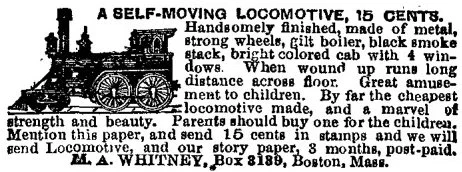
A SELF-MOVING LOCOMOTIVE, 15 CENTS.

A SELF-MOVING LOCOMOTIVE. 15 CENTS.
Handsomely finished, made of metal, strong wheels, gilt boiler, black smoke stack, bright colored cab with 4 windows. When wound up runs long distance across floor. Great amusement to children. By far the cheapest locomotive made, and a marvel of strength and beauty. Parents should buy one for the children. Mention this paper, and send 15 cents in stamps and we will send Locomotive, and our story paper, 3 months, post-paid. M. A. WHITNEY, Box 3189, Boston, Mass.

Catholic Mirror Challenges Sunday-Keeping Protestants on Scripture

THE Catholic Mirror, of Oct. 27, announces the fifth edition of its work, “The Christian Sabbath,” which is a challenge to Sunday-keeping Protestants to show scriptural authority for Sunday observance. The circulation of this pamphlet has reached half a million copies, and no Sunday-keeping Protestant has dared to attempt a reply.
“THE Catholic Church has been made to appear in a false light to those not of her communion,” says Cardinal Gibbons. Nothing could be more true; and nobody has contributed more to this result than has the cardinal himself. The mask should be once more torn aside, even as it was in Luther’s days, and Rome be made to stand forth in her true character. “Rome never changes.”
A CORRESPONDENT of the Gazette of Kankakee, Ill., writing to that paper from Canada, says of Toronto:—
The praises of Toronto have been long and grandly sung, but I will add my quota that it is the cleanest city in America. . . . Noticeable to the stranger are its narrowly-blocked streets, its dense shade trees, its buildings all of brick, its few saloons (though I saw more drunken men and women than I ever saw in the same length of time in Chicago); next, its many fine church buildings and the strained piety of Sabbaths. They seem to think if you but keep Sunday it will atone for any wrong of the week. No street cars on Sunday—which are the carriages of the poor man—but the liveried turnouts of the rich remind one of Chicago boulevards on a Sunday afternoon, and they think Chicago next door to hades.
Law can cause the mass of the people to cease work on Sunday, but it cannot make them regard the day as holy, nor can it make men moral.
ANOTHER evidence that religious persecution is “without natural affection” is to be found in the treatment of Mrs. Whaley, the wife of Robert R. Whaley who is now serving a sentence of ninety days in jail for doing common labor on Sunday. Mrs. Whaley is a dressmaker, and devotes the time not occupied in the care of her large family, to this occupation by which she was able to materially aid her husband in supporting the family. But when she began the observance of the seventh-day Sabbath, she became the victim of what is in effect a church boycott. Not only has an influence been brought to bear to prevent her from obtaining work, but a lady member of the Methodist Church, for whom Mrs. Whaley had made a dress, perceiving an opportunity of escaping payment and at the same time punishing a hated heretic, tendered the amount of the debt ($5) on the seventh day. Mrs. Whaley explained to the woman, what she well knew, that she did not transact business on that day, and asked her to hand it to her later. And now this professed follower of Jesus refuses to pay the debt, alleging that her duty has been performed in tendering the money.
THE gospel of National Reform, the gospel of force, is being carried into the newly-opened portions of Africa by the missionaries that have followed closely upon the heels of the troops of the British South African Company, to which was committed the conquest of Matabeleland and Mashonaland. First, the so-called company, which is in fact the colonial government of that part of Africa, despoiled the natives of their territory by force and fraud, and then doled out grants of land to the missionaries as a speculative investment, the returns to be made in “influence” in civilizing the natives. How the missionaries who have thus sold themselves for a mess of African pottage will succeed in serving two masters, remains to be seen; though, in view of our Lord’s declaration that it cannot be done, the issue can scarcely be considered doubtful.
THE two articles in this paper, “Roman Catholicism and Spiritualism,” and “What Is Modern Spiritualism?” will be found to be of more than usual interest. It has long been understood by many that prophecy teaches that in the last great conflict between truth and error, Spiritualism and Roman Catholicism, like Herod and Pilate, would be “made friends” in fighting against the truth of God; but how these two systems were ever to be united in a common cause has not been clearly seen. Now, however, light is breaking in, and it is apparent that the gulf that separates them is neither as wide nor as deep as many have supposed; and that Rome, while opposing certain forms of Spiritualism all these years, is, and has been, a gigantic organization of Spiritualists. And it is now becoming apparent to both bodies that they hold enough in common to make the transfer from “séance” to saint worship, and vice versa, short and easy. By her saintology Rome inculcates Spiritualism, though under another name, and it is not strange that in turn the spirits testify that Rome is “the true religion.” Satan is not divided against himself.
JUDGE W. J. KERR made a speech recently in Denver, Colo., in the interests of Governor Waite and the Populist party, and at its close asked the audience to join him in singing the doxology. “A Populist office holder under Governor Waite,” says a secular paper, “advanced to the front of the platform and waved a stout walking stick as a baton. The audience rose, and the doxology was sung with all the fervor of a camp meeting assembly.”
Such facts are ominous. Religious fanaticism is bad enough at best, but it is doubly dangerous when mingled with intense political feeling. The only purpose that can be served by injecting such an element into politics is to transform the political citizen into a religious crusader, bearing a divine commission, as he supposes, to redress his wrongs by any means in his power.
W. G. CURLETT, another Seventh-day Adventist, whose case was called at the same time as Mr. Whaley’s, but was postponed on account of the absence of a witness for the prosecution, was tried Friday, November 9th, and convicted on the charge of doing bodily labor on the “Lord’s day.” The witnesses testified to having seen the defendant working in his potato patch on two Sundays—June 3rd and 10th. When asked whether he had anything to say, Mr. Curlett said in substance:—
I do not deny working on the first day of the week, but I do deny working on the Lord’s day; because the first day of the week is not the Lord’s day. The commandment of God says, “Six days shalt thou labor, but the seventh day is the Sabbath of the Lord,” and we must keep it. If any one can point to a single scripture, showing that Sunday is the Lord’s day and should be kept, I will confess being in error. I have lived in this county all my life excepting eighteen months, and was never before charged with wrong.
There has been offered $2,000 for the production of a scripture which shows that Sunday should be observed, and Cardinal Gibbons has said there was no authority in the Bible for keeping Sunday; and some of you, gentlemen (to the jury), probably know of this. The Lord has said, “We ought to obey God rather than man,” and he also said, “Ye cannot serve two masters.”
I do not work on Sunday to defy the laws, but because I must obey God when his law conflicts with man’s laws.
The jury returned a verdict of “guilty,” and the judge imposed a fine of five dollars and costs in each case, which amounted in all to about $30, and committed the defendant to jail until the amount is paid. This means an imprisonment of sixty days, after which, if Mr. Curlett has any property upon which the State can levy, it will be sold to satisfy the costs.
Mr. Curlett is about forty years old, and is a fisherman by occupation. He has a wife in delicate condition, and four children, dependent on his labor for support. It is hardly necessary to say that those who instigated these persecutions are members of a professedly Protestant church.

You have reached the end of this edition.

The American Sentinel · Nov 22, 1894