SOMEBODY'S grandmother has bequeathed to her descendants these admirable rules of conduct:—
Always look at the person to whom you speak. When you are addressed, look straight at the person who speaks to you. Do not forget this.
Speak your words plainly; do not mutter or mumble. If words are worth saying, they are worth pronouncing distinctly and clearly.
Do not say disagreeable things. If you have nothing pleasant to say, keep silent.
Think three times before you speak once.
Have you something to do that you find hard and would prefer not to do? Do the hard thing first, and get it over with. If you have done wrong, go and confess it. If your lesson is tough, master it. If the garden is to be weeded, weed it first, and play afterward. Do first the thing you don't like to do, and then, with a clear conscience, try the rest.—Presbyterian Record.
Growing Demands
By L. R. Conradi
L. R. CONRADI
As a people we have longed for the day when God's message would extend to the very ends of the earth; we have prayed for the time when not only the printed page, but also the living missionary would carry the glad tidings of the soon-coming Saviour to every nation and kindred and tongue and people. The Lord in his mercy has answered our prayers, and that day has dawned. Our missionaries are pushing forward into the very heart of Africa, and into Asia, and they are going to the isles of the sea: there is hardly a country in the Americas, Europe, or Australia that has not been entered.
However, as our work thus extends, its demands upon God's people are increasing. The nearer we approach the great day of God, the more will be multiplied the calls for men and for means. One of the greatest demands of the hour is well-trained missionaries, who can turn their hand to almost anything, and who, not only have a knowledge of the Bible and are able to preach the gospel, but who are also capable of helping the sick and the afflicted. The great value of thorough, consecrated medical missionaries is being continually demonstrated more and more in the mission field.
Now, in order to educate such missionaries, we must have not only the gospel school, where our youth may be instructed in the Word of God, in the grammatical structure of languages, in history and geography, and in the history of missions; we must also have schools where they can gain a good practical experience in actual nursing and caring for the sick. That a school may offer such advantages, it should be closely connected with a sanitarium, and, if possible, with a printing-office and other industrial branches.
As hundreds of missionaries are needed to-day, training centers of this sort must be created and equipped not simply in the United States, but in such other parts of the world as will supply the young people to fill them; as is to-day the case in Australasia, England, Germany, and Scandinavia. Naturally, such institutions must be in unison with the cause of God, and assume that attitude that makes them capable of receiving counsel and instruction from leading brethren who have been accustomed to work in the various mission fields. For this reason, God, in his providence, has established a school at Takoma Park, that our people might realize throughout the field that the time has come that such a school should also have associated with it a well-equipped sanitarium, offering sufficient medical instruction to the students. Further plans have now been set on foot to make this school a representative missionary training center for our people in the United States. While this has called for quite an outlay, yet we are happy that our brethren in the States are hard at work raising the necessary means on the $150,000 fund, that the school may be fully equipped.
Although the work in the United States plays an important part in the missionary work of the denomination, yet God has so blessed the cause in Australia, Germany, England, and Scandinavia that thousands here have embraced the truth, and they are coming to the front, just as the Testimonies said they should, supplying men and means for the work within their own borders, and also providing money and helpers to enter the surrounding mission fields. Our people labored hard to help establish the sanitarium in Australia, and to-day they are reaping the benefits by securing a number of workers for the isles of the Pacific.
The German Union also received some help from the sale of the German “Object Lessons” in America, for the Friedensau school; and now our membership is almost nine thousand, and our people are constantly gathering money to equip their institution in such a way as to enable it to meet the demands of those who are to go out as missionaries to the darker portions of the earth. Our young men and women are going forth from the Friedensau School to not only the hundreds of millions in the fields of the German Union proper, but to Africa, to Asia Minor, and to Palestine.
The British Union does not have so many members as yet (only about seventeen hundred), but still there is no other country in the world that exerts such a strong missionary influence as Great Britain. Naturally, as the work extends in that field, something must be done to give our young people there the very best education. Our brethren have done what they could, having a school in the crowded quarters of the city of London, where there may hardly be a bright ray of sunshine for days. Their medical work has been carried forward chiefly at Caterham, out in the country,—too small an institution to conduct a regular training-school in connection with the sanitarium work,—and so the British brethren have been looking for a suitable location to establish a school, and connect with it the printing-office and their medical work: thus they hoped to create a strong educational center for our work in this great nation, which rules four hundred millions of the world's population. They have raised two thousand dollars through the sale of “Christ Object Lessons,” and they have13decided to raise ten thousand dollars toward the school on this side of the water. God in his mercy has helped them to find a beautiful property, at Stanborough Park, Watford, about fifteen miles northwest of London. This is a very nice location, indeed; but of course property costs considerable in such a country; so that we have already paid forty-five thousand dollars for the place. We are now erecting a plant for the food factory and printing-office, at a cost of twenty-five thousand dollars more. Although the buildings already on the estate when we purchased it would afford room for a good-sized family, yet in order to provide for the school, which has about one hundred students, we must have suitable school buildings, costing not less than thirty thousand dollars.
Now, in view of the urgent demands of our brethren in Great Britain, they are exerting themselves to do what they can to raise their share for the school, but have also called upon our brethren in America to help them with another ten thousand dollars—which is to be a part of the $150,000 fund. So, let us not forget that while this money is really for buildings, yet it has a higher object in view—to educate our intelligent young people in Great Britain not alone for the English field, but also for the great “regions beyond,” in the African possessions of Great Britain, in India, etc. The fact is, already several of their workers have left Great Britain for the very heart of Africa, and others are expecting to follow.
Great Britain is not the only field that will be benefited, for two thousand dollars is also to go to the Skodsborg Sanitarium. While our people in Scandinavia were in a strait financially a few years ago, and somewhat discouraged, we are pleased to report that they have nobly rallied until that union conference has not only become self-supporting, but is now selecting several young men who are to prepare to open work for the Abyssinians. The union has decided to have a permanent union school, and the delegates at each of the recent Scandinavian meetings showed the deepest interest in securing the necessary means to provide suitable quarters for the young people who shall attend the school. Thus far, quite a number of our young brethren and sisters have been connected with the Skodsborg Sanitarium. The institution has struggled hard to get sufficient capital to enlarge. It had the largest patronage of any of our European institutions, the patrons being from the very best classes of society in Scandinavia, and yet we did not have one suitable building. We had to pay tremendous rents for cottages outside, here and there, making the work for the nurses very difficult; and even these cottages were fast being withdrawn from us, so the only alternative left was to erect a suitable building on our own grounds. In order to insure the future good of the institution, they had to secure some additional ground, so that the total recent outlay for the new buildings, the lot, the furniture, and the equipment for the laundry aggregates about fifty thousand dollars. Heretofore, we had no laundry at all. Now, as the Skodsborg Sanitarium is straining every nerve to raise the necessary means for the institution, and as a few years ago the American delegates to Europe promised the Skodsborg Sanitarium two thousand dollars provided Denmark would raise the same amount (which the Danish brethren have long ago accomplished, and they still continue to raise more), and as the buildings have been erected, it is but natural that they should desire this promise to be remembered by the friends in the States, as they are anxious to receive all the help they can to lighten their financial burden.
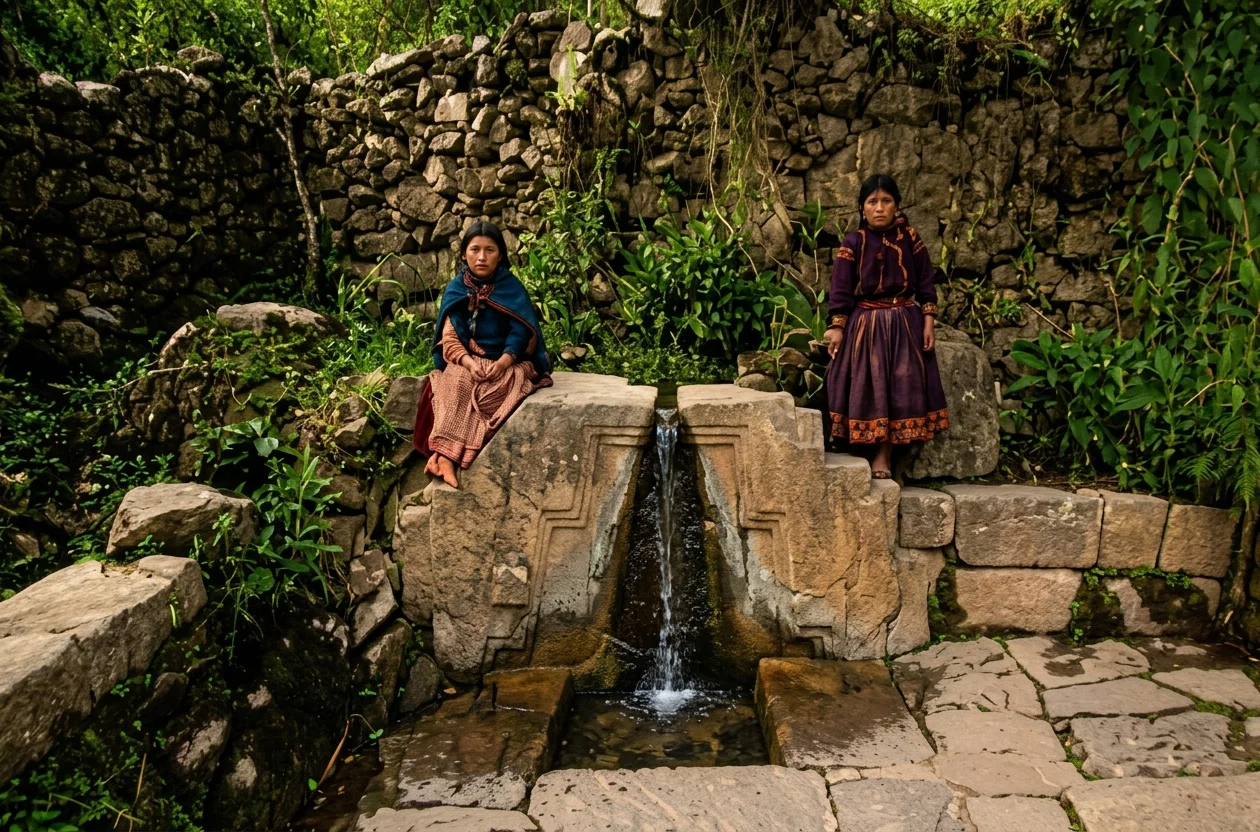
BATHING PLACE OF THE DAUGHTERS OF AN INCA MONARCH
One of the young men who has been trained at Skodsborg Sanitarium is going to Abyssinia. When I had a meeting with the nurses a few days since, there were three others who offered themselves for service in the hard Abyssinian field. Thus we can see the importance of this place as a training-center for workers. While some may to-day question whether we should put so much money into our institutions in brick and mortar, let us not forget to look a little into the future, and realize what these buildings stand for—that their main object is to provide suitable places where hundreds of our youth may be properly trained to go to the “regions beyond,” carrying the blessed gospel, thus being the means in God's hand of helping to finish the great, living temple, composed of “lively stones.”
As God is blessing our people in the States with prosperity and with means, and as they hear of the progress that he is granting to his work in all parts of the world, we sincerely hope they may be encouraged to liberally invest in these enterprises for hurrying forward the preparation of laborers, and laying up a treasure in the heavens which shall not perish, but bring dividends unequaled by any earthly enterprise—dividends that are eternal.
Canning Sweet Corn
By MRS. KATIE B. MADDEN
MRS. KATIE B. MADDEN
Have your glass or tin cans thoroughly scalded and cleaned.
Fill them with raw corn cut from the cob, and press into can with spoon or other utensil (not by hand) until completely full. The fresher the corn, the better it will be.
Screw down the cover loosely with thumb and finger, that the air may be permitted to escape while the corn is cooking.
Provide a boiler with false bottom, which may be done by using the grate from the oven, or some pieces of wood. This will remove the glass from the direct heat of the fire.
Set the cans of corn in the boiler on the false bottom, and fill the boiler with cold water to neck of jar. Place on stove, and boil from two to four hours, keeping the boiling water up to neck of jar. Boil one-half-gallon jars four hours, one-quart jars three hours, and one-pint glass jars two hours.
Remove from stove, and as soon as jars can be handled, tighten down covers, and place to cool. Keep in a cool, dark place, the same as other canned goods.
In using tin cans, solder the little lid on, leaving open the little punch hole while corn is boiling. After removing from the boiler, solder the small hole. High temperature is essential; therefore keep the lid on the boiler while cooking.
Self-Lifting Not Yet Possible
No man can get higher than himself by depending upon himself alone. And the man has not yet lived who is, or who ever could be in this world, satisfied with himself at his best. Yet some still preach the gospel of “ethical culture,” and urge that we offer to the “other half,” in city and neighborhood settlement work, the opportunity simply to do their best, helping them to be clean and thrifty, but rigorously keeping from them any suggestion of religion or of a Christ who is a Saviour. Such effort is like attempting to lift ourselves by our boot straps. The art of self-lifting has not yet been discovered. Men want some one who will lift them out of themselves. Christ is the only One who enables men to do better than their best.—Sunday School Times.
The Third Angel’s Message in the Land of the Incas
By J. W. Westphal
J. W. WESTPHAL
As one travels along the coast of Peru, he is impressed with its mountainous surface devoid of vegetation. Its mountains extend to the coast; and only in a narrow valley here and there, capable of irrigation by some small stream, does one see any sign of vegetable life. At Lima there is a rich valley producing abundantly for local need. During the winter months it is generally cloudy and cool. The rain is only a heavy mist. During my recent visit the thermometer registered forty-three degrees above zero, which is said to have been the lowest for many years.
Elder Perry came to Iquique, Chile, to meet me, where, with Elder Balada, we spent several days with the church. As the brethren are nearly all in the pampas, working in connection with the nitrate mines, but few were present. Elder Balada remained to make a public effort in the city, and one or two were expected to come in from the mines to be baptized. At Pisagua, a short distance to the north, we found one brother faithfully witnessing for the truth, and there are some others who believe the truth, and who gave us a hearty welcome. It was not advisable to hold public meetings during the few days of our stay, on account of an epidemic of the bubonic plague. The little child of one of the believers was taken to the lazaretto while we were there.
The first port in Peru from the south is Hilo, a small village fronting on the sea, surrounded with barren rocks and sand. One wonders why the people should ever locate in such a place. Several miles away is a valley where olives are raised, and from which the oil is exported. In this village a lone Peruvian brother has been observing the Sabbath for five years, and for some time has been calling for some one to come to baptize him. He was at work several leagues away. On sending him word, he lost no time in coming in, and a happy man he was. He had seen only two Adventists before, the last one three or more years ago. Several of his family and a lady are interested in the truth. We enjoyed our short stay with them, and left them greatly encouraged.
As steamers at Hilo are not frequent, and in order to gain time, we secured a rowboat to take us to Mollendo, the next port, a distance of fifty-four miles, a ride of twenty-five hours. However unpleasant a sea voyage by a large vessel may be, it does not begin to compare with this. It required several days to regain my equilibrium. We went by14train into the interior to Arequipa, the largest city in southern Peru, containing about thirty-five thousand inhabitants. It is a stronghold of Catholicism. There are about fifteen churches, one of which is a cathedral, and in connection with several there are large convents. In the cathedral were notices of indulgences, one of the conditions of which was to pray for the extermination of heretics. And this in a large measure represents the spirit that a laborer must expect to meet in this country. In the matter of religious liberty, Peru is the most backward of all South American republics. Protestant meetings may not be publicly announced. While in Lima, the archbishop was buried with military honors, the government being specially interested. A brother whom we wished to visit had moved from Iquique to Arequipa. However, our letter sent him still remained uncalled for in the post-office, and a diligent search failed to find him.
Arequipa is an important point as a center for work, as it is the principal town on the Peruvian railway to the interior of the southern part of the republic, and to many interior cities, among them Cuzco, the ancient Inca capital, Lake Titicaca, and La Paz, the capital of Bolivia.
At Pisco, a little to the south of Lima, our visit was very short. We have one sister there who has been baptized, but others are keeping the Sabbath. Brother Espinoza has done much work in this part, first as a Bible agent of the American Bible Society and later with our papers and books. As a result, there is an interest in the message in different places that ought to be followed up by steady work.
At Lima we have our only church in Peru, organized since the beginning of the year, with twenty members. A few others are keeping the Sabbath. Among the membership is an Indian and his wife, seemingly two noble souls. He has a small place several days by mule from the city, and while there recently looking after the fruit, he was very active in telling the people about the truth and in distributing the Señales de los Tiempos. This did not please the village priests, who influenced the authorities to arrest him. Fortunately, he was not at home when the officer came, and though the latter remained some hours waiting for his return, he did not make his appearance till the officer had gone. As the officer was to return the next day, he concluded that it was wise to do as Christ had sometimes done, and leave. Accordingly they at once left, and after several days’ hard traveling, with scarcely any food, they reached a place of safety. Had he remained, he thinks that the prayer for the extermination of heretics would have been answered in his case. Such instances are said still to occur in Peru. Just before this experience, he had much difficulty in securing a permit to bury his child, because he was a heretic.
Brother and Sister Perry seem of good courage in their work. He is now able to do some public work in the Spanish language.
Brother Espinoza is good help in doing pioneer work with books, tracts, and papers, and in private work with families, and is sowing the seeds of truth in many hearts in this way. He possesses the knowledge of the conditions, the adaptability, and the courage and activity to make a valuable laborer in the work in Peru. We also decided to employ Brother Beltran, a native Ecuadorian who has been a mainstay in the work in Lima for several years. Together they will shortly make as public an effort as the circumstances will permit to plant the message in Callao.
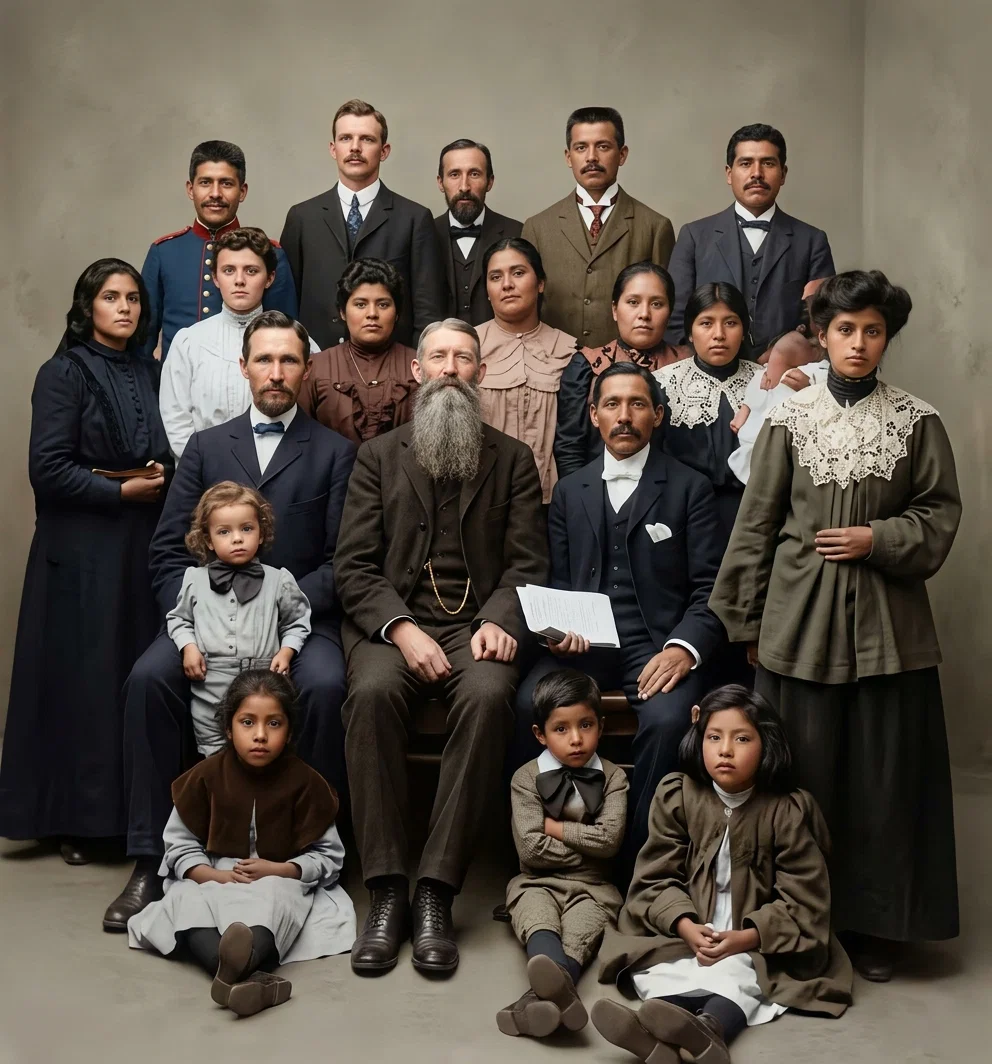
WORKERS AND BELIEVERS IN PERU
From every visible standpoint Peru is destined to be a hard field. It has about four million inhabitants, and in the interior as fanatical as can be found. Millions can not read. Nowhere have I ever seen the Indian so much in evidence. They are poor, and apparently hard working. There are already many Chinese, and it is said that fifty thousand more are to come soon. A great many of the population are at an elevation of seven thousand to fifteen thousand feet, and many of these are engaged in mining. Except east of the Andes, where the climate is not healthful, and the population is small, the country has a barren, forbidding aspect. But the message must and will go. From every nation, tongue, and tribe trophies will be gathered. From the ancient populous Inca empire, whose ruins are everywhere in evidence, and which show a state of civilization truly surprising, representatives are taking their place in the ranks of those keeping the commandments of God and the faith of Jesus. And as these various peoples are joining the ranks, they are doing their utmost in giving to others the glad news of Jesus’ soon coming. The lamps are thus being placed and trimmed ready for the Master to turn on the full current of his power and glory to finish the work of lightening the world.
I am now on my way to Ecuador on a German steamer, having been delayed some on account of a quarantine in Ecuador against Peru because of the bubonic plague. We shall be put in quarantine when we reach Guayaquil. On my return to Peru, I shall be quarantined at Callao on account of the yellow fever at Guayaquil. However, we have the assurance that each of them will be short.
It is only another sign of the times, and urges us on to hasten the work. Men’s hearts are failing them for fear and for looking after those things that are coming on the earth.
Remember our work in these dark lands before the throne of grace.
Lima, Peru.
No Man Ever Sought a Blessing for Another
“No man ever sought a blessing for another without getting one himself.”
Japan
By H. Kuniya
H. KUNIYA
AFTER our general meeting at Kobe in January, I left the work at Nagasaki in charge of Brother Kobayashi, and removed to Tokyo to assist in the work of translating for our paper, and of preparing other literature for publication. But before beginning my work in Tokyo, I made a visit to my home country, as some were interested there. I spent two days at home, and had a good visit with my parents. I am so thankful that my father no longer opposes the truth, but is willing to listen. One morning I saw him standing with clasped hands, praying as he used to do. I asked him why he did so. He replied, “I prayed for your God to bless your work.” He is not yet converted, but he has believed in the true God since the time I was delivered from the military service during the recent war.
Next day I went to see a friend with whom I had been corresponding. Here I met Brother Suzuki, who had come to assist me in the work. In the meetings we held from this time, I preached the simple gospel, using our magic lantern to show Scripture illustrations. At every meeting we had good attendance, and some were led to ask, “What shall I do to be saved?” Two families were converted, and are now giving the light to their neighbors. They asked me to stay and study the Bible with them for a month, so that they might teach the truth to others. I agreed to do so; but soon an invitation came from the next town, “Come and teach us about the true God.” Though I wished to remain for the sake of the believers, I sent the word, “I will come.” This word was like a signal gun; for soon invitations came from all directions, so that I could not answer them all.
Day after day, from early in the morning till midnight, I continued to teach. Often I hardly had time to eat or rest. It was like throwing a piece of bread into a pond among hungry fishes. They did not seem to think that I might be tired; but one after another came to me with questions. The Lord blessed me by giving strength for the work. Praise his name!
One family who kindly entertained us for a week were all converted, and began to observe the Sabbath. The aged father in this family was a Shinto priest. He and his wife were much opposed when their son and daughter were converted. But through the paper partitions of the house they could hear all that was said while we studied the Bible. One morning he beckoned me into his room. I entered, and asked him what he wanted. He replied, “I want to be a Christian from this time.” I was surprised and asked him, “Then shall I help you remove these images?” But he said that he wished first to tell his wife of his decision. So I went on with the Bible study with the others, and soon the old lady appeared, and bowing down with her eyes full of tears, confessed her sinfulness, and asked us to pray for her. We thanked God and praised his name for his wonderful way of saving souls.
Such were some of our experiences during a short stay in the country. Is it not a sign that the end is near? But who will water the seed we have sown? And there are many parts of the country where no gospel work has been done as yet by any church. We must have a school where we can train young men and women, and then send them out to sow the seeds of truth all over Japan. I hope you will remember this field in your prayers.
_Portugal—A Newspaper Publishes the Truth_
By C. E. RENTFRO
C. E. RENTFRO
I AM sending you a copy of a daily of the greatest circulation in Portugal. This issue contains an interesting article, written by one of the editors, entitled “The End of the World — A New Religion in Lisbon — What Is the Seventh-day Adventist Church? — The Sabbath Must Be Kept — Christ to Arrive upon the Clouds of Heaven.” A photograph of the writer and his prophetic chart is given: “Mr. Rentfro in his pulpit — at the back the chart with the symbolical animals of the prophecy of Daniel and the Revelation.” We read:—
“At the same hour in which, yesterday, in various temples of Lisbon, divested of their galas — from the sumptuous official church of the seat of the cardinal to the aristocratic and elegant churches of the Inglezinhos and Corpus Santo — a numerous clergy intoned the solemn offices of ‘Dark Wednesday,’ there was being preached, in a small house in the street of S. Bernardo . . . a new religion, though old in some fundamental points, which teaches expressly and principally the coming of Jesus Christ in the clouds of heaven, to resurrect the just dead, and to carry them, with the living righteous, to the splendors of heavenly eternity.”
Two paragraphs follow to show the people that we are not Mormons, though we come from the United States of America. Then a short report of the sermon is given, and several paragraphs mentioning the various signs of the end of the world.
Under the heading: “What Is the Adventist Church, and What Does It Teach?” a short exposition is given of the beginning of this people, with the principles, doctrines, and organization, and its branches of work.
The article reads further: “Every Adventist Christian must read and study the Bible, and take it as guide and rule, following its precepts, according to the clearest comprehension he shall be able to obtain from it. For adults there is baptism by immersion. They celebrate the Lord’s supper, in which they eat unleavened bread and drink unfermented wine; but for this ceremony there is no fixed date. A touching ceremony of their worship consists in the commandment of humility, that is, a mutual washing of feet. Each member has for a duty to help his coreligionary in everything that may be possible. The Adventists defend also open liberty of conscience, combating the intervention of governments in religions, and recognizing the right of each individual to believe or not to believe, but never impede others in believing.”
“It was in September, 1904, there arrived the first Adventist preacher. In June of 1906 disembarked the second, coming from Brazil, who followed to Oporto. In the capital Mr. Rentfro reunited around his pulpit, in a small room in the street S. Bernardo, some ten proselytes, if we are not in error. In the improvised temple — at the same time modest drawing-room — is not erected any religious symbol. Only extended on the walls, beside a small American banner, are curious charts of unbleached muslin, on which are inscribed names and number, for the elucidation and comparison of Bible texts; at the side of the pulpit (a small table, with a box covered with brown cloth, on top) a small harmonium; in the center of the room a dozen chairs.”
“Every Wednesday and Sabbath the Adventist worker reads and explains the Bible, comparing passages of Daniel with those of Revelation. . . . Fervently they sing the hymns, while he accompanies with the harmonium, then invokes the help of God. They hear constantly the minister of Adventism reminding them that Jesus Christ shall not delay in coming in the ineffable light of Omnipotent grandeur, upon the clouds of heaven, to assist at the destruction of the globe, that shall be annihilated with frightful noise, in the midst of burning flames.”
Although the editor put in his own thoughts on the matter, especially on the end of the world, yet on everything he wrote carefully and gentlemanly.
Yesterday being a holy day, many people passed the house, stopped, and tried to look in to see the curious place. As we are allowed to publish notices, we had placed in the hands of this editor a notice of our meeting, with the subject, “At death where do the dead go — to heaven, purgatory, hell, or where?” but he changed it to “The Destiny of the Dead.” The little room was full, with twenty-four, including an Episcopalian preacher. That day I had been out of the city with the colporteur, distributing the literature and selling the Arautos, and was very tired; but the Lord helped me to present the subject clearly.
We thank the Lord for this privilege to place before so many some of the truth; for the article was quite extensive, and the journal goes to Africa, Brazil, India, America, England, and every place where are Portuguese, and the readers will have presented to them the truths of the Sabbath, coming of Christ, the signs of his coming, the obligations of the Christian, the ceremonies of the church, the nature of man, etc. May God open hearts to come, see, and believe, is our prayer.
The Indiana Camp-Meeting
By G. B. Thompson
This meeting was held at Lafayette, July 25 to August 4. The city granted us the free use of Columbian Park. The location was an ideal one, and it was a matter of much surprise to the citizens that we were permitted to use this park, as other denominations had been denied the use of it. The weather was good, with the exception of one storm which blew down the large pavilion; but this did not materially interfere with the progress of the meeting.
The attendance of our own people was good; the largest I was told of any meeting held in the State in recent years, notwithstanding the fact that another meeting is to be held in the southern part of the State later. From the first, the greatest unity and oneness of spirit pervaded the meeting. The organization of the camp was very good, which was a great help in making the meeting a success.
The attendance from the city was fair, and many were deeply impressed with the truths presented. The message was preached from the first, and some from the city took their stand to keep the Sabbath. The Lord greatly blessed our own people also. Special revival services were held both Sabbaths. The last Sabbath nearly a score gave their hearts to God for the first time, backsliders were reclaimed, and the hearts of all were refreshed. Three baptismal services were held in the swimming pool in the park during the meeting, and thirty-three in all were baptized. A number of others will receive the rite at their home churches.
Most of the conference workers were present to share in the burdens of the meeting. Besides these, Elders G. A. Irwin, Allen Moon, W. D. Curtis, Dr. H. W. Miller, and the writer were present from outside the State.
The reports of the advancement of the message in the foreign fields were a source of much encouragement to all. A deep interest was manifested in assisting in the advancement of the work in the “regions beyond.” At the close of a discourse on the message and its needs, Elder Stone suggested that the conference give from its surplus tithe one thousand dollars for foreign missions. This met with a hearty response in the hearts of all present. It was one of the most important steps taken during the meeting, and brought new courage into the camp. This action will surely be attended with much of the blessing of the Lord, and shows that the pillar of cloud is rising in this conference. A few years ago they were not able to pay their own conference workers; but now they can not only settle with them in full, but help finance the great missionary problem which confronts us in carrying this message to the world. We believe this action marks a new era in the work in Indiana.
Another important matter which occupied the time of the meeting was the consideration of the establishment of the new sanitarium. A site has been purchased on the banks of the Wabash River a few miles from the city. The entire encampment visited the grounds during the meeting, and services were held there one day, and consideration was given to the erection of the necessary buildings. A good work is already being carried forward here in such buildings as they have, but to do proper work it is imperative that a new building be erected. All were delighted with the place, and it was unanimously decided that steps should be taken at once to put up a building. Toward this enterprise about five thousand dollars was donated by those present. The city manifests much interest in this undertaking, and some liberal donations will be made toward it. It is expected that the work of putting up the sanitarium will be begun without delay.
The site of this sanitarium is certainly a beautiful and ideal one, and has been purchased far below its original cost. It seems to be in every respect just such a place as has been outlined by the spirit of prophecy for our sanitariums. It is in the country, on the banks of a river among the hills, and is surrounded with orchards and everything essential for the making of a quiet, restful retreat for those who are ill. This institution is being established as a conference institution, on the principles outlined by the spirit of prophecy, and we feel sure that it will prove a success, and be a strong factor in building up the work in the State, and in training workers for other fields as well. It should have the hearty support of all the believers in Indiana.
This meeting was calculated to strengthen and establish all in the message for this time. Elder Irwin gave a number of studies on the gift of the spirit of prophecy. All departed for their homes greatly encouraged, and with new determination to be faithful in the work till it shall close in glory and power in the near future.
G. B. Thompson.
Mission Sunday-Schools
By M. Bessie DeGraw
“ONE of the most needy, as well as one of the most fruitful, fields of Sabbath-school missionary work is among the negroes of the South. This work has proved one of the most effectual agencies for their evangelization. Our greatest hope is in saving the negro boys and girls, of whom there are at least two million in our Southern States. We now have twelve Sabbath-school missionaries at work among them. They are organizing more than one hundred new Sabbath-schools every year, having them a membership of about four thousand children. One hundred and twenty mission churches have already grown from these schools during the past eighteen years. This is one of the fields into which we hope to send more workers this year.”
The preceding is a clipping from the Westminster Teacher, and it shows one phase of the missionary work now being done in the South by the Presbyterians. If they are organizing over one hundred new Sunday-schools each year, what should Seventh-day Adventists be doing?
Is not the conducting of Sunday-schools a most excellent way to reach the people in a new community? We are told in the Testimonies that it is well for us to make Sunday a day for missionary work. We find the people at leisure. If we meet them as Sunday-school teachers, we disarm prejudice, and open the avenue to the hearts of both children and parents. And when we have worked for them for a time in the Sunday-school, the Sunday-school may grow into a Christian day-school.
One of the most successful industrial schools in the South began its career as a Sunday-school, held in a leaky log cabin in the mountains of Georgia.
Let us follow the example of other missionary workers, and start Sunday-schools in the communities to which we hope to give the third angel’s message.