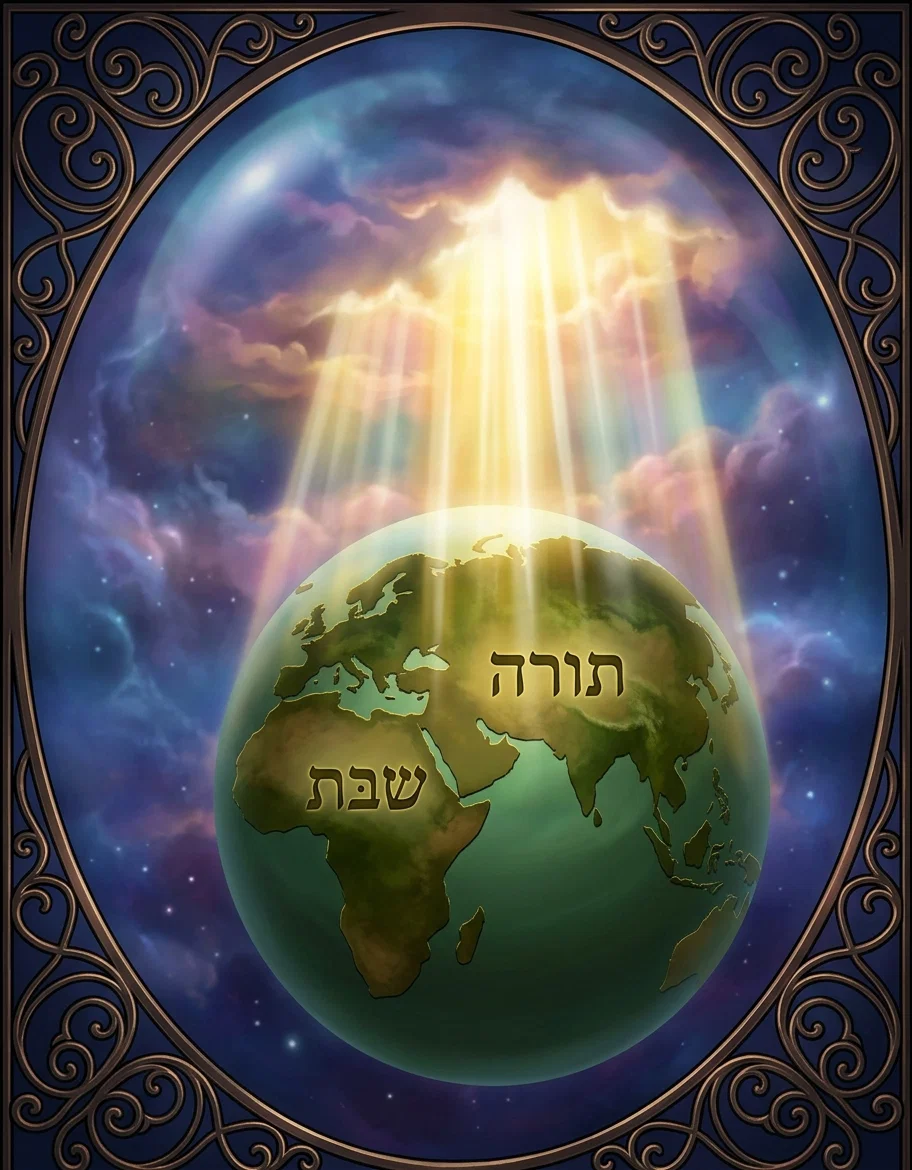
What Does the Word Mean?—When Was the Sabbath Instituted?—Which Was It?—How Was It Made, and for Whom?
The Sabbath is God’s great memorial of His creative work. It was instituted at the close of creation week, in commemoration of that marvelous act which originated the world and man. Gen. 2:1-3.
The commandment reads: “Remember the Sabbath day, to keep it holy. Six days shalt thou labor, and do all thy work: but the seventh day is the Sabbath of the Lord thy God: in it thou shalt not do any work, thou, nor thy son, nor thy daughter, thy manservant, nor thy maidservant, nor thy cattle, nor thy stranger that is within thy gates: for in six days the Lord made heaven and earth, the sea, and all that in them is, and rested the seventh day: wherefore the Lord blessed the Sabbath day, and hallowed it.” Ex. 20:8-11.
By way of introduction, we will raise the following questions:
1. What is the meaning of the word “Sabbath”?
2. When was the Sabbath instituted?
3. Which day was originally made the Sabbath?
4. How was it made?
5. For whom was it made?
These questions, properly considered and fairly answered, should give us intelligent information as to God’s purpose in making the Sabbath. Let us now consider the questions in their order.
THE MEANING OF THE WORD
1. What is the meaning of the word “Sabbath”? It comes from the Hebrew word Shabbath. It is defined by Gesenius as “rest, cessation.” Webster defines it “the day of rest”; Young, “cessation”; Liddell and Scott, “Sabbaton, Sabbath, rest; (2) a week.”
From these definitions, it is plain that the word “Sabbath” means primarily rest, secondarily week. Gesenius defines Shabbath, Sabbath, “cessation.” It therefore is a cessation, or rest. Since rest implies previous labor performed, it stands related to some work from which there was a cessation, or rest.
WHEN WAS IT INSTITUTED?
2. When was the Sabbath instituted? In order to learn when the Sabbath was instituted, we must find out when the first work was performed, after which there was a cessation, or rest. Such a time is found by going back to creation. “In the beginning God created the heaven and the earth.” Gen. 1:1. “And the earth was without form, and void; and darkness was upon the face of the deep. And the Spirit of God moved upon the face of the waters.” Verse 2. Then follows the record of creation. Here was a work performed, after which a cessation, or rest, followed. Hence the Sabbath, or “rest day,” was instituted at creation. Gen. 2:1-3.
WHICH WAS THE DAY?
3. Which day was originally made the Sabbath? It was certainly the day when the rest, or cessation, occurred. Which day was that? “And on the seventh day God ended His work which He had made.” The first chapter of Genesis enumerates six days of labor performed in the work of creation. God did not have a cessation before He labored, for the text says He “ended His work” and rested. The “rest” day, or Sabbath day, was the day following the six days of creation. Which day was that? “And He rested on the seventh day from all His work which He had made.” The seventh day in what succession or period?—The seventh day of the week, unquestionably. The period of seven days is here given, and no other period is mentioned. The seventh day was therefore the last day of the week.
Again, the Sabbath commandment given in the law from Sinai says, “The seventh day is the Sabbath of the Lord thy God.” Ex. 20:10. This text leaves no question as to which day was the Sabbath. The time of its institution is also given: “For in six days the Lord made heaven and earth, the sea, and all that in them is, and rested the seventh day: wherefore the Lord blessed the Sabbath day, and hallowed it.” Verse 11. These statements are from Him who made the Sabbath, and gave the law of the Sabbath from Sinai. The authority of the testimony is unimpeachable.
HOW WAS THE SABBATH MADE?
4. How was it made? Since “Sabbath” means rest, “Sabbath day” means rest day. By what act was it instituted a rest day? It must be the Lord’s rest, as related to the Lord’s work. This question is definitely answered in the following texts: “Thus the heavens and the earth were finished, and all the host of them. And on the seventh day God ended His work which He had made; and He rested on the seventh day from all His work which He had made.” Gen. 2:1, 2. “In six days the Lord made heaven and earth, and on the seventh day He rested, and was refreshed.” Ex. 31:17. “And God blessed the seventh day, and sanctified it: because that in it He had rested from all His work which God created and made.” Gen. 2:3.
Unquestionably these texts teach that it was the Lord’s work and the Lord’s rest that instituted the Sabbath day, and constituted it the Sabbath, or rest, of the Lord. This work and rest were performed at the time of creation. The work and rest of God are the underlying facts upon which the institution of the Sabbath is based. The Sabbath is therefore the Lord’s rest day from creation. One can no more change that fact than he can change the fact that he was born upon a certain day. No other day can ever be the Lord’s rest or Sabbath day, than the day upon which He rested. That was the seventh or last day of the week.
God did not make it the Sabbath day by the act of blessing it, but by the fact of resting upon it. Ex. 20:11 says, “Wherefore the Lord blessed the Sabbath day.” It was already the Sabbath day before He blessed it. In Gen. 2:3 we read, “God blessed the seventh day, and sanctified it: because that in it He had rested.” It was His resting that made it His rest day. He had rested before He blessed and sanctified it.
FOR WHOM WAS IT MADE?
5. For whom was the Sabbath made? As the blessing and the sanctifying were after God had rested, the only legitimate conclusion is that it was blessed and appointed for man. “Sanctify”170means to make holy. The Sabbath was therefore from creation made holy for man.
Christ was the Creator who worked and rested in the making of the Sabbath. The Son of man is mentioned in Col. 1:16: “For by Him were all things created, that are in heaven, and that are in earth, visible and invisible, whether they be thrones, or dominions, or principalities, or powers: all things were created by Him, and for Him.” Since it was Christ who worked with the Father, and rested in making the Sabbath, it follows that the Sabbath instituted at creation, on the seventh or last day of the week, is also Christ’s rest day, or Sabbath day. Since Christ is Lord of the Sabbath day, and the Sabbath instituted at creation by Him is His rest or Sabbath day, there is no one better prepared than He to tell us for whom it was made. “And He said unto them, The Sabbath was made for man, and not man for the Sabbath.” Mark 2:27.
The Sabbath was not made for God. The Lord made it for man. The only question to be settled, therefore, is, Who is man? It is a law of language that a noun unlimited is always used in the broadest sense. The term “man” therefore must refer to the race. It must embrace the first man, the last man, and every man of the race. No consistent scholar will attempt to limit it, since Christ declared it to be unlimited.
THE USE OF THE TERM “MAN”
Let us take a few illustrations, where the word “man” is used in the same way in other texts, and from this gather a correct view of its meaning. “Let us make man in Our image.” Gen. 1:26. “So God created man in His own image.” Verse 27. “God formed man of the dust of the ground.” Gen. 2:7. “My Spirit shall not always strive with man.” Gen. 6:3. It repented the Lord that He had made man. Verse 7. These texts refer to events long before there was a Jew in existence.
In the time of Israel, the term was used as follows: “And the Lord said unto him, Who hath made man’s mouth?” Ex. 4:11. “There shall no man see Me, and live.” Ex. 33:20.
Under “A man; a human being, Anthropos,” Young, in his concordance, gives the following: “The Sabbath was made for man.” Mark 2:27. “What shall it profit a man, if he shall gain the whole world, and lose his own soul?” Mark 8:36. “For this cause shall a man leave his father and mother, and cleave to his wife.” Mark 10:7. Christ is the speaker in each of these three instances. The word “man” is used similarly in all. If one is limited to the Jews, then they are all limited to that people. That would prohibit marriage to any but the Jews. Christ says, “The Sabbath was made for man.” Paul says the woman was made for man. 1 Cor. 11:9. There is a striking parallel between the woman and the Sabbath. They were both made before the fall, and both were made for man. Both the Sabbath and the marriage institution are called honorable. Isa. 58:13; Heb. 13:4. To limit the Sabbath to the Jews, and claim that the term “man” is unlimited when it applies to marriage, would be such folly as no reasonable man would be guilty of.
From these passages it is clear that the word “man” in the Saviour’s statement, “The Sabbath was made for man,” refers to the race of mankind, including every man of every age or dispensation. The seventh-day Sabbath made at creation by Christ Himself is therefore the Sabbath to-day, and will continue to be the Sabbath so long as man shall live upon the earth.
From this study, we have learned that the word “Sabbath” means rest, or cessation.
That the Sabbath was instituted at creation.
That the Sabbath was made by the work and rest of Christ, the Creator, at the time of creation.
That the seventh day of the week was the day upon which Christ rested.
FOREVER HIS REST DAY
It must therefore ever after be His rest day, the same as the date upon which one is born is ever afterward his birthday. Nothing can change the rest day of Christ, any more than can anything change a person’s birthday.
The rest, or Sabbath, is the Lord’s, not man’s; hence the seventh-day Sabbath is the Lord’s day. It was made and sanctified for man. Man includes every member of the race from first to last. Therefore the Sabbath instituted at creation by the work and rest of Christ is the Christian Sabbath, and is for all in every age who wish to walk in harmony with the requirements of God’s moral law, and accept pardon through Christ.
Since the woman “made for man” is acknowledged by all to include the gentile as well as the Jew, and since the expression “Man dieth” is bearing its constant testimony that every man of every race and nation is included in the expression “man,” there is no sound reasoning that will deny that the Sabbath made for man was made for all people during all time.
B. C. E.
The Image to the Beast and His Mark
By M. C. W.
Enforcement of Religious Dogma by Civil Law
This is the eighth and last article by Elder Wilcox on the sevenfold sign of the end, shown in the interesting prophecy concerning the United States government. In the first part of this article, he sums up what has appeared in preceding issues. Hence in that which follows, there is given a good survey of the entire subject. Editor.
The prophecy is found in Rev. 13: 11-17, and reads as follows in the American Revised Version:
“And I saw another beast coming up out of the earth; and he had two horns like unto a lamb, and he spake as a dragon. And he exerciseth all the authority of the first beast in his sight. And he maketh the earth and them that dwell therein to worship the first beast, whose death stroke was healed. And he doeth great signs, that he should even make fire to come down out of heaven upon the earth in the sight of men. And he deceiveth them that dwell on the earth by reason of the signs which it was given him to do in the sight of the beast; saying to them that dwell on the earth, that they should make an image to the beast who hath the stroke of the sword and lived. And it was given unto him to give breath to it, even to the image of the beast, that the image of the beast should both speak, and cause that as many as should not worship the image of the beast should be killed. And he causeth all, the small and the great, and the rich and the poor, and the free and the bond, that there be given them a mark on their right hand, or upon their forehead; and that no man should be able to buy or to sell, save he that hath the mark, even the name of the beast or the number of his name.”
Let us recall what we have learned thus far in our study:
1. The two-horned beast symbolizes a nation that would be seen rising to power in 1793 to 1798, when the ten-horned beast antitype, papal Rome, went into captivity. The beast of the prophecy is not the same beast, or a different phase of the same beast; it is “another beast,” another world power. This symbol is met in the United States; for this nation was then rising to power.
2. The two-horned beast did not rise out of the sea, as did the Old World symbols (Dan. 7: 3; Rev. 17: 15), but out of the earth, among the solitudes of hitherto unknown, unexplored regions. This specification was also met by the United States, described as “coming forth from vacancy.”
3. This nation meets the prophecy in that it rose rapidly, peacefully, as a plant would spring up before our eyes. Townsend says of this country, “Like a silent seed we grew into empire.”
4. The two horns like a lamb are symbols of Christian characteristics (Rev. 5: 6),—equality of man, and freedom of choice in matters of religion,—found alone in Christianity of all religions, and alone in this nation of all nations. In both systems these principles are fundamental. The evidences are clear and copious that the symbol refers to the United States. One of the mightiest molding governments of earth is not neglected in the prophetic Word.
5. It spoke as a dragon. In other words, it would promulgate intolerant laws, and persecute the people of God. And mighty growing movements in this land show that the fulfillment of the prophecy is just before.
6. It would deceive the people of earth, under the dragon spirit, and lead them to make an image to the beast which had the wound by a sword and lived. In other words, turning from God, the nation becomes deceived, and is used by “the deceiver of the whole world” to deceive the people into forming a union of church and state, or religion and the state.
The Image
The image is made by the people. The government, therefore, is a republic. The people rule. The vital step may be taken under the initiative or referendum. The education of the171people, with uncertain standards, is fitting them to be readily deceived. Let the people once come to believe that things would be greatly bettered, that Heaven would regard them more favorably, if they would honor God by joining organic religion and the state, the state supporting religious dogma, and ancient tradition be taken as the standard, and the work would be done.
More than that, such a step once taken, the leaders would not delay to put it in operation, or give life to it by effective laws. Religion with the state may be expressed in constitutional law. To give it life, is to pass such statute laws as will make it effective.
The worship of this image is to be enforced by law. That is, men must yield homage to it, regard it, obey its exactions on pain of death. In other words, when a government becomes so deceived as to place in operation a union of religion and the state, such union and such laws will in the very nature of the case be considered the most sacred of all laws, and their transgressor will be considered the greatest criminal. These laws will be considered divine, the laws of God, and the government God’s vicegerent to enforce them. He who flouts them, opposes them, or transgresses them, will be thought guilty of both blasphemy and treason, and worthy of death.
Such has ever been the logic of religious legislation. When Nebuchadnezzar, Babylon’s greatest king, set up on the plains of Dura the great golden image, and commanded its worship, the penalty was death. That image was the apotheosis or deification of patriotism. We need not be surprised when, in this later Babylon, in which proud man exalts himself, we shall again have religious patriotism deified, and its worship enforced under pain of death. And our “national reform” friends will not shrink from this conclusion.
The Jews, with the teachings of a millennium and a half, could become so deceived that they felt it necessary to crucify the Lord of life and glory; and He declared that there would come a time, even among His professed followers, when those who slew a true disciple of Christ would think they were doing God service. John 16: 1-3. A repetition of the principles in operation in this republic will bring the same result.
The Mark
As the result of the making of this image, a mark, the mark of the beast power, will be enforced. The beast is a symbol of Rome under the papacy. The mark is a sign of homage to that power. In the Revelation, it is set over against the seal of God. The people of God in the last generation bear His seal, His name, His mark and stamp of character. Rev. 7: 1-3; 14: 1. To put it in broader form, they “keep the commandments of God, and the faith of Jesus.” Rev. 14: 12. They worship God, and manifest that worship in its truest form—service. Compare Rev. 14: 7; Matt. 4: 10.
Those who follow the great apostasy in the last generation, bear the seal of the beast, his name, his mark or stamp of character. They worship and serve him directly or through the image. They obey his commandments.
The mark of the beast forms, therefore, a mark of distinction between the worshipers of the beast and the worshipers of God. It differentiates the two classes. Are you a servant of God?—You will bear His mark; you will be obedient to all His commandments. Are you a servant of the beast?—You will as truly bear his mark as though you were branded on the hand or in the forehead; you will keep his commandments.
What is the seal of God’s law?—It is His Sabbath, the memorial of His creation power, the sign of His redeeming and sanctifying power. Ex. 20: 8-11; Deut. 5: 15; Eze. 20: 12. It ever calls to mind, if observed, the mighty Creator, mighty also to redeem and cleanse. Therefore is the gospel based in His power. Rom. 1: 16; Rev. 14: 6, 7.
What is the mark of the great apostasy?—It is the change that the papacy has made, or sought to make, in the law of God—the substitution of Sunday for the Sabbath. For this change there is no Scriptural authority; therefore the papacy sets it forth as a mark of her power, as many authorities clearly show. We quote but one, “Abridgment of Christian Doctrine”:
“Ques.—How prove you that the church hath power to command feasts and holy days?
“Ans.—By the very act of changing the Sabbath into Sunday, which Protestants allow of, and therefore they fondly contradict themselves by keeping Sunday strictly, and breaking most of the other feasts commanded by the same church.
“Ques.—How do you prove that?
“Ans.—Because by keeping Sunday they acknowledge the church’s power to ordain feasts and to command them under sin.”
Testimony upon this point might be greatly enlarged. We have not space for more.
That Sunday-sabbath does not become the mark of the beast till a union of the state with religion sets it up for human observance instead of the law of God; and man does not receive that mark till in the light of God’s word he yields to human law, choosing it instead of God’s eternal Sabbath.
Over this will come the issue. The efforts for Sunday exaltation by statute law will succeed. Many honest, misguided men do not know for what they are working. Many devoted Sunday keepers believe the day to be holy. They are sincere Christians, and God accepts them despite their error. They are loyal at heart, and believe they are doing God’s will. But God’s great threefold message is going to the world, with its awfully solemn warning against the worship of the beast or his image and the reception of the mark of the beast. Rev. 14: 6-12. That message calls men back to God and His word, away from human traditions and error. It exalts God, and places the glory of man in the dust.
On the other hand, apostasy exalts error and tradition in the place of truth, and sets as a mark of loyalty in the state, a day around which cluster all the evils of sun worship in past ages. It demands that that day shall be observed, on penalty of boycott and confiscation of property. No man shall buy or sell who has not yielded his God-bought freedom to the world apostasy. And persistent refusal will mark, in that régime, rebellion and treason, and at last the sentence or decree of death. And the two-horned beast power becomes the false prophet to deceive. Rev. 16: 13.
The choice lies between error and truth; between the service of rebellious, dying man, and the service of the living God; between a humanly promised temporal deliverance, and the eternal victory and triumph under Christ. The end of all sin is destruction, and this is the doom of the worshipers deceived by the beast and the false prophet. Rev. 19: 19, 20. The fruit of all righteousness is eternal victory in our Lord Jesus Christ, over all the powers of evil. Rev. 14: 1-5; 15: 2, 3.
The great sevenfold—manifold—sign of Christ’s coming is before this generation, this people, this nation. Its fulfilling is marked with constantly clearer and cumulative evidence, as the days rush by. It is the duty of every loyal Christian to align himself with God in this struggle, and to do all in his power to carry to every soul the great threefold warning message. In that is there triumph.
M. C. W.
TRADITION UNSAFE
By G. B. T.
The tendency of the present is to appeal to tradition when confronted with evidence that shows our practice to be out of harmony with the plain requirements of the Scriptures. An illustration of this is seen in the Sabbath controversy. The Bible clearly states that “the seventh day is the Sabbath of the Lord thy God.” Ex. 20: 10. Men have departed from this plain precept of Jehovah, and seek to justify their departure by appealing to the practices of the people, particularly the early church.
But this is very unsafe and unsatisfactory. Truth has become mixed with error, through its long residence on earth. Even in Paul’s day he wrote that “the mystery of iniquity” was already working. 2 Thess. 2: 7. So we find even in the early church many gross errors.
Speaking of the early centuries, Wylie says: “Already, in the fourth century, we find images introduced into churches, the bones of martyrs hawked about as relics, the tombs of saints become the resort of pilgrims, and monks and hermits swarming in the various countries. We find the pagan festivals, slightly disguised, adopted into the Christian worship; the homage offered anciently to the gods transferred to the martyrs; the Lord’s Supper dispensed sometimes at funerals; the not improbable origin of masses; and the churches filled with the blaze of lamps and tapers, the smoke of incense, the perfume of flowers, and the goodly show of gorgeous robes, croziers, miters, and gold and silver vases; reminding one of the not dissimilar spectacles which might be witnessed in the pagan temples.”
This writer further says: “The evils of the time were legion; but all flowed from one colossal error: the cardinal truth of Christianity, that salvation is of grace, was completely obscured. By the most plausible pretext and the most subtle devices was172man led away from God, and taught to center all his hopes in himself. Faith was overthrown, and works were put in its room. The sacrifice of Christ was neglected, and man became his own savior. We trace the operation of this grand error in the superstitious and burdensome rites in which all holiness now began to be placed. Sanctification was no longer sought in a pure heart and a mind enlightened by divine truth, but in certain external rites, which were seldom either important or dignified. To nourish the passions and mortify the body was now the grand secret of holiness. . . . The caves of Egypt, the sands of Libya, and the deserts of Syria, were ransacked. The bones of dead men, and, if history may be credited, of the lower animals, were exhumed, were hawked over Christendom, and purchased at a high rate.”—“The Papacy,” pages 25, 49.
The only source of unadulterated truth is in the Scriptures. Like a perennial spring, truth flows from its sacred pages unmixed with error, or any of the sophistries and traditions of men. Men have too long been slaking their thirst for knowledge from the murky fountain of men’s traditions. We should come to the fountainhead of truth, and drink that which is pure. G. B. T.
Question Corner
By Milton C. Wilcox
Conducted by MILTON C. WILCOX
Mountain View, California
NOTE.—This department is for the purpose of helping Bible students. Answers must of necessity be brief, often only suggestive, never exhaustive, never infallible, only as they agree with the infallible Word. Such questions only will be answered as seem to the editors to minister to the mission of the paper. Questions of the same import can not be answered repeatedly in the same volume. Name and address must be given, not for publication, but as evidence of good faith and to insure reply by letter if thought best. It is well always to inclose stamp, not stamped envelope, unless answer is desired by letter alone.
95—Missionary Baptist Church
1. Have we any Bible proof that the Missionary Baptist Church is the oldest church? Can it be proved by Bible or history that they can trace their belief further back than any other denomination? 2. Are not the Catholics ahead of them in this respect? 3. Have we any Bible proof that Jesus' being baptized of John the Baptist makes Jesus a member of the Missionary Baptist Church? 4. Does John get his name “John the Baptist” simply because he baptized with water, or was he really a member of the Missionary Baptist Church? L. M. B.
We hardly believe that our Missionary Baptist friends would affirm all these claims in their fullest sense. There is no denomination on the earth that can say they trace their origin back as far as that, unless it is the Jews. Of course they have been a nation of themselves all the way through.
John the Baptist was the forerunner of our Lord Jesus Christ. He is called “John the Baptist,” or “John the Baptizer,” simply because he baptized those who accepted his message. John did not organize any church. He had his followers, and those who accepted his message, but we have no account whatever that he organized any church. When he baptized Jesus, he did not baptize Him into any church; for our Lord Himself was the very Founder of the Christian church. It is built upon the Rock Christ Jesus. (See the little tract “The Foundation Rock of the Church,” Apples of Gold No. 99, price one cent.)
That church founded by our Lord Himself continued from that time forward. The Roman Catholic Church, of course, contends that they began with Peter, and that Peter was the first bishop of the church. There is no proof of this, either Scriptural or historical. The true church of the Lord Jesus Christ is the church that meets the conditions God lays down in His word. They are the true “called-out ones”—those who have obeyed the call of God—called out according to the conditions of His word.
The great apostasy that developed into the Roman Catholic Church began even in the apostle Paul’s day. It grew apace, and the Catholic Church as an ecclesiastical body could be said to begin about the time of Constantine. Previous to that time there was far less of apostasy in the church. Some of those who were true to their conceptions of truth were persecuted by the apostate church just as soon as the apostate church could command power to do it. Many of them went into the wilderness, driven into mountain fastnesses, scattered here and there throughout Christendom. Among these were the Waldenses, the Albigenses, and others. Some of these baptized—continued the form of baptism; others lost much of the teachings of the Lord in their wandering, while still holding faith in God and in His word.
Among those who early came out of the apostasy of the Dark Ages were the Baptists, who have been able to trace Baptist believers, or Christians who held to immersion, back through the centuries; and it is doubtless a fact that the Lord had true followers who believed in immersion during all those dark and fearful times, but they were not organized into a Missionary Baptist Church, or into any other particular Baptist Church. They were faithful followers of God, whom the Lord counted His church in the wilderness.
The really important thing is not that we shall belong to this denomination or that denomination, but, Do we meet in our own lives God’s call? “Church” comes from ekklesia, and the ekklesia is composed of those who are legitimately and properly called out. God’s called-out ones constitute His church—those who are called out according to the truth that is given in His word.
Will you please explain? Does it mean that these animals are to be in the new earth? E. R. D.
The passage includes verses 6 to 8. In these verses we are told that “the wolf also shall dwell with the lamb, and the leopard shall lie down with the kid; and the calf and the young lion and the fatling together; and a little child shall lead them. And the cow and the bear shall feed; their young ones shall lie down together: and the lion shall eat straw like the ox. And the sucking child shall play on the hole of the asp, and the weaned child shall put his hand on the cockatrice’s den.”
It does not seem to us that all these literal things are demanded in the new earth. The prophet is using the very strongest figures it was possible for him to use to show the completeness of peace and the effect of righteousness in the kingdom of God restored. Among the evidences of sin in this world is the antagonism between the members of the brute creation. There have been developed, in consequence of sin, the carnivorous beasts that prey upon other beasts with unsparing cruelty. Nothing of that kind will be seen in God’s kingdom restored. Though the little child were there, it could play on the hole of the asp—now one of the most poisonous of serpents. Though the little child were there, it could put its hand on the adder’s den, and there would be nothing there to harm or destroy in any way.
Another thing: The prophecies of the Old Testament are oftentimes double. God would have brought about all those beautiful conditions in Israel at that time if Israel had been faithful to Him; but they failed, and now more blessed conditions will be fulfilled in the new earth. The strongest use we could make of such passages as Isa. 11:6-9 is, that conditions there will be absolutely peaceful, and all things dwell there absolutely harmless.
97—UNEQUALLY YOKED TOGETHER
Will you please explain 1 Cor. 7:14? One of the questions that I have in regard to it is the matter of eating and drinking. What is the wife’s duty in such a case? Should she control her children in respect to those things which she feels are not good for them, or should she for the sake of peace yield? Wife.
The scripture and context read as follows: “But to the rest speak I, not the Lord: If any brother hath a wife that believeth not, and she be pleased to dwell with him, let him not put her away. And the woman which hath an husband that believeth not, and if he be pleased to dwell with her, let her not leave him. For the unbelieving husband is sanctified by the wife, and the unbelieving wife is sanctified by the husband: else were your children unclean; but now are they holy. But if the unbelieving depart, let him depart. A brother or a sister is not under bondage in such cases: but God hath called us to peace. For what knowest thou, O wife, whether thou shalt save thy husband? or how knowest thou, O man, whether thou shalt save thy wife?” 1 Cor. 7:12-16.
First of all, there is a solemn and weighty responsibility that rests upon the Christian in such a union as this. It is a responsibility that must not be lightly regarded or ignored. The believing one should have one dominant desire and object in life, and that is, to save, if possible, the one who is unbelieving. To do that, he or she ought to be willing to compromise in everything where principle is not involved and character is not marred.
In the matter of eating and drinking what conscience forbade, it seems as though there could be no question between reasonable people. If a believing husband felt that he could not eat or drink that which the unbelieving wife did, she certainly ought not to object, and vice versa.
Regarding the children, the case would be different, because the children themselves might not know what would be best for them, and must depend to a greater or less extent upon their parents’ guidance. And here is where the difficulty many times would arise in the training of the children. The unbelieving father might demand that they should eat the same unwholesome things he eats. What shall a mother do? It is utterly impossible for the SIGNS OF THE TIMES to tell her. She knows the conditions, knows the circumstances, knows more or less of the disposition with which she has to deal, knows the children. What she could do is this: She could teach her children what is best. That certainly is the privilege of the mother preeminently. But if the father’s will and the rest of the home itself were involved, it would be much better not to compel or seek to compel acquiescence. In fact, this would probably be impossible in many cases. She could not compel the children to do as she thought they ought to do; and the only way she could do would be to yield, and teach the children aright, and endeavor to control them morally.
If the question were carried so far that it meant wrong to the children and wrong to her, then the privilege is left her to depart and leave the husband to himself. These are things that must not be decided by what somebody else may say.
We would say to the one who is making these inquiries, and to others similarly situated, that there is an ear that is open to our prayers. There is One who is willing to guide; One who is willing to forgive and cover all mistakes; One who is able to pierce the hard heart of the unbelieving ones; One who is able to give such wisdom as only God can give. Let the believing ones go to Christ, and find in Him guidance. But whatever may come, let them not lose their Christianity or their hold upon the Saviour. On the other hand, let them do everything in their power to make home pleasant and more than pleasant for the unbelieving ones.
In the matter of food, let the wife study how she can make the best kind of foods, the most palatable for the unbelieving husband. Let her so seek to do this that he shall come to prefer her way of living rather than his own. Let neither of them try to compel by argument or force what he or she may think to be right. Let them indulge in as little argument as possible, but let each seek to win the other.