Your ShelfYour Projects

Signs of the Times, Vol. 24, No. 1.

THE CONTINUOUS INFINITE SACRIFICE

Signs of the Times

Jan 6, 1898

Pacific Press Publishing Company · Oakland, California · Jan 6, 1898

THE CONTINUOUS INFINITE SACRIFICE.
THE death of Jesus of Nazareth upon the cross of Calvary was not the entire sacrifice which He made for a lost world. It was not the only evidence of His love for a fallen race. In a way it represents His sacrifice; it is a part of the sacrifice; in a sense it is its culmination, its supreme moment, but in itself it was not all. And yet how often we look upon His death as Jesus of Nazareth as the great evidence of His love. But how much more that sacrifice means than a few hours of agony and a physical death! These were but the representatives, so to speak, of the great eternal whole.
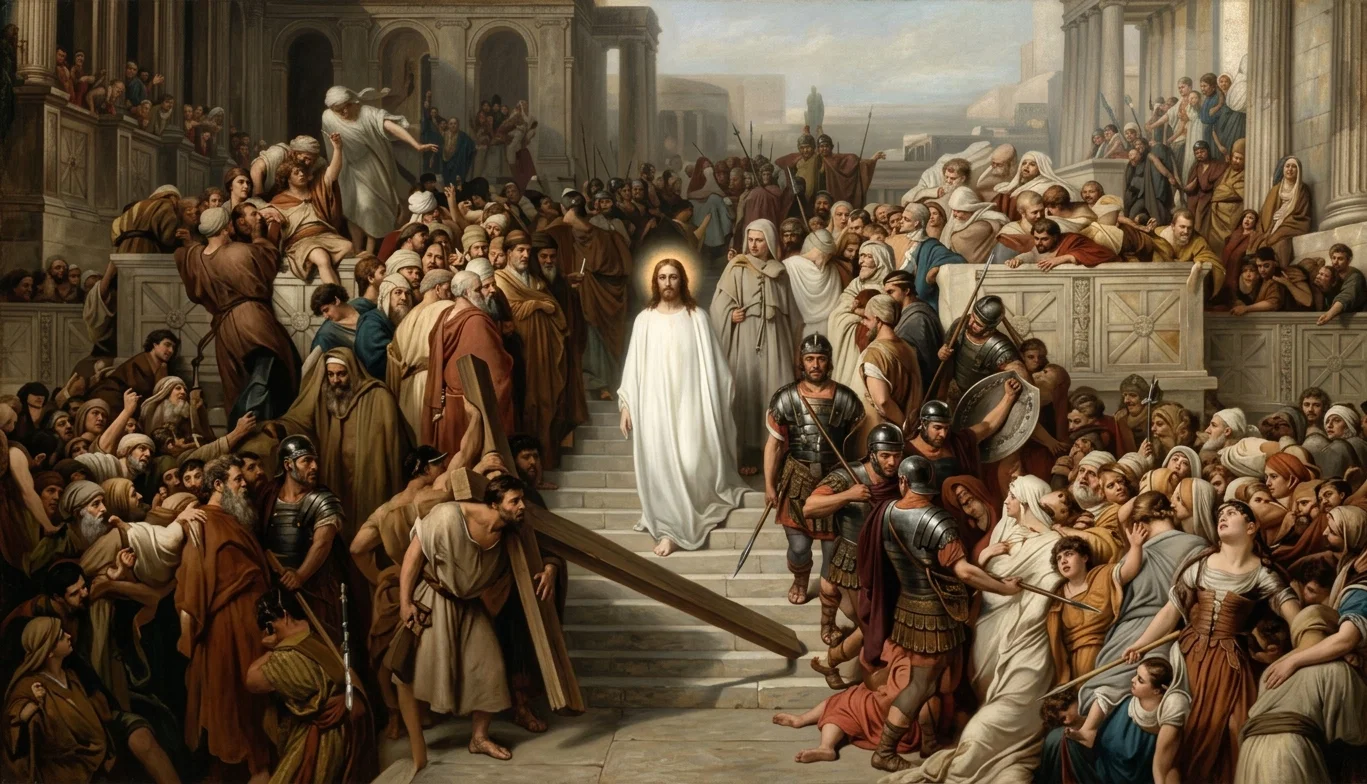
JESUS LEAVING THE PRAETORIUM.

Who Makes This Offering?

It is not merely Jesus of Nazareth, who was born in Bethlehem, about a third of a century before the crucifixion; it was He “whose goings forth have been from of old, from everlasting.” Micah 5:2. It was the eternal Son of God, who was with the Father “before the world was.” John 17:5. It was He by whom “were all things created, that are in heaven, and that are in earth, visible and invisible, whether they be thrones, or dominions, or principalities, or powers; all things were created by Him, and for Him; and He is before all things, and by Him all things consist.” Col. 1:17. Therefore, with the Father, the mighty, all-wise Upholder of the universe. He was in the form of God. Phil. 2:6, R. V. margin. He was “the brightness” of the Father’s “glory, and the express image of His person.” Heb. 1:3. He who died for man upon the cross of Calvary was the mighty, all-glorious Creator.

When Did He Make the Sacrifice?

The infinite love which prompted Him to make it was in Him eternally; for He is “Jesus Christ the same yesterday, and to-day, and forever.” Heb. 13:8. He is “the Lamb slain from the foundation of the world.” Rev. 13:8.

The Carrying Out of the Purpose

The first step in that sacrifice was not taken when He came to earth and took upon Him the form of flesh. It began in the beginning. He was angel before He was man. The first step was in that holy purpose, when for the salvation of His creatures, and to prove forever God’s eternal and undying love, He who was “originally in the form of God, counted it not a prize to be on an equality with God, but emptied Himself.” Phil. 2:6, 7, R. V. margin. In that purpose was embraced all that came after, even to the death of the cross. He was “the Lamb slain” from the beginning. In the carrying out of that purpose, He stepped down to the angelic creation, “the Angel of Jehovah, “the Messenger of the covenant, — “taking the form of a servant” (Phil. 2:7), the chief angel, because the chief servant. And thus we trace Him all through the past dispensation He was the Angel of the Lord to the patriarchs, Abraham, Isaac, and Jacob; the Angel of God’s presence to Noah; the Captain of the Lord’s host to Joshua; Michael, the Archangel, to Daniel.

The next step in the fulfilment of the purpose

was “becoming in the likeness of men” (Phil. 2:7, R. V., margin), taking the likeness of a flesh of sin (Rom. 8:3), born of woman, born under the law (Gal. 4:4), “in all things” “to be made like unto His brethren” (Heb. 2:17). “And being found in fashion as a man, He humbled Himself, becoming obedient even unto death, yea, the death of the cross.” Phil. 2:8. And thus was the sacrifice complete. The Son of God had given all in fact even as in the beginning He had given all in purpose. The giving in fact proved the integrity of the purpose and the wonderful love of God for man; for it was all purposed and wrought that men might be redeemed and made indeed “sons of God.” Gal. 4:4, 5.

On Earth

And every step of the way on earth was a step of sacrifice, of giving His life for a lost and sinful race. His temptation in the wilderness was a step. His prayers during the long, cold nights in the mountains, the giving of life in teaching and healing, the agony of Gethsemane, the trials before Ananias and Caiaphas, the cruel mocking in Herod’s court, the scourging and crowning with thorns, the unjust condemnation at last, the journey of our blessed Lord from the Roman Prætorium to the cruel cross, so beautifully suggested in our illustration, till that journey culminated in the crucifixion and death of Jesus, the King of the Jews,—all were but steps in the great, all-comprehending, divine sacrifice in behalf of fallen man.

It Is Not Yet Finished

Jesus Christ is in heaven, exalted by the Father at His right hand. But He has identified Himself with every suffering soul in the earth. The life of God flows out through Him to every human being, to every living thing. He is touched with the infirmities of all His children, with yours, reader, and mine. He suffers when we suffer. And all the sufferings of His children for Christ’s sake and truth’s sake, are but filling up “that which is behind of the afflictions of Christ” in their “flesh for His body’s sake, which is the church.” Col. 1:24. But if we suffer with Christ, we shall reign with Him. If we are yielded to Christ, we will follow Him in His humiliation, in His cruel mocking, in the bearing of the cross, in the complete sacrifice of self. But in its place, the place of self, Christ will fill us with His own precious fulness. “Ye are complete in Him.” X.

THE WAY, THE TRUTH, AND THE LIFE.

As the Saviour met with His disciples for the last time before His baptism of suffering, His thoughts were not of His approaching agony and death, but of the bitter disappointment that was to come upon His disciples. He saw them downcast and sorrowful; and, with a heart full of sympathy and tenderness for them, He said: “Let not your heart be troubled; ye believe in God, believe also in Me. In My Father’s house are many mansions; if it were not so, I would have told you. I go to prepare a place for you. And if I go and prepare a place for you, I will come again, and receive you unto Myself; that where I am, there ye may be also. And whither I go ye know, and the way ye know.”
Thomas showed his unbelief by saying mournfully, “Lord, we know not whither Thou goest, and how can we know the way?” This question showed that the disciples had not understood Christ’s oft-repeated lessons in regard to the kingdom of heaven and the future life. But Christ did not rebuke them. He answered Thomas, not alone to instruct him and his fellow-disciples, but for the benefit of all who should believe on Him through their word, “I am the Way, the Truth, and the Life.”
Jesus here made more distinct and plain than ever before the great central truth of all the Gospel. Every lesson given by the great Teacher called forth questions requiring explanation. His answers to these questions presented the truth with freshness and power. This truth is appropriate to all ages, and is spoken to us just as truly as tho Christ in person were among us, teaching us of the things of the kingdom of God.
Truth must be presented to the people in clear lines, and never was this more needed than when Christ came to this earth. Satan had arranged matters after his own order. Truth was not appreciated. Where God should reign supreme, the enemy of God and man was seen. Light was called darkness, and darkness light. Licentiousness and fiction had taken the place of righteousness and truth. Men seemed to be fascinated by evil. Any new ideas that started into life, even tho they were mere vagaries, seemed to possess a bewitching power.
The standard of morality was low. The impure mysteries of the worship of the people had a degrading power on them; and anything that called to remembrance the goodness, mercy, and love of God, was destroyed. The people could not even endure hereditary nobility of character, because this had a tendency to lift them from their debasement. Men of talent, through whom Christ was working to bring about a reformation, were despised, and many of them suffered a violent death.
Statues were worshiped. Art was made to minister to sin. Nearly every work of art and science was mingled with defilement. Genius was used to obliterate the knowledge of God. The richness of intellect was blotted out of existence. Satan’s dark shadow brooded over everything, and the only people who could have revealed God to the world were so destitute of faith and love that they could not be expected to do anything to stem the tide of woe.
Christ came to illuminate the chambers of the mind, to dispel the darkness, and to fill the soul-temple with hope and gladness. And the truth He brought lost nothing by being questioned and critically examined. Christ often illustrated His lessons by parables, which were afterward explained to the disciples, who were to herald the Gospel message.
The perversion and misinterpretation of the Scriptures by the Pharisees, and even by those who claimed to believe His words, made it necessary for Christ to speak plainly. It is thought by some to be a misfortune when erroneous theories are advanced, but the Lord has said, “All things work together for good to them that love God.” The contention among the Corinthians made it necessary for Paul to write his wonderful epistles to them. If the Gentiles had not backslidden from the faith, Paul would not have written, “I marvel that ye are so soon removed from Him that called you out of the grace of Christ unto another gospel, which is not another.” It was a misapplication of the Scriptures, to prove falsehood and error true. If the Thessalonians had not misinterpreted the instruction they received, they would not have entertained the belief that the Lord was immediately to be revealed in the clouds of heaven, thus making it necessary for Paul to present the truth as it is in Jesus, leaving on record truth important for all time. And so opposition against light and truth called from Christ a clearer definition of the truth. Every time that error is advanced, it will work for good to those who sincerely love God; for when the truth is shadowed by error, those whom the Lord has made His sentinels will make the truth sharper and clearer.
They will search the Scriptures for evidence of their faith. The advancement of error is the call for God’s servants to arouse, and place the truth in bold relief.
There are those who would rather start speculative ideas, and dwell on new themes, so arousing a desire for something new and strange, than learn the precious lessons given by Christ. By some these speculative ideas are made all and in all. And thus they neglect to seek for the qualifications that they must possess if they would win the eternal reward. The one thing for us to know is Christ, “the Way, the Truth, and the Life.” “This is life eternal,” He said, “that they might know Thee the only true God, and Jesus Christ, whom Thou hast sent.”
“I am the Way, the Truth, and the Life.” If men and women would hear these words, meditate on them, and believe them with the whole heart, all controversy would be ended. Men think too much of what they themselves can do. They become elated and self-confident. They fail to realize their entire dependence upon God. They think that God is dependent on their ability in His work of saving souls. If these looked to Jesus as the Way, the Truth, and the Life, they would realize the truth of the words, “Without Me ye can do nothing.” “No man cometh unto the Father, but by Me,” Christ declared. But while the good works even of the best men can not save them, none can be saved without bearing the fruit of good works. The sanctifying power of Christ upon the heart will produce precious fruit, and His Spirit and power will make our works acceptable to God. If by His Holy Spirit Christ abides in the soul, our features, our attitude, our words, will reveal Him to the world.
Christ prayed that His followers might be one, “as Thou, Father, art in Me, and I in Thee; that they also may be one in Us, that the world may believe that Thou hast sent Me.” If the truth were received, its transforming power, as seen in the lives of Christ’s followers, would have a convicting power on the most hardened sinners. The holy conversation, humble deportment, the meekness and kindness, would present such a marked contrast to the spirit and character of worldlings, the line of demarcation would be so evident, that this in itself would bring conviction. The words would reveal the purity and fragrance of heaven, and they would also be sharper than a two-edged sword, piercing even to the dividing asunder of joints and marrow, and of soul and spirit.
“I am the Way, the Truth, and the Life.” Through sin the world had been separated from heaven. Men might have looked hopelessly at the heavenly battlements, and in distress and anxiety exclaimed, How shall we reach the abode of bliss? With Thomas they could say truthfully, “Lord, we know not whither Thou goest, and how can we know the way?” But with His own body Christ bridged the gulf that sin had made. I have provided a way, He says, whereby you may again be united with heaven. I have bridged the deep and impassable gulf. To every soul that desires to cross that gulf I will give help and strength. Thus the exiles are made prisoners of hope. They are placed on probation.
God would have us realize the estimate He places on us. He would have us consecrate our whole energies to the help of the heavenly angels, who are striving to lead men to the Way, the Truth, and the Life. Men are working out their own destiny, but God helps every soul that appeals to Him in its helplessness. Those who look to Jesus as the Author and Finisher of their faith, never look in vain. They will never miss the road to Paradise; for they are walking in the true way, and from Christ they receive moral power.
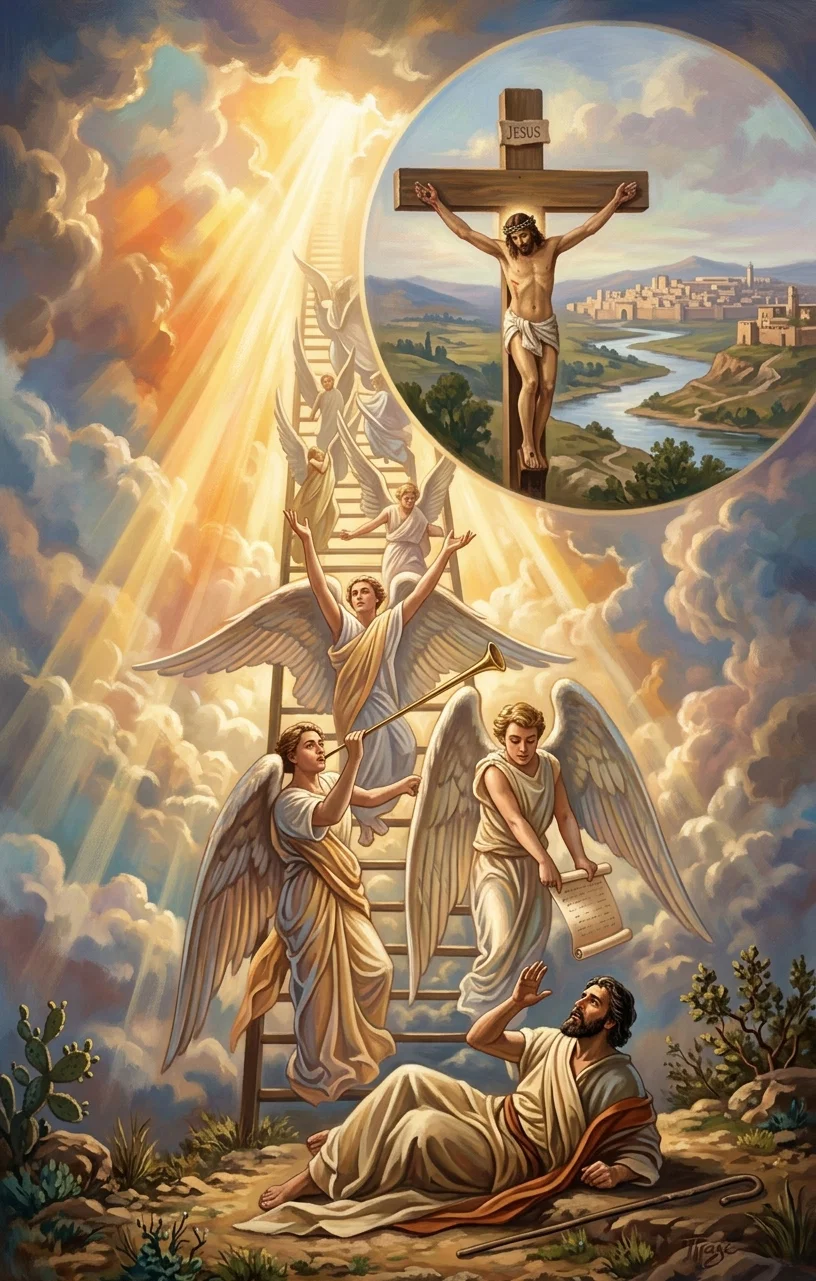
Christ is the ladder to heaven. The base of this ladder rests firmly on the earth, brought to the very level of humanity, while the topmost round reaches and rests firmly on the throne of God. Jacob saw the glory of God shining above this ladder, while the brightness of the Sun of Righteousness illuminated its whole length. Descending this ladder of shining brightness were angels of God, with communications to the inhabitants of this earth.
Only by Christ’s aid can we be saved. If by our own efforts we could reach heaven, Christ need not have left the royal courts, to come to a world all seared and marred by the curse, to be a man of sorrows and acquainted with grief, to be tempted in all points like as we are, and yet without sin. But we can reach heaven only by the mystic ladder, Jesus Christ; and He came to this earth that we might be enabled to do this. Here the battle between the prince of darkness and the Prince of light was fought, and here Christ conquered in our behalf. Of His own free will He laid down His life, that He might take it again; and to-day a living Saviour stands in the heavenly courts as our Intercessor, pleading for us, that through His merits we may be enabled to resist the temptations of the enemy, and be more than conquerors through Him. He knows how to succor them that are tempted, and to deliver the godly out of temptation. Surely He is “the Way, the Truth, and the Life.”
MRS. E. G. WHITE.

THE STABILITY OF GOD’S WORD.

THE reason assigned by the psalmist for loving God’s Word was a most excellent one: “Thy Word is very pure; therefore Thy servant loveth it.” Ps. 119:140. As given in the margin of the text, the word “pure” as used here means tried, or refined; that is, free from any tincture of adulteration, of whatever kind. It has no semblance of untruth, no element of weakness whatever. It is exactly what it purports to be, the Word of eternal truth. Coming from Jehovah Himself, it partakes of His nature, and reveals His will. His nature being love, and His will eternal righteousness, the Word is lovable and elevating to all who study its features.
It therefore follows that to add to that Word the sentiment of another, who has not this characteristic of purity, would be to change its nature and so make it false. He who would seek to change it in the least, would do so because it does not suit him in its present state. This would show him to be impure in sentiment and false at heart. Should he change the Word to suit him, it would then express his nature and his sentiment, which must be one of falsehood, since he does not agree with it in its pure condition. So, then, the warning of the wise man on this point is very timely: “Add thou not unto His words, lest He reprove thee, and thou be found a liar.” Prov. 30:6.
Every pure object has great virtues. One of the potent elements of God’s Word is its creative energy. This is well expressed by the psalmist: “By the Word of the Lord were the heavens made; and all the host of them by the breath of His mouth.” Ps. 33:6. Men form objects with their hands, from material within reach, after periods of labor. In the creation it was different; no material previously existed; no long period of time was consumed in laborious work; but the voice of God took shape, and a universe appeared where none previously existed. Bible writers are unanimous on this point. The audible breathing of God produced, and gave shape to, the physical universe. Thus we are taught by the simple words of Scripture that the creation was an instantaneous work. In confirming this idea, the writer of the Psalms continues: “For He spake, and it was done; He commanded, and it stood fast.” Verse 9. We notice that the word “done” in this text is printed in Italics to show that it was supplied by the translators, not being found in the original text. Reading this as it was first given, it tells us that “He spake, and it was;” that is, when God’s voice was heard, that which it called for instantly appeared.
Not only are we taught that the Word of God produced the worlds, but that His command caused them to continue as evidence of the creative energy of His Word. Speaking on this point the apostle testifies to Christ’s “upholding all things by the Word of His power.” Heb. 1:3. Then His is a Word of power, which not only created the worlds, but upholds them all in their courses. It is not necessary for God frequently to repeat the order of light and darkness, and the changing seasons, because that Word was spoken once for all at the beginning, when “He commanded, and it stood fast.”
As the worlds are the production of a God-breathed energy, so, too, the life of all creatures came from the same source. The record of man’s creation tells us this: “The Lord God formed man of the dust of the ground, and breathed into his nostrils the breath of life,” and so he “became a living soul.” Gen. 2:7. Adam lived by a God-breathed life; that is, his life and energy were forces received direct from the breath of God.
The breathing of God is, therefore, not only a creative energy, but the pulse-beat, as it were, of His own life. It quickens everything which it begets, or upon which it rests. So we are told that “all Scripture is given by inspiration of God.” 2 Tim. 3:16. Literally rendered, this would read, “All Scripture is God-breathed,” which would imply that the Bible itself is also endowed with the life and energy of God.
But as this God-breathed Word was to be for the benefit of man, who had lost the knowledge of God and His ways, it was necessary to breathe it through chosen ones who were in touch with the needy, and who could therefore impart it to them in its purity. Thus we read: “The prophecy came not in old time by the will of man; but holy men of God spake as they were moved by the Holy Ghost.” 2 Peter 1:21. So the Scriptures were not given as the mind of men directed, but the Holy Spirit,—the breathing of God,—moved them to speak and write as they did.
David tells how this was. He says, “The Spirit of the Lord spake by me, and His Word was in my tongue.” 2 Sam. 23:2. Independent of his own mind, the tongue of the holy man was operated by the Spirit,—the breathing of God,—and so the words expressed were purely those of the breath of God.
The living Word still has the same power, and is able to re-create man, and make him a new creature in Christ Jesus. See Eph. 2:10; 4:24; 2 Cor. 5:17. No other power can eliminate from the fallen one the gross uncleanness placed there by sin. One of old asked, “Wherewithal shall a young man cleanse his way?” The answer is quickly given: “By taking heed thereto according to Thy Word.” Ps. 119:9. It is the power of this Word that makes the Gospel potent to save; for the Gospel is “the power of God” (Rom. 1:16), and we have already seen that the power of God is revealed in His Word. Were not the eternal Word,—the breathing of God,—the foundation of the Gospel, it could have no power to save, because the Word of God is both the beginning and ending of power. But we are not left to logic to settle this question. Inspiration itself declares: “The Word of the Lord endureth forever. And this is the Word which by the Gospel is preached unto you.” 1 Peter 1:25. It is truly assuring to know that this Word of power which upholds the universe, will ever be available for man’s needs. Referring to the effect of that Word when proclaiming the law from Sinai, the apostle says: “Whose voice then shook the earth; but now hath He promised, saying, Yet once more I shake not the earth only, but also heaven. And this word, Yet once more, signifying the removing of those things that are shaken, as of things that are made, that those things which can not be shaken may remain.” Heb. 12:26, 27. From this we understand that God’s voice will sometime shake everything that has been made, which will be the removing of them. Every mountain and island will then be moved out of their places. Rev. 6:14–17. Only that which can not be shaken will remain. God’s Word has never been shaken, but has remained steadfast under all circumstances, therefore it will stand when every other support has been removed from men. At that time, those whose feet have been planted on the eternal Word will continue, even tho the foundations of the world itself have been removed. There is nothing so sure as the Word of God, upon which to build the hope of life.
“How firm a foundation, ye saints of the Lord, Is laid for your faith in His excellent Word; What more can He say than to you He hath said, Who unto the Saviour for refuge have fled?”
JOHN ORR.

THE VOICE OF GOD IN HIS WORKS.

The words and works of God contain lessons which are infinite and far-reaching. They teach the same truths, but in a different manner. In speaking of God’s works the psalmist writes: “Surely through this His universal temple everything speaks of His glory.” Ps. 29: 9 (Spurrell’s translation). The margin of our common version reads, “Every whit of it uttereth His glory.”
Thus, everything that God created in the universe, proclaims the glory of the Lord. In nature, as in the written Word, His character stands revealed. The mind clouded by sin, can not comprehend God, neither can it fathom the infinite teaching that His words contain. “Great is our Lord, and of great power; His understanding is infinite.” Ps. 147: 5. “Canst thou by searching find out God? canst thou find out the Almighty unto perfection? It is as high as heaven; what canst thou do? deeper than hell; what canst thou know? The measure thereof is longer than the earth, and broader than the sea.” Job 11: 7-9. Until man believes there is infinite instruction in every revelation of God, he can not properly appreciate God. He is not prepared to sit at Jesus’ feet, as did Mary, and learn of Him.
“The heavens declare the glory of God; and the firmament showeth His handiwork. Day unto day uttereth speech, and night unto night showeth knowledge. There is no speech nor language, where their voice is not heard.” Ps. 19: 1-3. These last words are quoted by the Spirit of God, to show that the heathen heard and recognized in nature the same Gospel that the apostle preached. See Rom. 10: 12-18.
“God is love,” and with Him there “is no variableness, neither shadow of turning.” Every manifestation of creative power is therefore an expression of infinite love. Wherever the sun shines, it proclaims the grace of Christ, that is manifested toward the righteous and the wicked. “Ye have heard that it hath been said, Thou shalt love thy neighbor, and hate thine enemy. But I say unto you, Love your enemies, bless them that curse you, do good to them that hate you, and pray for them which despitefully use you, and persecute you; that ye may be the children of your Father which is in heaven; for He maketh His sun to rise on the evil and on the good, and sendeth rain on the just and on the unjust.” Matt. 5: 43-45.
The rain, the fruitful seasons, and the sun, are witnesses of the Gospel of Christ. They were appealed to by the great apostle when preaching to the heathen. Acts 14: 15-17. The sun has ever proclaimed to the inhabitants of the earth that God is love, and has made it manifest to all men. Because man can not see attributes in nature which he thinks God possesses, this is no evidence that they are not there. With the heavenly anointing man may be able to behold it, for the Scriptures state positively, “The Lord God is a sun and shield; the Lord will give grace and glory; no good thing will He withhold from them that walk uprightly.” Ps. 84: 11.
The sun and its effects in the natural world, may therefore be studied as an object lesson of the character of the divine Redeemer. As extensive as the warm rays of the sun are felt, so the grace of Christ encircles this earth. The sunshine is the mightiest thing in the world. It enables the seed to germinate in the earth, and send up its little shoot, and bud and blossom in a beautiful, fragrant flower. It enables the rootlets to descend into the soil, and the leaves to unfold in the atmosphere, gathering from the air and the soil the elements out of which is builded the trunk, branches, leaves, and fruit of a noble tree. See Deut. 33: 14-16.
What Christ is to the natural world by the sun, He is to the spiritual and the moral world by His Word. All light emanates from Him. His Word brings to the human family all it receives. It was Christ who created the light on the first day of the week, and it was placed in the sun, which God created for that purpose; and He divided it “unto all nations under the whole heaven.” Gen. 1: 3, 4; Deut. 4: 19. It is thus the sun, the moon, and the stars become revealers of the character of our divine Redeemer, who is their Author. They become the object lesson of the greatness and the glory of God. When this truth is believed, the way is prepared for God to communicate to the heart the glorious truths of the Gospel by the luminaries of heaven. Christ, pointing to the sun, said, “I am the light of the world; he that followeth Me shall not walk in darkness, but shall have the light of life.” John 8: 12; 9: 4, 5; 12: 33-36, 46. “In Him was life; and the life was the light of men. And the light shineth in darkness; and the darkness comprehended it not. . . . That was the true Light, which lighteth every man that cometh into the world.”
These are some of the lessons the works of God proclaim to mankind; and they may be studied with profit; for in them the character of Christ is revealed. S. N. HASKELL.

“DID THE APOSTLES KEEP SUNDAY?”

The above question has been asked me several times, and, in reading the New Testament, I conclude they did not. I find that the Scriptures were read every Sabbath day. Acts 13:27.
There is only one meeting recorded as being held on Sunday (Acts 20:7), and that was a night meeting (Acts 20:8), after the Sabbath was past, on what we call Saturday night, and Paul continued his journey the next day on foot to Assos (Acts 20:13). This he would not have done had he observed it as the Sabbath, for it was more than a Sabbath-day’s journey, being about nineteen miles.
To offset this one meeting on Sunday, I find the following meetings on the Sabbath recorded:—
Acts 13:14-16 1 Sabbath-day meeting
“ 13:44 1 “ “
“ 16:13 1 “ “
“ 17:2 3 “ “
“ 18:4-11 78 “ “
Total 84 “ “
Now if the apostles kept Sunday, why did the Gentiles ask that these words be preached to them the next Sabbath (Acts 13:42-44) instead of the next day, which was Sunday? If meeting once on Sunday to break bread (Acts 20:7), proves it to be the Sabbath, then all days are proven to be sabbaths, for they continued daily breaking bread from house to house (Acts 2:46).
Every one claims the Ten Commandments as the law of the Jews. Paul said he had not offended against the law of the Jews (Acts 25:8), so he must have kept the fourth commandment. He also said, “I have committed nothing against the people, or customs of our fathers.” Acts 28:17. But it was their custom to keep the seventh day. Did Paul keep Sunday?—C. L. Clarke, in Sabbath Recorder.

Liquor Trade in West Africa

Rev. James Johnson, who has labored in the British Colony of Lagos, West Africa, for eighteen years, states that “packages of gin and rum were found everywhere. Large steamers loaded with liquor, lay at anchor; warehouses were crammed to the doors with gin; canoes were loaded with gin, highways and byways, the river bank, and the bush were littered with demijohns. The very soil of Abbeokuta seemed composed of broken bottles. At Aforjupa the seats in the churches were empty gin boxes.”

COME HOME.

Come home, come home, ’tis the Saviour’s voice Calling you out from this world’s alarms, From its sickness and sin to that heavenly choice, To the bosom of heaven, God’s yearning arms— Tenderly pleading through long, long years, Still interceding in sorrow and tears; Turn ye, O turn, from the world and its sin, Heed Him, O heed Him, come in, child, come in!
Come home, come home, from your hunger and wo, From the husks of the herds you’ve been feeding so long, To the River of Life, whose eternal flow Will laden your lips with a heart’s love-song— Home to the heart that was broken for you Far from the mart of the evil we rue, No more to sigh for the sins of the soul, Home, home with Christ, while the long ages roll.
C. M. SNOW.
Oakland, Cal.

Omnipotent Love

Love is the greatest conquering force in the universe. Here is a little bundle of flesh and blood that can not talk or walk, but it stretches out its tiny hands, and the strongest man is held a willing victim by that silken touch. We are very feeble and ignorant, it may be, but when we stretch out our hands to God He is taken captive by us. Love is omnipotent, and even Omnipotence Himself surrenders to it.—Rev. C. W. Gullette, Baptist, Cincinnati, Ohio.

Generosity

GENEROSITY.—To love to receive is natural; to love to give is supernatural. Generosity is divine; selfishness is Satanic.—Rev. J. C. Jackson, Jr., Congregationalist, Columbus, Ohio.

Nature’s Efforts to Erase Painful Impressions

“ALL the efforts of nature, during the early years of a healthy childhood, are bent on effacing and obliterating painful impressions, wiping out from each day the sorrows of the last, as the daily tide effaces the furrows on the seashore.”

God’s Gifts for Others

“We are at our best when we try to be it not for ourselves alone, but for our brethren; and we take God’s gifts most completely when we realize that He sends them to us for the benefit of other men who stand beyond us needing them.”

Contentment in Living on Little

THE greatest riches a man can possess consist in the ability to live upon little with a contented mind.—Lucretius.

INCREASE OF CRIME.

The rapid increase of crime in our land is without a parallel. The public prints are loaded with the most shocking recitals of blood and violence. In one State a young woman instigates her lover to murder his own father; and the two, after killing him, kerosened his clothes and set him afire. In another State three young men engage in a triangular duel over a young woman, on the way to a prayer-meeting, and all three are shot to death. And so the bloody record grows bigger and more awful every day.
Another sickening feature of the times is that people are coming to enjoy such reading; a morbid and prurient taste is thus fed, and a newspaper which prints the fullest details of crime with flaming headlines gains the largest public patronage. The press of to-day, with its daily record of evil, written up in a sensational and tragic style, supplies to the modern the satisfaction of the same desires which in ancient Rome were furnished by the gladiatorial contests in the arena. Worst of all, the reading of such things by those people, whom an eminent physician has lately described as “the physically unstable and viciously endowed, the neuropathic cripples, the mentally squint-brained and obliquely-visioned, the lame and halt and blind in mind and morals,” has a direct tendency to lead the readers to the commission of similar crimes. Thus the demand for this kind of reading actually contributes to a never ending supply of it. Surely to-day, as in the day of Noah, “the earth is filled with violence.”
The National Prison Association of Texas lately convened at Austin, in that State. A reporter of the Chicago Inter-Ocean, writing up this meeting, says:—
The report of the committee on criminal-law reform stated that the progress of crime is something frightful, and recommends that it should be checked by the following changes in the handling of the criminals of the world: Greater security of punishment, doing away with all technicalities in trials; abolishment of juries, making conviction more summary and trial more speedy; depriving defendants of the right to appeal to a higher court; offering rewards for the discovery and conviction of criminals; sterilization of defectives, both moral and physical; abolishment of poverty; removing or restricting the power to pardon; prohibiting the use of intoxicating liquors; reconstruction of the ethical code of lawyers; curing inherent defects in the law as distinguished from its enforcement; developing a scientific motherhood; state regulation of marriage; restricting immigration; popular education and colonization of criminals; the reformation of criminals by the abolition of the definite sentence.
Some of the above suggestions can be carried out; others are entirely impracticable; and none of them will do what is hoped will be done—eliminate, or even to any appreciable extent lessen, crime.
We are living in the last days, when, according to the predictions of the Word of God, “evil men and seducers shall wax worse and worse.” God alone has a sovereign remedy for all the evils of this age. It may be found in the Gospel of His Son. Whoever, in his plans of reform, leaves out the Gospel, is at once shorn of the highest power. All other powers are human; they depend upon human efforts. The Gospel is divine. It brings to the soul that accepts it the very strength of God both to resist evil and to do good. He who expects to stand firm against the temptations that are in the world without divine assistance, will surely fail, and did not the Spirit of God still strive with men, keeping them oftimes, even against their inclinations, from crime, the world would be in a far more deplorable condition than it now is.
In the days of Noah, which these days so much resemble, God said, “My Spirit shall not always strive with man.” There is a limit even to the wonderful long-suffering and forbearance of God. Now, as in the days of Noah, His Spirit pleads. But as the day God had appointed for the deluge came on, the Spirit of God was gradually withdrawn from those who had slighted it, and they were left to destruction. So will it be in the end of this world; so it may be even now. How else can we account for the frightful increase of crime on every hand, Let us cherish the Spirit of God; only in so doing is there safety. M. E. K.
Continue reading: GOD’S WAY VERSUS MAN’S WAY