In my work as evangelist I have had quite as much experience with those who professed utter disbelief, even atheism, as any other class of people. This will be understood when it is remembered that the influence of strong drink is to entirely destroy the knowledge of God and faith in Him.
But not all of these unbelievers have been drinking men. One notable case has been coming to my mind for several days as I have been thinking of preparing something for the SIGNS OF THE TIMES. The name is well known and must be covered by a fictitious one.
It was at a summer assembly. Mr. Z. and I were talking together concerning the work in which we were colaborers. We had never met before, but had known of each other, the lines of our engagements in temperance work often lying close together for a long period. He had asked to have an interview in which to compare notes, he wishing especially to know more about my special work for the hopeless classes. We sat on the lawn in front of the hotel, and something which I said caused him to reply, “But, Mrs. Henry, you must talk so that a man who is not a Christian can understand.”
“A man who is not a Christian,” I said, “you? If you are not a Christian, what are you?”
“I am known by those who know me, as an unbeliever, an infidel, an atheist.”
“An unbeliever! an infidel! an atheist! how can that be? How can you be in the temperance work then?”
“Because I believe in the temperance reform.”
“But,” I said, “how can you go on in the temperance reform without even believing that there is a God? I am astonished; a man like you! There must be a reason for it. Tell me what brought you to this.”
He sat a moment, silent, and then said: “Pardon me, but this is something about which I never talked to any one. I have too much regard for my wife and her convictions to speak against anything which is sacred to her.”
“Then if you should say anything about it, it would be against it?”
He looked earnestly into my face, but did not reply.
“I understand,” I said, “I do not think that I can continue this conversation about the work: I am too much hurt. I could not think of anything else to say just now, so I must leave you.”
THE GOLDEN GATE.
I arose and turned away, had gone a few steps, when he recalled me, saying, “Don’t go like that; come back; come to think about it I believe I would like to tell you.”
I returned, seated myself, and waited. He began with his early life, and told me how he had been brought up in a formal Christian home; how he had been, as he supposed, converted when he was a child; had united with the church; but the atmosphere in which he was required to live as a young Christian took all the zeal and spirit out of him. He made up his mind that the leaders of Christian thought and experience with whom he was acquainted did not believe what they professed; and doubts began to arise which led him into an investigation of the subject, as it is to be found in the writings of men, instead of God. In the course of years he had read nearly everything which modern skepticism had produced, as well as any amount of earlier literature of the same class. He had made a practise of taking two or three volumes in his satchel as he had been going on his circuit as lawyer and judge, and later in his temperance work, reading until his mind had become filled with the arguments against Christianity, while all the time the desire of his heart was to know the truth. At last he found that the more he read the more bitter, censorious, and wicked he became; and he had some time before decided never to read another line upon this subject, never to discuss it, to live a life as honorable as he could, but to let dogma of every sort alone.
As a consequence of these investigations, the faith with which he started out had given place to an absolute unbelief. He said:—
“I can but admire the beauty of a genuine Christian life, consistent with the theory of Christianity, wherever I find it. I have seen it in the Woman’s Christian Temperance Union. Many times I have thought, If I were only a woman, I could be a Christian. I have longed to come into the experience which some of you women have; and as I have read of the work which has been done in Gospel lines from the crusade until now, my heart has warmed, and I have thought that it was blessed to believe; but the power to believe is dead in me. I can also see the logic of Christianity. Granted that there is a God, the Christian scheme is the only way out. But I can not find any evidence anywhere that there is a personal God. I can not conceive of a disembodied person, and since a spirit in a body could not be omnipotent and omnipresent, as Christians believe God to be, the whole subject is so impossible, so dark with uncertainty and doubt, and yet so peculiar in its relations to man, that, as I have said before, I must decline, as a rule, to discuss it. But now if you have anything to say to me, I would be glad to hear it, since you know the worst.”
I replied: “I can not think of entering into discussion. Argument will never reach your case. The only thing which I am able to bring to you concerning this matter is personal testimony.”
(To be continued.)
“JUST AROUND THE CORNER.”
By Blanche Bailey King
“Was you goin’ to throw them flowers away, ma’am?” Jane was standing in the middle of the room, duster in hand, watching me attentively, as I listlessly refilled a bowl with fresh roses, tossing the others on the table, though they were scarcely withered at all. What did it matter? The conservatory was full of flowers.
“Yes, you may gather them in a paper and take them, Jane,” I replied, wondering a little at the girl’s sudden interest.
“Would it be all the same to you, ma’am, if I kept ’em?” she asked, as she carefully placed them in the paper.
“Do what you like with them,” I answered, turning away. Dropping wearily into my chair, I took up my book again, when something—O, these mysterious “somethings”—made me look up! She was standing at the table carefully holding the paper of flowers and gazing intently at me with her honest blue eyes.
Jane was a typical Irish girl, and her blue eyes with their dark lashes, and her black hair, together with her Irish brogue, had always attracted me—that is, until lately; nothing interested me now.
“What are you going to do with the flowers?” I asked, struck, in spite of myself, by her expression. Her face lighted up instantly; she was evidently waiting for just that question.10
“They’re for the Donnelly baby, ma’am. It died yesterday, and the mother, poor soul, she do hate to bury it without a sign of a flower at all.”
“Donnelly,” I said, wonderingly; “who are they, and where do they live, Jane?”
“Why, ma’am, she’s your own wash-woman, and she lives just around the corner, like. Her man is a poor stick of a lad. [Jane called all her men acquaintances “lads,” regardless of their ages.] She’s five children left. She’s a good, dacint woman, and it’s a hard time she’s havin’.”
“Tell James to cut you a box of fresh flowers,” I said, “and tell Mrs. Donnelly I am very sorry for her.”
Thinking this settled the matter I resumed my reading. Still Jane lingered; I felt her eyes upon me, and impatiently laid down my book and looked up at her. There were actually tears in the girl’s eyes as they looked appealingly into mine.
“O Mrs. Grant,” she said, and her voice trembled, “will ye excuse me if I make bold to ax a favor of ye?” In her excitement she had unconsciously dropped into the Irish brogue she was gradually losing. “Wouldn’t ye be willin’, just this once, to take in the flowers your own self? She’d be that plazed, and she’s little enough to plaze her, God knows. I wouldn’t ask ye, but she’s a nate, cleanly woman, and”—here Jane hesitated, watching me closely—“she was so sorry for you, ma’am.”
And with this last remark she left the room softly, and, decidedly surprised and rather annoyed at her unusual behavior, I again opened my book. But it was no use; I could not read. The pathetic little story of the dead child “just around the corner” brought back so vividly my own grief, for only a few weeks ago my darling baby was buried! I could see her now, lying in a bed of flowers, her little hands clasping a tiny rosebud, and the grave in which it was so terrible to leave her, a bank of the choicest flowers.
Now “just around the corner, like,” as Jane expressed it, was this other baby with no flowers—no daintiness. But such people are so different, I argued with myself. She can’t miss her baby as I do mine. She has five children left, and I have—nothing. Then I thought of my husband, who was such a tower of strength to me, and of the loving sympathy of so many friends, and, selfish as I was, I had the grace to feel ashamed. This woman’s husband was evidently worthless, from what Jane said. Well, the girl would take her the flowers, and I had done my part. So I opened my book again, and read the same page over and over.
Why did the words of a simple Irish maid ring so persistently in my unwilling ears: “She’s little enough to plaze her, God knows?” I closed the book with a bang and flung it on the table, and rang hastily for Jane. She came instantly with an eager, expectant look on her face.
“Put on your hat, Jane, and come with me quickly before I change my mind. We’ll take the flowers to Mrs. Donnelly.”
“The Lord be praised, ma’am!” she ejaculated with Irish fervor. “She’ll be proud indade to think a lady like yourself has thought of her.”
With the memory of my baby as I saw her last so plainly before my eyes, the pathos of that little figure in its cheap pine coffin was beyond description. It would have been a pretty child had its face not been so thin, or so prematurely old. The dress it wore was white as snow, tho very coarse, but what made the tears roll down my cheek, was the poor, faded little bunch of artificial flowers clasped in its hands. O, the pity of it! And only “just around the corner” I had more flowers than I knew what to do with, flowers to throw away. I sent Jane home for all she could carry, and for the first time for weeks I felt thankful for one of my blessings.
Very sweet the little “Donnelly baby” looked when we had heaped flowers around it, till the hard pine wood was covered, and the thin hands clasped a lovely white rosebud. Then the poor, tired, hard-working mother (who could not take time for the luxury of grief) and I stood and wept together, as we looked at the little one so peacefully resting there.
“You did all you could for her,” I said gently, remembering the comfort which that thought had given me,—the remembrance that nothing had been left undone to save my child.
“I did the best I could,” said this poor mother, sobbing piteously. “But the doctor ordered good food that I couldn’t give her. See how thin she is. She might have been saved. That makes it so much harder.” And I, a neighbor, had plenty!
I learned a lesson that day too bitter to be easily forgotten. The “Donnelly baby” had not died in vain. Mine was rapidly growing into a case of chronic selfishness and morbid grief, and needed just the heroic treatment it received. “Through the mouth of babes” we are often taught, and my little Irish maid had taught me as no one else had done. I hope never again to forget that “just around the corner” there is some one who needs just what I can give.—Blanche Bailey King, in the New York Observer.
BABY’S PRAYER.
By Will T. Hale
IN looking backward now they come to me—
The scene, the shadows, and the summer air;
His little head low bowed upon my knee.
As sweetly offered he his baby prayer:
“B’ess papa, an’ my ma, an’ all who need,
An’ make of me a dood boy, I am p’ayin’.
An’ if at firs’, dear Dod, ’ou don’t sutseed,
Den twy, twy again!”
I smiled—but on the smile there also went
To God another simple prayer from me,
Repeated now, with teardrops sadly blent,
For the dear boy wherever he may be:
“If he should stumble in the untried way,
Still plead with Thy dear Spirit from aloft:
Be patient should his feet be led astray,
Not once, not once, but oft!”
—Will T. Hale.
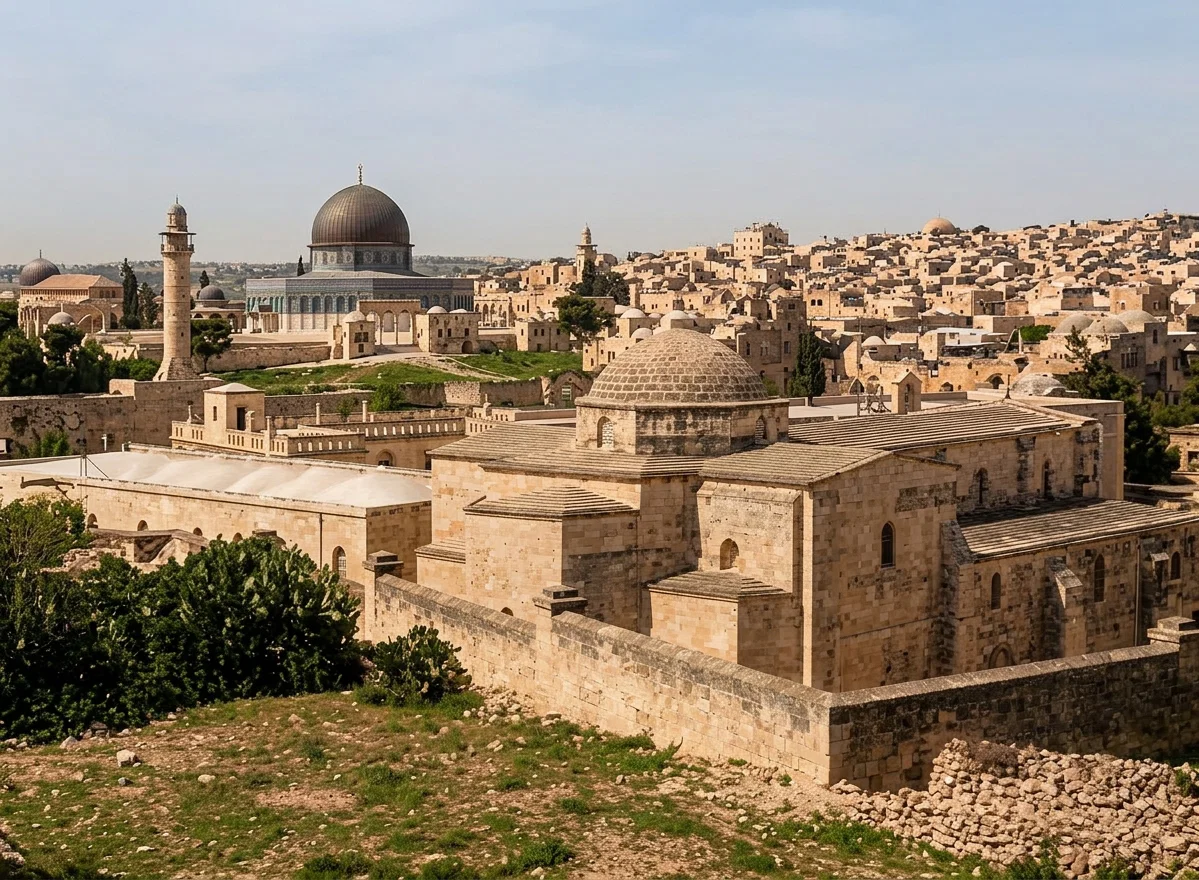
JERUSALEM
By W. N. G.
The Old Story of Persecution.
It is still literally true in Jerusalem that men are put out of the synagogs and otherwise persecuted for believing in Jesus of Nazareth. We have before mentioned the Christian Union Mission, conducted by the noted Jewish Christian, A. Ben-Oliel, and several assistants. This mission is especially the object of bitter enmity on the part of the rabbis. They often placard the gates of synagogs and schools, and even the doors of private houses, with interdicts full of curses and threatenings against all Jews who go to the mission schools, the hospital, or near the missionaries; but the strongest of these are against the work of the “pervert” Ben-Oliel.
All who persist in listening to his teaching have been threatened with the publication of their names by placard, expulsion from the Jewish community, and all sorts of bad consequences. Spies were set around this mission to note all who would go in. Jewish friends of the mission tore down some of these placards, but they were soon replaced. While this11species of persecution was at its height, says a correspondent, “the only papers published in all Palestine (and both are in Hebrew) contained leading articles, letters and comments, on these rabbinic interdicts—all, of course, upholding the authority of the rabbis. One leading article was headed, ‘What Shall We Do against the Missions?’ and the answer practically is, ‘Send us larger sums of money, that we may entice them away from the missionaries.’”
While this excitement was running high, a quite prominent rabbi went to the Ben-Oliel Mission and had a long conversation on the subject of the Messiah. He was detected by the spies and called before the rabbinic court, where he was severely censured and made to promise that he would not go there again. The general result, however, is that while some are turned away for a while, more new-comers are reported than before.
Nabi Mussa Pilgrimage.
Unlike the olden time, Jerusalem is now holy ground to the followers of Mohammed, as well as to the Jews, and some classes of professed Christians. To the Mohammedans Jerusalem is second only to Mecca or Medina, to which cities they flock in thousands every year as pilgrims. A press correspondent says:—
Not far from Jericho, and overlooking the Dead Sea, there is a chapel on the top of a hill to which Moslem tradition points as Pisgah, the burial-place of Moses. To this hill they resort yearly in large numbers during Passover week. The procession starts from Jerusalem accompanied by the governor, soldiers on foot and on horseback, military bands, and the sheiks (holy men) of the city. It is a grand display, and almost all the Moslem inhabitants—men, women, and children—clad in their best, go and sit on the declivities of Mount Moriah, facing Olivet, to witness it start. I saw it last spring, and heard the military salute from cannon brought out for the purpose.
This Nabi Mussa pilgrimage is a sort of open-air picnic, and it is said that, contrary to the Koran prohibition, strong drinks are indulged in, especially on the return journey. Apprehensions of this kind have not been infrequent of late, particularly when the army reserves or militia have been called out to assemble in the outskirts of the city.
W. N. G.
AFTER FRUIT.
AMONG the seven trades which a student in mechanical engineering must learn at Cornell, is that of the blacksmith. Occasionally there is a protest, but it is never heeded. One dude ten years ago was unusually averse to soiling his hands. But he had to work at the forge just the same. This fall he came to Professor Morris and thanked him for being compelled to learn blacksmithing. “Why?” asked the professor. “Why, you see,” replied the former dude, “I am now superintendent of a mine, away back in Colorado. Last summer our main shaft broke, and there was no one in the mine but myself could weld it. I didn’t like the job, but I took off my coat and welded that shaft. It wasn’t a pretty job, but she’s running now. If I couldn’t have done it, I’d have had to pack that shaft on a mule-back and send it 300 miles over the mountains to be fixed, and the mine would have shut down till it got back. My ability to mend that shaft raised me in the eyes of every man in the mine, and the boss raised my salary.”
A GOLDEN PAGODA.
AT Rangoon, the capital of Burma, is situated the famous golden pagoda of a Buddhist temple, the whole of the exterior of which is one mass of shimmering gold. This generous coating of the metal is the result of years and years of votive offerings to Buddha, for devotees from all parts of the world go to Rangoon and take packets of gold-leaf, which they place on the pagoda. During the last century Tshewbyo-Yen, the king of Burma, gave his weight in gold to the walls of the pagoda, an offering worth $45,000.
A Born Debater
“O, HE’S a born debater! There is nothing he likes better than an argument. He won’t even eat anything that agrees with him.”
“TAKE MY HAND.”
By J. G. Whittier
A TENDER child of summers three,
Seeking her little bed at night,
Paused on the dark stairs timidly,
“O mother, take my hand,” said she,
“And then the dark will all be light!”
We older children grope our way,
From dark behind to dark before;
And only when our hands we lay,
Dear Lord, in Thine, the night is day,
And there is darkness nevermore.
—J. G. Whittier.
HUMAN PROPS.
TO THOSE earnest but misguided people who think the cause of God needs propping up, supporting or promoting by government aid or religious legislation, the following from the Sunday School Times is especially commended:—
When Luther was at Coburg, watching the proceedings of the Diet of Augsburg—which he, as an outlaw, dare not attend—he made a noteworthy discovery. Looking out of his window one night, he saw the stars bestud the canopy of the sky, and, tho there were no pillars to prop them up, they kept their place, and the sky fell not. Of this discovery, he writes to his friends at Augsburg, to uphold their faith in one of the darkest hours of the Reformation. Charles V. had got through with his wars in Italy, had made peace with France, and now had his hands free to put down Protestantism. He was brushing aside the Augsburg Confession as an impertinence, and telling the Protestant princes that by next spring they must restore the old order of things in their dominions, or be outlawed, as Luther was. Truly, the sky seemed to be falling at Augsburg, and timid men in the party of reform were longing for a good, stout prop to hold it up. Luther felt that, if it was God’s cause, he could leave the matter to Him. “We plainly tell our Lord God,” he said on another occasion, “that, if He will have His church, He must see to it, for we can not, and, if we could, we should be the proudest asses under heaven.” And the Lord did see to it. Before the emperor could take a single step to enforce the policy he announced at Augsburg, the sultan was coming up the Danube valley with his myrmidons. To drive him back the forces of a united Germany were needed, and the Protestants had to be conciliated, not coerced.
OUR WORK AND WORKERS.
At Temple, Clare County, Mich., December 12, a church of ten members was organized by Brother W. R. Matthews.
Brother P. L. Hoen, who is laboring among the Scandinavians in Michigan, reports accessions at South Frankfort and Manistee.
General meetings for Montana are announced for the present month, as follows: Great Falls, 3–8; Helena, 10–15; Missoula, 17–22; Bozeman, 24–29.
In the West Indies and adjoining islands there are about eight hundred Christian people who observe the Sabbath “according to the commandment.”
Of the cause in Jamaica, Brother C. A. Hall says: “The work is going rapidly despite the obstacles in the way. Every element of heathenism, save ferocity, is to be met.”
At Springfield, Ohio, Thanksgiving day, two sisters gave a dinner to sixty-six little urchins, besides sending out thirty baskets of groceries, etc., to poor families.
Brother J. F. Ballenger writes from London, Ontario, to Field Echoes that “the truth is working like heaven. . . . The health food manufacturing enterprise is a success. The grocers and doctors are doing all they can to encourage the sale of these foods.”
Brother W. T. Knox, president of California Conference, returned on the 24th inst., from the council of conference presidents and representatives of the Medical Missionary and Benevolent Association at Chicago. Plans were recommended by the council for co-operative labor on the lines of medical missionary and Christian help work, now commanding the attention of our brethren, especially in the larger cities.
The Minnesota Worker says: “The librarian at Stewartville, with her husband, is working for the street boys. They gather them in and give them a pleasant evening once a week, and try to instruct and help them.”
Any one who has a house can do likewise, and—
“O, the good we all may do,
While the days are going by!”
The first public meeting ever held by our people in Swansea, Wales, was held November 15 last, by Brethren E. J. Waggoner and J. S. Washburn. Most of those in attendance, however, had been readers of Present Truth. There were so many questions asked that it was necessary to continue some time after the meeting proper had been dismissed.
Brother F. L. Moody reports as partial results of meetings held at Birmingham, Iowa, that twelve adults have decided to obey the commandments of God. The Sabbath-school numbers thirty-five. The schoolhouse where his meetings were being held was about to be closed against him, but the directors of an adjoining district were anxious to have him occupy their house. So “all things work together for good to them that love God.”
Brother J. H. Durland, president of Michigan Conference, makes this call: “We want one hundred and fifty men and women to sell our books in the State of Michigan. We want fifty men and women to sell our books in the province of Ontario. We do not want persons who can not endure hardships. We do not want those who only desire to make money. But we do want men and women who are not afraid to work ten hours a day if necessary, and who have the missionary spirit.”
We hear of special manifestations of the Spirit of the Lord in connection with our institutions, which indicate that they are of His planting, and that He is anxious to work through them. In reporting recent district conference at South Lancaster, Mass., to the Indicator, Brother A. E. Place, president of New York Conference, says that one Sunday evening, at the close of a preaching service, “nearly one hundred came forward for prayers. A large number of these were students from the academy. Several came seeking God for the first time. As I saw these dear souls, with tender hearts, coming to the front to seek forgiveness of sins, some of them small boys and girls, the thought came to me, What would this sight be worth to their parents who are here and there through this district? Fathers and mothers, God hears your prayers and counts your tears for your children. Angels of God are working for their salvation. Angels are standing by the side of teachers in the school, working through them to lead souls to Christ.”
In a report in the Kansas Worker, by Brother G. G. Rupert, we note these items: At Liberal, Sister Rupert took forty orders for the SIGNS. At Preston, four persons were baptized and a club of SIGNS ordered. At Lawndale, one was added to the church. At Eldorado, seventy-five subscribers were secured for the SIGNS and nine were added to the church. To this he adds, “There are openings ahead, and most earnest appeals for labor.”
Brother O. O. Farnsworth is now laboring in the island of Trinidad, in company with Brother E. W. Webster. By private sources we learn that the yellow fever is epidemic, and all our brethren are at present quarantined. With this comes the sad news of the death of Sister Webster from the yellow plague, wife of Brother E. W. Webster. He has our heartfelt sympathy, and we pray God to give him the needed grace. In a little while and there will be no more death.
The Missionary Magazine (a continuation of the Home Missionary) is out in popular magazine form and is issued from the office of the Seventh-day Adventist Foreign Mission Board, 1730 N. Fifteenth Street, Philadelphia. The January number is filled with live missionary matter, of interest to all who love to see the Gospel of the kingdom going to all nations. J. E. Jayne, secretary of the board, is editor, and L. T. Nicola is associate editor. The new magazine is issued monthly, at 25 cents a year; to foreign countries, 50 cents.
Brother Frank Richards arrived in this city from Chicago on the 23d ult., for the purpose of inaugurating rescue mission work here or in San Francisco, or in both places. In connection with conference officers and other leading brethren he is looking over the ground and preparing for active work at once. On Sunday evening, the 26th ult., Brother Richards spoke to an enthusiastic audience in the Seventh-day Adventist Church in this city, and there is a quite general determination to support the enterprise in every possible way. In fact, it was because of the desire of this church and the publishers of the SIGNS OF THE TIMES to inaugurate such a work that Brother Richards was invited to come to the coast. He has made a success of this kind of work in Chicago, and comes to this field fresh from victorious efforts in behalf of the fallen. There were various other openings before him, but he decided to give these cities the benefit of his practical experience. The spirit of this work is moving upon our brethren in other cities, as they realize that increasing poverty calls for more urgent efforts for the relief of the suffering.
36 “And after some days Paul said unto Barnabas, Let us return now and visit the brethren in every city wherein we proclaimed the Word of the Lord, and see how they fare. And Barnabas was minded to take with them John also, who was called Mark. But Paul thought not good to take with them him who withdrew from them from Pamphylia, and went not with them to the work. And there arose a sharp contention, so that they parted asunder one from the other; and Barnabas took Mark with him, and sailed away unto Cyprus; but Paul chose Silas, and went forth, being commended by the brethren to the grace of the Lord. And he went through Syria and Cilicia, confirming the churches.”
1 “And he came also to Derbe and to Lystra; and behold, a certain disciple was there, named Timothy, the son of a Jewess which believed; but his father was a Greek. The same was well reported of by the brethren that were at Lystra and Iconium. Him would Paul have to go forth with him; and he took and circumcised him because of the Jews that were in those parts; for they all knew that his father was a Greek. And as they went on their way through the cities, they delivered them the decrees for to keep, which had been ordained of the apostles and elders that were at Jerusalem. So the churches were strengthened in the faith, and increased in number daily.”
6 “And they went through the region of Phrygia and Galatia, having been forbidden of the Holy Ghost to speak the Word in Asia; and when they were come over against Mysia, they assayed to go into Bithynia; and the Spirit of Jesus suffered them not; and passing by Mysia, they came down to Troas. And a vision appeared to Paul in the night: There was a man of Macedonia standing, beseeching him, and saying, Come over into Macedonia, and help us. And when he had seen the vision, straightway we sought to go forth into Macedonia, concluding that God had called us for to preach the Gospel unto them.”
11 “Setting sail therefore from Troas, we made a straight course to Samothrace, and the day following to Neapolis; and from thence to Philippi, which is a city of Macedonia, the first of the district, a Roman colony; and we were in this city tarrying certain days. And on the Sabbath day we went forth without the gate by a river-side, where we supposed there was a place of prayer; and we sat down, and spake unto the women which were come together.”
QUESTIONS.
1. Give a statement of the cause, the work, and the result of the general meeting held in Jerusalem.
2. Where did Paul and Barnabas labor immediately after the meeting?
3. After some days, what proposal did Paul make to Barnabas? Acts 15:36.
4. What did Barnabas determine to do? V. 37.
5. What objection had Paul to this plan? V. 38.
6. What was the result of this disagreement? Where did Barnabas go with his chosen companions? Verse 39.
7. Whom did Paul select to labor with him? V. 40.
8. Where did they go? Verse 41.
9. After passing through Syria and Cilicia, to what place did they come? Whom did Paul find at Lystra? Chapter 16:1.
10. What do we know about this young man? Verses 1, 2.
11. What did Paul wish? What did he first do? Why was this done? Verse 3.
12. As they went through the cities, what did they do? Verse 4.
13. With what result? How often were additions made to the churches? Verse 5.
14. What countries did the apostles next pass through? What were they forbidden to do? By whom? Verse 6.
15. Where did they then go? In what province did they then think to preach? Why did they not do so? Verse 7.
16. To what place did they then come? Verse 8.
17. While at this place, what appeared to Paul in the night? What was the vision? Verse 9.
18. After this vision, what did Paul and his companions immediately set out to do? Of what did they feel assured? Verse 10.
19. By what course did they sail to Macedonia? Verse 11.
20. Having reached Macedonia, what important city did they first visit? Verse 12.
21. Where did they go on the Sabbath day? What did they do? Verse 13.
NOTES AND QUESTIONS.
1. Is the example of the apostles alone an infallible guide? What evidence can you give? What must back their example, in order to have it of authority? Whose example may be followed implicitly? 1 Peter 2:21, 22; 1 John 2:6.
2. In circumcising Timothy, did Paul go contrary to his position before the meeting at Jerusalem? What was the difference between the reason for which he circumcised Timothy and that given by the men who came from Judea to Antioch? What positive statements does Paul in his epistles make concerning the nature and value of circumcision?
3. “Forbidden of the Holy Ghost to preach the Word in Asia.” As a matter of fact they were in Asia all the time, that is, they were in the continent of Asia; but as used in the Acts, the word “Asia” signifies what is known as Asia Minor—the extreme western part of the continent. In Biblical maps this portion of the country is designated as Asia.