PRINTING, that mighty engine which the fifteenth century had invented, seconded all these efforts [by the Reformers], and by means of its powerful projectiles was continually making breaches in the walls of the enemy. What Luther and his friends composed, others disseminated. . . . In towns, burgs, and even villages, Luther’s writings were read in the evening at the fireside, or in the house of the schoolmaster. Some of the inhabitants were struck by this reading. They applied to the Bible to clear up their doubts, and were astonished when they saw the strange contrast between their Christianity and the Christianity of the Bible. Hesitating for a time between tradition and the Holy Scriptures, they took refuge in that living Word, which shed a sudden and delightful light on their souls. After reading these writings, the people, or their leaders, frequently wrote for some man of known faith to come and enlighten them.— Selected.
Present Attainments
If you allow yourself to rest satisfied with present attainments, however respectable they may be, your mental garments will soon look threadbare.— Anon.
Trust
O TIRED heart!
God knows;
Not you, nor I,
Who reach our hands for gifts
That wise love must deny.
We blunder when we fain would do our
best,
Until a-weary; then we cry, “Do thou
the rest!”
And in his hands the tangled threads we
place
Of our blind weaving, with a shamèd
face.
All trusts of ours he sacredly will keep.
Rest, tired heart; God knows; go thou
to sleep.
— Selected.
How to Cure a Headache
By David Paulson, M. D.
DAVID PAULSON, M. D.
Every one should know the following harmless yet efficient treatment for headache: Take a Turkish towel, wring it out of hot water, fold it in several thicknesses over the face in such a way as to leave the nose exposed so the patient can breathe. At the same time put another towel wrung out of ice-water over the top of the head, and have the patient lie down with an ice-bag to the back of his neck. In ordinary cases this will relieve the headache in a few moments, because it lessens the congestion in the head. It must never be forgotten that headaches are often due to eye-strain, and often to the excessive use of flesh foods, to tea and coffee, and to other dietetic sins.
The longer one uses an artificial remedy, the less effect it has, while the longer a natural remedy is used, generally speaking, the more effective it becomes. For example, morphin will relieve pain quickly, but at the same time it puts the brakes on all the bodily functions; it relieves the pain by cutting off the nerves for a time, so they can not signal their misery to the brain, just as burglars often cut the telephone wires. But when the effect of the morphin wears off, the abused nerves shriek out their misery all the louder; and hence it requires a larger dose next time to produce the same effect, until the amount that can be taken by a drug slave is amazing.
My Neighbor’s Way
New neighbors are always interesting, and a great deal may be learned from them. Mine is a frail little woman with three hearty children, and a robust, happy-looking husband. She keeps her pretty house in order, and her pretty children trim and neat. The frequent whirring of her sewing-machine attests to her doing her own sewing. Yet she finds time to look very comfortable and pretty on her porch in late afternoons and evenings, and to be friendly and social.
When I became well enough acquainted, I could not resist asking her how she did it.
“Indeed I do not mind telling you,” she said with a smile. “I am never very strong, and last year I was threatened with a serious breakdown. Plan the best way I could, the work for a family of five was becoming too much for me, yet I did not feel that we could afford hiring much done. ‘I could stand the housework if it were not for the cooking,’ I told my husband when we talked it over, ‘but when I am tired from the morning work, it seems as if I could not get dinner!’”
“Why not simplify the meals then?” he suggested; “leave out the salads and cakes and desserts that take so long to prepare. We shall be just as well off, and it will be better for the children.”
“At first I thought this impossible, as we are all so fond of such things; but the more I thought of it, the better the plan seemed to be.
“We have fruit and grains for breakfast, with one warm, substantial dish, fresh brown bread and butter, milk for the children, and cereal coffee for us grown-ups. We do not miss the absent cookies and doughnuts.
“We have our dinner at one o’clock. This meal consists of a simple soup, potatoes, and one other vegetable. The dessert is varied; sometimes it is fruit and cream with bread and butter. We frequently use custards; at other times nuts or home-made candy; and occasionally dried fruits, such as raisins, figs, and dates. At supper we let bread and butter with fruit take the place of the time-honored cake.
“On special occasions such as holidays and birthdays we have a cake with beautiful icing, or a real pie with two crusts, and value it accordingly.
“All this makes a great difference with my work. I have almost forgotten the trials of baking day, and I am sure we all feel better for our simpler living. The increased amount of fresh fruit and vegetables is very good for us, and our desire for sweets is satisfied with something simple and wholesome. I wish more busy mothers would give my plan a trial; for in this case ‘seeing is believing.’”—American Motherhood.
Drinking Water
Not long ago the writer was on an interurban car, when the conductor, who had just finished collecting the fares of a carful of people, left the car at one of the stops, and returned with a large piece of ice in his hands, which he placed in the water-cooler. He carried the ice in his hands, which were black with dirt, and when the ice stuck in the top of the cooler, he pounded it with his fist until it went in. Hardly had he left the cooler, when a nicely dressed woman with a little child walked up to the faucet, and both took a drink, others soon following their example. Scientists tell us that money contains millions of bacteria, many of them the disease-producing kind. This conductor by handling money had many of these bacteria on his hands; and when he handled the ice, these were washed off into the water-cooler, together with the other dirt. This being true, think of the danger to those drinking the water.
Then, too, the public drinking cup is a spreader of bacteria. Sit in a railroad car, and watch the different people who drink from the same cup. Some of them show unmistakable signs of disease, often of the worst nature, and when they drink from the cup, they are apt to leave germs on it that will contaminate the next person who drinks. So great a source of danger is this, that many States have passed laws abolishing the public drinking cup. All States should have such laws. But even with individual cups, if the water in the cooler is contaminated, there is danger of contracting disease. It is better not to drink water on trains. One can afford to deprive oneself of water and suffer a little thirst, rather than drink foul water, and run the risk of disease.—Farmer's Guide.
Curing a Cold in a Day
By David Paulson
If you want to cure a cold in a day, you must get after it the very first day that it sets in, otherwise it is likely to run its course. If it has settled on the chest, take a hot foot-bath in the evening and hot fomentations to the chest; follow by a heating chest pack to be worn overnight, arranged on the same plan as the heating compress for the joints. Wrap up warm in bed, and leave the windows wide open.
Or if you feel chilly all over, take a general hot blanket pack in the evening. Finish off with a cold-mitten friction, and go to bed immediately. These treatments translate the individual for the time being almost into the kingdom of health.—David Paulson, M. D.
Anhwei Province, China
By Frederick Lee
FREDERICK LEE
One bright day last May we were coming down the Hwai River. The brightness of the day was in marked contrast to the spiritual darkness and terrible needs of the people surrounding us for hundreds of miles. We had almost forgotten, for the moment, the misery and distress among the people, but their sad condition was forcibly brought to mind as we sailed past a village. Here were gathered hundreds of people, eagerly waiting for something, we knew not what. Looking ahead of us, we saw hundreds of Chinese coming from every direction. As far as we could see, men, women, and children were hurrying as fast as they could toward the village. Boats of many descriptions were also going to the village, crowded as one never saw boats crowded anywhere else. Mile after mile we saw crowds of Chinese, all hastening in the same direction. The people were going to this village, I found, to obtain a few pennies, given them by the government, with which to buy rice to keep from starving.
This spring was a very hard time in China. In places rice and wheat were scarce, and what could be had was very expensive; starvation was spreading. For this reason there were riots in many places, as in Hankow and Chang-sha. In our vicinity, in the province of Anhwei, we noticed much distress. Many committed suicide. One whole family of eight persons ended their lives by putting poison into their food. Women were willing to sell their children for almost nothing. One woman came into our compound, and wanted to sell her child to my wife for about five dollars, in order that she might buy food. To be relieved of caring for their children, many kill them, and throw them away. The first day we arrived at our station, last spring, I saw a little girl about three years old, who had evidently been struck in the head, and thrown into the hole in which I saw her. She had no clothes on, and her bruised face in the cold clutches of death, looking up at mine, was a chilling picture of the distress in this land.
Coming down the river, we saw a dead man's body. A dog was chewing at his head; and, gruesome as the sight was, a woman near by, washing clothes, only laughed and pointed to it as she noticed the astonished expression on our faces. These things are the effect of long centuries of heathenism. But the Lord has some jewels in this dark land. Isaiah saw that some would come from China, and exclaimed, “Sing, O heavens; and be joyful, O earth.”
Our station is located at Ying Shang Hsien, in the province of Anhwei. It was recently opened by Pastor Han, who accepted the truth by reading our papers. Through this man's influence, we now have a company of twenty-five Sabbath-keepers. Ying Shang Hsien is about four hundred miles northwest from Shanghai. It takes from twelve days to three weeks to reach there by boat. Traveling is slow, and not very comfortable; but one has the happiness of knowing that he is on his way to his place of duty. For nearly two months we lived in a typical Chinese house, with a straw roof full of bugs, and a cold, damp brick floor. There were no windows, except two square holes in one wall, which were covered with thin paper. Many times we had to light a lamp during the day, in order to study. We were alone among the Chinese, with not a person who could speak English. For nearly three months we did not see a foreigner, nor hear an English word spoken, except as my wife and I talked together. But we were happier than we ever had been before.
We now have a Chinese house fitted up with doors, windows, and a floor. This is more comfortable. We live in the midst of a Chinese city, filthier than an American can imagine. Under such conditions as these, many missionaries have sickened and died, or been forced to leave the field.
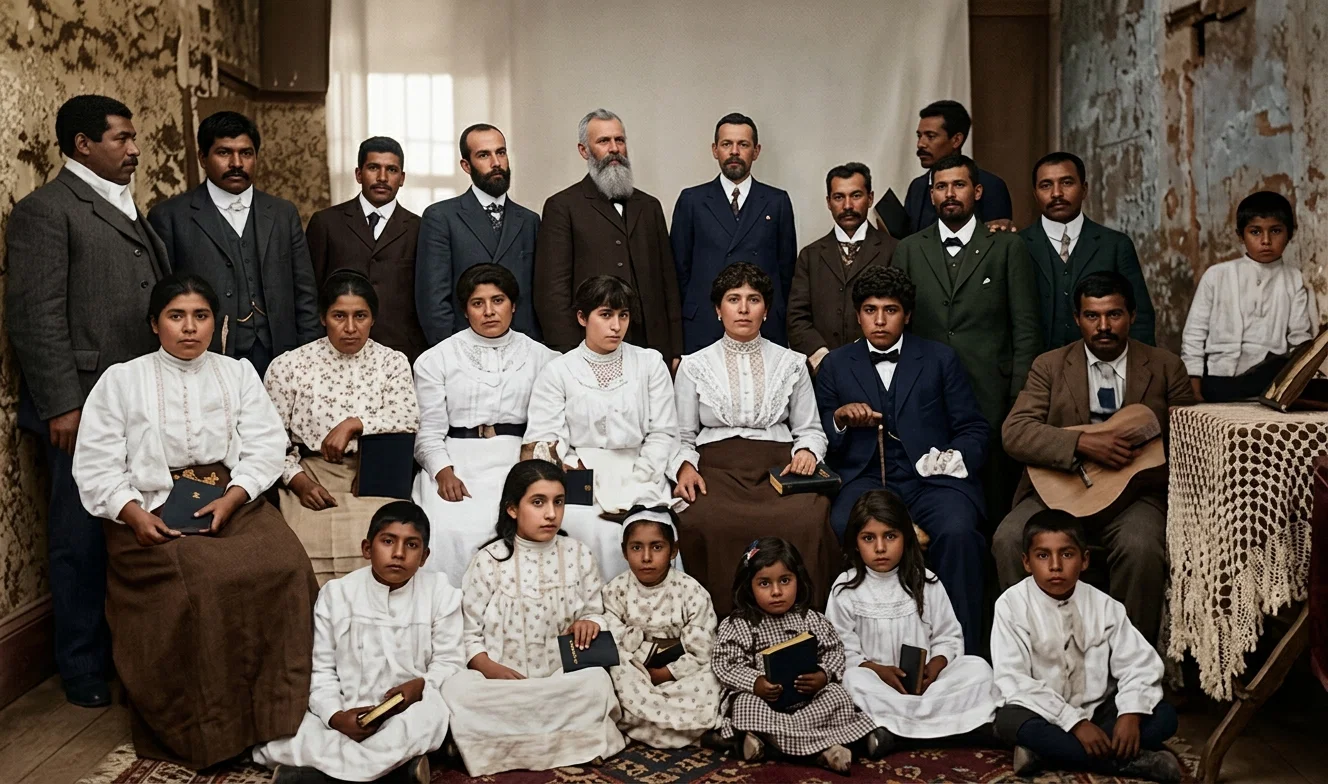
GROUP OF BELIEVERS ATTENDING A GENERAL MEETING IN NORTHERN CHILE
The $300,000 Fund is truly a life-saving fund. Not only will it save the lives of our missionaries, but by saving them to the work, it will save others to the message. Brethren, if you can not have an active part in saving souls in China, give of your means, which will also do much good.
Ying Shang Hsien.
Chile, South America
By F. H. WESTPHAL
F. H. WESTPHAL
AFTER an absence of four years, I have just visited the northern portion of Chile again. In this time Brethren E. Balada and D. Soto have visited these parts, and during the past year Brother S. Mangold has been stationed as pastor in the north. The Lord has blessed his labors, and we have been glad to see the progress of the work.
With this I enclose a picture of a meeting held in the interior. In the group are Peruvians, Bolivians, Chilenos, one North American, and two Swiss-Germans. So we see how, even in the interior, various nations are represented among those who love and obey the truth. During the meeting several offered themselves for baptism.
Some of those who believed in the past have not remained faithful. A young man in Peru accepted the truth lately. On his way to the general meeting he saw a man with a Bible in his hand. Thinking he might be one of our people, the brother thought he would speak with him. But soon the stranger took a cigar out of his pocket and began to smoke. Our brother said to himself, “This man does not belong to my people, for they do not smoke.” He came on to the meeting, and in a short time this same man came also. We spoke to the unfaithful brother about it, and told him he really did not belong to us, even though his name was on the church-book. He promised to quit the use of tobacco forever.
A number were expelled, and the standard was raised, and now doors are opening for evangelical work. Several promising young men are laying their plans to attend our school next year, to prepare for the work. One of these has four hundred pesos laid by for this purpose. He said he was going to deposit some of the money in the school at once, so that he may find it there when he comes next year.
We have reason to believe there are better days ahead for the work in Chile.
Santiago.
Mokanshan Rest Home, China
By H. W. Miller
H. W. MILLER
In no unmistakable way did the Lord lead us in the purchase of a mountain property on Mokanshan. This mountain has been used for twelve years by the missionaries of the neighboring district as a place of refuge from the scorching heat of the tropical summers. It is situated 145 miles southwest of Shanghai, in the province of Che-kiang. The mountain is very accessible from Shanghai by both steam launch and railway. At present the distance can be covered in seventeen hours, and it is hoped that shortly the time will be reduced to ten hours. Our workers first went to this mountain instead of returning to the home land when ill; and as the exhilarating climate proved a blessing to the sick, we decided to purchase three acres of land having on it a five-room cottage. The total purchase price did not exceed $850 in United States currency.
The following season (1909) the summer found a number of our brethren in the field disabled, owing to sickness. These were invited to take advantage of the healthful conditions found here, and without exception the expectations of every one were more than realized. Two rooms were added to the cottage, and a two-story stone structure was erected for bath- and treatment-rooms. The top floor is for the exclusive use of women, and the lower floor for men. These bath-rooms are after the plan of those usually found in our sanitariums. The building is situated near a beautiful little mountain stream, whose waters are divided so as to throw a part of the stream on either side of the house, thus giving a cool effect.
THE TWO-STORY TREATMENT-ROOMS AT MOKANSHAN
This season an additional piece of land with several good building locations for cottages was purchased. On this plot is found the beautiful Mokanshan cascade, a precipice over which flows the water from all the springs on the habitable portion of the mountain. The drop is about one hundred feet. This fall will be very convenient, as an electric motor can be attached to a water-wheel propelled by the force of the falling water, thus giving us, at little cost, electricity for use in electric-light cabinets and other medical appliances. The total purchase price of this plot, including about three acres, was $250.
There was another desirable piece of land, having two springs and a fine location for a main building; but we learned that the owner had refused to sell. We approached him regarding the matter, and he replied by asking a price that indicated that he was not anxious to part with it. As we neared the Chinese new year, however, which is a good time to purchase property here, we renewed negotiations.
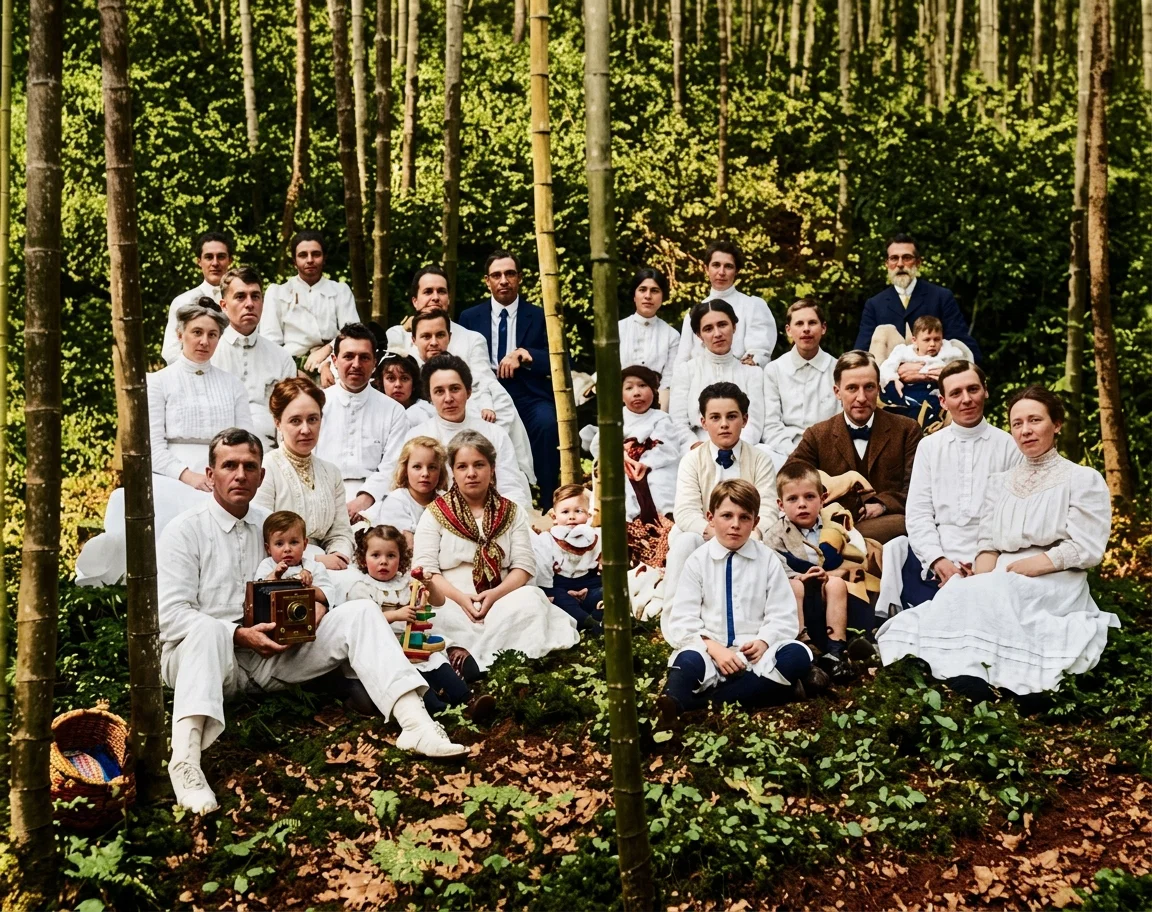
SABRATH-KEEPERS AT MOKANSHAN IN MIDSUMMER
This last purchase gives us about ten acres altogether, by which we control the falls, and have two beautiful little mountain streams of clear water running through our land, and joining just before passing over the bluff. As regards its picturesque situation and adaptation for a hydropathic health retreat, it is the best and only suitable place on the mountain. Why it has been left all these years unoccupied, is a mystery to some, but to us it seems clear that it was held in reservation for us. Various members of the mission family have built cottages on this land. A small chapel has also been erected, where religious services are conducted daily. Adjoining it is a Chinese dispensary, where a number of persons receive treatment every day. At this writing we have just completed the installation of a plant for heating water, which is supplied by a reservoir elevated one hundred fifty feet above the treatment-rooms. This furnishes plenty of hot and cold water under sufficient pressure for sprays and other treatments. The reservoir is fed by a large spring on our own land.
This mountain truly is like an oasis in a desert. Our land, as well as the whole mountain, is covered with a dense growth of bamboo, through which are numerous walks in almost every direction. These, being shaded nearly all the time, make exercise a pleasant recreation. The altitude of two thousand feet, while not so high as to give trouble to those suffering from heart-disease, or make the place inconvenient to reach, is still sufficiently high to affect the temperature so that the nights are cool and pleasant. A good breeze is usually stirring all the time, and from the mountain we have a fine perspective. The near view is one of terraced rice-fields and Chinese villages and waterways, while in the distance the bay of Hanchow can be seen10in one direction and a lake in the opposite. On clear days the ocean may be seen, and its breezes always reach us. While all these things are a striking contrast to the steaming plains below, perhaps that which is most appreciated is the clear, sparkling spring water, on which one often hears the children comment, ‘Why, you can drink this water without boiling it!’ To those accustomed to cool well water the year around, it can hardly be appreciated what a trial it is to drink tepid boiled water twelve months in the year.
There is no crowding together on the hill, a grove of bamboo separating the different houses. Here we enjoy a quietude and freedom which are never to be found on the plains, and which are very restful to the overstrained nerves of the missionary. We indeed feel thankful for Mokanshan, and for the benefits received from the short time spent in comfort on the hill.
Shanghai.
Selling Bibles in the Philippines
By Walter Prichard Eaton
JUAN was a native colporteur. He had worked over horrible roads till he was five weeks from Manila, in the Cagayan province. The “Evangelio de San Mateo” could not find purchasers, even for the low price of two cents. Night was falling as the weary Juan reached the provincial capital, without knowing where he was to lodge. Finally he met a servant of the local governor, who offered, in exchange for two books, to find Juan a lodging with his brother.
Thus, when the colporteur departed the next day, two Gospels were left in that town. The brother used his up, leaf by leaf, rolling cigarettes; but the servant read his copy. One day he chanced to leave it in the governor's chair. Don Jose, the governor, found it, read it, became interested, then perplexed. He did not know what to think of it, so he resolved to take the five weeks' journey to the nearest missionary.
When he reached the missionary, he took from his pocket a small package wrapped in the fine white bark of the gobo tree. This contained an inner package wrapped in silk, and this in turn the stained and worn copy of the Gospel of St. Matthew, left by the servant in the chair.
“Five weeks I have been on the road,” said Don Jose. “With my companion I have traveled over the far blue mountains and by strange rivers. While we came along the narrow trail in the valley, we sometimes knew that armed savages of the head-hunters stealthily followed us in the shadows of the trees. By boat and raft and trail we came. I have come, Señor Missionary, because my people need help. Americans have among them a book of the gospel, that every man may learn for himself the way of life and truth. I have come to get you to go and teach my people out of that book.”
But the missionary had no one to send. The Bible Society, too, was without funds even to send a colporteur back again. The disappointed governor had to go back alone. But the story of his trip was told abroad; and one day, three years afterward, a man came to the Bible agent in Manila, and asked to be sent to Cagayan. He had been a volunteer soldier, a teacher, a half-dozen things, sticking to nothing. The agent mistrusted him, and had no funds; but the man, who was an American named Sanderson, persisted; and finally, some funds coming in, he was sent as a colporteur, on half pay.
Don Jose had died, and the new governor was hostile; but Sanderson was not daunted. He sailed, rode, walked, even swam, to get from place to place, preaching everywhere and selling the Scriptures. In November, 1906, he perished in a great flood, and nobody knows where his body lies; but six months later, when a missionary pushed his way up into that wild region, he found a thousand converts waiting for him, and now the valley is dotted with chapels.—Walter Prichard Eaton.
Notes
THERE are more than one hundred twenty boarders in the Barotseland Mission schools at present, with the prospect good for an increase to two hundred soon. Students have been coming at the rate of five a week for more than a month at the main station. They number more than ninety at present.
ELDER W. H. ANDERSON reports the fruit-trees doing well on his station in Barotseland, South Africa. Lemon trees and orange trees are so filled with fruit that it is necessary to prop up the limbs to keep them from breaking. Some of the berry bushes have made a growth of fifteen feet in a year. The workers at this mission are setting out a thousand blackberry plants this year, besides many other kinds of fruit, and with the present prospects they hope to have fruit for the market erelong. Elder Anderson took with him two hundred seventy fruit-trees from the Cape on his return to the mission.
THERE was once a pendulum waiting to be fixed on a new clock. It began to calculate how long it would be before the big wheels were worn out, and its work was done. It would be expected to tick night and day, so many times a minute, sixty times that every hour, and twenty-four times that every day, and three hundred sixty-five times that every year. It was awful! Quite a row of figures, enough to stagger you! Millions of ticks! “I can never do it,” said the poor pendulum. But the clockmaker encouraged it. “You can do one tick at a time?” he said. “O, yes!” the pendulum could do that. “Well,” he said, “that is all which will be required of you.” So the pendulum went to work, steadily ticking, one tick at a time, and it is ticking yet, quite cheerfully.— D. L. Moody.
JULY 8, 1853, Commodore Perry dropped anchor in the bay of Yeddo, Japan. He was sent by the United States government with a message from the president looking toward a treaty opening up to the commerce of the world this hermit nation. The message was delivered. Seven months later, Feb. 13, 1854, Perry cast anchor once more off the shores of Japan. He was not a welcome visitor to many by any means, but on March 31 his purpose was realized in the signing of a treaty between the two nations. Thus a way was prepared for Japan to later receive the gospel.
HERE is a bit of experience that came to one of our missionaries in Africa, Brother J. R. Campbell. He says: “As I was walking through the tall grass the other day, I suddenly found myself facing a lion and a lioness about twenty-five yards distant. The lion only disclosed his teeth, when both slunk away in the grass.” Again the promise of God was proved: “He shall give his angels charge over thee, to keep thee in all thy ways.” Brother Campbell says the last two years, spent in Africa, have been the most pleasant of his life, adding, “True, trials fall to the lot of the missionary, but what are they when compared with the blessings received?”
I CAN not but think that the world would be better and brighter if the teachers would dwell on the duty of happiness as well as on the happiness of duty; for we ought to be as cheerful as we can, if only to be happy ourselves as a most effectual contribution to the happiness of others. Every one must have felt that a cheerful friend is like a sunny day, shedding brightness on all around; and most of us can, if we choose, make of the world a palace or a prison. To be bright and cheerful often requires an effort; there is a certain art in keeping ourselves happy; and in this respect, as in others, we require to watch over and manage ourselves almost as if we were somebody else.— Lord Avebury.
“WHEN Livingstone went to Africa, Mrs. MacRobert, quite advanced in life, who had saved thirty pounds, gave it to the great missionary, saying: ‘When you go to Africa, I want you to spare yourself exposure and needless toil by hiring some competent body-servant, who will go with you wherever you go, and share your sacrifices and exposures.’ With that money he hired his faithful servant known as Sebalwe. When a lion had thrown Livingstone down, and crushed the bones of his left arm, and was about to destroy him, this man, seeing his critical condition, drew off the attention of the lion to himself, thinking that he would save his master at the cost of his own life. The lion sprang at him, but just at that moment the guns of other companions brought him down, and Livingstone’s life was prolonged for thirty years.”
John Nussbaum and the Sabbath Examination
By William A. Spicer
way seemed closed. But in looking for a meeting hall one day, in the university town of Montpellier, the young man's father met a Catholic lady professor, who volunteered freely to put the student through the private tutoring for the necessary bachelor's degree. As the reason for such a surprising offer, she said:— “I will tell you a secret of my life. I am a professor now, but all I am I owe to a Protestant pastor, who instructed me, and secured pupils for me. He told me that the only return he would ask was that I should do as much some day for the son of a Protestant minister. That was twenty years ago, and this is the first opportunity I have had to fulfil the conditions.”
In connection with university studies and examinations, Brother John Nussbaum has again and again come to places where it seemed he would have to give it up; for he could not compromise with sin. An examination came so that the oral part was on the Sabbath. The dean said it could not be otherwise; said they would make it unusually short, and that, if need be, our brother could have a private room, so no one should know he was taking an examination on that day. But it was explained to him that no arrangement could make it right to break the Sabbath.
That Sabbath the father and son prayed earnestly that God's will might be done; for it seemed the end of the course had come. On the next Thursday, however, our brother was called to the faculty room, and found several university professors there, as the dean explained, to give him his examination. Such a thing had never before been known, some said; but our brother thanked God for his gracious intervention.
Later on, in Toulouse, where the course is being continued, his class was required to report every morning at a hospital clinic. No exemption for the Sabbath could be secured. Our brother was faithfully at his post every day—on the Sabbath with the believers worshiping God, on the other days at the clinic. Again it seemed the way was closed, for three absent marks during the period meant failure to pass. At the end of the time, however, Brother Nussbaum found that by some unaccountable error his name had been omitted from the list, so that he had no record marked against him; and as the error was on the part of the authorities, his attendance was credited at full value. Then came a competitive five days' examination—none of which fell upon the Sabbath—in which our brother was successful, gaining a position in which thereafter no attendance on the Sabbath was required.
It was a simple story that the brother told me; but it had meant at each crisis the laying down at the Lord's feet of the whole life's purpose; for he had determined, to begin with, that he could never allow any pressure to lead him to yield the slightest in giving obedience to God. And it is this uncompromising determination to stand by God and by his truth, come what may, that gives the Lord his opportunity to open ways where there are no ways.
It is the lesson of faith. Christ is not only the Truth, but he says, “I am the Way.” When we find Christ, we find the way of loyalty to God. The Sabbath is God's testing truth. The controversy rages round that holy institution. But in these last days a people keeping “the commandments of God, and the faith of Jesus,” will gain the victory over all the power of the evil one. No force of human will, no physical bravery, no boastful, defiant spirit, will carry us through. The way through is the way of self-surrender at every step, and of faith in the God who is able to make ways where there are none. W. A. S.
Be Honest
By F. M. W.
It has long since passed into a proverb that honesty is the best policy. This has been demonstrated many times in the affairs of the world. It is emphatically true of the cause of Christianity; in fact, the quality of honesty is of the very essence of true Christianity.
The life of Christ affords a beautiful example of simple, honest, straightforward living. True to himself, he exemplified, honestly and openly, the high and holy character of his exalted mission. He was honest with his fellow men, honest with his enemies in warning them of the judgment to come, honest with his truest friends in pointing out to them defects in life and character. He evaded no just obligation. He discharged the filial respect due his parents. He recognized and satisfied the proper claims of civil government. He honored the proper authority of churchly officials, and he taught to his disciples this same law of honest dealing. He says, “Render to Cæsar the things that are Cæsar’s, and to God the things that are God’s.” The apostle Paul, in his inspired commentary upon these divine principles, elucidates the thought in the following words: “Render therefore to all their dues: tribute to whom tribute is due; custom to whom custom; fear to whom fear; honor to whom honor. Owe no man anything, but to love one another: for he that loveth another hath fulfilled the law.” Rom. 13:7, 8.
There will be found in the life of every Christian to-day this quality of honesty. False pretension will be laid aside. Deceit and equivocation and lying will find no resting-place in the heart. Every man will count his word as good as his bond, and will seek to live before his neighbors an honest, upright life. It may be necessary at times to incur debts in one’s business, but these obligations will be promptly met. No advantage will be taken of legal technicalities to avoid the discharge of a moral obligation.
Christ’s disciple will seek to live within his means. Unnecessary desires will be held in check, and every promise and12obligation, whether made to God or to his fellows, will be discharged faithfully and promptly to the very best of his ability. Honesty should be a synonym for Christianity. Seventh-day Adventists should be honest men and honest women. By the manifestation of no other quality can they do more to commend to others the principles they hold dear. Walking honestly before God and his fellows, let each seek to manifest in his daily experience among all his associates the honest simplicity of the character of the Lord Jesus Christ.
F. M. W.
The Uncompromising Way of Faith
FAITH can walk where unbelief can never go.
Of the children of Israel it is written: “By faith they passed through the Red Sea as by dry land: which the Egyptians assaying to do were drowned.” Heb. 11:29.
The feet of faith could pass where those who did not trust in God could find no way.
We are seeing the experience repeated continually. “Follow me,” said Christ, as he walked unswervingly the way of his Father’s commandments. And ever with “the commandments of God” as the way, there must be “the faith of Jesus” as the means. When Abraham, the father of the faithful, was plainly led of God into a way that seemed impossible, we are told that against hope he believed in hope. “He staggered not at the promise of God through unbelief; . . . being fully persuaded that what he had promised, he was able also to perform.” Apparent impossibilities may hedge up the way of obedience; but never yet has that way proved a failure to the man who cast his helpless soul upon God, and ventured his all by faith, come life or come death.
Men are to-day giving up cherished plans because the carrying out of them would compromise faith; and they find more than compensation in the grace of Christ. Where one way closes, God has another way, and a better one, though it may be a harder.
In the matter of loyalty to God’s Sabbath—which has in it the cross of Christ that crucifies unto the world—many in various lands are proving in common daily affairs that he who in olden time “made the depths of the sea a way for the ransomed to pass over,” is still making ways for those who trust in him. Here is one experience—that of a young medical student in France:—
He desired to take the medical course for service in our work in France, where we have never had a physician. With regular school work so often encroaching on the Sabbath, and with no means for the expensive private tutoring, the