The Youth’s Instructor, Vol. 64, No. 32.

Women Doctors Licensed to Practice in Peking

The Youth’s Instructor

Aug 8, 1916

Review and Herald Publishing Assn. · Takoma Park Station, Washington, D. C. · Aug 8, 1916

Women Doctors Licensed to Practice in Peking

Forty-two women doctors, graduated from various medical schools, will shortly be given certificates to practice in Peking. These will be the first women granted official permission to practice medicine in the Chinese capital.
Secretary McAdoo, of the Treasury Department, sent six experts of the United States Public Health Service to New York City to cooperate with the State and city health authorities in suppressing the epidemic of infantile paralysis.
The recently discovered antarctic continent has an area approximately of 5,860,000 square miles, which is one and one-half times the size of Europe. Another notable fact concerning this continent is its height. Dr. Meinardus found the mean height to be approximately 6,560 feet, or an average height equal to the top of Mt. Washington.
Isaac Levy, who has been in the Klondike region for sixteen years, recently returned to New York, where his family consisting of a wife and eight children reside. The special reason for Mr. Levy’s return at this time was to attend the wedding of six of his children, which was to take place immediately after his arrival in New York.
A leading American automobile manufacturer has found it advantageous to install a compressed-air device for driving wood screws and machine screws and nuts. The compressed-air engine can be fitted with any attachment best suited to the work in hand. It is reported that a saving of seventy-five per cent in labor cost over the usual manual operation has been effected by this installation.
Equipped with a simple form of thermostat, there has been introduced an electric iron which automatically maintains its temperature at any desired point. Adjustments in temperature are effected by turning the knob, after which the thermostat member turns off the current when the heat exceeds the limit set, and again closes the circuit when the temperature falls slightly below the lower limit.
Mrs. Amy D. Winship, eighty-five years of age, is studying botany and physics in the summer session of the University of Wisconsin. She is not working for a degree, but studying for the pleasure of it. She has said that she intends to attend college till she is ninety. Mrs. Winship has always been interested in social and political problems of the day. She knew Abraham Lincoln personally, and attended the famous Lincoln-Douglas debates with her husband, who was a member of the Illinois Legislature.
“An artist in Rome saw a beggar on the street, so utterly abject and forlorn that he hired him to sit for his picture, as a typical beggar. The next day the man came to him, quite transformed. He had hired the clothes of a companion in which to have his portrait taken. The artist did not recognize him, and on learning that he was the beggar he had hired, said: ‘No! I hired a beggar, and wanted him just as he was, or not at all.’ Christ, for a different reason, wants us just as we are, without any effort at self-transformation, that the new creation may all be ‘to the praise of the glory of his grace.’”

An Accidental Discovery

BLOTTING paper was discovered purely by accident. Some ordinary paper was being made one day at a mill in Berkshire, England, when a careless workman forgot to put in the sizing material. The whole of the paper made was regarded as useless. The proprietor of the mill desired to write a note shortly afterward, and he took a piece of this waste paper, thinking it was good enough for the purpose. To his intense annoyance the ink spread all over the paper. Suddenly there flashed over his mind the thought that this paper would do instead of sand for drying ink, and he at once advertised his waste paper as “blotting.”
There was such a big demand that the mill ceased to make ordinary paper, and was soon occupied in making blotting paper only, the use of which rapidly spread to all countries.
A great many good things have been found out by accident. The one who keeps his eyes open to see the significance and value of unusual things, is the one who makes useful discoveries. The one who thinks about his work is the one who makes valuable discoveries.—The Expositor.

Montana: Gold, Copper, and Agriculture Today

Montana

If we except the missionaries and the explorers, it was gold that lured the first white men into Montana. The value of the minerals that have since been taken out of Montana's hills mounts to the enormous total of $1,717,585,246. That sum would have probably carried on the wars of Napoleon and have left something over besides.
Today, though the great Anaconda hill at Butte is still producing its annual sixty millions of dollars in copper, it is agriculture which is luring home seekers to the State. The latest government statistics show that one third of all the homesteads taken up in the United States in 1914 were taken up in Montana. During the last two years it has led all other States in the number of new post offices established.
It is a land of wheat and oats, of barley and rye, of potatoes and flax and sugar beet. Its apples are shipped direct to New York and London. The value of its agricultural products in 1915 was $68,000,000 That isn't bad for a State where they shot buffalo in the eighties.—The Independent.

The Heights by Great Men Reached and Kept

THE heights by great men reached and kept Were not attained by sudden flight, But they, while their companions slept, Were toiling upward in the night. —Longfellow.

A "Hike" Through Yellowstone

(Concluded from last week)
A. C. MADSEN
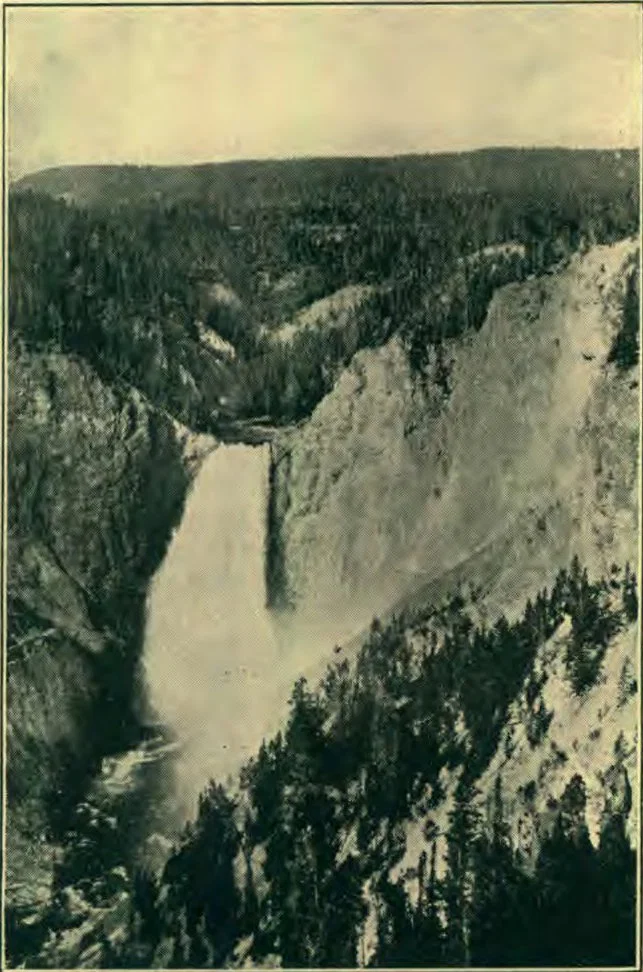
THE LOWER FALLS, YELLOWSTONE PARK
The next morning after a bountiful breakfast and the refilling of our lunch sack, we had an eighteen-mile walk ahead of us. With a "Well, fellows, follow me today," our leader set the pace. Only a short distance from Fountain Hotel, are the Mammoth Paint Pots. These pots are of different colors and resemble thick paint bubbling and shooting into the air. The next main point of interest is Firehole Lake or Hell’s Half Acre, and it seems well named.
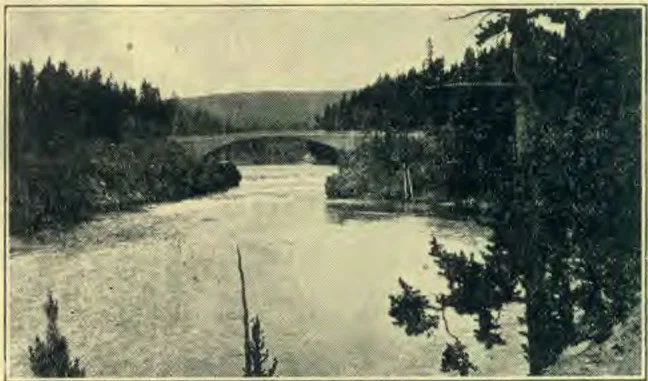
YELLOWSTONE RIVER ABOVE THE DAM
Looking from the western part one can see the so-called flames. At the eastern side of the lake is a small circular opening in the bottom of the lake, of a deep-seated spring not unlike other vents of thermal waters. Through the vent numerous bubbles of mingled air and superheated steam rise gradually. Before reaching the surface they unite to form one large mass that in its upward passage strikingly resembles a flame of fire. The whole lake is one steaming vat and looks very treacherous. A short distance from here is the beautiful Prismatic Lake. All the tints of a prism are seen in the lake.
Each day, coaches passed us, and the travelers, cramped in the coaches, tired and dusty, envied our freedom and the good times we had examining flowers and other things of interest. With a cheery “We’ll see you at the next camp,” they passed by. At eleven o’clock we were about a mile from Old Faithful Hotel, which is in the Upper Geyser Basin. This basin is the most noted and has the most interesting geysers. Here we spent about eighteen hours.
Of the geysers here, Old Faithful is no doubt the most noted though not the largest. It plays every seventy-five minutes, sending large volumes of steam and water as high as one hundred and seventy-five feet into the air. I saw it play seven times, and obtained some good views of it. Other geysers here of interest are the Giant, Beehive, Grotto, and the Lion and Lioness.
Old Faithful Inn is a wonderful building, constructed entirely of logs. Some of these logs are eighty feet long without tapering. The inn is built in a rustic, yet ornate style. While here we struck up a friendship with several interesting men, professors from different universities, and had an enjoyable time.
At Old Faithful we found ourselves in a real bed for the first time in the park. The last words I heard that night were, “Boys, this feels good.”
At five o’clock in the morning one of us felt inclined to start out, and with his enthusiasm we were soon all in the notion. On these early morning walks we saw many deer and other game which later in the day leave the road. We set out on our uphill trip, crossing the Continental Divide twice. The first has an altitude of 8,240 feet. The road crosses it at Craig Pass, alongside a little lake, whose waters in the springtime hesitate whether to flow out of one end into the Pacific or out of the other into the Atlantic, and usually compromise by going in both directions. While we were wading and rowing our logs in this pond for lilies, several automobiles came and picked us up for a ride of ten miles.
During the whole afternoon the road wound along the banks of the Yellowstone Lake. This is a very beautiful lake. Its altitude is 7,741 feet. It is twenty-odd miles long and nine wide. It has a large island around which we motored in the evening, a very refreshing ride after a day’s walk. In this lake the Yellowstone River, so noted for the Grand Cañon, has its beginning. At the Lake Hotel are large numbers of bear, deer, and elk. The bears are very sociable and the tourists amuse themselves by feeding them candy and nuts. The animals throughout the park have but little fear of man.
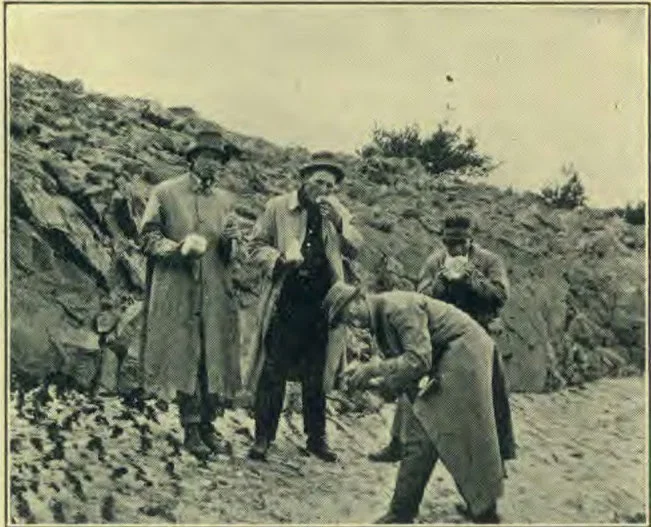
ON MT. WASHBURN
ON MT. WASHBURN
During the day we also visited Fish-pool and Mud Geysers. Fish-pool is a crater in the lake. The water in the crater is boiling, while that surrounding it is cool. Here one can stand and catch a fish, turn around and boil it in the pool.
The next day we arrived at the Cañon Hotel, which is the largest in the park. Many tourists spend several days there.
Arriving at the cañon, we left our baggage in the care of friends and spent the afternoon and evening sight-seeing. First we visited Upper Falls, one hundred and nine feet high. The cañon from here is twenty miles long, but it is only the first three miles below that has the wonderful colors.
The largest or Lower Falls lie a half mile below Upper Falls. To get the best view of these we went down Uncle Tom’s trail, a bank over 1,000 feet high and almost perpendicular, ropes being fastened on trees and rocks to assist us. It having rained, some of the guards warned us not to undertake the descent; but as it was our only chance, we attempted it and were well repaid.
From the Lower Falls for three miles down the river, abrupt walls a thousand feet high upon both sides of the cañon, present a brilliancy and mingling of color beyond power of description. From the brink of the cañon to the water’s edge the walls are sheer bodies of decomposed rhyolite. Varied hues of orange, red, purple, and sulphur-yellow are irregularly blended in one composite mass.
As one stands at the bottom of the cañon near the falls whose waters take a perpendicular leap of three hundred and nine feet and are dashed into spray and foam upon the rocks, speech is impossible and tears come to one’s eyes at the wonder of creation. Surely no one who has had this privilege can doubt the existence of God who created the universe. With sadness we left the cañon.
One morning we bade farewell to the friends we had met in the park, they going back to Gardiner by the way of Norris, while our walking quartet set out for Mt. Washburn. Very few tourists make this trip, as it involves extra expense. However, it is one of the interesting features of the park.
While making our way upgrade, two of us by tipping the driver of a coach caught a ride, half way up the mountain, then sat down to await our weary companions. By noon we were on the top of Mt. Washburn, an altitude of 10,388 feet, where we got a view of the whole park. As it was chilly, we built a fire by which to eat our dinner. The mountain was covered with snow banks, and we engaged in snow-balling on the sixth of August.
Many varieties of flowers abound in the peak, growing in the very edge of the snow. On our way down we came upon a flock of mountain sheep, a very rare sight. We were able to get a picture of them at a distance of one hundred feet, while they were gazing at us.
Our next stop was at Lower Falls, one of the most picturesque scenes in our trip, though only one hundred and thirty-two feet high and with but a small volume of water flowing over it. As the sun was setting we took a shower bath in the icy spray of the falls.
Sunday morning found us on the last twenty miles of our trip. After a brisk walk of eight miles we partook of our lunch. At noon we again reached Mammoth Hot Springs. After taking some pictures, we set out for Gardiner, five miles distant.
The six days spent in the park had been ideal in weather conditions. However, when we were only two miles from the station a mountain shower surprised us and we had a real cloud-burst. Rivers seemed to pour down the mountains, and the streams were soon flooded. We were drenched through, but were thankful it didn’t come sooner.
Each expressed himself as having had the best trip of his life. And though we were sore-footed and tired, the educational pleasure received far overbalanced the discomfort. The next day we were in the canvassing field again selling books.

Today: The Only Real Time

Today

THE best thing you have in this world is Today. Here it is, a wonderful treasure, a marvelous jewel. It's yours, all yours. It's in your hands. What are you going to do with it?
Today is your savior; it is often crucified between two thieves, Yesterday and Tomorrow.
Today you can be happy, not yesterday nor tomorrow. There is no happiness except Today's.
Most of our misery is left over from yesterday or borrowed from tomorrow. Keep Today clean. Make up your mind to enjoy your food, your work, your play, Today anyhow.
Time is not divided into three parts, past, present, and future. There is only one real time: it is Now.
You can do anything, if you'll only go at it a day at a time.
If you're bereaved, betrayed, heartbroken, why, take a day off. One day will not matter. Today put away your festering thoughts. Today take some simple joys. Today be a little happy in the sunshine. You can do it. It's the burden of the coming days, weeks, years, that crushes us. The present is always tolerable.
Whoever planned this life of ours did well in giving it to us one day at a time. We don't have to live it all at once, thanks be! We've only got to get through till bedtime.
And at the end of every day we are bathed in death. In sleep we go back to our original nothingness. Every morning we are born again.
Why let life oppress you? You don't have to live your life, only a day of it. Come, let's finish our small task manfully. It's not long.
Don't let life mass against you. Attack it in detail and you can easily triumph.
“Oh, but I can't help thinking of the Past. And one must plan for the Future.”
To be sure. Only forget not that it is not the Past that determines the Present; it is the Present that determines the Past.
The Past is what we make of it. It is the temper of the Present that qualifies it. It all depends upon how you now consider it, whether it brings you despair or discouragement.
Suck out its wisdom, keep its lessons, utilize its experience, make of all those things elements of present power. But forget its septic qualities. Don't let the Past unman you, benumb you with remorse, weaken you with self-contempt.
The poet says we rise by stepping on our dead selves. And as for the Future, the best preparation for it is an unafraid Today.
Whatever hills you have to climb, whatever bridges you have to cross, whatever enemies are lying in wait for you, whatever crises are to be met, you can be no better equipped for them than by living this day soundly, cheerfully, and free from fear.
Apprehensions, premonitions, worries, these are the poison gases of our foe, the Future.
If you are to die tomorrow, the best way to be ready is to discharge faithfully Today's duties, and to enjoy heartily Today's simple pleasures.
Today is yours. God has given it to you. All your Yesterdays he has taken back. All your Tomorrows are still in his hands.
Today is yours. Take its pleasures and be glad. Take its pains and play the man.
Today is yours, just a little strip of light between two darknesses, just a bit of life between two sleep-deaths.
Today is yours. Use it so that at its close you can say:—
“I have lived, and loved, Today!”—Dr. Frank Crane, in Pictorial Review.

Joy in Work

Joy comes when we least expect it. When we deliberately go forth in search of it, we can seldom, if ever, find it. But when we forget our own pleasure in trying to help others, in working to accomplish something worth while, then in some way, joy comes to us. Some one has said, “Happiness is allus whar you ain’t lookin’ for it.”
Work is the best recipe for happiness. The only true joy in life results from the consciousness of work well done, of a life well lived. It is work, struggle, and contest that develop the best there is in us and make us happy. Gladstone said, “I have found my greatest happiness in labor,” and I think our own experience and the experiences of others bear out his statement.
In order that a person may like the work he is about to take up, he must be fitted for it. He must fill the place nature meant for him to fill. There are men who succeed as statesmen, and are in love with their work, that would never succeed on the farm. They are not naturally inclined to that kind of life, and see no pleasure in it for themselves or for any one else. Without interest, no one can succeed, and without success, at least to some extent, there can be no joy.
The feeling that one has done nothing worth while at the end of a day, a month, a year, is the most distressing, most disheartening feeling there is. Everything about is dull and cold—anything but pleasant. On the other hand, no joy compares to the joy which comes from feeling that one has done a good work; has carried it to a complete finish. To know that he has really accomplished the thing he set out to do makes one stronger and more ready to face future difficulties that might have to be met.
Work for its own sake does not bring this joy. There must be a true aim directing it. There must be some good motive, some purpose in hand. A good definition for drudgery is simply work without a purpose, motive, or aim. The higher the aim, the greater will be our joy when that aim is reached. If we put our best into our work each day, using our best thoughts and judgment, we shall possess a feeling of satisfaction, not such as will cause us to be content with what we have done, but such as will lead us to climb higher, and to desire to do what lies before us better than we did what lies behind. Then our most pleasant memories will not be of times when we were free from responsibility, but when many hard tasks and difficulties surrounded us, and we were victorious in overcoming them.
When we meet an unexpected task, or one that is not, strictly speaking, our duty to perform, we must meet it with the same willingness with which we would take it up if it were our set work to perform. To do this may change our plans to some extent and so inconvenience us, but when we think that the amount of joy we get depends upon our earnestness and unselfishness in doing, we see that, after all, it is to our credit.
Our helping others and making them happy not only brings happiness to them, but makes us happier. An example can be drawn from the work of a teacher. She may do all that is expected of her. She may teach the lessons thoroughly and faithfully, but unless she is willing to do the little extra things cheerfully, she misses the greatest opportunities for service and hence the greatest opportunity for joy.
To keep our higher ideals, we must have moments of inspiration. We need to get away from our work and cares at times, and seek rest and recreation. This renews our vigor, gives us a fresh interest and a new determination to press onward to a still higher ideal, and we will not forget the saying, “Give to the world the best you have, and the best will come back to you.” HILDA HOLSTEN.

Expecting Great Things

THE INSTRUCTOR family was introduced to our little Sabbath school in Southern California last quarter, so I thought they would like to hear what we did on the thirteenth Sabbath in June.
We received word early in the quarter that our offering this time was to go to Brazil, and the superintendent was beginning to talk about it and plan the program, when along came Rally Day.
Of course we knew Rally Day was needed to make us realize what a great blessing our Sabbath school is, so we began immediately to prepare the program.
The children all helped with the singing and speaking, and we had a fine lunch under the big trees in front of our little white church. We went home late in the afternoon feeling that we had been greatly helped and blessed.
After that we went to work on our thirteenth Sabbath program in earnest, and this is what we had when the time came:—
The church was sweet with flowers and evergreens that morning when we took our seats and bowed our heads for a moment of silent prayer. Then we sang, prayer was offered, and the secretary’s report was read the same as usual; then followed the special program.
Only ten children, and less than twenty grown persons of our membership were present, as some had gone away. The first number was a song by the intermediate class. It is called “The Builders,” and by words and motions tells how we build characters like Jesus just as a carpenter builds a fine house.
Next the quarter’s lessons were reviewed in a new way. We have had one of the Picture Rolls this quarter, and the superintendent hung it up where everybody could see it, then each child told the lesson story of one picture.
George, who was the first speaker, called attention to the picture, then told the story. That lesson was about dividing the sheep from the goats, and what Jesus said. When George finished telling the story, he added,—
“I think the most important thing we can learn from this lesson is that whenever we are helping the needy we are helping Jesus. We will be helping Jesus today when we give our money to send the gospel to those poor people in Brazil.”
The superintendent wrote on the blackboard: “1. When we help the needy, we help Jesus.”
The next picture was turned, and Helen told the lesson story. At the end she told what she thought we could learn from it, and the superintendent wrote that on the board as No. 2. Mabel and Donald followed with their stories, then we had a song.
Next the intermediate class took turns telling the stories illustrated by the pictures. Dean, Dale, and Julit did well. Doris is a very little girl, and was frightened at first, but when she remembered she was doing it for Jesus, she did well.
There were not children enough to go round, so at the end four of the teachers told the stories. The superintendent said afterward that the children’s stories seemed to her better, on the whole, than those of the grown-up folk, and she thought it was because the children had studied and thought more about them than the grown people had.
When the review was over we had seen all the twelve pictures and the twelve most important things we should learn from the lessons were on the board before us.
There are only two little girls in our kindergarten class, and they entered carrying lighted candles. They sang very sweetly, “Jesus Bids Us Shine.”
The children had been asked to learn all the memory verses for the quarter and recite them at home to save time. Each child that recited them all perfectly was to bring a slip of paper from his mother to give to the superintendent, and in return was to have, for his very own, one of the beautiful big pictures from the Picture Roll.
Even the kindergarten class had been promised a picture if they learned their song perfectly. The little tots sang the three verses of the song without a mistake, and all in the junior and intermediate classes knew all the memory verses, so every child in Sabbath school carried home a picture. There were two pictures left over, and these were given to two little boy visitors, as souvenirs of our happy day together.
After the memory verse papers had been collected the children rose, faced the congregation, and recited the verses in concert. A big map of the world was then hung up, and the junior teacher I told you of before, talked to us about Brazil, the people who live there, and how much they need our help to learn about Jesus and his soon coming. Then Dale and Julit took up the offering.
The superintendent had worked and prayed that God would impress us to give a large offering for Brazil, but some way she did not expect as much as had been given before; that seemed too wonderful to be repeated.
While the collection was being counted, we all sang “Jesus Saves.” Just before the song was finished the assistant secretary stepped to the board to write the amount of the offering. Some of the children were so anxious to see that they almost forgot to sing; but the superintendent did not turn to look until the song was finished.
She heard the stroke of the chalk on the blackboard making a one, and decided that the offering was about $11; she thought that was not bad for such a little school. But when the song was finished, and she turned around, this is what she saw:—
God is love. $21.20
It was nearly a dollar more than last quarter.
She couldn’t say a word at first, and the tears just rolled down her cheeks. Then she thanked, for herself and for Jesus, those who had made the generous offering, and said to the minister,—
“Elder Healey, will you ask God to bless this money, and to bless us?”
While the congregation stood the minister prayed, then we were dismissed.
The junior teacher’s face was alight as she came to speak a word with the superintendent, but the superintendent, though happy, was feeling very humble.
She said, “I have been praying for God to make us want to help liberally in his work, but some way I did not think it possible we could have such a large offering today.”
“It is a large offering for a little company as poor as most of us are, but I wasn’t surprised at all,” answered the little teacher calmly. “As soon as I heard George begin to talk I knew how it would be.”
“Why, what was there about George’s talk that made you feel so sure?” asked the superintendent.
“Oh, the — the spirit of it, I think; you could feel that God’s Spirit was in the room. And then at the end he reminded us that when we gave to Brazil we would be giving to Jesus, and the rest of the children all followed right along in the same spirit. No, I’m not surprised at all, and I’m so glad.”
“Well,” said the superintendent slowly, “I’m glad too, and very thankful. And the best of it is I’ve proved that God is able to do ‘exceeding abundantly above all that we ask or think.’ That is worth much to me, for in the future I shall not fear to expect great things from God.” ELIZABETH J. ROBERTS.

Beauty of Humanity in Forgiveness

HUMANITY is never so beautiful as when praying for forgiveness, or else forgiving another.—Richter.

Marjorie's Lesson

“MARJORIE,” her mother called as she started outdoors to play, “I wish you would go over to Mrs. Jones’s for me, and see if she will do the washing tomorrow.”
“Where’s Florence? Can’t she go, mother?” objected Marjorie, stopping in the doorway.
“Florence has gone to the store,” replied her mother. “You know where Mrs. Jones lives, don’t you?”
“But, mother, the girls are waiting for me to play. Can’t Florence go when she comes back?”
“Why, Marjorie, Florence will be too tired when she gets back,” said her mother reprovingly. “It is a long way to the store, and it is nearly dinner time. So get your hat and I’ll have a note ready for you to take.”
“I don’t see why Florence can’t go as well as I. I never have any time to play,” said Marjorie, poutingly.
“Well, girlie, don’t go then. I do not want my little girl to go if she feels that way about it,” the tired mother responded.
Marjorie stood there a moment thinking. How tired and ill mother looked! Poor little mother, always so patient and uncomplaining. A sense of regret filled her, and she stood irresolute, but then—
“Marjorie! Marjorie!” called the girls, “aren’t you coming?”
“Yes, I’ll be right there,” and she flew to join the children in the garden.
Marjorie was only nine years old, and as she had always been a rather frail child, she had been indulged by her parents more than the other children; so when she refused to do anything, Florence, three years older, usually did it. So it was this time.
Florence returning from the store a half hour later dropped wearily into a chair exclaiming, “Oh! I’m tired. I went down town. You see I couldn’t get the kind of cloth you wanted at Benson’s.”
“That is too bad, Florence; and I was going to ask you to go over and see Mrs. Jones about the washing; but if you are too tired, we will let it go. I think I can do part of it myself.”
“Dear mother,” cried Florence impulsively, “you won’t do any such thing! I’ll go right away. I’m not so very tired after all.”
Mother’s tired eyes brightened and her step seemed lighter as Florence hastened off the second time. How like Florence anyway! dear, helpful Florence, always to be depended on.
Time passed; the incident had been forgotten by all except Marjorie. Somehow it was always recurring in her mind. Her mother had not been well all summer, and was steadily becoming really ill. What the doctor said was the matter Marjorie could not understand, but any way it meant to her that mother would not be well again for a long time. How she wished she had done more for her! Marjorie grew more thoughtful those days, and whenever the chance offered, she was ready to do the slightest little errand for her.
One night there was an anxious family in the home. Mother was decidedly worse. The nurse was kept busy, and another doctor was called. He shook his head, and Marjorie, standing fearful near the door of the sickroom, heard the doctor say, “There’s only one chance in a hundred that she will live through the night.”
Marjorie sped up to her room, and throwing herself upon the bed, gave way to a torrent of tears.
Mother — no mother? No, it couldn’t be! It wasn’t possible — that was all. Memories crowded thick and fast upon her. Why, O why hadn’t she obeyed her? Why had she been so stubborn and selfish?
“O God,” she prayed, “don’t let mother die, don’t, don’t! I’ll always do just as she wants me to, but don’t let her die!”
It was too late. That night poor weary mother dropped into the peaceful slumber that knows no awakening. All her trials and cares were over. Nothing should fret or vex her more. Marjorie was almost crazed with grief. Through it all, “You might have saved her pain; you might have helped her,” rang continually in her ears. Every one tried to comfort her; but always before her, her mother’s eyes gazed sadly, reproachfully at her, as they had that day.
In time she became resigned, but never did she, for once, forget. She had learned her lesson. From that time, she became more quiet, more thoughtful, and kind to others. GLADYS SHAW.

The Cross Sticks

I HAVE been living this past winter on the Colorado Desert near an old Indian spring close to the entrance of a big rocky gorge. Except far up in the cañon there are no trees near me. Only short shrubs, cacti, or low bushes grow out on the desert sands. And so, it is often quite difficult to find wood to burn in my little rock stove. Every day I must take my sack, just as the Indians do, and wander about over the desert floor searching for sticks. Sometimes my sack is full in a few minutes, but often I am gone half an hour or more. When I get home I turn my sack upside down to shake out the sticks, and almost every time I notice that before I get through I have trouble with some little sticks that get crosswise in my sack. They lodge themselves “square in the middle,” and keep the other wood from getting out no matter how hard I shake my sack. Until I put my hand down among the thorny sticks and take the cross pieces out I can have no wood to burn.
Whenever I have this troublesome time with the wood I think how like those cross sticks are some people. They are always finding something to be crosswise about (when they can’t have their own way), and they stop all sorts of good and happy times for others and get no benefits for themselves. One crosswise child in a family game can spoil the fun of all the other children, and one crosswise person in the home can make all the days go wrong.
So don’t be a “cross stick.” Try to find some way to be agreeable and join those who are trying to be happy. EDMUND JAEGER.

Love, Loyalty, and Lofty Souls

WHEREVER are love and loyalty, great purposes and lofty souls, even though in a hovel, or a mine, there is fairyland.— Kingsley.
Continue reading: All Things Common