The Youth’s Instructor, Vol. L, No. 18

Two Prunings

The Youth’s Instructor

MAY 1, 1902

Review and Herald Publishing Company · Battle Creek, Mich. · MAY 1, 1902

Two Prunings
WE had a lovely flowering maple which made the whole winter more tolerable by its profuse blossoming all through the weary days when the cold reigned supreme. But as spring came nearer, the little tree did not do well. Its branches seemed to be weak. The coloring of the leaves was paler than it ought to have been. We took the pretty thing, and with a sharp knife cut every branch far back toward the parent stalk. We put the crippled tree away for a time. But every day we visited it, giving it the warmest and most sunshiny places, and furnishing it with water to quench its thirst.
Then, by and by, the tree came back and took its old place. The branches were no longer slender and weak; they had become thick and full of strength. The blossoms had a deeper color than ever before. The green of the leaves was fresher, and the entire appearance of the plant was more charming.
Sometimes it seems to us that we can not endure the sharp blows which come from the hand of the Father. One after another the things we hold dear, and think necessary to our very being, are severed, and at last we stand bare and shivering under the chastening which has been visited upon us. For a time it does not seem to us that we can ever take our places again among men.
But lo! in a little while, if we accept the sore trials which have come to us, we shall see that they have been sent in love, and with only the most benign intention. New graces begin to appear in our lives. In our hearts, hope sings a song it never sang before. The world takes on a new and more glorious aspect. After the night the clouds have fled away, and we see, as he has seen, that joy has indeed come with the morning.—Well Spring.

— Young People’s Weekly

Arbutus

THERE’S a gleam of spring in my dark old room, And a breath of spring in the air;
I can not write, and I can not think, So I fling down my pen in despair For my truant heart is out in the woods. Still damp from the melted snows, Where the sweet wild things of the shadows hide, And the trailing arbutus grows.
I lay my head down on my folded arms, And drowsily shut my eyes; My dark old room whirls lightly away, And the din of the city dies; The long, hard years of struggle and fret, Of hope and despair and pain, Slip from me silently, one by one,— And I am a child again.
’Tis spring in the country, and on the hills, In the secret places of gloom, Where the thick brown mosses cover the earth, The arbutus is all abloom.
Dear little flowers in the cracked blue jar, We are homesick, you and I; We fain would be back in the dear old spot, Where the shadows so gently lie.
Children we are of the woods and fields, Comrades of the wild and the free; And the city with all its confusion and glare Was never for such as we.

— Young People’s Weekly

Abroad with Nature

To the lover of nature, May is a glorious month. The earth has been renewed, and everything is in its brightest dress. The air is soft and balmy, the whole earth is fresh in its tender green, and there is pleasant perfume everywhere. It is a time that entices one to ramble abroad, and along every stream and water-side are to be seen the persevering anglers with rod and line. One who was a follower of the practice has written:—
“Then weary is the street parade, And weary books, and weary trade; I'm only wishing to go a fishing— For that the month of May was made.”
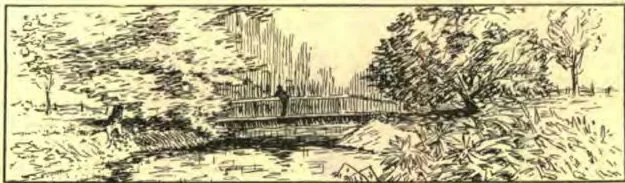
For myself, there are many other things I would rather do at this season than fish. I feel that I could spend every moment of May and June in the open fields, and spend it profitably, were it not for the sterner demands of life. I would live there, and eat there, and even sleep there. And I would be fishing, too,—not for fish, but to catch some of the wonderful secrets of nature that lie hidden on all sides.
I would spend many hours looking for the spring plants and flowers, studying their habits and traits, making careful notes, drawings, etc., and, best of all, learning many precious lessons that life will be all too short to forget.
The grasses and weeds have already made good headway; and if the weeds are taken as a type of sin, we have thus early in the season a reminder of the fact that Satan comes also. No matter how early we begin anything, we find that he has been ahead of us, and his work is already well begun. Was it not so when we first awoke to the fact that we had a character to develop for eternity? No matter if we were but children when the first serious moment broke upon us,—that moment when we dimly understood, that we must be “about our Father's business,”—when it came, there came also the consciousness that there was a work already begun, a work for evil, which must be eradicated. Already we had formed habits and dropped into ways that were anything but wholesome. Yes, truly the weeds are early.
But the industrious, intelligent farmer begins his spring work, for the same reason, as early as he can cultivate the ground. He gets at the weeds the moment they appear; and if any part of his possessions has gained the start of him, he goes at it the more earnestly to undo the evil already wrought. Let us be wise, and learn this lesson in the development of our lives.
By the end of May the trees are in full leaf; wood and roadside, garden and orchard, are full of songsters; the swallows gleam and circle in the air; and aloft in the tree-tops countless gayly dressed warblers flit and sparkle, filling the air with the music of their song. More birds are seen during May than during any other month in the year.
The chestnuts stand out boldly against the dark background of the hillside woods, laden with a wealth of yellow blossoms. Dandelions begin to creep out on our lawns, the violet is in blossom, and buttercups and marsh-marigolds in the swamps and meadows add their glory to make the landscape radiant with the color of the sun.
Along the roadsides and in open spots the winter butterflies are sporting in the warm sunshine; and in the cabbage patches the white cabbage-worm butterflies are busy at mischief-making. There will be a host of cabbage-worms a little later if we do not make way with these troublesome butterflies.
Hornets, wasps, bumblebees, and ants are already at work, teaching mankind a lesson of industry.
May we, too, breathe in inspiration from the spring, and take up the battle of life with new courage. L. A. REED.

ELLA CORNISH

May

THE green trees proclaim her, The bright flowers name her, The birds carol of her, And all things, they love her. We hasten to meet her, With gladness we greet her, With floral wreaths crown her, The queen of spring own her— Our beautiful month of May!

ELLA CORNISH

The Hand That Never Lets Go

The sun shone brilliantly on the dazzling snow of one of the highest mountains of the Alps, as a traveler followed his guide along the narrow path. The Englishman reveled in the scenes of beauty through which he passed. He had confidence in his guide, and followed fearlessly in his footsteps, though the track was entirely new to him. Suddenly he hesitated; for the bold mountaineer stepped across a narrow but very deep chasm, and then, holding out his hand, asked the Englishman to take it, and step across. Still the traveler hesitated, but the guide encouraged him to obey, saying, reassuringly, “Take my hand; that hand never lets go.”
Dear young friends, One greater than any human guide calls upon you to follow him over the heights of patience and self-sacrifice. The path is not an easy one. Christ says, “Strait is the gate, and narrow is the way, which leadeth unto life, and few there be that find it.” In order to follow this path, we must lay aside every weight, and the sin which so easily besets us. Directly at the entrance of the path lies the cross of self-denial. This we must lift if we would follow the Saviour. We must rid ourselves of pride and selfishness. While weighed down by them, we can not scale the heights over which Christ bids us follow him. All the way along, Satan has prepared pitfalls for the feet of the unwary. But following our Guide, we may walk with perfect security; for the path is consecrated by his footsteps. It may be steep and rugged, but he has traveled it; his feet have pressed down the thorns to make the way easier for us. Every burden we are called upon to bear, he himself has borne. Personal contact with him brings light and hope and power. Of those who follow him, he says, “They shall never perish, neither shall any man pluck them out of my hand.” “I the Lord . . . will hold thy right hand, saying unto thee, Fear not; I will help thee.” More precious in the Saviour’s sight than the whole world is the soul who gives himself to Jesus. Christ would have passed through the agony of Calvary that one soul might be saved in his kingdom. He will never abandon one for whom he has died. Unless his children choose to leave him, he will hold them fast.
Christ’s true disciples follow him through sore conflicts, enduring self-denial and experiencing bitter disappointment; but this teaches them the guilt and woe of sin, and they are led to look upon it with abhorrence. Being partakers of Christ’s sufferings, they are destined to be partakers of his glory. In holy vision the prophet saw the triumph of the people of God. He says: “I saw as it were a sea of glass mingled with fire: and them that had gotten the victory . . . stand on the sea of glass, having the harps of God. ‘And they sing the song of Moses the servant of God, and the song of the Lamb, saying, Great and marvelous are thy works, Lord God Almighty; just and true are thy ways, thou King of saints.” MRS. E. G. WHITE.

Star Study for May

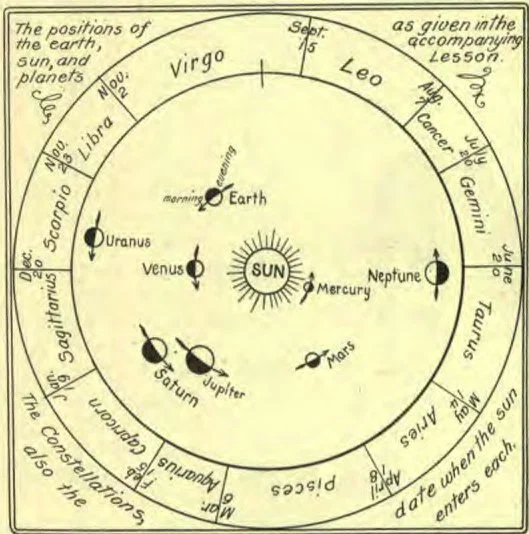
By comparing the accompanying diagram of our solar system as it now is with the illustrations shown in our Star Study for the months of March and April, you will readily see what changes have taken place.
Mercury, in place of being between us and the sun, as it was the first of March, has passed on ahead of us, and is now coming in behind, preparatory to another race with our old earth. Last month Mercury appeared as a morning star, being visible about April 23; but so rapid has been his flight, that he will appear as an evening star about May 28, though our chances of seeing him will not be nearly so good then as they were the first of February.
Mercury is very erratic in his travels around the sun, which, were there not other intervening causes, would make the changes in his seasons so marked and distinct as to be beyond endurance. It is commonly thought by scientists that Mercury is uninhabitable by beings subject to the same physical laws as ourselves, but we do not believe that this conclusion follows.
May 4 Mercury will be at perihelion, or at that point in his journey that brings him nearest the sun; and if, as in the case of our own earth, one of his poles were at that point directed toward the sun, that hemisphere would suffer an extreme of heat as compared with the extreme cold- which would consequently come to that same quarter when it reached its aphelion, or the point in its journey that lies farthest from the sun. The reason the inhabitants of this little world would suffer so much more than we is because the extremes of its path are so great. Its perihelion is estimated to be 28,569,000 miles from the sun, and its aphelion 43,347,000 miles away, making a difference which is considerable when applied to so small a journey as Mercury’s.
Just at present Mercury’s northern zones are passing out of a comparatively mild summer into a mild fall and winter, while the southern zones are coming from a cold winter into a hot summer. These seasons are, however, short, the planet’s whole year being only eighty-eight days in length, making each season only twenty-two days long.
From what we know of Mercury’s reflection of light, this planet has a thin stratum of atmosphere, with few clouds and a moderate amount of heat and light, but possesses the best possible conditions for rapid plant growth. We also learn from the same source that the surface of the planet is somewhat broken and uneven, though not so much so as that of our moon.
DR. O. C. GODSMARK.

MINNIE ROSILLA STEVENS

Obstacles

Sharp thorns and brambles oft impede Our progress as we go our way; But, drawing garments close, we slip As quickly by them as we may— Perhaps among the thorns to spy A fragrant bud or blossom start, That hides the brambles for a time, And helps us to forget their smart.
Upon the hill of high ideals, The rocks are smooth and thickly set; They give no foothold in themselves, And wrench the feet that slip and fret: But when we view the scene below, And breathe the summit’s purer air, The upward struggle we forget, With rocky road that led us there.
Perhaps the gateway to success Is hung upon a rusty hinge, That opens not, though long we strive With tug and pull and painful twinge: Yet, spite of groan and piercing creak, Sweet triumph will our souls imbue, If effort swings the gate at last Enough to let us struggle through.
The sunbeam-lighted lane that threads The summer of prosperity, Oft ends in drifts impassable, And winter’s cold adversity: But Spring-breath melts the deepest snow, And frost and cold with drifts depart; So trials dwindle in the warmth Of courage in a strong, true heart.

MINNIE ROSILLA STEVENS

A Suggestion or Two

WE should never allow our conscience to become blunted; for if we do, we shall thereby deprive ourselves of some of the sweetest experiences that can come to us in this life.
We must exert ourselves to improve every opportunity where we may learn something good. If it is worth while for the world to pay an extra dollar in order to get a front seat at some lecture, surely it is worth while for us to occupy the front seats in our public meetings, that we may not lose a single word. Instead of that, how many of our young people are content simply to drop into a back seat, and manifest an air of stolid indifference, as if the whole thing did not concern them. Such will have a mighty awakening when it is altogether too late.
Another reason for occupying the front seats in religious gatherings is the fact that the arrow of truth loses its force according to the distance which it has to traverse. There is a power, a spirit, an influence, experienced by one who goes to meeting because he expects to be helped, that the man who drops indifferently into a back seat knows nothing about.
Sometimes we do not allow people to teach us anything because they themselves are such poor exponents of the truth's saving power. When you are tempted to indulge this feeling, remember that the multiplication table is just as true when it is recited by a wicked man as it would be if spoken by a saint. It is the truth, not the man, that we are to guide our lives by. When we grasp this thought, we shall find something helpful in every experience that comes to us.
DAVID PAULSON, M. D.

Do Not Measure Your Work by Present Fruitfulness

You can not measure your work by its present fruitfulness or fruitlessness. You can not measure God’s will by present obstacles. You can not conclude that you have chosen the wrong path because it is apparently hedged up before you. You can not justly conclude that you are to stop because you can not see how to go forward.—Lyman Abbott, D. D.

Facing the Orient

I WILL attempt to give you an account of our journey as we left home, and turned our faces toward the Orient. Our packing was done at my father's home at Mauston, Wisconsin, and it was from this point we started. Wednesday morning, December 25, found us in Chicago. We had expected to take the train for Oakland that evening; but owing to some misunderstanding, our transportation and baggage privileges had not been secured, and we were therefore obliged to wait for the next overland and tourist train. The interim was spent in calling on old friends and in final arrangements for transportation.
A number of pleasant surprises awaited us in Chicago. Some one had presented a typewriter, an article much needed for our work in China, and this we found waiting for us at the Branch Sanitarium. But this was only a beginning. Through the efforts of the little church at Harvey, Illinois, and of some of the friends in Chicago, a small cottage organ had been secured, with money enough to purchase a kodak. Brethren W. O. Worth and W. R. Donaldson gave us two bicycles. All these articles will be much needed; and besides making us realize that our brethren are greatly interested in the China mission, these gifts made us feel that the dear Lord, who has called us, prompted these kindly remembrances. They seemed silently to say, “Your Father knoweth that ye have need of these things;” and the promise, “My God shall supply all your need according to his riches in glory,” was quickened in our hearts.
Two days later, on the evening of December 27, we left Chicago in a tourist car bound for San Francisco by way of the Burlington and Rio Grande railroads. The car was full, so we were limited to the room our tickets called for,—a space about four by six feet,—the size of one compartment for our party of four. This served for sitting-room and dining-room by day, and for bedrooms at night. When the two seats were converted into one bed, and a berth from above was lowered to form a second, we were really very comfortable. Of course traveling by tourist leaves something to be desired; but as we jogged along at the rate of five hundred miles a day, we thought how much more comfortable we were than the apostle Paul could have been on his first missionary journey.
Nothing of unusual interest occurred on our journey overland; but as it was our first trip across the continent, everything was full of interest to us. This was especially true the third day, which was spent in the Rocky Mountains. The air was soft, and the sun shed a hazy white light over the bare, bold peaks. At first the ascent is so gradual as to be unnoticeable; but presently, having passed the foothills, and come into the range, the track passes along the side of some peaks where we caught a glimpse of the plains far beneath. Then for the first time we realized that we were in the mountains. Now and then we passed a mountain village, where it seemed that all the inhabitants turned out to see the train. Later, the only signs of human life were now and then a rude cottage or dug-out in the mountain. The people who emerged from these, or peered out of the small windows, looked as if they belonged to a different race from those we have known all our days. We were all day ascending the mountains, and all night descending into the Salt Lake Valley.
The city of Mormonism was wrapped in fog as we passed early next morning. A ride of a few hours more carried us over the crest of the Sierra Nevadas, and out upon the slopes that descend into the Sacramento Valley. Here was an absolute change of scenery. Beautiful, well-kept farmhouses, surrounded with orchards of peach and plum, vineyards and orange-groves in fruit, and wreathed in rose-trees in bloom, were everywhere present, in striking contrast with the snow-capped peaks forming the background.
The steamer “America Man of the Tayo Kisen Kaisha,” on which our passage had been secured, was scheduled to leave San Francisco at one o’clock in the afternoon of January 4. At eleven o’clock we went aboard, with all that was left of our earthly possessions. Looking back to the wharf crowded with Chinese of all ages and different social castes, we began to realize for the first time that we were leaving home and native land, to enter a new and strange world, a sample of which was before us. A continual stream of Mongolian orientals,—Chinese merchants richly dressed, returning to enjoy at home the fruits of trade in the States; keen-eyed diplomats and official interpreters, together with a far greater number of the poor, and old, and lame, and blind, hurrying back that their remains might lie in ancestral burying-places,—jostled up the gang-plank, happy in the thought of going home.
A few friends, including Dr. Law Keen, of Fresno, and Charles Holt, of Oakland,—Chinese brethren who are preparing to return to China as medical missionaries,—gathered at the wharf to bid us farewell.
Promptly at one the ship weighed anchor, and began to move. We were scarcely through the Golden Gate when the long swells of an angry sea caught us, and within a few hours the adults of our party were all laid out in the little wooden bunks of our staterooms. O, for one moment of quiet! for time to draw one free, easy breath! But in spite of our most earnest longing, the swinging, rocking, rolling, rising, and falling continued all the way to Honolulu. Miss Thompson was unable to eat or to walk about the entire seven days. No one who has not passed through a similar experience can appreciate with what feelings of relief we sighted the outlines of Diamond Head early in the morning of our eighth day from San Francisco. At eight o’clock the ship had passed quarantine inspection, and was lying at rest, bathed in tropical sunshine in the beautiful harbor of Honolulu.
The bay is deep and clear; and our ship had scarcely come to a stand awaiting the opportunity to make to the wharf, when it was besieged by the divers,—natives who swim out to the boats, and dive for coins thrown from the decks by passengers. Their motions are so rapid and accurate that they often seize the coin in their teeth before it has passed the length of their bodies under water; but if it goes to the bottom, they go after it, and come up puffing and spouting like small whales.
The brethren at Honolulu had had notice of our coming; and as soon as the boat had landed, Brother C. P. Moon, of the Chinese school, came aboard to receive us. It was Sabbath morning,—a bright, clear Sabbath morning in the tropics, with singing birds, smiling flowers, and waving palms, all inviting to worship. My sister was too weak to sit up, and so went directly to the charming little sanitarium in the outskirts of the city. The rest of the party followed our guide past the busy market, where everything edible and many things questionable were displayed for sale; up the street, under the shade of palm, cocoanut, banana, mango, and magnolia; and along the pavements fringed with hedges of dark, glossy green, brilliant with scarlet blossoms. What a fairyland! The place was so dream-like that we were almost startled to see a most up-to-date trolley-car dash down the line intersecting the path of our progress.
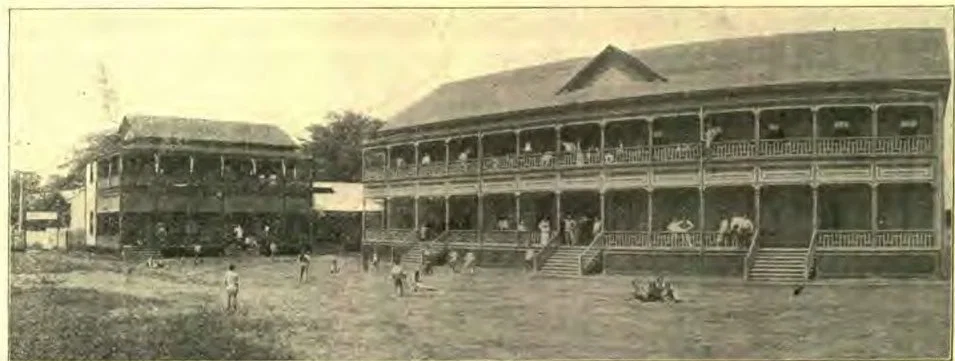
OUR CHINESE SCHOOL AT HONOLULU
Following down the narrowing street, we came to a place where a quiet, small, gray building, almost hidden with the deep, overhanging foliage, invited us by its open doors and cool shade to enter. It was a quiet little sanctuary; and as we took our places among the silent worshipers, waiting the opening of the Sabbath-school, the very peace and presence of God seemed to fill the place. In the afternoon, we visited the Anglo-Chinese school and the sanitarium.
The school is situated in the Chinatown of Honolulu, a location which, on the whole, is most favorable for practical work. The public avenues about the place are narrow, crooked, and irregular passages, which one does not suspect of pretending to be streets till he sees the name on a fence corner. But the buildings themselves are commodious and well furnished beyond our expectations; and the grounds, including the three cottages for the management, are well kept and beautiful. The Sabbath afternoon Bible class was a most interesting sight. Two of the young men have lately become members of the church.
The sanitarium looks as if it had originally been a commodious dwelling in a quiet part of the city, and had been refitted for its present service. The surroundings and atmosphere are very homelike, and under the present management the place is an ideal one for rest and treatment.
Altogether, our Sabbath was one of the most refreshing in our lives. Our hearts went out to the dear people here, who, strangers though we were, gave us so royal a welcome; and we could not but feel that had we been called to this field, to share their opportunities for service, we should be quite content to cast our lot with them. But lying to the westward is the great empire of China, literally wrapped in heathenism; and at six o’clock we gladly moved on, once more facing the Orient. MRS. J. N. ANDERSON.

Young People's Work at Mt. Vernon Academy

From the Mt. Vernon Academy

The report of the Young People’s work in this school has been long delayed, but this is not because we have had nothing to report. As it is better, however, to tell of something accomplished, rather than to set forth the best plans and most promising intentions, it is not too late to report even now.
Our work is somewhat differently conducted than that of the other Young People’s Societies that have reported through the INSTRUCTOR. It may be considered under three heads:—
I. Special preparation for public work by the young men.
  1. The same among the young women.
  2. Work in connection with the missionary meetings.
Soon after the beginning of the school year, a number of young men who were planning to work in the field in the future, met and organized a society for mutual help and improvement. We meet in one of the recitation-rooms every Sabbath afternoon. The officers are a president and a secretary. As most of the members expect to enter the ministry, a large part of the time is taken up in public speaking and reading. Each member who so desires is given an opportunity to present any Bible subject he may choose, in a stated time. After each presentation the other members give helpful criticisms and commendations. Often the program is varied by having a number of five-minute extemporaneous talks on vital points of doctrine. This gives facility in presenting a reason for our hope. Often the Spirit of God is present in such measure that the meeting is turned into a service of praise and prayer. Our Helper is preciously near in these seasons; and our hearts are full of thankfulness for our young men’s society.
The young women have organized a band nearly on the same order as that of the young men. Their officers are a president, secretary, and program committee. In their weekly meetings, they have Bible readings, talks, reading, singing, etc. Many who were backward about speaking or reading in public have been greatly benefited as they have taken up this work.
Every third Sabbath the two societies meet in a union gathering in the chapel, where members from both take part in the program. These union meetings are largely attended, and God blesses us abundantly. It is impossible to tell of the ultimate result of these efforts, both to the students who are here and to those to whom they shall carry the message. Already fruits of this work are seen, and we are of good courage.
The students’ missionary meeting is held the evening after the Sabbath. The programs of the four meetings in each month are based upon home missions, foreign missions, religious liberty, and health and temperance, each subject being arranged for by a different leader. Thus every phase of God’s work is kept before our minds, and the fires of missionary zeal are kept growing. After all, the work that brings us into closest touch with the field that we expect to enter is the most important. A large club of Signs, besides smaller clubs of other papers, is taken and mailed to interested readers. We frequently receive encouraging reports about the work they are doing. Something has also been done in the town in selling Good Health and visiting the sick and poor.
Children’s meetings are a part of our work. These are conducted by the students for the children of the church. A few weeks ago the special topic was the second coming of Christ, each child taking part in answering the questions. Thus in fertile soil are sown precious seeds of truth, which will soon spring up and bring forth a harvest of efficient workers for the Master.
The result of laboring with God is attested in the fervent petitions and stirring testimonies in our Friday-evening prayer-meetings—the boon of every Mt. Vernon Academy student. God is giving his mighty power to strengthen hearts and hands to carry “the advent message to all the world in this generation.” We all want a part in this work. ROBERT THURBER.
Continue reading: May Study of the Field